When to mulch depends on the goal: established beds in spring once 4-inch soil holds about 50 to 55°F (early February in Austin, late May in central Minnesota in 2026), new plantings the day you plant, and winter mulch only after the ground freezes.
Most advice on when to mulch stops at “spring, after the soil warms.” This page puts dates on it. We pulled 2025 to 2026 daily soil temperatures for 24 stations in NOAA’s U.S. Climate Reference Network and found the day 4-inch soil held 50°F and 55°F each spring, the day 2-inch soil first froze each winter, and how often it froze and thawed. In 2026, 4-inch soil held 55°F as early as Jan. 13 near Tucson and Feb. 7 near Austin, and as late as June 4 near Old Town, Maine and Lewistown, Montana.
When to mulch, by what the mulch is for
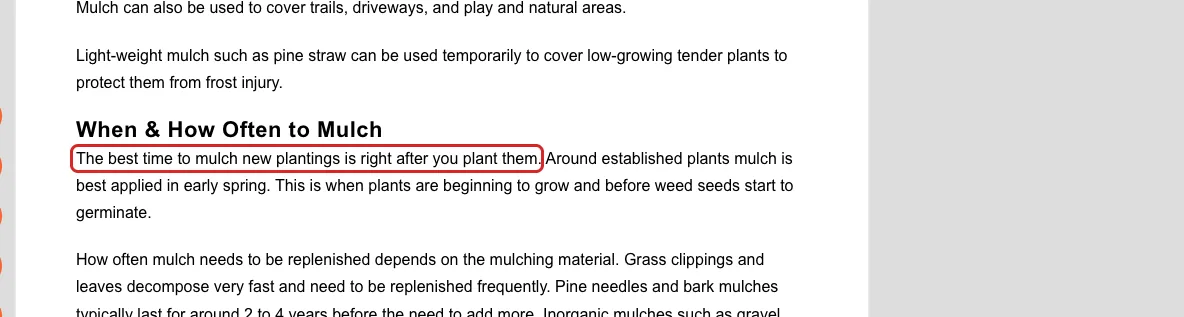
The right week changes with the job. Clemson Extension puts mulch on new plantings “right after you plant them” and around established plants “in early spring” (Clemson HGIC 1604), while University of Wisconsin Extension says to mulch annual flowers and vegetables “only after the soil has warmed up” (UW Extension). Winter protection is a separate, later job.
Planting annuals into a bed that is already mulched follows the same soil-warmth rule: rake the layer aside, plant into soil and return it, as our guide on whether you can plant flowers in mulch lays out step by step.
| Goal | When | Depth | Source |
|---|---|---|---|
| Refresh established shrub and perennial beds | Spring, between the dates 4-in soil holds 50°F and 55°F (table below) | Bring the total to 2 to 3 in fine or up to 4 in coarse; measure first | Clemson |
| New trees, shrubs and perennials | The day you plant, any season | 2 to 3 in; 3 to 4 ft circle for a new tree, kept off the trunk | Clemson |
| Vegetables and annual flowers | After the soil has warmed; 1 in around young transplants, raised to 3 in as they grow | 3 in organic; straw 4 to 6 in | UW Extension |
| Fall-planted trees and shrubs | Right after planting; roots grow until soil drops below 40°F | 2 to 3 in | UNH Extension |
| Winter protection for perennials | After several freezes, once the ground freezes (late November in much of Iowa) | About 4 in over the crown (Iowa State); 6 to 8 in straw (UW Kenosha) | Iowa State; UW Kenosha |
| Strawberries | Late fall, before air drops to 18°F, which damages unprotected plants | 2 to 4 in straw or marsh hay | UW Kenosha |
| Young or marginally hardy woody plants | Late fall | 6 in wood chips over the root zone, cut back to 2 to 3 in by mid to late spring | UW Kenosha |
| Remove winter mulch | As the top layer thaws (about mid-March in much of Iowa) or when new growth starts | Pull back to normal depth | Iowa State; UW Extension |
One check comes before any of these dates: push a ruler into the bed in 3 or 4 spots. If 2 to 3 inches of mulch are still there, Clemson’s fine-mulch ceiling is already met, and adding a full layer is how beds creep to 5 or 6 inches. The ordering math for a top-up is in our guide to how much mulch you need.
The target for that reading depends on the material and the soil, from 2 inches of fine mulch on wet clay to 4 inches of coarse chips, as our guide to how deep mulch should be shows.
When to mulch in spring: the soil temperature dates
No extension source we read puts a single number on “after the soil has warmed.” We use a window instead: start once 4-inch soil holds 50°F, and finish before it holds 55°F. The upper edge is the one with a measured reason. NC State says crabgrass germinates once 24-hour mean soil temperature averages about 55°F for 3 or 4 days in a row (NC State TurfFiles), so the mulch and any pre-emergent should be down by then.
Swipe the table sideways to see every column.
| USCRN station | 4-in soil held 50°F, spring 2026 | 4-in soil held 55°F, spring 2026 | 4-in soil fell below 50°F, fall 2025 | 2-in soil first averaged 32°F or colder, winter 2025 to 2026 | Days 2-in soil averaged 32°F or colder | Last such day, 2026 |
|---|---|---|---|---|---|---|
| Tucson 11 W, AZ | Before Jan. 1 | Jan. 13 | Not reached | Never | 0 | None |
| Austin 33 NW, TX | Feb. 3 | Feb. 7 | Jan. 24, 2026 | Never | 0 | None |
| Watkinsville 5 SSE, GA | Feb. 26 | March 20 | Dec. 7 | Never | 0 | None |
| Batesville 8 WNW, AR | Feb. 27 | March 20 | Dec. 1 | Never | 0 | None |
| Manhattan 6 SSW, KS | March 19 | March 21 | Nov. 26 | Never | 0 | None |
| Durham 11 W, NC | March 4 | March 22 | Nov. 28 | Never | 0 | None |
| Versailles 3 NNW, KY | March 21 | March 31 | Nov. 10 | Jan. 29 | 13 | Feb. 10 |
| Charlottesville 2 SSE, VA | March 22 | April 2 | Dec. 2 | Never | 0 | None |
| Corvallis 10 SSW, OR | March 12 | April 4 | Nov. 19 | Never | 0 | None |
| Avondale 2 N, PA | April 1 | May 2 | Nov. 11 | Never | 0 | None |
| Brigham City 28 WNW, UT | April 30 | May 4 | Oct. 17 | Dec. 1 | 33 | Feb. 21 |
| Sioux Falls 14 NNE, SD | April 21 | May 8 | Oct. 22 | Jan. 10 | 45 | March 3 |
| Nunn 7 NNE, CO | March 19 | May 10 | Oct. 28 | Nov. 30 | 22 | Feb. 22 |
| Des Moines 17 E, IA | April 13 | May 12 | Nov. 8 | Jan. 19 | 31 | Feb. 20 |
| Necedah 5 WNW, WI | April 13 | May 12 | Oct. 24 | Dec. 21 | 62 | March 5 |
| Wooster 3 SSE, OH | April 13 | May 14 | Nov. 11 | Never | 0 | None |
| Durham 2 N, NH | April 26 | May 16 | Oct. 27 | Never | 0 | None |
| Ithaca 13 E, NY | May 4 | May 17 | Oct. 23 | Jan. 20 | 46 | March 6 |
| Spokane 17 SSW, WA | April 30 | May 21 | Oct. 13 | Jan. 26 | 8 | Feb. 2 |
| Gaylord 9 SSW, MI | May 16 | May 25 | Oct. 22 | March 13 | 11 | March 23 |
| Jamestown 38 WSW, ND | May 21 | May 25 | Oct. 21 | Dec. 13 | 104 | April 10 |
| Sandstone 6 W, MN | May 24 | May 26 | Oct. 20 | Jan. 19 | 73 | April 7 |
| Old Town 2 W, ME | May 15 | June 4 | Oct. 26 | Jan. 1 | 85 | March 26 |
| Lewistown 42 WSW, MT | May 23 | June 4 | Oct. 6 | Nov. 29 | 53 | March 11 |
The window is short in some places and long in others. At Manhattan, Kansas, 4-inch soil went from holding 50°F (March 19) to 55°F (March 21) in 2 days; at Wooster, Ohio, it took 31 days, April 13 to May 14. In the Southeast and Texas the window closes in February or March, which is why Clemson can say “early spring” and Wisconsin can say “wait.” Both are right for their soil.
One season is one season. These are 2026 dates, and a cold or warm spring can move them by weeks. For this week’s reading near you, the free maps and station networks in our soil temperature for planting guide report 4-inch soil daily. If you use a probe thermometer at 4 inches instead, an 8 a.m. reading ran 1.4 to 3.5°F below the daily mean at 6 USCRN stations in spring 2026, per the same guide.
Why early mulch keeps soil cold
Mulch insulates in both directions, so a layer spread over cold soil slows its warm-up. Cornell’s Greenly and Rakow measured the top 3 cm (about 1.2 inches) of soil under wood chips at 3, 6 and 10 inches deep in 1992. On June 28 the bare plots read 72.5°F; 3 inches of chips read 68.4°F, 6 inches 64.0°F and 10 inches 60.9°F. The authors wrote that in spring “any depth of mulch has a buffering effect on the soil’s rate of warming” (Greenly and Rakow, Journal of Arboriculture 21(5), 1995).
| Date | Bare soil | 3 in | 6 in | 10 in |
|---|---|---|---|---|
| June 19, 1992 | 70.8°F | 67.6°F | 65.8°F | 64.3°F |
| June 28, 1992 | 72.5°F | 68.4°F | 64.0°F | 60.9°F |
| July 14, 1992 | 73.9°F | 71.7°F | 67.9°F | 66.2°F |
| Aug. 27, 1992 | 75.4°F | 75.2°F | 72.8°F | 71.0°F |
| June to Sept. mean | 70.5°F | 70.0°F | 66.7°F | 65.3°F |
The gap shrinks as summer goes on. By Aug. 27 the 3-inch plots were only 0.2°F cooler than bare soil, and the season mean at 3 inches was 0.5°F below bare. That is the case for a normal 2 to 3 inch layer: a short spring delay, then little difference. The 6 and 10 inch layers stayed 3.8 to 5.2°F cooler on average, and the 3-inch plots produced the most tree stem growth of the four depths.
Wet soil adds a second reason to wait. University of Tennessee Extension notes that on heavy soils mulch “can prolong saturated conditions, especially during spring,” which can harm roots and favor root rot, and it suggests 2 to 3 inches on heavy soils where rain is frequent against 3 to 4 inches on well-drained soils in dry climates (UT Extension SUL12). If a handful of bed soil squeezes into a dripping ball, give it a dry week first.
Mulch or pre-emergent first?
Read the label of the product you have. Preen Garden Weed Preventer (trifluralin, EPA Reg. No. 961-280) says “for best weed control, apply Preen Garden Weed Preventer after spreading mulch,” sprinkled on top and watered in, then reapplied every 9 to 12 weeks (Preen label). Other active ingredients are placed under the mulch instead; our review of whether mulch prevents weeds lists placement by ingredient. Either way, both go down before the soil reaches the 55°F crabgrass mark in the table above.
Whether the granules go on before or after the mulch, and how much water 0.5 inch means for your bed, is in our guide to applying Preen before or after mulch.
Pre-emergents are pesticides: the label is the law for plants, rate and timing. This is general information, not label advice.
When to put down mulch in fall and winter
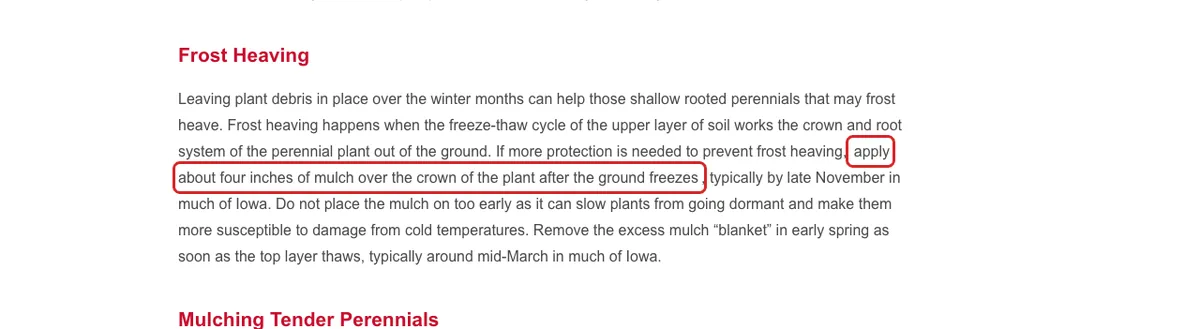
Fall mulching for looks or moisture can happen any time; winter mulching is about timing. Iowa State says to apply about 4 inches over perennial crowns “after the ground freezes, typically by late November in much of Iowa,” and warns that mulch put on too early “can slow plants from going dormant” (Iowa State Extension). UW Extension’s version is “after several freezes (usually about Thanksgiving)” (UW Extension). Oklahoma State, farther south, puts winter mulch on after plants go dormant, which “usually occurs in very late December” (OSU HLA-6005).
The USCRN data shows why “after the ground freezes” is hard to pin down. Near Des Moines, Iowa, 2-inch soil first averaged 32°F or colder on Jan. 19, 2026, almost 2 months after Iowa State’s late-November marker, because the surface freezes at night long before the daily mean at 2 inches does. At Durham, New Hampshire, and Wooster, Ohio, 2-inch soil never averaged 32°F or colder all winter despite 85 and 70 days of below-freezing daily means, a pattern consistent with snow insulating the ground. Treat the first hard freezes as the start of the window, not the frozen-soil date.
Winter mulch exists to stop heaving: repeated freezing and thawing that pushes crowns and roots out of the ground, which UW Kenosha says happens when there is “little or no snow cover” (UW Extension Kenosha County). The station counts agree. The 2-inch daily mean crossed 32°F 14 times at Lewistown, Montana, 12 at Nunn, Colorado and 10 at Brigham City, Utah, against 2 at Old Town, Maine and Ithaca, New York, where the soil froze once and stayed frozen for 85 and 46 days. Winter mulch matters most where soil freezes and thaws repeatedly.
Pull winter mulch back when the top layer thaws. Iowa State puts that at about mid-March in much of Iowa; at the stations, the last day 2-inch soil averaged 32°F or colder ran from Feb. 2, 2026 at Spokane, Washington to April 10 at Jamestown, North Dakota. Fall-planted trees are different: mulch them at planting, since UNH Extension notes roots keep growing until soil drops below 40°F (UNH Extension).
How often to mulch: top-up timing by material
Mulch thins at different speeds, so the calendar for a refresh is really a ruler. In a University of Florida trial, six mulches laid 3.5 inches (9 cm) deep near Gainesville were measured for 2 years: pine straw lost half its depth in year 1 and was “almost completely gone” by year 2, while melaleuca kept almost 7 of 9 cm (UF/IFAS FR052).
| Material | Left of 3.5 in after 2 years (Florida) | Other published note | Our reading: when to top up |
|---|---|---|---|
| Pine straw | About 0.4 in (1 cm) | Lost half its depth in year 1 | Top up every year; see pine straw vs mulch |
| Utility tree-trimming chips | About 2.0 in (5 cm) | Annual or every-other-year replenishment (UC ANR 8672) | Every 1 to 2 years |
| Eucalyptus | About 2.0 in (5 cm) | Settled like utility chips | Every 2 years |
| Pine bark | About 2.4 in (6 cm) | Clemson: bark lasts about 2 to 4 years before adding more | Every 2 to 3 years |
| Cypress | About 2.4 in (6 cm) | Same as pine bark in the Florida plots | Every 2 to 3 years; see cypress mulch |
| Melaleuca | About 2.8 in (7 cm) | Deepest left of the six | Every 3 years or so |
Florida is hot and wet, so expect slower losses farther north. The practical rule is the same everywhere: measure each spring in your 50 to 55°F window and add only the difference, usually about 1 inch. If a bed has faded but still reads 2 to 3 inches, rake it to turn up the darker layer instead of adding more.
When should you not mulch?
1Are you planting something new this week?
YesMulch it the day you plant, 2 to 3 in deep and clear of stems (Clemson).
NoGo to the next question
2Is a ruler pushed into the bed reading 2 in or more of mulch already?
YesDo not add a full layer. Rake to freshen it, or add only enough to reach 3 in.
NoGo to the next question
3Is it late fall or winter and you want to stop frost heaving?
YesWait for several hard freezes, then 4 in over perennial crowns (Iowa State). Pull it back as the top layer thaws.
NoGo to the next question
4Is 4-inch soil still below 50°F, or is the bed soil wet enough to drip when squeezed?
YesWait. Early mulch keeps cold, wet soil cold and wet (UW Extension; UT SUL12).
NoGo to the next question
5Has 4-inch soil already held 55°F for several days?
YesMulch now; a crabgrass pre-emergent may already be late, since germination starts near 55°F (NC State).
NoYou are in the spring window: weed, then spread mulch to a 2 to 3 inch total.
Source: Clemson HGIC 1604; Iowa State Extension; UW Extension; NC State TurfFiles
- Over cold soil in early spring, before 4-inch soil holds about 50°F: the layer slows warming (UW Extension).
- Over saturated clay: mulch “can prolong saturated conditions” (UT SUL12).
- Over a layer already 2 to 3 inches deep: fine mulch past 3 inches “can suffocate plant roots” (Clemson).
- Over standing weeds: Clemson’s prep step is to weed the area first; killing them is covered in our guide to flower bed weed control.
- Winter mulch before several hard freezes: it can slow dormancy (Iowa State).
- Where you want annuals to self-sow: mulch will inhibit germination (Brooklyn Botanic Garden).
Around tree trunks the timing rules are the same, but the placement rules are stricter; those are in our guide to how to mulch around trees. Bulk and bagged prices by the yard are in our mulch cost survey.
How we compiled this
We downloaded NOAA NCEI USCRN daily01 files for 2025 and 2026 (through Nov. 10, 2026) for 29 stations and kept 24 with near-complete soil records. For each we found the first day 4-inch (10 cm) soil held 50°F and 55°F in spring 2026, the first day it fell below 50°F in fall 2025, and the days 2-inch (5 cm) soil averaged 32°F or colder from September 2025 to April 2026. We read 1 field trial in full (Greenly and Rakow 1995), the UF/IFAS settling trial, 7 extension documents and 1 pesticide label, checked Nov. 11, 2026. Daily means hide overnight freezing. We ran no field tests.
Frequently asked questions
What month should you mulch?
For established beds, the month your 4-inch soil holds 50 to 55°F. In 2026 that was February in Austin, March in Georgia, North Carolina and Kansas, April to mid-May across the Ohio Valley and Corn Belt, and late May to early June in Minnesota, North Dakota and Maine (NOAA USCRN). New plantings get mulch the day they go in.
When should you not mulch?
Over cold or waterlogged soil in early spring, over a layer already 2 to 3 inches deep, over standing weeds, and with winter mulch before several hard freezes. Iowa State says early winter mulch “can slow plants from going dormant” (Iowa State).
What is the 3-3-3 rule for mulch?
It is a garden rule of thumb, not an extension standard: 3 inches deep, 3 inches from stems, 3 feet around trees. Clemson’s published figures are close: 2 to 3 inches of fine mulch (up to 4 coarse), 2 to 3 inches clear of woody stems, and a 3 to 4 foot circle for a new tree (Clemson HGIC 1604).
Is October too late to mulch?
No. In fall 2025, 4-inch soil stayed above 50°F until at least Oct. 20 at 21 of 24 USCRN stations, and UNH Extension says roots grow until soil drops below 40°F (UNH Extension). Brooklyn Botanic Garden notes late-summer or fall mulch is “less effective for weed suppression” (BBG).
Can I just lay mulch over dirt?
Yes, over bare, weeded soil; that is the standard method. Brooklyn Botanic Garden’s steps are to remove weeds, level the soil and spread 2 to 3 inches (BBG). Over lawn or a weedy patch, smother or kill the growth first.
Sources
- NOAA National Centers for Environmental Information, U.S. Climate Reference Network daily01 data files, 2025 and 2026, Data through Nov. 10, 2026. Accessed November 2026.
- NOAA National Centers for Environmental Information, U.S. Climate Reference Network, 2026. Accessed November 2026.
- Greenly, K.M. and D.A. Rakow, Journal of Arboriculture 21(5): 225 to 232, The Effect of Wood Mulch Type and Depth on Weed and Tree Growth and Certain Soil Parameters, 1995. Accessed November 2026.
- University of Wisconsin Extension, Mulches for Home Gardens and Plantings, Undated. Accessed November 2026.
- University of Wisconsin Extension, Kenosha County, Winter mulch your landscape plants, Nov. 13, 2020. Accessed November 2026.
- Iowa State University Extension and Outreach, How should I prepare my perennial beds for winter?, Undated. Accessed November 2026.
- Clemson Cooperative Extension, HGIC 1604, Mulch, Undated. Accessed November 2026.
- UF/IFAS Extension, FR052, Landscape Mulches: How quickly do they settle?, Undated. Accessed November 2026.
- NC State University TurfFiles, When to apply preemergent herbicides for turfgrasses, Undated. Accessed November 2026.
- University of Tennessee Extension, SUL12, Using Mulches in Managed Landscapes, Undated. Accessed November 2026.
- Oklahoma State University Extension, HLA-6005, Mulching Garden Soils, Undated. Accessed November 2026.
- Preen (Lebanon Seaboard Corp.), Preen Garden Weed Preventer label, EPA Reg. No. 961-280, Undated. Accessed November 2026.
- University of California ANR, Publication 8672, Mulches for Landscapes, Undated. Accessed November 2026.
- UNH Extension, Fall is a good time to plant trees and shrubs, Aug. 2019. Accessed November 2026.
- Brooklyn Botanic Garden, Ask a Gardener: What Is Mulch, and When Should I Use It?, Undated. Accessed November 2026.