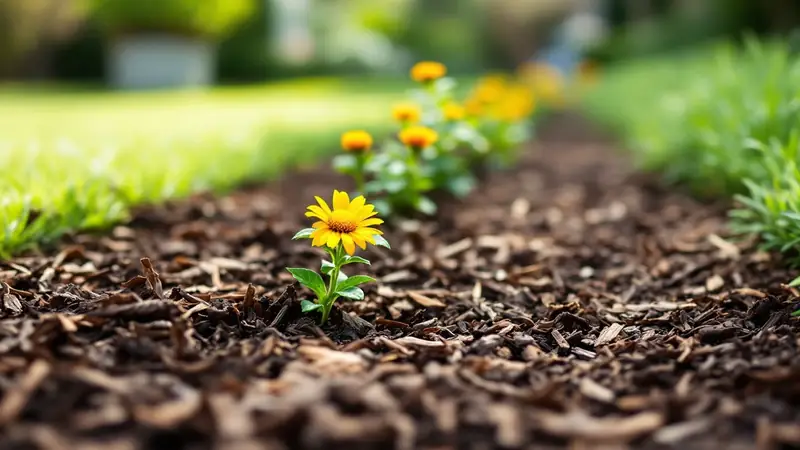
Can you plant flowers in mulch? Yes, if the roots go into soil: rake the mulch back, plant at container depth, then return 2 to 3 inches kept off the stems. Fresh wood mulch alone dries fast and leaves shallow roots short of nitrogen.
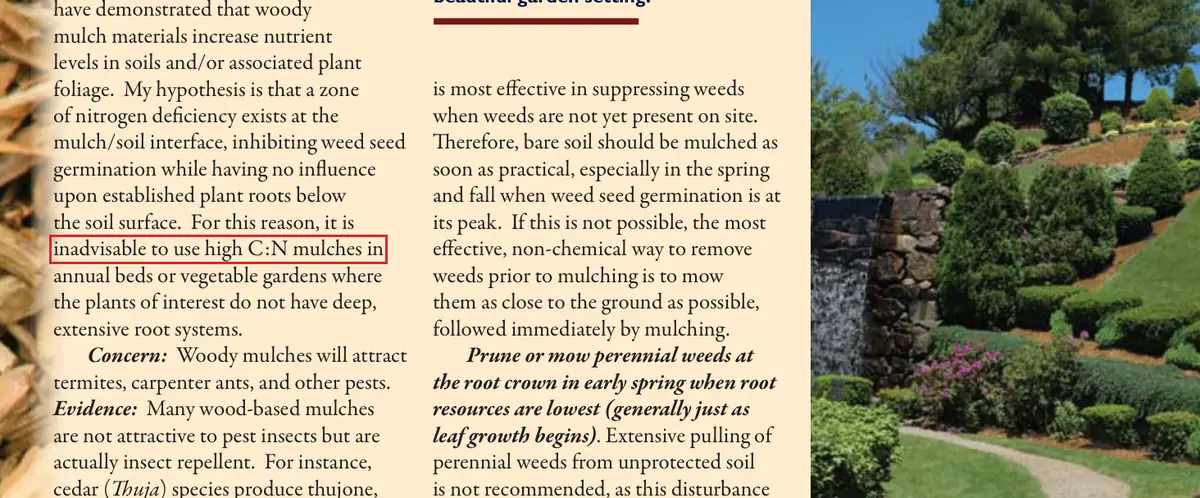
Can you plant flowers in mulch that is already down? You can, and you do not need to strip the bed: the mulch is the cover and the soil under it is the root zone. Washington State University horticulturist Linda Chalker-Scott calls high carbon-to-nitrogen mulches such as wood chips “inadvisable” in annual beds, where the plants lack deep, extensive roots (WSU, 2007), and University of Maryland Extension says fresh arborist chips are not recommended around annuals (UMD Extension). On top of the soil, after planting, the same chips are fine.
Two things on this page are missing from the forum threads and video demos that rank for this question. The first is a plant-by-plant table: how wide to open the mulch, how deep to plant and how much goes back, with the extension source for each number. The second is a check of seed sowing depths against mulch depth, which shows that a zinnia seed sown 1/4 inch deep under a 3-inch layer sits 12 times deeper than its seed packet allows. Depth by material has its own page on how deep mulch should be for each material and spot, and the field trials on chips and soil nitrogen are compared in wood chips vs mulch.
Why don’t flowers grow in mulch alone?
Three measured problems explain it. Water: Rutgers Cooperative Extension says mulch dries out more rapidly than soil, and that when roots grow up into a layer deeper than 6 inches, much of that root mass dies in a drought (Rutgers FS099). Nitrogen: Iowa State Extension says high carbon-to-nitrogen (C:N) mulches such as hardwood bark, straw and sawdust deplete available soil nitrogen, with the larger effect on herbaceous plants and new transplants (Iowa State). Air: the same page says fine mulch piled more than 10 inches deep uses up the oxygen before it reaches the soil.
The carbon gap is easy to see in Cornell’s composting tables: wood chips and sawdust run 100 to 500 parts carbon per part nitrogen, against the 30:1 that decomposers work best at (Cornell Composting). Chalker-Scott’s hypothesis places the resulting low-nitrogen zone at the boundary between mulch and soil, where it slows weed seeds without reaching established roots below. A flower planted in the soil sits under that zone; a flower planted in the mulch sits inside it.
| Mulch in the bed | C:N ratio | Plant roots into it? | Source |
|---|---|---|---|
| Fresh wood chips or sawdust | 100 to 500:1 | No. WSU’s fact sheet says wood mulch should never be worked into the soil as an amendment; keep it out of the hole | Cornell; WSU FS160E |
| Shredded or chipped bark | 100 to 130:1 | No. Plant through it; Iowa State lists hardwood bark among the nitrogen-depleting mulches | Cornell; Iowa State |
| Straw | 40 to 100:1 | No. A short-term and winter mulch, not a rooting medium | Cornell; Iowa State |
| Fresh autumn leaves | 30 to 80:1 | No. Rutgers says uncomposted leaves compete with plants for soil nitrogen | Cornell; Rutgers FS117 |
| Leaf compost or finished compost | Low; see compost vs mulch | Only as a thin top layer: 1/16 to 1/8 inch helps seeds germinate | Rutgers FS117 |
| Mulch from a wet, compacted pile that smells sour | Not applicable | No. Iowa State says its methanol and acetic acid can injure annuals and perennials within hours to days | Iowa State |
Some gardening sites say annuals such as petunias, begonias or marigolds can go straight into mulch if the layer is at least 8 inches deep. We found no extension publication that recommends it. Rutgers caps the total layer at 3 inches, or 2 inches on compacted and poorly drained soil, and its 6-inch warning is about roots that move into mulch and die when it dries (Rutgers FS099). Compost and leaf mold are the exception covered below; for the measured C:N of bagged compost, see compost vs mulch lab numbers.
How to plant flowers in a mulched bed
Iowa State’s method for container perennials works for annual transplants too, with one change for a mulched bed: the mulch never goes in the hole (Iowa State, How to Plant Perennials). Each step below carries the measurement its source gives.
- Rake the mulch back from a circle at least twice the width of the pot and pile it to one side. Do not mix it into the soil; WSU’s fact sheet says wood mulch should never be worked in as an amendment.
- Dig a hole at least twice as wide as the container and as deep as the soil in it (Iowa State). In poorly drained or clay soil, Iowa State widens it to 3 or 4 times the container width.
- Set the plant at the same level it grew in the container and backfill with the soil that came out. Iowa State says amendments are unnecessary in nearly all cases, and planting too deep can cause poor growth or flowering.
- Water right away to settle the soil against the roots.
- Rake the mulch back to 2 to 3 inches around annuals (Illinois Extension) and perennials (Iowa State), never over the crown. Rutgers keeps mulch 3 to 5 inches off the stems of young plants; the City of Bellingham’s minimum is 1 inch.
- Give annuals about 1 inch of water a week (Illinois) and perennials 1 to 1 1/2 inches, soaking the soil 8 to 10 inches deep (Iowa State), through the first season.
The stem gap is where the sources differ most. At the 6-inch spacing Montana State gives for sweet alyssum (MSU MontGuide MT199501AG), a 3 to 5 inch gap around every plant leaves almost no mulch between them, so for small, tightly spaced annuals Bellingham’s 1 inch is the workable figure. Keep the wider Rutgers gap around woody stems and perennial crowns, which rot when bark stays wet.
How far to open the mulch for each kind of flower
The opening, the planting depth and the mulch that goes back change with what you are planting. Bulbs go deeper than any mulch layer, and seeds need the opening left bare. Fall-planted perennials get a heavier straw cover in Iowa, and groundcover plugs need the smallest opening. Timing for each is set by soil temperature, covered in soil temperature for planting.
| What you are planting | Opening in the mulch | Planting depth | Mulch after planting | Gap at stem or crown | Source |
|---|---|---|---|---|---|
| Annual transplants (cell packs, 4-inch pots) | Circle at least 2x the pot width, down to soil | Same level as in the pot | 2 to 3 in, once the soil has warmed | At least 1 in | Illinois; UW; Bellingham |
| Container perennials | 2x the container width; 3 to 4x in clay or wet soil | Same level as in the container | 2 to 3 in (Iowa State bed care) to 3 to 4 in (Iowa State planting page) | Not over the crown; 3 to 5 in for young plants | Iowa State; Iowa State; Rutgers |
| Spring bulbs (tulips, daffodils, hyacinths) | The whole bed or each hole, to soil | 2 to 3x bulb height, from the bulb base: about 8 in for tulips and daffodils, 3 to 4 in for small bulbs | 2 to 3 in over the bed; none over small early bulbs | Shoots come up through it | Illinois |
| Perennials planted in fall | As for container perennials | Same level as in the container | 4 to 6 in of straw over the plants in November, off in early April (Iowa) | Remove in spring | Iowa State |
| Groundcover plugs under trees and shrubs | Small hole; Rutgers suggests 2-inch plugs to limit root disturbance | Plug level with the soil | Existing mulch pulled back around the plug | 3 to 5 in for young plants | Rutgers |
| Large flower seeds (sunflower, nasturtium) | Narrow row or spot pulled to bare soil, left open | 1/2 to 1 in | None over the row | Not applicable | USask; OSU; UW |
| Seeds that need light (petunia, ageratum, begonia, impatiens) | Same open row | On the surface, pressed in | None over the seed | Not applicable | WSU; Iowa State |
1Are you sowing seed?
YesPull the mulch back to bare soil in a narrow row, sow at packet depth (surface for petunia, ageratum, begonia, impatiens) and leave the row open (USask, WSU).
NoGo to the next question
2Are you planting spring bulbs?
YesDig into soil 2 to 3 times the bulb's height, cover with soil, then 2 to 3 inches of mulch over the bed; none over small early bulbs (Illinois).
NoGo to the next question
3Is the bed new sheet mulch (cardboard under chips) laid less than 3 months ago?
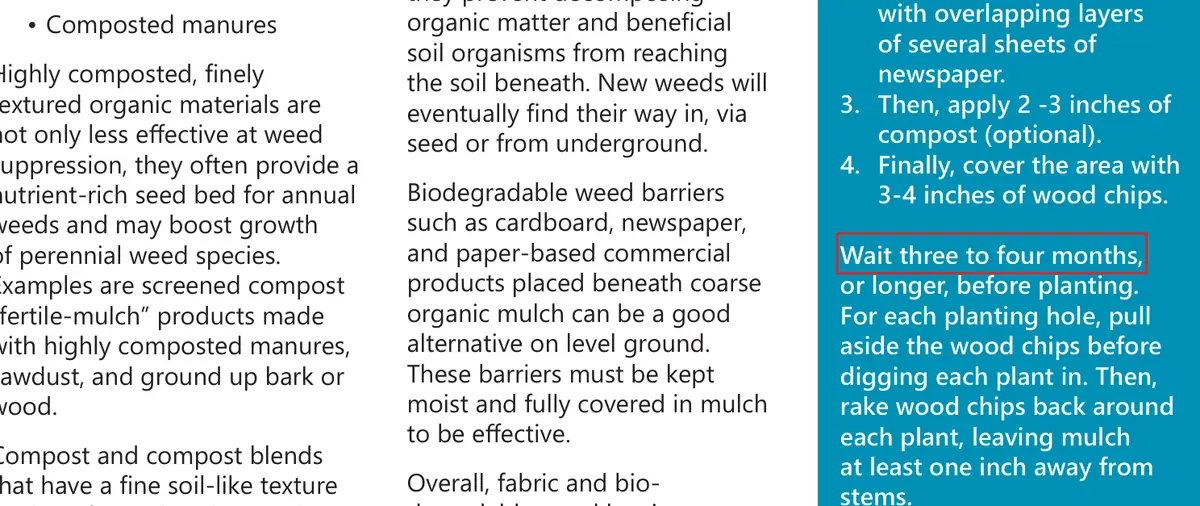
YesWait 3 to 4 months or longer, then pull chips aside for each hole and plant into soil (City of Bellingham).
NoGo to the next question
4Does the mulch smell sour, like vinegar?
YesDo not plant into it or spread it around annuals; Iowa State says the acids can injure plants within hours to days.
NoTransplant: rake mulch back at least 2x the pot width, plant at container depth in soil, water, return 2 to 3 inches kept at least 1 inch (annuals) to 3 to 5 inches (young perennials) off the stems.
Source: Iowa State, Illinois, Rutgers, City of Bellingham, USask and WSU extension
Can you plant flower seeds in mulch?
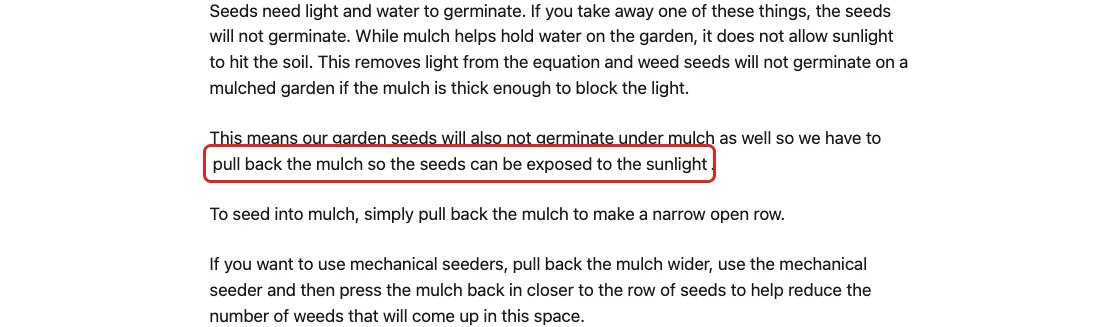
Not under it. The University of Saskatchewan’s no-till garden guide says mulch blocks the light seeds need, so garden seeds will not germinate under it any more than weed seeds do; pull the mulch back into a narrow open row, sow, and leave the row open (USask). The sowing depths below show how far off a mulch layer is.
| Flower | Sowing depth | Light or dark to germinate | A 3-inch mulch layer is | Source |
|---|---|---|---|---|
| Petunia | Surface; press in, do not cover | Needs light | No light reaches the seed | Iowa State |
| Ageratum | Surface, or a light dusting of fine peat or vermiculite | Needs light | No light reaches the seed | WSU |
| Begonia | Surface, or a light dusting | Needs light | No light reaches the seed | WSU |
| Impatiens | Surface, or a light dusting | Needs light | No light reaches the seed | WSU |
| Browallia | Surface, or a light dusting | Needs light | No light reaches the seed | WSU |
| Cosmos | 1/8 in; Utah State says deep planting reduces germination | Not stated | 24x | Utah State |
| Zinnia | 1/4 in, soil at least 70°F | Not stated | 12x | UMN |
| Marigold | About 1/4 in, soil 65°F | Not stated | 12x | UMN |
| Nasturtium | 1/2 in | Needs darkness | 6x | UW Extension |
| Sunflower | About 1 in | Not stated | 3x | Oregon State EM 9866 |
| Calendula, annual phlox, verbena, vinca | Twice the seed’s largest diameter (MontGuide rule) | Need darkness | Depends on seed size | WSU; MSU |
The fix is the opening, not a thinner layer. Saskatchewan’s guide pulls the mulch back a few inches into a narrow row and keeps it open all season, letting the plant canopy shade out the few weeds that sprout there (USask, planting seedlings). Compost is the one cover that helps: Rutgers says compost in a thin mulch 1/16 to 1/8 inch thick helps seeds germinate (Rutgers FS117). If the bed got a pre-emergent herbicide this season, check the timing in Preen before or after mulch first, because those products stop seedlings of any kind.
When to plant, and when the mulch goes back
Plant by soil temperature and put the mulch back after the soil warms. University of Minnesota Extension sets zinnia transplants at 60°F soil and direct seed at 70°F (UMN), marigold seed at 65°F (UMN), and Utah State sows cosmos after soil reaches 65°F (Utah State). University of Wisconsin Extension mulches annual flowers only after the soil has warmed, about mid to late June in Wisconsin or mid-May on sandy soil (UW Extension), because early mulch keeps soil cold longer.
Iowa State gives the same reason for perennial beds: wait until the ground warms and perennials emerge, since a layer put down too early insulates the soil and slows emergence (Iowa State). In an established bed, rake the mulch aside on planting day and return it the same day; season-by-season timing for whole beds is in when to mulch, by soil temperature.
When can the mulch be the planting layer?
Only after it has had time to rot, or when it is compost to begin with. The City of Bellingham’s sheet-mulch method covers cardboard or newspaper with 3 to 4 inches of wood chips, then waits 3 to 4 months or longer before planting; even then, it pulls the chips aside and digs each plant into the soil (City of Bellingham). Smothering lawn this way is compared in will mulch kill grass.
Compost and leaf mold can go in annual beds, and Iowa State lists both for nearly every garden setting (Iowa State). Illinois Extension works compost, shredded leaves and dry grass clippings into the soil in fall to add organic matter (Illinois), which turns this year’s mulch into next year’s soil. If a fresh delivery smells sour, like vinegar, do not plant into it or spread it around annuals; the cause is covered in why mulch smells.
How we compiled this
We read 22 primary documents in November 2026: extension publications from Iowa State, Illinois, Rutgers, Maryland, Minnesota, Wisconsin, Utah State, Oregon State, Montana State and Washington State, the University of Saskatchewan’s no-till garden pages, the City of Bellingham mulch fact sheet and Cornell’s composting tables. We did not plant or measure anything ourselves. The seed-depth multiples are our arithmetic from the published sowing depths, and where two sources disagree (stem gap, mulch depth after planting) both figures are shown.
Frequently asked questions
Can you plant flowers in just mulch?
Not in fresh wood or bark mulch. Rutgers says mulch dries out faster than soil and roots that grow into it die in drought, and Iowa State says high C:N mulches deplete nitrogen most for herbaceous plants. Plant into the soil underneath.
What is the 3-3-3 rule for mulch?
It is a tree rule: about 3 inches deep, out to a 3-foot radius, with a 3-inch gap at the trunk, as Casey Trees puts it. Flower beds use 2 to 3 inches; tree rings are covered in how to mulch around trees.
Do you put mulch down before or after planting flowers?
After. Illinois Extension applies a 2 to 3 inch layer once annuals are planted. If the bed is already mulched, rake it back, plant in the soil and return it, at least 1 inch off the stems.
Can perennials grow through mulch?
Yes, at the 2 to 3 inches Iowa State uses around perennials, as long as the mulch is not placed directly over the crowns. In spring, Iowa State waits until perennials emerge before adding a fresh layer.
What flowers can I plant in mulch?
Any bedding annual or container perennial, planted through the mulch into soil. Seeds are the exception: petunia, ageratum, begonia and impatiens need light, so sow them on bare soil in an opening with no mulch over them.
Sources
- L. Chalker-Scott, Washington State University, Wood Chip Mulch: Landscape Boon or Bane? MasterGardener magazine, Summer 2007. Accessed November 2026.
- L. Chalker-Scott, WSU Extension (copy hosted by choosenatives.org), Using Arborist Wood Chips as Landscape Mulch, FS160E, 2015. Accessed November 2026.
- University of Maryland Extension, Mulching Trees and Shrubs, current page. Accessed November 2026.
- Iowa State University Extension and Outreach, Using Mulch in the Garden, current page. Accessed November 2026.
- Iowa State University Extension and Outreach, How to Plant Perennials, current page. Accessed November 2026.
- Iowa State University Extension and Outreach, How to Maintain Perennial Beds and Borders, current page. Accessed November 2026.
- Iowa State University Extension and Outreach, How to Start Petunias from Seed Indoors, current page. Accessed November 2026.
- University of Illinois Extension, Caring for Annuals, current page. Accessed November 2026.
- University of Illinois Extension, Planting Bulbs, current page. Accessed November 2026.
- Rutgers Cooperative Extension, Problems With Over-Mulching Trees and Shrubs, FS099, current page. Accessed November 2026.
- Rutgers Cooperative Extension, Using Leaf Compost, FS117, current page. Accessed November 2026.
- University of Saskatchewan, Gardening at USask, Seeding into a no till garden, current page. Accessed November 2026.
- University of Saskatchewan, Gardening at USask, How to plant seedlings into mulch in a no till garden, current page. Accessed November 2026.
- City of Bellingham, Wash., Manage Weeds Naturally: Mulching fact sheet, current edition. Accessed November 2026.
- Cornell Waste Management Institute, Compost Chemistry: C/N ratio table, current page. Accessed November 2026.
- University of Minnesota Extension, Zinnia, current page. Accessed November 2026.
- University of Minnesota Extension, Marigolds, current page. Accessed November 2026.
- Utah State University Extension, Cosmos in the Garden, current page. Accessed November 2026.
- University of Wisconsin Extension, Nasturtium, Tropaeolum majus, current page. Accessed November 2026.
- Oregon State University Extension, Grow your own sunflowers, EM 9866, current page. Accessed November 2026.
- D. Creighton, WSU Extension Master Gardener program, Growing Plants from Seeds, March 14, 2014. Accessed November 2026.
- Montana State University Extension, Annual Flowers, MontGuide MT199501AG, revised June 2020. Accessed November 2026.
- University of Wisconsin Extension, Mulches for Home Gardens and Plantings, current page. Accessed November 2026.
- Casey Trees, Mulching Dos and Don’ts, May 2024. Accessed November 2026.