Will mulch kill grass? Yes, if it blocks light long enough: Iowa State uses at least 8 inches of wood chips alone, or cardboard under mulch. At 3 inches, spreading grasses grew through in a Cornell trial; UC IPM says bermuda pushes through chips.
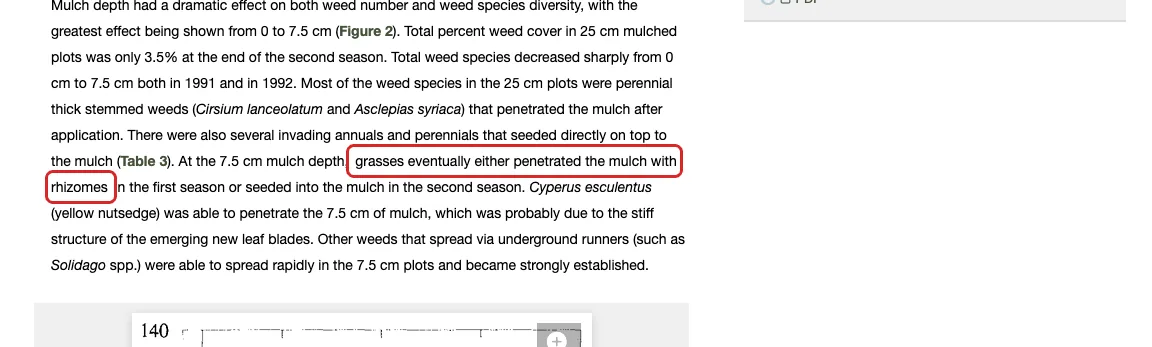
Published answers to will mulch kill grass disagree by a factor of 9 on depth. Bartlett Tree Experts’ research lab says a 2 to 4 inch layer of fresh wood chips “will quickly kill any turf grass” (Bartlett technical report); Iowa State Extension says to start with at least 8 inches, and that 12 to 18 is better (Iowa State, reviewed June 2026). The one field trial we found that counted weeds by mulch depth sides with the deep end for spreading grasses: in Cornell plots, grasses got through 3 inches (7.5 cm) of wood mulch on rhizomes in the first season, and 10 inches held total weed cover to 3.5 percent after 2 seasons (Greenly and Rakow, 1995).
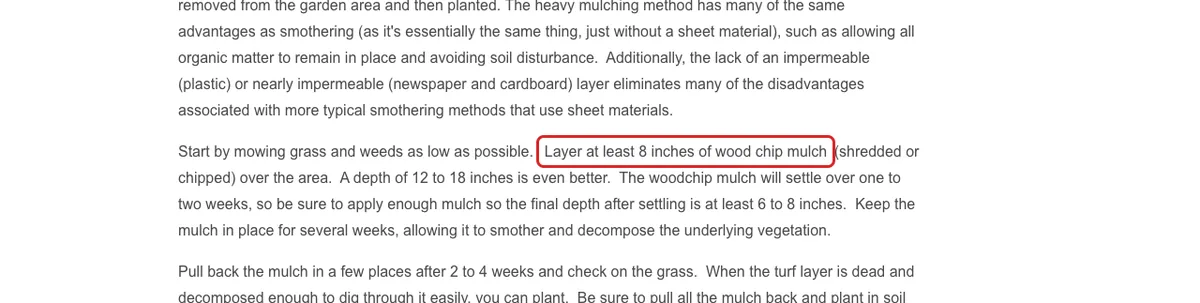
The practical split is whether a sheet goes down first. Cardboard or newspaper does the light blocking, so 3 to 6 inches of mulch on top is enough to hold it down and hide it. Without a sheet, the mulch has to block the light by itself, which takes the 6 to 8 inches Iowa State wants after settling. Neither works on every grass, and both are slower than the plastic and spray routes compared in our guide to killing grass before replanting.
How many inches of mulch will kill grass?
The 14 published rule sets below split into 2 groups: mulch alone (the first 5 rows) and mulch over a sheet (the rest). Read the purpose column before the depth. Bartlett’s 2 to 4 inches is a tree-ring figure, and WSU’s 4 to 6 inches is for keeping weeds out of planted beds, not for killing an established lawn.
Swipe the table sideways to see every column.
| Source | Purpose | Sheet layer | Mulch depth | Wait or result |
|---|---|---|---|---|
| Bartlett Tree Experts (E.T. Smiley) | Tree mulch ring over turf | None | 2 to 4 in. fresh chips | “Quickly”; no time given |
| Greenly and Rakow, Cornell (trial) | Measured weeds under mulch around trees | None | 3, 6 and 10 in. tested | 3 in.: grasses through by rhizome in season 1; 10 in.: 3.5% weed cover after 2 seasons |
| Iowa State Extension, heavy mulching | New garden bed in lawn | None | 8 in. minimum, 12 to 18 better; 6 to 8 after settling | Check at 2 to 4 weeks; plant when turf is dead and decomposed |
| WSU Extension, arborist chips | Weed control in planted beds | None | 4 to 6 in. | Not stated |
| UC IPM, Bermudagrass Pest Note | Bermudagrass | None | Any depth of wood chips | Not effective: bermuda pushes through |
| Iowa State Extension, smothering | New garden bed in lawn | 1 to 2 layers cardboard or 6 to 8 sheets newspaper | Organic mulch, depth not stated | 6 weeks or longer; several months to kill fully |
| UVM Extension (A. Simone) | Lawn-to-garden conversion | Cardboard or 10 sheets newspaper, 8 to 10 in. overlap | 4 to 6 in. | 4 to 6 months to break down |
| UC Master Gardeners, Placer County | Lawn removal | 1 layer cardboard or 6 sheets newspaper, over 2 to 3 in. compost | 4 to 5 in. | About 6 months before planting |
| East Multnomah SWCD | Lawn removal | Cardboard or 15 to 20 layers newspaper, 6 in. overlap | 4 to 6 in. soil, compost or mulch | 6 to 8 weeks |
| TreePeople (L. Cahill) | Lawn removal | 1 layer cardboard or 6 sheets newspaper, 6 in. overlap | 4 to 6 in. | 2 months, then dig through to plant |
| Clemson HGIC (J. Jordan) | New landscape planting over lawn | Cardboard, sod staples | 3 in. medium to coarse | 4 to 6 months for cardboard to break down |
| Organic Growers School | Bermudagrass in a garden | 2 layers cardboard, 6 in. overlap, staples, 1/2 in. compost under | 3 in. | 4 to 6 months or more |
| Oregon State Extension EM 9559 | Lasagna bed | 4 to 6 layers, 8 in. overlap | Layers to 18 in. to 3 ft | About 6 months; quackgrass may not smother |
| NC State Extension Gardener | Sheet-mulched planting area | Cardboard or newspaper | Layers to 1.5 to 3 ft | About 6 months (November to May) |
Iowa State’s 8 inches is the only mulch-alone figure written for turning lawn into a bed, and the Cornell result explains it. At 3 inches, spreading grasses came through on rhizomes in the first season and yellow nutsedge also got through; at 10 inches, most of the weed species left were thick-stemmed perennials, bull thistle and common milkweed, that penetrated the mulch. For a tree ring, stay with 2 to 4 inches and dig the turf out instead, as our page on mulching around trees explains, because a deep pile against a trunk causes its own damage.
Depth means settled depth. Iowa State says chips settle over 1 to 2 weeks, so a bed meant to sit at 6 to 8 inches needs 8 or more on day one. After the grass dies, it says to pull the excess back to the 2 to 4 inches a planted bed needs; our guide to how deep mulch should be has that figure by material.
Which grasses survive mulch?
Grasses that store energy in rhizomes or stolons are the ones that come back. UC IPM puts bermudagrass rhizomes 1 to 6 inches deep in undisturbed soil and deeper in sand, under sidewalks and along foundations (UC IPM Pest Note 7453). Wisconsin Extension says quackgrass and zoysiagrass often need repeated herbicide rounds because they regrow from rhizomes, while tall fescue’s bunch habit usually yields to one (Wisconsin Extension).
Quackgrass is the hardest of them: the Maine organic fact sheet says opaque plastic has to stay down a full season, at least 6 months, and our guide on how to kill quackgrass compares tarping, digging and spraying by site.
| Grass | Spreads by | Mulch alone | Cardboard plus mulch | What to do |
|---|---|---|---|---|
| Bermudagrass | Stolons and rhizomes, 1 to 6 in. deep or deeper | Fails: pushes up through wood chips (UC IPM) | 2 layers, 6 in. overlap, staples, no planting holes, 4 to 6 months or more (OGS); landscape fabric under mulch works if seams overlap (UC IPM) | Use plastic or spray first; see bermuda control |
| Quackgrass | Aggressive rhizomes (Wisconsin) | No trial found | May not smother; remove first (Oregon State EM 9559) | Dig or spray before mulching |
| Zoysiagrass | Stolons and rhizomes (Wisconsin) | No trial found | No trial found | Expect regrowth at seams and edges; check monthly |
| St. Augustinegrass | Aboveground stolons (UF/IFAS LH010) | No trial found | No trial found | Overlap sheets and trench the edge so stolons cannot run in over the top |
| Grasses in Cornell field plots (species not named) | Rhizomes or seed | Through 3 in. in season 1; reseeded into mulch in season 2 (Greenly and Rakow) | Not tested | Go deeper than 3 in. or add a sheet |
| Tall fescue | Bunch type; very short rhizomes that do not readily spread (Wisconsin) | No trial found; 8 in. per Iowa State | Standard sheet mulch, 6 weeks to 6 months | Easiest of these to smother |
| Yellow nutsedge (a sedge) | Tubers | Penetrated 3 in. on stiff leaf blades (Greenly and Rakow) | Not tested | See nutsedge control |
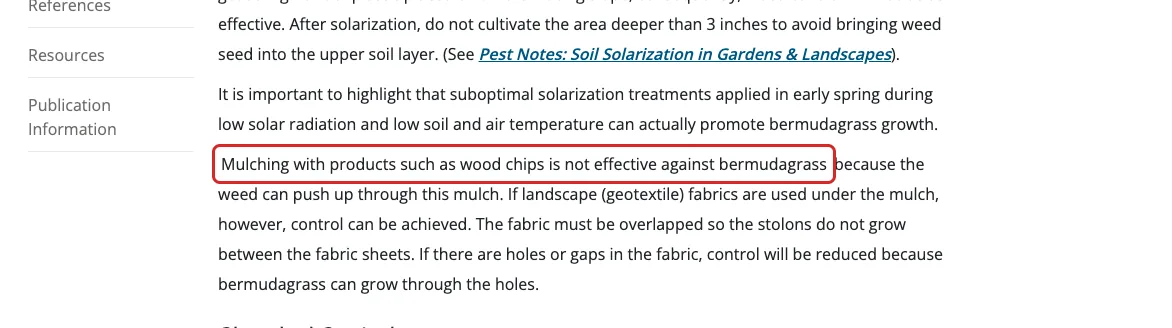
Bermuda is the grass most likely to beat a mulch job. Besides chips, UC IPM warns that plastic laid in winter will not control it, because dormant bermuda is not trying to grow; covering works only in summer, left intact for at least 6 to 8 weeks. UC IPM adds that stolon and rhizome fragments root and regrow if left on or in moist soil, so a patch that greens up through the mulch should be dug out whole or spot-treated, not chopped into the bed with a spade (UC IPM).
How to lay mulch over grass to kill it
This is the sheet method, built from the UVM, Iowa State, East Multnomah and Organic Growers School steps in the table above. Start in fall if you can: Iowa State and NC State both time it for spring planting, and Placer County’s Master Gardeners suggest late autumn so winter rain keeps the layers wet (UC Master Gardeners, Placer County).
- Mow as low as the mower goes and leave the clippings. Water the lawn first (East Multnomah SWCD).
- Cut the bed edge 4 to 6 inches deep at a 45 degree angle from both sides to make a V-shaped trench, and spread the removed turf over the grass inside the bed (UVM Extension). Our guide to edging a lawn covers tools for it.
- Strip all tape, staples and labels from plain brown corrugated cardboard. Skip waxed or glossy boxes and magazine paper (Iowa State).
- Lay 1 to 2 layers of cardboard, or 6 to 10 sheets of newspaper, with 6 to 10 inch overlaps and no gaps. Tuck the edge into the trench. On bermuda, use 2 layers and pin them with sod staples (OGS).
- Soak the cardboard until it is soggy all the way through (East Multnomah). Oregon State says soaking lets water through and speeds decomposition (EM 9559).
- Spread 4 to 6 inches of wood chips, leaves or bark on top (UVM). Arborist chips are often free in urban areas (WSU Extension); our mulch calculator page converts any depth to cubic yards.
- Keep it as moist as a damp sponge through dry spells, which East Multnomah says keeps the breakdown going.
- Shallow-rooted ground covers can go into the top layer at once if they do not puncture the sheet; wait 6 to 8 weeks for deeper-rooted plants (East Multnomah), or about 6 months for the cardboard to break down (Placer County, UVM). Iowa State says you can plant through the paper right away, but not on bermuda, where OGS says the holes are where it gets back in.
Thinner sheets are safer. Iowa State says thicker is not better because paper and cardboard can block water and air, and Washington State University’s Linda Chalker-Scott found sheet mulches turn water-repellent when dry and anaerobic when wet on poorly drained soil (The Myth of Paper-Based Sheet Mulch). If water beads on the bed later, the drop test in how to fix hydrophobic soil applies.
- Cubic yards
- 2.47
- Cubic feet
- 67
- 2 cu ft bags
- 34
Default: 200 sq ft at 4 inches over cardboard needs 2.47 cubic yards (67 cu ft, 34 bags of 2 cu ft). Volume is sq ft x inches / 12; chips settle over 1 to 2 weeks (Iowa State).
| Method and depth | Inches | Cubic yards for 200 sq ft | 4 x 4 ft cardboard sheets |
|---|---|---|---|
| Sheet mulch, 3 in. (Clemson, OGS) | 3 | 1.85 | 17 at 6 in. overlap; 20 at 10 in. |
| Sheet mulch, 4 in. (UVM, TreePeople low end) | 4 | 2.47 | 17 at 6 in. overlap; 20 at 10 in. |
| Sheet mulch, 6 in. (UVM high end) | 6 | 3.70 | 17 at 6 in. overlap; 20 at 10 in. |
| Mulch alone, 8 in. (Iowa State minimum) | 8 | 4.94 | None |
| Mulch alone, 12 in. | 12 | 7.41 | None |
| Mulch alone, 18 in. (Iowa State high end) | 18 | 11.11 | None |
The table shows the cost of skipping cardboard: 8 inches of chips is twice the volume of a 4 inch sheet mulch, and 18 inches is 4.5 times. Iowa State’s method also ends with raking the excess back out, so at a settled 6 inches, cutting a 200 sq ft bed back to 3 inches moves about 1.85 cubic yards somewhere else in the yard.
How long does it take mulch to kill grass?
No source we found measured how many weeks lawn grass takes to die under sheet mulch; the waits are recommendations, and they run from 6 weeks to 6 months. East Multnomah gives 6 to 8 weeks, TreePeople 2 months, UVM and Clemson 4 to 6 months, and Placer County, Oregon State and NC State about 6 months. The short waits are for the grass to die; the long ones are for the cardboard to rot enough to plant through (Clemson HGIC).
Season changes the clock. Oregon State’s Alec Kowalewski puts the fastest route, plastic sheeting in summer heat, at 2 to 3 weeks, and the same article warns living root fragments can persist (Oregon State Extension, July 2023). A fall start gives the layers the winter to work, which is why Iowa State, NC State and Placer County time it that way. Bermuda is dormant then, and UC IPM says winter covers do not control it, so expect it to test the layer when growth resumes in spring.
1Is it bermudagrass or quackgrass?
YesDo not rely on mulch alone: UC IPM says bermuda pushes through wood chips and Oregon State says quackgrass may not smother. Use intact plastic in summer or a labeled herbicide first.
NoGo to the next question
2Is it a ring around a tree or existing shrubs?
YesKeep mulch 2 to 4 inches deep and dig the turf out by hand instead of burying it.
NoGo to the next question
3Do you need to plant within 8 weeks?
YesLay cardboard under 4 to 6 inches of mulch and plant through it now (Iowa State); expect a harder job watering the new plants.
NoGo to the next question
4Can you get enough cardboard or newspaper to cover the area with 6 to 10 inch overlaps?
YesSheet mulch: 1 to 2 layers of cardboard, 4 to 6 inches of mulch, wait 6 weeks to 6 months.
NoHeavy mulch alone: at least 8 inches of wood chips, settling to 6 to 8, checked at 2 to 4 weeks, then raked back to 2 to 4 inches for planting (Iowa State).
Source: Iowa State Extension; UC IPM Pest Note 7453; Oregon State EM 9559; UVM Extension
Why is grass growing through my mulch?
Usually it came in from the side. Illinois Extension’s Richard Hentschel says lawn grass grows 3 to 4 inches a year toward and into beds, and suggests leaving a strip of open soil between mulch and lawn so edging stays easy (Illinois Extension, 2018). An edge cut 4 inches deep and 4 inches wide “can easily contain bluegrass,” per Illinois Extension’s Rhonda Ferree, but it needs touching up once or twice a year (Illinois Extension, 2015).
The second cause is a thin layer. WSU’s review of mulch trials found shallow mulch enhances weed growth rather than preventing it, by holding moisture (WSU Extension). Top a bed up to 3 inches, pull runners by hand while short, and for bermuda in shrub beds, use a grass-selective herbicide on the plant list in our bermuda grass guide. Mulch keeps new weed seed from sprouting better than it kills what is rooted; the depth trials are in does mulch prevent weeds.
How we compiled this
We read 19 primary documents in November 2026: 17 extension, conservation district and nonprofit guides (Iowa State, UC IPM, UVM, UC Master Gardeners, Oregon State twice, NC State, Clemson, WSU twice, Wisconsin, UF/IFAS, Illinois twice, East Multnomah SWCD, TreePeople, Organic Growers School), Bartlett’s technical report, and 1 field trial (Greenly and Rakow 1995). Volumes and sheet counts are our arithmetic. We laid no mulch and timed no grass for this page.
Frequently asked questions
Can I just put mulch down over grass?
Only deep enough to block the light: Iowa State uses at least 8 inches of chips settling to 6 to 8. A typical 2 to 3 inch bed layer lets spreading grasses through; Cornell plots saw grasses penetrate 3 inches in the first season.
Do I need to remove grass before mulch?
No, if you cover it with cardboard and 4 to 6 inches of mulch and wait 6 weeks to 6 months. Remove it first if it is bermuda or quackgrass, which UC IPM and Oregon State say can push through or survive.
Will grass grow back through mulch?
Yes, from the edges and through thin spots. Illinois Extension says lawn grass grows 3 to 4 inches a year into beds; a 4 by 4 inch trench edge contains bluegrass if recut once or twice a year.
What is the cheapest way to kill grass?
Free cardboard under free arborist chips, which WSU says are often available at no charge. A 200 sq ft bed takes about 2.5 cubic yards at 4 inches. It costs time instead: 6 weeks to 6 months.
Will mulch kill grass in the fall?
Yes, and fall is the start date Iowa State, NC State and Placer County Master Gardeners suggest for spring planting: November to May in NC State’s example. Plastic laid over dormant bermuda in winter will not control it, per UC IPM.
Sources
- Iowa State University Extension and Outreach (A. Steil), How to Kill Grass to Create a New Garden Bed, Last reviewed June 2026. Accessed November 2026.
- Bartlett Tree Experts Research Laboratory (E. Thomas Smiley), Fresh Woodchip Mulch, technical report, Undated PDF. Accessed November 2026.
- K.M. Greenly and D.A. Rakow, Journal of Arboriculture 21(5), The Effect of Wood Mulch Type and Depth on Weed and Tree Growth and Certain Soil Parameters, 1995. Accessed November 2026.
- Washington State University Extension (L. Chalker-Scott), Using Arborist Wood Chips as a Landscape Mulch (archived), January 2015. Accessed November 2026.
- UC Statewide IPM Program, Pest Notes: Bermudagrass, Publication 7453, Current page. Accessed November 2026.
- University of Vermont Extension (A. Simone), Sheet Mulching for Lawn-to-Garden Conversion, March 23, 2026. Accessed November 2026.
- UC Master Gardeners of Placer County (J. Long), How to Kill Your Lawn by Sheet Mulching, Current page. Accessed November 2026.
- East Multnomah Soil and Water Conservation District, Lawn Removal using Newspaper or Cardboard, 2017 PDF. Accessed November 2026.
- TreePeople (L. Cahill), How to Kill Your Lawn, July 16, 2014. Accessed November 2026.
- Clemson Cooperative Extension HGIC (J. Jordan), How to Use Cardboard in the Landscape: Benefits and Drawbacks, May 1, 2025. Accessed November 2026.
- Oregon State University Extension, EM 9559, Sheet mulching and lasagna composting with cardboard, Current page. Accessed November 2026.
- NC State Extension (M. Brennan), Smart Gardening: Sheet mulching, January 20, 2020, updated Nov. 19, 2022. Accessed November 2026.
- Organic Growers School, Ask OGS: Eradicating Bermuda Grass from Your Garden, Current page. Accessed November 2026.
- Washington State University (L. Chalker-Scott), The Myth of Paper-Based Sheet Mulch, Undated PDF. Accessed November 2026.
- Oregon State University Extension, Beyond grass: Removing lawns to make room for new landscapes, July 2023, reviewed 2025. Accessed November 2026.
- University of Wisconsin Extension, Perennial Grass Weeds in Lawns, Current page. Accessed November 2026.
- UF/IFAS Extension, ENH5/LH010, St. Augustinegrass for Florida Lawns, 2021 revision. Accessed November 2026.
- University of Illinois Extension (R. Hentschel), Edging and mulching landscape beds, May 23, 2018. Accessed November 2026.
- University of Illinois Extension (R. Ferree), Bed Edges, May 24, 2015. Accessed November 2026.