
How to edge a lawn: mow first, then cut a vertical line where grass meets pavement or bed. Pavement edges go 0.5 to 1 inch deep, bed edges 3 to 4 inches. Wear ANSI Z87.1 glasses; keep people 50 to 100 feet back.
Learning how to edge a lawn comes down to three numbers that every top-ranking guide leaves out: how deep the blade goes, which side of the tool throws debris, and how far away other people must stand. We took all three from 12 operator manuals. ECHO calls 0.5 inch the optimal depth for its PE-225 stick edger, BLACK+DECKER recommends 1 inch on the LE750, and EGO lets its edger attachment cut up to 3 inches.
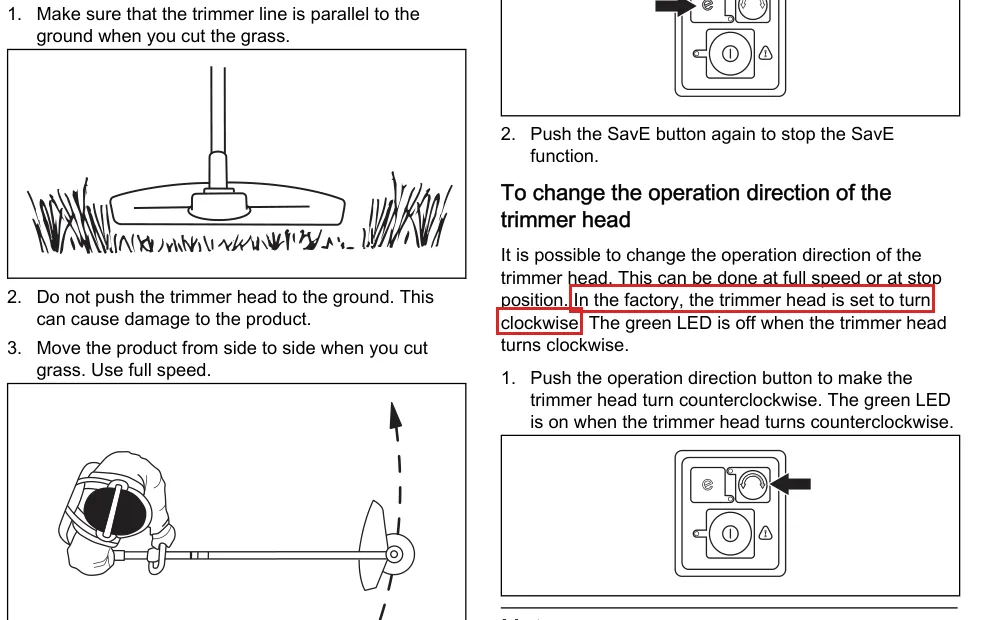
The manuals also contradict a tip in one of the top-ranking guides: This Old House says most trimmers spin clockwise, so you should move left to right. ECHO prints “counterclockwise; viewed from top” for the SRM-225, Honda prints counterclockwise for the UMK422 and UMK431, and Husqvarna ships the 520iLX turning clockwise with a button that reverses it. Check your own manual before you choose a walking direction.
Edging vs trimming: two different cuts
Edging is a vertical cut along a boundary: a walk, a driveway, a curb or a bed. Trimming is a horizontal cut of grass the mower missed, around posts, trees and fences. The EGO EA0800 manual says to hold the edger “so that the blade is vertical,” and the Ryobi P2008 has a foot pedal that rotates its head into a separate edger position (p. 11). Mow before you edge, so you can see the line; our guide on how to mow a lawn covers the cut height that edge should match.
Edge depth, speed and price by tool
Depth is the setting that changes the result most, and the printed figures run from a surface cut to 3 inches. Hard-surface edges need only enough depth to sever the runners at the seam; ECHO calls for a “fine cut line between sidewalk and grass.” The table covers each tool type the top results recommend, with the depth, handling rule and dated price each source gives.
| Tool (example model) | Type | Depth as printed | How the source says to run it | Speed | Price (Nov. 11, 2026) | Source |
|---|---|---|---|---|---|---|
| String trimmer turned vertical (ECHO SRM-225) | Gas trimmer, nylon line | Surface cut; no depth setting | Nylon line only against hard surfaces (Honda); .080 or .095 in line trimmed to 5 in (ECHO pp. 15, 37) | Not printed | $279.99 MSRP | ECHO Incorporated |
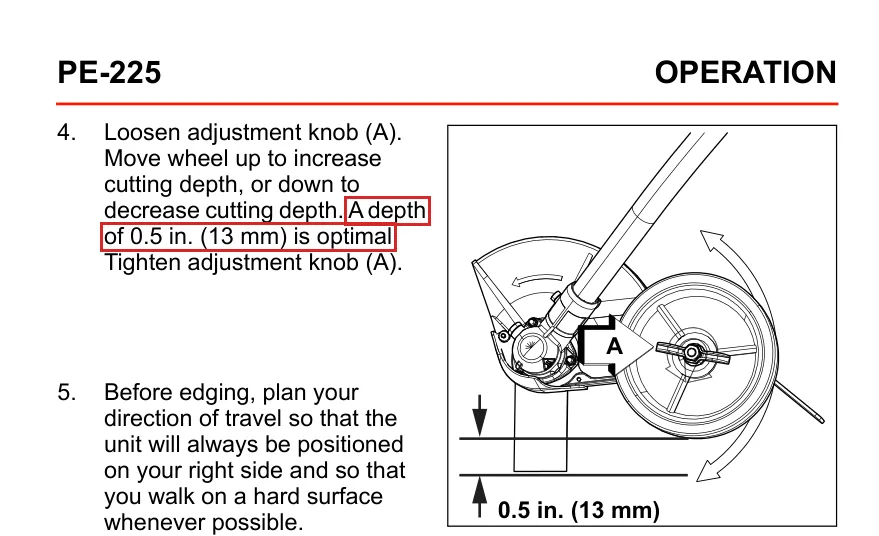
| Stick edger (ECHO PE-225) | Gas, 8 in blade | 0.5 in (13 mm) “is optimal” | Unit on your right side, walk on the hard surface; replace the blade below 6 in long (pp. 25, 37) | Not printed | $319.99 MSRP | ECHO Incorporated |
| Stick edger (Greenworks ED60L00) | 60V battery, 8 in blade | Blade “barely touches the ground” | Set depth with the battery out, recheck standing in working position (p. 7) | 7,000 rpm no-load | Not captured | Greenworks |
| Edger attachment (EGO EA0800) | 56V multi-head, 8 in blade | Up to 3 in | Blade “just touches the ground or breaks the surface”; no faster than a walk (pp. 9, 16) | Not printed | Not captured | EGO Power+ |
| Wheeled edger (BLACK+DECKER LE750) | Corded, 12 A | 1, 1.25 or 1.5 in; 1 in recommended | Stand left of the main handle; blade worn to 1/4 in of cut needs replacing (pp. 1, 2) | Not printed | $99.00 | BLACK+DECKER |
| Wheeled edger (WORX WG896) | Corded, 12 A, 7.5 in blade | 1, 1.25 or 1.5 in | Both rear wheels on the pavement, edge guide against its edge (p. 9) | 5,300 rpm no-load | $139.99 | WORX |
| Walk-behind edger (MTD Series 550) | Gas, notched depth lever, 3-position bevel | Lever notches; lower one notch per pass | Left rear wheel on the hard surface; several passes for full depth (p. 8) | Not printed | Not captured | MTD LLC |
| Half-moon edger (Fiskars T98936935) | Manual, 14-gauge steel blade | Blade depth, driven by foot | Stand on the blade top so it goes in fully; overlap cuts (RHS) | Hand speed | $42.99 | Royal Horticultural Society |
| Flat spade | Manual | 7.5 cm (3 in), marked with tape | RHS method for a new edge | Hand speed | Already owned | Royal Horticultural Society |
| Dual-wheel rotary edger (Ames 2916000) | Manual, serrated wheel blade | Cuts overhang at the paving edge | Roll along the walk or drive | Hand speed | $69.99 | McGuckin Hardware |
| Long-handled edging shears | Manual | Cuts the overhang only | Hold upright, keep the lower handle still, move the upper (RHS) | Hand speed | Not captured | Royal Horticultural Society |
Two patterns stand out. The deeper settings belong to corded wheeled edgers, which ride on the pavement: both the LE750 and the WG896 offer 1, 1.25 and 1.5 inches. BLACK+DECKER also says to keep the initial depth at the minimum and lower it as the blade wears, because a worn blade cuts only 1/4 inch. Cutting deeper than the runners only digs soil and shortens the blade.
Which tool should you use?
1Is the edge against a bed, not pavement?
YesCut a 3 to 4 inch V or cliff with a half-moon edger or a spade marked at 3 in (RHS; Illinois and NC State Extension).
NoGo to the next question
2Has grass grown over the paving so the old line is lost?
YesRecut the line with a stick or wheeled edger, lowering one notch per pass (MTD Series 550 manual).
NoGo to the next question
3Do you already own a string trimmer with nylon line?
YesTurn it vertical and edge with the debris thrown away from you (Honda UMK manual, p. 23).
NoGo to the next question
4Is it only a light overhang on a short run of paving?
YesUse a rotary edger or long-handled edging shears (RHS).
NoBuy or rent a powered edger: start at 0.5 to 1 inch deep (ECHO PE-225; BLACK+DECKER LE750).
Source: ECHO PE-225, Honda UMK and MTD Series 550 manuals; RHS; Illinois and NC State Extension
If you already own a string trimmer and your edges are pavement, start there; it costs nothing extra and the Ryobi P2008 is even sold as a trimmer/edger with an edger wheel. Move to a stick or wheeled edger when the trimmer leaves a ragged, scalloped line. For a bed edge, no power tool in the table cuts the 3 to 4 inch trench; use a half-moon edger or spade.
Edging against concrete wears line fast, so learn how to restring a weed eater for your head type; the Ryobi P2008 takes about 9 ft of 0.065 or 0.080 in. line per spool.
How to edge a lawn with a string trimmer
- Fit nylon line, never a blade. Honda says blades “should never be used for edging against solid surfaces” (UMK manual, p. 10). ECHO lists .080 or .095 inch line for the SRM-225, and its cutoff knife trims the line to 5 inches (pp. 15, 37).
- Find your head’s rotation. Look for it in the specifications: ECHO SRM-225, counterclockwise viewed from the top (p. 43); Honda UMK, counterclockwise from the operator’s position (p. 23); Husqvarna 520iLX, clockwise by default and reversible (p. 14).
- Turn the head vertical. On a trimmer/edger, use the built-in edging position: the Ryobi P2008 rotates its head counterclockwise into edger position with a foot pedal (p. 11). On a fixed-head trimmer, roll the shaft so the line spins in a vertical plane over the seam.
- Aim the debris away from you. Honda: “The trimmer will throw debris in the direction of blade movement at the point of contact,” so work from an angle where debris that hits the hard surface ricochets away (pp. 23, 25). Ryobi says to stand to the left of the grass deflector and never in the line’s path.
- Walk on the hard surface and go slowly. Keep the head at the same height and the line over the seam; a wheel, where fitted, rides on the pavement.
- Blow the clippings back onto the lawn, not into the street.
| Trimmer | Rotation as printed | Where the manual puts you or the debris | Line | Source |
|---|---|---|---|---|
| ECHO SRM-225 | Counterclockwise, viewed from top | Not stated for edging | .080 or .095 in | Manual, pp. 37, 43 |
| Honda UMK422 / UMK431 | Counterclockwise, from the operator’s position | Cut with the right side to throw debris away; tilting left throws it toward you | Nylon only for hard surfaces | Manual, pp. 10, 23, 25 |
| Husqvarna 520iLX | Clockwise from the factory; button reverses it | Not stated for edging | Not checked | Manual, p. 14 |
| Ryobi P2008 | Not printed | Stand to the left of the grass deflector; never in the line’s path | .065 in round or twisted, or .080 in twisted | Manual, pp. 8, 11 |
| EGO ST1500F | Not printed | No edging section | .095 in twist (recommended), .080 compatible | Manual, p. 9 |
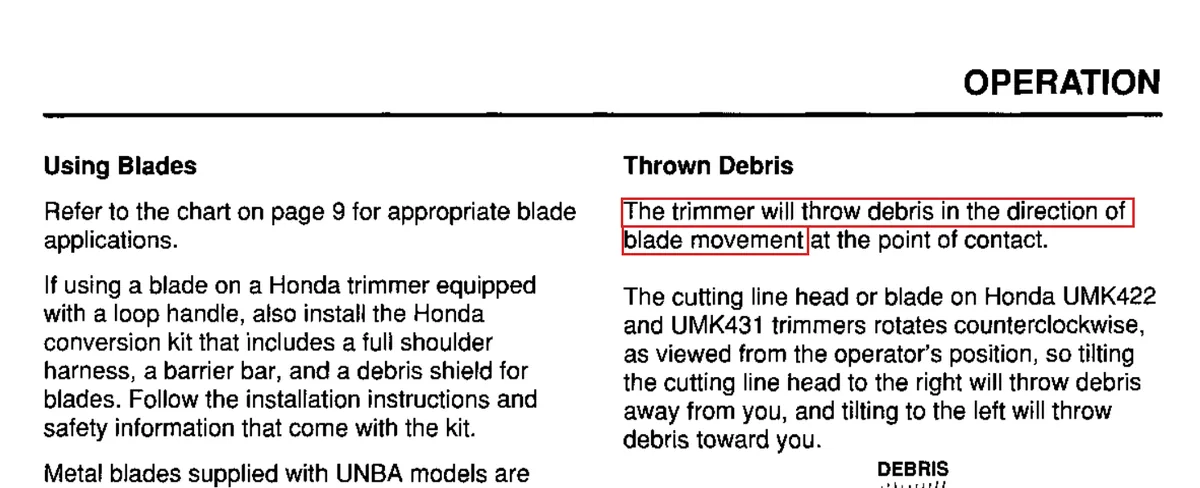
Set against the manuals, the “clockwise” tip holds only sometimes: on the Husqvarna 520iLX it is true out of the box and wrong after one press of the direction button, and on the ECHO and Honda it is the opposite of what the manual prints. The safe rule is Honda’s: debris goes the way the line moves where it touches, so position yourself on the other side.
How to use a stick or wheeled edger
- Set the depth with the power off. ECHO: move the wheel up for deeper, down for shallower, and aim for 0.5 inch (PE-225 manual, p. 25). BLACK+DECKER: 1 inch on the LE750. Greenworks and EGO: the blade should just touch or break the soil.
- Line up on the hard surface. The WORX WG896 wants both rear wheels on the paving with the edge guide pressed lightly against its edge (p. 9); the MTD Series 550 keeps its left rear wheel on the hard surface (p. 8); ECHO keeps the unit on your right side as you walk the paving.
- Start with the blade clear of the ground, let it reach speed, then lower it into the seam (WORX: tilt the handle down first to avoid kickback).
- Walk at a steady pace. EGO says no faster than a normal walk; if the blade bogs down, slow down (EA0800 manual, p. 16). WORX says to back up an inch or two if the motor slows.
- Go deeper in passes, not in one bite. MTD: “Do not lower blade more than one depth notch at a time without making a pass.” The first edge of the season is the slowest, WORX notes, because the grass is thickest then.
Replace blades on the schedule each maker prints: ECHO at less than 6 inches long on an 8-inch blade (p. 37), BLACK+DECKER when wear reaches the small hole at each end. BLACK+DECKER also says not to sharpen the LE750 blade at all, while WORX lists “keep blades sharp” in its safety rules, so follow the manual for your model.
How to edge by hand
A half-moon edger cuts a new line or recuts an old one; a rotary edger and edging shears only clean up overhang. The RHS method for a new edge:
- Mark the line with a string tied between pegs for straight runs, or a hose, rope or string for curves, and check the shape from an upstairs window.
- Stand on the flat top of the half-moon blade so it goes in fully. With a flat spade, tape a 7.5 cm (3 in) mark on the blade and push to that mark.
- Take small steps so each cut slightly overlaps the last, then pull out the narrow strips of turf by hand.
- Trim the overhang after each mow with long-handled edging shears held upright, keeping the lower handle still and moving the upper one (RHS).
RHS says to avoid frozen or very wet ground, and to work off a wooden board when soil is only slightly wet, to avoid compaction. Along paving, the Ames 2916000 rotary edger rolls on the walk and slices runners with a serrated wheel; at $69.99 it costs less than a quarter of the ECHO stick edger’s $319.99 MSRP but cuts only at the surface.
How deep to cut a bed edge
A bed edge is a trench, not a line. Lawn grass grows 3 to 4 inches a year into beds, says Illinois Extension educator Richard Hentschel, which is why he calls annual edging “quite beneficial.” The depth figures below come from three horticultural sources; none of the power edgers in the first table reaches them except the EGO attachment at its 3-inch maximum.
| Source | Depth | Shape and width | Upkeep it states |
|---|---|---|---|
| Illinois Extension (Ferree) | 4 in | 4 in wide; spade-cut “small cliff”; “can easily contain bluegrass” | Touch up once or twice a year |
| NC State Extension, Lee County | 3 to 4 in | V-trench cut with a sharp spade | Not stated; advises against installed edging |
| RHS, creating an edge | 7.5 cm (3 in) | Vertical cut with a half-moon edger or spade | Not stated |
| RHS, maintaining an edge | About 7.5 cm (3 in) drop | Drop from lawn to border | Redefine annually; edging shears after each mow |
| Illinois Extension (Hentschel) | Not stated | Edging tool or flat spade for new beds | Annual, since grass advances 3 to 4 in a year |
For the V-trench NC State describes, cut straight down on the lawn side and slope the bed side to meet it; Lowe’s angles the blade toward the bed for the same taper. Hentschel suggests leaving some open soil between mulch and lawn so touch-up edging stays easy; mulch depth and volume are in how much mulch you need. Skip the deep trench around trees, where it severs roots; see how to mulch around trees.
Grass that has already crossed the edge needs more than a recut: selective grass sprays and their label rates are in our flower bed weed control guide, and what mulch does and does not stop is in does mulch prevent weeds.
How often should you edge?
Published schedules run from every mow to once a year. RHS trims edges with shears after each mowing, which “may be as often as once a week when grass is in full growth.” Illinois Extension touches up hand-cut bed edges once or twice a year. A public grounds contract we read, the Washington, Iowa, school district specification, requires sidewalks to be “edged at least once per year and as needed,” and bans chemicals in place of mechanical trimming.
A workable homeowner rhythm from those figures: trim the overhang at every mow in peak growth, run a powered edger along pavement every second or third mow, and recut bed edges once or twice a season. ECHO’s advice supports the frequent end: edging regularly avoids having to make more than one pass (p. 24). How often you mow is set by grass height; see how often to mow your lawn.
Safety: glasses, gear and the 50 to 100 foot zone
The ECHO, Honda, Ryobi, EGO and Greenworks manuals ask for eye protection marked ANSI Z87.1, the U.S. standard for safety eyewear, and the ECHO SRM-225 manual adds that a full-face shield may be worn over it. The bystander distance is less uniform than the “50 feet” most guides repeat: 6 of 10 manuals print 50 feet, MTD prints 75 and three print 100.
| Product | Type | Keep bystanders and pets at least | Source |
|---|---|---|---|
| ECHO SRM-225 trimmer | Gas trimmer | 50 ft | Manual, p. 11 |
| STIHL FS 56 trimmer | Gas trimmer (15 m) | 50 ft | Manual, p. 6 |
| Honda UMK422/431 trimmer | Gas trimmer | 50 ft | Manual, p. 6 |
| Ryobi P2008 trimmer/edger | 18V trimmer/edger | 50 ft | Manual, p. 5 |
| ECHO PE-225 edger | Gas stick edger | 50 ft | Manual, p. 12 |
| Greenworks ED60L00 edger | 60V stick edger | 50 ft | Manual, p. 4 |
| MTD Series 550 edger | Gas walk-behind edger | 75 ft | Manual, p. 4 |
| EGO ST1500F trimmer | 56V trimmer | 100 ft | Manual, p. 20 |
| BLACK+DECKER LE750 edger | Corded wheeled edger | 100 ft | Manual, p. 1 |
| WORX WG896 edger | Corded wheeled edger | 100 ft | Manual, p. 9 |
Before trenching a bed edge, check for buried lines: BLACK+DECKER says to check for buried electrical cables before landscaping or trenching with the LE750, and lists safety glasses, gloves, long pants and substantial footwear. STIHL’s FS 56 manual says that even beyond 15 m, “the danger cannot be ruled out.”
How we compiled this
In November 2026 we read 12 operator manuals (6 string trimmers and 6 edgers or edger attachments), 2 RHS guides, 3 extension articles from Illinois and NC State, one public grounds specification and the top Google results for this query. Depths, rotation, distances and page numbers are as printed (PDF page numbers); prices are from 6 product pages checked on November 11, 2026. We did not test any tool or edge any lawn.
Frequently asked questions
What is the 3 inch edging rule?
No code sets it. The figure traces to gardening guidance such as the RHS, which recommends a drop of about 7.5 cm (3 in) from lawn to border and marks a spade at 3 inches when cutting a new edge. Illinois Extension and NC State Extension go to 4 inches for bed edges.
How deep should edging be to prevent grass?
For a cut bed edge, about 4 inches deep and 4 inches wide, which Illinois Extension says can easily contain bluegrass; NC State Extension uses a 3 to 4 inch V-trench. Along pavement you only need to sever the runners: ECHO calls 0.5 inch optimal and BLACK+DECKER recommends 1 inch.
What do professionals use to edge a lawn?
Along pavement, a dedicated edger: a gas stick edger such as the ECHO PE-225 ($319.99 MSRP) or a walk-behind with a notched depth lever such as the MTD Series 550, with a string trimmer for touch-ups. Bed edges are cut by hand with a half-moon edger or spade, since power edgers stop at 1.5 to 3 inches.
Can a string trimmer be used for edging?
Yes, with nylon line only. Ryobi sells the P2008 as a trimmer/edger with an edger wheel and foot-pedal head rotation, and Honda says nylon line is the attachment for cutting against a hard surface; blades should never be used for edging against solid surfaces. Expect a surface cut, not a trench.
What are common mistakes when edging?
Cutting too deep in one pass (MTD says lower one notch per pass), standing on the side the line throws debris toward, using a metal blade against concrete, edging wet soil (RHS says wait until it dries) and edging before mowing, which hides the line you are following.
Is 2 inches too short to cut grass?
For Kentucky bluegrass and tall fescue, yes: Arkansas Extension lists 2.5 to 3.5 and 2.5 to 4 inches. For bermudagrass and zoysiagrass, 2 inches is within range. Mow at the right height first, then edge to match it.
Sources
- ECHO Incorporated, SRM-225 String Trimmer Operator’s Manual, X7722279402, February 2016 edition. Accessed November 2026.
- ECHO Incorporated, PE-225 Power Edger Operator’s Manual, X7732272805, December 2022 edition. Accessed November 2026.
- American Honda Motor Co., UMK422 and UMK431 Trimmer/Brush Cutter Owner’s Manual, 31VF9604, Current PDF. Accessed November 2026.
- Husqvarna, 520iLX Operator’s Manual, Current PDF. Accessed November 2026.
- Ryobi (Techtronic Industries), P2008 18V String Trimmer/Edger Operator’s Manual, Current PDF. Accessed November 2026.
- EGO Power+ (Chervon), ST1500F/ST1500SF 15in String Trimmer Operator’s Manual, Current PDF. Accessed November 2026.
- STIHL, FS 56 Instruction Manual, 0458-547-0121-F, Current PDF. Accessed November 2026.
- EGO Power+ (Chervon), EA0800/EA0820 Edger Attachment Operator’s Manual, Current PDF. Accessed November 2026.
- Greenworks, ED60L00/ED60L210 60V Edger Operator Manual, Current PDF. Accessed November 2026.
- BLACK+DECKER, LE750/EH1000 Edge Hog Instruction Manual, Form 90630018, September 2015. Accessed November 2026.
- WORX (Positec), WG896 12 Amp 2-in-1 Lawn Edger/Trencher Owner’s Manual, Current PDF. Accessed November 2026.
- MTD LLC, Lawn Edger Model Series 550 Operator’s Manual, Form 769-02351A, Current PDF. Accessed November 2026.
- Royal Horticultural Society, How to maintain lawn edges, Current web page. Accessed November 2026.
- Royal Horticultural Society, How to create a lawn edge, Current web page. Accessed November 2026.
- University of Illinois Extension, Bed Edges (Rhonda Ferree), May 24, 2015. Accessed November 2026.
- University of Illinois Extension, Edging and mulching landscape beds (Richard Hentschel), May 23, 2018. Accessed November 2026.
- NC State Extension, Lee County Center, Fall is for planting: guide for how to establish a new ornamental garden bed, Current web page. Accessed November 2026.
- Washington Community School District, Washington, Iowa, Landscaping/Grounds Specifications, Bid Package 1, 2025 to 2027, Issued November 12, 2024. Accessed November 2026.
- University of Arkansas Cooperative Extension, FSA6023, Mowing Your Lawn, Current PDF. Accessed November 2026.
- ECHO USA, PE-225 edger product page (MSRP), Checked November 11, 2026. Accessed November 2026.
- ECHO USA, SRM-225 trimmer product page (MSRP), Checked November 11, 2026. Accessed November 2026.
- BLACK+DECKER, LE750 12 Amp 2-in-1 Landscape Edger and Trencher product page, Checked November 11, 2026. Accessed November 2026.
- WORX, WG896 7.5in Electric Lawn Edger and Trencher product page, Checked November 11, 2026. Accessed November 2026.
- Hills Flat Lumber, Fiskars 38.5 in. Steel Handle Manual Lawn Edger, model T98936935, Checked November 11, 2026. Accessed November 2026.
- McGuckin Hardware, Ames 2916000 Dual Wheel Rotary Edger, Checked November 11, 2026. Accessed November 2026.