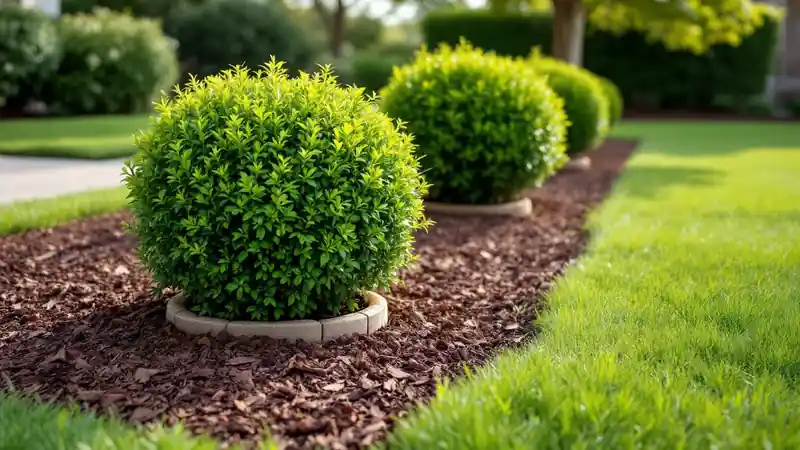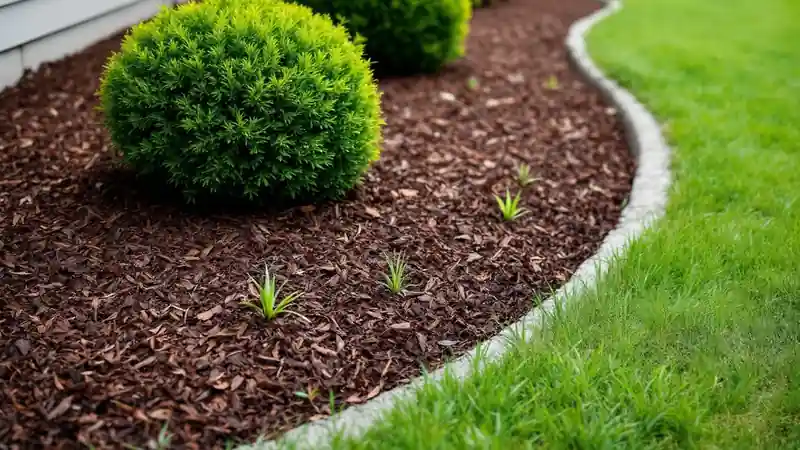
Does mulch prevent weeds? Mostly the annual ones. In Cornell plots, weed cover fell from about 95 percent on bare soil to about 25 percent under 3 inches of wood chips, but yellow nutsedge, thistles and runner weeds pushed through even deep layers.
So does mulch prevent weeds in a planting bed? It prevents germination, not growth: a layer blocks the light small weed seeds need, while weeds with food stored in tubers, rhizomes or thick roots grow up through it (UC IPM Pest Notes 7441). Below are the measured results of 14 published trials sorted by depth and material, and one placement conflict none of the usual guides mention: Preen’s label says to sprinkle its trifluralin on top of mulch, while UC IPM lists trifluralin as an under-the-mulch herbicide.
Oxalis shows why: Cornell reports its seed needs light to sprout and survives at least 5 years in undisturbed soil, and our guide to getting rid of oxalis in a lawn or bed pairs 2 to 3 inches of mulch with a preemergent for that reason.
What the trials measured at each depth
The cleanest field test of depth is Cornell’s. Katrina Greenly and Donald Rakow spread chipped pine and shredded hardwood 3, 6 and 10 inches (7.5, 15 and 25 cm) deep around young white pines and pin oaks for two seasons, with no herbicide before mulching. Weed density and the number of weed species both fell as depth rose, and the biggest drop came between bare soil and 3 inches (Greenly and Rakow, Journal of Arboriculture 21(5), 1995).
The 0, 3 and 6 inch values in that chart are read from the study’s Figure 2 by a 2015 University of Florida review: about 95, 25 and 10 percent weed cover (Marble, Koeser and Hasing, HortScience 50(6), 2015). The 10 inch value, 3.5 percent after the second season, is from the paper’s own text. Mulch type made no difference, so the ruler matters more than the hardwood or pine label on the bag.
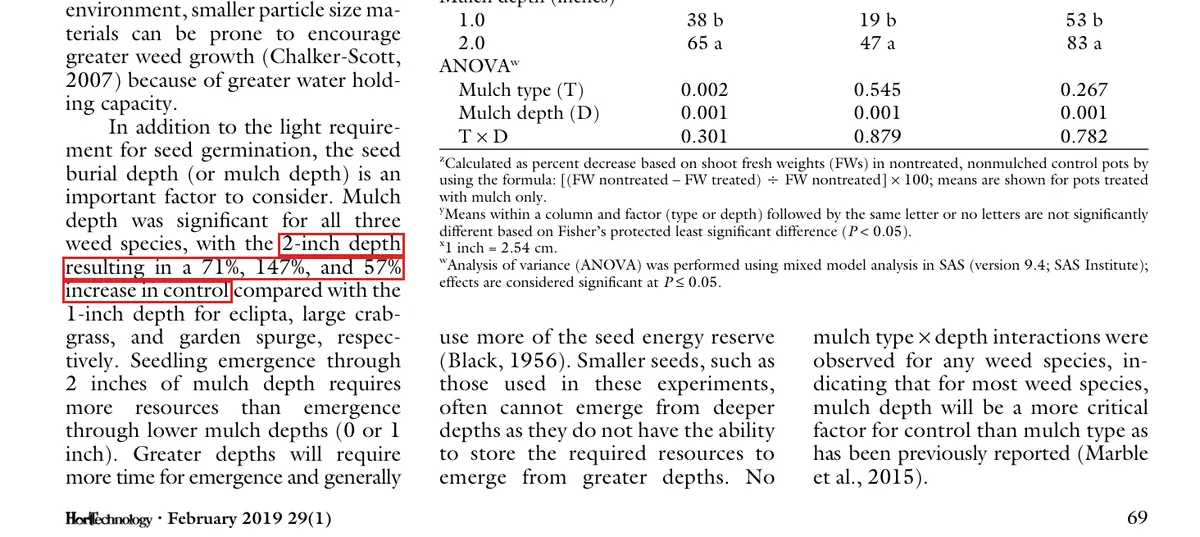
Container trials put a number on the shallow end. In a 2019 University of Florida study, weed seed was sown on the soil and covered with hardwood chips, pine bark or pine straw. Mulch alone at 1 inch controlled 19 to 53 percent of three weeds by fresh weight; at 2 inches it controlled 47 to 83 percent, with no type by depth interaction for any species (Saha and others, HortTechnology 29(1), 2019).
Swipe the table sideways to see every column.
| Mulch | Depth | Weed result | Setting | Source |
|---|---|---|---|---|
| Bare soil (Cornell control) | none | About 95% weed cover | Field, 2 seasons | Greenly and Rakow 1995, as read by Marble 2015 |
| Chipped pine or shredded hardwood | 3 in | About 25% weed cover; yellow nutsedge and rhizome grasses came through | Field, 2 seasons | Greenly and Rakow 1995 |
| Chipped pine or shredded hardwood | 6 in | About 10% weed cover | Field, 2 seasons | Greenly and Rakow 1995, as read by Marble 2015 |
| Chipped pine or shredded hardwood | 10 in | 3.5% weed cover; bull thistle and common milkweed penetrated | Field, 2 seasons | Greenly and Rakow 1995 |
| Hardwood, pine bark or pine straw | 1 in | 19% large crabgrass, 38% eclipta, 53% garden spurge control | Greenhouse pots | Saha and others 2019, Table 2 |
| Hardwood, pine bark or pine straw | 2 in | 47% crabgrass, 65% eclipta, 83% spurge control | Greenhouse pots | Saha and others 2019, Table 2 |
| Same mulches plus a pre-emergent | 1 in or more | 88% to 100% crabgrass and spurge control | Greenhouse pots | Saha and others 2019 |
| Three mulch types | 1 to 4 in | 90% to 100% spotted spurge control for up to 90 days; herbicide spent by day 168 | Nursery containers | Bartley and others 2017, via Saha 2019 |
| Pine bark nuggets | 2 in | 99.5% control of spotted spurge and eclipta | Nursery containers | Bartley and others 2017, via UF/IFAS ENH1380 |
| Pine bark mini-nuggets | 3 in | Hairy bittercress and yellow woodsorrel controlled up to 150 days | 3 to 7 gal containers | Richardson and others 2008, via Saha 2019 |
| Pine bark mini-nuggets | 1 in | Eclipta counts down 87%, spotted spurge 90% | Nursery containers | Cochran and others 2009, via Marble 2015 |
| Pine bark, hardwood bark, cedar, 2 pine needles | not given in review | Weed counts about half of bare plots, incl. bermudagrass and yellow nutsedge | Landscape plots | Skroch and others 1992, via Marble 2015 |
| Pine straw, pine bark nuggets, cypress | not given in review | Yellow nutsedge shoots down 40% to 60% | Landscape plots | Chen and others 2013, via Marble 2015 |
| 15 organic mulches | not given in review | All beat bare soil; few differences between types | Landscape plots | Stinson and others 1990, via Marble 2015 |
Two patterns hold across all 14 rows. Depth moves the result more than material does, and no depth reaches zero: the 2 inch pots still let through about half the crabgrass, and the Cornell 10 inch plots still grew perennials that were rooted before the mulch went down.
How deep should mulch be to prevent weeds?
Three inches of coarse mulch, settled, is where the measured benefit is large and the plant risk is low, and most extension advice sits within an inch of it. The sources split at the deep end because they guard different things: UC IPM caps the layer at 4 inches around plants because deeper mulch keeps soil wet and invites root and stem rot, while UC ANR Publication 8672 allows 6 to 12 inches of fresh chips for maximum suppression.
| Source | Depth for weed control | Condition or limit |
|---|---|---|
| UC IPM Pest Notes 7441 | 3 to 4 in of medium (3/4 in) mulch; coarse up to 4 in, fine about 2 in | Over 4 in may injure plants: soil too wet, less oxygen |
| UC ANR Pub. 8672 | At least 4 in of coarse mulch controls most annuals; 6 to 12 in fresh for maximum | Pieces over 1 in; no compost as mulch |
| Cornell Turfgrass and Landscape Weed ID | 2 to 4 in | Reapply organic mulch every 2 to 3 years |
| Chalker-Scott, WSU, 2007 review | Above 3 in; 4 to 6 in in some situations | As summarized by Marble 2015 |
| Greenly and Rakow 1995 | 3 in confirmed as appropriate | 6 and 10 in slowed soil warming and tree shoot growth |
| UF/IFAS ENH1380 | 1 to 2 in (nursery pots) | 4 in or more can cut plant growth |
For a shrub or perennial bed that resolves to 3 inches of bark or chips with pieces about 1/4 to 3/4 inch, or 2 inches of fine double-shredded mulch, measured after it settles. Save 4 inches or more for open ground with no small plants. Bed volume at any depth is in our guide to how much mulch you need.
Grade matters more than the word bark: screened pine bark fines let through 10.36 weeds per plot against 4.20 for shredded hardwood and 1.42 for large nuggets, figures set side by side in our mulch vs bark guide.
Which mulch prevents weeds best?
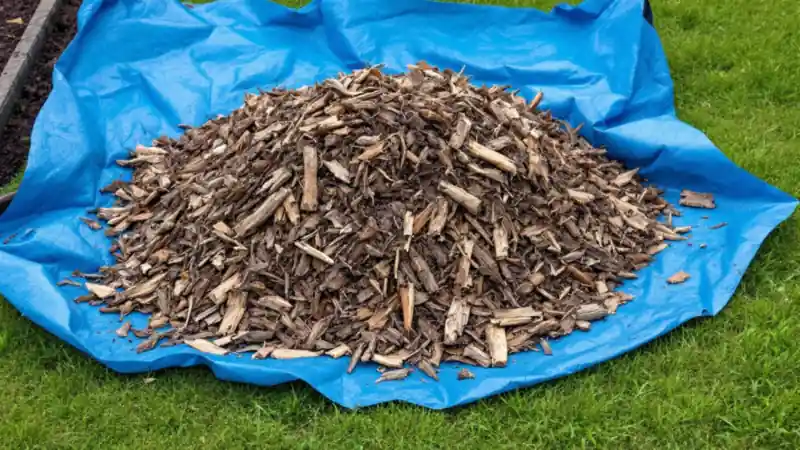
Particle size beats species. UC IPM recommends pieces of about 1/4 to 3/4 inch with low water-holding capacity, and warns that pieces over 1 1/2 inches leave gaps that let light and weeds through unless the layer is 6 inches or deeper. Fine material does the opposite: it stays wet and becomes a seedbed.
| Material | Measured weed result | Catch | Source |
|---|---|---|---|
| Decorative pine bark nuggets (3 to 4 in pieces) | 1.42 weeds per plot vs 15.03 bare | Big gaps need depth | Billeaud and Zajicek 1989, via Marble 2015 |
| Hardwood (0.2 to 3 in pieces) | 4.20 weeds per plot | Hardwood fines grew more sowthistle than bare soil (Cregg and Schutzki 2009) | Billeaud and Zajicek 1989 |
| Cypress (0.2 to 3 in pieces) | 5.6 weeds per plot | More annual sowthistle than bare soil in a 2009 trial | Billeaud and Zajicek 1989; Cregg and Schutzki 2009 |
| Screened pine bark (0.2 to 0.4 in) | 10.36 weeds per plot, close to bare | Too fine to block light | Billeaud and Zajicek 1989 |
| Hardwood chips vs pine bark vs pine straw | Hardwood 64% eclipta control vs 44% and 46%; no difference on crabgrass or spurge | Pots, 1 and 2 in | Saha 2019 |
| Rubber tire chips, 3 to 4 in | Less control than hardwood bark at 4 to 6 in | Depth differed, so not a clean test | Calkins and others 1996, via Marble 2015 |
| Gravel, 1.5 to 2 in | Stopped galleta grass emergence | Blown-in seed grows on top; hard to hand weed | Winkel and others 1995, via Marble 2015; UC IPM |
| Compost or composted manure | Not suitable for weed control | Nutrient-rich seedbed | UC ANR 8672 |
Cost, lifespan and fire risk change the pick more than weeds do, and each has its own page: wood chips vs bagged mulch, pine straw vs mulch, rubber mulch, mulch vs rock and compost vs mulch.
Why do weeds grow through mulch?
Two different failures look the same from the patio. Perennials push up from below on stored food: in the Cornell plots yellow nutsedge penetrated 3 inches on its stiff new leaf blades, goldenrod spread on underground runners, and bull thistle and common milkweed came through 10 inches (Greenly and Rakow, 1995).
Lawn grass under a new bed is the same kind of rooted perennial, and the depths, sheet layers and waits for smothering it are compared in whether mulch will kill grass.
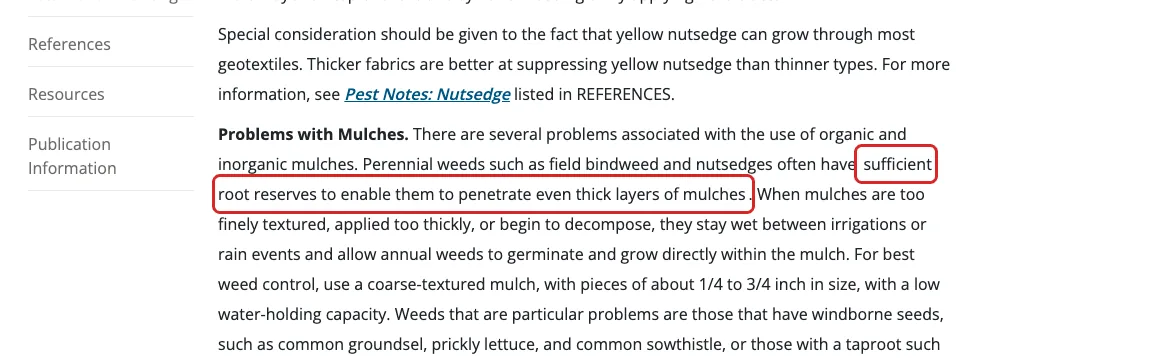
Annuals arrive from above. UC IPM names windborne seeders, common groundsel, prickly lettuce and common sowthistle, as the particular problem, because seed lands on the mulch and sprouts once the layer is fine, decomposed or wet between waterings. In Cregg and Schutzki’s 2009 trial, plots under cypress, ground pallets or hardwood fines grew more annual sowthistle than bare soil (via Marble 2015).
A bed that has turned fine and soil-like on top is not always a case for stripping it; our guide to whether to remove old mulch before adding new mulch sorts decomposed, matted and moldy layers into keep, thin or remove.
| Weed | Comes from | How it beats mulch | What works |
|---|---|---|---|
| Yellow and purple nutsedge | Below: tubers | Yellow nutsedge came through 3 in of chips (Greenly and Rakow) and most fabrics (UC IPM) | Dig tubers or spot-treat; see nutsedge control |
| Field bindweed | Below: deep roots | Root reserves penetrate thick layers (UC IPM) | Remove before mulching; repeat pulling |
| Bermudagrass | Below: rhizomes and stolons | Came through 7 of 9 fabrics (Martin 1987) | See how to kill bermuda grass |
| Bull thistle, common milkweed | Below: thick stems | Through 10 in of chips (Greenly and Rakow) | Kill before mulching |
| Goldenrod and other runner weeds | Below: underground runners | Spread fast at 3 in (Greenly and Rakow) | Dig runners out |
| Groundsel, prickly lettuce, sowthistle | Above: windborne seed | Sprout in the mulch itself (UC IPM) | Pull while small; pre-emergent over mulch where the label allows |
| Spotted spurge | Above: seed, then taproot | Roots down into soil (UC IPM) | Pull before the taproot sets |
1When you pull it, does it snap off at a white runner, a tuber or a thick root that goes down into the soil?
YesA perennial pushing through from below (nutsedge, bindweed, bermudagrass, thistle). More mulch will not stop it: dig it out or spot-treat, then re-cover.
NoGo to the next question
2Do its roots sit mostly in the mulch layer and pull out easily?
YesSeed that landed on top. Pull or hoe while small, and check whether the top of the layer has broken down into fine, damp crumbs.
NoGo to the next question
3Is the mulch under 2 inches deep at any of 5 spots you measure?
YesLight is reaching the soil. Top up to 3 inches of coarse mulch or 2 inches of fine.
NoGo to the next question
4Is there landscape fabric under the mulch with soil or decayed mulch on it?
YesWeeds are rooting into the fabric. Pull them small, or lift the fabric and rely on mulch depth.
NoThe layer is doing its job. Expect a few windblown seedlings; pull them monthly or use a pre-emergent placed as its label directs.
Does landscape fabric under mulch stop weeds?
In the short term, yes. UC IPM states that fabric under mulch gives greater weed control than mulch alone, and in Skroch’s 630-day trial black polyethylene under organic mulch gave complete control, although that film was nonporous and had been shown to slow plant growth (Skroch and others 1992, via Marble 2015).
The long-term record runs against it. Nutsedge, bermudagrass, johnsongrass and pigweed came up through 7 of 9 polypropylene fabrics in Martin’s 1987 trial, and Derr and Appleton (1989) found that weeds sprouting in decomposed mulch on top of fabric root into it, which makes hand weeding slower. Washington State University’s Linda Chalker-Scott adds that geotextiles can degrade in as little as one year when sunlight reaches them (The Myth of Landscape Fabric).
If you use fabric anyway, meet UC IPM’s conditions: a planting that stays 4 years or more, seams overlapped and stapled, about 1 inch of mulch on top, and no soil left on the fabric from planting holes. Paper is the short-term option: Texas A&M AgriLife horticulturist Skip Richter’s 4 to 6 wet sheets of newspaper under organic mulch block most weeds for about 3 to 4 months (AgriLife Today, March 2021).
Can you use a pre-emergent with mulch?
Yes, and the pair beats either one alone. In the 2019 Florida trial, prodiamine or dimethenamid-P plus pendimethalin with mulch at 1 inch or deeper controlled 88 to 100 percent of large crabgrass and garden spurge, against 19 to 53 percent for 1 inch of mulch alone (Saha and others, 2019). Placement is the catch: UC IPM says fine or thick mulch can bind an herbicide or keep it from reaching the zone where seeds germinate.
| Active ingredient | Example product checked | Label rate | Placement with mulch |
|---|---|---|---|
| Trifluralin | Preen Garden Weed Preventer, 1.47%, EPA Reg. No. 961-280 | 1 oz per 10 sq ft; reapply every 9 to 12 weeks (label) | Label: on top of mulch, then water in. UC IPM (as Treflan): under the mulch |
| Isoxaben plus trifluralin | Snapshot 2.5 TG, 0.5% plus 2%, EPA Reg. No. 62719-175 | 2.3 to 4.6 lb per 1,000 sq ft (label) | UC IPM: isoxaben best under, moderate on top |
| Dichlobenil | Casoron 4G, 4%, EPA Reg. No. 400-168 | Woody ornamentals: 100 to 150 lb per acre for annuals, 150 to 200 for listed perennials (label) | Not in UC IPM table; perennial use Nov. 15 to Feb. 15; not within 4 weeks of transplanting |
| Oxadiazon | Ronstar | See product label | UC IPM: over the mulch |
| Oryzalin | Surflan | See product label | UC IPM: best under, some control on top |
| Dithiopyr | Dimension | See product label | UC IPM: best under, some control on top |
| Napropamide | Devrinol | See product label | UC IPM: under the mulch |
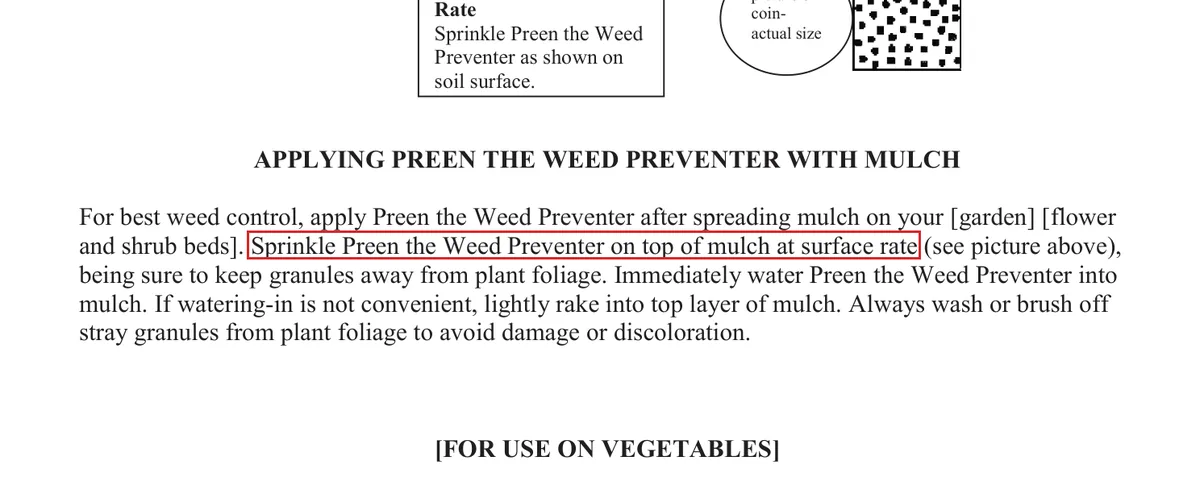
The trifluralin conflict is real but not a contradiction: the Preen label is the legal use direction for that product, and UC’s table reflects how well the chemistry reaches seed through a thick layer. Follow the label of the product in your hand. Killing weeds that are already up is a separate job, covered in our guide to killing weeds in flower beds.
Our label-by-label answer to Preen before or after mulch lines up 9 Preen and trifluralin labels and shows when the under-the-mulch order is still within the label.
Crabgrass starts germinating near a 55°F soil mean, so the mulch and any pre-emergent both need to be down before then; the dates that happened in 2026 by region are in our guide to when to mulch.
Pre-emergent herbicides are pesticides: the label is the law. Read it for the plants it allows, rate, re-entry and food-crop limits before you apply, and check whether your state requires a license for paid application.
How to keep weeds out of mulch, in order
- Clear perennials first. Dig nutsedge tubers and bermudagrass rhizomes or spot-treat them; Greenly and Rakow advised killing strong-stemmed and rhizome weeds before mulching, since 10 inches did not stop them.
- Flush the seed bank on a new bed. UC IPM: water after grading, let weeds emerge, remove them with cultivation less than 1 inch deep, and repeat 2 or 3 more times.
- Add a pre-emergent if you want one, placed under or over the mulch as its label directs.
- Spread 3 inches of coarse mulch or 2 inches of fine, settled, and keep it off stems and trunks; tree rings are covered in how to mulch around trees.
- Pull seedlings while small. Weeds rooted in mulch pull easily; Cornell suggests stirrup or diamond hoes and rules out flame weeding in mulch.
- Measure each spring at 5 spots. Top up thin areas to 3 inches, loosen matted layers, and plan on a refresh every 2 to 3 years (Cornell).
How we compiled this
We read 1 field trial and 1 container trial in full (Greenly and Rakow 1995; Saha and others 2019) and took 12 more trials from the summaries in the 2015 University of Florida review, the 2019 paper and UF/IFAS ENH1380. We added 5 extension documents (UC IPM, UC ANR, Cornell, Washington State, Texas A&M) and 4 label documents for 3 EPA-registered products, all checked November 9, 2026. Rows marked “via” use a review’s summary because the original paper is paywalled. We ran no field tests of our own.
Frequently asked questions
Does mulch prevent weeds in the fall?
Yes for winter annuals that sprout in fall and winter. Three inches of pine bark mini-nuggets controlled hairy bittercress for up to 150 days in container trials (Richardson and others 2008, via Saha 2019). It will not stop perennials already rooted in the bed.
Will mulch kill weeds that are already there?
Only small ones. Seedlings smothered under paper and mulch die and decompose, per Texas A&M AgriLife, but thistles and milkweed pushed through 10 inches in the Cornell plots. Pull or treat established weeds first.
Should I kill weeds before putting down mulch?
Yes. UC IPM says to apply mulch to weed-free areas, and Cornell says to clear weeds and cart them away first. Perennials such as bindweed and nutsedge left in place will come through any depth you can use around plants.
For a bed already full of it, our plan for getting rid of field bindweed pairs overlapped landscape fabric, which UC IPM says can take 3 to 5 years to kill the roots, with 2 percent glyphosate painted on the leaves.
What can I put on mulch to prevent weeds?
A pre-emergent labeled for use over mulch, such as Preen Garden Weed Preventer at 1 oz per 10 sq ft every 9 to 12 weeks, or oxadiazon, which UC IPM rates as working over mulch. It will not kill weeds already up.
What is the 3-3-3 rule for mulch?
A tree ring 3 feet out, 3 inches deep and 3 inches clear of the trunk. It is a tree rule, not a weed rule; our guide on how to mulch around trees covers it.
What are the disadvantages of mulching?
Layers over 4 inches can keep soil wet and raise root and stem rot (UC IPM), decomposed mulch becomes a seedbed, fine mulch can tie up pre-emergent herbicide, and organic mulch needs topping up every 2 to 3 years (Cornell).
Sources
- Greenly, K.M. and D.A. Rakow, Journal of Arboriculture 21(5): 225 to 232, The Effect of Wood Mulch Type and Depth on Weed and Tree Growth and Certain Soil Parameters, 1995. Accessed November 2026.
- Marble, S.C., A.K. Koeser and G. Hasing, HortScience 50(6): 851 to 856, A Review of Weed Control Practices in Landscape Planting Beds: Part I, Nonchemical Weed Control Methods, June 2015. Accessed November 2026.
- Saha, D. and others, HortTechnology 29(1): 65 to 77, Mulch Type and Depth, Herbicide Formulation, and Postapplication Irrigation Volume Influence on Control of Common Landscape Weed Species, Feb. 2019. Accessed November 2026.
- UC Statewide IPM Program, Pest Notes: Weed Management in Landscapes, Publication 7441, updated Sept. 2018. Accessed November 2026.
- Downer, J. and B. Faber, UC ANR, Mulches for Landscapes, Publication 8672, Sept. 2019. Accessed November 2026.
- Cornell University, Turfgrass and Landscape Weed ID, Mulch, 2022. Accessed November 2026.
- Chalker-Scott, L., Washington State University, The Myth of Landscape Fabric, undated. Accessed November 2026.
- Khamare, Y. and C. Marble, UF/IFAS, Using Mulch for Weed Control in Container Plant Production, ENH1380, 2024. Accessed November 2026.
- Texas A&M AgriLife Today, How to manage garden weeds with mulch, March 26, 2021. Accessed November 2026.
- Lebanon Seaboard Corp., Preen Garden Weed Preventer label, EPA Reg. No. 961-280, current label. Accessed November 2026.
- U.S. EPA Pesticide Product Label System, Preen the Weed Preventer, EPA Reg. No. 961-280 (accepted label), March 24, 2022. Accessed November 2026.
- U.S. EPA Pesticide Product Label System, Casoron 4G, EPA Reg. No. 400-168, Nov. 6, 2020. Accessed November 2026.
- U.S. EPA Pesticide Product Label System, Snapshot 2.5 TG, EPA Reg. No. 62719-175, Dec. 17, 2012. Accessed November 2026.