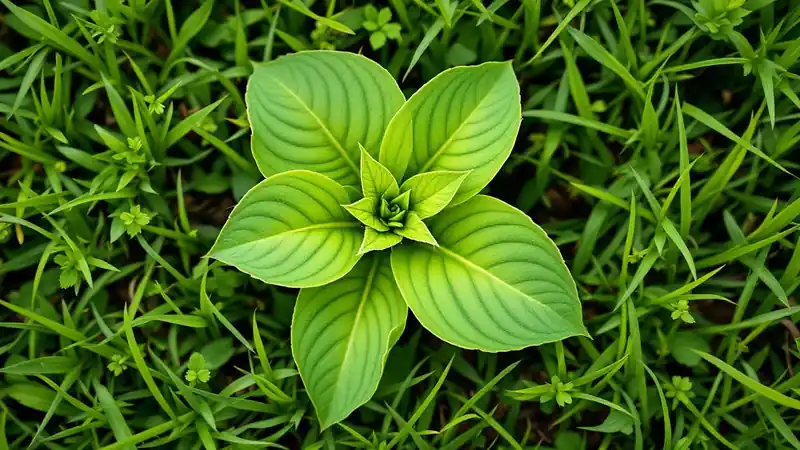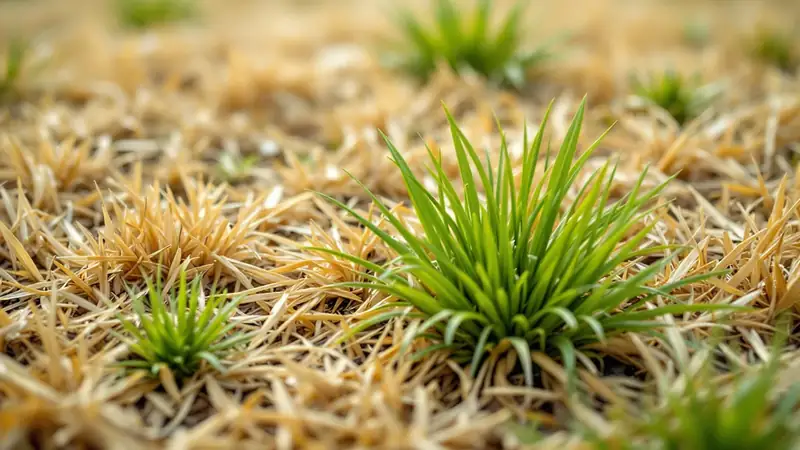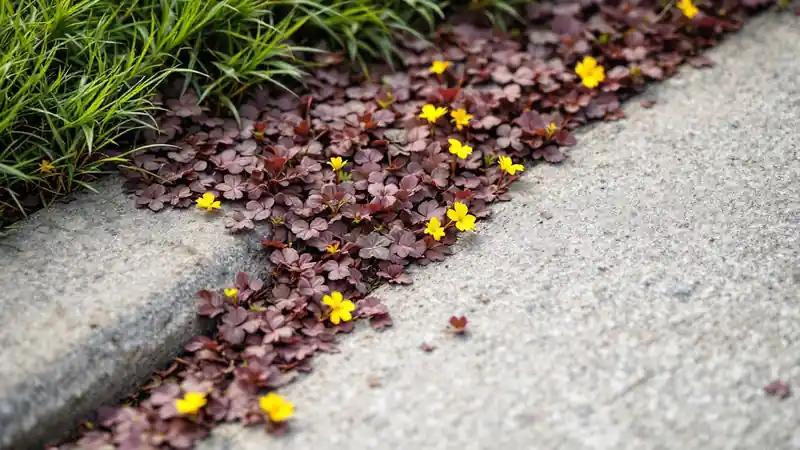
How to get rid of oxalis in lawn grass: spray triclopyr on fescue, bluegrass, ryegrass or zoysia, or fluroxypyr or a 3-way mix on bermuda, repeat in 3 to 6 weeks, then apply a dithiopyr or prodiamine preemergent in early fall.
How to get rid of oxalis in lawn turf: kill plants before their pods pop, then stop the seed already in the soil. In a University of California trial on bermudagrass, fluroxypyr rated 7.9 of 10 three weeks after a November spray, a homeowner 2,4-D mix 3.5; after a second spray, every product reached 9.4 or better.
The seed bank is why one spray rarely ends it: Cornell counts about 21,000 seeds on one undisturbed yellow woodsorrel plant, viable for at least 5 years. So the plan pairs label-matched sprays with a preemergent, and treats flower beds separately. For photos of oxalis beside its lookalikes, see our lawn weed identification guide.
This page summarizes EPA labels and university research; it is not a product endorsement. The label is the law: read the current label of the product you buy, and check whether your state requires a pesticide applicator license before anyone treats a lawn for pay.
Is it oxalis or clover?
Check the leaflet tips. Oxalis leaflets are heart-shaped, notched, fold down at night, and the flowers are yellow with 5 petals (Penn State, Feb. 13, 2026). Clover leaflets are rounded, with white ball-shaped flowers; our guide on getting rid of clover in a lawn covers that weed.
If the yellow flowers sit in tight balls and the middle leaflet is on its own short stalk, it is black medic, not oxalis, and our guide on how to get rid of black medic pairs the PNW herbicide ratings with the nitrogen rate that keeps it out.
| Plant | Leaves | Spreads by | Where it is a problem | Source |
|---|---|---|---|---|
| Yellow woodsorrel (Oxalis stricta) | Light green, 3 heart-shaped leaflets 1/4 to 1/2 in wide | Seed, rhizomes and taproot | Lawns, sidewalk edges, beds | Penn State; Cornell |
| Creeping woodsorrel (O. corniculata) | Green to purple, often reddish under drought; stems root at nodes | Seed and rooting stems | Lawns, beds, nursery pots | UC IPM 7444 |
| Bermuda buttercup (O. pes-caprae) | Larger, succulent, often purple-spotted; flowers 3/4 to 1 1/2 in on 6 to 12 in stalks | Bulbs, about a dozen per plant a year; no viable seed documented in California | Beds and groundcovers; mowing keeps it out of lawns | UC IPM 7444 |
| White clover (Trifolium repens) | Rounded leaflets, no notch | Stolons and seed | Lawns | Cornell |
Bermuda buttercup is the outlier: UC IPM says triclopyr, fluroxypyr and glyphosate kill its top growth but not its bulbs, so regrowth should be expected. Everything below targets the two seed-spreading woodsorrels that take over lawns.
How many seeds does oxalis make, and how far do they fly?
More than most guides suggest, and farther than one source says. The published figures spread 4-fold on throw distance and 37-fold on seeds per plant, because they measure two species under different conditions. Each row names whose number it is.
| Measure | Figure | Species and conditions | Source |
|---|---|---|---|
| Seeds per pod | 10 to 50 | Creeping woodsorrel | UC IPM 7444 |
| Seeds per pod | 23 average, 900 pods per plant | Yellow woodsorrel, spring seedlings left undisturbed | Cornell (Mohler, unpublished) |
| Seeds per plant | 570 to 5,000 | Yellow woodsorrel, earlier reports | Cornell (Stevens 1932; Halvorson and Guertin 2003) |
| Seeds per plant | About 21,000 | Yellow woodsorrel, little competition | Cornell |
| Throw distance | Several feet | Yellow woodsorrel in turf | Penn State |
| Throw distance | Up to 6.5 ft (2 m) | Yellow woodsorrel | Cornell |
| Throw distance | Up to 10 ft | Creeping woodsorrel | UC IPM 7444 |
| Throw distance | Up to 16 ft | Yellow woodsorrel, ornamental production | UF/IFAS ENH1253 (citing Halvorson and Guertin 2003) |
| Seed to flowering | About 4 weeks | Creeping woodsorrel seedlings | UC IPM 7444 |
| Germination temperature | 48 to 85°F, best 60 to 80°F; light required | Yellow woodsorrel | Cornell |
| Seed survival | 83% viable after 1 year; at least 5 years in undisturbed soil | Yellow woodsorrel | Cornell |
| Mowing tolerance | Sets seed when mowed as low as 1/4 in | Creeping woodsorrel | UC IPM 7444 |
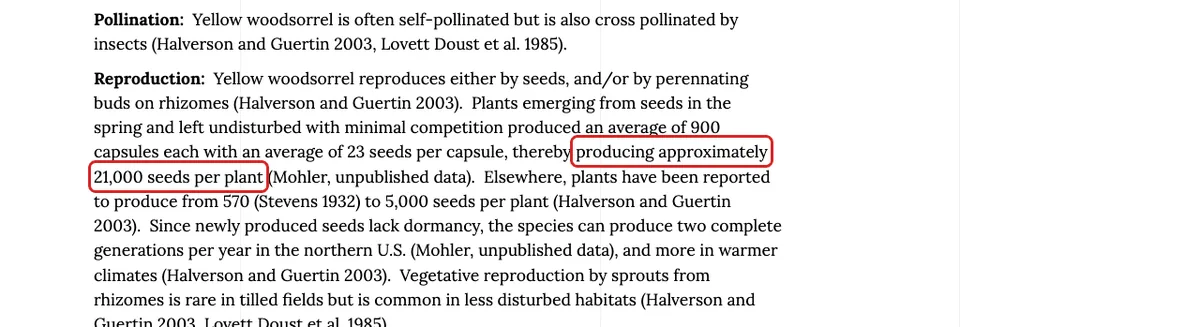
Three actions follow. Kill plants before pods form, since seedlings flower in about 4 weeks. Clean the mower after cutting infested turf, as UC IPM advises, because seed rides on clippings. And spread a preemergent over the whole lawn, because a 6.5 to 16 ft throw lands well past the visible patches.
What kills oxalis in a lawn? The trial ratings
Fluroxypyr worked fastest; 2,4-D mixes caught up after a second spray. UC Cooperative Extension advisors Michelle Le Strange and Pamela Geisel tested common bermudagrass with at least 70 percent oxalis cover, in a Fresno park (sprays Nov. 18, 2003 and Feb. 24, 2004) and at UC Kearney, Parlier (May 13, June 23 and Nov. 4, 2005).
| Product as tested | Active ingredients | Rate per 1,000 sq ft | Dec. 9, 2003 | Feb. 20, 2004 | Apr. 30, 2004 | June 9, 2005 | Nov. 5, 2005 |
|---|---|---|---|---|---|---|---|
| Untreated | None | None | 1.4 | 5.3 | 5.3 | 1.8 | 5.6 |
| Trimec, homeowner strength | 2,4-D 5.67% + MCPP 2.67% + dicamba 0.63% | 1.5 oz | 3.5 | 8.0 | 9.7 | 4.7 | 7.3 |
| Trimec 992, professional | 2,4-D 30.56% + MCPP 16.34% + dicamba 2.77% | 1.5 oz | 5.0 | 9.4 | 9.8 | 7.8 | 8.8 |
| Trimec Plus, homeowner* | 3-way + MSMA 9.81% | 1.5 oz | 3.1 | 8.8 | 9.9 | 6.3 | 7.4 |
| Trimec Plus, professional* | 3-way + MSMA 18.0% | 1.5 oz | 3.3 | 8.8 | 9.8 | 7.1 | 8.0 |
| Speedzone Southern | 2,4-D ester 10.49% + MCPP 2.66% + dicamba 0.67% + carfentrazone 0.54% | 1.5 oz | 6.1 | 8.3 | 9.4 | 5.5 | 8.1 |
| Spotlight | Fluroxypyr 26.2% | 0.5 oz | 7.9 | 9.3 | 9.9 | 8.8 | 9.1 |
Two readings matter. Speed: in December only fluroxypyr and Speedzone beat 6, which the authors put down to systemic herbicides working slowly in cool weather. Strength: in June the professional Trimec rated 7.8 and the homeowner bottle 4.7 at the same 1.5 oz rate. The MSMA mixes are history; EPA canceled MSMA on residential lawns in 2009.
The trial also tested preemergents, applied at label rates over the same plots. In the winter trial, Dimension (dithiopyr), Pendulum (pendimethalin) and Barricade (prodiamine) all rated 8.6 to 9.0 by Aug. 12 and kept seedlings out for more than 6 months after the second application. Summer separated them: by Nov. 5, Barricade rated 9.0, Dimension 7.5 and Pendulum 5.0, against 1.8 for untreated plots.
Clemson HGIC (reviewed Aug. 20, 2021) rates 3-way mixes and Celsius WG Good, meaning 80 to 90 percent control with a high rate or repeat, and triclopyr alone and atrazine Fair to Good. UC IPM says 2,4-D alone has limited effect and one triclopyr spray is often enough, while other products almost always need a second.
Which oxalis killer is labeled for your grass?
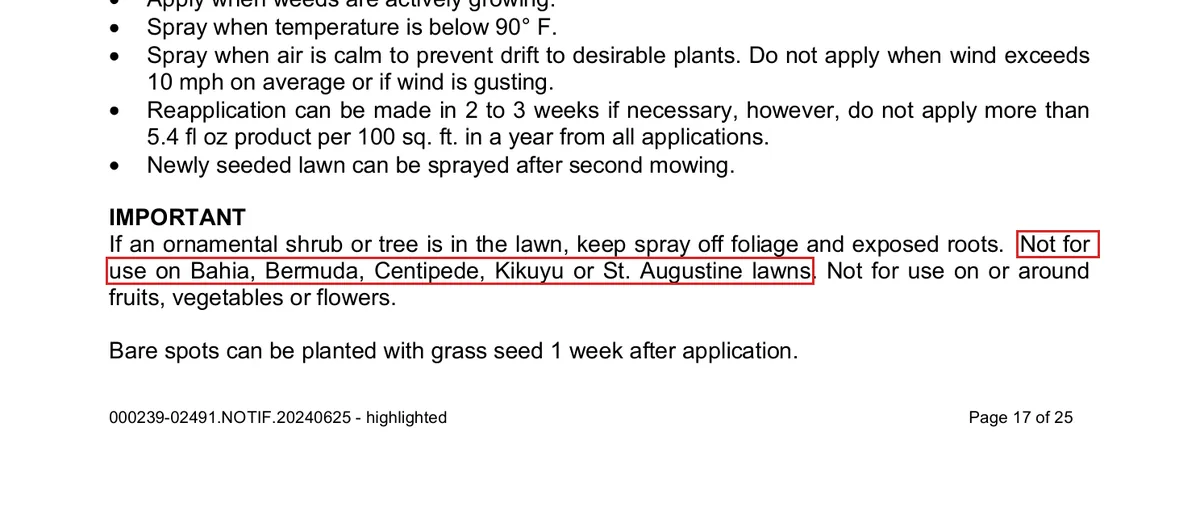
Grass type decides the product more than the weed does. Triclopyr is the cool-season answer, but the Ortho triclopyr label (EPA Reg. No. 239-2491) bars bahia, bermuda, centipede, kikuyu and St. Augustine. Warm-season lawns use fluroxypyr, a carfentrazone 4-way, Celsius or atrazine. We read each EPA label below to confirm it names oxalis or woodsorrel and to pull its rate and limits.
| Product (EPA Reg. No.) | Active ingredient | Pre or post | Lawn grasses on label | Oxalis rate per 1,000 sq ft | Limits | Rated control |
|---|---|---|---|---|---|---|
| Ortho Weed B Gon Chickweed, Clover & Oxalis Killer for Lawns Concentrate (239-2491) | Triclopyr TEA 8.0% | Post | Buffalo, fescues, Kentucky bluegrass, ryegrass, zoysia; not bahia, bermuda, centipede, kikuyu, St. Augustine | 5 fl oz (1 fl oz per gal per 200 sq ft) | Repeat in 2 to 3 weeks; max 5.4 fl oz per 100 sq ft a year; below 90°F | Clemson: Fair to Good (triclopyr) |
| Turflon Ester Ultra (62719-566) | Triclopyr ester | Post | Cool-season ornamental turf; label warns of injury to bahia, bentgrass, bermuda, centipede, St. Augustine | Spot max 1.5 fl oz | Professional concentrate | K-State: very effective (triclopyr) |
| Trimec Classic (2217-543) | 2,4-D 25.93% + MCPP-p 6.93% + dicamba 2.76% | Post | Cool-season, common bermuda, bahia, zoysia; hybrid bermuda; centipede and St. Augustine spot only, never Floratam, and no St. Augustine spray at spring green-up | 1.2 to 1.5 fl oz (0.75 to 1.5 on hybrid bermuda) | 2 broadcasts a year, 30 days apart | UC trial (pro 3-way): 7.8 to 9.8 |
| SpeedZone Southern EW (2217-1031) | 2,4-D + dichlorprop-p + dicamba + carfentrazone | Post | Bermuda, bahia, buffalo, centipede, seashore paspalum, zoysia, St. Augustine except Floratam and Bitterblue | 0.7 to 1.5 fl oz | Professional product | UC trial (Speedzone Southern): 5.5 to 9.4 |
| Celsius WG (432-1507) | Thiencarbazone + iodosulfuron + dicamba | Post | St. Augustine, bermuda, centipede, zoysia | 0.113 oz (3.2 g) | Licensed commercial applicators only; max 4.8 g per 1,000 sq ft a year | Clemson: Good; may need a second spray in 2 to 4 weeks |
| Drexel Auguzine (19713-567) | Atrazine | Pre and post | St. Augustine, centipede | 8.6 fl oz (4.3 fl oz per gal per 500 sq ft) | Read the label’s groundwater and turf-stage limits | Clemson: Fair to Good (atrazine) |
| Fiesta Lawn Weed Killer, iron HEDTA (67702-26) | Iron HEDTA 26.52% | Post | Lawns; the label lists no grass exclusions | 25.2 fl oz in 4.9 gal of spray | Controls or suppresses oxalis; oxalis claim not for use in California | No trial found |
| Barricade 4FL (100-1139) | Prodiamine | Pre | Established turf and listed ornamentals | Label rate table | Yellow woodsorrel from seed only | UC trial: 9.0 (summer, Nov. 5) |
| Dimension 2EW (62719-542) | Dithiopyr | Pre | Established turf and listed ornamentals | Label rate table | Lists creeping and yellow woodsorrel | UC trial (Dimension): 7.5 (summer, Nov. 5) |
Celsius WG is for licensed commercial applicators only, per its label, so on a home lawn it means hiring a service. Fluroxypyr, the UC trial leader, is also a professional ingredient: UC IPM lists Spotlight as unavailable to home gardeners, and Kansas State names Escalade 2, Momentum FX2 and Vista XRT. Grass-specific cautions are in our St. Augustine lawn guide and centipede lawn guide.
1Is the oxalis in a flower bed, groundcover or pot?
YesNo selective spray exists there (UC IPM). Pull moist plants before pods form, apply a labeled preemergent, cover with 2 to 3 in of mulch, spot-spray escapes with glyphosate off ornamental leaves.
NoGo to the next question
2Is the lawn fescue, Kentucky bluegrass, ryegrass, buffalograss or zoysia?
YesTriclopyr: Ortho 239-2491 at 1 fl oz per gal per 200 sq ft, repeat in 2 to 3 weeks if needed, below 90 F; then a fall preemergent.
NoGo to the next question
3Is the lawn bermuda?
YesNo triclopyr-only product. Use a 3-way such as Trimec Classic (up to 1.5 fl oz per 1,000 sq ft) or SpeedZone Southern EW, twice 30 days apart; a lawn service can use fluroxypyr or Celsius WG (licensed applicators only).
NoGo to the next question
4Is the lawn St. Augustine or centipede?
YesAtrazine (Auguzine at 4.3 fl oz per gal per 500 sq ft) or SpeedZone Southern EW (not on Floratam or Bitterblue St. Augustine); 3-way mixes only as spot sprays and never at spring green-up; Celsius WG through a licensed applicator.
NoBahia, kikuyu or unsure of the grass: identify it first, then pick a label that names both oxalis and that grass.
Source: EPA labels 239-2491, 2217-543, 2217-1031, 432-1507, 19713-567; UC IPM Pest Notes 7444
The calculator turns a label rate into concentrate for your area: 1,000 sq ft takes 5 fl oz (147.9 mL) of the Ortho triclopyr product, but 25.2 fl oz of Fiesta.
- Concentrate per spray (mL)
- 147.9
- Concentrate per spray (teaspoons)
- 30.0
- Concentrate per spray (fl oz)
- 5.00
Default: 1,000 sq ft at the Ortho triclopyr rate takes 147.9 mL (5 fl oz). Worked example: 2,500 sq ft at the Trimec Classic maximum takes 110.9 mL (3.75 fl oz). Rates from the EPA labels on this page, read Nov. 21, 2026. Celsius WG is weighed in grams (3.2 g per 1,000 sq ft) and is for licensed applicators only.
When should you spray oxalis and apply a preemergent?
Spray while oxalis is growing and the air is below 90°F, then put a preemergent down before the next flush of seed. Clemson says most woodsorrel seed germinates in late winter and early spring, though some sprouts year-round; UC IPM names early fall as the main germination window in California. The steps below follow the labels and those two sources.
- Water the lawn the day before if it is dry. Clemson says this cuts drought stress and helps uptake; the Ortho label says to water thoroughly before spraying a dry lawn.
- Skip mowing for 1 to 2 days before and after, and spray when no rain is due for 6 hours (Ortho label). Our page on spraying weeds before or after rain lists rainfast times for other labels.
- Spray to just wet the leaves, below 90°F and with wind under 10 mph. Treat the whole infested area, not single plants, if seedlings are scattered.
- Check in 2 to 3 weeks. Reapply then if the Ortho label allows it on your grass, or at 3 to 6 weeks for other products (UC IPM); Trimec Classic needs 30 days between broadcasts.
- Apply a preemergent once the lawn is clean: dithiopyr, isoxaben, pendimethalin or prodiamine, per UC IPM. For a heavy infestation it suggests up to 3 applications a year, in early fall, midwinter and late spring. Preemergents do nothing to plants already growing from rhizomes (Penn State).
- Wash or air-blow the mower deck after cutting infested turf before moving to clean turf (UC IPM).
On turf density, sources disagree. Penn State and Clemson say a dense lawn leaves oxalis less room; UC IPM says feeding, mowing and watering fail against creeping woodsorrel, which thrives as the turf does and seeds at a 1/4 in cut. Our reading: thick turf slows seedlings but will not clear an established mat.
How do you get rid of oxalis in flower beds?
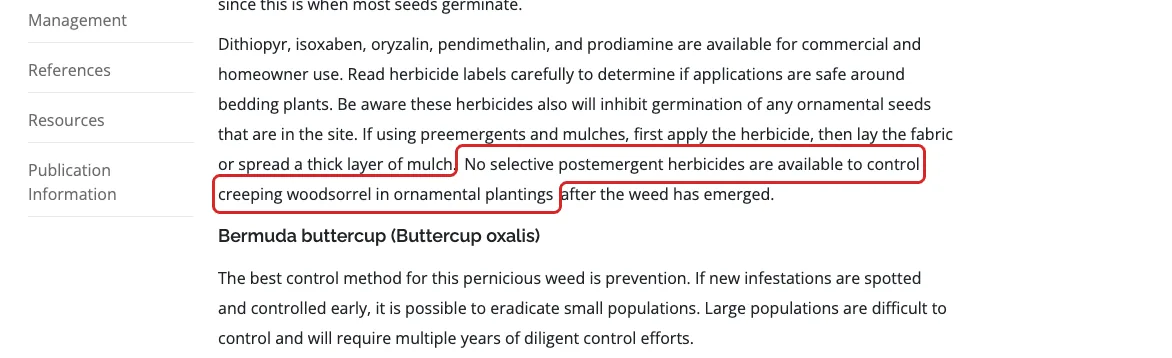
By hand, by mulch and by preemergent, because no selective spray exists. UC IPM states that no selective postemergent herbicide controls creeping woodsorrel in ornamental plantings after it emerges, so lawn products such as triclopyr are off the table near flowers and shrubs. Infested nursery pots are a common source (UC IPM), and our flower bed weed control guide covers the other bed weeds.
- Pull plants when the soil is moist and before pods form. UF/IFAS says hand weeding works best on plants 6 weeks old or younger; get the taproot and stem pieces, because fragments regrow, and bag them rather than composting seed (Clemson).
- Apply a preemergent labeled for your ornamentals: dithiopyr, isoxaben, oryzalin, pendimethalin or prodiamine. UC IPM says two applications about 8 weeks apart in early fall may be needed to catch all the seedlings.
- Cover with 2 to 3 inches of organic mulch over the preemergent (UC IPM). Seeds need light, so any gap lets them sprout; our guide on whether mulch prevents weeds has the depth trials, and Preen before or after mulch covers the order for that product.
- Spot-spray escapes with glyphosate, which Clemson names the best choice for beds, keeping it off ornamental leaves. Roundup Weed & Grass Killer Super Concentrate (EPA Reg. No. 71995-25) lists oxalis.
- For a bed you can clear and replant, solarize under clear plastic for at least 4 consecutive weeks in June, July or August (UC IPM).
Can you get rid of oxalis naturally?
Partly. Pulling works on plants 6 weeks old or younger (UF/IFAS) and mulch stops bed seedlings, but neither reaches seed in a lawn. Iron HEDTA (Fiesta) lists oxalis on its label at 25.2 fl oz per 1,000 sq ft, though not in California. Vinegar burns leaves only, as our vinegar weed killer review explains.
How we compiled this
On Nov. 21, 2026 we read 10 EPA label PDFs, the 2003 to 2005 UC Cooperative Extension bermudagrass trial report and 6 extension publications (UC IPM 7444, Cornell, Penn State, Clemson HGIC 2329, UF/IFAS ENH1253, Kansas State). Ratings are the researchers’; we ran no trials. EPA’s product search was down that day, so we checked registrations on the label PDFs.
Frequently asked questions
What kills oxalis but not grass?
A selective herbicide whose label lists oxalis and your grass: triclopyr (Ortho 239-2491) on fescue, bluegrass, ryegrass, buffalo or zoysia; a 2,4-D, MCPP and dicamba mix or SpeedZone Southern on bermuda; atrazine on St. Augustine or centipede. In the UC trial, fluroxypyr rated 8.8 to 9.9 of 10 on bermuda.
Can you kill oxalis with Roundup?
Yes, but glyphosate kills lawn grass too, so use it only as a spot spray in beds or before reseeding. Roundup Weed & Grass Killer Super Concentrate (EPA Reg. No. 71995-25) lists oxalis. Our page on whether Roundup kills grass covers the replant waits.
Does oxalis come back every year?
Yes. Both lawn woodsorrels are perennial; yellow woodsorrel dies back after a hard frost and regrows from rhizomes, and Cornell reports seed survives at least 5 years in undisturbed soil, so new seedlings appear even after the old plants die.
How do you get rid of oxalis permanently?
Kill existing plants with 2 label-matched sprays 3 to 6 weeks apart, then keep a preemergent down. UC IPM suggests up to 3 preemergent applications a year for heavy infestations; in UC’s bermuda trial, preemergents kept seedlings out for over 6 months after the second application.
Is oxalis poisonous to pets or children?
Mildly. Clemson says all parts contain soluble oxalate but are only mildly toxic, and UC IPM notes livestock can suffer oxalate poisoning after eating large amounts. Keep people and pets off sprayed turf until the spray has dried, as the Ortho label directs.
Sources
- UC Statewide IPM Program (LeStrange, Cudney, Elmore), Pest Notes: Creeping Woodsorrel and Bermuda Buttercup, UC ANR Publication 7444, Current page, 2026. Accessed November 2026.
- Le Strange and Geisel, UC Cooperative Extension, Application Timing Affects Herbicide Options for Oxalis Control in Bermudagrass Turf, Trials 2003 to 2005. Accessed November 2026.
- Cornell University Weed Science, Weed profile: Yellow woodsorrel, Current page. Accessed November 2026.
- Penn State Extension (Abbey, Landschoot, Delvalle), Lawn and Turfgrass Weeds: Yellow Woodsorrel, Oxalis stricta L., Updated Feb. 13, 2026. Accessed November 2026.
- Clemson Cooperative Extension HGIC, Oxalis Control, HGIC 2329, Reviewed Aug. 20, 2021. Accessed November 2026.
- UF/IFAS Extension (Lollar and Marble), Biology and Management of Oxalis (Oxalis stricta) in Ornamental Crop Production, ENH1253, Revised Feb. 2022, reviewed Feb. 2025. Accessed November 2026.
- Kansas State University (Hoyle), Yellow Woodsorrel (Oxalis stricta) Control, Sept. 11, 2018. Accessed November 2026.
- U.S. EPA, Monosodium Methanearsonate (MSMA), an Organic Arsenical, Current page. Accessed November 2026.
- U.S. EPA PPLS, Ortho Weed B Gon Chickweed, Clover & Oxalis Killer master label, EPA Reg. No. 239-2491, Aug. 6, 2024. Accessed November 2026.
- U.S. EPA PPLS, Turflon Ester Ultra label, EPA Reg. No. 62719-566, Mar. 21, 2019. Accessed November 2026.
- U.S. EPA PPLS, Trimec Herbicide (Trimec Classic) label, EPA Reg. No. 2217-543, Apr. 2, 2014. Accessed November 2026.
- U.S. EPA PPLS, EH-1620 Herbicide (SpeedZone Southern EW) label, EPA Reg. No. 2217-1031, Aug. 9, 2024. Accessed November 2026.
- U.S. EPA PPLS, Celsius WG label, EPA Reg. No. 432-1507, Sept. 1, 2021. Accessed November 2026.
- U.S. EPA PPLS, Drexel Auguzine label, EPA Reg. No. 19713-567, Nov. 10, 2021. Accessed November 2026.
- U.S. EPA PPLS, NEU1173H Concentrate (Fiesta) label, EPA Reg. No. 67702-26, Apr. 10, 2025. Accessed November 2026.
- U.S. EPA PPLS, Barricade 4FL label, EPA Reg. No. 100-1139, Feb. 21, 2024. Accessed November 2026.
- U.S. EPA PPLS, Dimension 2EW label, EPA Reg. No. 62719-542, July 2, 2021. Accessed November 2026.
- U.S. EPA PPLS, Roundup Weed & Grass Killer Super Concentrate label, EPA Reg. No. 71995-25, Jan. 28, 2021. Accessed November 2026.