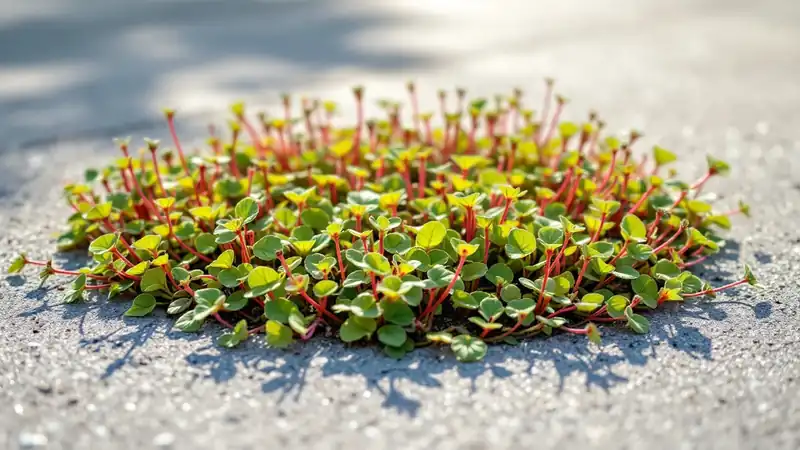
How to get rid of purslane: pull it from moist soil before it flowers, bag every piece, spray lawn mats with a broadleaf mix that contains dicamba, and keep a preventer that lists purslane active into midsummer.
How to get rid of purslane is mostly a timing problem. Common purslane (Portulaca oleracea) is a succulent summer annual: one plant may produce 240,000 seeds that can sprout after 5 to 40 years (UC IPM Pest Note 7461), and Cornell’s weed profile says plants flower 4 to 8 weeks after they emerge and set seed 7 to 16 days later, or within 2 to 3 weeks for midsummer sprouts (Cornell Weed Science). Our guide to where weeds come from explains how that seed bank builds up.
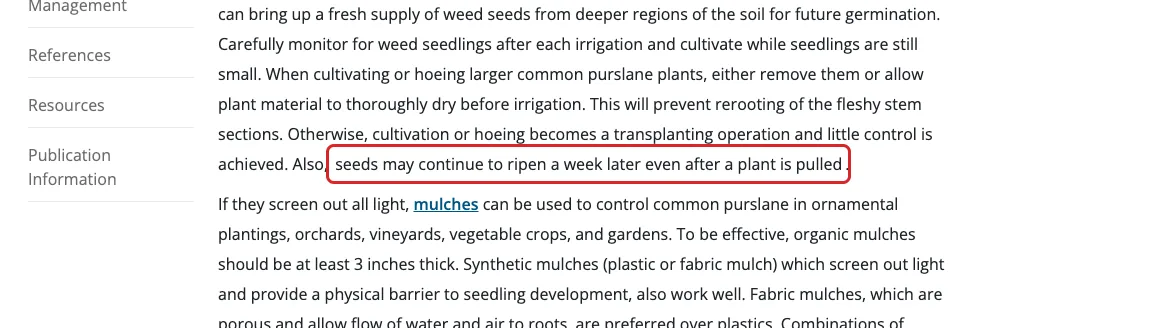
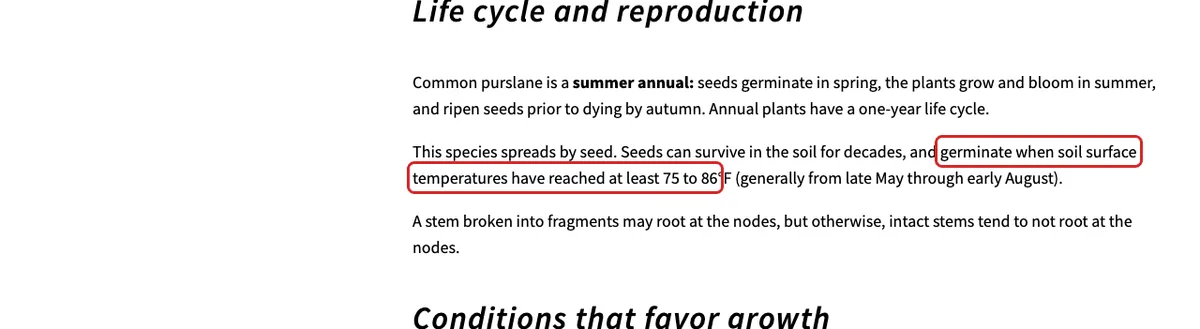
Two things the top-ranking pages leave out decide whether the plan works. First, purslane sprouts late: Maryland Extension puts germination at a soil surface of 75 to 86°F, late May through early August (UMD), against 55 to 58°F for crabgrass (Penn State), so a preventer timed for crabgrass in March or April can be running thin by the time most purslane sprouts. Second, pulling is not the end: a pulled plant keeps ripening seed for about a week and hoed stems re-root after watering (UC IPM). We lined up 7 extension timing figures and read 14 EPA labels to show which products list purslane and for how long.
This page summarizes extension research and EPA labels; it is not a product endorsement or legal advice. The label is the law: follow the current label of the product you buy, and check whether your state requires a pesticide applicator license before anyone treats a yard for pay.
Is it purslane, spurge or knotweed?
Break a stem. Purslane has no milky sap; every spurge bleeds white, milky sap, and prostrate knotweed has a papery sheath (ocrea) wrapped around the stem above each leaf (Cornell; Penn State, 2025). Purslane leaves are thick, smooth and paddle-shaped, up to 1.5 inches long (Penn State turf); spurge leaves are thin and under 1 inch. If the sap is milky, use our spurge control plan instead, since the preventer labels differ, and see the lawn weed identification chart for other summer mats.
| Plant | Stem and sap | Leaves | Flowers | Notes | Source |
|---|---|---|---|---|---|
| Common purslane (Portulaca oleracea) | Thick, smooth, reddish; clear juice | Fleshy, paddle-shaped, 1/2 to 2 in, glossy | Yellow, 5 petals, 1/4 to 3/8 in; open only in sun | Edible (oxalates; see below); toxic to pets | UC IPM; UMD |
| Spotted or prostrate spurge (Euphorbia spp.) | Thin, pink to red; milky white sap | Thin, oval, under 1 in, often a maroon spot | Tiny, inconspicuous | Do not eat; see the spurge page | Penn State; Cornell |
| Prostrate knotweed (Polygonum aviculare) | Wiry, jointed; papery sheath at each leaf | Thin, blue-green, not fleshy | Tiny, white to pink | Not a food plant | Cornell; Penn State |
| Prostrate pigweed (Amaranthus blitoides) | Reddish, not succulent | Not fleshy | Green clusters | Leaves not fleshy, so a squeeze tells them apart | Cornell |
| Horse purslane (Trianthema portulacastrum) | Succulent | Fleshy, on stalks | Pinkish purple | Fleshy lookalike; check for leaf stalks | Cornell |
| Moss rose (Portulaca grandiflora) | Succulent | Fleshy and narrow | Showy: red, orange, pink, yellow or white | Garden annual; ASPCA lists it toxic to dogs and cats | NC State; ASPCA |
1Does a broken stem ooze milky white sap?
YesIt is a spurge, not purslane. Use the spurge plan; the preventer labels differ.
NoGo to the next question
2Is there a papery sheath around the stem above each leaf, and are the leaves thin?
YesIt is prostrate knotweed, a compacted-soil weed. Dicamba is the key active; aerate the spot.
NoGo to the next question
3Are there yellow flowers or bud-like pods in the leaf clusters?
YesPull it today and bag it. Pulled plants ripen seed for about a week (UC IPM) and a spray may not act before the pods ripen (Colorado State).
NoGo to the next question
4Is it in a vegetable bed?
YesHoe seedlings 1 to 2 inches deep every 7 to 10 days and mulch with straw or plastic between rows; no preemergent (UC IPM).
NoGo to the next question
5Is it in the lawn?
YesSpray young mats with a lawn product that lists purslane and contains dicamba, below 90°F; overseed thin spots in early fall (Penn State).
NoBeds, gravel and cracks: pull after rain and bag, then 3 inches of mulch or a bed preventer that lists purslane (Preen 961-280 every 9 to 12 weeks, 961-421 every 6 months); spot-spray glyphosate in paving cracks.
Why does pulled purslane come back?
Because a pulled plant is not a dead plant. UC IPM says the fleshy stems stay moist and viable for several days after hoeing and re-root when the bed is watered, so hoeing large plants becomes “a transplanting operation” (UC IPM). Cornell adds that a stem piece needs a node with leaves to regrow, takes several weeks to do it, and comes back weaker, but an uprooted plant can also finish its seed without touching soil (Cornell).
| Stage | Published timing | Source |
|---|---|---|
| Sprout to first flower | 4 to 8 weeks; 2 to 3 weeks for midsummer sprouts | Cornell |
| Sprout to first flower | As soon as 1 month, at about a dozen leaves | UMD |
| Sprout to viable seed | As early as 3 weeks | WVU Extension |
| Flower to ripe seed | 7 to 16 days (Cornell); as soon as 1 week (UMD); within 3 weeks (USU) | Cornell; UMD; USU |
| Pulled plant left on soil | Seed keeps ripening about 1 week | UC IPM |
| Hoed stem pieces | Viable several days; re-root after irrigation | UC IPM |
| Seed in the soil | Can sprout after 5 to 40 years; 60% a year decline in one untilled Mississippi soil, 76 to 87% tilled | UC IPM; Cornell |
| First freeze | Kills the plant; chilling can kill it earlier | Cornell |
UC IPM calls hand control the usual method in home landscapes. The clock sets the routine:
- Weed every 7 to 10 days from late May. A Maryland seedling can bloom a month after it sprouts and ripen seed a week later (UMD).
- Pull after rain or watering, gripping the center so the taproot comes out; Colorado State says a hoed plant can regrow from a taproot left in the soil.
- Bag every plant that has flowers or pods and put it in the trash, not a passive compost pile (UMD); Colorado State says to bag even plants pulled before bloom if they would sit on moist soil.
- Hoe seedlings no deeper than 1 to 2 inches: Cornell’s profile says 2 to 4 shallow passes after the soil warms remove most of a season’s seedlings, while deeper hoeing lifts buried seed to the surface, where it germinates (UC IPM).
- In August, flip a mature mat before you lift it: UC IPM says thousands of seeds can sit on the soil under it, so scrape that layer into the bag too.
When does purslane germinate, and when should a preventer go down?
Later and over a longer window than crabgrass, and the sources disagree on the starting point. California and Utah put it at about 60°F soil; Maryland and West Virginia start at 75 to 77°F; Cornell says freshly shed seed wants more than 86°F at first, falling to 68°F as spring goes on (Cornell). Seed also needs to sit at the surface: Cornell reports no emergence from deeper than 1 inch.
| Source | Where | Published germination temperature or season | Link |
|---|---|---|---|
| UC IPM Pest Note 7461 | California | Soil about 60°F; February to March in the southern desert, late spring in cooler areas | UC IPM |
| Utah State (USU) | Utah | Soil 60°F, late spring; flushes after irrigation | USU |
| Cornell Weed Science | New York | Best above 86°F at first, then 68°F as spring progresses; emergence starts when daily highs pass 86°F | Cornell |
| Maryland Extension | Maryland | Soil surface at least 75 to 86°F; late May through early August | UMD |
| WVU Extension (Chandran) | West Virginia | Soil above 77°F (25°C); optimum 86°F (30°C) | WVU |
| Penn State (Abbey, 2025) | Pennsylvania | Germinates May through August | Penn State |
| Colorado State PlantTalk 2110 | Colorado | After soil warms in early summer; preemergents “not very effective” for that reason | CSU |
| Crabgrass, for comparison | Pennsylvania | 55 to 58°F in the top inch at daybreak for 4 to 5 days | Penn State |
The practical reading: a crabgrass preventer put down in late March or April with a 2 to 4 month label claim can lapse inside Maryland’s late-May to early-August purslane window. Greenview’s dithiopyr granule (961-392), for example, claims 2 to 3 months at 2.2 lb per 1,000 sq ft in the North and up to 4 months at 3.1 lb. Penn State lists dithiopyr, pendimethalin, prodiamine and isoxaben as preemergents that control purslane from seed (Penn State); our crabgrass preventer timing guide covers the first application.
- Put the spring preventer down on the crabgrass date, before soil at 1 inch holds 55°F, using a product whose label lists purslane.
- If last year’s purslane came in July, plan a second application inside the label’s limits: Pendulum CS allows a repeat after 5 to 8 weeks, Surflan AS splits 8 to 10 weeks apart on tall fescue, and Preen 961-280 reapplies every 9 to 12 weeks.
- Water it in. UC IPM says preemergents must be at the soil surface during emergence and activated by irrigation; mixing them 2 to 3 inches into the soil has failed on purslane (UC IPM).
- Do not rake or dig the bed afterward; any disturbance breaks the treated layer and brings fresh seed up.
What kills purslane in a lawn without killing the grass?
A broadleaf mix with dicamba, sprayed while the mats are small. The Pacific Northwest handbook rates common purslane susceptible to dicamba and to mixtures, intermediate to 2,4-D or MCPA alone, and resistant to MCPP (PNW Weed Management Handbook). Rutgers FS385 (April 2025) says both that 2,4-D alone “generally” gives excellent purslane control and, in its active-ingredient section, that 2,4-D does not control purslane well (Rutgers); the mix sidesteps that disagreement.
| Herbicide | Common purslane rating |
|---|---|
| 2,4-D alone | I (intermediate) |
| Dicamba alone | S (susceptible) |
| MCPP alone | R (resistant) |
| MCPA alone | I |
| Mixtures with triclopyr | S |
| Mixtures without triclopyr | S |
Spray seedlings, not August mats. UC IPM says postemergence sprays work on the seedling stage and control of mature plants “is often erratic” (UC IPM), and Colorado State warns that seed can ripen in the days a spray takes to kill a flowering plant (CSU). Purslane’s leaves carry a waxy outer layer (Cornell); the Tenacity label (100-1267) calls for a nonionic surfactant with every postemergence spray and a repeat in 2 to 3 weeks. For grass-safety limits on 2,4-D products, see whether 2,4-D kills grass.
Then close the gap the weed used. UC IPM says purslane is rarely a problem in healthy established turf, and Penn State’s turf team says new lawns seeded in late summer or fall see less of it than spring seedings (Penn State). For a spring seeding, mesotrione (Tenacity) is the one listed product that can go down at seeding (not on fine fescue, per its label); otherwise overseed thin spots in early fall. If a spring seeding failed under weeds, our page on why grass seed is not growing covers the other causes.
Which products list purslane on the label?
All 14 labels below name common purslane; that is the test, not the brand. Five are professional formulations (Barricade, Pendulum, Tenacity, Surflan, Gallery). None of the 14 is a restricted-use product in EPA’s label database, but local law can still bar them: Maryland Extension notes Montgomery County bars most synthetic lawn pesticides and Baltimore City bars glyphosate on lawns (UMD).
Swipe the table sideways to see every column.
| Where | Product (EPA Reg. No.) | Active ingredient | Purslane on label | Key limits | Label date |
|---|---|---|---|---|---|
| Lawn, preventer | Greenview Green Power Crabgrass Prevention and Control (961-392) | Dithiopyr 0.13% | “Common Purslane” | 2.2 to 3.1 lb per 1,000 sq ft North, 3.4 to 4.5 South; up to 4 months | Dec. 10, 2025 |
| Lawn, preventer (pro) | Pendulum CS (241-416) | Pendimethalin 38.7% | “purslane” in each turf table | 1.1 to 1.6 fl oz per 1,000 sq ft; repeat 0.86 to 1.1 fl oz after 5 to 8 weeks | July 2, 2020 |
| Lawn and beds, preventer (pro) | Barricade 4FL (100-1139) | Prodiamine 40.7% | “Purslane, Common” | Must go down before weeds germinate; beds 0.5 to 1.1 fl oz per 1,000 sq ft | Feb. 21, 2024 |
| Lawn, pre and post (pro) | Tenacity (100-1267) | Mesotrione 40% | Yes, pre and post | Post 4 to 8 fl oz per acre with nonionic surfactant, repeat in 2 to 3 weeks; injures bermuda, zoysia, bentgrass | Sept. 28, 2022 |
| Lawn, granular post | Scotts Turf Builder Weed and Feed (538-333) | 2,4-D 1.22% + dicamba 0.081% | “Purslane” | Apply to wet grass; days 60 to 90°F; twice a year at most; no rain for 24 hours | Sept. 17, 2026 |
| Lawn, spray | Ortho Weed B Gon Weed Killer for Lawns Concentrate (239-2744) | 2,4-D + MCPP-p + dicamba | “Purslane” | Up to 4 fl oz per 1,000 sq ft; not above 90°F; 2 a year, 30 days apart; not in vegetable gardens | Aug. 23, 2023 |
| Lawn, spray | Ortho WeedClear Lawn Weed Killer Concentrate (2217-896) | 2,4-D + quinclorac + dicamba | “Purslane, common” | 2 broadcast sprays a year, 21 days apart; below 90°F, 85°F on bermuda | Jan. 21, 2026 |
| Lawn, spray | Spectracide Weed Stop for Lawns Concentrate 2 (9688-342) | 2,4-D + MCPP-p + dicamba + sulfentrazone | “Common Purslane” | 2 a year, at least 2 weeks apart; not on Floratam or Bitterblue St. Augustine | June 29, 2021 |
| Beds, preventer | Preen Garden Weed Preventer (961-280) | Trifluralin 1.47% | “Purslane” | 1 oz per 10 sq ft, watered in; reapply every 9 to 12 weeks | June 16, 2026 |
| Beds and gravel, preventer | Preen Extended Control, Preen Weed Preventer with Snapshot (961-421) | Trifluralin 1.5% + isoxaben 0.375% | “purslane, common” | 0.98 oz per 10 sq ft; every 6 months, never sooner than 60 days | Sept. 20, 2022 |
| Lawn and landscape, preventer | Roundup Landscape Weed Preventer (71995-63) | Pendimethalin 1.71% | “Purslane” | 2.01 lb per 1,000 sq ft on lawns | Apr. 5, 2024 |
| Beds, preventer (pro) | Surflan AS (70506-44) | Oryzalin 40.4% | “purslane, common” (controlled) | 2 qt per acre; on tall fescue 1.5 qt, then 1.5 qt 8 to 10 weeks later | Nov. 6, 2025 |
| Beds and turf, preventer (pro) | Gallery SC (62719-658) | Isoxaben 45.45% | “purslane, common” | Controlled at the lowest tier, 16 fl oz per acre (0.3 fl oz per 1,000 sq ft) | May 8, 2017 |
| Cracks and bed edges, spot spray | Roundup Weed and Grass Killer Super Concentrate (71995-25) | Glyphosate 50.2% | “Common Purslane” | Kills grass and bed plants it touches; hose-end 2.5 fl oz rate for hard-to-kill annuals including purslane | Jan. 28, 2021 |
How do you get rid of purslane in beds, vegetable gardens and paver cracks?
Starve it of light. UC IPM says organic mulch at least 3 inches deep, or landscape fabric with mulch on top, controls purslane in ornamental plantings and may remove the need for herbicide; Utah State gives the same 3 inches (USU). Cornell says purslane needs less mulch than most annual weeds because it is prostrate and rots under shade. Our page on how deep mulch should be sizes the layer by material.
Vegetable gardens get no preventer. UC IPM says preemergents are almost never used there because of the range of crops and residues that last for months; the plan is shallow hoeing after each watering, straw over newspaper or 6-mil black plastic between rows (WVU), and pulling before the first pod. The Ortho lawn label (239-2744) bars use in gardens with vegetables, fruit trees, vines and berries.
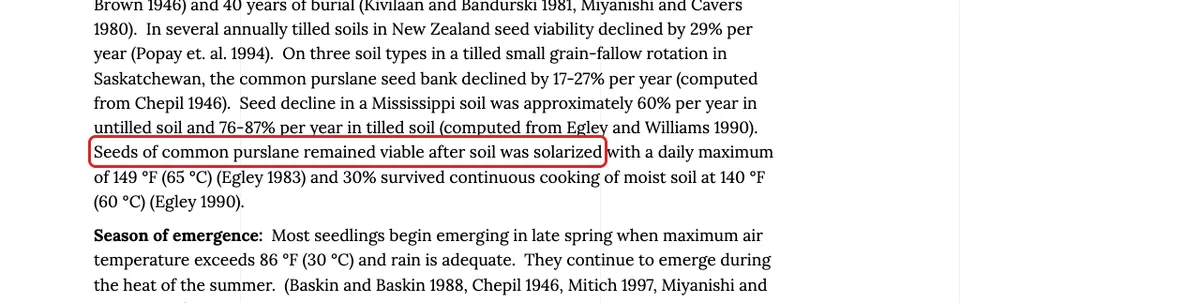
Solarizing is the one point where the sources conflict. UC IPM says 4 to 6 weeks of clear plastic over moist soil in July and August can kill purslane and its seed; Cornell cites trials where purslane seed stayed viable after solarized soil peaked at 149°F, and 30 percent survived constant 140°F (Cornell). Treat solarization as a way to clear the plants and part of the seed bank, then mulch.
For paver joints and driveway cracks, pull after rain and bag; where roots hold, spot-spray glyphosate and keep it off the leaves of plants you want (UC IPM). The Roundup Super Concentrate label (71995-25) lists common purslane among the annuals that may need its higher 2.5 fl oz hose-end rate. Our page on killing weeds between pavers covers joint sand and polymeric fill.
Can you eat the purslane you pull?
Yes, if you know it is purslane and nothing was sprayed on it. UC IPM, Wisconsin Extension and NC State all describe it as edible raw or cooked, and Wisconsin notes it is high in omega-3 fatty acids (UW-Madison). It is also high in oxalates: a 2014 review reports 671 to 869 mg per 100 g of fresh leaves (Uddin et al., Scientific World Journal), and Wisconsin says people prone to kidney stones should not eat it in quantity.
Skip any purslane from a treated lawn, bed or crack. The lawn labels above list vegetable gardens as a place not to apply them, so none gives a waiting period after which treated weeds are safe to eat, and UC IPM notes preemergent residues last for months after application. Check the sap too: the spurges that grow alongside it bleed milky sap and are not edible. For pets, the ASPCA lists purslane as toxic to dogs, cats and horses from soluble calcium oxalates.
Purslane dies at the first freeze (Cornell notes chilling can kill it even earlier), so skip fall sprays and spend October on seed and mulch.
How we compiled this
On Nov. 26, 2026 we read 14 herbicide labels from EPA’s Pesticide Product Label System, the PNW handbook susceptibility table, Rutgers FS385, and purslane pages from UC IPM, Maryland, Cornell, Penn State, Colorado State, Utah State, West Virginia, UW-Madison and NC State, plus the ASPCA plant list and a 2014 nutrition review. We did not run trials or test products; the chart plots the temperatures those sources publish, using the low end of each range.
Frequently asked questions
Why do I have so much purslane in my yard?
Bare, warm, fertile soil and a seed bank. Maryland Extension ties it to newly seeded turf, vegetable gardens and paver cracks; Cornell says it responds most to phosphorus and flushes after digging. One plant can drop up to 240,000 seeds (UC IPM).
What kills purslane naturally?
Pulling and bagging before flowers, shallow hoeing every 7 to 10 days, and 3 inches of mulch (UC IPM, USU). Household vinegar killed weeds only in their first 2 weeks in USDA trials, so it is a seedling tool; see what vinegar weed killer kills.
Will purslane come back next year?
From seed, yes: frost kills the plant, but seed can sprout after 5 to 40 years (UC IPM). Cornell cites seed banks falling 17 to 87 percent a year depending on soil and tillage, so 2 or 3 seasons with no new seed shrink the problem fast.
What is mistaken for purslane?
Spotted and prostrate spurge (milky sap, thin leaves), prostrate knotweed (papery sheath at each leaf), horse purslane (stalked leaves, pink flowers) and moss rose, its ornamental cousin (Cornell, Penn State).
Will Roundup kill purslane?
Glyphosate Roundup products such as 71995-25 list common purslane, with a higher rate for established plants, but they kill lawn grass too. Roundup For Lawns products use different actives; our page on which Roundup kills grass sorts them.
Sources
- UC Statewide IPM Program, Pest Notes: Common Purslane, UC ANR Publication 7461, Updated August 2007. Accessed November 2026.
- University of Maryland Extension, Common Purslane: Identification and Management, Current page. Accessed November 2026.
- Cornell University Weed Science, Weed profile: Common purslane, Current page. Accessed November 2026.
- Penn State Extension (Abbey, Landschoot, Delvalle), Lawn and Turfgrass Weeds: Common Purslane, Current page. Accessed November 2026.
- Penn State Extension (Abbey), Purslane, Updated Sept. 11, 2025. Accessed November 2026.
- Penn State Extension, Lawn and Turfgrass Weeds: Smooth Crabgrass and Large Crabgrass, Current page. Accessed November 2026.
- Colorado State University Extension, PlantTalk 2110: Purslane, Current page. Accessed November 2026.
- Utah State University Extension, Ornamental Pest Guide: Common Purslane, Current page. Accessed November 2026.
- West Virginia University Extension (Chandran), Common Purslane, Reviewed August 2020. Accessed November 2026.
- University of Wisconsin-Madison Extension, Common Purslane, Portulaca oleracea, Current page. Accessed November 2026.
- NC State Extension Gardener Plant Toolbox, Portulaca oleracea, Current page. Accessed November 2026.
- ASPCA Animal Poison Control Center, Toxic and Non-Toxic Plants: Purslane, Current page. Accessed November 2026.
- Uddin et al., Scientific World Journal, Purslane Weed (Portulaca oleracea): A Prospective Plant Source of Nutrition, Omega-3 Fatty Acid, and Antioxidant Attributes, 2014. Accessed November 2026.
- Pacific Northwest Weed Management Handbook, Susceptibility of Broadleaf Weeds in Turf to Common Herbicides, Current table. Accessed November 2026.
- Rutgers Cooperative Extension, Fact Sheet FS385: Broadleaf weed control in lawns, April 2025. Accessed November 2026.
- U.S. EPA PPLS, Greenview Green Power Crabgrass Prevention and Control, EPA Reg. No. 961-392, Dec. 10, 2025. Accessed November 2026.
- U.S. EPA PPLS, Pendulum CS, EPA Reg. No. 241-416, July 2, 2020. Accessed November 2026.
- U.S. EPA PPLS, Barricade 4FL, EPA Reg. No. 100-1139, Feb. 21, 2024. Accessed November 2026.
- U.S. EPA PPLS, Tenacity, EPA Reg. No. 100-1267, Sept. 28, 2022. Accessed November 2026.
- U.S. EPA PPLS, Scotts Turf Builder Weed and Feed, EPA Reg. No. 538-333, Sept. 17, 2026. Accessed November 2026.
- U.S. EPA PPLS, Ortho Weed B Gon Weed Killer for Lawns Concentrate, EPA Reg. No. 239-2744, Aug. 23, 2023. Accessed November 2026.
- U.S. EPA PPLS, Ortho WeedClear Lawn Weed Killer Concentrate, EPA Reg. No. 2217-896, Jan. 21, 2026. Accessed November 2026.
- U.S. EPA PPLS, Spectracide Weed Stop for Lawns Concentrate 2, EPA Reg. No. 9688-342, June 29, 2021. Accessed November 2026.
- U.S. EPA PPLS, Preen Garden Weed Preventer, EPA Reg. No. 961-280, June 16, 2026. Accessed November 2026.
- U.S. EPA PPLS, Preen Extended Control, Preen Weed Preventer with Snapshot, EPA Reg. No. 961-421, Sept. 20, 2022. Accessed November 2026.
- U.S. EPA PPLS, Roundup Landscape Weed Preventer, EPA Reg. No. 71995-63, Apr. 5, 2024. Accessed November 2026.
- U.S. EPA PPLS, Surflan AS, EPA Reg. No. 70506-44, Nov. 6, 2025. Accessed November 2026.
- U.S. EPA PPLS, Gallery SC, EPA Reg. No. 62719-658, May 8, 2017. Accessed November 2026.
- U.S. EPA PPLS, Roundup Weed and Grass Killer Super Concentrate, EPA Reg. No. 71995-25, Jan. 28, 2021. Accessed November 2026.