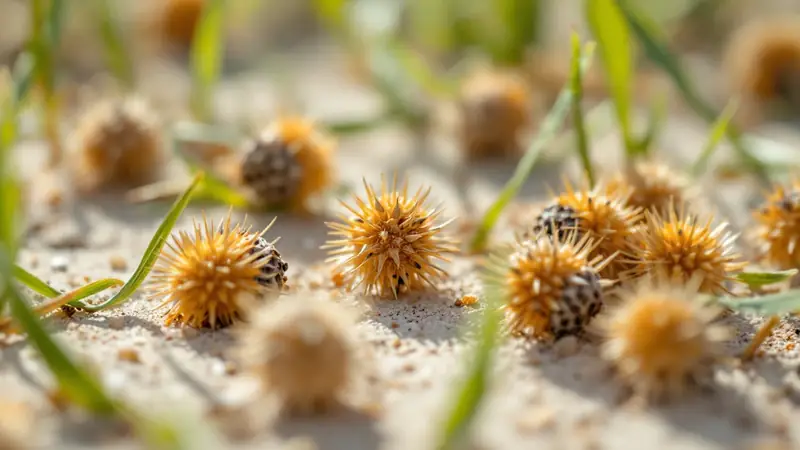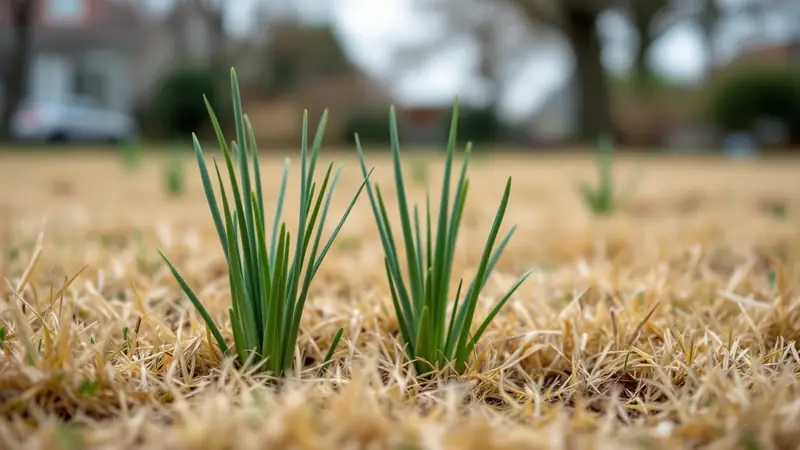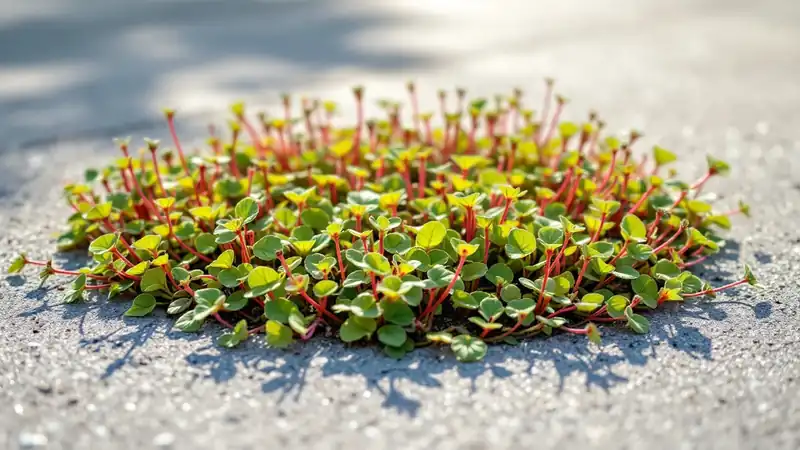
How to get rid of spurge: pull it from moist soil before it seeds, spray small plants with a lawn weed killer that lists spurge, and lay a preemergent before soil reaches 55 to 60°F, then again about 60 days later.
How to get rid of spurge comes down to speed and surface. Spotted spurge (Euphorbia maculata) is a summer annual that can set seed about 5 weeks after it sprouts and makes several thousand seeds a plant (UC IPM Pest Note 7445), so the plan is different in a lawn, a mulched bed and a gravel path, and it always ends with stopping the next flush.
The labels are where most advice goes wrong. We read 16 current EPA-stamped product labels and found that the original Preen Garden Weed Preventer (EPA Reg. No. 961-280, June 2026), does not list spurge at all; Surflan AS controls one spurge and only suppresses spotted spurge; and five labels use “prostrate spurge” for a different species than Maryland Extension does. The label table below shows which name each product covers. For the other summer weeds in a thin lawn, start with our lawn weed identification chart.
This page summarizes EPA labels and extension research; it is not a product endorsement or legal advice. The label is the law: read the current label of the product you buy, and check whether your state requires a pesticide applicator license before anyone treats a yard for pay.
Spotted, prostrate or ground spurge: does the name matter?
For control, mostly no; for pulling and for reading a label, yes. Every spurge bleeds white, milky sap from a broken stem (UC IPM). Whether the stems root where they touch the soil changes how you pull it, and a label that lists “prostrate spurge” may mean Euphorbia humistrata, not the spotted spurge in your yard.
If a broken stem shows no milky sap and the leaves are thick and paddle-shaped, the mat is common purslane, a succulent that re-roots from hoed pieces; our guide on how to get rid of purslane covers bagging it and the later preventer window it needs.
| Name you see | Species | Leaf spot | Roots at stem nodes? | Who uses the name | Source |
|---|---|---|---|---|---|
| Spotted spurge | Euphorbia maculata (Chamaesyce maculata) | Maroon blotch mid-leaf; under 5% of plants lack it (Wisconsin), not a reliable trait (UMD) | No | UC IPM, Penn State, UF/IFAS; Gallery, Snapshot, Dimension and Surflan labels | UW-Madison; UF/IFAS HS1529 |
| “Prostrate spurge” (same plant) | Euphorbia maculata (K-State lists E. supina, a synonym NC State gives) | Same as above | No (UMD); K-State says stems may root | Maryland Extension, NC State, K-State; Celsius WG label (432-1507) | UMD; NC State; Celsius label |
| “Prostrate spurge” (label sense) | Euphorbia humistrata, spreading sandmat | Often light green; can have spots | Yes | Iowa State; Dimension 2EW, Gallery SC, Surflan AS, Snapshot 2.5 TG and Preen 961-421 labels | Iowa State ICM; Dimension label |
| Ground or prostrate spurge | Euphorbia prostrata | No spot; shorter, rounder leaves | No | UC IPM (ground spurge), NC State, UMD, UF/IFAS | UMD; NC State |
| Creeping spurge | Euphorbia serpens | No markings; hairless | Almost always | UC IPM | UC IPM |
| Prostrate knotweed (look-alike) | Polygonum aviculare | None | No | Not a spurge: no milky sap, alternate leaves | Iowa State ICM |
When does spurge germinate, and when does the preemergent go down?
Later than crabgrass and for longer. Penn State puts crabgrass germination at 55 to 58°F in the top inch of soil at daybreak for 4 to 5 days (Penn State); K-State says spurge starts when soil warms to 60 to 65°F and keeps germinating as soil climbs past 90°F. UC IPM also says the seed needs light: seed buried deeper than 1/2 inch germinates poorly.
| Source | Where | Germination temperature and season | What it changes | Link |
|---|---|---|---|---|
| UC IPM Pest Note 7445 | California | As low as 60°F, best 75 to 85°F, up to 100°F; February to September | Apply preemergent before soil passes 55 to 60°F at 1 in | UC IPM |
| K-State Lawn Problem Solver | Kansas | Soil 60 to 65°F to start; continues above 90°F | Preemergent in spring; post sprays late spring to midsummer on young plants | K-State |
| Illinois Extension (Wiesbrook, 2017) | Illinois | Soil 60 to 65°F to start; continues above 90°F with moisture | Repeat applications are often necessary | Illinois |
| NC State Plant Toolbox; UF/IFAS HS1529 | N.C.; Florida | 60 to 100°F; Florida peak early May to early October | No preemergent gives season-long control (UF) | NC State; UF/IFAS |
| UW-Madison Extension | Wisconsin | Best above 75°F; cooler if moist | Often not noticed until late summer | UW-Madison |
| Clemson HGIC (Jordan, 2022) | South Carolina | Soil above 75°F | 3 in of medium to coarse mulch in beds | Clemson |
| Penn State Extension | Pennsylvania | Emerges early to midsummer | Seed turf in late summer or fall | Penn State |
| Crabgrass, for comparison | Pennsylvania | 55 to 58°F, top inch, 4 to 5 days | The usual spring preemergent date | Penn State |
That gap is why one crabgrass application often fails on spurge: the first spurge flush comes weeks later and keeps coming. UF/IFAS says no preemergent gives season-long control, and the labels set the spacing for a second application: at least 60 days for Gallery SC (EPA Reg. No. 62719-658), and up to 4 months of control from Greenview Green Power at 3.1 lb per 1,000 sq ft in the North (EPA Reg. No. 961-392).
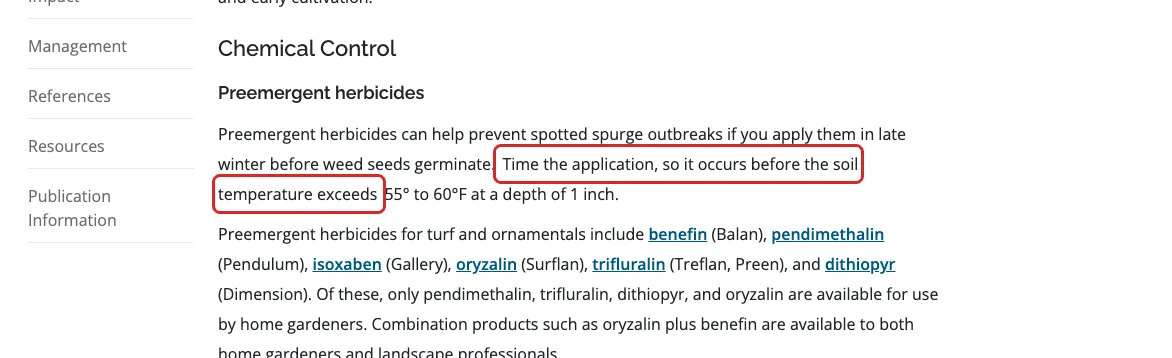
- Put the first preemergent down with your crabgrass application, before soil at 1 inch passes 55 to 60°F (UC IPM). Our crabgrass preemergent timing guide covers the soil readings.
- Put the second one down about 60 days later, inside the label’s yearly maximum: Gallery SC allows 124 fl oz per acre in 12 months, Preen Extended Control 18.37 lb per 1,000 sq ft a year.
- Plan around seeding: Greenview 961-392 says not to apply it within 8 weeks before seeding, and not to seed for 12 weeks after a fall application.
- Scout weekly from June. K-State’s post-emergent window is late spring through midsummer, while plants are young.
What kills spurge in a lawn without killing the grass?
A broadleaf mix that lists spurge, sprayed while the mats are small. The PNW handbook rates prostrate spurge only intermediate to 2,4-D or MCPP alone and susceptible to mixtures with triclopyr (PNW Weed Management Handbook), and Illinois Extension adds triclopyr, 2,4-DP, carfentrazone and sulfentrazone as the stronger options in cool-season turf. UC IPM warns that 2,4-D combinations do not control larger, mature spotted spurge.
| Herbicide | Prostrate spurge rating |
|---|---|
| 2,4-D alone | I (intermediate) |
| dicamba alone | S-I |
| MCPP alone | I |
| Mixtures with triclopyr | S (susceptible) |
| Mixtures without triclopyr | S-I |
Three label rules decide the date. Most lawn mixes stop at 90°F (Ortho 239-2744, Spectracide 9688-342) and the Ortho quinclorac mix at 85°F on bermudagrass; Spectracide says to spot-treat tough weeds again if they are alive after 3 weeks, and the Ortho 2217-896 label allows 2 broadcast sprays a year, 21 days apart. On 2,4-D rates and grass injury, see whether 2,4-D kills grass.
St. Augustine and centipede lawns need their own labels. Spectracide 9688-342 excludes Floratam and Bitterblue St. Augustine; 4% atrazine products such as Drexel Auguzine (EPA Reg. No. 19713-567) list spurge on St. Augustine and centipede at up to 8.6 fl oz per 1,000 sq ft, 2 applications a year, below 90°F. EPA lists these 4% atrazine products as not restricted use; check your state’s rules before buying.
Then remove the opening. UC IPM says raising the mowing height to 2 inches or more in tall fescue or perennial ryegrass cuts new invasions and that thatch should stay under 1/2 inch; Maryland Extension ties spurge to under-fed lawns short of nitrogen, and Clemson to compacted soil worth core-aerating. Two legume weeds that follow the same low-nitrogen pattern have their own plans: getting rid of black medic and getting rid of lespedeza.
Leave it alone after September. Spotted spurge dies with frost (UF/IFAS HS1529), so October sprays spend money on a plant with weeks left; our page on whether weeds die in winter sets out which ones frost kills.
Which products list spurge on the label?
Sixteen labels, read in November 2026, sorted by where they can go. The column to check is the third: “prostrate spurge” alone may not cover spotted spurge.
Swipe the table sideways to see every column.
| Where | Product (EPA Reg. No.) | Active ingredient | Spurge on the label | Label limits that matter | Label date |
|---|---|---|---|---|---|
| Lawn, preemergent | Greenview Green Power Crabgrass Prevention and Control (961-392) | Dithiopyr 0.13% | Prostrate and spotted spurge | 2.2 to 3.1 lb per 1,000 sq ft North, 3.4 to 4.5 lb South; up to 4 months; fall use needs a spring repeat | Dec. 10, 2025 |
| Lawn, preemergent | Dimension 2EW (62719-542) | Dithiopyr 24% | Spotted, garden and prostrate (E. humistrata) | Emulsifiable concentrate (EPA PPLS) | July 2, 2021 |
| Lawn, preemergent | Barricade 4FL (100-1139) | Prodiamine 40.7% | “Spurge, prostrate” only | Single or sequential applications, all before weeds germinate | Feb. 21, 2024 |
| Lawn or bed, preemergent | Gallery SC (62719-658) | Isoxaben 45.45% | Spotted (C. maculata), prostrate (C. humistrata), petty | Up to 0.7 fl oz (21 mL) per 1,000 sq ft; repeat no sooner than 60 days; 124 fl oz per acre per 12 months | Label text Mar. 13, 2017 |
| Bed or gravel, preemergent | Preen Weed Preventer with Snapshot, sold as Preen Extended Control (961-421) | Trifluralin 1.5% + isoxaben 0.375% | Spotted and prostrate (E. humistrata) | 0.98 oz per 10 sq ft on soil or gravel; every 6 months; not sooner than 60 days; 18.37 lb per 1,000 sq ft a year | Sept. 20, 2022 |
| Bed, preemergent | Snapshot 2.5 TG (62719-175) | Trifluralin 2% + isoxaben 0.5% | Spotted at 3.5 lb, prostrate at 4.6 lb per 1,000 sq ft | Repeat no sooner than 60 days | Aug. 11, 2023 |
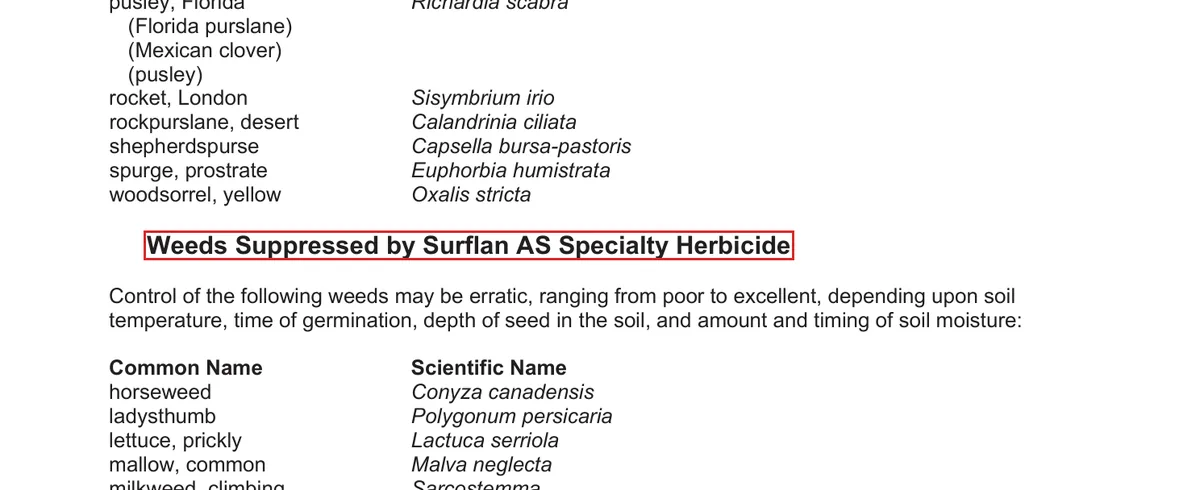
| Bed, preemergent | Surflan AS (70506-44) | Oryzalin 40.4% | Prostrate (E. humistrata) controlled; spotted only suppressed, “may be erratic” | In warm-season turf, prostrate spurge is suppressed only | Nov. 6, 2025 |
| Bed, preemergent | Preen Garden Weed Preventer (961-280) | Trifluralin 1.47% | Not listed | 1 oz per 10 sq ft every 9 to 12 weeks for the weeds it does list | June 16, 2026 |
| Lawn, post | Ortho WeedClear Weed Killer for Lawns Concentrate (239-2744) | 2,4-D + MCPP-p + dicamba | Spotted and prostrate spurge | 4 fl oz per 1,000 sq ft on cool-season grass; not above 90°F | Aug. 23, 2023 |
| Lawn, post | Ortho WeedClear Lawn Weed Killer Concentrate (2217-896-239) | 2,4-D + quinclorac + dicamba | Spotted and prostrate spurge | 2 broadcast sprays a year, 21 days apart; 12.8 fl oz per 1,000 sq ft a season; below 90°F, 85°F on bermuda | Jan. 21, 2026 |
| Lawn, post | Spectracide Weed Stop for Lawns Concentrate 2 (9688-342-8845) | 2,4-D + MCPP-p + dicamba + sulfentrazone | Spotted and prostrate spurge | 45 to 90°F; spot-treat again if tough weeds live past 3 weeks; not on Floratam or Bitterblue St. Augustine | June 29, 2021 |
| Lawn, post | Ortho Weed B Gon Chickweed, Clover and Oxalis Killer (239-2491) | Triclopyr 8% | Spotted and garden spurge | 1 fl oz per 200 sq ft; lawns of buffalograss, fescues, Kentucky bluegrass, ryegrass, zoysia; below 90°F | Aug. 6, 2024 |
| Lawn, post | SpeedZone EW (2217-1053) | 2,4-D + MCPP-p + dicamba + carfentrazone | Spotted spurge, spurge | Turf label; more effective above 50°F; lower rates on warm-season turf above 90°F | June 29, 2023 |
| St. Augustine, centipede | Drexel Auguzine (19713-567) | Atrazine 4% | Spurge | 8.6 fl oz per 1,000 sq ft; 2 applications a year; below 90°F | Nov. 10, 2021 |
| Warm-season lawn, post | Celsius WG (432-1507) | Thiencarbazone + iodosulfuron + dicamba | “Prostrate spurge, Chamaesyce maculata” | Licensed commercial applicators only; 0.17 oz per 1,000 sq ft a year | Sept. 1, 2021 |
| Gravel, cracks, bed spots | Roundup Weed and Grass Killer Concentrate Plus (71995-29) | Glyphosate 18% + diquat 0.73% | Spotted spurge | Kills grass too; best results above 60°F; repeat if new growth appears | Apr. 6, 2022 |
How do you get rid of spurge in flower beds?
Pull it, then take away the light. UW-Madison says to loosen the soil under the mat, because the plant regrows from the crown if the stems just break off. UC IPM says 2 inches of bark, compost or straw blocks many spurge seeds, coarse bark needs 3 to 4 inches, and UF/IFAS cites a container study in which 1 inch of pine bark nuggets cut spotted spurge emergence by about 90 percent. Our page on how deep mulch should be has the depths by material.
Check the preventer’s weed list before you spread it. Preen Garden Weed Preventer (961-280) lists 14 broadleaf weeds and no spurge; Preen Extended Control (961-421) and Snapshot 2.5 TG list spotted spurge. Surflan AS lists spotted spurge under weeds it only suppresses. Where the granules go, on top of mulch or under it, is set out in whether Preen goes before or after mulch.
Before planting a new bed, UC IPM’s option is soil solarization: clear plastic for 4 to 6 weeks in summer, which only partly works where summer temperatures stay below 90°F. In vegetable gardens, UC IPM says preemergents are almost never used, so pull, mulch and hoe shallowly instead.
How do you get rid of spurge in gravel, pavers and cracks?
Maryland Extension notes spurge most often on exposed sites such as gravel mulch, driveway seams and paver joints, where nothing competes with it. The seeds are sticky and travel on shoes and mower tires (Penn State), and ripe pods fling them a foot or two (UMD).
- Pull after rain or a soaking, wearing gloves; slide a weeding tool under the center to lift the taproot, which UC IPM says can reach more than 24 inches.
- Bag plants that already carry seed pods instead of leaving them on the stone.
- Spot-spray larger mats with a glyphosate product that lists spotted spurge, such as 71995-29, on a warm day (its label says above 60°F works best), and keep it off lawn edges and plant roots.
- Follow with a preemergent labeled for gravel surfaces: Preen Extended Control (961-421) at 0.98 oz per 10 sq ft, no sooner than 60 days apart.
Heat and acid only burn the top. In UF/IFAS research, 8-week-old spurge treated with diquat, acetic acid or capric acid products at label rates fully recovered within 4 weeks (UF/IFAS EP580); our page on vinegar as a weed killer explains why roots survive. Method costs per 1,000 sq ft are in our guide on how to kill weeds in gravel.
1Does a broken stem stay dry, with no milky sap?
YesIt is not a spurge. Prostrate knotweed has no milky sap and alternate leaves (Iowa State); check the lawn weed ID chart.
NoGo to the next question
2Is it in gravel, paver joints or a driveway crack?
YesPull it wet with gloves, lifting the crown; spot-spray glyphosate (such as 71995-29) on big mats above 60°F; then Preen Extended Control (961-421) on the gravel, no sooner than 60 days apart.
NoGo to the next question
3Is it in a flower or shrub bed?
YesPull it, mulch 2 inches (coarse bark 3 to 4 inches, UC IPM) and use a preventer that lists spotted spurge, such as 961-421 or Snapshot 2.5 TG, not Preen Garden Weed Preventer (961-280).
NoGo to the next question
4Is it September or later?
YesLeave it: frost kills it (UF/IFAS HS1529). Seed thin spots now and plan a preemergent before soil reaches 55 to 60°F next spring.
NoGo to the next question
5Is it late spring to midsummer, with the lawn mats still young?
YesSpray a lawn product that lists spurge, ideally with triclopyr, sulfentrazone or carfentrazone, below 90°F, and repeat in 3 weeks.
NoBefore soil at 1 inch passes 55 to 60°F: a preemergent that lists spotted spurge (Greenview 961-392, Dimension 2EW or Gallery SC), then a second application about 60 days later within the label's yearly maximum.
Is spotted spurge poisonous to people, dogs and cats?
The sap is the hazard. UC IPM calls the sap of the whole genus an eye and skin irritant; NC State lists spotted spurge as toxic to humans and pets with low-severity symptoms; and UC IPM records sheep dying within hours after eating as little as 0.62 percent of their body weight in the plant.
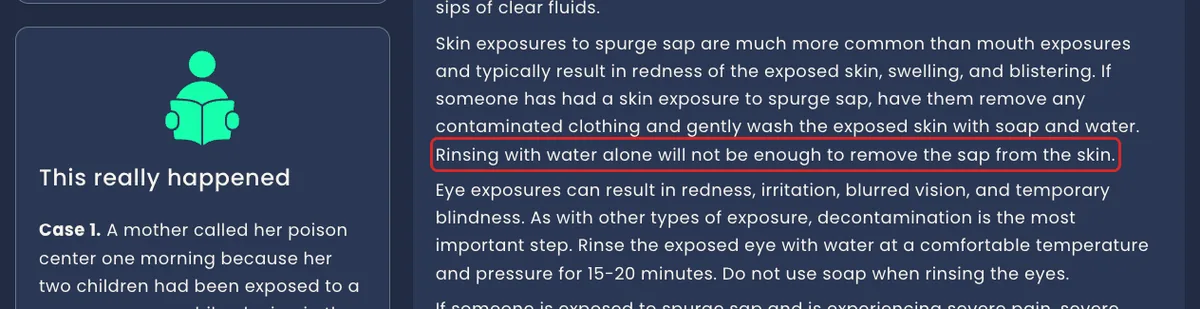
Poison Control advises washing skin with soap and water, because water alone does not remove the sap, rinsing eyes for 15 to 20 minutes, and calling 1-800-222-1222 if someone exposed is having a problem. For a pet, the ASPCA Animal Poison Control Center line is (888) 426-4435, and it notes a consultation fee may apply.
How we compiled this
On Nov. 24, 2026 we read 16 herbicide labels from EPA’s Pesticide Product Label System, the PNW handbook susceptibility table, and spurge publications from UC IPM, Maryland, Penn State, Iowa State, NC State, UF/IFAS, UW-Madison, Clemson, K-State and Illinois, plus Poison Control’s spurge page. We did not run trials or test products; the chart plots the temperatures those sources publish.
Frequently asked questions
What kills spurge the best?
In lawns, a broadleaf mix with triclopyr: the PNW handbook rates prostrate spurge susceptible to triclopyr mixtures but only intermediate to 2,4-D alone. Illinois Extension adds carfentrazone and sulfentrazone. In gravel, glyphosate kills the root.
How can I kill spurge without killing my grass?
Use a selective lawn product whose label lists spurge and your grass, below 90°F, and repeat after about 3 weeks. On St. Augustine and centipede, use a 4% atrazine product labeled for them, and skip Floratam and Bitterblue with Spectracide 9688-342.
Does Roundup work on spurge?
Roundup Weed and Grass Killer Concentrate Plus (71995-29) lists spotted spurge, but its glyphosate and diquat kill lawn grass too. Use it only in gravel, cracks or shielded bed spots, on a day above 60°F.
Is there a preemergent for spurge?
Yes: dithiopyr (Dimension 2EW, Greenview 961-392), isoxaben (Gallery SC) and isoxaben plus trifluralin (Preen Extended Control, Snapshot) list spotted spurge. Barricade 4FL lists only prostrate spurge, and Preen Garden Weed Preventer lists none.
Should you pull spurge?
Yes, while it is small and before seed: UC IPM says plants can seed 5 weeks after sprouting. Pull from moist soil with gloves and lift the crown, because stems that snap off leave a root that can regrow.
Sources
- UC Statewide IPM Program (Molinar et al.), Pest Notes: Spotted Spurge and Other Spurges, Publication 7445, Current page. Accessed November 2026.
- University of Maryland Extension, Prostrate Spurge: Identification and Management, Updated Nov. 11, 2026. Accessed November 2026.
- Penn State Extension (Abbey and Landschoot), Lawn and Turfgrass Weeds: Spotted Spurge, Updated March 25, 2026. Accessed November 2026.
- Penn State Extension, Lawn and Turfgrass Weeds: Smooth Crabgrass and Large Crabgrass, Current page. Accessed November 2026.
- Iowa State Integrated Crop Management (Hartzler and Anderson), Prostrate spurge, Reviewed June 5, 2026. Accessed November 2026.
- NC State Extension Gardener Plant Toolbox, Euphorbia maculata, Current page. Accessed November 2026.
- UF/IFAS Extension (Rodriguez and Marble), Biology and Management of Spotted Spurge, HS1529, 2026. Accessed November 2026.
- UF/IFAS Extension, Natural Products for Managing Landscape and Garden Weeds, EP580, 2020. Accessed November 2026.
- UW-Madison Extension, Spotted Spurge, Euphorbia maculata, Current page. Accessed November 2026.
- Clemson HGIC (Jordan), Weed of the Month: Prostrate Spurge, Aug. 11, 2022. Accessed November 2026.
- Kansas State University, Lawn Problem Solver: Prostrate Spurge, Updated March 27, 2026. Accessed November 2026.
- University of Illinois Extension (Wiesbrook), Are You Seeing Spots? Spotted Spurge, June 26, 2017. Accessed November 2026.
- Pacific Northwest Weed Management Handbook, Susceptibility of Broadleaf Weeds in Turf to Common Herbicides, Current table. Accessed November 2026.
- Poison Control (National Capital Poison Center), Keep away from spurge sap, Current page. Accessed November 2026.
- ASPCA, Animal Poison Control Center, Current page. Accessed November 2026.
- U.S. EPA PPLS, Greenview Green Power Crabgrass Prevention and Control, EPA Reg. No. 961-392, Dec. 10, 2025. Accessed November 2026.
- U.S. EPA PPLS, Dimension 2EW, EPA Reg. No. 62719-542, July 2, 2021. Accessed November 2026.
- U.S. EPA PPLS, Barricade 4FL, EPA Reg. No. 100-1139, Feb. 21, 2024. Accessed November 2026.
- U.S. EPA PPLS, Gallery SC, EPA Reg. No. 62719-658, May 8, 2017 (label text Mar. 13, 2017). Accessed November 2026.
- U.S. EPA PPLS, Preen Weed Preventer with Snapshot, EPA Reg. No. 961-421, Sept. 20, 2022. Accessed November 2026.
- U.S. EPA PPLS, Snapshot 2.5 TG, EPA Reg. No. 62719-175, Aug. 11, 2023. Accessed November 2026.
- U.S. EPA PPLS, Surflan AS Specialty Herbicide, EPA Reg. No. 70506-44, Nov. 6, 2025. Accessed November 2026.
- U.S. EPA PPLS, Preen The Weed Preventer, EPA Reg. No. 961-280, June 16, 2026. Accessed November 2026.
- U.S. EPA PPLS, Ortho WeedClear Weed Killer for Lawns Concentrate, EPA Reg. No. 239-2744, Aug. 23, 2023. Accessed November 2026.
- U.S. EPA PPLS, EH-1437 Herbicide (Ortho WeedClear Lawn Weed Killer Concentrate), EPA Reg. No. 2217-896, Jan. 21, 2026. Accessed November 2026.
- U.S. EPA PPLS, Chemsico Lawn Weed Killer Concentrate (Spectracide Weed Stop for Lawns Concentrate 2), EPA Reg. No. 9688-342, June 29, 2021. Accessed November 2026.
- U.S. EPA PPLS, Ortho Brush-B-Gon (Weed B Gon Chickweed, Clover and Oxalis Killer), EPA Reg. No. 239-2491, Aug. 6, 2024. Accessed November 2026.
- U.S. EPA PPLS, EH-1681 Herbicide (SpeedZone EW), EPA Reg. No. 2217-1053, June 29, 2023. Accessed November 2026.
- U.S. EPA PPLS, Drexel Auguzine, EPA Reg. No. 19713-567, Nov. 10, 2021. Accessed November 2026.
- U.S. EPA PPLS, Celsius WG, EPA Reg. No. 432-1507, Sept. 1, 2021. Accessed November 2026.
- U.S. EPA PPLS, Roundup Weed and Grass Killer Concentrate Plus, EPA Reg. No. 71995-29, Apr. 6, 2022. Accessed November 2026.