How to kill weeds in gravel: pull or spot-spray what is growing, rake out the leaves and grit it roots in, then lay down a preemergent or a year-long product only where no tree or shrub roots reach. Fabric underneath will not stop them.
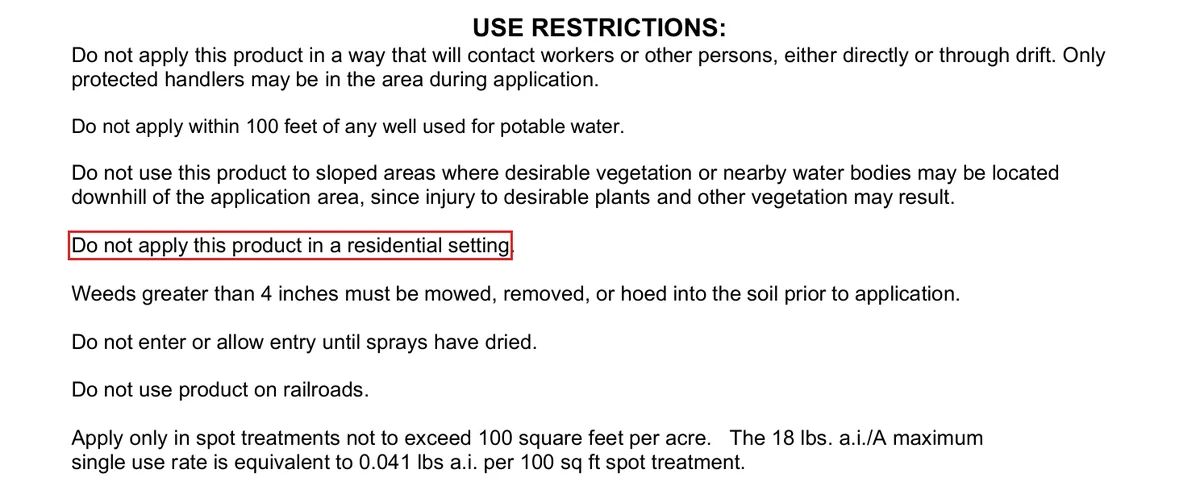
Most advice on how to kill weeds in gravel names a product and stops. The labels say more. We read 9 EPA-accepted labels for products sold or used on gravel and found three limits none of the top results mention. Pramitol 25E, the prometon “soil sterilant” that driveway threads still recommend, says “Do not apply this product in a residential setting” (EPA Reg. No. 53883-505, amended July 16, 2025), a line on its labels since at least 2014. Ortho GroundClear Year Long Vegetation Killer must stay back twice the distance from a tree’s trunk to its drip line. And Esplanade 200 SC lists gravel driveways only among its non-residential sites.
Cost spreads far more than results do. Per 1,000 sq ft at label rates and November 2026 prices, a flame pass burns about $0.65 of propane, a prodiamine preemergent costs $1.02 to $2.34, and the ready-to-use year-long spray about $105. The method table below puts all of them, plus hand pulling, boiling water and vinegar, against the same four questions: does it kill the root, how long does it hold, is it safe near trees, and what does it cost.
Why do weeds grow in gravel, even over landscape fabric?
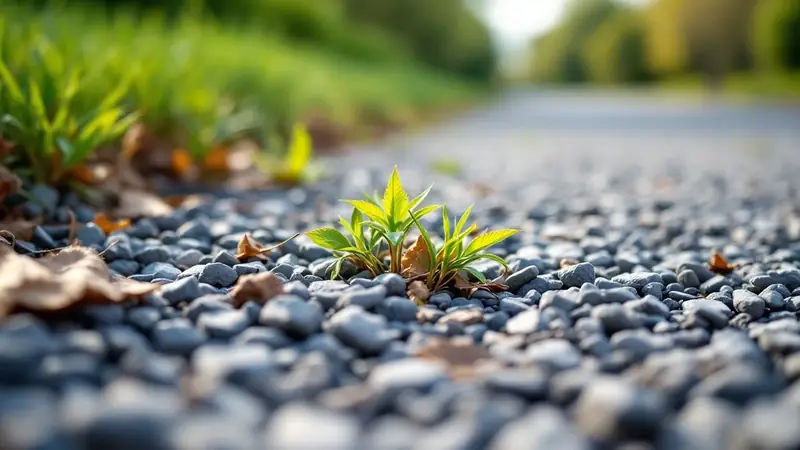
Gravel weeds mostly start on top of the stone, not under it. University of Arizona Extension says weed seeds are “easily blown into gravel or stone and soon establish themselves (even if you use landscape fabric underneath),” and that soil blowing in lets weeds grow on top of fabric after a few years (Schalau, Mulches, BYG #30, June 2022). Our guide on where weed seeds come from covers the wind, bird and soil routes in.
The flat, milky-sapped mat that turns up on so much gravel is usually spotted spurge, which Maryland Extension finds most often on gravel mulch, driveway seams and paver joints; our guide on how to get rid of spurge covers pulling it, the labels that list it and the gravel-surface preemergent.
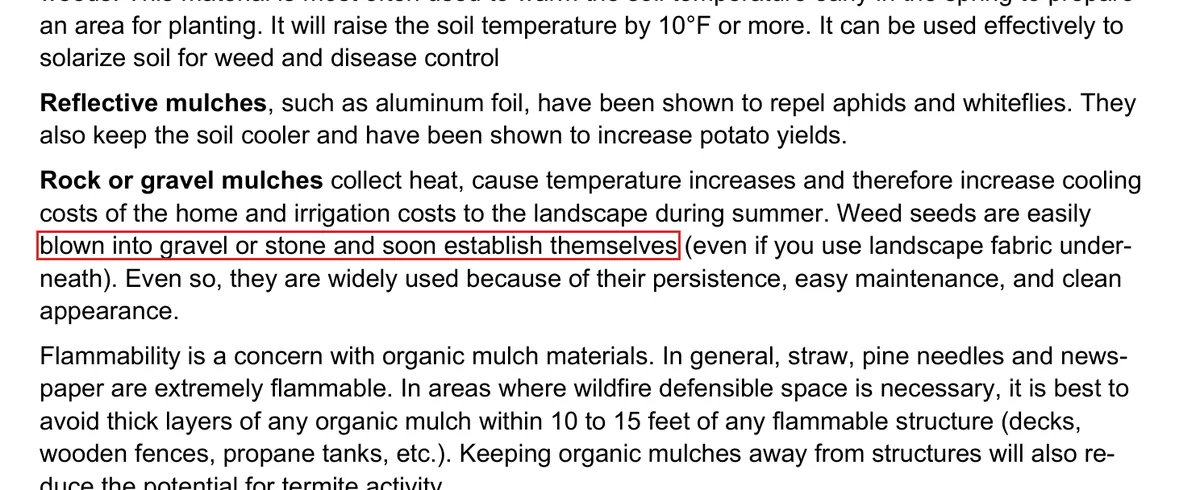
The seedbed is the grit. K-State Research and Extension in Johnson County says wind carries fine soil and seed into the gaps, that leaves left on gravel break down into fine pieces that speed up silting and weed pressure, and that a hoe is useless in rock: the only options are hand pulling or herbicides applied multiple times a season. Washington State University’s Linda Chalker-Scott adds that geotextiles can degrade in as little as 1 year in sunlight and that organic matter on top hastens weeds colonizing them (The Myth of Landscape Fabric).
Fabric still has a job. UC IPM suggests it under rock because it keeps stones from sinking into soil and stops soil, with its buried seed, from rising into the rock. It just does nothing about seed that lands from above. Stone size matters more: Colorado State University Extension says gravel under 1 centimeter suppresses weeds about as well as wood chips, that stones should be smaller than 1/2 inch to work as mulch, and that weed suppression needs about 4 inches of depth. Fabric’s price per square foot is in our mulch vs rock cost comparison.
Which methods kill weeds in gravel, and for how long?
Only four of the methods below reach roots: hand pulling that gets the whole root, glyphosate, the year-long kill-and-prevent mixes and prometon. Heat and acid kill the leaves they touch, so they work on seedlings and need repeats. Preemergents kill nothing that is already up. Costs are product only, per pass, at the label rate for broadcast coverage; spot treating a few weeds uses far less.
| Method | Kills roots? | How long it holds | Near trees and shrubs | Cost per 1,000 sq ft per pass, Nov. 2026 | Source |
|---|---|---|---|---|---|
| Hand pulling or a weeding knife | Only if the whole root comes out | Until new seed lands and roots | Safe | $0 in product | K-State Extension |
| Boiling water | Top growth; 2-leaf seedlings often die | 33 to 60 days on a test footpath; 3 to 6 rounds a season | Pour away from shallow roots | Water and stove energy | Vermeulen 2006 |
| Propane flame, 2 to 5 seconds per weed | Broadleaf seedlings under 3 in.; grasses regrow in about 2 weeks | 59 to 64 days spot flaming; 3 to 4 rounds a season | Fire risk near mulch, dry grass, fences | $0.65 to $1.95 (0.23 to 0.69 gal propane) | UNL flame manual; EIA |
| 20% acetic acid (vinegar herbicide) | No: contact burn | Contact only; repeat on each new flush | Burns any leaf it wets | $10.30 to $20.60 | Vinagreen label, EPA Reg. No. 85208-1 |
| Glyphosate, Roundup Super Concentrate | Yes: complete kill in 1 to 2 weeks, some perennials 4+ weeks | No soil residual claim: label allows planting 1 to 3 days after | Kills any foliage it drifts onto | $8.99 to $13.37 | EPA Reg. No. 71995-25 |
| Roundup Dual Action 365 Concentrate (triclopyr, fluazifop-P, imazapic, diquat) | Yes | Up to 12 months; plant 12 months after | Not over the root zones of desirable plants | $22.74 to $40.62 | EPA Reg. No. 71995-68 |
| Ortho GroundClear Year Long (imazapyr 0.09%, pelargonic acid 2%) | Yes | Up to 1 year, longer in heavy clay; 1 application a year | No closer than 2 times trunk-to-drip-line distance | $104.97 (1 gal per 300 sq ft) | EPA Reg. No. 239-2761 |
| Prodiamine preemergent (Barricade 4FL) | No: stops seeds only | Higher rate gives longer control; needs 0.5 in. of water within 14 days | Labeled over landscape ornamentals | $1.02 to $2.34 (0.48 to 1.10 fl oz) | EPA Reg. No. 100-1139 |
| Indaziflam preemergent (Specticle FLO) | No: preemergent | Bare ground in non-crop areas, including driveways and gravel areas | Can move downhill and injure sensitive grasses | $5.74 to $11.80 (0.21 to 0.42 fl oz) | EPA Reg. No. 101563-207 |
| Prometon (Pramitol 25E) | Yes, mostly through roots | Usually inhibits growth for a year or more | Feeder roots reach far beyond the drip line; 100 ft from wells | Not for homes: residential use barred | EPA Reg. No. 53883-505 |
| Salt | By dose; kills grass too | Lingers until about 1 ft of water passes through | Runs off into the lawn edge | Not a labeled herbicide | our salt dose page |
Three numbers change the choice. The year-long ready-to-use jug costs 45 to 100 times as much per square foot as a professional prodiamine preemergent, because it is mostly water: its label maximum is 1 gallon per 300 sq ft, and Ortho’s online store lists the 1-gallon refill at $31.49. The concentrate route is cheaper: Roundup Dual Action 365 Concentrate mixes at 6 fl oz per gallon, so one 32 fl oz bottle covers 1,600 sq ft. And flame weeding is the cheapest pass on the list, but the University of Nebraska manual’s 10 gallons per acre gave 90 percent control of broadleaf seedlings only; flowering grasses needed 27 to 30.
Heat and vinegar are repeat jobs. On the Dutch test footpath, spot flaming held 59 to 64 days and hot water 33 to 60, while one glyphosate spray held 120 to 141 days (Vermeulen 2006). Our pages on how hot water kills weeds, propane doses by weed and stage and which vinegar strengths work carry the dose detail; the same trial ranks methods for paver joints in our guide to killing weeds between pavers.
Default: a 12 by 50 ft driveway (600 sq ft) with one pass of Roundup Super Concentrate costs about $5 to $8 in product. Product only, broadcast coverage at label rates; spot treating uses less. Check each label's yearly maximum before choosing more than 1 pass.
Which method fits your gravel: driveway, stone bed, path or near trees?
The same product can be right on a parking pad and wrong 10 feet away, because the year-long ingredients stay active in soil and move with water. Two label lines decide most cases: Ortho’s “DO NOT apply to slopes” because movement on the soil surface may damage plants downslope, and the Specticle FLO warning that it can move to sensitive grasses when applied uphill of them.
| Your gravel | First choice | Skip | Why (label or source) |
|---|---|---|---|
| Gravel driveway or parking pad, nothing planted within reach | Kill, then one year-long product a year, or glyphosate plus a prodiamine or indaziflam preemergent | Prometon (barred at homes), salt | Year-long labels list driveways and gravel areas; Pramitol label bars residential use |
| Driveway edge beside a lawn, or gravel uphill of a bed | Glyphosate spot spray and hand pulling; preemergent only on the flat | Imazapyr and imazapic mixes, salt | Ortho: no slopes; Specticle FLO: moves to grass downhill |
| Decorative stone bed with shrubs or perennials | Hand pull, shielded spot spray, preemergent labeled for landscape ornamentals | Year-long vegetation killers | 71995-68 and 239-2761: not on or around flowers, trees or shrubs |
| Pea gravel patio or path people sit on | Hand pull, boiling water, flame on a calm damp day; rake out fines | Residual sprays on seating areas | Labels keep people and pets out until spray dries; heat leaves no residue |
| Gravel within 2 times the trunk-to-drip-line distance of a tree | Pull, heat or a contact spray | Every soil-residual product | Ortho setback; Pramitol: feeder roots extend far beyond the drip line |
| Gravel near a well, ditch, pond or storm drain | Pull or heat | Prometon within 100 ft of a well; any spray with rain due | Pramitol well rule; Ortho: no runoff into drains or ditches |
1Is a tree or shrub within twice its trunk-to-drip-line distance, or does the gravel slope toward a lawn, bed, ditch or well?
YesNo soil-residual products. Pull, flame (outside fire restrictions), boiling water, or a glyphosate spot spray, which carries no soil residual claim (EPA Reg. No. 71995-25).
NoGo to the next question
2Are the weeds perennials with taproots or runners, such as dandelion, bindweed or bermudagrass?
YesDig them or spot spray glyphosate and wait 1 to 2 weeks, 4 or more for perennials. Heat and vinegar burn the top only.
NoGo to the next question
3Are there plants you want growing in the gravel?
YesHand pull and use a shielded spot spray, then a preemergent labeled for landscape ornamentals, such as prodiamine at 0.48 to 1.10 fl oz per 1,000 sq ft.
NoGo to the next question
4Is it flat gravel where nothing should grow for a year?
YesKill, rake, then one year-long product at its label rate: Roundup Dual Action 365 Concentrate (about $23 to $41 per 1,000 sq ft) or Ortho GroundClear Year Long (about $105). Never prometon at a home.
NoSeedlings only: flame 2 to 5 seconds or pour boiling water, repeat every 4 to 9 weeks, and rake out leaves and grit each fall.
Source: EPA-accepted labels 239-2761, 71995-68, 71995-25, 100-1139, 53883-505; UC IPM
Driveways take the most abuse, and the stone itself is part of the fix. After the kill, a 2-inch top-up of clean stone buries the grit layer seedlings root in; our gravel driveway cost guide prices that at $0.38 to $1.28 per sq ft. On stone beds, CSU’s 4-inch depth for weed suppression applies to gravel as well as wood chips.
What do the year-long gravel weed killers allow?
“Soil sterilant” is a forum word, not a label category. The labels sort these products by where they may go, and three of them now draw lines around homes. Pramitol 25E has told users “Do not apply this product in a residential setting” since at least its 2014 label. The July 2025 amendment, made under EPA’s registration review of prometon, keeps that line and adds two more: no use within 100 feet of any drinking-water well, and spot treatments capped at 100 sq ft per acre.
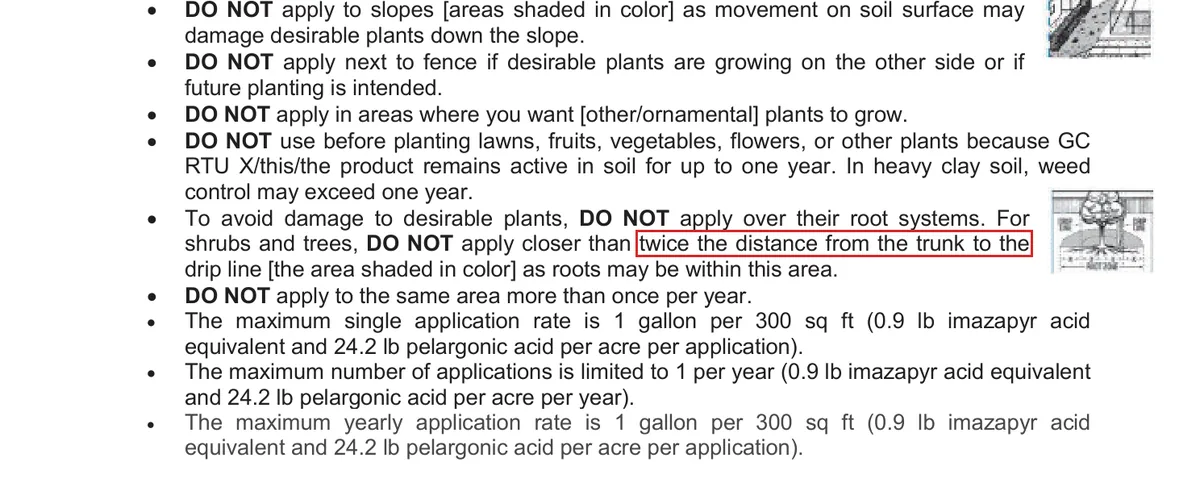
Ortho GroundClear Year Long is the consumer version of the same idea, and its tree rule is a measurement you can take. Pace off the distance from trunk to drip line, double it, and keep the spray outside that circle: for a maple with a 15-foot canopy radius, that is 30 feet. The label also says to water the day before if soil is dry, cut weeds over 6 inches first and apply once a year; in heavy clay, control may last past 1 year.
Read “up to 1 year” as a ceiling. University of Illinois Extension (June 2020) warns that warm, wet seasons can break these products down faster than the label’s length of control, that some are soil mobile, and that a year-long jug grabbed by mistake for a garden bed can block planting there for months. Store it apart from other herbicides, or mark the jug where you cannot miss it.
Roundup Dual Action 365 Concentrate is not a glyphosate product. Its label, EPA Reg. No. 71995-68, lists triclopyr 2.5%, fluazifop-P 2%, imazapic 1.6% and diquat 1.5%, claims visible results in as little as 3 to 6 hours, and bars planting for 12 months. The older Roundup Max Control 365 formula, glyphosate plus imazapic and diquat, is a separate registration, 71995-49. If you want to replant the gravel edge next spring, glyphosate alone is the label-friendly kill: 71995-25 allows planting 1 to 3 days after the last spray.
The professional preemergents are cheaper per square foot but come with rules a homeowner rarely meets. Barricade 4FL lists parking and storage areas under non-crop sites at 0.48 to 1.10 fl oz per 1,000 sq ft and needs at least 0.5 inch of rain or irrigation within 14 days to activate. Specticle FLO allows bare ground on driveways and gravel areas at 9 to 18.5 fl oz per acre. Esplanade 200 SC names gravel driveways only under “Non-Residential Non-Crop Sites.” Neither preemergent kills what is already up, so both labels list glyphosate as a tank-mix partner for weeds already up.
This page is general information, not pesticide or legal advice. The label is the law: read the full label of any product you use, and ask the National Pesticide Information Center (800-858-7378) if a label line is unclear. Some states restrict products or require a license to apply them for hire.
Step by step: clearing a weedy gravel driveway
- Cut the tall growth. Mow or cut weeds over 6 inches and haul them off before any spray; the Ortho label requires it, and Pramitol’s sets the line at 4 inches.
- Deal with perennials first. Dig taprooted weeds with a dandelion fork after a rain, when moist soil lets the root come out (University of Illinois Extension), or spot spray glyphosate in calm weather above 60°F with no rain forecast for 24 hours, then wait 1 to 2 weeks, 4 or more for perennials (71995-25 label).
- Hit seedlings with heat or a contact spray. UC IPM says 2 to 5 seconds of flame is usually enough; check the next day and repeat if the plant still looks healthy. Skip the torch during local fire restrictions.
- Rake out the dead plants and the grit. Blow leaves off in fall; K-State says leaves left on gravel break down into silt that raises weed pressure.
- Top up thin spots with 2 inches of clean stone so seed lands on stone, not soil.
- Prevent the next flush. On flat gravel with nothing planted nearby, apply a preemergent or year-long product at its label rate and water it in as the label directs (Barricade 4FL: 0.5 inch within 14 days).
- Walk it monthly. Pull singles while small; contact methods took 3 to 6 rounds a season on the Wageningen test path.
How we compiled this
We downloaded and read 11 EPA-accepted labels from the Pesticide Product and Label System (Pramitol 25E, Ortho GroundClear Year Long, Roundup Dual Action 365 and Super Concentrate, Barricade 4FL, Specticle FLO, Esplanade 200 SC, Gallery SC and three related Roundup registrations), plus 5 extension publications and the Wageningen pavement trial, in November 2026. Costs multiply each label rate by retail prices checked Nov. 5 to 17, 2026, and by the EIA residential propane average. We ran no field tests; trial figures come from a paved path, not gravel.
Frequently asked questions
How do you permanently stop weeds from growing in gravel?
Nothing is permanent, because new seed keeps blowing in. The longest single treatments are year-long kill-and-prevent products, which labels limit to about 12 months, and only where no tree or shrub roots reach. Pair one with a yearly raking of leaves and grit, and top up the stone so seed lands on rock instead of soil.
Does sprinkling salt on gravel kill weeds?
Yes, at high enough doses, but it kills grass too and stays in soil until about a foot of water washes through, per our salt dose page. On a driveway it runs off into the lawn edge, where the damage shows.
What is the best weed killer for gravel?
It depends on what grows next to the gravel. For a driveway with nothing planted nearby, a year-long product such as Roundup Dual Action 365 (about $23 to $41 per 1,000 sq ft) kills and prevents for up to 12 months. Near trees, lawns or beds, use a glyphosate spot spray, which has no soil residual claim.
Does vinegar, Dawn and salt really kill weeds?
It burns leaves. Our vinegar strength comparison found 5% household vinegar mostly kills weeds in their first 2 weeks, while grasses and perennial roots regrow. The salt adds soil damage, and the soap only helps the spray stick.
Will bleach kill weeds in my gravel driveway?
It burns the leaves it wets, and the sodium it leaves behind builds up in soil the way salt does. Boiling water does the same contact job in 1 to 3 days and leaves nothing behind.
Sources
- U.S. EPA PPLS, Pramitol 25E, EPA Reg. No. 53883-505, amended label, July 16, 2025. Accessed November 2026.
- U.S. EPA PPLS, Ortho GroundClear Year Long Vegetation Killer (GC RTU X), EPA Reg. No. 239-2761, June 24, 2020. Accessed November 2026.
- U.S. EPA PPLS, Roundup Dual Action 365 Weed & Grass Killer Plus 12 Month Preventer Concentrate (Roundup Residual Concentrate), EPA Reg. No. 71995-68, April 7, 2022. Accessed November 2026.
- U.S. EPA PPLS, Roundup Weed & Grass Killer Super Concentrate, EPA Reg. No. 71995-25, Jan. 28, 2021. Accessed November 2026.
- U.S. EPA PPLS, Barricade 4FL, EPA Reg. No. 100-1139, Feb. 21, 2024. Accessed November 2026.
- U.S. EPA PPLS, Specticle FLO, EPA Reg. No. 101563-207 (formerly 432-1608), Aug. 31, 2020. Accessed November 2026.
- U.S. EPA PPLS, Esplanade 200 SC, EPA Reg. No. 101563-144, Sept. 16, 2026. Accessed November 2026.
- U.S. EPA PPLS, Vinagreen, EPA Reg. No. 85208-1, Aug. 22, 2024. Accessed November 2026.
- University of Arizona Cooperative Extension, Mulches, Backyard Gardener #30 (J. Schalau), June 25, 2022. Accessed November 2026.
- K-State Research and Extension, Johnson County, Rock Mulch, a Solution, or a Problem?, current page. Accessed November 2026.
- UC IPM, Weed Management in Landscapes, current page. Accessed November 2026.
- Washington State University, The Myth of Landscape Fabric (L. Chalker-Scott), undated. Accessed November 2026.
- Colorado State University Extension, Mulching, current page. Accessed November 2026.
- University of Nebraska-Lincoln, Propane-Fueled Flame Weeding in Corn, Soybean and Sunflower (Knezevic and others), 2014. Accessed November 2026.
- Plant Research International, Wageningen, Vermeulen, Verwijs and Kempenaar, weed control on pavements, report, 2006. Accessed November 2026.
- U.S. EIA, Heating Oil and Propane Update, residential propane, week of Nov. 16, 2026. Accessed November 2026.
- Ortho (ScottsMiracle-Gro store), Weed control product listing, Year Long Vegetation Killer Refill price, checked Nov. 17, 2026. Accessed November 2026.
- Roundup.com, Dual Action 365 Concentrate product page and retailer prices, checked Nov. 17, 2026. Accessed November 2026.
- Roundup.com, Super Concentrate product page, Lowe’s listed price, checked Nov. 5, 2026. Accessed November 2026.
- Village Hardware, Williston, Vt., Roundup Super Concentrate 35.2 oz listing, checked Nov. 5, 2026. Accessed November 2026.
- Lawn and Pest Control Supply, Barricade 4FL, 1 gallon, checked Nov. 17, 2026. Accessed November 2026.
- Lawn and Pest Control Supply, Specticle FLO, 18 oz, checked Nov. 17, 2026. Accessed November 2026.
- University of Illinois Extension, Home, Yard & Garden Newsletter, Controlling Weeds in the Driveway (M. Wiesbrook), June 1, 2020. Accessed November 2026.
- National Pesticide Information Center, npic.orst.edu, current. Accessed November 2026.