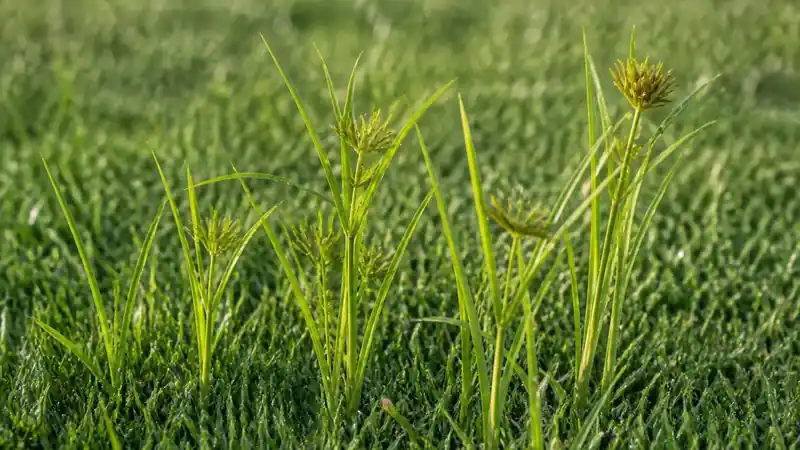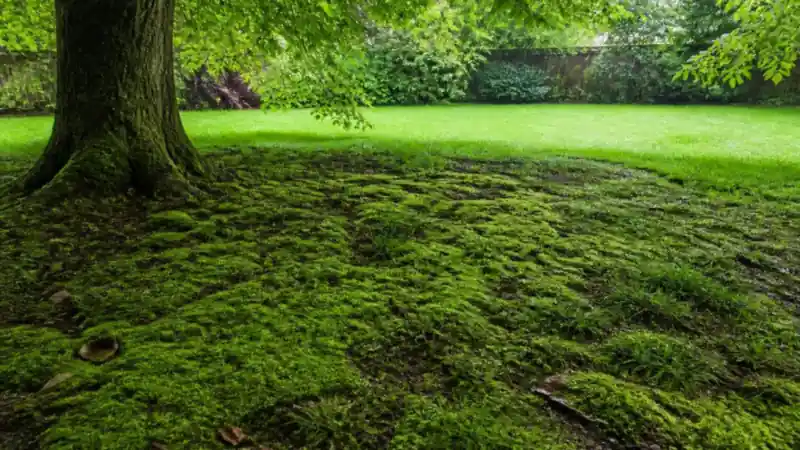
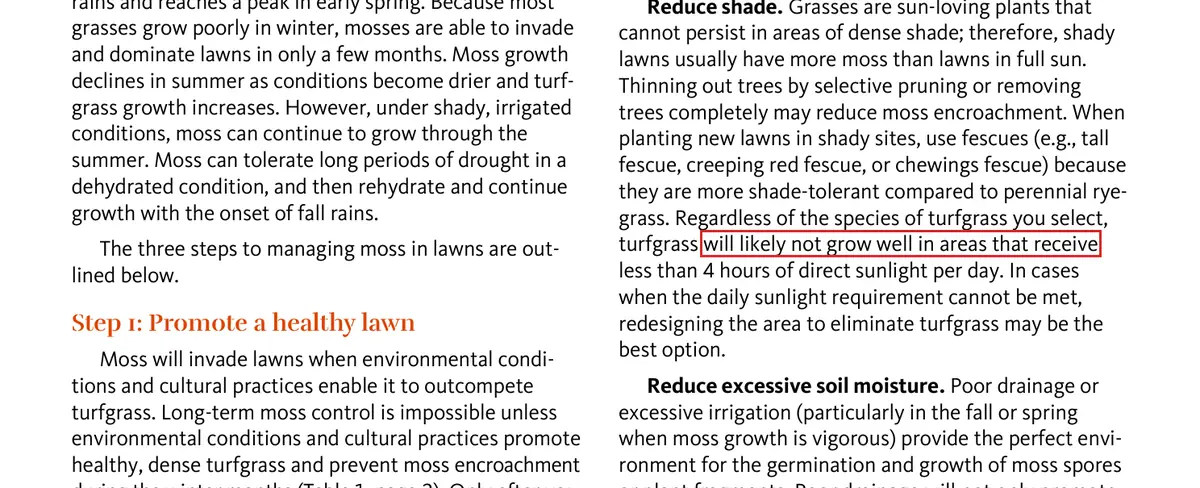
A moss lawn is a signal that grass lost on light, water or fertility: Oregon State says turf will likely not grow well under 4 hours of direct sun. Fix the site and reseed, or keep the moss.
Key takeaways
- Moss does not kill grass; it fills ground where turf already thinned (UW-Madison). Under 4 hours of direct sun a day, turfgrass of any species will likely not grow well (Oregon State EM 9175).
- Iron is the standard lawn moss killer. Six EPA-registered granules we read put down about 3.7 to 8 lb of product per 1,000 sq ft, or 0.64 to 3.74 lb of ferrous sulfate monohydrate; Lilly Miller Moss Out! Lawn Granules (EPA Reg. No. 802-543) runs 20 lb per 4,000 sq ft for heavy moss (label, 2020).
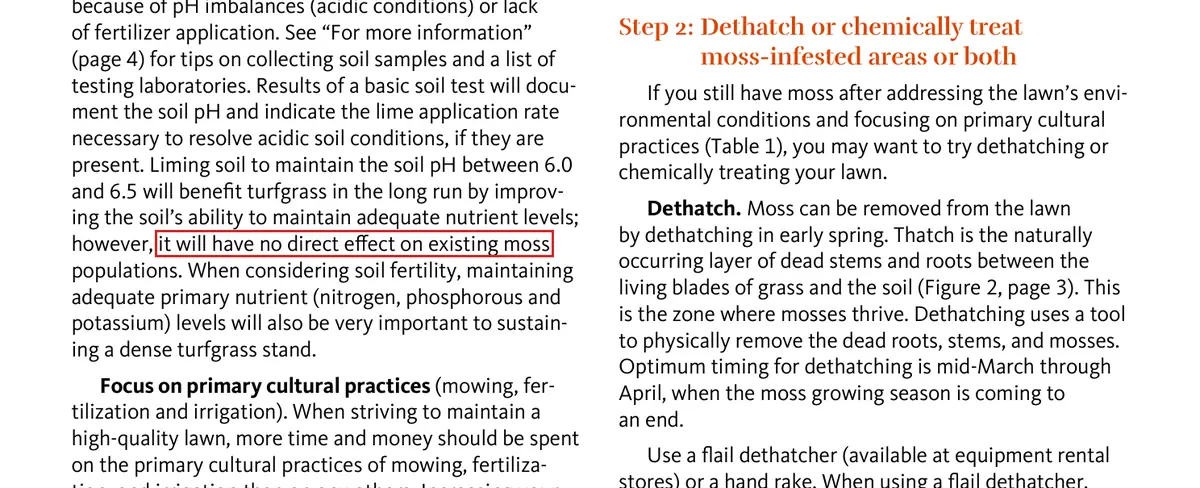
- Lime does not kill moss. Oregon State says liming to pH 6.0 to 6.5 helps turf but has no direct effect on existing moss, and the Missouri Botanical Garden lists lime and copper sulfate as ineffective (MoBot).
- Roof and walkway moss products with copper or zinc injure or kill lawn grass (EM 9175).
- A deliberate moss lawn suits about 1 hour of sun or less; Moss Acres posts live sheet moss at $2.80 to $13.95 per sq ft as of October 2026, and fragments take 12 to 18 months to carpet (Moss Acres).
Why is moss growing in my lawn?
Moss grows where the grass has already thinned. Iowa State Extension names heavy shade, low fertility, poor drainage and compacted soil, alone or together, and Oregon State adds mowing too short. Of more than 9,000 moss species, only a few invade turf (NC State), and none is parasitic (Missouri Botanical Garden). Killing moss without fixing the cause buys one season.
To check the drainage part, refill a 12-inch hole and time it: extension services call under 1 inch per hour slow, the threshold behind our explainer on what well-drained soil is.
| Cause | Threshold or test | Fix | Source |
|---|---|---|---|
| Shade | Under 4 hours of direct sun a day: turf will likely not grow well. Tall fescue needs about 5 hours | Thin or remove trees; plant fine fescue; or redesign without turf | OSU EM 9175; Clemson HGIC |
| Wet soil | Standing water, or irrigation in fall and spring when moss grows fastest | Regrade, core aerate, sand topdress, drain tile; cut back watering | OSU EM 9175; UW-Madison |
| Compaction | Hard, compacted soil in traffic areas | Core aerate in spring or fall; loosen the top 2 to 4 inches | MoBot; Iowa State |
| Low fertility | Below 4 to 6 lb nitrogen per 1,000 sq ft a year in western Oregon; shaded turf needs 1/2 to 2/3 of the sun rate | Soil test, then 1 lb N per 1,000 sq ft per feeding in spring and fall | OSU EM 9175; Clemson HGIC |
| Acid soil | pH near 5.0: nutrients tie up and aluminum toxicity rises | Lime to pH 6.0 to 6.5, only at the soil test rate | OSU Extension; OSU EM 9175 |
| Short mowing | Under 2 to 3 inches for cool-season lawns; 3 to 4 inches in shade | Raise the deck; mow weekly; take off no more than 1/3 | OSU EM 9175; UW-Madison |
| Thatch | Dead stem layer between grass and soil, where moss thrives | Dethatch mid-March through April (western Oregon) | OSU EM 9175 |
Timing tells you which cause to fix first. In western Oregon moss starts growing with the fall rains, peaks in early spring and slows in summer, except under shade and irrigation, where it keeps going (EM 9175). The species there are mostly Rhytidiadelphus and Brachythecium albicans; on golf greens it is silvery thread moss, Bryum argenteum (NC State Extension).
Should you kill the moss or grow a moss lawn?
Decide by hours of direct sun, then by drainage and foot traffic. Above about 5 hours, moss means a fertility, drainage or mowing problem you can fix. Between 1 and 4 hours, grass will keep thinning no matter the seed (EM 9175). At 1 hour or less, Moss Acres sells shade moss for exactly that spot, so the cheaper move is often to keep the moss.
Count sun hours on a clear midsummer day: photograph the mossy patch every hour from 8 a.m. to 6 p.m. and total the hours in direct sun. Repeat in April or May if deciduous trees leaf out late.
| If your situation is | Do this | Why (source) |
|---|---|---|
| 5 or more hours of direct sun, moss in patches | Soil test, fertilize, raise mowing height, kill moss with iron, overseed | Tall fescue grows with about 5 hours (Clemson); moss there points to fertility, drainage or mowing |
| 4 to 5 hours, well-drained soil | Thin tree canopy; overseed with creeping red, chewings or hard fescue | Fine fescues tolerate considerable shade (Iowa State); OSU sets 4 hours as the floor |
| 4 to 5 hours, wet soil | Fix drainage, then seed rough bluegrass | UW-Madison and MoBot name rough bluegrass for moist shade |
| 1 to 4 hours of sun | Convert to a shade groundcover, mulch or moss; stop reseeding grass | Turf will likely not grow well under 4 hours (OSU EM 9175) |
| Under 1 hour, damp, acid soil | Keep the moss and grow a moss lawn | Shade moss wants no more than 1 hour of sun (Moss Acres); pH 5.0 to 5.5 (UVM Extension) |
| Daily traffic from kids or dogs | Grass or a path, not moss | Limit traffic on new moss for a year (UVM); light traffic with flat soles only (Moss Acres) |
| You own a roof or walkway moss product | Do not use it on the lawn | Copper and zinc in those products injure or kill grass (OSU EM 9175) |
1Does the mossy spot get less than 4 hours of direct sun a day?
YesStop reseeding grass. Under about 1 hour on damp, acid soil, keep the moss or grow a moss lawn; otherwise plant a shade groundcover (OSU EM 9175; Moss Acres).
NoGo to the next question
2Does water stand there after rain, or does the soil stay soggy?
YesFix drainage first (regrade, drain tile, core aeration), then kill the moss and seed rough bluegrass or fine fescue (OSU EM 9175; UW-Madison).
NoGo to the next question
3Is soil pH under 6.0, or has the lawn had little or no fertilizer?
YesLime and fertilize to the soil test, then apply a lawn-labeled iron moss killer and overseed (OSU EM 9175).
NoGo to the next question
4Is the lawn mowed shorter than 2 inches?
YesRaise the mower to 2 to 3 inches, or 3 to 4 inches in shade, then kill the moss and overseed (OSU EM 9175; UW-Madison).
NoKill the moss with a lawn-labeled iron or soap product at the label rate, rake it out once it turns black, and overseed the same week (EPA labels; OSU EM 9175).
Source: Oregon State EM 9175; UW-Madison XHT1114; Moss Acres; EPA labels
What kills moss but not grass?
Iron and soap kill moss and leave established grass alive at label rates. Granular ferrous sulfate products are the common homeowner choice; liquid ferric sulfate, iron HEDTA and potassium salts of fatty acids are the sprays. Every rate below is copied from the newest EPA-accepted label in the EPA Pesticide Product Label System, checked October 30, 2026. The label is the law: the rate on your bag governs.
| Product (EPA Reg. No.) | Active ingredient | Label lawn rate | Product per 1,000 sq ft | Active per 1,000 sq ft | Source |
|---|---|---|---|---|---|
| Scotts Moss Control Granules master label (538-223) | Ferrous sulfate monohydrate 17.5% | Bag covers 5,000 sq ft regular, 4,000 heavy | 3.67 to 4.59 lb (18.37 lb bag) | 0.64 to 0.80 lb | Label, Aug. 12, 2026 |
| Bonide MossMax (4-480) | Ferrous sulfate monohydrate 23.5% | 4 lb normal, 8 lb heavy per 1,000 sq ft | 4 to 8 lb | 0.94 to 1.88 lb | Label, 2013 |
| Jonathan Green Lawn Moss Control (9240-8) | Ferrous sulfate monohydrate 25.8% | 4 lb normal, 8 lb heavy per 1,000 sq ft | 4 to 8 lb | 1.03 to 2.06 lb | Label, June 7, 2026 |
| Lilly Miller Moss Out! Lawn Granules (802-543) | Ferrous sulfate monohydrate 32% | 20 lb per 5,000 sq ft light, per 4,000 heavy | 4 to 5 lb | 1.28 to 1.60 lb | Label, May 18, 2020 |
| Loveland Moss Control Plus Lawn Food (34704-745) | Ferrous sulfate monohydrate 32% | 40 lb per 5,000 sq ft | 8 lb | 2.56 lb | Label, 2013 |
| NuLife Rid-Moss (72106-5) | Ferrous sulfate monohydrate 46.75% | 10 lb per 1,250 sq ft | 8 lb | 3.74 lb | Label, 2000 |
| Lilly Miller Moss Out! For Lawns liquid (802-509) | Ferric sulfate 35% | 1/2 pint in 3 gal water per 125 sq ft | 64 fl oz in 24 gal | Not stated | Label, 2011 |
| Fiesta Lawn Weed Killer (67702-26) | Iron HEDTA 26.52% | Moss rate 12.6 fl oz, standard 25.2 fl oz per 1,000 sq ft | 12.6 to 25.2 fl oz in 2.5 to 4.9 gal | Not stated | Label, Apr. 10, 2025 |
| Safer Brand Moss & Algae Killer (59913-4) | Potassium salts of fatty acids 40% | 4 oz per gal; 1 gal per 50 sq ft | 80 fl oz in 20 gal | Not stated | Label, 2008 |
| Garden Safe Moss & Algae Killer (67702-12) | Potassium salts of fatty acids 22.11% | 1:19 dilution, 12 to 25 gal per 1,000 sq ft | 81.6 to 170 fl oz | Not stated | Label, May 1, 2025 |
Two labels disagree on watering, so read yours. Lilly Miller 802-543, Bonide 4-480 and Jonathan Green 9240-8 say to water the granules in. The Scotts 538-223 label says “Do not water-in after application” and applies to wet grass and moss instead, and it warns that 1/2 inch or more of rain may force a second application.
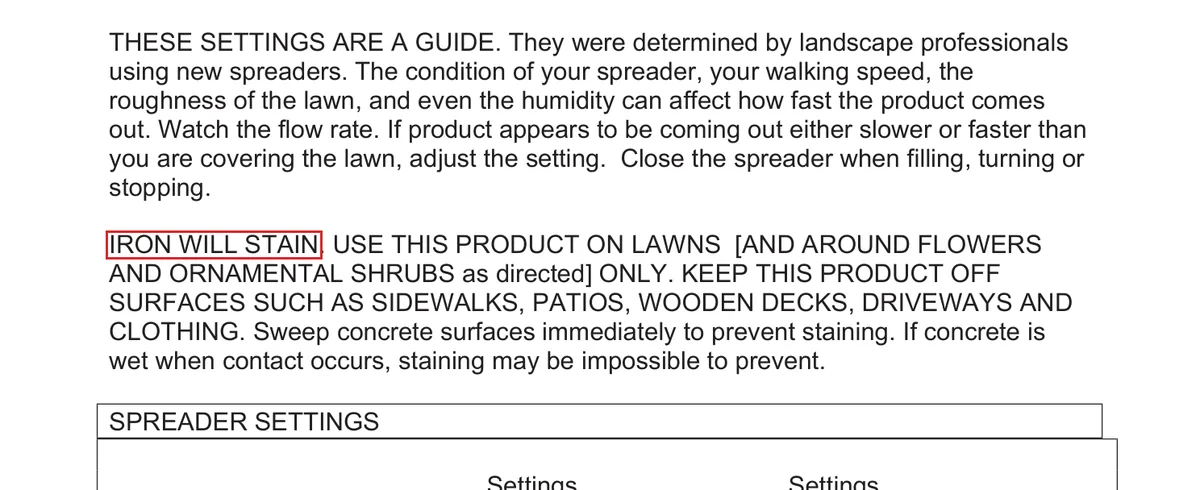
Iron stains concrete. The Lilly Miller (802-543) and Bonide (4-480) labels print “IRON WILL STAIN” and say staining may be impossible to prevent if the concrete is wet when granules land; sweep walks and drives before you water. The soap products do not stain the same way, but Safer’s label warns of a white residue on cement and dark shingles.
Heat and pets have label limits too. Safer and Garden Safe say not to treat turf above 85°F, and Fiesta also bars drought-stressed grass and bentgrass. Lilly Miller 802-543 says to keep people and pets off until the granules are watered in and the area is dry. Oregon State adds that fatty acid products can cause significant eye damage, so wear the eye protection the label lists.
Pros have one more tool. NC State Extension reports carfentrazone (QuickSilver) as the most effective selective moss herbicide on golf greens, at 6.7 fl oz of product per acre repeated every 10 to 14 days, and says chlorothalonil may not be used on residential turf.
Baking soda is the one kitchen product with a golf green trial behind it: spot sprays at 44 g per liter suppressed moss as well as carfentrazone in Illinois and Kansas, as our page on whether baking soda kills weeds details.
How much moss killer do I need?
Multiply the mossy area by your label rate. For a granule at 4 lb per 1,000 sq ft, a 600 sq ft patch needs 2.4 lb; at the 8 lb heavy rate it needs 4.8 lb. The calculator below uses the label rates from the table above and posted October 2026 prices for each product family.
- Granules needed (lb)
- 20.0
- 20 lb bags (Jonathan Green, Lilly Miller)
- 1
- 18.37 lb bags (Scotts)
- 2
Pounds = area x label rate from each product's EPA label (PPLS, Oct. 30, 2026). Your bag's printed rate governs. Cost uses posted shelf prices for whole pounds; you buy whole bags, so round up with the bag counts.
| Worked example: 5,000 sq ft lawn | Label rate | Product needed | Bags | Posted price, Oct. 30, 2026 |
|---|---|---|---|---|
| Jonathan Green Lawn Moss Control, normal moss | 4 lb per 1,000 sq ft | 20 lb | One 20 lb bag | $21.99 to $23.99 (Toolbox Supply; Hemlock Hardware) |
| Jonathan Green Lawn Moss Control, heavy moss | 8 lb per 1,000 sq ft | 40 lb | Two 20 lb bags | $43.98 to $47.98 |
| Scotts Moss Control Granules, regular rate | One 18.37 lb bag per 5,000 sq ft | 18.37 lb | One bag | $20.84 sale to $24.05 (Shell Lumber; Hemlock Hardware) |
| Lilly Miller Moss Out! Lawn Granules, light moss | 20 lb per 5,000 sq ft | 20 lb | One 20 lb bag | $25.49 (Toolbox Supply; Life and Home) |
| Lilly Miller Moss Out! Lawn Granules, heavy moss | 20 lb per 4,000 sq ft | 25 lb | Two 20 lb bags (15 lb left) | $50.98 |
How do you get rid of moss in a lawn, step by step?
Fix light, water and fertility first, then kill and rake, then seed into the gap. Oregon State EM 9175 orders it exactly that way and says to try chemicals only after the site is corrected. Skipping the seeding step leaves bare soil, and moss returns to bare soil first.
- Test the soil and lime only to the report’s rate, aiming for pH 6.0 to 6.5 (EM 9175). Our soil test guide covers sampling and the lawn lime guide covers rates.
- Prune or thin trees until the patch gets 4 hours of direct sun; if it cannot, stop and keep the moss or plant a groundcover (EM 9175).
- Regrade low spots, redirect downspouts, add drain tile and core aerate compacted soil (Nebraska Extension); see when to aerate.
- Mow, then apply the moss killer at the label rate while moss is actively growing: any time on the Bonide label, fall or early spring on Lilly Miller, winter through early spring on Scotts.
- Rake out the moss once it turns black: several days on the Lilly Miller and Bonide labels, about 2 weeks on Scotts, which allows seeding after 1 week.
- Or dethatch instead: Oregon State uses a flail dethatcher in alternating passes from mid-March through April, never in fall. Prices are in our dethatching cost guide.
- Fertilize at 1 lb nitrogen per 1,000 sq ft, seed the same day, mulch lightly and water daily for 2 weeks (EM 9175); see our overseeding guide.
- Mow weekly at 2 to 3 inches in sun (EM 9175) or 3 to 4 inches in shade, and feed shaded turf half the bag rate, about 1/2 lb N per 1,000 sq ft (UW-Madison).
| Step | Western Oregon and Washington | Midwest and East | Source |
|---|---|---|---|
| Kill moss | First fall rains, warm rainy winter spells, or early spring | Fall or early spring, while moss grows and soil is moist | Lilly Miller 802-509; Lilly Miller 802-543 |
| Dethatch or rake | Mid-March through April; never fall | After moss blackens, several days after iron | OSU EM 9175; labels |
| Seed cool-season grass | Spring through Memorial Day | Late July to late September; mid-March to mid-April second best | OSU Extension; Purdue TURF-64-W |
| Fertilize | 1 lb N per 1,000 sq ft, 4 to 6 times a year, spring and fall | Spring, September, late October to early November | OSU Extension; Iowa State |
Does lime, dish soap or copper sulfate kill moss?
No to all three, as most guides use them. Lime corrects pH for the grass but does not kill moss, copper sulfate is listed as ineffective by the Missouri Botanical Garden, and no extension source we read gives a dish soap rate. The soaps with lawn moss directions on EPA labels, such as Safer 59913-4, are potassium salts of fatty acids.
| Common claim | What the primary source says | Source |
|---|---|---|
| Lime kills moss | Liming to pH 6.0 to 6.5 helps turf but has “no direct effect on existing moss populations” | OSU EM 9175 |
| Lime kills moss | “Lime will not fix the problem”; more sun and regular nitrogen will | OSU, Kowalewski 2020 |
| Moss means acid soil | Some mosses favor acid soil, not all; lime only when a soil test says so | Iowa State |
| Moss means acid soil | Sun-tolerant moss grows above pH 7.0 | UVM Extension |
| Zinc or copper moss killer is fine on grass | Roof and walkway products with copper and zinc injure or kill lawn grass | OSU EM 9175 |
| Zinc sulfate is a lawn moss killer | Kills moss but can also damage grass; lime and copper sulfate ineffective | MoBot |
| Glyphosate kills moss | Systemic herbicides do not work: moss has no vascular system | NC State |
| Glyphosate kills moss | Kills moss and the turf with it; only for full renovation | OSU EM 9175 |
| Dish soap kills moss | Registered soap moss killers are potassium salts of fatty acids at 1 gal of 4 oz-per-gallon mix per 50 sq ft | Safer label 59913-4 |
Copper sulfate does have one extension rate. NC State lists copper or ferrous sulfate sprayed at 3 to 5 oz per 1,000 sq ft in 4 gallons of water, or ferrous ammonium sulfate at 10 oz per 1,000 sq ft on damp moss, not watered in. It adds 5 to 10 lb of ground limestone per 1,000 sq ft before reseeding to tie up copper that can harm seedlings. We found no active EPA lawn moss registration for copper or ferrous ammonium sulfate: the one copper lawn label, Ion Moss (50019-1), was cancelled in 2013, and the zinc sulfate Moss Out! for Roofs (802-591) tells users to cover the lawn.
What grass grows where moss grows?
Fine fescues for dry shade, rough bluegrass for wet shade, and St. Augustinegrass in the warm South; tall fescue needs about 5 hours of sun (Clemson). All grasses still prefer sun, and the Missouri Botanical Garden warns that neither fine fescue nor rough bluegrass survives extremely heavy shade or soil saturated for long periods. Match the grass to the hours of sun you counted.
| Grass | Light | Seed per 1,000 sq ft | Nitrogen per 1,000 sq ft a year | Source |
|---|---|---|---|---|
| Strong or slender creeping red fescue | Shade, well drained | 4 to 6 lb | Under 2 lb | Purdue TURF-64-W, Table 1 |
| Chewings fescue | Shade, well drained | 3.5 to 6 lb | Under 2 lb | Purdue TURF-64-W, Table 1 |
| Hard and sheep fescue | Shade, low input | 3 to 6 lb | Under 1 lb | Purdue TURF-64-W, Table 1 |
| Rough bluegrass (Poa trivialis) | Shade, moist soil | Not given | Not given | UW-Madison; MoBot |
| Tall fescue | About 5 hours of sun or more | See our tall fescue guide | See our tall fescue guide | Clemson HGIC |
| St. Augustinegrass (Raleigh, Palmetto, Delmar, Jade) | Best warm-season shade tolerance | Sod or plugs | Not given | Clemson HGIC |
| Zoysiagrass (El Toro, Diamond, Belaire, Cavalier) | Light to moderate shade | Sod or plugs | Not given | Clemson HGIC |
| Bermudagrass | Extremely poor in any shade | Not for mossy shade | Not given | Clemson HGIC |
At posted prices, reseeding a mossy patch with fine fescue is cheap. Hancock Seed lists creeping red fescue at $157.99 for 50 lb ($3.16 per lb) and $31.99 for 5 lb ($6.40 per lb), checked October 30, 2026 (Hancock Seed), so 5 lb per 1,000 sq ft costs about $16 to $32. Profiles of each species are in our guide to types of lawn grass, and our tall fescue guide compares cultivars for partial shade.
How do you grow a moss lawn on purpose?
Start from the moss you already have, or buy sheets grown in similar light. UVM Extension says most shade mosses prefer pH 5.0 to 5.5 and firm soil, and that a new moss area needs limited traffic for a year. Moss Acres says to keep transplanted moss moist at all times for at least the first 3 weeks.
| Trade name | Species | Growth form | Light | Source |
|---|---|---|---|---|
| Sheet moss, flat fern moss | Hypnum imponens | Creeping mat, peels in sheets | Shade to partial sun, no direct afternoon sun | Penn State; Moss Acres |
| Sheet moss, curvy fern moss | Hypnum curvifolium | Creeping mat | Shade | Penn State |
| Sheet moss, delicate fern moss | Thuidium delicatulum | Fern-like creeping mat | Shade | Penn State |
| Mood moss, broom fork moss | Dicranum scoparium | Cushion clumps | Shade | Penn State; UMD |
| White cushion moss | Leucobryum glaucum | Rounded cushions | Shade | Penn State |
| Haircap moss | Polytrichum spp. | Upright clumps on soil | Shade; some sun | UMD Extension |
- Check pH. Shade mosses prefer 5.0 to 5.5; if the test reads higher, UVM says to spread elemental sulfur at the package rate before planting (UVM).
- Clear weeds, leaves and debris to bare soil, firm it with a tamper or your feet, then lightly scratch the surface with a rake or cultivator.
- Soak the soil, press the moss flat and very firmly into it (Moss Acres suggests a water-filled lawn roller for large areas), and pin pieces on slopes (Moss Acres).
- Keep it moist at all times for at least 3 weeks (Moss Acres); mist in the morning or evening, never in hot sun, and do not water fragments above 80°F (Moss Acres instructions).
- Keep leaves off with a blower on low or netting, and pull weeds by hand; UVM says no mowing, aerating or fertilizing is needed.
Do not strip moss from public woods. Penn State Extension measured how slowly it returns: mosses grow 0.25 to 2.5 inches a year, a log stripped bare takes about 20 years to recover, and about 10 years when a third to half is left behind (Penn State, Forest Moss).
How much does a moss lawn cost?
Live moss costs more than seed per square foot. Moss Acres, a Pennsylvania grower, posts live sheet moss at $13.95 for 1 sq ft down to $2,799 for 1,000 sq ft, or $2.80 per sq ft, as of October 30, 2026. Fragments run $1.48 to $1.55 per sq ft but take 12 to 18 months to knit, by the vendor’s own estimate.
| Product (Moss Acres) | Pack covers | Posted price | Per sq ft | Source |
|---|---|---|---|---|
| Sheet moss (Hypnum), live | 1 sq ft | $13.95 | $13.95 | Moss Acres |
| Sheet moss (Hypnum), live | 10 sq ft | $59.95 | $6.00 | Moss Acres |
| Sheet moss (Hypnum), live | 100 sq ft | $389 | $3.89 | Moss Acres |
| Sheet moss (Hypnum), live | 500 sq ft | $1,490 | $2.98 | Moss Acres |
| Sheet moss (Hypnum), live | 1,000 sq ft | $2,799 | $2.80 | Moss Acres |
| Sheet moss fragments | 100 sq ft | $155 | $1.55 | Moss Acres |
| Sheet moss fragments | 200 sq ft | $295 | $1.48 | Moss Acres |
| Moss milkshake (powdered fragments) | 15 sq ft | $34.99 | $2.33 | Moss Acres |
| Creeping red fescue seed at 5 lb per 1,000 sq ft | 1,000 sq ft | $15.80 to $32.00 | $0.016 to $0.032 | Hancock Seed |
Worked example for a 500 sq ft shaded side yard, materials only:
| Route | Arithmetic | Materials cost | Time to full cover |
|---|---|---|---|
| Live sheet moss | One 500 sq ft pack at $1,490 | $1,490 | Immediate cover; moist 3 weeks to root |
| Moss fragments | Two 200 sq ft packs ($590) + one 100 sq ft pack ($155) | $745 | Thin green in 3 to 6 months; solid carpet in 12 to 18 months (vendor) |
| Moss milkshake | 500 / 15 = 33.3, so 34 packs x $34.99 | $1,190 | Not stated by vendor |
| Fine fescue overseed | 2.5 lb seed x $3.16 to $6.40 | $8 to $16 | Germinates in 5 to 14 days (Purdue); fails under 4 hours of sun (OSU) |
The seed route is two orders of magnitude cheaper only where grass can live. On ground under 4 hours of sun, the seed money is spent again every year the turf thins, which is the case for paying once for moss.
How we compiled this
We read 16 extension and university documents (Oregon State, Penn State, Purdue, Iowa State, NC State, UW-Madison, Nebraska, Maryland, Vermont, Clemson, Missouri Botanical Garden, Washington State) and the newest EPA-accepted labels for 10 registered lawn moss products, pulled from EPA PPLS on Oct. 30, 2026. Prices are posted retail listings checked the same day. We did not test any product; per-1,000 sq ft figures are arithmetic from label rates.
| Recap | Number | Source |
|---|---|---|
| Turf floor | 4 hours of direct sun a day | OSU EM 9175 |
| Target soil pH for turf | 6.0 to 6.5 | OSU EM 9175 |
| Granular iron moss killer | 3.7 to 8 lb product per 1,000 sq ft | EPA labels |
| Fine fescue seed | 3 to 6 lb per 1,000 sq ft | Purdue TURF-64-W |
| Shade moss pH | 5.0 to 5.5 | UVM Extension |
| Live sheet moss | $2.80 to $13.95 per sq ft | Moss Acres, Oct. 2026 |
This page is general information, not pesticide advice. The label is the law: read the full label of the product you buy, follow its rate, timing and re-entry directions, and check your state’s rules before applying any pesticide for hire.
Frequently asked questions
Is moss bad for your lawn?
Moss does not harm grass directly. UW-Madison and Iowa State both say moss does not kill turf; it grows only where grass has already thinned from shade, wet soil, compaction or low fertility. The problem is the cause underneath. If you can fix light and drainage, grass returns; if the spot gets under 4 hours of sun, moss may be the better groundcover.
What kills moss but not grass?
Iron and soap products labeled for lawns. Granular ferrous sulfate products go on at 4 to 8 lb per 1,000 sq ft on most labels, such as Bonide MossMax and Jonathan Green Lawn Moss Control. Potassium salts of fatty acids sprays like Safer Brand work too, but labels bar turf use above 85°F. Never use roof products with copper or zinc.
When should I apply moss killer to my lawn?
When moss is actively growing and the lawn is moist: any time it grows on the Bonide (4-480) label, fall or early spring on Lilly Miller (802-543), and winter through early spring on Scotts (538-223). Mow first to expose the moss. Check whether your label says to water in, as Lilly Miller does, or not to, as Scotts does.
Does lime get rid of moss?
No. Oregon State Extension says liming to pH 6.0 to 6.5 helps grass compete but has no direct effect on existing moss, and the Missouri Botanical Garden lists lime as ineffective. Lime only when a soil test calls for it, then kill or rake the moss and overseed.
Should I rake out dead moss?
Yes, once it turns black. The Lilly Miller and Bonide labels say to wait several days after treatment, then rake gently; the Scotts label says about 2 weeks. Raking exposes soil for seed. Oregon State says to fertilize at 1 lb nitrogen per 1,000 sq ft and seed right away so moss does not refill the gap.
How long does it take to grow a moss lawn?
Live sheets give cover on day one but need constant moisture for at least 3 weeks to attach, per Moss Acres. Fragments green thinly in 3 to 6 months and form a solid carpet in 12 to 18 months, by the same vendor’s estimate. UVM Extension says to limit foot traffic for the first year.
Can you walk on a moss lawn?
Lightly. Moss Acres says light traffic in flat-soled shoes is fine, while high heels, running children and repeated heavy traffic damage it, and dry moss scuffs more easily than damp moss. UVM Extension advises limiting traffic for 1 year after planting. Put a path where people walk daily.
Sources
- Oregon State University Extension, EM 9175 Managing Moss in Lawns in Western Oregon (Edmunds and Kowalewski), December 2017. Accessed October 2026.
- Oregon State University Extension, How to manage moss in Oregon lawns (Kowalewski), Published Jan. 2024, reviewed 2025. Accessed October 2026.
- Oregon State University Horticulture, Lime won’t fix your moss problem and other garden myths debunked (Kowalewski), Nov. 16, 2020. Accessed October 2026.
- Penn State Extension, Moss in the Lawn (Landschoot), Updated Nov. 17, 2020. Accessed October 2026.
- Penn State Extension, Nontimber Forest Products from Pennsylvania: Forest Moss, 2011. Accessed October 2026.
- Purdue Extension, TURF-64-W Fine Fescues: Establishment of Fine Fescues (Braun, Patton), Current PDF. Accessed October 2026.
- Iowa State University Extension, How to Manage Moss in the Lawn and Garden, Current page. Accessed October 2026.
- NC State Extension, Moss Control in Turf, Current page. Accessed October 2026.
- University of Wisconsin-Madison, Moss in Lawns (Stier), XHT1114, Revised Dec. 2, 2011. Accessed October 2026.
- Nebraska Extension, Moss in Lawns and Landscapes (Fech), July 11, 2017. Accessed October 2026.
- University of Maryland Extension, Moss in the Landscape, Current page. Accessed October 2026.
- University of Vermont Extension, Embracing moss (VanZandt), Current page. Accessed October 2026.
- Clemson Cooperative Extension HGIC, Growing Grass in Shade, Current page. Accessed October 2026.
- Missouri Botanical Garden, Moss in Lawns, Current page. Accessed October 2026.
- Washington State University HortSense, Lawn and Turf: Moss, Reviewed Aug. 16, 2025. Accessed October 2026.
- U.S. EPA, Pesticide Product Label System (registration status lookup), Checked Oct. 30, 2026. Accessed October 2026.
- U.S. EPA PPLS, Label 538-223 Moss Control Plus Lawn Fertilizer (Scotts), Accepted Aug. 12, 2026. Accessed October 2026.
- U.S. EPA PPLS, Label 4-480 Bonide MMax Lawn Granules, Accepted May 7, 2013. Accessed October 2026.
- U.S. EPA PPLS, Label 9240-8 All Pro Lawn Food with Moss Control (Jonathan Green Lawn Moss Control), Accepted June 7, 2026. Accessed October 2026.
- U.S. EPA PPLS, Label 802-543 Lilly Miller UltraGreen Moss Control Lawn Food (Moss Out! Lawn Granules), Accepted May 18, 2020. Accessed October 2026.
- U.S. EPA PPLS, Label 34704-745 Moss Control Plus Lawn Food, Feb. 6, 2013. Accessed October 2026.
- U.S. EPA PPLS, Label 72106-5 NuLife Rid-Moss, Jan. 6, 2000. Accessed October 2026.
- U.S. EPA PPLS, Label 802-509 Lilly Miller Moss Out (liquid), Aug. 18, 2011. Accessed October 2026.
- U.S. EPA PPLS, Label 67702-26 NEU1173H Concentrate (Fiesta), Accepted Apr. 10, 2025. Accessed October 2026.
- U.S. EPA PPLS, Label 59913-4 Safer Brand Moss and Algae Killer and Surface Cleaner Concentrate, Oct. 31, 2008. Accessed October 2026.
- U.S. EPA PPLS, Label 67702-12 HO2 Moss Killer Concentrate (Garden Safe Moss and Algae Killer), Accepted May 1, 2025. Accessed October 2026.
- Moss Acres, Sheet Moss (Hypnum) product page, Prices checked Oct. 30, 2026. Accessed October 2026.
- Moss Acres, Sheet Moss Fragments product page, Prices checked Oct. 30, 2026. Accessed October 2026.
- Moss Acres, Moss Milkshake product page, Price checked Oct. 30, 2026. Accessed October 2026.
- Moss Acres, Transplanting instructions, Checked Oct. 30, 2026. Accessed October 2026.
- Moss Acres, Growing Moss, Checked Oct. 30, 2026. Accessed October 2026.
- Hancock Seed, Creeping Red Fescue Grass Seed, Prices checked Oct. 30, 2026. Accessed October 2026.