Does baking soda kill weeds? Small ones it coats, sometimes: it is a sodium salt that dries out leaves. Trials tested it on moss and liverwort, not dandelions or crabgrass, and 1 teaspoon per weed carries 1.26 g of sodium, enough to burn grass.
Does baking soda kill weeds well enough to replace a weed killer? We looked for every published rate and found one gap the top results skip: no trial has sprinkled or sprayed baking soda on a lawn or garden weed. The measured doses come from moss on golf greens and liverwort in nursery pots, and the one weed trial fired it from a sandblaster. Set side by side, a teaspoon on one weed is 10 to 20 times the liverwort rate.
Baking soda is sodium bicarbonate, and USDA FoodData Central lists it at 27,360 mg of sodium per 100 g: 1,259 mg in a 4.6 g teaspoon, about half the 2,325 mg in a teaspoon of table salt. It works the way salt does, so our page on how much salt kills weeds and grass is the closest evidence for weeds with seeds and roots.
What the trials measured, and what they never tested
| What was treated | Baking soda rate | Result on the target | Damage to wanted plants | Source |
|---|---|---|---|---|
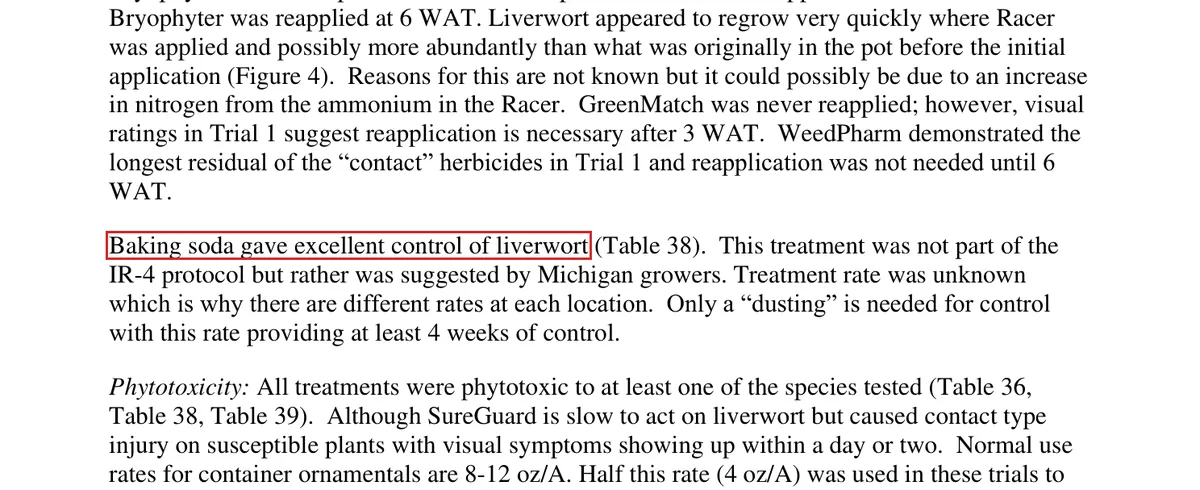
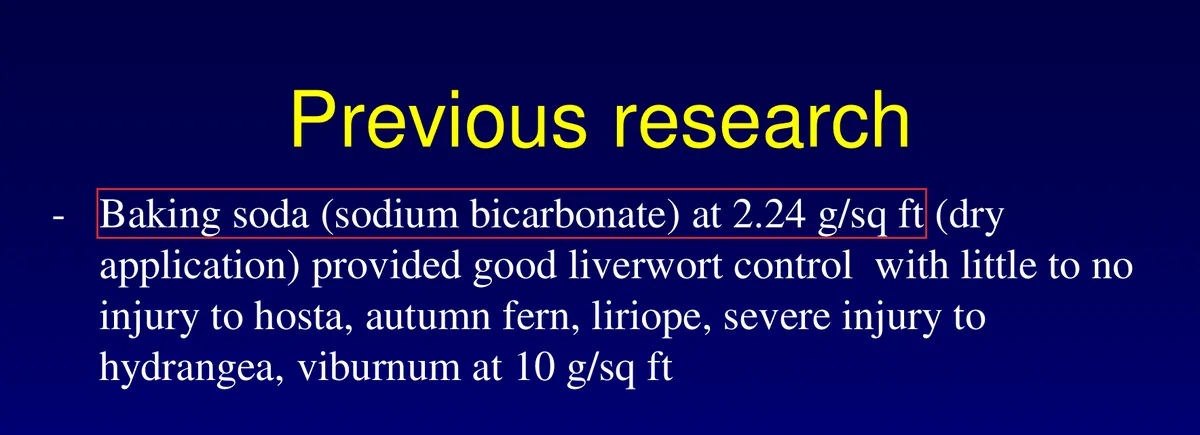
| Liverwort in nursery containers (Virginia Tech) | 2 to 4 g per sq ft, dry | Fair to good control; hosta, autumn fern and liriope barely injured at 2.24 g | 10 g per sq ft severely injured hydrangea and viburnum | Derr, slides 32 to 33 |
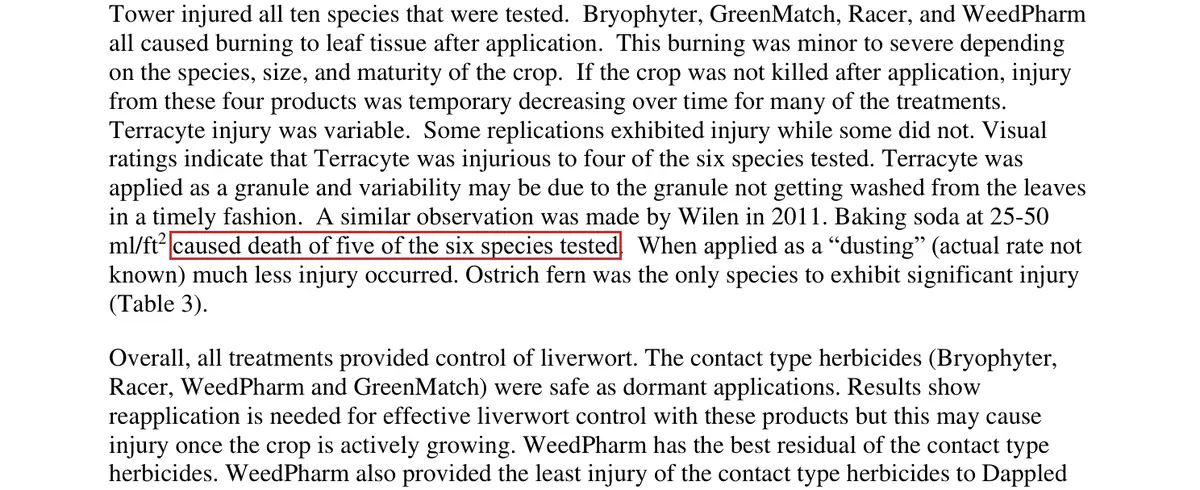
| Liverwort, 3 Michigan nurseries (Mathers 2011) | 25 or 50 mL per sq ft (about 23 to 47 g) | Complete control all season; a light dusting held at least 4 weeks | 25 to 50 mL killed 5 of 6 crop species; 50 mL killed hydrangeas and willow in one dose | IR-4, 2023, pp. 42, 43, 65 |
| Moss on creeping bentgrass greens (Illinois, Kansas) | 44.2 g per liter, about 2 mL per moss colony | Suppressed moss as well as the herbicide carfentrazone | Bentgrass tip burn within 10 cm of treated colonies, gone within 14 days | Kennelly and others, 2010 |
| Lamb’s quarters, wild buckwheat in potatoes (Canada) | Sandblasted with a bioherbicide; rate not published | Good control; baking soda the best of the blast grits | No potato injury or yield loss | AAFC, McKenzie-Gopsill |
| Crabgrass in St. Augustine, bahia, bermuda lawns | Powder of 40 to 80% baking soda, flour and cinnamon on wet blades | Inventor reports crabgrass dead in 68 to 72 hours | Inventor reports no turf damage; no replication or untreated plot | US Patent 6,756,341 B2 |
| Dandelion, clover, bindweed, any perennial | None found | No trial | No trial | Our search, Nov. 2026; UF/IFAS EP580 |
The pattern is plain. Moss and liverwort have no true roots, and a contact salt dries them out; the IR-4 report says only a dusting was needed. Seed plants are a different target, and UF/IFAS EP580 notes that most online herbicide recipes have never been tested. Rooted weeds treated by sprinkle or spray get our answer by analogy, through sodium. For moss in turf, our lawn moss control guide lists EPA-labeled iron and soap products with rates.
How baking soda burns a weed
Sodium bicarbonate (NaHCO3, molecular weight 84.007 per PubChem) dissolves into sodium and bicarbonate ions on a wet leaf. The salt pulls water out of the cells it touches, which Kennelly’s team describes as desiccation of living cells. It does not move through the plant, so only coated tissue dies, and a crown or root below the powder survives.
That is why every extension voice in the results limits it to seedlings. Colorado State’s Linda Langelo told Martha Stewart that established perennials are less affected, and University of Minnesota educator Robin Trott told the same publisher it suits small, shallow-rooted weeds in pavement cracks. Our page on killing weeds between pavers covers crack weeds; perennial roots are covered in our guide to killing dandelions without killing grass.
Kitchen recipes next to research doses
| Recipe or rate | Baking soda | Concentration or dose | Sodium | Table salt with the same sodium |
|---|---|---|---|---|
| 1 tsp dry on one weed (The Spruce) | 4.6 g | 41 g per sq ft on a 4 x 4 in weed | 1.26 g | 0.54 tsp |
| 1 tbsp dry | 13.8 g | 124 g per sq ft on the same weed | 3.78 g | 1.6 tsp |
| 10 tbsp per gallon spray (The Spruce) | 138 g per gallon | 36.5 g per liter | 37.8 g per gallon | 16 tsp per gallon |
| 1 cup per gallon (Almanac) or 1 tbsp per cup (The Spruce) | 221 g per gallon | 58.3 g per liter | 60.4 g per gallon | 26 tsp (0.53 cup) per gallon |
| Research: moss spot spray (Kennelly 2010) | 167 g per gallon | 44.2 g per liter | 45.8 g per gallon | 20 tsp per gallon |
| Research: liverwort dusting (Derr) | 2 to 4 g per sq ft | 0.2 to 0.4 g on a 4 x 4 in weed (about 1/16 tsp) | 0.5 to 1.1 g per sq ft | 0.24 to 0.47 tsp per sq ft |
Two numbers stand out. The 10-tablespoon spray, at 36.5 g per liter, sits inside the 37 to 55 g per liter range Pennsylvania researchers used to kill moss, so it is not a weak mix. And a gallon of the 1-cup recipe carries 60 g of sodium, the same as 0.53 cup of table salt. A teaspoon on one 4-inch weed works out to 41 g per sq ft, close to the 47 g that killed nursery hydrangeas.
Enter how many weeds you treat and how, and the calculator returns the baking soda, the sodium and its table-salt equivalent.
- Baking soda (g)
- 92
- Baking soda (cups)
- 0.42
- Sodium (g)
- 25.2
- Teaspoons of table salt with the same sodium
- 10.8
Default: 20 weeds at 1 tsp, once = 92 g (0.42 cup) of baking soda, 25.2 g of sodium, the sodium in 10.8 tsp of table salt. USDA FDC: 4.6 g per tsp, 27.36% sodium; table salt 6 g per tsp, 38.76% sodium.
Does baking soda kill grass?
Yes, wherever enough of it lands. In the Kennelly trial, a careful spot spray of about 2 mL per moss colony still drifted: bentgrass within 10 cm (4 inches) of treated colonies turned gray-brown from tip burn after a fall application in Illinois, gone within 14 days, and tip burn showed 3 days after one in Kansas. In the IR-4 nursery trials, 50 mL per sq ft killed shrubs outright, so a lawn dusted at the teaspoon rate is taking a shrub-killing dose.
The viral crabgrass trick says baking soda kills crabgrass and spares St. Augustine. The only data behind it is a 2002 patent whose inventor reports dead crabgrass in 68 to 72 hours. The nearest real trial used table salt: McCullough and Raymer (2011) got 90 to 100 percent control of tillered smooth crabgrass at 976 kg per hectare, the sodium of about 13 g of baking soda per sq ft, yet common bermudagrass took over 20 percent injury at half that rate.
Grass type explains the mixed reports. UF/IFAS LH005 rates St. Augustine, bermuda and zoysia good for salt tolerance and bahia very poor, so the same dusting can look selective in one Florida lawn and leave a dead patch in the next. For crabgrass in turf, the labeled options in our guide to a crabgrass killer that will not kill grass are tested on named turf species.
| Claim in the results | Where it appears | What the evidence says |
|---|---|---|
| “Does baking soda kill weeds permanently? Yes” | The Spruce | Contact only: CSU’s Linda Langelo calls it less effective on established perennials, and a garden coach quoted by Martha Stewart says deep-rooted weeds reemerge. |
| “One of its major ingredients is salt” | The Spruce | It is a salt itself: 27.36 percent sodium by weight (USDA FDC). |
| “Baking soda neutralizes the ph in the soil and nothing will grow there” | Gardening forum thread in the results | Sodium, not pH, is the lasting effect; CSU puts sodic soil at SAR 13 or ESP 15. |
| Kills crabgrass without harming St. Augustine | Forums, videos, patent | Patent anecdote only; salt trial injured bermudagrass at half the crabgrass dose. |
Sodium left behind in the soil
Rain carries the sodium off the leaf and into the soil, where it swaps onto clay in place of calcium. Colorado State Extension classes a soil as sodic at a sodium adsorption ratio of 13 or an exchangeable sodium percentage (ESP) of 15, often with pH above 8.5, and warns that sodium disperses clay so the soil crusts and drains poorly. We worked out how much baking soda reaches ESP 15 in the top 3 inches of 1 sq ft.
| Soil | Assumed CEC (meq/100 g) | Sodium for ESP 15 | Baking soda | Teaspoons per sq ft |
|---|---|---|---|---|
| Sandy soil | 5 | 1.6 g | 6 g | 1.3 tsp |
| Loam | 15 | 4.8 g | 17 g | 3.8 tsp |
| Clay soil | 30 | 9.5 g | 35 g | 7.6 tsp |
The teaspoon-per-weed habit lands about 9 teaspoons per sq ft on the weed’s footprint, more than the clay figure. One dose on a crack weed rinses away; repeat it on the same bed edge and the sodium accumulates. Our guide to raising soil pH covers the alkalinity side, and the UC Master Gardeners of Sonoma County warn that repeated baking soda sprays add salt that damages plant life.
Baking soda, vinegar or another method?
Mixing the two kitchen favorites cancels them. Sodium bicarbonate neutralizes acetic acid mole for mole (PubChem weights), so each tablespoon of baking soda uses up about 197 mL of 5 percent vinegar. A cup stirred into a gallon leaves about 0.8 percent acid plus sodium acetate, about a sixth of household vinegar’s 5 percent, which our vinegar weed killer review shows kills only weeds in their first 2 weeks.
| Method | What it kills | What stays in the soil | Federal status | Our page |
|---|---|---|---|---|
| Baking soda | Moss, liverwort; seedlings it coats (no dusting or spray trial on seed plants) | Sodium stays until water leaches it | Not a minimum-risk active; inert only | This page |
| Table salt | Tillered crabgrass at 9.1 g per sq ft (trial) | Sodium and chloride stay | Minimum-risk active (40 CFR 152.25) | Does salt kill weeds and grass? |
| Vinegar, 5 to 20% | Young broadleaf weeds; grasses regrow | Breaks down in days to weeks (EPA) | 20% products EPA-registered | Vinegar weed killer |
| Boiling water | Seedlings at about 3 fl oz per sq ft | None | Not a pesticide | Does boiling water kill weeds? |
| Selective lawn herbicide | Named weeds in named turf | Per label | EPA-registered; the label is the law | Lawn weed killer guide |
The federal rule matters if you buy rather than mix. The minimum-risk exemption at 40 CFR 152.25(f) lists sodium chloride among permitted active ingredients and sodium bicarbonate only among permitted inert ingredients. A product sold with baking soda as its weed-killing ingredient would therefore need EPA registration, and the National Pesticide Information Center notes that home remedies come with no label telling you how much, where or how often.
1Is the weed in a lawn or within about 4 inches of grass or plants you want to keep?
YesSkip it. Drift from a 2 mL spot spray burned bentgrass up to 10 cm away (Kennelly 2010). Dig the weed or use a selective lawn product.
NoGo to the next question
2Is it a perennial with a taproot or runners (dandelion, bindweed, nutsedge)?
YesExpect regrowth: baking soda kills only coated leaves. Dig out the root or use a product that moves to the roots.
NoGo to the next question
3Is the spot in a bed you will replant, or on clay soil?
YesSkip it. About 4 tsp per sq ft can carry loam to ESP 15 in the top 3 inches, the CSU sodic line, and sodium disperses clay.
NoGo to the next question
4Is it moss or liverwort on paving or in pots?
YesThis is where the research is: 2 to 4 g per sq ft dry, or 44 g per liter as a spot spray, with no product label behind either.
NoA seedling in a pavement crack: a light dusting on wet leaves on a dry day may burn it. Pull the dead weed and refill the joint so seeds have nowhere to root.
Source: Kennelly 2010; IR-4 2023; Derr, Virginia Tech; CSU Extension; our ESP arithmetic
How we compiled this
On Nov. 14, 2026 we read the 91-page IR-4 liverwort report, the Kennelly 2010 paper and Derr’s Virginia Tech slides in full, the McCullough 2011 and Thelen 1995 abstracts, a 2002 patent, CSU, UF/IFAS, UC and NPIC pages, the eCFR text of 40 CFR 152.25 and USDA and PubChem data. We searched Google Scholar phrasings and extension sites for a dusting or spray trial of baking soda on seed-plant weeds and found none. We applied baking soda to nothing; every gram, teaspoon and ESP figure is arithmetic with its assumptions shown.
This page is general information, not pesticide or legal advice. Homemade mixtures carry no EPA label, as NPIC notes; follow the label of any product you buy, and keep powders and sprays away from plants you want to keep.
Frequently asked questions
How long does it take for baking soda to kill weeds?
Days. Bentgrass showed tip burn 3 days after a spot spray (Kennelly 2010), IR-4 saw liverwort controlled within 1 week, and the crabgrass patent reports dead blades in 68 to 72 hours. Check at 2 weeks: green growth from the crown means the roots survived.
What kind of weeds does baking soda kill?
The measured targets are moss and liverwort, which have no roots, at 2 to 4 g per sq ft dry. Seedlings it coats in pavement cracks may die the way they do under salt, but no dusting or spray trial on seed plants exists. Perennials such as dandelion and bindweed regrow from roots.
Does baking soda keep working after rain?
No. Rain rinses it off the leaves and into the soil, where the sodium stays. Researchers withheld irrigation for at least 12 hours after spraying moss, and IR-4 notes contact products work better when irrigation is delayed.
Is baking soda or vinegar better for killing weeds?
Vinegar has field trials and EPA-registered 20 percent products, and EPA says acetic acid breaks down in days to weeks. Baking soda has neither for seed-plant weeds and leaves sodium behind. Do not mix them: the reaction cancels the acid.
Is it okay to sprinkle baking soda on grass?
Not as a weed or fungus treatment. It burned bentgrass in a moss trial, and kitchen baking soda is not a registered lawn fungicide; our page on lawn fungus diseases lists the registered potassium bicarbonate products instead.
Sources
- IR-4 Project, Environmental Horticulture Program (C. L. Palmer), Liverwort Efficacy research summary, incl. Mathers 2011 Michigan trials, Aug. 31, 2023. Accessed November 2026.
- Kennelly, Todd, Settle and Fry, HortScience 45(4):654 to 659, Moss Control on Creeping Bentgrass Greens with Standard and Alternative Approaches, 2010. Accessed November 2026.
- Jeffrey Derr, Virginia Tech (conference slides), Alternatives to Synthetic Herbicides for Nursery Weed Control, undated. Accessed November 2026.
- Agriculture and Agri-Food Canada, Weed hunters reloaded: scientists targeting troublesome weeds with grit and innovation, accessed Nov. 2026. Accessed November 2026.
- McCullough and Raymer, Weed Technology 25(4), Sodium Chloride Efficacy for Smooth Crabgrass Control and Safety to Common Bermudagrass and Seashore Paspalum (abstract), 2011. Accessed November 2026.
- U.S. Patent and Trademark Office, via Google Patents, US 6,756,341 B2, Natural herbicide for weed removal (S. A. Grimm), filed Nov. 26, 2002; issued June 29, 2004. Accessed November 2026.
- USDA Agricultural Research Service, FoodData Central, Leavening agents, baking soda, FDC 175040, accessed Nov. 14, 2026. Accessed November 2026.
- USDA Agricultural Research Service, FoodData Central, Salt, table, FDC 173468, accessed Nov. 14, 2026. Accessed November 2026.
- National Library of Medicine, PubChem, Sodium bicarbonate, CID 516892 (molecular weight 84.007), accessed Nov. 2026. Accessed November 2026.
- National Library of Medicine, PubChem, Acetic acid, CID 176 (molecular weight 60.05), accessed Nov. 2026. Accessed November 2026.
- Colorado State University Extension, Managing Sodic Soils, accessed Nov. 2026. Accessed November 2026.
- eCFR, 40 CFR 152.25(f), minimum risk pesticides, Tables 1 and 2, current as of Nov. 14, 2026. Accessed November 2026.
- UF/IFAS Extension, LH005, Selecting a Turfgrass for Florida Lawns, accessed Nov. 2026. Accessed November 2026.
- UF/IFAS Extension (Marble, Neal, Senesac), EP580, Use of Glyphosate and Herbicide Alternatives for Weed Control in Florida Landscapes, accessed Nov. 2026. Accessed November 2026.
- UC Master Gardener Program of Sonoma County, Debunking a few common garden remedy myths, June 13, 2026. Accessed November 2026.
- National Pesticide Information Center, Pesticide Home Remedies, updated Oct. 14, 2025. Accessed November 2026.
- The Spruce, Yes, Baking Soda Can Kill Weeds (claims compared), accessed Nov. 14, 2026. Accessed November 2026.
- Old Farmer’s Almanac, Baking Soda Weed Killer: Tips and Tricks for a Homemade Solution (recipe compared), accessed Nov. 14, 2026. Accessed November 2026.
- Martha Stewart, How to Use Baking Soda to Get Rid of Weeds in Driveway and Sidewalk Cracks (extension quotes), accessed Nov. 14, 2026. Accessed November 2026.