How to raise pH in soil: mix ground limestone 6 inches deep at the rate your soil test’s buffer pH sets, 14 to 197 lb of calcium carbonate per 1,000 sq ft for pH 6.5, divided by the product’s CCE. Retest in 6 months.
Knowing how to raise pH in soil starts with two numbers on a lab report, not one. Soil pH says whether to lime; buffer pH says how much, and Iowa State Extension notes that its lime table uses the buffer figure, not the soil pH. Two soils both reading pH 5.8 can need 14 lb or 197 lb of calcium carbonate per 1,000 sq ft, depending on whether their buffer pH is 6.8 or 5.7 (Iowa State PM 1688, Table 16).
This page turns that lab math into pounds for a garden bed, a 3-inch lawn layer and a single 100 sq ft bed, then converts the result into 15 materials people actually reach for, from pelletized lime to wood ash, eggshells and baking soda. None of the top 5 results we read in November 2026 gave a rate by buffer pH for a bed and a lawn together, or showed what the popular baking soda method adds in sodium: about 3 lb per 100 sq ft at a typical lime rate.
Step 1: Check whether the soil needs a higher pH at all
Raise pH only when a lab reading sits below the range for what you grow. Clemson Extension (HGIC 1650, reviewed May 2026) puts most vegetables and ornamentals at pH 5.8 to 6.5 and acid-loving plants at 5.0 to 5.5; Iowa State names 6.0 to 7.0 as ideal for most plants. Blueberries want 4.5 to 5.2, per UVM Extension, so lime or ash near them works against you.
| What you grow | Target soil pH | Raise pH when the test reads below | Source |
|---|---|---|---|
| Most vegetables and ornamentals | 5.8 to 6.5 | 5.8 | Clemson HGIC 1650 |
| Most garden plants (Iowa) | 6.0 to 7.0 | 6.0 | Iowa State |
| Azaleas, rhododendrons, conifers | 5.0 to 5.5 | 5.0; usually never limed | Clemson HGIC 1650 |
| Blueberries | 4.5 to 5.2 | 4.6 (Arkansas lab trigger) | UVM; Arkansas FSA2201 |
| Lawn grasses | 5.0 to 7.0 by species | See our lime for lawn guide | GIR lime for lawn |
A kit or probe gives pH but not buffer pH, so it can tell you whether to lime but not how much. A routine lab test runs $0 to $40 at the state labs in our soil test guide, and labs report buffer pH only when pH is low enough that lime may be needed (Iowa State). If a drop of vinegar makes dry soil fizz, the soil already holds free lime: Colorado State uses that test, and lime will not help.
Step 2: Turn buffer pH into pounds of calcium carbonate
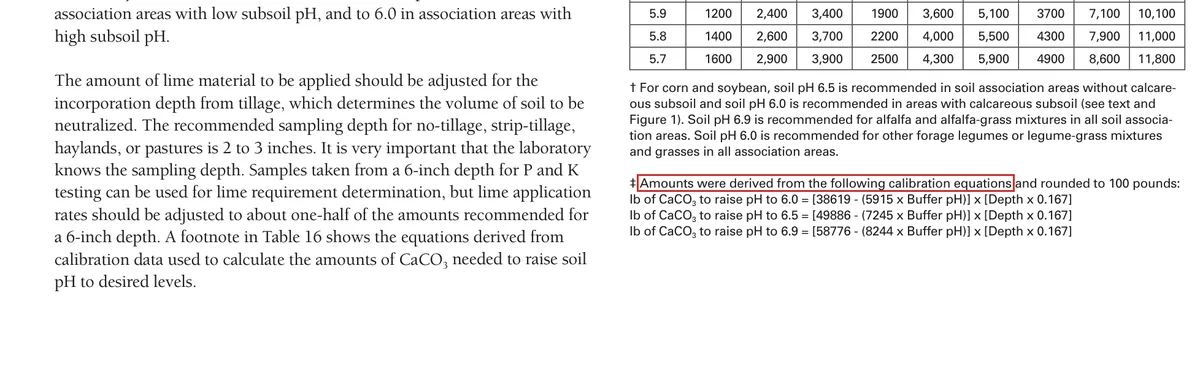
Find your buffer pH in the first column. The rates are pounds of pure, finely ground calcium carbonate from Iowa State’s PM 1688 (October 2013), Table 16, calibrated for the SMP and Sikora buffer methods, which we divided by 43.56 to get pounds per 1,000 sq ft. A tilled bed is limed through 6 inches; an established lawn only through the top 3, so its rate is about half.
Swipe the table sideways to see every column.
| Buffer pH on report | 6-inch bed to pH 6.0 (lb per 1,000 sq ft) | 6-inch bed to pH 6.5 (lb per 1,000 sq ft) | Same, per 100 sq ft bed (lb) | 6-inch bed to pH 6.9 (lb per 1,000 sq ft) | 3-inch lawn layer to pH 6.5 (lb per 1,000 sq ft) | Iowa table, 6-inch to pH 6.5 (lb per acre) |
|---|---|---|---|---|---|---|
| 7.0 | 0 | 0 | 0 | 25.3 | 0 | 0 |
| 6.9 | 0 | 0 | 0 | 43.6 | 0 | 0 |
| 6.8 | 0 | 13.8 | 1.4 | 62 | 6.9 | 600 |
| 6.7 | 0 | 29.8 | 3 | 80.3 | 16.1 | 1,300 |
| 6.6 | 0 | 48.2 | 4.8 | 101 | 25.3 | 2,100 |
| 6.5 | 4.6 | 64.3 | 6.4 | 119.4 | 32.1 | 2,800 |
| 6.4 | 18.4 | 80.3 | 8 | 137.7 | 41.3 | 3,500 |
| 6.3 | 32.1 | 96.4 | 9.6 | 156.1 | 48.2 | 4,200 |
| 6.2 | 45.9 | 114.8 | 11.5 | 176.8 | 57.4 | 5,000 |
| 6.1 | 57.4 | 130.9 | 13.1 | 195.1 | 66.6 | 5,700 |
| 6.0 | 71.2 | 146.9 | 14.7 | 213.5 | 73.5 | 6,400 |
| 5.9 | 84.9 | 163 | 16.3 | 231.9 | 82.6 | 7,100 |
| 5.8 | 98.7 | 181.4 | 18.1 | 252.5 | 91.8 | 7,900 |
| 5.7 | 112.5 | 197.4 | 19.7 | 270.9 | 98.7 | 8,600 |
- 6-inch bed to pH 6.5
- 6-inch bed to pH 6.0
- 3-inch lawn layer to pH 6.5
Source: Iowa State PM 1688 Table 16 (Oct. 2013); lb per acre divided by 43.56 Pure CaCO3. Divide by your product's CCE for pounds of product.
Show the numbers
| 6-inch bed to pH 6.5 | 6-inch bed to pH 6.0 | 3-inch lawn layer to pH 6.5 | |
|---|---|---|---|
| 6.8 | 13.80 | 0 | 6.90 |
| 6.7 | 29.80 | 0 | 16.10 |
| 6.6 | 48.20 | 0 | 25.30 |
| 6.5 | 64.30 | 4.60 | 32.10 |
| 6.4 | 80.30 | 18.40 | 41.30 |
| 6.3 | 96.40 | 32.10 | 48.20 |
| 6.2 | 114.80 | 45.90 | 57.40 |
| 6.1 | 130.90 | 57.40 | 66.60 |
| 6.0 | 146.90 | 71.20 | 73.50 |
| 5.9 | 163 | 84.90 | 82.60 |
| 5.8 | 181.40 | 98.70 | 91.80 |
| 5.7 | 197.40 | 112.50 | 98.70 |
The curve is close to a straight line because Iowa State derived it from calibration equations; the 6.5 target is 49,886 minus 7,245 times buffer pH, times depth times 0.167, in pounds per acre. Each 0.1 drop in buffer pH adds about 16 lb per 1,000 sq ft to a 6-inch bed.
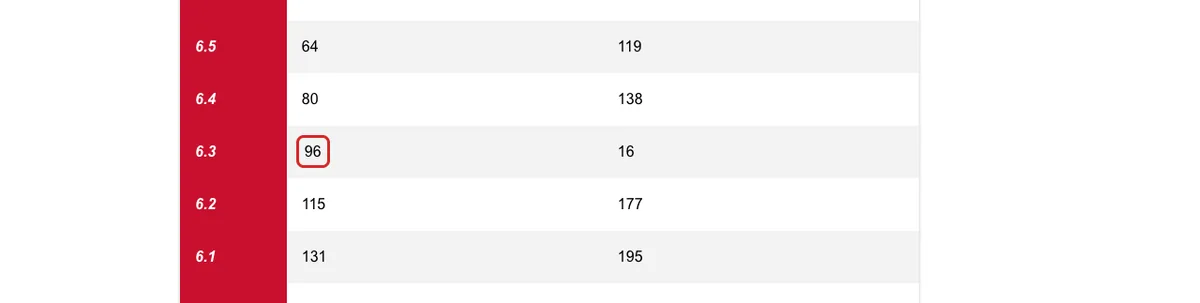
Check the web copy against the PDF. Iowa State’s How To Change Your Soil’s pH page (reviewed April 2026) prints 16 lb per 1,000 sq ft at buffer pH 6.3 for a 6.9 target, between 138 and 177 in the rows beside it. PM 1688 gives 6,800 lb per acre for that cell, which is 156 lb per 1,000 sq ft; the web value looks like a dropped digit.
No buffer pH on your report? Use texture and color
Without a buffer number, Colorado State Extension gives a rule of thumb by soil texture and organic matter. Its Table 2 is in pounds per acre to reach pH 6.5; we converted it below, with the per-100 sq ft figure in brackets. Darker, higher-organic soils and finer textures resist change, so they take more lime at the same starting pH.
| Soil color | Texture | Starting pH 4.5 | Starting pH 5.0 | Starting pH 5.5 | Starting pH 6.0 |
|---|---|---|---|---|---|
| Light colored (about 1% organic matter) | Sandy loam | 91.8 (9.2) | 68.9 (6.9) | 45.9 (4.6) | 11.5 (1.1) |
| Light colored (about 1% organic matter) | Silt loam | 137.7 (13.8) | 114.8 (11.5) | 68.9 (6.9) | 23 (2.3) |
| Light colored (about 1% organic matter) | Silty clay loam | 183.7 (18.4) | 160.7 (16.1) | 114.8 (11.5) | 45.9 (4.6) |
| Dark colored (about 2.5% organic matter) | Sandy loam | 137.7 (13.8) | 114.8 (11.5) | 68.9 (6.9) | 23 (2.3) |
| Dark colored (about 2.5% organic matter) | Silt loam | 183.7 (18.4) | 137.7 (13.8) | 91.8 (9.2) | 45.9 (4.6) |
| Dark colored (about 2.5% organic matter) | Silty clay loam | 229.6 (23) | 183.7 (18.4) | 137.7 (13.8) | 68.9 (6.9) |
One top-ranking garden blog prints 2 lb per 100 sq ft for sandy soil, 3.5 for loam and 5 for clay with no starting pH (Kellogg Garden, 2020). In Colorado State’s table a light sandy loam at pH 5.5 already needs 4.6 lb per 100 sq ft, and a dark silty clay loam at pH 4.5 needs 23, so a single number per texture can miss by 4 times or more.
Step 3: Convert to pounds of the product you will spread
Divide the calcium carbonate rate by the product’s calcium carbonate equivalent (CCE) written as a decimal: Ohio State’s HYG-4026 gives the same formula. Fineness changes speed, so Iowa and Arkansas use an effective CCE (ECCE) that multiplies CCE by a fineness score and dry matter, with factors of 0.1, 0.3 and 0.6 for the 4-, 8- and 60-mesh fractions under the Iowa Agricultural Limestone Act (Holmes and others, 2011).
Swipe the table sideways to see every column.
| Material | Calcium carbonate equivalent | Pounds equal to 10 lb of CaCO3 | What else it adds | Speed or limit | Source |
|---|---|---|---|---|---|
| Calcium carbonate, pure (the lab’s reference) | 100% | 10 | Calcium | Reference value for every lime rate on a soil report | Colorado State |
| Calcitic limestone (ag lime) | 95 to 100% (Arkansas); 60 to 90% for aglime with impurities (Colorado State) | 10 to 17 | Calcium | Speed set by fineness: 200-mesh dust reacts in about 1 month, 60-mesh in about 1 year | Arkansas FSA2201 |
| Dolomitic limestone | 85 to 108% (Arkansas); 109% for pure dolomite (Colorado State) | 9.2 to 11.8 | Calcium and magnesium | Arkansas: a good option when the soil is also low in magnesium | Arkansas FSA2201 |
| Pelletized limestone | About 90% for most products (Arkansas) | 11.1 | Calcium, plus magnesium if dolomitic | Arkansas key points: reacts quickly, but not quicker than ag lime at equal effective rates | Arkansas FSA2201 |
| Hydrated lime, calcium hydroxide | 120 to 135% (Arkansas); 135% (Colorado State); 140% (Ohio State) | 7.1 to 8.3 | Calcium | Fast; hazardous; Ohio State caps it at 20 lb per 1,000 sq ft | Ohio State HYG-4026 |
| Burned lime, quicklime, calcium oxide | 179% (Colorado State); 180% (Ohio State) | 5.6 | Calcium | Hazardous; Ohio State caps it at 10 lb per 1,000 sq ft | Ohio State HYG-4026 |
| Basic slag | 50 to 70% (Arkansas) | 14 to 20 | Calcium, magnesium silicates, some phosphate | Steel by-product; farm-scale material | Arkansas FSA2201 |
| Wood ash, untreated wood | 20 to 60% (Arkansas); 25 to 59% (UNH) | 17 to 50 | About 5% potassium and 25% calcium (UNH) | UNH: no more than 20 lb per 1,000 sq ft in a garden at pH 6.5; salts can hurt germination | UNH Extension |
| Ground eggshells (egg-breaking plant) | 56 to 74% CCE; ECCE only 300 to 400 lb per ton because they were coarse (Iowa State) | 14 to 18 by CCE | Calcium; some nitrogen | Raised pH 2 to 3 times more than their ECCE predicted in Iowa field plots | Iowa State, 2011 |
| Baking soda, sodium bicarbonate | 59.6% by formula (our arithmetic from PubChem molecular weights) | 16.8 | 27.4% sodium by weight | Sodium disperses clay; Colorado State classes soil as sodic above 15% exchangeable sodium | PubChem |
| Gypsum, calcium sulfate | None: does not raise pH | No amount | Calcium and sulfur | Arkansas and Iowa State: no net change in soil pH | Arkansas FSA2201 |
| Epsom salt, magnesium sulfate | None: does not raise pH | No amount | Magnesium and sulfur | Arkansas: will not raise soil pH | Arkansas FSA2201 |
| Liquid lime at a few gallons per acre | Too little carbonate to matter | Not achievable at label rates | Calcium | Arkansas: will not raise soil pH to desired values | Arkansas FSA2201 |
| Spent coffee grounds | Not a liming material | No amount | Organic matter | Oregon State: pH 6.5 to 6.8 after brewing | Oregon State |
| Coal ash | None: no lime value | No amount | Varies | Clemson: no lime value, may be acidic | Clemson HGIC 1650 |
The calculator below runs the same arithmetic for any bed or lawn size: area times the buffer-pH rate, times depth, divided by CCE. Its default is the worked example underneath, a new 200 sq ft vegetable bed with buffer pH 6.4 and a pH 6.5 target.
- Pounds of product
- 17.9
Pounds = area × buffer-pH rate ÷ 1,000 × depth factor ÷ CCE. Default: 200 sq ft at buffer pH 6.4, 6-inch bed, 90% CCE lime = 17.9 lb. Split anything over 50 lb per 1,000 sq ft on established plantings (Ohio State).
| Material | Pounds for a 200 sq ft bed | What limits it | Source |
|---|---|---|---|
| Lab rate as pure calcium carbonate | 80.3 lb per 1,000 sq ft x 0.2 = 16.1 lb | Buffer pH 6.4, target 6.5, 6-inch depth | Iowa State PM 1688, Table 16 |
| Ground or pelletized limestone, 90% CCE on the label | 16.1 ÷ 0.900 = 17.9 lb | Tilled into bare soil in one go; on a lawn this 89 lb per 1,000 sq ft rate would take 2 passes under Ohio State’s 50 lb cap | Ohio State HYG-4026 |
| Hydrated lime, 135% CCE | 16.1 ÷ 1.350 = 11.9 lb | Ohio State: hazardous; at most 20 lb per 1,000 sq ft per application (4 lb here) | Colorado State; Ohio State |
| Wood ash at 40% CCE (middle of UNH’s 25 to 59%) | 16.1 ÷ 0.400 = 40.2 lb | 10 times UNH’s 20 lb per 1,000 sq ft garden limit (4 lb here) | UNH Extension |
| Baking soda, 59.6% CCE by formula | 16.1 ÷ 0.596 = 27 lb | Adds 7.4 lb of sodium to the bed | PubChem; our arithmetic |
Only the limestone row is practical. On a lawn, hydrated lime would take 3 passes under Ohio State’s 20 lb ceiling, wood ash would need 10 times UNH’s garden limit, and baking soda would load the bed with sodium. For an established lawn the 3-inch column applies: buffer pH 6.2 means 57 lb of calcium carbonate, or 64 lb of a 90% lime, which Ohio State’s 50 lb per 1,000 sq ft cap splits into 2 passes; the rest of the lawn method is in our lime for lawn guide.
Does baking soda raise soil pH?
Yes, but at a cost no lime-based method carries. Sodium bicarbonate neutralizes one unit of acid per 84 g while calcium carbonate neutralizes two per 100 g, so baking soda works at about 60% of lime’s strength by weight (PubChem molecular weights, our arithmetic). Every pound also carries 27.4% sodium, matching the 27,360 mg per 100 g in USDA FoodData Central record 175040.
The popular tablespoon-per-gallon drench delivers about 8.2 g of calcium carbonate equivalent per gallon, using FoodData Central’s 4.6 g per teaspoon. A 100 sq ft bed at buffer pH 6.5 needs 6.4 lb of calcium carbonate, which works out to 10.8 lb of baking soda, about 355 gallons of that drench, and 3 lb of sodium.
Sodium is the problem lime avoids. Colorado State Extension says sodium on clay particles makes them disperse, which wrecks structure and slows water infiltration, and classes soil as sodic above 15% exchangeable sodium or an SAR of 13. Leave baking soda out of pH plans: ground limestone does the same job at about 1.7 times the neutralizing power per pound and adds calcium instead of sodium.
Wood ash, eggshells and other lime substitutes
Wood ash is the one substitute extension services endorse, in small doses. UNH Extension measures it at 25 to 59% CCE with about 5% potassium and 25% calcium, needs 2 to 4 times as much ash as limestone for the same pH effect, and says a 1,000 sq ft garden at pH 6.5 would generally need no more than 20 lb. UVM Extension puts 15 to 20 lb at one 5-gallon bucket.
At UNH’s 20 lb cap, ash supplies only 5 to 12 lb of calcium carbonate equivalent per 1,000 sq ft, against the 64 lb a bed at buffer pH 6.5 needs, so treat it as maintenance. Arkansas Extension warns that large applications build up salts, and Clemson says coal ash has no lime value. Keep ash off blueberries, rhododendrons and germinating seed (UNH).
Eggshells do neutralize acid. In two Iowa field trials, ground shells from egg-breaking plants tested 56 to 74% CCE yet raised pH more per pound of ECCE than ag lime; measured 18 to 78 months after application, the authors put the needed ECCE correction at 1.9 and 2.9 times, or 2 to 3 times (Iowa State, 2011). Kitchen shells are coarser: Penn State Extension says whole shells can take decades to break down, so grind them to powder or compost them.
Several common answers do not raise pH at all. Arkansas FSA2201 says gypsum, calcium chloride and Epsom salt will not raise pH, because the carbonate, hydroxide or oxide does the neutralizing, not the calcium. Spent coffee grounds sit near neutral at pH 6.5 to 6.8 after brewing (Oregon State, 2023), so they move pH neither way in a measurable amount.
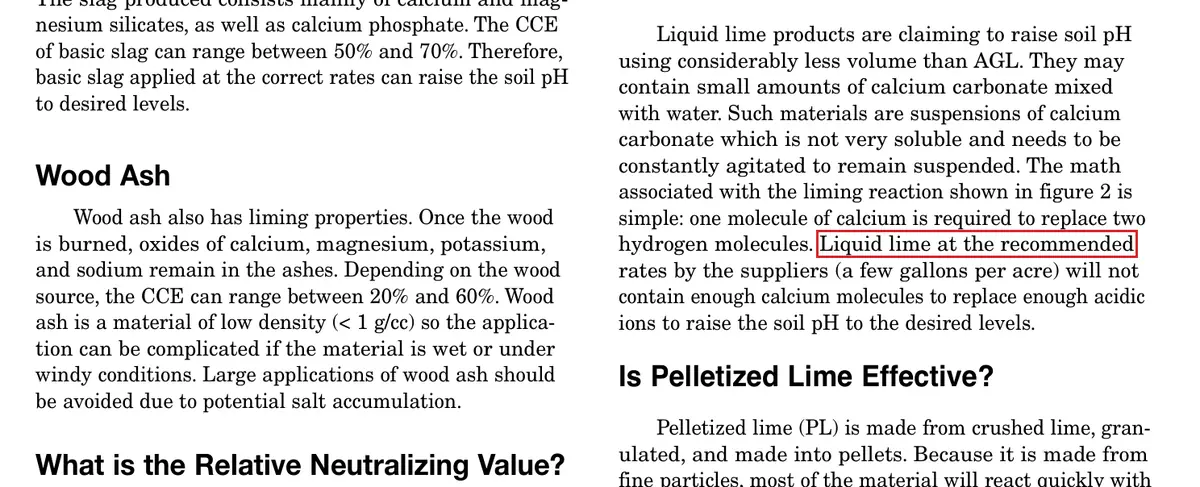
The same Arkansas bulletin addresses liquid lime: at supplier rates of a few gallons per acre it cannot carry enough calcium carbonate to replace the acidity in the soil, because one calcium ion replaces only two hydrogen ions. Compare any liquid product by the pounds of calcium carbonate equivalent it supplies per 1,000 sq ft against the Step 2 table.
Step 4: Mix it in, then wait and retest
Lime is not water soluble, so placement decides how fast it works. Iowa State says to incorporate lime 6 to 8 inches deep with a tiller, shovel or disk before planting, in spring or fall when soil is above 55°F. Clemson says to apply it 2 to 3 months before planting, and Arkansas notes calcium carbonate barely moves down through the profile once applied.
- Test in fall for next year’s garden (Clemson) and note pH, buffer pH, magnesium and texture. Our soil test guide covers sampling.
- Look up pounds of calcium carbonate in the Step 2 table for your buffer pH, target and depth, and multiply by your area in thousands of sq ft.
- Divide by the bag’s CCE as a decimal. Pick dolomitic lime when magnesium tests low (Arkansas).
- Spread evenly over bare soil on a calm day; pellets flow better in a spreader, and finer powder reacts sooner.
- Till or dig it 6 to 8 inches deep (Iowa State). On a planted bed, rake it into the top 1 to 2 inches and split the amount over several years, as Iowa State advises, to protect roots. Our tilling guide covers depth and timing.
- Water it in thoroughly; lime reacts slowly in dry soil (Clemson).
- Retest after 6 months before planting perennials, and add more only if pH is still short of target (Iowa State).
| Lime particle size or situation | Time to react | Source |
|---|---|---|
| Passes 200-mesh (0.07 mm) | About 1 month | Arkansas FSA2201 |
| Passes 100-mesh (0.15 mm) | Less than 3 months | Arkansas FSA2201 |
| Passes 60-mesh (0.25 mm) | About 1 year | Arkansas FSA2201 |
| Held on 10-mesh (over 2 mm) | Little effect on pH | Arkansas FSA2201 |
| Ag lime blend (fines plus particles up to 0.5 mm) | Fines soon after application; coarse part over 1 year | Arkansas FSA2201 |
| Whole field: apply ahead of the crop | 6 to 12 months; full reaction 12 to 18 months | Arkansas FSA2201 |
On heavy soil the extra rate comes from buffering, not from texture alone: our guide to improving clay soil covers compost rates that change structure, which lime does not. If a later test overshoots past pH 7.0, sulfur reverses it at the rates in our soil acidifying guide, though Colorado State calls lowering pH difficult and raising it relatively easy.
What is the fastest way to raise soil pH?
Use the finest calcium carbonate you can buy and mix it in moist soil. In Arkansas’s figures, particles passing a 200-mesh screen react in about 1 month and 100-mesh in under 3 months, while 60-mesh particles can take a year. Pelletized lime is made from fine particles, but Arkansas’s key points say it is not quicker than ag lime applied at an equal effective rate.
Hydrated lime is the genuinely fast option and the risky one. It runs 120 to 140% CCE, so you need 17 to 29% less by weight, but Ohio State lists it as hazardous and difficult to apply, with a maximum of 20 lb per 1,000 sq ft per application against 50 lb for ground limestone. Anything above the cap is split in half and applied at 2 times of the year, per Ohio State.
1Do you have a lab soil test from the past 3 years?
Yes
NoTest first: a kit gives pH but not the buffer pH that sets the rate.
2Is pH already at or above the target for your plants (5.8 to 6.5 for most vegetables, Clemson)?
YesDo not lime.
NoGo to the next question
3Are you growing blueberries, azaleas or rhododendrons (target 4.5 to 5.5)?
YesDo not lime or add wood ash near them.
NoGo to the next question
4Does dry soil fizz with vinegar?
YesFree lime is present; do not lime (Colorado State).
NoGo to the next question
5Does the report give a buffer pH?
YesUse the Step 2 buffer table, then divide by CCE.
NoUse Colorado State's texture and color table, then divide by CCE.
6Is it bare soil you can till 6 to 8 inches deep?
YesApply the full 6-inch rate, mix it in 2 to 3 months before planting, retest at 6 months.
NoGo to the next question.
Established lawn or bed: use the 3-inch rate on the surface, at most 50 lb of ground limestone per 1,000 sq ft per pass (Ohio State), and split the rest over later seasons.
Source: Clemson HGIC 1650; Iowa State; Colorado State; Ohio State HYG-4026
General information, not agronomic advice for a specific site. Rates come from extension calibrations for particular soils and buffer methods; if your lab prints its own lime rate, use the lab’s number. Ohio State lists hydrated and burned lime as hazardous: follow the product label.
How we compiled this
We read 12 extension publications and studies from Iowa State, Arkansas, Colorado State, Ohio State, Clemson, UNH, UVM, Penn State and Oregon State in November 2026, plus PubChem and USDA FoodData Central for the baking soda arithmetic. Lime rates come from Iowa State PM 1688 Table 16 and Colorado State Table 2, converted at 43.56 thousand sq ft per acre. The worked examples and the calculator are arithmetic; we did not test any soil or product.
Frequently asked questions
What is the fastest way to raise the pH of soil?
Mix finely ground limestone into moist soil 6 to 8 inches deep: 200-mesh particles react in about 1 month (Arkansas FSA2201). Hydrated lime acts faster but is caustic and capped at 20 lb per 1,000 sq ft per application (Ohio State). Pellets are not faster than ag lime at equal effective rates.
Does baking soda raise pH in soil?
Yes, at about 60% of lime’s strength, but each pound adds 27% sodium. Raising a 100 sq ft bed at buffer pH 6.5 to pH 6.5 would take about 10.8 lb of baking soda and add 3 lb of sodium, which Colorado State says disperses clay. Use lime instead.
Do coffee grounds raise pH in soil?
No. Oregon State Extension measured spent grounds at pH 6.5 to 6.8 after brewing and calls the idea that they lower soil pH a myth; Penn State gives pH 6.8. They add organic matter, not neutralizing value.
Does Epsom salt make soil more acidic?
Not in a way that matters for liming: Epsom salt is magnesium sulfate, and University of Arkansas Extension lists it with gypsum and calcium chloride as materials that will not raise soil pH. Use dolomitic limestone if you need magnesium and a higher pH together.
What to do if the pH of soil is low?
Get a lab test with buffer pH, look up pounds of calcium carbonate for your target (14 to 197 lb per 1,000 sq ft to reach pH 6.5 in a 6-inch bed, Iowa State), divide by the product’s CCE, mix it in 2 to 3 months before planting and retest after 6 months.
What are signs of low pH in soil?
Plant symptoms are unreliable; a lab test is the sign. In highly acidic soils, Clemson says aluminum and manganese become more available and more toxic to plants, while calcium, phosphorus and magnesium become less available. Moss, yellowing and weeds all have other causes too, so test before liming.
Sources
- Iowa State University Extension and Outreach (Mallarino, Sawyer, Barnhart), PM 1688, A General Guide for Crop Nutrient and Limestone Recommendations in Iowa, Table 16, Revised October 2013. Accessed November 2026.
- Iowa State University Extension and Outreach (J. Hannan), How To Change Your Soil’s pH, Last reviewed April 2026. Accessed November 2026.
- University of Arkansas System Division of Agriculture (Espinoza, Jennings, Runsick, Fryer), FSA2201, Not all Liming Materials are Created Equal, FSA2201-PD-3-2022R. Accessed November 2026.
- Colorado State University Extension, Changing Soil pH, Current online edition. Accessed November 2026.
- Colorado State University Extension, Managing Sodic Soils, Current online edition. Accessed November 2026.
- The Ohio State University Extension (Nangle, Gardner), HYG-4026, Lime and the Home Lawn, Sept. 1, 2021. Accessed November 2026.
- Clemson Cooperative Extension Home and Garden Information Center, HGIC 1650, How to Change Soil pH in South Carolina, Reviewed May 13, 2026. Accessed November 2026.
- UNH Cooperative Extension (O. Saunders), Guide to Using Wood Ash as an Agricultural Soil Amendment, Current online edition. Accessed November 2026.
- University of Vermont Extension (B. Kirn Donahue), Wood ashes in the home garden, March 21, 2023. Accessed November 2026.
- Holmes, Sawyer, Kassel and Ruiz Diaz, Crop Management, Using Ground Eggshells as a Liming Material in Corn and Soybean Production, Nov. 29, 2011. Accessed November 2026.
- Penn State Extension (M. J. R. Gibson), Coffee Grounds and Eggshells: Garden Myths vs Facts, Updated Sept. 24, 2026. Accessed November 2026.
- Oregon State University Extension, Coffee grounds boost soil health and help control slugs, 2023. Accessed November 2026.
- National Library of Medicine, PubChem, Sodium Bicarbonate, compound summary (molecular weight 84.007), Current record. Accessed November 2026.
- USDA Agricultural Research Service, FoodData Central, Leavening agents, baking soda, FDC ID 175040 (4.6 g per tsp; 27,360 mg sodium per 100 g), Published April 1, 2019. Accessed November 2026.
- Kellogg Garden Products, How to Organically Raise pH in Soil (cited as the claim we compared), Jan. 6, 2020. Accessed November 2026.