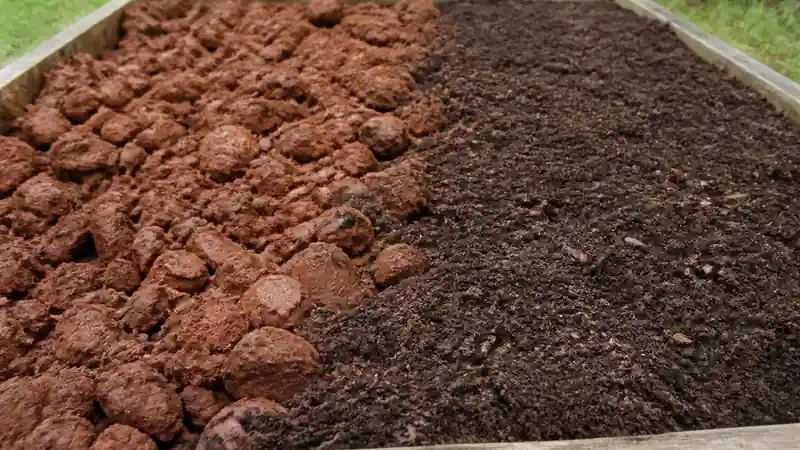
Clay soil improves with compost, not sand: work 1 to 2 inches into lawns or 3 to 4 inches into new beds, 6 to 12 inches deep, and use gypsum only if a lab finds exchangeable sodium above 15 percent.
Key takeaways
- A soil is in the clay texture class at 40 percent or more clay particles, and soils above 30 percent clay are considered unacceptable as topsoil (Utah State University Extension, Gardening in Clay Soils).
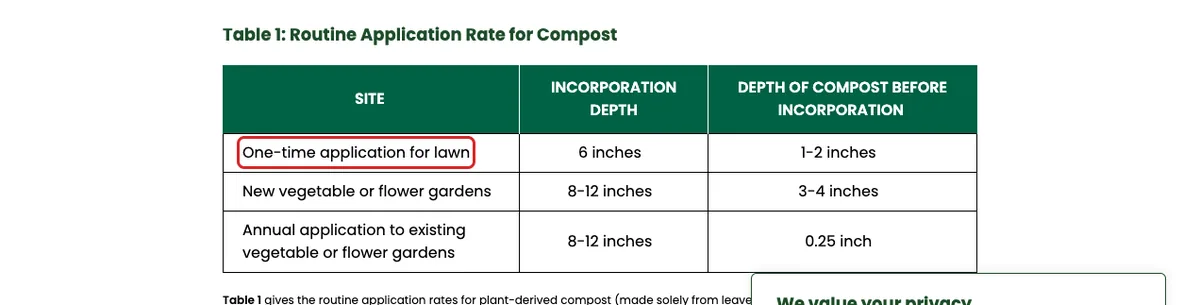
- Colorado State’s rate table calls for 1 to 2 inches of compost mixed 6 inches deep before a lawn, 3 to 4 inches mixed 8 to 12 inches deep for a new bed, then 0.25 inch a year; 3 cubic yards covers 1,000 sq ft about 1 inch deep (CSU Extension fact sheet 7.235).
- Sand only changes clay at 50 percent or more by volume (University of Arkansas Extension), and Oregon State says it lowers porosity until it reaches about 80 percent (OSU EC 1550): 18.5 to 74 cubic yards per 1,000 sq ft for a 6-inch layer.
- Gypsum fixes sodic soil, where exchangeable sodium is above 15 percent of the cation exchange capacity; Arkansas’s worked example needs 3.4 tons an acre, about 156 lb per 1,000 sq ft (UADA FSA2199).
- Washington State University’s gypsum fact sheet says gypsum does not change pH or water-holding capacity, and advises against adding it unless calcium is deficient and pH is in range (WSU FS307E).
- Core-aerate clay lawns to 20 to 40 holes per square foot with cores about 3/4 inch wide and 3 inches long, and topdress 1/4 inch of compost with it (Iowa State Extension).
40%+ clay particles puts a soil in the clay class (Arkansas and Utah State Extension)
9.3 cu yd of compost per 1,000 sq ft for a 3-inch layer (CSU 7.235 arithmetic)
50 to 80% sand by volume before sand helps clay (Arkansas, Illinois, Oregon State)
15% exchangeable sodium: the point where gypsum has a job (UADA FSA2199)
How do you know if you have clay soil?
Squeeze a moist handful into a ribbon between thumb and finger. A ribbon longer than 2 inches before it breaks puts the soil in the clay group, 1 to 2 inches in the clay loams, and under 1 inch in the loams and sands, per the University of Arizona Extension texture-by-feel guide (Schalau, 2021). A jar test or a lab texture analysis then gives the actual percentages.
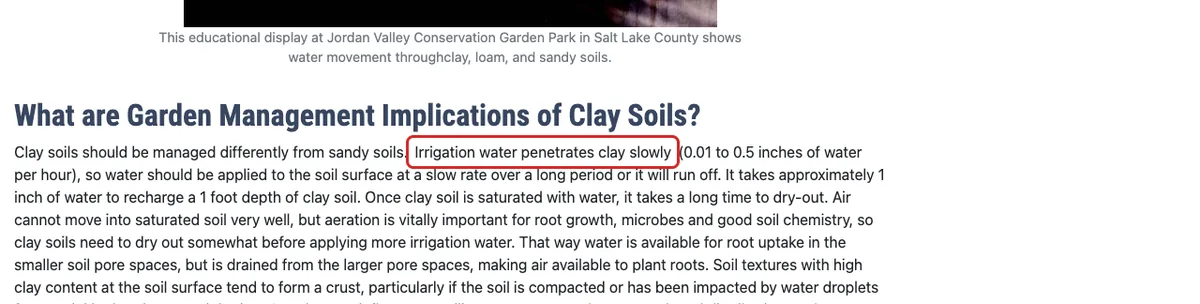
Clay particles are smaller than 0.002 millimeter and plate-shaped, so they pack into dense layers and pans, says Utah State University Extension (Wagner, Kuhns and Cardon, June 2015). That shape is why clay takes in irrigation at only 0.01 to 0.5 inch per hour and why a surface crust can look dry while the soil under it is saturated.
| Test | How to run it | Clay result | Source |
|---|---|---|---|
| Ribbon (texture by feel) | Wet a walnut-size ball to putty, push it out over your finger | Ribbon over 2 in: clay, sandy clay or silty clay; 1 to 2 in: clay loam group | Arizona Extension, 2021 |
| Grit check on the ribbon | Rub a very wet pinch in your palm | Smooth: silty clay; gritty: sandy clay; neither: clay | Arizona Extension, 2021 |
| Jar test | Shake soil and water in a straight-sided jar; mark sand at 1 minute, silt at 2 hours, clay at 48 hours | Clay layer 40% or more of total settled height | Clemson HGIC 1656, Dec. 2023 |
| Percolation test | Dig a 12-inch hole, fill it, let it drain, refill 24 hours later | Water still standing after 24 hours: drainage too slow (target 1 to 2 in per hour) | UC IPM |
| Lab texture analysis | Ask your state lab for particle-size analysis with the routine test | Reports % sand, silt and clay; read the class off the USDA triangle | Our soil test guide |
The percentages matter because the word clay covers several classes. On the USDA texture triangle a clay soil can hold 40 to 100 percent clay, 0 to 60 percent silt and 0 to 45 percent sand (University of Arkansas Extension, McWhirt, Jan. 2021); classes with loam in the name, such as clay loam, generally run 20 to 40 percent clay (Utah State). The Royal Horticultural Society uses a looser line: more than 30 percent fine clay particles.
What actually improves clay soil?
Organic matter mixed in, core aeration on lawns, deep-rooted cover crops and raised beds or mounds all have extension backing; sand and gypsum mostly do not. Utah State calls organic matter the best amendment for clay, and Colorado State says an amendment must be mixed into the soil, because buried or surface-laid material can block water and air movement (CSU 7.235).
| Method | What it changes in clay | Rate or spec | Limits | Source |
|---|---|---|---|---|
| Compost mixed in | Improves aggregation, porosity, aeration, drainage and rooting depth | 1 to 2 in into 6 in (lawn); 3 to 4 in into 8 to 12 in (new bed); 0.25 in a year after | Manure and biosolids composts are often high in salts | CSU 7.235 |
| Core aeration (lawns) | Pulls plugs, opens the surface; repeated passes improve structure | 20 to 40 holes per sq ft; cores 3/4 in by 3 in | Spike and solid tines compact clay between holes | Iowa State; Nebraska Extension |
| Cereal rye cover crop | Roots reduce compaction, add organic matter and aggregation | 4 lb seed per 1,000 sq ft, sown early October | Must be cut and tarped 4 weeks before planting or it regrows | Illinois Extension, Sept. 2026 |
| Coarse woody mulch | Reduces compaction and conserves water at the surface | Left on top, not mixed in | Fresh wood mixed into soil ties up nitrogen | WSU FS307E; CSU 7.235 |
| Raised beds or mounds | Lifts roots above saturated clay at once | RHS: plant woody plants on 25 cm (10 in) mounds | Imported soil must be mixed at the interface (see topsoil FAQ) | RHS; Utah State |
| Sand | Changes texture only at very high volumes | 50% or more by volume; porosity falls until about 80% | Smaller amounts make a denser soil | Arkansas; OSU EC 1550 |
| Gypsum | Replaces sodium with calcium on sodic clay | Only when exchangeable sodium is above 15% of CEC | No pH change; can leach K, Mg, Fe and Mn | UADA FSA2199; WSU FS307E |
How do you improve clay soil, step by step?
Test first, work the soil only when it crumbles, mix compost to the depth the planting needs, then keep adding a thin layer every year. The sequence below uses Colorado State’s compost table, Utah State’s wet-soil warning and Illinois Extension’s cover-crop timing; quantities are per 1,000 sq ft so they scale to any bed with the calculator further down.
- Send a sample to your state lab and ask for texture, organic matter, pH and sodium. WSU’s gypsum fact sheet lists pH, nutrients and sodium as the minimum before adding gypsum or fertilizer (FS307E). Our soil test guide lists lab fees.
- Run a percolation test in the wettest spot. If water stands in a 12-inch hole 24 hours after the refill, plan a raised bed or a drain rather than amendments alone (UC IPM).
- Wait until the soil crumbles in your hand. Utah State warns that tilling wet clay forms large clods and compacts it, and that foot and vehicle traffic should stay off wet clay (USU).
- Spread compost: 3 to 4 inches for a new vegetable or flower bed (9.3 to 12.3 cubic yards per 1,000 sq ft), or 1 to 2 inches before seeding or sodding a lawn (3.1 to 6.2 cubic yards).
- Mix it in completely: 8 to 12 inches deep for beds and 6 inches for lawns. CSU’s rates are for plant-derived compost or compost known to be low in salts (CSU 7.235, Table 1).
- Plant clay-tolerant species, or set woody plants on a 10-inch mound where water lingers (RHS).
- Mulch beds with coarse wood chips, and add 0.25 inch of compost each year to beds that are dug every season (CSU).
- In vegetable beds left bare over winter, broadcast 4 lb of cereal rye seed per 1,000 sq ft in early October, cut it in spring and tarp it for at least 4 weeks before planting (Illinois Extension, Sept. 22, 2026).
Expect a fast change in how the soil works and a slow change in how it drains. Oregon State says incorporated compost lowers the bulk density of clay and gives a short-term improvement in tilth (OSU EC 1550), while CSU’s 0.25-inch annual rate shows how gradual the long-term gain is. Clay holds most nutrients well, so Utah State says clay beds usually need nitrogen each year but not phosphorus or potassium when a soil test shows them high.
How much compost do you need for clay soil?
Multiply area in square feet by depth in inches and divide by 324 to get cubic yards. A 3-inch layer on 1,000 sq ft is 9.3 cubic yards; Colorado State rounds the rule to 3 cubic yards per 1,000 sq ft per inch (CSU 7.235). At October 2026 bulk prices of $39.50 to $64 a cubic yard, that layer costs about $366 to $593 before delivery.
| Job (CSU Table 1) | Compost depth | Mix depth | Cubic yards per 1,000 sq ft | 1.5 cu ft bags per 1,000 sq ft | Bulk cost per 1,000 sq ft at $39.50 to $64 |
|---|---|---|---|---|---|
| One-time, before a lawn (low) | 1 in | 6 in | 3.1 | 56 | $122 to $198 |
| One-time, before a lawn (high) | 2 in | 6 in | 6.2 | 111 | $244 to $395 |
| New vegetable or flower bed (low) | 3 in | 8 to 12 in | 9.3 | 167 | $366 to $593 |
| New vegetable or flower bed (high) | 4 in | 8 to 12 in | 12.3 | 222 | $488 to $790 |
| Yearly top-up, existing beds | 0.25 in | 8 to 12 in | 0.77 | 14 | $30 to $49 |
- Cubic yards of compost
- 1.85
- 1.5 cu ft bags
- 34
Cubic yards = area x depth in inches / 324. Default: 200 sq ft at 3 in = 1.85 cu yd, $73.15 to $96.30 in bulk. Bulk prices from Sequoia, Cheaper Than Dirt, Mr. Mulch and Cummin; bag price from Mr. Mulch.
The calculator’s default is a 200 sq ft bed with 3 inches of compost: 1.85 cubic yards, or 34 bags of 1.5 cubic feet, and $73 to $96 at $39.50 to $52 a cubic yard. In bags at $8.75 per 1.5 cubic feet the same job costs $291.67 for 33.3 bags, which is why beds larger than about 100 sq ft are usually cheaper in bulk.
| Seller | Location | Product | Price per cubic yard | Checked |
|---|---|---|---|---|
| Sequoia Landscape Materials | Santa Rosa, Calif. | Sonny’s Organic Compost, bulk | $39.50 | Oct. 30, 2026 |
| Cheaper Than Dirt Landscape Supply | Belton and Waco, Texas | Cottonseed compost, bulk | $40.00 | Oct. 30, 2026 |
| Cheaper Than Dirt Landscape Supply | Belton and Waco, Texas | Pecan hull compost, bulk | $40.00 | Oct. 30, 2026 |
| Cheaper Than Dirt Landscape Supply | Belton and Waco, Texas | Organic compost / garden mix, bulk | $50.00 | Oct. 30, 2026 |
| Mr. Mulch Landscape Supply | Columbus, Ohio | Zoo Brew Bulk Compost | $52.00 | Oct. 30, 2026 |
| Sequoia Landscape Materials | Santa Rosa, Calif. | Cold Creek Compost, bulk | $54.00 | Oct. 30, 2026 |
| Cheaper Than Dirt Landscape Supply | Belton and Waco, Texas | Turkey manure compost, bulk | $55.00 | Oct. 30, 2026 |
| Cummin Landscape Supply | Atlanta area, Ga. | Compost, bulk | $64.00 | Oct. 30, 2026 |
| Cheaper Than Dirt Landscape Supply | Belton and Waco, Texas | Cow manure compost, bulk | $70.00 | Oct. 30, 2026 |
| Mr. Mulch Landscape Supply | Columbus, Ohio | Zoo Brew Bags of Compost, 1.5 cu ft at $8.75 | $157.50 | Oct. 30, 2026 |
Why doesn’t adding sand fix clay soil?
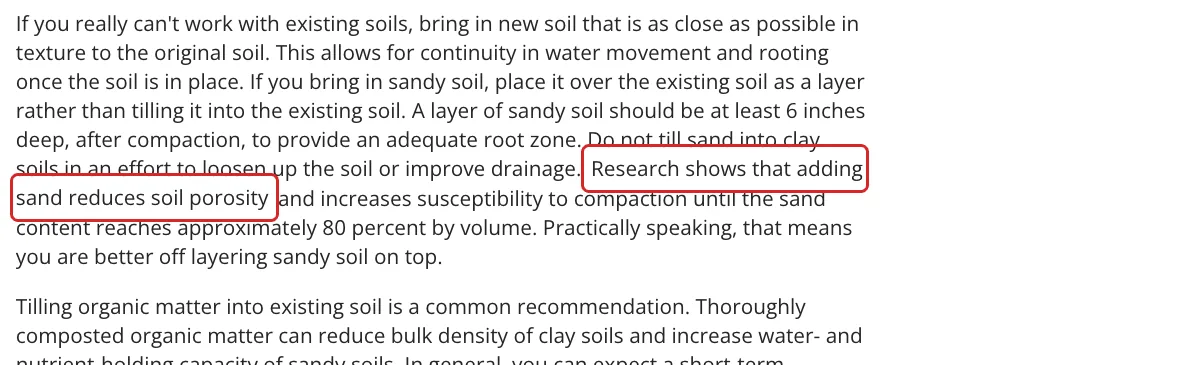
Because the volume needed is enormous. University of Arkansas Extension says sand must reach 50 percent or more of the soil by volume to change a clay’s texture, University of Illinois Extension puts it at a 1:1 ratio of sand to clay, and Oregon State EC 1550 says adding sand reduces porosity and raises compaction until sand is about 80 percent.
Below 50 percent sand, clay fills the spaces between sand grains. Arkansas compares it to cement binding gravel into concrete; Utah State calls the result too compact to work, similar to low-grade concrete. The arithmetic below shows why a few bags or a single truckload make clay worse rather than better.
| Goal for the top 6 inches | Sand to add | Cubic yards per 1,000 sq ft | Compared with 3 in of compost (9.3 cu yd) | Source of threshold |
|---|---|---|---|---|
| 1 in of sand mixed in (14% of the mix) | 1 in | 3.1 | Below every threshold: denser soil | Arithmetic: 1 / (6 + 1) |
| 50% sand by volume (1:1) | 6 in | 18.5 | 2 times the compost volume | Arkansas; Illinois |
| About 80% sand by volume | 24 in | 74.1 | 8 times the compost volume | Oregon State EC 1550 |
Sand does have one use on clay lawns: as a separate layer, not a mix. Oregon State says imported sandy soil should go on top as a layer at least 6 inches deep after compaction rather than be tilled in (OSU EC 1550). That turns a sand job into a topsoil job, priced in our topsoil cost guide.
Does gypsum help clay soil?
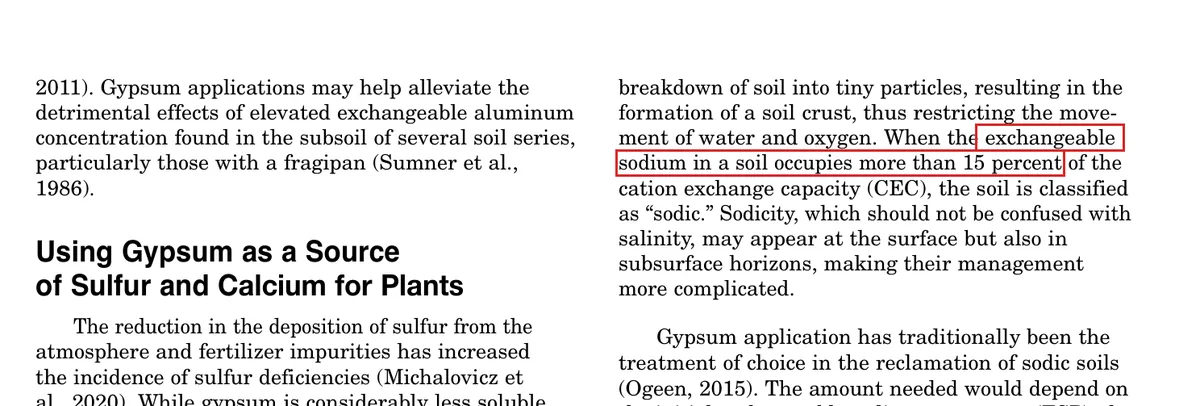
Only clay that is sodic. Gypsum is calcium sulfate, about 22 percent calcium and 18 percent sulfur; its calcium replaces sodium on clay particles, and the sodium then has to be leached out with good-quality water (UADA FSA2199). A soil is sodic when exchangeable sodium fills more than 15 percent of its cation exchange capacity.
On other clays the evidence is thin. Washington State University’s FS307E (Chalker-Scott and Guggenheim) says gypsum does not change soil pH, cannot change water-holding capacity, adds no fertility beyond calcium and sulfur, and can leach potassium, magnesium, iron and manganese. Its advice: unless calcium is deficient and pH is in the optimal range, do not add gypsum.
| Claim on bags and garden sites | What the extension documents say | Source |
|---|---|---|
| Loosens clay and improves drainage | Yes on sodic soils and some heavy clays above about 40% clay; urban soils with abrupt layers are not amendable with gypsum | WSU FS307E, pp. 2 to 4 |
| Lowers or raises pH | No: gypsum does not change soil pH; use lime or sulfur for pH | WSU FS307E; UADA FSA2199 |
| Improves water-holding capacity | No: that depends on organic matter and texture, which gypsum cannot change | WSU FS307E, p. 3 |
| Improves fertility | Only as a calcium and sulfur source | WSU FS307E, p. 3 |
| Cures tomato blossom end rot | No: blossom end rot follows water stress, not soil calcium | WSU FS307E, p. 3 |
| Safe at any rate | Excess can leach K, Mg, Fe and Mn and harm mycorrhizae | WSU FS307E, p. 4 |
Gypsum is also not a pH tool: point 3 of the FSA2199 summary reads that gypsum will not change soil pH, so our lime for lawns guide covers raising it. If a lab report shows high sodium and you plan to use gypsum, Arkansas adds that remediation gets complicated where good-quality water is unavailable or internal drainage is poor.
Whether your clay starts out acidic or alkaline depends on where you live: in USDA soil survey data, clay layers average pH 5.2 in the Southeast and 7.6 in the Mountain West, the regional numbers behind our answer to is clay soil acidic.
How much gypsum should you add to clay soil?
None, unless the soil test shows sodium. For a sodic soil, Arkansas’s rule of thumb is 1.7 tons of pure gypsum per acre for each cmolc/kg of sodium replaced, about 78 lb per 1,000 sq ft (UADA FSA2199). Its example, a CEC of 20 cut from 15 to 5 percent sodium, needs 3.4 tons an acre, or 156 lb per 1,000 sq ft.
| Soil CEC (cmolc/kg) | Sodium to replace, ESP 15% to 5% | Pure gypsum per acre | Pure gypsum per 1,000 sq ft | At 70% purity per 1,000 sq ft |
|---|---|---|---|---|
| 10 | 1 cmolc/kg | 1.7 tons | 78 lb | 112 lb |
| 20 | 2 cmolc/kg | 3.4 tons | 156 lb | 223 lb |
| 30 | 3 cmolc/kg | 5.1 tons | 234 lb | 335 lb |
Bag labels use smaller, fixed rates. Espoma Organic Garden Gypsum’s directions read 36 lb per 1,000 sq ft on lawns, doubled for exceptionally heavy clay, and 6 lb per 30 sq ft worked into the top 6 inches of garden beds, which is 200 lb per 1,000 sq ft (Espoma product page, Oct. 2026). Mined gypsum runs 70 to 90 percent calcium sulfate and FGD gypsum 96 percent or more, so check purity before converting (UADA FSA2199).
How do you improve clay soil under an existing lawn?
Core-aerate, then topdress. Iowa State calls for 20 to 40 holes per square foot, cores about 3/4 inch in diameter and 3 inches long, usually in several passes, and suggests spreading 1/4 inch of fine compost and dragging it into the holes (Iowa State Extension, Apr. 2024). Kansas State asks for holes 3 inches deep and 3 inches or less apart (K-State MF2130).
- Use hollow tines only. Nebraska Extension says solid-tine and spike aeration, aeration shoes included, push soil apart and increase compaction between the holes in clay and silt (Nebraska Extension).
- Water the lawn deeply 2 days before if the soil is dry, so the tines reach at least 3 inches (Nebraska).
- Aerate compacted areas at least once a year and twice where compaction is severe (Nebraska); our aeration timing guide sets the month by grass type.
- Topdress 1/4 inch of screened compost, about 0.77 cubic yard per 1,000 sq ft, and drag it in with a mat (Iowa State).
- Water in cycles: clay takes in 0.01 to 0.5 inch per hour (Utah State), so split each run as our lawn watering guide shows.
Do not spread a 1/4-inch layer of sand to fix a clay lawn; it sits on top of the clay, and our lawn leveling guide explains why sand topdressing belongs on sandy soils. For crew pricing on one or two passes, see the lawn aeration cost guide.
What grows well in clay soil?
Plants that tolerate waterlogging, compaction or poor aeration. Utah State lists trees for clay, and the Missouri Botanical Garden 2025 fact sheet lists perennials, shrubs and trees chosen for the Lower Midwest. Illinois Extension adds columbine, New England aster, purple coneflower and blazing star for wet, sticky clay (Enroth, 2018).
Swipe the table sideways to see every column.
| Plant | Type | Listed by | Note |
|---|---|---|---|
| River birch (Betula nigra) | Tree | Utah State; MoBot | Tolerates poor drainage (USU) |
| Baldcypress (Taxodium distichum) | Tree | Utah State; MoBot | Large tree |
| Swamp white oak (Quercus bicolor) | Tree | Utah State | Large tree |
| Black gum (Nyssa sylvatica) | Tree | MoBot | Medium tree |
| Eastern redbud (Cercis canadensis) | Tree | MoBot | Small tree |
| Red-osier dogwood (Cornus sericea) | Shrub | Utah State; MoBot | Tolerates poor drainage (USU) |
| Winterberry (Ilex verticillata) | Shrub | MoBot | Deciduous holly |
| Ninebark (Physocarpus opulifolius) | Shrub | MoBot | Deciduous shrub |
| Purple coneflower (Echinacea purpurea) | Perennial | MoBot; Illinois | Wet, sticky clay (Illinois) |
| New England aster (Symphyotrichum novae-angliae) | Perennial | MoBot; Illinois | Wet, sticky clay (Illinois) |
| Blue false indigo (Baptisia australis) | Perennial | MoBot | Herbaceous perennial |
| Switchgrass (Panicum virgatum) | Ornamental grass | MoBot | Ornamental grass |
| Prairie dropseed (Sporobolus heterolepis) | Ornamental grass | MoBot | Ornamental grass |
| Karl Foerster feather reed grass | Ornamental grass | Our Karl Foerster guide | Does well in heavy clay (UW-Madison) |
For turf, buffalograss is native to clay soils of the Great Plains that get 15 to 30 inches of rain a year; our buffalo grass guide covers where it fails. MoBot’s plant notes add a practical rule: a slope or mound may drain well enough, even in clay, to grow plants that need better drainage. More plant and lawn pages sit in our Turf and Trees section.
Which clay soil fix fits your yard?
Match the fix to what the test and the site show. The 9 rows run from the cheapest checks to the most expensive work, and the flowchart below holds the same logic; each threshold comes from the extension document named in its row.
| If your situation is | Do this | Why (source) |
|---|---|---|
| Ribbon under 1 in, soil drains 1 to 2 in per hour | No clay fix needed; mulch and plant | Loam or sand by feel (Arizona); optimal drainage (UC IPM) |
| Lab shows exchangeable sodium above 15% of CEC | Gypsum at about 78 lb per 1,000 sq ft per cmolc/kg of sodium to remove, plus leaching water | UADA FSA2199 |
| Clay with normal sodium and pH | No gypsum; compost instead | WSU FS307E |
| Water still in a 12-in hole 24 hours after refilling | Raised bed, mound or drain before amending | UC IPM; RHS |
| New bed on clay | 3 to 4 in compost mixed 8 to 12 in deep (9.3 to 12.3 cu yd per 1,000 sq ft) | CSU 7.235 |
| New lawn on clay | 1 to 2 in compost mixed 6 in deep, or 6 in of sandy soil as a layer on top | CSU 7.235; OSU EC 1550 |
| Existing lawn on compacted clay | Hollow-tine aeration, 20 to 40 holes per sq ft, plus 1/4 in compost | Iowa State; Nebraska |
| Vegetable bed bare over winter | Cereal rye at 4 lb per 1,000 sq ft in early October | Illinois Extension |
| Someone suggests mixing in sand | Skip it unless you can reach 50 to 80% sand by volume | Arkansas; OSU |
1Does a moist ribbon break before 1 inch and the soil drain 1 to 2 inches an hour?
YesIt is not a clay problem: mulch and plant (Arizona Extension; UC IPM).
NoGo to the next question
2Does water stand in a 12-inch hole 24 hours after refilling?
YesBuild a raised bed or mound, or install a drain, before amending (UC IPM; RHS).
NoGo to the next question
3Does the lab report exchangeable sodium above 15 percent of CEC?
YesUse gypsum: about 78 lb per 1,000 sq ft per cmolc/kg of sodium to remove, then leach with good water (UADA FSA2199).
NoGo to the next question
4Is it an existing lawn?
YesHollow-tine aerate to 20 to 40 holes per sq ft and topdress 1/4 inch of compost (Iowa State; Nebraska).
NoGo to the next question
5Is it a new lawn?
YesMix 1 to 2 inches of compost 6 inches deep, or lay 6 inches of sandy soil on top (CSU 7.235; OSU EC 1550).
NoNew bed: mix 3 to 4 inches of compost 8 to 12 inches deep, then add 0.25 inch a year (CSU 7.235). Skip sand and gypsum.
Source: CSU 7.235; UADA FSA2199; WSU FS307E; UC IPM; Iowa State; OSU EC 1550
This page is general information. Gypsum and compost rates depend on your soil test; confirm sodium, pH and texture with your state extension lab before applying amendments at scale.
How we compiled this
We read 15 extension and university documents (Colorado State, Washington State, Arkansas, Illinois, Oregon State, Utah State, Arizona, Clemson, UC IPM, Iowa State, Kansas State, Nebraska, the Missouri Botanical Garden and the RHS), one manufacturer’s label directions and 5 supply yards’ posted compost prices, all in October 2026. No soil was tested and no product was applied for this page; volumes, costs and gypsum rates are the arithmetic shown under each table.
| Question | Short answer | Best evidence |
|---|---|---|
| Is it clay? | 40% or more clay; ribbon over 2 in | Arkansas; Arizona |
| Best fix? | Compost mixed 6 to 12 in deep | CSU 7.235; Utah State |
| How much compost? | 3.1 cu yd per 1,000 sq ft per inch | CSU arithmetic |
| Sand? | Only at 50 to 80% by volume | Arkansas; Oregon State |
| Gypsum? | Only if sodium is above 15% of CEC | UADA FSA2199; WSU FS307E |
| Lawn? | Hollow-tine aeration plus 1/4 in compost | Iowa State; Nebraska |
Frequently asked questions
What is the best way to improve clay soil?
Mix compost into it: 3 to 4 inches worked 8 to 12 inches deep for a new bed, or 1 to 2 inches worked 6 inches deep before a lawn, then add about 0.25 inch a year to beds you dig, per Colorado State fact sheet 7.235. On existing lawns, hollow-tine core aeration with a 1/4 inch compost topdressing does the same job without digging.
How do you break down clay soil fast?
Nothing changes clay’s texture fast, but its workability can change in one season. Oregon State says incorporated compost gives a short-term improvement in tilth, and a raised bed or a 10-inch mound lifts roots above saturated clay at once. Gypsum works quickly only on sodic soil, and only when good-quality water can leach the displaced sodium out.
Can I put topsoil on top of clay soil?
Yes, if it is deep enough and the boundary is blended. Oregon State says imported sandy soil should go on as a layer at least 6 inches deep after compaction rather than being tilled into clay. WSU notes that urban soils with abrupt layers are not fixed by gypsum, so loosen the clay surface before spreading the new soil.
What is the best additive for clay soil?
Compost made from plant material, such as leaves, grass clippings or wood chips. Colorado State’s rate table is written for plant-derived compost or compost known to be low in salts, and it warns that manure and biosolids products are often very high in salts. Sand and gypsum are poor general additives: one needs 50 to 80 percent by volume, the other a sodic soil.
Does gypsum loosen clay soil?
Only sodic clay, where sodium fills more than 15 percent of the cation exchange capacity, per the University of Arkansas. Washington State University’s fact sheet FS307E adds that gypsum may help some heavy clays above about 40 percent clay, does not change pH or water-holding capacity, and should not be added unless calcium is deficient and pH is in range.
Will adding sand to clay soil improve drainage?
Not in the amounts most people add. Arkansas Extension says sand must reach 50 percent or more by volume to change clay’s texture, and Oregon State says sand lowers porosity until it is about 80 percent. For a 6-inch layer that is 18.5 to 74 cubic yards per 1,000 sq ft; 1 inch of sand mixed in only makes the soil denser.
When is the best time to amend clay soil?
When the soil is moist but crumbles rather than smears, usually early autumn or late spring. Utah State warns that working wet clay forms clods and compacts it, and the RHS notes that clay often cannot be worked from the first winter rains until mid-spring. Sow a cereal rye cover crop in early October if beds will sit bare.
Sources
- Colorado State University Extension, Choosing a Soil Amendment, fact sheet 7.235 (Murgel, Davis, Whiting, Oleszak, Hammond), published June 2000, reviewed May 2024. Accessed October 2026.
- Washington State University Extension, Gypsum Use in Home Gardens and Landscapes, FS307E (Chalker-Scott and Guggenheim), undated fact sheet. Accessed October 2026.
- University of Arkansas Division of Agriculture, Gypsum as a Soil Amendment, FSA2199 (Espinoza and Ismanov), current PDF. Accessed October 2026.
- University of Arkansas Division of Agriculture, Adding Sand to Soil (McWhirt), Arkansas Fruit, Vegetable and Nut Update, Jan. 19, 2021. Accessed October 2026.
- University of Illinois Extension, Does Sand Improve Clay Soil Drainage? (Enroth), Jan. 31, 2018. Accessed October 2026.
- Oregon State University Extension, Practical Lawn Establishment and Renovation, EC 1550, current edition. Accessed October 2026.
- Utah State University Extension, Gardening in Clay Soils (Wagner, Kuhns, Cardon), June 2015. Accessed October 2026.
- University of Arizona Extension, Soil: Determining Soil Texture by Feel (Schalau), Feb. 10, 2021. Accessed October 2026.
- Clemson Cooperative Extension, Soil Texture Analysis: The Jar Test, HGIC 1656, revised Dec. 1, 2023. Accessed October 2026.
- UC Statewide IPM Program, Percolation test illustration and guidance, current page. Accessed October 2026.
- Iowa State University Extension, Core Aeration of Lawns (Steil), reviewed April 2024. Accessed October 2026.
- Kansas State University Research and Extension, Aerating Your Lawn, MF2130, current PDF. Accessed October 2026.
- University of Nebraska-Lincoln Extension, Getting Your Lawn Ready for Summer: Aeration, current page. Accessed October 2026.
- University of Illinois Extension, Plant cereal rye this fall and prepare garden soil for success in 2027 (Frillman), Sept. 22, 2026. Accessed October 2026.
- Missouri Botanical Garden, Gardening in Heavy Clay Soils fact sheet, 2025. Accessed October 2026.
- Royal Horticultural Society, Clay soils, current page. Accessed October 2026.
- Espoma Company, Organic Garden Gypsum directions, Oct. 2026. Accessed October 2026.
- Cummin Landscape Supply, Mulch and soil price list, Oct. 30, 2026. Accessed October 2026.
- Mr. Mulch Landscape Supply, Bulk mulch and compost prices, Oct. 30, 2026. Accessed October 2026.
- Mr. Mulch Landscape Supply, Bagged mulch and compost prices, Oct. 30, 2026. Accessed October 2026.
- Cheaper Than Dirt Landscape Supply, Bulk landscape material pricing, Oct. 30, 2026. Accessed October 2026.
- Sequoia Landscape Materials, Price list, Oct. 30, 2026. Accessed October 2026.