Is clay soil acidic? Not by nature: clay is a particle size, and its pH comes from the rock it formed in and the rain it gets. USDA survey clay layers average pH 5.2 in the Southeast and 7.6 in the Mountain West.
Is clay soil acidic where you live? We pulled every mapped clay layer in 46 states from USDA NRCS Soil Data Access, the database behind Web Soil Survey: 305 million acres where a layer of 40 percent clay or more starts within 20 inches of the surface. Nationally they split into near thirds: 38% of those acres test below pH 6.5, 30% sit at 6.5 to 7.3 and 32% run above 7.3. None of the top 5 search results we read in November 2026 cited a data source for any clay pH figure they gave.
That split explains why the top results contradict each other. A Sunnyside Gardens page says tested clay is typically alkaline, while NC State Extension in Henderson County, writing about clay, says its county’s soils tend to be acidic, averaging pH 5.5. Both are right for their ground: North Carolina’s clay layers average pH 5.15 in the survey data and Utah’s average 7.90. Raising or lowering the number is a separate job, covered in how to raise soil pH with lime by buffer pH and how to make soil more acidic with sulfur.
Clay soil pH by region: the map in numbers
| Region | States | Clay-layer acres | Average pH | State range | Acres below pH 6.5 | Acres above pH 7.3 | Acres with free lime |
|---|---|---|---|---|---|---|---|
| Southeast Piedmont and Coastal Plain | AL, FL, GA, NC, SC, VA | 45.4M | 5.23 | 5.15 (NC) to 6.26 (FL) | 92% | 2% | 2% |
| Mid-South and Mississippi Delta | AR, KY, LA, MS, TN | 36.9M | 5.70 | 5.44 (AR) to 6.00 (KY) | 70% | 3% | 3% |
| Northeast and Mid-Atlantic | DE, MA, MD, ME, NH, NJ, NY, PA, VT, WV | 4.1M | 6.03 | 5.31 (DE) to 6.68 (NH) | 59% | 0% | 4% |
| Corn Belt and Great Lakes | IA, IL, IN, MI, MN, MO, OH, WI | 37.2M | 6.13 | 5.77 (MO) to 6.84 (MN) | 56% | 4% | 9% |
| Pacific Coast | CA, OR, WA | 22.4M | 6.92 | 5.97 (WA) to 7.09 (CA) | 25% | 33% | 12% |
| Great Plains | KS, ND, NE, OK, SD, TX | 96.7M | 7.13 | 6.79 (KS) to 7.53 (ND) | 18% | 49% | 53% |
| Mountain West and Southwest | AZ, CO, ID, MT, NM, NV, UT, WY | 62.7M | 7.57 | 7.24 (ID) to 7.90 (UT) | 4% | 61% | 47% |
The gradient runs east to west, wet to dry. In the Southeast group, 92% of clay-layer acres test below pH 6.5 and only 2% hold free lime. In the Mountain West and Southwest, 61% run above pH 7.3 and 47% contain free lime; the Great Plains sit between at an average of 7.13, with 53% carrying free lime. Colorado State University Extension (GardenNotes 222) puts many Colorado soils at pH 7.0 to 8.3 because carbonate built up under limited rainfall, and Clemson HGIC 1650 puts South Carolina soils at pH 4.5 to 6.0.
At the state level, texture adds little on top of region. Across the 39 states with at least 500,000 acres of clay layers, the clay-layer average and the average surface pH of all soils in the same state track closely (correlation 0.91), and differ by 0.32 pH units on average in our calculation. If your neighbors on sandy loam lime every few years, your clay probably needs it too; if they fight yellow, iron-starved shrubs, expect the same. The exception is the far Northeast: Vermont and Maine clay layers average pH 6.10 and 6.27, above the 4.84 and 4.65 of those states’ soils overall.
Is clay soil acidic in your state?
Find your state below, then confirm with your own yard: soil survey values are representative estimates for whole map units, and a lot graded for a house can expose subsoil from several feet down. For a parcel-level read, draw your lot in Web Soil Survey and open the Soil Chemical Properties section, which reports pH from the same database. States with under 100,000 acres of mapped clay layers are thin samples.
Swipe the table sideways to see every column.
| State | Clay-layer acres | Clay-layer pH | Reads as | Acres below 6.5 | Acres above 7.3 | Acres with free lime | All-soil surface pH |
|---|---|---|---|---|---|---|---|
| North Carolina | 9.63M | 5.15 | Acidic | 96% | 0% | 0% | 5.17 |
| Georgia | 11.41M | 5.22 | Acidic | 94% | 0% | 0% | 5.29 |
| Alabama | 8.76M | 5.22 | Acidic | 87% | 6% | 7% | 5.22 |
| Virginia | 7.66M | 5.24 | Acidic | 93% | 0% | 0% | 5.24 |
| South Carolina | 7.18M | 5.26 | Acidic | 91% | 0% | 0% | 5.28 |
| Delaware | 9,444 (thin) | 5.31 | Acidic | 100% | 0% | 0% | 5.78 |
| Arkansas | 8.88M | 5.44 | Acidic | 78% | 1% | 0% | 5.46 |
| New Jersey | 82,052 (thin) | 5.47 | Acidic | 100% | 0% | 0% | 5.07 |
| Tennessee | 5.13M | 5.54 | Acidic | 82% | 0% | 2% | 5.36 |
| West Virginia | 1.49M | 5.55 | Acidic | 79% | 0% | 0% | 4.97 |
| Mississippi | 6.40M | 5.64 | Acidic | 70% | 3% | 4% | 5.31 |
| Maryland | 0.10M | 5.74 | Acidic | 82% | 0% | 0% | 5.40 |
| Missouri | 12.75M | 5.77 | Acidic | 82% | 3% | 3% | 5.95 |
| Louisiana | 10.33M | 5.85 | Acidic | 65% | 4% | 3% | 5.63 |
| Pennsylvania | 0.54M | 5.90 | Acidic | 68% | 0% | 0% | 5.27 |
| Washington | 1.16M | 5.97 | Acidic | 60% | 6% | 2% | 6.17 |
| Iowa | 3.13M | 5.98 | Acidic | 75% | 2% | 9% | 6.41 |
| Illinois | 4.05M | 6.00 | Acidic | 49% | 1% | 1% | 6.40 |
| Kentucky | 6.18M | 6.00 | Slightly acidic | 55% | 3% | 9% | 5.71 |
| Vermont | 0.24M | 6.10 | Slightly acidic | 71% | 0% | 6% | 4.84 |
| Florida | 0.72M | 6.26 | Slightly acidic | 48% | 12% | 9% | 5.36 |
| Maine | 0.40M | 6.27 | Slightly acidic | 76% | 0% | 0% | 4.65 |
| Ohio | 6.99M | 6.30 | Slightly acidic | 35% | 0% | 15% | 5.99 |
| Indiana | 3.63M | 6.36 | Slightly acidic | 46% | 3% | 7% | 6.25 |
| Massachusetts | 2,535 (thin) | 6.37 | Slightly acidic | 7% | 0% | 0% | 4.97 |
| Michigan | 1.81M | 6.43 | Slightly acidic | 42% | 11% | 14% | 5.86 |
| New York | 1.27M | 6.63 | Near neutral | 22% | 1% | 12% | 5.55 |
| Wisconsin | 1.85M | 6.63 | Near neutral | 25% | 2% | 36% | 5.94 |
| New Hampshire | 8,829 (thin) | 6.68 | Near neutral | 0% | 0% | 0% | 4.58 |
| Kansas | 13.84M | 6.79 | Near neutral | 21% | 15% | 12% | 6.72 |
| Oklahoma | 9.96M | 6.81 | Near neutral | 30% | 41% | 35% | 6.55 |
| Minnesota | 2.99M | 6.84 | Near neutral | 27% | 19% | 19% | 6.52 |
| Nebraska | 3.35M | 6.85 | Near neutral | 25% | 20% | 21% | 6.74 |
| Oregon | 10.95M | 6.85 | Near neutral | 27% | 32% | 3% | 6.17 |
| California | 10.33M | 7.09 | Near neutral | 18% | 37% | 23% | 6.94 |
| Texas | 52.33M | 7.19 | Near neutral | 20% | 60% | 66% | 7.25 |
| Idaho | 2.61M | 7.24 | Near neutral | 3% | 31% | 33% | 6.40 |
| South Dakota | 13.39M | 7.39 | Alkaline | 2% | 54% | 61% | 7.02 |
| Arizona | 12.45M | 7.49 | Alkaline | 5% | 60% | 47% | 7.66 |
| Montana | 16.14M | 7.51 | Alkaline | 2% | 64% | 41% | 7.03 |
| Colorado | 8.51M | 7.52 | Alkaline | 6% | 62% | 44% | 7.01 |
| North Dakota | 3.81M | 7.53 | Alkaline | 4% | 61% | 58% | 7.16 |
| New Mexico | 7.36M | 7.65 | Alkaline | 3% | 69% | 63% | 7.60 |
| Nevada | 8.60M | 7.73 | Alkaline | 0% | 53% | 41% | 7.88 |
| Wyoming | 4.56M | 7.74 | Alkaline | 7% | 72% | 61% | 7.26 |
| Utah | 2.51M | 7.90 | Alkaline | 7% | 70% | 63% | 7.91 |
Why Georgia clay is acidic and Texas clay is alkaline
Two things set the number: what the clay weathered from and how much water has moved through it. Rain leaches calcium and magnesium out of the profile, and NC State Extension says hydrogen added to soil reacts with clay minerals and releases aluminum, which sits on exchange sites and keeps the soil acid. Where rain is short, carbonate stays: Colorado State ties its alkaline soils to free lime that accumulated through rock weathering and limited rainfall.
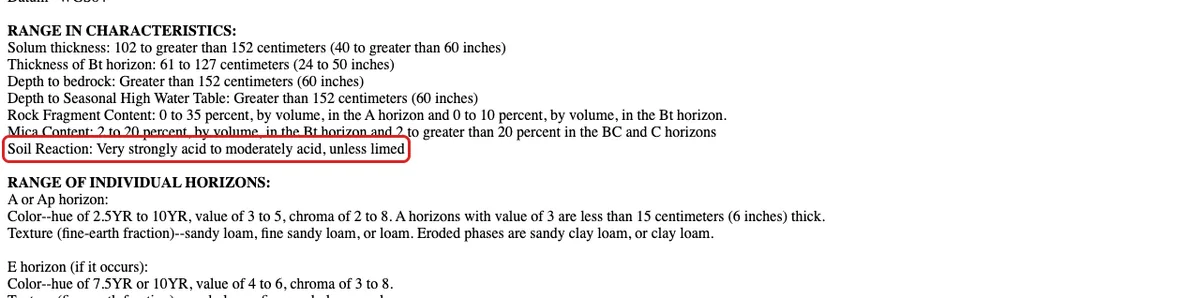
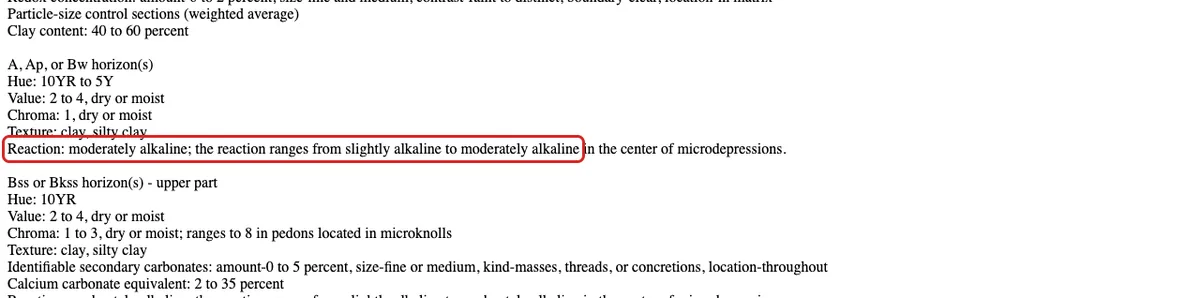
The two textbook clays show it. The Cecil series, the red clay of the Carolina and Georgia Piedmont, formed in material weathered from felsic igneous and metamorphic rock under about 48 inches of rain a year; its official description classes it as kaolinitic and gives its reaction as very strongly to moderately acid unless limed. The Houston Black series of the Texas Blackland Prairie formed in calcareous mudstone under about 35 inches; it is smectitic, moderately alkaline at the surface and carries 2 to 35 percent calcium carbonate equivalent in its upper subsoil.
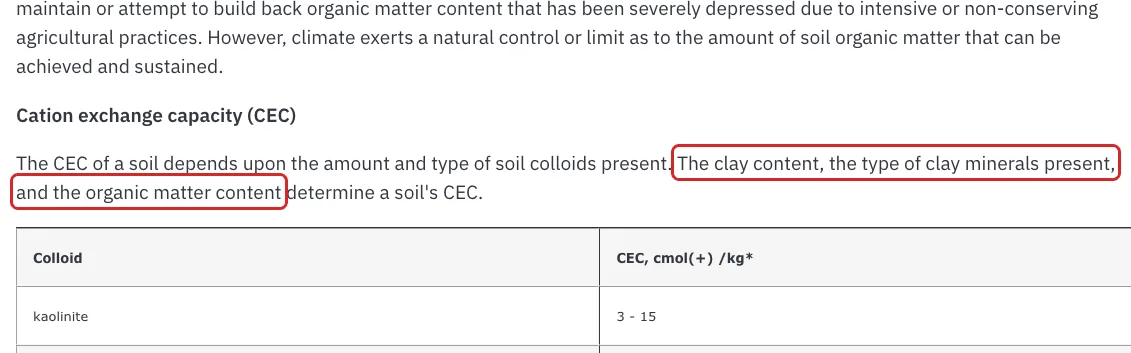
The clay minerals differ too, and that changes how hard the soil resists a pH change. University of Florida soil scientists list kaolinite, which they call the dominant clay mineral in their region’s soils, at a cation exchange capacity (CEC) of 3 to 15 cmol per kg and montmorillonite, a smectite, at 60 to 100. Dividing each soil’s CEC by its clay content gives a rough check: Cecil’s clay layer holds about 12 meq per 100 g of clay, inside the kaolinite range, and Houston Black’s about 85, inside the montmorillonite range.
Swipe the table sideways to see every column.
| Soil series | Where | Mapped acres | Clay % | pH | pH range in map units | CEC (meq/100 g soil) | CEC per 100 g clay | Acres with free lime |
|---|---|---|---|---|---|---|---|---|
| Cecil | Piedmont red clay, AL to VA | 2.59M | 53.4 | 5.16 | 5 to 5.6 | 6.3 | 12 | 0% |
| Pacolet | Piedmont red clay, AL to VA | 0.78M | 49.0 | 5.45 | 4.7 to 5.8 | 5.8 | 12 | 0% |
| Davidson | Piedmont dark red clay, AL to VA | 0.12M | 56.2 | 5.52 | 5.5 to 5.8 | 5.9 | 11 | 0% |
| Iredell | Piedmont, AL to VA | 0.22M | 50.4 | 6.50 | 6.4 to 6.9 | 26.9 | 53 | 0% |
| Blount | Glacial till, IL to WI | 2.26M | 42.0 | 6.50 | 5.5 to 7.2 | 24.0 | 57 | 1% |
| Sharkey | Mississippi Delta, AR to TN | 3.55M | 62.9 | 6.53 | 5.5 to 7 | 41.1 | 65 | 18% |
| Hoytville | Lake plain, IN to OH | 0.81M | 45.1 | 6.93 | 6.3 to 7.2 | 25.9 | 57 | 76% |
| Lake Charles | Texas Gulf Coast | 0.64M | 51.2 | 7.10 | 6.7 to 7.1 | 48.0 | 94 | 0% |
| Pierre | Shale plains, CO to WY | 1.22M | 48.6 | 7.18 | 7 to 8 | 35.6 | 73 | 28% |
| Capay | California valleys | 0.21M | 50.0 | 7.21 | 6.3 to 8.3 | 37.6 | 75 | 9% |
| Diablo | California hills (adobe clay) | 0.23M | 50.1 | 7.25 | 6.8 to 7.9 | 33.7 | 67 | 77% |
| Nunn | Colorado Front Range, CO to WY | 0.45M | 42.7 | 7.28 | 7 to 7.9 | 30.6 | 72 | 21% |
| Houston Black | Texas Blackland Prairie | 1.29M | 54.1 | 7.90 | 7.9 to 7.9 | 45.8 | 85 | 100% |
Is red clay soil acidic?
Usually, in the United States. The three red Piedmont series in the table, Cecil, Pacolet and Davidson, average pH 5.16 to 5.52 in their clay layers, with no free lime in any mapped acre. Cecil’s official description lists its upper subsoil as red (10R 4/8) clay, strongly acid. Off the Piedmont, test before assuming: the Sharkey clay of the Mississippi Delta ranges from pH 5.5 to 7 across its map units, and its official description gives the surface reaction as strongly acid through moderately alkaline.
Acid red clay also carries the aluminum problem. NC State says aluminum below pH 5.4 ties up fertilizer phosphorus and that liming reduces aluminum and manganese toxicity in most Piedmont and mountain soils; its target for most field crops on mineral soils is pH 6.0. Plants matched to acid ground skip the fight: centipedegrass wants pH 5.0 to 6.0, per our centipede grass care guide.
Why acidic clay takes more lime than acidic sand
Clay’s exchange sites hold a reserve of acidity that has to be neutralized before the reading moves. Cornell Agronomy Fact Sheet 22 puts sandy soils low in organic matter below 3 cmol per kg CEC and heavier clays above 20, and says the higher the CEC, the more lime it takes to raise pH. Clemson adds that low-clay soils need less lime for the same pH change.
| Starting pH | Sandy loam | Silt loam | Silty clay loam | Silty clay loam vs sandy loam |
|---|---|---|---|---|
| 4.5 | 4,000 (92) | 6,000 (138) | 8,000 (184) | 2.0x |
| 5.0 | 3,000 (69) | 5,000 (115) | 7,000 (161) | 2.3x |
| 5.5 | 2,000 (46) | 3,000 (69) | 5,000 (115) | 2.5x |
| 6.0 | 500 (11) | 1,000 (23) | 2,000 (46) | 4.0x |
By that rule, a pound of kaolinitic Piedmont clay buffers less than a pound of smectitic Plains clay: about 12 versus 85 meq of CEC per 100 g of clay for Cecil and Houston Black in the series table. Use the lab’s lime requirement, not this table: rates for lawns, products and the 50 lb per pass ceiling are in our lime for lawn rates and timing guide.
How to tell whether your clay is acidic or alkaline
- Look up your soil. In Web Soil Survey, mark your lot, then open Soil Data Explorer, Soil Properties and Qualities, Soil Chemical Properties, pH (1 to 1 water). Set the depth to the clay layer your shovel hits; our state table gives the regional baseline.
- Run the vinegar test on dry soil. Colorado State GardenNotes 222: put a heaping tablespoon of crumbled dry soil in a cup and moisten it with vinegar. Bubbles mean free lime, so the soil is alkaline and sulfur will not move it far.
- Sample beds near the house separately. UF/IFAS SL 256 says concrete, stucco and other calcium carbonate building debris left in the soil can make landscape soil alkaline.
- Send a lab test. Ask for pH plus buffer pH or lime requirement; NC State says a pH reading alone cannot give an accurate lime rate. Lab prices and sampling depth are in our soil test guide.
- Act on the number. Below your plants’ range, lime by the lab rate. Above 7.3 with fizz, choose plants for high pH; above 7.3 without fizz, sulfur can work, at the clay rate in our sulfur rate table.
1Does a spoonful of dry soil bubble when wetted with vinegar?
YesAlkaline with free lime: plan for pH above 7.3; sulfur will not hold it down, so pick plants for high pH (Colorado State).
NoGo to the next question
2Is the sample from a bed next to a foundation, patio or stucco wall?
YesBuilding debris can raise pH there (UF/IFAS SL 256): test it apart from open lawn.
NoGo to the next question
3Are you in the Southeast: Virginia, the Carolinas, Georgia, Alabama or Florida?
YesExpect acidic clay: 92% of clay-layer acres there read below pH 6.5. Lime only to the lab's rate.
NoGo to the next question
4Are you in the Great Plains or Mountain West?
YesExpect neutral to alkaline clay: averages run 7.13 to 7.57. Test before adding anything.
NoLook up your map unit in Web Soil Survey and get a lab pH and buffer pH test before liming or adding sulfur.
Source: USDA NRCS SSURGO (Nov. 2026); Colorado State GardenNotes 222; UF/IFAS SL 256
Alkaline clay shows itself in the plants: yellow new leaves with green veins point to iron shortage, common above pH 7, and our guide to why grass turns yellow sorts it from nitrogen shortage. Drainage, compaction and compost rates are a texture problem rather than a pH one, and they are covered in how to improve clay soil with compost and gypsum; the organic matter gap between clay subsoil and topsoil is measured in soil vs dirt: what USDA data shows.
What top-ranking pages say about clay pH, checked
| Claim (page) | What the data shows | Source |
|---|---|---|
| “When tested, clay soil is typically alkaline” (Sunnyside Gardens) | True for 32% of U.S. clay-layer acres; 38% test below pH 6.5 | SSURGO, Nov. 2026 |
| Clay “usually leans towards the alkaline side,” pH 7.5 to 10 (First Tunnels, UK) | Highest state average in our data is 7.90 (Utah); Colorado State tops its range at 8.3 and links 8.3+ to sodic soil | CSU GardenNotes 222 |
| Local soils “tend to be acidic averaging 5.5 pH” (NC State, Henderson Co.) | Consistent: North Carolina clay layers average 5.15 | SSURGO, Nov. 2026 |
| Clay can be either acidic or alkaline, because clay is a texture (Rivers Family Farm, paraphrased) | Correct; region predicts it, texture does not | SSURGO, Nov. 2026 |
How we compiled this
On Nov. 12, 2026 we queried USDA Soil Data Access for every major soil component in 48 states, kept the uppermost horizon with at least 40 percent clay that starts within 50 cm, and weighted its representative pH, CEC and carbonate values by map unit acres times component percent. We read 4 Official Series Descriptions and 8 extension publications from NC State, Clemson, Colorado State, Cornell and UF/IFAS. These are NRCS estimates, not our measurements, and no soil was sampled for this page. State groupings are ours.
Frequently asked questions
Is clay soil acidic or alkaline?
Either. Across 305 million acres of U.S. clay layers in USDA survey data, 38% test below pH 6.5, 30% near neutral and 32% above 7.3. Southeastern clay is mostly acidic; Plains and western clay is mostly alkaline.
How do I make my clay soil more acidic?
Do the vinegar test first: if dry soil fizzes, free lime will absorb the acid. Without fizz, elemental sulfur works, at about 30 lb per 1,000 sq ft per pH unit on clay, per the Oklahoma State table in our sulfur guide. Retest after 3 months.
Does clay soil need lime?
Only if a lab test says pH is below your plants’ range. In the Southeast that is common: 92% of clay-layer acres there read below 6.5. In the Mountain West it is rare: 4%.
Is sandy soil more acidic than clay?
Not as a rule; region matters more. Sand does acidify faster, because low CEC means less reserve: Cornell says sandy soils need liming more often, and NC State calls leaching especially pronounced in sandy Coastal Plain soils.
Is clay soil good for acid-loving plants?
Only where the clay is acidic and drains. Southeastern clay often sits at pH 5 to 5.5, close to the 5.0 to 5.5 Clemson HGIC 1650 gives acid-loving plants; Plains clay with free lime cannot be held there.
Sources
- USDA NRCS, Soil Data Access (SSURGO): legend, mapunit, component and chorizon tables for 48 states, Queried Nov. 12, 2026. Accessed November 2026.
- USDA NRCS, Web Soil Survey, Current app. Accessed November 2026.
- USDA NRCS, Official Series Description: Cecil, Current OSD. Accessed November 2026.
- USDA NRCS, Official Series Description: Houston Black, Current OSD. Accessed November 2026.
- USDA NRCS, Official Series Description: Pierre, Current OSD. Accessed November 2026.
- USDA NRCS, Official Series Description: Sharkey, Rev. Feb. 2013. Accessed November 2026.
- University of Florida, Soil, Water and Ecosystem Sciences, Nutrient Management Program: Overview (CEC by colloid), Current page. Accessed November 2026.
- Cornell University (Ketterings, Reid, Rao), Agronomy Fact Sheet 22, Cation Exchange Capacity (CEC), 2007. Accessed November 2026.
- Clemson Cooperative Extension, HGIC 1650, Changing the pH of Your Soil, Current page. Accessed November 2026.
- Colorado State University Extension, Changing Soil pH, Current page. Accessed November 2026.
- Colorado State University Extension, CMG GardenNotes 222, Soil pH, Current file. Accessed November 2026.
- NC State Extension and NCDA&CS, Soil Acidity and Liming for Agricultural Soils, Current page. Accessed November 2026.
- UF/IFAS Extension (Shober, Wiese, Denny, Mylavarapu), SL 256, Soil pH and the Home Landscape or Garden, Current PDF. Accessed November 2026.
- NC State Extension, Henderson County (S. Pettis), Plant Health Alert: Improving Clay Soils for Better Gardens (claim checked), Oct. 15, 2025. Accessed November 2026.
- Sunnyside Gardens, How to Improve Clay Soil (claim checked), Read Nov. 2026. Accessed November 2026.
- First Tunnels, Is Clay Soil Acidic? (claim checked), May 16, 2019. Accessed November 2026.
- Rivers Family Farm, Is Clay Soil Acidic? (claim checked), Read Nov. 2026. Accessed November 2026.