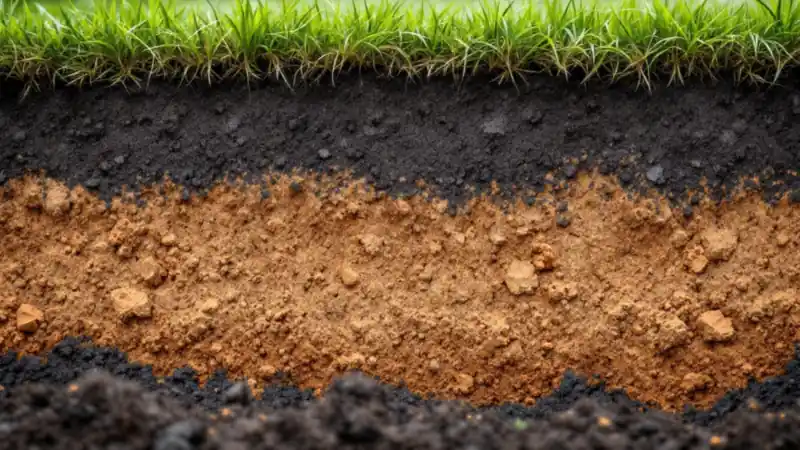
Soil vs dirt: soil is the layer still in place that holds minerals, organic matter, water, air and living organisms, about 45/5/25/25 percent by volume. Dirt is soil displaced from that layer or stripped of its organic matter and life, such as fill dirt.
The soil vs dirt difference can be measured, and the numbers sit in a public USDA database. We pulled the horizon records for 7 benchmark U.S. soils from USDA NRCS Soil Data Access (the data behind Web Soil Survey): organic matter runs 0.75 to 5.5 percent in the plow layer and falls to 0.1 to 0.55 percent in the deepest layer, the material an excavator hauls off as fill dirt. None of the top 5 search results we read in November 2026 gave a single measured figure for either one.
That matters when you buy or move material. Fill is sold for grading, and builders are told to strip topsoil out from under slabs (IRC 2021, R506.2), while New York’s highway spec will not accept lawn topsoil under 5 percent organic content. Prices per yard and ton are in our topsoil and fill dirt cost guide, and bagged products are covered in what 9 topsoil and garden soil bag labels contain.
What do soil scientists call soil, and what is dirt?
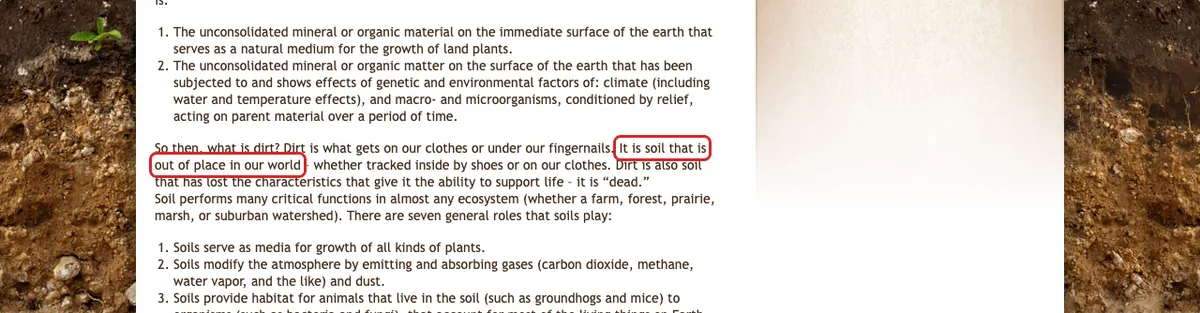
The Soil Science Society of America Glossary of Soil Science Terms defines soil as “the layer(s) of generally loose mineral and/or organic material” near the surface that “usually hold liquids, gases, and biota and support plants.” The same glossary has no entry for dirt: its D list runs from “direct shear test” straight to “discharge” (SSSA glossary, letter D, read Nov. 12, 2026).
Dirt gets two working definitions from soil scientists. One is about place: J. Patrick Megonigal of the Smithsonian Environmental Research Center told Science News Explores in 2017 that “dirt is displaced soil.” The other is about function: SSSA’s own Soils 4 Kids site calls dirt soil “out of place” and also soil that has “lost the characteristics that give it the ability to support life.”
| Source | Term | What it says | What it means on a job site |
|---|---|---|---|
| SSSA Glossary | Soil (a) | Loose mineral or organic layers near the surface that usually hold liquids, gases and biota and support plants | The working top layer, in place |
| SSSA Glossary | Dirt | No entry between “direct shear test” and “discharge” | Not a defined technical term |
| Soils 4 Kids (SSSA) | Dirt | Soil out of place, or soil that has lost the ability to support life | Tracked-in soil, or stripped and dead material |
| Megonigal, Smithsonian (2017) | Dirt | “Displaced soil” | Anything dug up and moved |
| USDA NRCS Soil Quality sheet (2001) | Soil | Mineral particles, organic matter and numerous species of living organisms | Biology is part of the definition |
| IRC 2021, R506.2 and R506.2.1 | Top soil, fill | Remove all vegetation and top soil inside foundation walls; fill must be free of vegetation and compacted | Builders treat topsoil as waste under slabs and want inert fill |
Soil vs dirt by the numbers
A typical mineral soil is about 50 percent solids and 50 percent pore space, split as 45 percent minerals, 5 percent organic matter, 25 percent air and 25 percent water (Illinois Extension, Soil Basics; Oregon State EM 9544). NRCS adds that organic matter is under about 5 percent of the volume in most soils (NRCS Soil Quality Indicators: Organic Matter), so small percentages carry most of the difference.
| Property | Soil (topsoil in place) | Dirt (displaced or subsoil fill) | Source |
|---|---|---|---|
| Volume makeup | About 45% minerals, 5% organic matter, 25% air, 25% water | Same minerals; organic share near zero at depth | Illinois Extension |
| Organic matter, 7 U.S. soils | 0.75% to 5.5% in the plow layer | 0.1% to 0.55% in the deepest layer | USDA SSURGO |
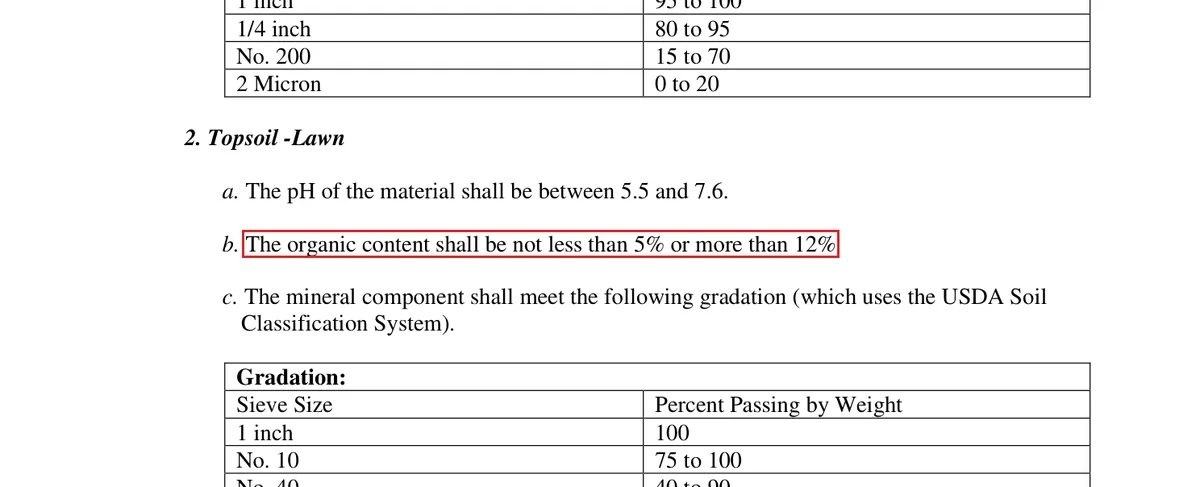
| Organic content in a lawn topsoil spec | 5% to 12% (NYSDOT 713-01, lawn) | No minimum for fill | NYSDOT, Jan. 2026 |
| Bulk density and pore space | 1.33 g/cm3 is about 50% pore space, the ideal | Miami 2Cd at 1.85 g/cm3 is 30% pore space | SDSU Extension; SSURGO |
| Bacteria per teaspoon (1 gram) | 100 million to 1 billion in healthy soil | No count published; carbon limits biology | NRCS Soil Biology Primer |
| Smell and color | Humus is dark brown with a pleasant, earthy smell | Subsoil colors run lighter: Cecil subsoil is red (10R 4/8) clay | NRCS; Cecil OSD |
| Job-site rule | Removed from under slabs | Must be compacted; 8 inch limit for earth fill unless approved | IRC R506.2.1 |
Pore space is the number to watch, because air, water and organisms all live there. SDSU Extension gives the formula: pore space equals 1 minus bulk density divided by 2.65 g/cm3, the density of mineral particles (SDSU, Bulk Density). Its NRCS table marks 1.75 g/cm3 as the point where a silt loam starts to restrict roots; the dense till under a Miami silt loam sits at 1.85.
Soil and dirt in the same hole: 7 U.S. soils
Every soil survey map unit carries horizon-by-horizon estimates of organic matter, bulk density and texture. We queried Soil Data Access on Nov. 12, 2026 for the main component of one map unit each from 7 benchmark soil series, from the Corn Belt to the Georgia Coastal Plain and California’s Central Valley. The top layer is the soil you garden in; the bottom layer is what a basement dig or a grading job turns into fill dirt.
| Soil series (county, map unit) | Top layer | Organic matter | Bulk density g/cm3 (pore space) | Deepest layer | Organic matter | Bulk density g/cm3 (pore space) | Top vs deepest |
|---|---|---|---|---|---|---|---|
| Miami (Hamilton Co., IN, MmA) | Ap, 0 to 7 in | 2% | 1.45 (45%) | 2Cd, 34 to 79 in | 0.25% | 1.85 (30%) | 8x |
| Drummer (Champaign Co., IL, 152A) | Ap, 0 to 14 in | 5.5% | 1.3 (51%) | 2Cg, 47 to 60 in | 0.1% | 1.55 (42%) | 55x |
| Cecil (Wake Co., NC, CeB) | Ap, 0 to 8 in | 0.75% | 1.58 (40%) | C, 50 to 80 in | 0.25% | 1.56 (41%) | 3x |
| Houston Black (Williamson Co., TX, HoA) | Ap, 0 to 6 in | 3% | 1.23 (54%) | BCkss, 70 to 80 in | 0.55% | 1.29 (51%) | 5.5x |
| Tifton (Tift Co., GA, TfA) | Apc, 0 to 11 in | 0.75% | 1.63 (38%) | C, 65 to 80 in | 0.15% | 1.4 (47%) | 5x |
| Plano (Dane Co., WI, 7199A) | Ap, 0 to 11 in | 4% | 1.34 (49%) | 2C, 46 to 79 in | 0.25% | 1.5 (43%) | 16x |
| Hanford (Madera Area, CA, HaA) | H1, 0 to 12 in | 0.75% | 1.55 (42%) | H3, 36 to 60 in | 0.25% | 1.55 (42%) | 3x |
Two patterns stand out. In the Midwest prairie soils the gap is wide: Drummer silty clay loam in Champaign County, Ill., holds 5.5 percent organic matter in its top 14 inches and 0.1 percent below 47 inches, a 55-fold drop. In the Southeast and the Central Valley, the plow layer of Cecil, Tifton and Hanford is only 0.75 percent, which is less than Drummer’s subsoil at 1.2 percent.
So no single organic matter cutoff separates soil from dirt nationwide. What separates them on your lot is position and life: the top 6 to 14 inches carry the roots, the granular crumb and the biology, and the layer 3 to 6 feet down does not. Sandy soils like Tifton and Hanford hold so little organic matter that the question becomes whether grass can grow in sand at all, and compost does most of the lifting there.
How much life is in a teaspoon of soil?
The NRCS Soil Biology Primer slide set gives typical counts per gram, about a teaspoon, for healthy soils under 3 land uses. Bacteria hold steady at 100 million to 1 billion; fungi, protozoa and arthropods climb sharply from farm fields to prairie and forest. Ohio State’s Role of Soil Bacteria fact sheet quotes the same 100 million to 1 billion range and puts the bacterial mass at about two cows per acre.
| Organism | Farmland | Prairie | Forest |
|---|---|---|---|
| Bacteria, per gram (teaspoon) | 100 million to 1 billion | 100 million to 1 billion | 100 million to 1 billion |
| Fungi, per gram | Several yards of hyphae | 10s to 100s of yards | 1 to 40 miles (conifers) |
| Protozoa, per gram | 1,000s | 1,000s | 100,000s |
| Nematodes, per gram | 10 to 20 | 10s to 100s | 100s |
| Arthropods, per sq ft | Under 100 | 500 to 2,000 | 10,000 to 25,000 |
| Earthworms, per sq ft | 5 to 30 | 10 to 50 | 10 to 50 (0 in conifers) |
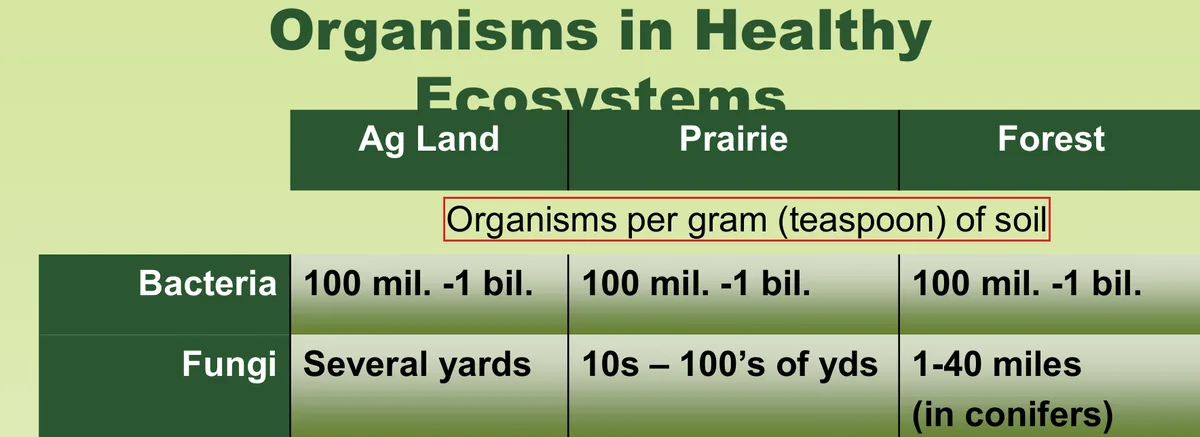
Dirt has no matching table because nobody publishes one, but NRCS names the two limits. Carbon from residue, compost and manure is typically the limiting resource for soil life, and compaction removes the large pores the organisms live in (NRCS Soil Quality: Soil Biodiversity, 1998). Subsoil at 0.1 to 0.55 percent organic matter is short on carbon, and the densest layers, like the till under Miami silt loam at 30 percent pore space, are short on room.
What several soil vs dirt guides get wrong
Four claims recur across the pages ranking for this question. We checked each against the primary source in November 2026; the table names the page we compared, not every site that repeats it.
| Claim | Where we read it | What the primary source shows |
|---|---|---|
| The Soil Science Society of America defines dirt as “displaced soil” | Nature’s Path blog | The SSSA glossary has no dirt entry. The phrase is Megonigal’s (Science News Explores, 2017); SSSA’s kids site says “out of place” |
| Dirt “has none of the minerals” found in soil | Nature’s Path blog | Displaced soil keeps its sand, silt and clay. Cecil’s red subsoil is 53% clay and Tifton’s Btc2 subsoil is 63.5% sand (SSURGO) |
| Dirt “does not compact when wet” | Nature’s Path blog | IRC R506.2.1 requires earth fill to be compacted; NRCS says moist or wet soil compacts more easily than dry (NRCS, Compaction) |
| A teaspoon of healthy soil holds more organisms than there are people on Earth | MyLand blog | NRCS lists 100 million to 1 billion bacteria plus thousands of protozoa per teaspoon of farmland, against 8.2 billion people in 2024 (UN WPP 2024) |
Fill dirt, topsoil or garden soil: which goes where?
Use the material whose organic content matches the job. New York’s DOT, one of the few agencies that writes numbers into a topsoil spec, asks for 3 to 8 percent organic content in roadside topsoil, 5 to 12 percent under lawns and 10 to 15 percent in planting mix (NYSDOT Standard Specifications, Section 713-01, Jan. 1, 2026). Fill carries no organic minimum because organic matter decomposes and settles.
| Material | Typical organic matter | Use it for | Avoid it for | Source |
|---|---|---|---|---|
| Fill dirt (subsoil) | 0.1% to 0.55% at depth in our 7 soils | Raising grade, backfill, base under slabs (compacted) | The top 4 to 6 inches under a lawn or bed | SSURGO; IRC R506.2.1 |
| Native topsoil in place | 0.75% to 5.5% in our 7 soils | Keep and amend it; restore it after grading | Under slabs, where IRC R506.2 requires removal | SSURGO; IRC |
| Purchased lawn topsoil | 5% to 12% in the NYSDOT lawn spec | A settled 4 to 6 inch layer for new turf | Pots and containers | NYSDOT 713-01; Penn State |
| Bagged topsoil or garden soil | Often little or no mineral soil | Mixing into existing beds | As the only fill in raised beds | UMaine Bulletin 2283 |
| Compost | Mostly organic matter | 3 to 4 inches mixed 6 to 8 inches deep in new beds | Filling beds on its own | Oregon State EM 9308 |
For a new lawn, Penn State calls for at least 4 to 6 inches of good topsoil, measured settled, over the graded subsoil, with 2 inches of it mixed into the top 2 to 3 inches of subsoil so water and roots cross the line (Penn State Extension, Lawn Establishment). Delivered prices for each grade are in our topsoil cost per yard tables, and the bag-by-bag contents are in our comparison of garden soil vs potting soil.
How to tell whether you have soil or dirt
These 6 checks, from free to lab, settle it for a bed or a lawn area. Do them in moist weather, not after a week of drought, because earthworms and smell both fade in dry ground.
- Dig a 1 sq ft hole one spade deep (about 8 inches). Topsoil in place is darker than what lies under it: Drummer’s top 7 inches are black (10YR 2/1) with “many fine roots,” while Cecil turns from dark yellowish brown to red clay at 8 inches (Drummer OSD; Cecil OSD).
- Count earthworms in the spoil. NRCS lists 5 to 30 per sq ft for healthy farmland and 10 to 50 for prairie (Soil Biology Primer); none in moist ground points to dirt.
- Smell a handful. Well-decomposed organic matter is “dark brown, porous, spongy” with “a pleasant, earthy smell” (NRCS Soil Quality: Organic Matter). Pale, odorless material is low in it.
- Squeeze and crumble. NRCS says organic matter makes soil “more friable, less sticky, and easier to work” (NRCS); Drummer’s topsoil is described as “weak fine granular.” Dense clods or loose single grains point to subsoil.
- Run a jar test for texture: fill a straight-sided jar 1/3 with sieved soil, top with water, shake, then mark sand at 1 minute, silt at 2 hours and clay at 48 hours (Clemson HGIC 1656; Montana State marks silt at 6 hours, MSU). Texture tells you sand, silt and clay, which soil and dirt share; it does not measure life.
- Send a sample to a lab. A standard report gives organic matter percent, which is the one number that settles it; our guide to lab soil tests and kits lists what labs charge.
1Did the material come from a pile, a trench or below the top 14 inches?
YesTreat it as fill dirt: use it for grade, then cap lawn areas with 4 to 6 inches of settled topsoil (Penn State).
NoGo to the next question
2Is it dark brown to black, crumbly and earthy-smelling?
Yes
NoOrganic matter is likely low: get a lab organic matter test before planting.
3Did a spade-deep 1 sq ft hole in moist ground turn up 5 or more earthworms?
Yes
NoBiology is thin: mix 3 to 4 inches of compost 6 to 8 inches deep (Oregon State EM 9308).
4Does a wire flag push in 6 inches by hand?
Yes
NoCompacted: loosen to the depth of the hard layer before planting.
It is working soil: test pH and nutrients, then plant.
Source: NRCS Soil Biology Primer; NRCS Soil Quality sheets; Penn State; Oregon State EM 9308
If a wire flag or screwdriver stops within the top few inches, the bigger problem is compaction, not the material. Our guide to planting grass seed on hard dirt matches the fix to the depth of the hard layer.
Can you turn dirt into soil?
Yes, for the top 6 to 12 inches, and the recipe is organic matter plus time. Oregon State says to spread 3 to 4 inches of compost and mix it 6 to 8 inches deep for landscape beds, or 8 to 12 inches for new vegetable beds, then add 1/4 to 1 inch a year (OSU EM 9308). Penn State limits each tilled layer to 2 inches of organic material, because thicker layers do not mix evenly (Penn State).
Biology follows the carbon. NRCS reports that organic matter decomposes very slowly below 38°F and fastest up to about 102°F in moist soil, so compost worked in during spring feeds organisms through the growing season (NRCS Soil Quality: Organic Matter). For the depth and moisture rules, see how to till soil without wrecking its structure; to choose between amendments, compost and mulch do different jobs. Heavy red clay has its own steps in our guide to improving clay soil with compost and gypsum and in whether clay soil is acidic.
How we compiled this
In November 2026 we read the SSSA glossary, 3 USDA NRCS publications, 2 Official Series Descriptions, the 2021 IRC, the NYSDOT 2026 topsoil specification and 9 university extension pages, and queried USDA Soil Data Access for 30 horizons in 7 soil series on Nov. 12, 2026. The horizon values are NRCS representative estimates, not our measurements; we did not test any soil. We compared 4 claims from the top-ranking pages against those sources.
Frequently asked questions
Are soil and dirt the same thing?
Not to soil scientists. Soil is the layer in place that supports plants; dirt is soil that has been moved or has lost its organic matter and life (Soils 4 Kids, SSSA). In everyday speech the words overlap, and the SSSA glossary does not define dirt at all.
Can I use regular dirt as soil?
For grading and backfill, yes. For planting, mix in 3 to 4 inches of compost 6 to 8 inches deep first (Oregon State), because subsoil dug from 3 feet or deeper held only 0.1 to 0.55 percent organic matter in our 7 USDA soils.
Is topsoil just regular dirt?
No. Topsoil is the upper, darker layer with most of the organic matter: 0.75 to 5.5 percent in our 7 soils, and 5 to 12 percent in New York’s lawn topsoil spec (NYSDOT 713-01). Fill dirt is usually subsoil from below it.
Can dirt be turned into soil?
In the root zone, yes: add compost in layers of 2 inches or less, mix it into the top 4 to 8 inches, and keep it moist (Penn State). Soil organisms build up as carbon arrives; NRCS names carbon as the usual limit on soil life.
Is potting soil considered dirt?
Usually it is neither. UMaine Extension says most bagged soil products contain no true mineral soil and are mixes of manure, bark, peat and compost (Bulletin 2283). Our sibling page on potting soil vs potting mix reads the labels.
Will grass grow on fill dirt?
Seed may sprout but roots struggle. Penn State calls for at least 4 to 6 inches of settled topsoil over graded subsoil for turf, with 2 inches mixed into the top 2 to 3 inches of subsoil (Penn State Lawn Establishment).
Sources
- USDA NRCS, Soil Data Access (SSURGO), chorizon records for Miami, Drummer, Cecil, Houston Black, Tifton, Plano and Hanford map units, Queried Nov. 12, 2026. Accessed November 2026.
- Soil Science Society of America, Glossary of Soil Science Terms, letter S (soil), Read Nov. 12, 2026. Accessed November 2026.
- Soil Science Society of America, Glossary of Soil Science Terms, letter D (no entry for dirt), Read Nov. 12, 2026. Accessed November 2026.
- Soil Science Society of America, Soils 4 Kids, All About Soil, Current page. Accessed November 2026.
- Science News Explores (J. Raloff), Explainer: What makes dirt different from soil, Nov. 16, 2017. Accessed November 2026.
- International Code Council, 2021 International Residential Code, R506.2 Site Preparation and R506.2.1 Fill, 2021 edition. Accessed November 2026.
- USDA NRCS, Soil Biology Primer slide set, Typical Numbers of Soil Organisms in Healthy Ecosystems, Current file. Accessed November 2026.
- USDA NRCS, Soil Quality Information Sheets: Organic Matter (1996), Compaction, Soil Quality Introduction (2001), Soil Biodiversity (1998), 1996 to 2001. Accessed November 2026.
- University of Illinois Extension, Soil Basics, Current page. Accessed November 2026.
- Oregon State University Extension, EM 9544, Soil-plant-water relationships, Current page. Accessed November 2026.
- Oregon State University Extension, EM 9308, How to use compost in gardens and landscapes, Current page. Accessed November 2026.
- Penn State Extension, Lawn Establishment, Current page. Accessed November 2026.
- South Dakota State University Extension, Bulk Density: An Indicator of Soil Health (NRCS ideal and root-restricting values), Current page. Accessed November 2026.
- Ohio State University CFAES, Role of Soil Bacteria, Current page. Accessed November 2026.
- Clemson Cooperative Extension, HGIC 1656, Soil Texture Analysis: The Jar Test, Revised Dec. 1, 2023. Accessed November 2026.
- Montana State University Extension, Soil Texture Jar Test, June 2021. Accessed November 2026.
- New York State Department of Transportation, Standard Specifications (USC), Volume 4, Section 713-01 Topsoil, Jan. 1, 2026. Accessed November 2026.
- USDA NRCS, Official Series Description: Drummer, Current OSD. Accessed November 2026.
- USDA NRCS, Official Series Description: Cecil, Current OSD. Accessed November 2026.
- University of Maine Cooperative Extension, Bulletin 2283, Purchasing Topsoil, Current page. Accessed November 2026.
- United Nations DESA Population Division, World Population Prospects 2024: Summary of Results, 2024. Accessed November 2026.
- Nature’s Path, Soil vs Dirt: The Difference and Why It Matters (cited as the claim we compared), Read Nov. 2026. Accessed November 2026.
- MyLand, Soil vs Dirt Explained (cited as the claim we compared), Read Nov. 2026. Accessed November 2026.