How to plant grass seed on hard dirt: find how deep the hard layer goes and loosen that depth. Core-aerate if it ends within 3 inches, till 4 to 8 inches if deeper, mix in 1 to 2 inches of compost, then seed.
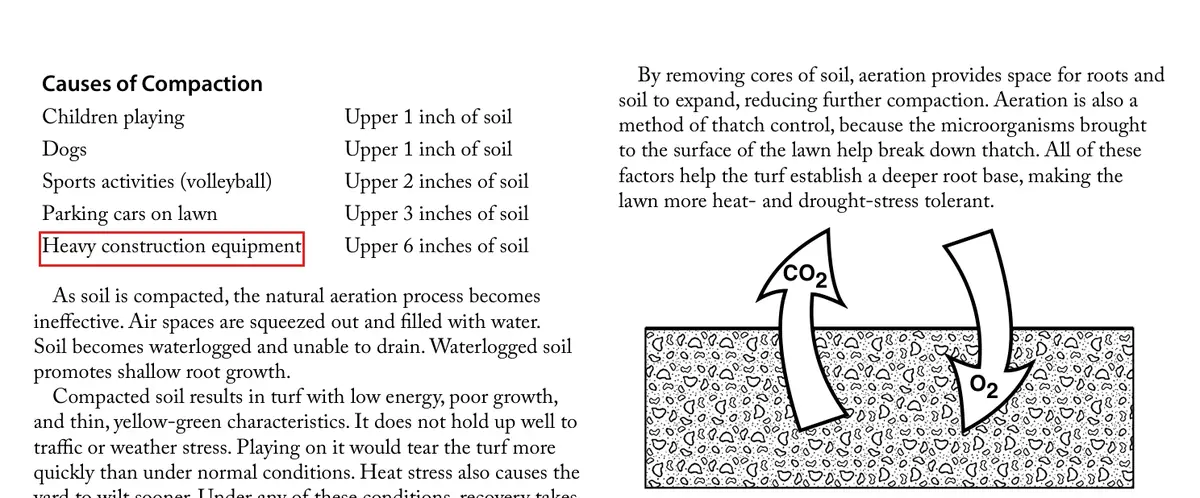
Learning how to plant grass seed on hard dirt starts with one measurement most guides skip: the depth of the hard layer. Kansas State Extension’s MF2130 tables how deep each cause packs soil: 1 inch for children and dogs, 2 inches for sports play, 3 inches for cars parked on the lawn and 6 inches for construction equipment. A core aerator’s 3-inch tine fixes the first three. It cannot reach the fourth, which is why seed on a new-build lot often comes up and then stalls.
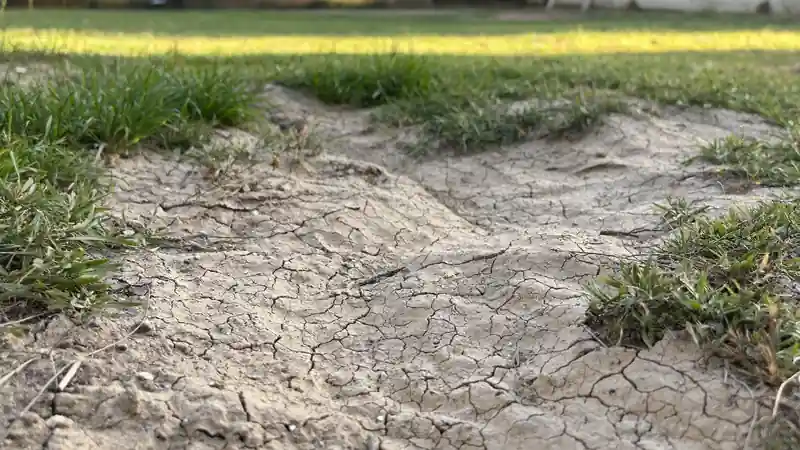
The yardstick is root resistance. Penn State Extension’s penetrometer guide says roots practically stop growing above 300 psi of penetration resistance, whatever the soil texture. Seed can still sprout on hard dirt if the surface stays wet, but the seedlings run out of root room within weeks. Kansas State adds that most compaction sits in the top 2 inches, right where new roots start. The sections below turn that 300 psi line into a test you can run with a wire survey flag, then match the fix to the depth you find.
Is your dirt actually compacted? Four tests, from free to lab
Test when the soil is evenly moist. Penn State reads penetrometers at field capacity, about 24 hours after a soaking rain, because dry soil reads harder than roots experience it and mud reads softer. If the yard is dust-dry, water it deeply 2 days ahead, the lead time Nebraska Extension gives before aerating. Probe at least 5 spots, including paths, gate areas and wherever vehicles or equipment ran.
| Test | How to run it | Compacted if | Source |
|---|---|---|---|
| Screwdriver | Push a long screwdriver straight down in moist soil at several spots | It cannot be pushed in easily | Illinois Extension |
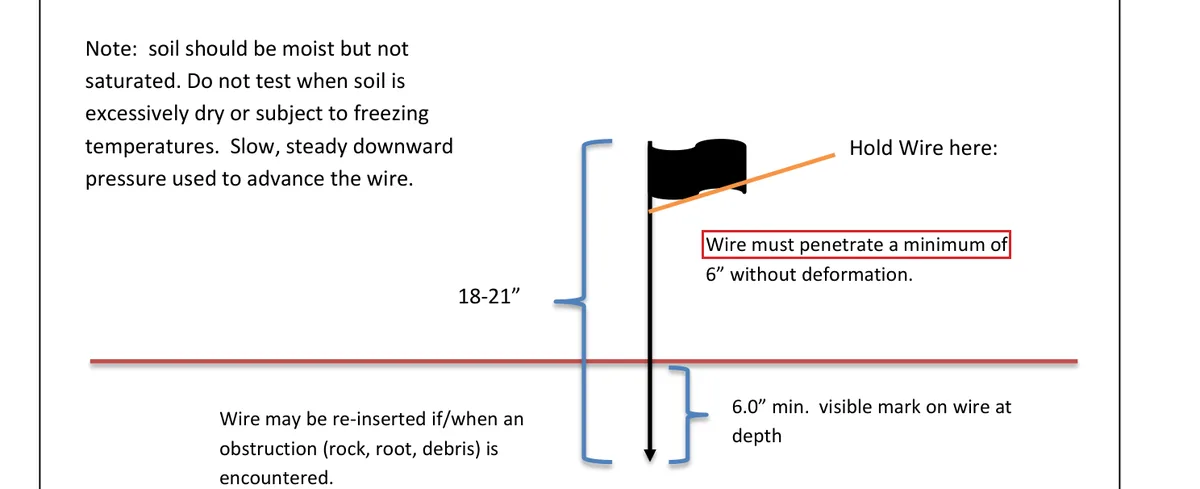
| Wire flag (15.5-gauge survey flag) | Push the wire straight down with slow, steady pressure | It bends before reaching 6 in (re-insert if you hit a rock or root) | NJ Soil Restoration Standard notes |
| Hand penetrometer (about $200) | Push at about 1 inch per second; note the depth where the gauge passes 300 psi and where it drops back | Above 300 psi within the top 6 in | Penn State Extension; NJ standard |
| Bulk density core (lab or kit) | Drive a ring sampler, dry and weigh the soil | Above 1.47 g/cm³ in clay up to 1.80 g/cm³ in sand (table below) | USDA NRCS |
The wire flag is the useful middle ground. New Jersey’s soil restoration standard, used by its soil conservation districts to sign off seeded construction sites, accepts a 15.5-gauge steel survey flag that goes 6 inches into moist soil without deforming, or a penetrometer reading of 300 psi or less at 6 inches (Ocean County Soil Conservation District copy, effective Dec. 7, 2017). Mark the depth at which each probe stops or bends; that number, not how hard the surface feels underfoot, picks your fix.
Soil texture changes how dense is too dense. Clay packs to a root-restricting state at a lower density than sand, so a clay yard that feels only moderately firm may already be past the line. USDA NRCS publishes the cutoffs by texture in its Soil Health Guide on bulk density:
| Soil texture | Ideal for roots (g/cm³) | Starts to affect roots | Restricts roots |
|---|---|---|---|
| Sand, loamy sand | Below 1.60 | 1.63 | Above 1.80 |
| Sandy loam, loam | Below 1.40 | 1.63 | Above 1.80 |
| Sandy clay loam, clay loam | Below 1.40 | 1.60 | Above 1.75 |
| Silt, silt loam | Below 1.40 | 1.60 | Above 1.75 |
| Silt loam, silty clay loam | Below 1.40 | 1.55 | Above 1.65 |
| Sandy clay, silty clay, clay loam | Below 1.10 | 1.49 | Above 1.58 |
| Clay (under 45% clay) | Below 1.10 | 1.39 | Above 1.47 |
If the screwdriver and wire both slide in, compaction is not your problem. Check pH and nutrients with a lawn soil test instead; Maryland Extension adds compost only when the test shows organic matter below 3 percent (UMD, Starting a New Lawn).
Match the fix to how deep the hard layer goes
Every fix has a reach, and a fix that stops above the hard layer does not count. Penn State’s renovation guidance runs slicer blades only 1/4 to 1/2 inch deep; K-State sets core holes 3 inches deep, no more than 3 inches apart and about 3/4 inch wide; Purdue and Maryland till 4 to 6 inches; Oregon State’s EC 1550 tills 6 to 8. Read your probe depth against this table.
For a hard layer within core depth, the soil test, flagging and pass-by-pass steps are in our guide on how to aerate a lawn.
| Hard layer found | Usual cause (K-State MF2130) | Fix that reaches it | Source |
|---|---|---|---|
| Surface crust, 1/4 to 5/8 in, loose below | Rain or sprinklers on bare soil; freeze and thaw | Rake or slice 1/4 to 1/2 in, seed, then mulch so the crust does not re-form | NRCS crust sheet; Penn State |
| Top 1 to 2 in | Children, dogs, sports play | Core-aerate, holes 3 in deep and 3 in or less apart (several passes); overseed into the holes | K-State MF2130; Illinois Extension |
| Top 3 in | Cars parked on the lawn | Core-aerate in several directions if turf remains; on bare dirt, till 4 to 6 in instead | K-State; Purdue AY-3 |
| 4 to 6 in | Heavy construction equipment; topsoil stripped | Spread 1 to 2 in compost, till 4 to 8 in in 1 or 2 passes, let it settle | UMD; Oregon State EC 1550; Penn State |
| Still above 300 psi below 8 in | Grading and site work | Rip or chisel-plow (a contractor job); set a subsoiler 1 in below the bottom of the hard zone | Penn State lawn establishment; Penn State penetrometer guide |
Two cautions apply at every depth. Penn State’s compaction review says tilling compacted soil makes it more susceptible to recompaction, so tilled ground needs traffic kept off it until roots fill it, and NRCS notes that wetting and drying or freeze and thaw cycles do very little to lower bulk density (NRCS). Waiting a winter for hard dirt to soften on its own rarely works.
Before a tiller goes in, run the squeeze test and check your state’s 811 depth rule in our guide to tilling soil.
1Does a 15.5-gauge wire flag slide 6 inches into moist soil at most spots?
YesCompaction is not the problem. Rake 1/4 inch, seed, and check pH and nutrients with a soil test (NJ soil restoration standard).
NoGo to the next question
2Is the hard part only a surface crust under 5/8 inch, with loose soil beneath?
YesRake or slice 1/4 to 1/2 inch, seed, roll lightly and mulch so the crust does not re-form (NRCS; Penn State).
NoGo to the next question
3Does the hard layer end within the top 3 inches, with grass you want to keep?
YesCore-aerate in several passes (holes 3 in deep, 3 in apart), topdress up to 1/2 inch of compost, slice and overseed (K-State; Penn State).
NoGo to the next question
4Does the hard layer end within 8 inches?
YesSpread 1 to 2 inches of compost, till 4 to 8 inches when the soil crumbles, let it settle, then seed (UMD; Purdue; Oregon State).
NoHard below 8 inches (penetrometer above 300 psi): hire ripping or subsoiling set 1 inch below the hard zone, then compost, till and seed (Penn State).
How to plant grass seed on hard, bare dirt, step by step
This is the sequence for a bare patch or a whole yard with no turf worth saving. The seeding itself, rates and starter fertilizer included, follows our 12-step guide to planting grass seed; the steps here are the extra work hard ground needs before and after.
- Wait for workable moisture. Soil should crumble, not smear. Purdue AY-3 warns that working wet soil causes clods and that overtilling destroys structure (Purdue AY-3). If the ground is dry and hard, soak it and wait 1 to 2 days.
- Probe and record depth. Push a wire flag or penetrometer at 5 or more spots and note where each stops or passes 300 psi. Use the deepest common reading to set tilling depth.
- Spread compost. 1 to 2 inches, which Maryland Extension equates to 3 or 6 cubic yards per 1,000 sq ft (UMD). Colorado State’s rate table gives the same 1 to 2 inches for a one-time lawn application, mixed 6 inches deep (CSU Extension 7.235). Use the calculator below for your area.
- Till to the probe depth. At least 4 inches, in 1 or 2 passes, per Penn State; 6 to 8 inches after construction traffic (Oregon State). New Jersey’s standard sets 6 inches as the minimum depth for decompacting a construction subgrade.
- Grade and firm. Alternate raking and rolling, changing direction each pass (Oregon State); Purdue says to let tilled soil settle, or firm it slightly, before seeding. Our lawn roller guide covers roller weight.
- Seed, rake and roll lightly. Purdue pairs a light raking with a pass of an empty water-fill roller because seed-to-soil contact is critical for quick germination (Purdue AY-3).
- Mulch and water. A light straw mulch reduces surface crusting and holds moisture (Penn State). NRCS lists sprinkler water as a way to ease seedling emergence through a crust.
- Keep traffic off. Maryland says to keep people and pets off for at least a month after germination, or until the lawn has been mowed twice (UMD).
- Compost, cubic yards
- 3.1
- Compost, cubic feet
- 83
- 2 cu ft bags
- 42
Default: 1,000 sq ft at 1 inch = 3.1 cu yd (83 cu ft, 42 two-cubic-foot bags), Colorado State's 3 cu yd per 1,000 sq ft. Add 5 to 10 percent for settling and spillage.
The compost volume is simple arithmetic: area times depth. One inch over 1,000 sq ft is 83.3 cubic feet, or 3.1 cubic yards, which matches Colorado State’s 3 cubic yards per 1,000 sq ft at about 1 inch. At 1,000 sq ft and 1 inch, that is 42 two-cubic-foot bags; bulk delivery prices per cubic yard are in our topsoil cost guide.
| Area | 1 in compost | 2 in compost | 2 cu ft bags at 1 in |
|---|---|---|---|
| 200 sq ft (bare patch) | 0.6 cu yd (16.7 cu ft) | 1.2 cu yd (33.3 cu ft) | 9 |
| 500 sq ft | 1.5 cu yd (41.7 cu ft) | 3.1 cu yd (83.3 cu ft) | 21 |
| 1,000 sq ft | 3.1 cu yd (83.3 cu ft) | 6.2 cu yd (166.7 cu ft) | 42 |
| 2,500 sq ft | 7.7 cu yd (208.3 cu ft) | 15.4 cu yd (416.7 cu ft) | 105 |
| 5,000 sq ft | 15.4 cu yd (416.7 cu ft) | 30.9 cu yd (833.3 cu ft) | 209 |
Hard dirt under a thin lawn you want to keep
Where grass still covers part of the area, skip the tiller. Penn State’s renovation sequence is several passes with a core aerator, no more than 1/4 to 1/2 inch of compost spread on top, then a slicer or dethatcher run 1/4 to 1/2 inch deep to break the cores and work the mix into the holes before seeding (Penn State, Lawn Establishment). That works for compaction in the top 3 inches. K-State notes it can take 3 consecutive years of aeration for a yard to get the full effect; timing by grass and month is in our aeration timing guide.
Seed lands best in the holes. Illinois Extension recommends core aeration before overseeding and says to keep the seeded area moist, often watering once or twice a day for about 2 weeks (Illinois Extension). Rates and passes for cool-season lawns are in our overseeding guide, and posted prices for aeration with seed in our lawn aeration cost guide.
Can you just put topsoil over hard dirt?
Only a thick layer over loosened ground. New Jersey’s standard decompacts the subgrade to 6 inches first, then requires topsoil at an average depth of 5 inches, never under 4, firmed in place, and holds the site to 80 percent vegetative cover. Oregon State says imported soil should match the original texture, and a sandy layer should be at least 6 inches deep after compaction (OSU EC 1550).
A 1 to 2 inch skim of bagged topsoil on packed dirt gives seed a place to sprout, but not a place to root. Penn State puts cool-season turf rooting depth at 2 to 6 inches and says severely compacted soils cannot supply the oxygen roots need (Penn State, cool-season turfgrass structures). On a 2-inch skim, most of that root zone sits in the hard layer underneath. Loosen first, then add soil; our clay soil guide covers clay amendments and why sand makes clay worse.
Packed dirt is often subsoil exposed by grading, and its organic matter, pore space and earthworm counts are set against topsoil in our guide to the difference between soil and dirt.
What is the best grass seed for hard dirt?
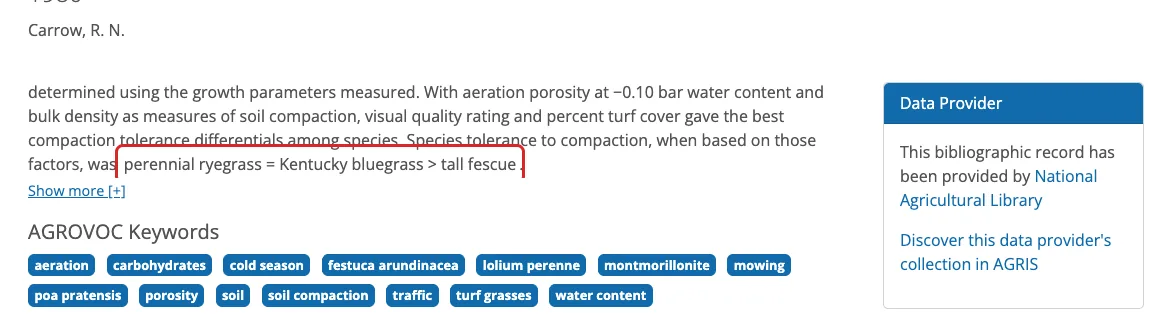
No seed fixes compaction, and the pick most repeated online ranked last in the one controlled trial we found. One of the top-ranking guides for this query recommends tall fescue because it pushes “deeper taproots” through dense ground, but Penn State Extension describes turfgrass roots as fibrous, branching and very slender, the opposite of a taproot. In a field trial that compacted turf with a power roller 12 or 24 times a week for 8 weeks, tall fescue ranked least tolerant of compaction (Carrow, Agronomy Journal, 1980).
| Species (cultivar tested) | Effect of compaction | 8 months after compaction stopped | Tolerance rank |
|---|---|---|---|
| Perennial ryegrass (‘Pennfine’) | No adverse effects except some loss of root weight at 12 passes a week | Not reported as reduced | 1 (tie) |
| Kentucky bluegrass (‘Baron’) | Lost verdure, shoot density and root growth | Visual quality and cover still reduced | 1 (tie) |
| Tall fescue (‘Kentucky 31’) | Lost verdure | Visual quality and cover still reduced | 3 |
Read that as a 1980 trial of 3 older cool-season cultivars on 1 soil; modern turf-type cultivars and warm-season grasses were not tested. The practical point: pick the grass for your climate and sun (see our grass type comparison and tall fescue guide), then fix the soil, because all 3 species lost turf cover under compaction.
How we compiled this
We read 14 primary documents in full in November 2026: 7 university extension publications (Penn State, Kansas State, Purdue, Maryland, Oregon State, Colorado State, Nebraska and Illinois), 2 USDA NRCS soil quality sheets, New Jersey’s soil restoration standard notes and the abstract of Carrow’s 1980 Agronomy Journal trial. Depth thresholds were matched to each tool’s published reach; compost volumes are our arithmetic. We did not test soils or seed. No turf-specific study we found gives germination percentages on crusted versus loosened soil, so we give none.
Frequently asked questions
Can I just throw grass seed on top of dirt?
On loose, moist dirt, some will grow; on hard dirt, most will not. Purdue calls seed-to-soil contact critical, and NRCS says a wet crust can cut oxygen diffusion to seed by as much as 50 percent. Rake the surface 1/4 inch first, then roll lightly.
Will grass seed grow on hard soil?
It will usually sprout, then stall. Penn State reports root growth practically stops above 300 psi of penetration resistance, so seedlings on packed dirt stay shallow and dry out. Loosen to the depth where a wire flag stops before seeding.
How do I prepare hard soil for planting grass seed?
Moisten it, probe it, then loosen to that depth: core-aerate for a hard layer within 3 inches, or spread 1 to 2 inches of compost and till 4 to 8 inches for deeper compaction. Let tilled soil settle, then seed, rake and roll.
What is the best grass seed for hard dirt?
There is no compaction-proof seed. In Carrow’s 1980 roller trial, perennial ryegrass and Kentucky bluegrass tolerated compaction equally and better than tall fescue. Choose for climate and sun, then fix the soil.
Will grass grow through 2 inches of topsoil?
It will germinate in it, but cool-season roots run 2 to 6 inches deep (Penn State), so most of the root zone ends up in the hard layer below. New Jersey’s standard uses 5 inches of topsoil, minimum 4, over a subgrade loosened 6 inches.
How long does it take for grass to grow from dirt?
Cool-season seed sprouts in 3 to 21 days and warm-season seed in 10 to 30 days, with the first mowing 2 to 6 weeks after seeding (our germination timeline has each grass). Hard, crusted dirt that dries between waterings stretches those times.
Sources
- Penn State Extension (S.W. Duiker), Diagnosing Soil Compaction Using a Penetrometer (Soil Compaction Tester), Updated Sept. 9, 2025. Accessed November 2026.
- Penn State Extension, Effects of Soil Compaction, Updated Mar. 8, 2005. Accessed November 2026.
- Penn State Extension (P. Landschoot), Lawn Establishment, Updated Sept. 19, 2025. Accessed November 2026.
- Penn State Extension, The Cool-Season Turfgrasses: Basic Structures, Growth and Development, Updated Sept. 19, 2025. Accessed November 2026.
- Ocean County Soil Conservation District (New Jersey), Soil Restoration Notes Required on Plans: Soil De-compaction and Testing Requirements, Effective Dec. 7, 2017. Accessed November 2026.
- Kansas State University Research and Extension (J. Hoyle, R. Braun), MF2130, Aerating Your Lawn, Feb. 2018. Accessed November 2026.
- USDA Natural Resources Conservation Service, Soil Health Guide: Bulk Density, 2022. Accessed November 2026.
- USDA Natural Resources Conservation Service, Soil Quality Information Sheets: Soil Crusts (Apr. 1996), 1996. Accessed November 2026.
- University of Maryland Extension, Starting a New Lawn, Updated Dec. 2025. Accessed November 2026.
- Purdue University and University of Illinois, AY-3-W, Establishing Turfgrass Areas From Seed, Current PDF. Accessed November 2026.
- Oregon State University Extension, EC 1550, Practical Lawn Establishment and Renovation, Current online edition. Accessed November 2026.
- Colorado State University Extension, Fact Sheet 7.235, Choosing a Soil Amendment, Current online edition. Accessed November 2026.
- R.N. Carrow, Agronomy Journal 72(6), Influence of Soil Compaction on Three Turfgrass Species (abstract, FAO AGRIS), 1980. Accessed November 2026.
- Nebraska Extension in Lancaster County, Getting Your Lawn Ready for Summer: Aeration, Current online edition. Accessed November 2026.
- University of Illinois Extension, Lawn Aeration and Overseeding (Good Growing), Sept. 10, 2020. Accessed November 2026.