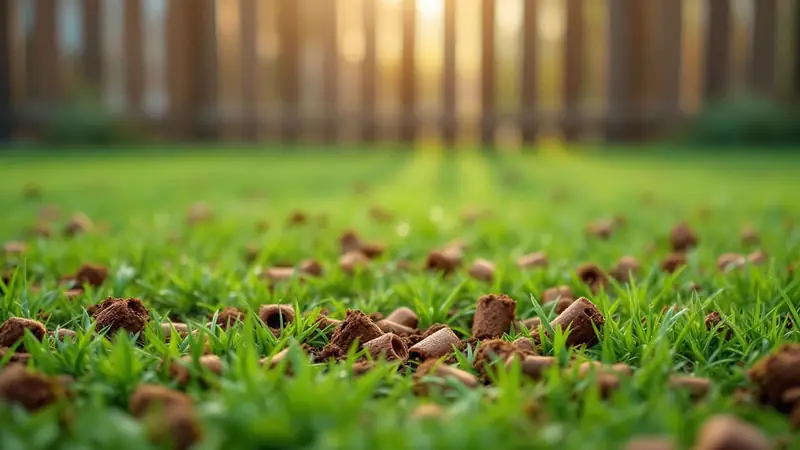
How to aerate lawn soil: water the day before if a screwdriver will not sink 2 to 3 inches, flag sprinkler heads, then run a core aerator in crossing passes until cores 2 to 3 inches long sit at 20 to 40 per square foot.
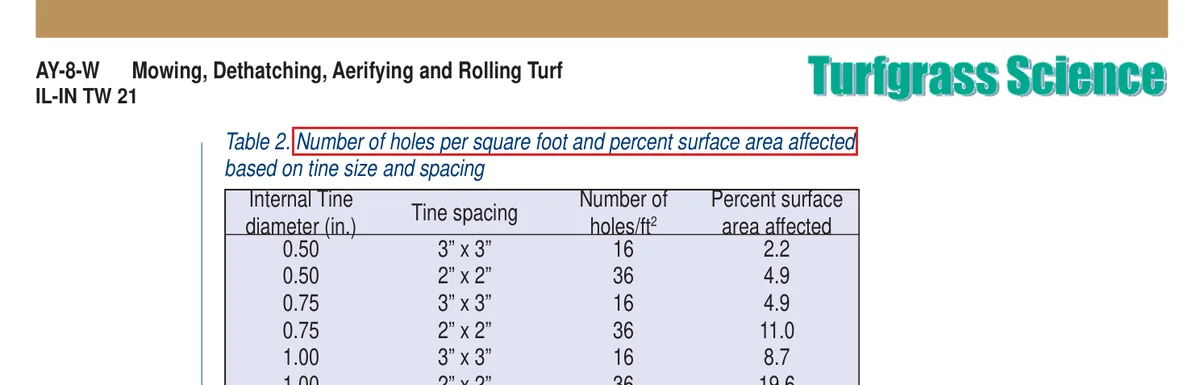
Learning how to aerate lawn soil properly comes down to one number most guides leave out: holes per square foot. Purdue Extension AY-8 says aeration is most beneficial when cores go 2 to 3 inches deep and 20 to 40 holes are punched per square foot, and that most machines at rental agencies need multiple passes to get there. Spike tools that remove no soil do not count as aeration in that publication at all.
So we took the hole pattern printed in 9 aerator spec sheets and manuals (Billy Goat, Ryan, Classen and Bluebird) and did the arithmetic. One pass of a walk-behind drum aerator, the kind rental stores stock, leaves 4.3 to 6.2 holes per square foot. That means 4 or 5 passes, not the 2 most guides describe, to reach Purdue’s floor. The makers’ own “holes per sq ft” figures run 7 to 64 percent above what their printed patterns produce, so we use the pattern number throughout.
How many passes does your aerator need?
Divide 144 square inches by the hole pattern to get holes per square foot from one pass, then divide 20 by that. A 4 x 7 inch pattern gives 144 / 28 = 5.1 holes, so 4 passes. Penn State Extension runs the same arithmetic for the common 4 x 8 inch pattern: 4.5 holes, which opens only 1.38 percent of the surface with 3/4 inch tines.
| Machine | Type | Width and tines | Tine | Core depth | Hole pattern | Holes per sq ft, 1 pass (pattern math) | Maker’s stated holes per sq ft | Passes to reach 20 per sq ft | Minutes per 1,000 sq ft per pass at rated maximum | Weight |
|---|---|---|---|---|---|---|---|---|---|---|
| Billy Goat AE401H (AE400 ser) | Drum, walk-behind | 19 in, 24 tines | 5/8 in | Up to 2.75 in | 4.75 x 7 in | 4.3 | Not stated | 5 (21.7 holes) | 3.2 min | 242 lb dry |
| Billy Goat PLUGR PL1801H | Reciprocating, walk-behind | 18 in, 4 tines | 5/8 in | Up to 2.75 in | 3.63 x 6 in | 6.6 | Not stated | 3 (19.8 holes) | 2.7 min | 236 lb |
| Ryan Lawnaire IV with EST | Drum, walk-behind | 19 in, 30 tines | 3/4 in | Up to 2.75 in | 3.75 x 7 in | 5.5 | 9 | 4 (21.9 holes) | 2.1 min | 240 lb dry, 279 lb with weights |
| Ryan Lawnaire 28 | Reciprocating, walk-behind | 28 in, 8 tines | 3/4 in | Up to 2.5 in | 3.5 x 5 in | 8.2 | 12 | 3 (24.7 holes) | 2.5 min | 404 lb |
| Classen TA22H | Split drum, walk-behind | 21 in, 36 tines | 3/4 in | Up to 3 in | 3.4 x 7 in | 6.1 | 6.5 | 4 (24.2 holes) | 1.9 min | 214 lb dry (sheet also lists 270 lb) |
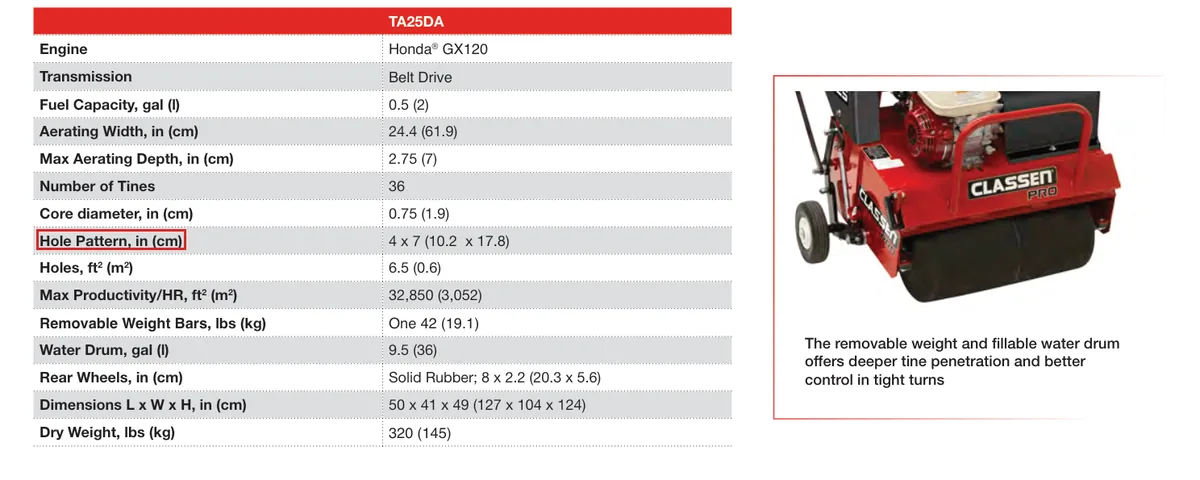
| Classen PRO TA25DA PowerSteer | Split drum, walk-behind | 24.4 in, 36 tines | 3/4 in | Up to 2.75 in | 4 x 7 in | 5.1 | 6.5 | 4 (20.6 holes) | 1.8 min | 320 lb dry |
| Bluebird H424 | Drum, walk-behind | 17.5 in, 24 tines | 3/4 in | Up to 3 in | 4.5 x 6.5 in | 4.9 | 6.7 | 4 (19.7 holes) | 2.6 min | 265 lb |
| Bluebird H530A | Drum, walk-behind | 19 in, 30 tines | 3/4 in | Up to 3 in | 3.8 x 6.5 in | 5.8 | 7.7 | 4 (23.3 holes) | 2.4 min | 288 lb |
| Bluebird H742 | Drum, walk-behind | 25.5 in, 42 tines | 3/4 in | Up to 3 in | 3.6 x 6.5 in | 6.2 | 8.1 | 4 (24.6 holes) | 1.5 min | 420 lb |
Two machines stand apart. The Ryan Lawnaire 28, a reciprocating unit, punches 8.2 holes per square foot by its 3.5 x 5 inch pattern, so 3 passes reach 24.7 holes. The Billy Goat white paper says its cam-driven AE1300H can place 8 to 48 holes per square foot in one pass when the operator slows down. Purdue agrees that aerifiers with reciprocating arms are the most effective type.
Tow-behind plug aerators sit at the other end. The Agri-Fab 45-0299 is a 48-inch tow-behind unit with knife-style plugger points; it weighs 94 lb, its tray takes up to 140 lb of added weight, but publishes no hole pattern. Purdue says aerifiers that roll behind garden tractors are less effective because they do not penetrate deep enough or punch enough holes.
- Holes per square foot
- 8.7
- Percent of Purdue's 20-hole minimum
- 43
- Cores per 1,000 sq ft
- 8,662
Default: 2 passes with a Billy Goat AE401H = 8.7 holes per sq ft, 43 percent of Purdue's 20-hole minimum. Purdue AY-8 recommends 20 to 40 holes per sq ft; K-State's 3 inch spacing equals 16.
Core, spike, manual or liquid: which method actually aerates?
Only methods that pull a soil core relieve compaction on clay and silt. Nebraska Extension says solid-tine and spike tools, including aeration shoes, push soil particles apart and increase compaction between the holes, and that there is no chemical substitute for core aeration. Iowa State tells homeowners to avoid spike devices.
| Method | Depth | Holes per sq ft per pass | Speed | Removes soil? | Source |
|---|---|---|---|---|---|
| Walk-behind drum core aerator (rental) | Up to 2.75 to 3 in | 4.3 to 6.2 by pattern | 19,000 to 40,000 sq ft/hr rated | Yes | Maker sheets in table above |
| Reciprocating (cam) core aerator | Up to 2.5 to 2.75 in | 6.6 to 8.2 fixed; 8 to 48 variable (AE1300H) | 22,000 to 24,000 sq ft/hr rated | Yes | Billy Goat PL1800; Ryan Lawnaire 28; Billy Goat |
| Tow-behind plug aerator | Up to 3 in (Agri-Fab) | Not published | Tractor speed | Yes, shallower | Agri-Fab; Purdue AY-8 |
| Hand coring tool (2 tubes) | About 3 in | 2 per plunge: 10 plunges per sq ft for 20 holes | Spot work only | Yes | Clemson HGIC 1200; our arithmetic |
| Spading fork, rocked | At least 4 in | Depends on tine count | Spot work only | No; compacts around the hole | Clemson HGIC 1200 |
| Spike aerator or aeration shoes | Short spikes | Varies | Fast | No; adds compaction between holes | Nebraska; K-State MF2130 |
| Liquid aeration spray | None | None | Spray | No | Colorado State 1545; Henry et al. 2025 |
Liquid aeration has one field trial behind it, and it lost. In a 2020 to 2022 Georgia study on TifTuf bermudagrass over Cecil clay loam, Henry and colleagues found only sequential hollow-tine cultivation reduced penetration resistance and raised long-term water infiltration, and concluded that liquid aeration does not substitute for it. Price comparisons for both services are in our lawn aeration cost guide.
Hand tools fit a dog run, not a yard. At 2 cores per plunge, 20 holes per square foot means 10 plunges per square foot, or 10,000 for 1,000 square feet. Clemson recommends a sod-coring tool over a spading fork for small areas because the fork forces soil closer together around each hole.
What do you do the day before aerating?
Test the soil, water if it fails, mow to your normal height and mark everything the tines could hit. The order matters because watering after flagging can knock flags over, and dry clay can break tines: Penn State warns that tines in dry soil will not go deep enough and risk breaking, while wet soil adds compaction.
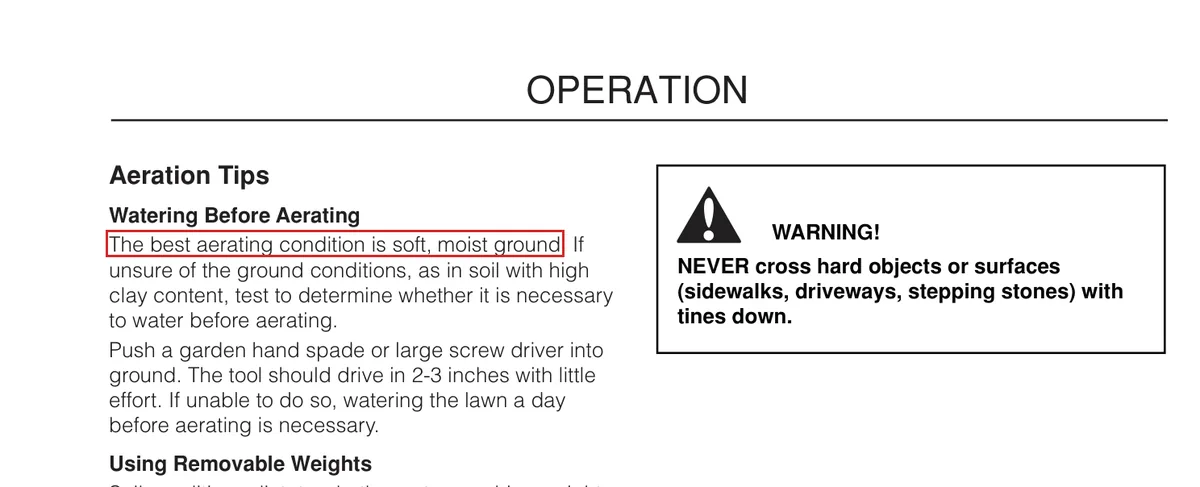
- Probe the soil. Push a garden spade or large screwdriver into the lawn. The Bluebird aerator manual says it should drive in 2 to 3 inches with little effort; if it will not, water the lawn the day before.
- Water by the day, not by the inch. Colorado State, Billy Goat and Ryan all say to water thoroughly the day before; Nebraska Extension says to water deeply 2 days ahead in dry weather. Agri-Fab’s manual says 1 to 2 hours of sprinkling for extremely hard, dry ground. None of the extension publications or manuals we read sets an amount in inches.
- Check it is not too wet. If soil sticks to your shoes or to a soil probe, wait for it to dry (Clemson HGIC 1200). Wet soil clogs tines and they stop dropping cores (K-State MF2130).
- Mow at your normal height. The Billy Goat AE401 manual says to mow to the lawn’s normal cut height; the Agri-Fab manual adds to remove loose clippings first. Neither tells you to scalp.
- Flag what is buried shallow. Mark sprinkler heads, shallow irrigation lines and cable TV lines (Colorado State 1505), plus valves, stakes and clothesline anchors (Bluebird manual).
- Request an 811 locate. The 811 service is free and asks for a few business days. Michigan’s MISS DIG 811 says notice is required at least 3 business days ahead for any project regardless of size or depth, and that private lines, such as irrigation or landscape lighting, will not be marked.
1Is the grass dormant, the ground frozen, or is it extremely hot and dry?
YesWait. Aerate when the grass is actively growing (Nebraska Extension; Colorado State). See when to aerate your lawn.
NoGo to the next question
2Does soil stick to your shoes or to a probe?
YesToo wet: wait for it to dry (Clemson HGIC 1200).
NoGo to the next question
3Will a screwdriver or spade fail to go in 2 to 3 inches with little effort?
YesWater thoroughly today and aerate tomorrow (Bluebird manual; Colorado State).
NoGo to the next question
4Are sprinkler heads, shallow lines or cable runs unflagged?
YesFlag them, and request an 811 locate a few business days ahead (Colorado State; 811).
NoGo to the next question
5Is the thatch layer more than 1 inch thick?
YesDethatch first; aeration alone reduces thatch only over several years (Purdue AY-8).
NoAerate: mow at normal height, add weight, run crossing passes until you reach about 20 holes per square foot, and measure a few cores for 2.5 to 3 inches.
Source: Clemson HGIC 1200; Colorado State 1505; Bluebird manual; Nebraska Extension; Purdue AY-8
How do you run the aerator?
Run straight, overlapping rows the way you mow, then cross them. Clemson HGIC 1200 says to go over the lawn twice, the second time perpendicular to the first, and K-State’s Johnson County office says at least two directions, with holes about 3 inches apart, gives the greatest benefit. Most drum machines need 4 or 5 passes to reach 20 holes, so plan at least 2 crossing pairs on compacted areas.
- Add weight. Fill the water drum (5.2 gal on the Lawnaire IV) or mount the weights: 2 x 36 lb on Bluebird drums, a 42 lb bar plus a 9.5 gal drum on the Classen TA25DA.
- Engage tines only on turf. Ryan and Bluebird both say never cross sidewalks, driveways or stepping stones with the tines down.
- Lean on the handle. Billy Goat and Ryan say downward pressure on the handle gives maximum tine penetration. Start at about half throttle (Billy Goat AE401 manual).
- Lift to turn. At the end of each row, release the clutch, raise the tines and pivot; Ryan pivots the Lawnaire IV on its water drum.
- Measure the cores. Pull 3 or 4 and check length: Penn State wants a full 2.5 to 4 inch core, Nebraska at least 3 inches. Short cores mean dry soil or too little weight.
- Add passes where it is hard. Hit paths, gates and dog runs again rather than the whole lawn (Nebraska lists them as the first places compaction shows).
Slopes: which way to run
The manuals disagree on direction, so follow the one for your machine. Bluebird and Agri-Fab say up and down; Ryan says across for walk-behinds; Billy Goat splits it at 45 degrees.
| Machine | Direction on slopes | Stated limit | Source |
|---|---|---|---|
| Bluebird 424, 530, 742 | Up and down; move the removable weight to the uphill side if you must cross | 35% grade maximum | Bluebird manual |
| Billy Goat AE401 | At a 45 degree angle to the slope, not straight across | 20 degrees | Billy Goat AE401 manual |
| Ryan Lawnaire IV and V | Across slopes with walk-behind machines, not up and down | Too steep if the machine must be crabbed or turns downhill | Ryan manual |
| Agri-Fab 45-0299 (towed) | Up and down, never across the face | Stay off steep slopes | Agri-Fab manual |
What do you do with the cores and the lawn afterward?
Leave the cores, water the lawn and decide on seed. Colorado State says to leave cores on lawns with more than 1/2 inch of thatch so they work back in, and to water soon after aerating. Iowa State suggests pulling a drag mat or a weighted piece of fencing to break them up; its FAQ says mowing over them breaks them up too.
Rake the cores instead if you mow with a reel mower: the Agri-Fab manual warns that small rocks and gravel in the plugs can damage blades. A 4,000 sq ft lawn aerated to 20 holes per square foot gives 80,000 cores, up to about 2 cubic yards of soil at 3/4 inch by 2.75 inches each, which is why raking them all is rarely worth it.
Seed and fertilizer can go down right away by Colorado State’s rule; Iowa State prefers fertilizing 1 week before. Clemson recommends 6 to 10 passes when seeding and waiting about a month before sowing so seed does not sprout only in the holes; rates and timing are in our guide to overseeding a lawn. Make crabgrass preventer applications after aerating (Clemson), though Nebraska turf research found aerating after a preemergence herbicide did not reduce control.
If the probe test showed the hard layer goes deeper than 3 inches, tines will not reach it: K-State puts construction-equipment compaction at 6 inches. Our guide to planting grass seed on hard dirt covers tilling for that depth, and the right month for your grass is in when to aerate your lawn. Thatch over 1 inch is a job for dethatching first.
How we compiled this
We read 12 extension publications from 8 land-grant universities, 1 peer-reviewed field study and 10 manufacturer spec sheets, product pages and operator manuals for 9 aerators from Billy Goat, Ryan, Classen and Bluebird, plus Agri-Fab, all in November 2026. Holes per pass come from each printed hole pattern; where a maker also states a holes-per-square-foot figure we show it beside ours. We did not test any machine.
Frequently asked questions
Can I aerate my lawn by myself?
Yes. A walk-behind core aerator weighs 236 to 420 lb in the 9 spec sheets we read, so plan a pickup or trailer and a second person to load it. Water the day before, flag sprinkler heads, then expect 4 or 5 passes with a drum aerator to reach 20 holes per square foot.
What is the best way to aerate my lawn?
Core aeration with hollow tines, 2 to 3 inches deep and 20 to 40 holes per square foot (Purdue AY-8). Reciprocating machines reach that in fewer passes: 3 for the Ryan Lawnaire 28 versus 4 or 5 for drum machines, by their printed hole patterns.
What’s better, a spike or plug aerator?
A plug (core) aerator. Nebraska Extension says spike tools push soil apart and increase compaction between the holes in clay and silt, Iowa State says to avoid them, and Purdue does not count spiking as aerification. Nebraska’s turf program notes solid tines are nearly as effective on sports fields and golf turf.
Can I put grass seed down after aerating?
Yes. Colorado State says lawns may be seeded immediately after aeration, and Nebraska’s turf program says seeding right after aerating gives good seed-to-soil contact. Clemson prefers 6 to 10 passes and a month’s wait so seed does not come up only in the holes.
Do you put topsoil down after aerating?
Not required: Colorado State says there is no need to top dress after aeration. If you want to add organic matter, Iowa State suggests 1/4 inch of fine compost raked in, then aerating and dragging the cores to mix it.
Sources
- Purdue University and University of Illinois, AY-8-W, Mowing, Dethatching, Aerifying and Rolling Turf (Table 2), Rev. May 2006, current PDF. Accessed November 2026.
- Penn State Extension, Tips to Improve Your Lawn Care Program This Fall (Table 1), September 11, 2025. Accessed November 2026.
- Kansas State University Research and Extension, MF2130, Aerating Your Lawn, February 2018. Accessed November 2026.
- K-State Research and Extension, Johnson County, September: Core Aerate the Lawn, Undated web article. Accessed November 2026.
- Nebraska Extension in Lancaster County, Getting Your Lawn Ready for Summer: Aeration, April 17, 2022. Accessed November 2026.
- University of Nebraska-Lincoln Turfgrass Science, Updated information on lawn aerification, August 20, 2026. Accessed November 2026.
- Iowa State University Extension and Outreach, Core Aeration of Lawns, April 2024. Accessed November 2026.
- Iowa State University Extension and Outreach, What is the proper way to aerate a lawn?, Current FAQ. Accessed November 2026.
- Clemson University Home and Garden Information Center, HGIC 1200, Aerating Lawns, Revised April 29, 2020. Accessed November 2026.
- Colorado State University Extension, PlantTalk Colorado, 1505, Lawn Aeration, Undated web page. Accessed November 2026.
- Colorado State University Extension, PlantTalk Colorado, 1545, Liquid Lawn Aeration, Undated web page. Accessed November 2026.
- University of Illinois Extension, Lawn Aeration and Overseeding, September 10, 2020. Accessed November 2026.
- Henry, G.M., Wang, C.J., Begitschke, E.G., and Tucker, K.A., Agronomy Journal 117(3), Hybrid bermudagrass and soil response to liquid aeration compared with hollow-tine cultivation, Published 2025. Accessed November 2026.
- Common Ground Alliance, 811: Before you dig, Current web page. Accessed November 2026.
- MISS DIG 811 (Michigan), Homeowner FAQ, Current web page. Accessed November 2026.
- Billy Goat (Briggs & Stratton), Aerator Technology white paper, January 27, 2022. Accessed November 2026.
- Billy Goat (Briggs & Stratton), AE400 ser Core Aerator specifications, Checked November 2026. Accessed November 2026.
- Billy Goat, AE401 Owner’s Manual, Form F050112A, Current PDF. Accessed November 2026.
- Billy Goat (Briggs & Stratton), PLUGR PL1800 ser Reciprocating Aerator specifications, Checked November 2026. Accessed November 2026.
- Ryan (Schiller Grounds Care), Lawnaire IV and V with EST Operator/Parts Manual, MAN 4168066 Rev. B, June 2013. Accessed November 2026.
- Ryan (Schiller Grounds Care), Lawnaire 28 Aerator specification sheet, 2010. Accessed November 2026.
- Classen (Schiller Grounds Care), TA22 Steerable, Split-Drum Aerator sell sheet, September 2024. Accessed November 2026.
- Classen (Schiller Grounds Care), PRO TA25 PowerSteer Aerator spec sheet, June 2023. Accessed November 2026.
- Bluebird (Husqvarna), Aerator Owner’s Manual, models H424, H530A, H742, S530B, Current PDF. Accessed November 2026.
- Agri-Fab, 45-0299 48 in. Plug Aerator Owner’s Manual, Current PDF. Accessed November 2026.
- Agri-Fab, 48″ Plug Aerator, Model 45-0299 (product specifications), Checked November 2026. Accessed November 2026.