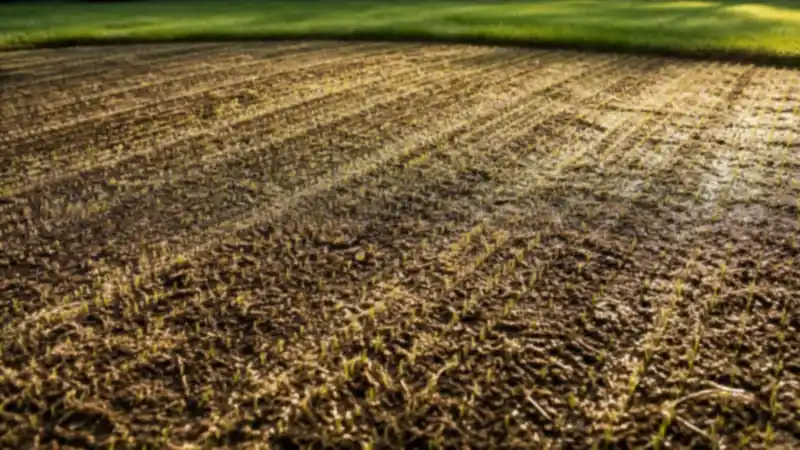
A lawn roller helps in four jobs: firming a seedbed, pressing seed or new sod into soil, and resetting frost-heaved or mole-lifted turf. Rolling an established lawn to flatten bumps compacts soil and will not fix bad grading.
Key takeaways
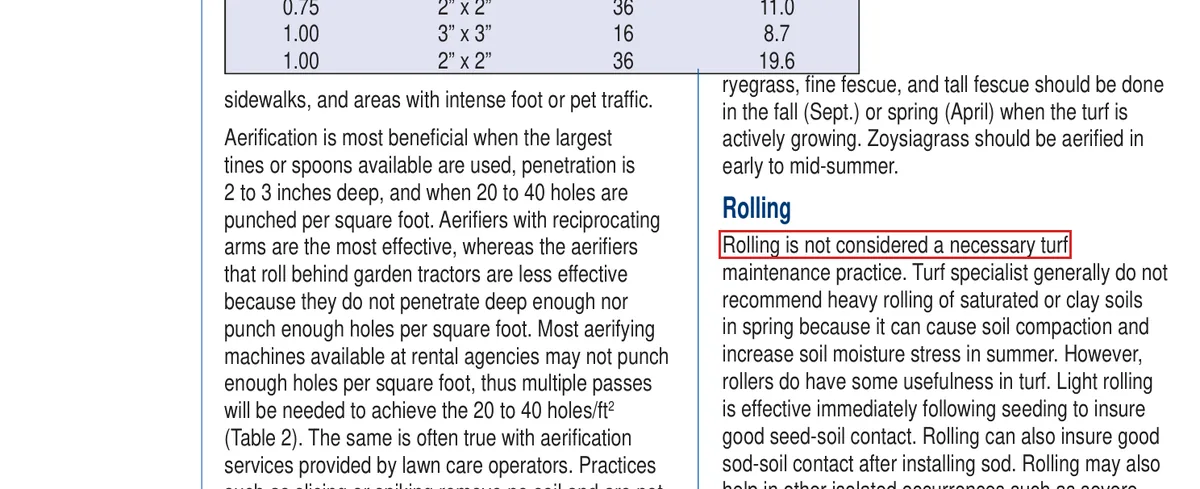
- Purdue Extension calls rolling optional, useful only right after seeding, after laying sod, and after severe mole damage or frost heaving, and says it “should never be used to correct surface undulations caused by improper grading” (Purdue AY-8).
- Michigan State Extension gives household weights: a 200 to 300 lb roller to firm a raked seedbed, then a 50 to 75 lb roller after the seed is down (MSU E2910). An empty 24-inch poly roller weighs 30 to 42 lb, so 1 to 5 gallons of water gets it there.
- A full 24 x 36 inch drum holds about 70 gallons, 588 lb of water at 8.34 lb a gallon (USGS); makers rate those rollers at 600 to 690 lb, or 17 to 19 lb per inch of width. In golf research, raising roller load from 4.8 to 11.9 lb per lateral inch added no ball roll (UT Extension W161L).
- In NC State trials, rolling a sandy loam green 4 or 7 times a week raised soil bulk density 3 to 4 percent in year one; a sand-based green showed no change at any frequency (Hartwiger et al., Crop Science 2001). Freeze and thaw cycles do very little to lower bulk density again (USDA NRCS).
- Roll only when soil will not knead into a ball in your hand (Penn State Extension), and start a water roller about one quarter full, adding water only if bumps remain (MSU Extension).
- Day rates posted by 10 rental stores, checked in October 2026, run $15 to $44; new rollers list at $199 to $349.99 (roller data).
| Lawn roller number | Value | Source |
|---|---|---|
| Seedbed firming weight | 200 to 300 lb | MSU E2910 |
| Weight after seeding | 50 to 75 lb, or an empty water roller | MSU E2910; Purdue AY-3 |
| Starting fill for bumps and mole runs | About 1/4 full, add water gradually | MSU Extension, 2006 |
| Water per gallon of drum | 8.34 lb | USGS, 62.366 lb per cu ft at 60°F |
| Dry play sand per gallon of drum | 13.37 lb (1.6 x water) | Sakrete play sand data sheet: 50 lb = 0.5 cu ft |
| Greens-roller load with no extra gain above | 4.8 lb per lateral inch (tested to 11.9) | Beard 1994, via UT W161L |
| Home roller load, full of water | 9.2 to 19.2 lb per inch of width | Maker and rental specs, Oct. 2026 |
| Rental, 1 day | $15 to $44 | 10 stores’ posted rates, Oct. 2026 |
What does a lawn roller do, and when does rolling help?
A lawn roller is a hollow drum, usually 18 or 24 inches across and 24 to 60 inches wide, that you weight with water or sand and push or tow. Purdue Extension’s AY-8 says rolling “is not considered a necessary turf maintenance practice” and lists the exceptions: light rolling right after seeding, after laying sod, and after severe mole damage or frost heaving.
| Job | Does rolling help? | Roller weight | Source |
|---|---|---|---|
| Firm a raked seedbed before sowing | Yes | 200 to 300 lb, or water the soil and let it settle | MSU E2910 |
| Press seed into soil after sowing | Yes | 50 to 75 lb; an empty water roller works | MSU E2910; Purdue AY-3 |
| Press new sod onto the soil | Yes, lightly | “Lightly roll”; no weight given | Purdue AY-28; UMD |
| Frost-heaved turf in early spring | Sometimes: fall-seeded lawns and thin turf | “As light a roller as possible” | Missouri and Kentucky Extension, quoted by Ask Extension #176569 |
| Fresh mole runs | For a while | Light; tunnels return unless moles are trapped | Purdue Turf |
| Bumps, ruts and uneven grade | No | Heavy rolling compacts soil | Iowa State; Purdue AY-8 |
| A thick, healthy lawn every spring | No | None needed | Ask Extension #176569 (MSU network) |
University of Kentucky guidance, quoted by Ask Extension, narrows the frost-heave case to well-drained, medium and coarse-textured soils, says it “most frequently benefits fall-seeded lawns” and thin turf under shade trees, and adds that well-established lawns are seldom damaged by heaving. The same answer warns that rolling wet, heavy clay soils will cause compaction.
Does rolling a lawn cause soil compaction?
It can on native soil, and the best measurements come from golf greens rolled with machines lighter per inch than a full home drum. In NC State trials, rolling a gravelly sandy loam green 4 or 7 times a week raised bulk density 4 and 3 percent in year one, while a sand-based USGA green showed no change at any frequency (Hartwiger, Peacock, DiPaola and Cassel, Crop Science 2001).
| Study | Turf and soil | Rolling | Measured result |
|---|---|---|---|
| Hartwiger et al., Crop Science 2001 (NC State) | Penncross bentgrass, USGA sand root zone | 0, 1, 4, 7 times a week, 10 weeks, light roller | Bulk density unchanged at every frequency |
| Same study | Cecil gravelly sandy loam (native soil) | 4 and 7 times a week | Bulk density +4 and +3 percent in year 1, no change in year 2; turf quality down; thatch +12 and +11 percent |
| Beard 1994, via UT W161L | Sand-based bentgrass greens, Michigan | One early-morning roll | Ball roll +10 percent; no further gain from 4.8 to 11.9 lb per lateral inch |
| Dannenberger et al. 1993 (Ohio State), via UT W161L | Penncross at 3/16 inch, sand-based | Twice a week | No added wear, no drop in water infiltration |
| Rieke, Nikolai et al., MSU 1995 | Three root zones incl. native push-up green | 3 times a week | Green speed +1 ft; under 6 inches of gain left the next day |
| Binder, MSU thesis 2018 | Kentucky bluegrass sports field, loam and sandy loam | 3 and 5 times a week, two seasons | Infiltration unchanged (0.77 to 0.82 cm per hour); harder surface on one date only |
| Golembiewski et al., Oregon State 2011 | Annual bluegrass green | 845 lb vs 1,140 lb rollers | Both about +1 ft of ball roll; the heavier roller added nothing |
Two caveats keep these results from transferring to a home lawn. Binder’s 2018 review notes that a Hartwiger “treatment” was a pass back and forth, so the damaging rates were 8 and 14 passes a week. And Thom Nikolai of Michigan State, who never saw compaction in his trials, wrote that his plots were sand-topdressed every 2 to 3 weeks and rolled with the lightest rollers on the market, so heavier rollers used often are untested (Nikolai, Greenkeeper International, 2013).
The USDA’s bulk density table shows how little headroom a fine soil has. A clay at 1.10 g/cm³ is ideal and restricts roots above 1.47 g/cm³; a sandy soil is fine below 1.60 and restrictive above 1.80 (NRCS Soil Quality Indicators: Bulk Density). NRCS also says freeze and thaw cycles “generally do very little to alter soil bulk density”, so winter will not reverse a spring rolling.
| Soil texture | Ideal bulk density (g/cm³) | Affects root growth | Restricts root growth |
|---|---|---|---|
| Sand, loamy sand | Below 1.60 | 1.63 | Above 1.80 |
| Sandy loam, loam | Below 1.40 | 1.63 | Above 1.80 |
| Silt loam, silty clay loam | Below 1.40 | 1.55 | Above 1.65 |
| Sandy clay, silty clay, clay loam | Below 1.10 | 1.49 | Above 1.58 |
| Clay (under 45 percent clay) | Below 1.10 | 1.39 | Above 1.47 |
If your lawn sits on clay, start with our guide to improving clay soil before any roller touches it.
Can a lawn roller level a bumpy lawn?
Not in a way that lasts. Iowa State Extension says rough, bumpy lawns should not be rolled with a heavy roller because rolling “also damages the turf by compacting the soil”, and Purdue AY-8 says rolling should never correct undulations caused by improper grading. A roller presses down soft high spots; it does not move soil into the low ones.
| Cause of the bump | What rolling does | Fix that works | Source |
|---|---|---|---|
| Frost heave after a freeze-thaw winter | Presses lifted plants back down | One light roll after thaw, surface relatively dry | Missouri Extension via Ask Extension |
| Fresh mole runs | Flattens tunnels until moles dig new ones | Roll lightly and trap; trapping is the only way to remove moles | Purdue Turf |
| Earthworm castings | Smears them; compacts soil | Core aerate and power rake; the worms help the lawn | Iowa State |
| Thin, older turf | Nothing lasting | Fertilize (best late August to mid-September) and reseed thin spots in early fall | Iowa State |
| Dips from settling or poor grading | Nothing | Topdress in thin passes or lift the sod and fill | Purdue AY-8; Colorado State GardenNotes 554 |
Colorado State notes that heavy rolling can flatten a bumpy lawn, then says it “is likely to cause soil compaction and should be followed by core cultivation”. For dips you can measure, our lawn leveling guide gives the extension depth limits per topdressing pass and the lift-the-sod method.
How heavy is a lawn roller when filled with water or sand?
Drum size sets the weight. A drum holds 1.10 gallons per inch of width at 18 inches across and 1.96 gallons at 24 inches, so an 18 x 24 inch roller holds about 26 gallons, or 220 lb of water, and a 24 x 36 inch roller about 70 gallons, or 588 lb. Dry play sand weighs 1.6 times as much as water in the same drum.
| Drum (diameter x width) | Gallons (geometry) | Water ballast | Dry sand ballast | Maker-rated full weight, model | Lb per inch of width, maker figure |
|---|---|---|---|---|---|
| 18 x 24 in | 26.4 | 220 lb | 353 lb | 270 lb Brinly PRC-243BH (28 gal); 250 lb Agri-Fab 45-0610 | 10.4 to 11.2 |
| 18 x 36 in | 39.7 | 331 lb | 530 lb | 390 lb Brinly PRT-362SBH (42 gal); 400 lb Agri-Fab 45-0606; 400 lb Ohio Steel 9W | 10.8 to 11.1 |
| 18 x 48 in | 52.9 | 441 lb | 707 lb | 485 lb Brinly PRT-482SBH (54 gal); 550 lb Agri-Fab 45-0604 | 10.1 to 11.5 |
| 24 x 36 in | 70.5 | 588 lb | 942 lb | 690 lb Brinly PRT-362BH (76 gal); 640 lb Agri-Fab 45-0179; 600 lb Ohio Steel 10T | 16.7 to 19.2 |
| 24 x 48 in | 94.0 | 784 lb | 1,257 lb | 910 lb Agri-Fab 45-0216; 920 lb Ohio Steel 48T | 19.0 to 19.2 |
| 24 x 60 in | 117.5 | 980 lb | 1,571 lb | 1,150 lb Agri-Fab 45-0549; 1,150 lb Ohio Steel 60T | 19.2 |
Maker ratings run 2 to 25 percent above the geometry because they add the drum itself, 30 to 137 lb empty on Agri-Fab’s six models, and because nominal sizes round off. Nobody publishes a wet-sand figure; damp sand packs heavier than dry and will not pour back out through the 1.625-inch fill hole Brinly prints in its specs (Brinly PRC-243BH).
- Ballast volume (gallons)
- 26.4
- Weight if filled with water (lb, drum not included)
- 220
- Weight if filled with dry sand (lb, drum not included)
- 353
- 0.5 cu ft bags of play sand
- 8
Gallons = width x gallons per inch for the diameter x fill level. Water 8.34 lb a gallon (USGS); dry play sand 13.37 lb a gallon (Sakrete: 50 lb = 0.5 cu ft). Add the empty drum, 30 to 137 lb. Water fills cost cents, so the water result rounds to $0.
| Worked example: 18 x 24 inch drum, filled to the top | Arithmetic | Result |
|---|---|---|
| Drum volume | 3.1416 x 9² x 24 ÷ 231 | 26.4 gallons (3.53 cu ft) |
| Water ballast | 26.4 x 8.34 lb | 220 lb (plus the drum) |
| Dry sand ballast | 26.4 x 13.37 lb | 353 lb (plus the drum) |
| Bags of play sand | 3.53 cu ft ÷ 0.5 cu ft per bag | 7.1, so buy 8 bags |
| Sand cost | 7.07 bags x $4.95 to $8.59 | $35 to $61 by volume; $40 to $69 for 8 whole bags |
| Water cost | 26.4 gal x $0.00225 to $0.00602 | $0.06 to $0.16 |
How heavy should a lawn roller be for each job?
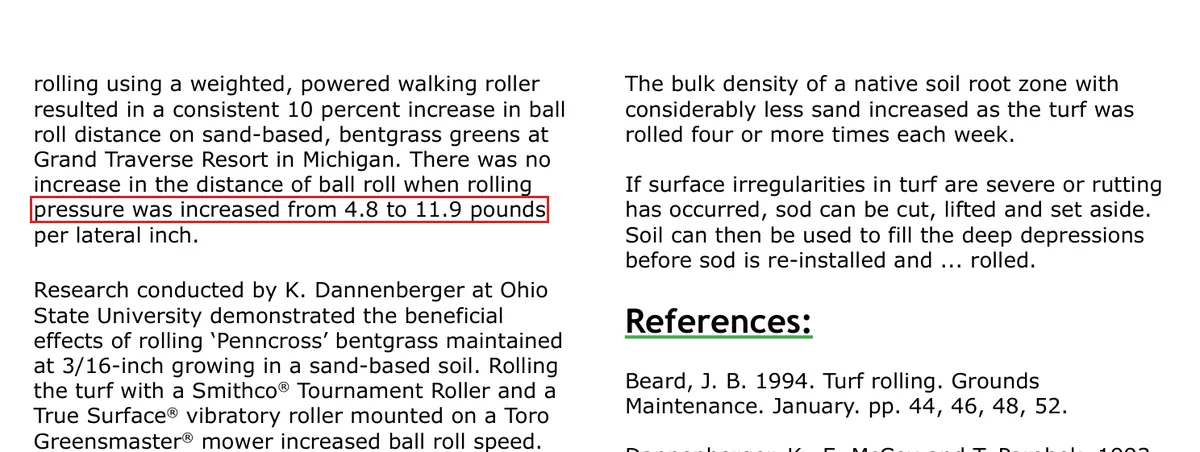
Use the lightest weight that does the job. MSU Extension’s E2910 gives the household numbers: 200 to 300 lb to firm a raked seedbed, then 50 to 75 lb after seeding. Golf research points the same way: Beard found no extra ball roll from 4.8 to 11.9 lb per lateral inch, while a full 24-inch home drum puts 17 to 19 lb on each inch.
| Job and target | Roller | Empty weight | Water to add | Source |
|---|---|---|---|---|
| After seeding: 50 to 75 lb | Agri-Fab 45-0610, 18 x 24 in | 30 lb | 2.4 to 5.4 gallons | MSU E2910 |
| After seeding: 50 to 75 lb | PLR1824 rental roller, 24 in | 42 lb | 1.0 to 4.0 gallons | MSU E2910 |
| Seedbed firming: 200 to 300 lb | Any full 18 x 24 in poly roller | 30 to 42 lb | Fill it: 221 to 270 lb full | MSU E2910 |
| Seedbed firming: 200 to 300 lb | Brinly PRT-362SBH, 18 x 36 in | About 40 lb (390 lb full minus 42 gal of water) | 19 to 31 gallons, about half to three quarters full | MSU E2910 |
| Frost heave or mole runs | Any water roller | Drum only | Start about 1/4 full; add water only if bumps stay | MSU Extension 2006 |
Per-inch load is the fair comparison across sizes, since a wider drum spreads its weight. The table below divides each roller’s rated full weight by its width and sets it beside the range Beard tested on greens, as reported by UT Extension W161L. It is a line load, not contact pressure: a bigger-diameter drum also spreads weight over a wider strip.
| Roller or study | Rated weight | Width | Lb per inch of width |
|---|---|---|---|
| Greens rolling, Beard 1994 (low end tested) | n/a | n/a | 4.8 |
| Greens rolling, Beard 1994 (high end tested) | n/a | n/a | 11.9 |
| Middleton PLR1824 push roller, full | 221 lb | 24 in | 9.2 |
| Brinly PRC-243BH, full | 270 lb | 24 in | 11.2 |
| Brinly PRT-362SBH, full | 390 lb | 36 in | 10.8 |
| Agri-Fab 45-0604, full | 550 lb | 48 in | 11.5 |
| Ohio Steel 10T, full | 600 lb | 36 in | 16.7 |
| Agri-Fab 45-0179, full | 640 lb | 36 in | 17.8 |
| Brinly PRT-362BH, full | 690 lb | 36 in | 19.2 |
| Taylor Rental 24 x 48 in steel, full | 1,290 lb | 48 in | 26.9 |
For scale, a USGA agronomist calculated that a 200 lb golfer standing on both feet puts about 5 psi on turf and a walking heel about 25 psi, (Wienecke, USGA Green Section Record, 2004), against 3.5 to 7.5 psi that Hartwiger gave for self-propelled greens rollers (Golf Course News, 1994). A roller covers every square inch it crosses, which is why per-pass weight still matters.
Should you fill a lawn roller with water or sand?
Water, for nearly every lawn job. Water lets you start light and add weight a few gallons at a time, drains on the spot and costs under $1 a fill at 2026 Minnesota utility rates. Dry sand adds 60 percent more weight to the same drum, costs $35 to $69 for an 18 x 24 inch roller and comes out only through a 1.625-inch fill hole.
| Factor | Water | Dry sand | Source |
|---|---|---|---|
| Weight per gallon of drum | 8.34 lb | 13.37 lb | USGS; Sakrete data sheet |
| 18 x 24 in drum, full | 220 lb | 353 lb | Arithmetic above |
| Cost to fill 18 x 24 in | $0.06 to $0.16 | $35 to $69 | 2026 water rates; Oct. 29, 2026 bag prices |
| Adjust weight on the lawn | Yes, drain or add with a hose | No | Brinly manual; MSU Extension |
| Freezing | Drain below 32°F, or add ethylene glycol antifreeze with rust inhibitor | “No risk of freezing” | Ohio Steel 10T manual; Brinly manual |
| Maker position | Standard fill for every maker | Brinly allows it but excludes damage from non-water fill; Agri-Fab copy on a dealer listing says fill only halfway with sand; Agri-Fab and Ohio Steel manuals do not mention sand | Brinly product FAQ; Farm & Home Supply listing; Agri-Fab manual |
| Filling | Garden hose, never coupled tight to the fill hole | Funnel through a 1.625 in hole | Agri-Fab manuals; Brinly specs |
The Agri-Fab steel manuals warn that attaching a garden hose to the fill hole can build dangerous pressure inside the drum, and tell owners to drain the roller to keep it from freezing. Brinly recommends storing it drained with the plug out, hung if possible, so the drum does not develop a flat spot.
When should you roll a lawn, and how wet should the soil be?
Roll in spring after the frost is out, once the surface has dried enough that soil will not knead into a ball, or right after seeding or sodding. Michigan State warns that rolling saturated soil causes compaction and runoff, and Penn State’s soil scientists say soil compacts most at a moist, workable water content, so drier is safer for an established lawn.
Penn State’s Avoiding Soil Compaction explains the physics: dry soil cannot be compressed as far as moist soil, and soil near saturation resists because water fills the pores. That is why Missouri Extension, quoted by Ask Extension, says “rolling moist soil causes maximum compaction” and asks for a relatively dry surface on established turf. Cornell adds the other limit: if the soil is too dry there will be no response to rolling (Cornell sports field rolling).
| Soil condition | What a roller does | Source |
|---|---|---|
| Dry, hard surface | Little response; wilted turf is stressed further | Cornell; Minner, Iowa State |
| Surface relatively dry, soil will not knead into a ball | Least compaction for frost heave and mole runs | Missouri via Ask Extension; Penn State |
| Moist and workable, kneads into a ball | Most compaction: “a fine way to build roadways” | Missouri via Ask Extension; Penn State |
| Saturated or standing water | Compaction, runoff and ruts | MSU Extension |
- Wait for the frost to leave the ground and for standing water to drain. MSU Extension says to let the soil dry rather than roll early and risk compaction or ruts from tractor tires (MSU Extension).
- Take a handful of soil and knead it. If it forms a ball easily, it is too wet for traffic (Penn State Extension).
- Check that the grass is actively growing. Iowa State’s Dave Minner, quoted by Cornell, warns that rolling wilted or dormant turf can kill it.
- Fill a water roller about one quarter full, make one pass, and add water only if the bumps stay (MSU Extension, 2006).
- Roll across slopes, never straight up or down, and stay off slopes over 10 degrees (Agri-Fab manual). Tow at about 3 mph for the best results (Brinly manual).
- Roll as needed, not routinely: at most once a year in spring on an established lawn (Cornell). Core aerate afterward if you rolled with a heavy roller (Colorado State).
Aeration timing by grass type is in our aeration timing guide, and posted prices for core aeration are in our lawn aeration cost breakdown.
How do you roll a lawn after seeding or laying sod?
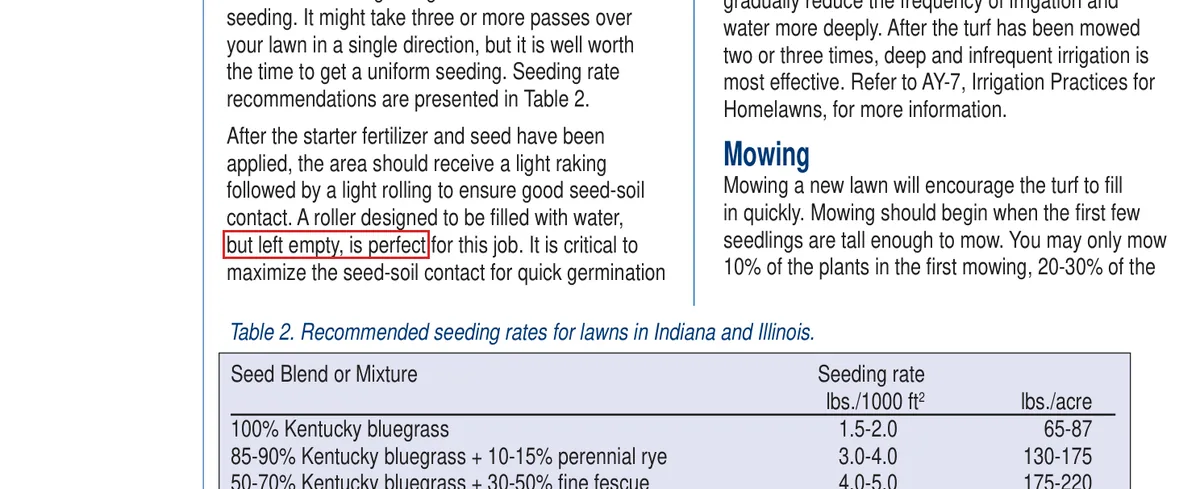
One light pass. MSU Extension rolls the raked bed at 200 to 300 lb before sowing and drops to 50 to 75 lb afterward, and Purdue’s AY-3 says a water roller left empty is right for pressing seed. For sod, Purdue’s AY-28 says to roll lightly right after installation to remove air pockets, then start watering at once.
Seeding, step by step:
- Rake the graded bed smooth, then roll it at 200 to 300 lb, or water it thoroughly and let it settle (MSU E2910).
- Walk it. Purdue’s sod guide says footprints deeper than 0.5 inch mean the bed needs more watering or rolling (Purdue AY-28).
- Sow, then rake so the tines only touch the surface (MSU E2910).
- Drain the roller to 50 to 75 lb: 1 to 5 gallons in a 24-inch poly drum, or leave it empty (MSU E2910; Purdue AY-3).
- Make one pass, then mulch and keep the top inch moist.
Sod, step by step:
- Lay the sod on a bed firm enough that footprints sink no deeper than 0.5 inch (Purdue AY-28); each roll weighs 20 to 40 lb depending on moisture and thickness (UMD).
- Roll lightly right after installation to press the sod onto the soil and remove air pockets (Purdue AY-28; UMD).
- Water thoroughly as soon as the sod is rolled (Purdue AY-28).
The full seedbed sequence, from soil test to straw, is in our guide on how to plant grass seed. Seeding into an existing lawn is covered in our overseeding guide, and installed sod prices are in our sod installation cost guide.
Should you buy or rent a lawn roller, push or tow?
Rent unless you roll every year. Day rates posted by 10 rental stores in October 2026 run $15 to $44, while new rollers list at $199 to $349.99 at the maker or a dealer. A 24-inch push roller weighs 221 to 270 lb full and suits seeding; 36 to 60-inch tow models weigh 390 to 1,150 lb full and need a tractor that can stop them.
Swipe the table sideways to see every column.
| Maker and model | Type and drum | Size (in) | Capacity | Rated full weight | Price, Oct. 30, 2026 |
|---|---|---|---|---|---|
| Brinly PRC-243BH | Push or tow, poly | 18 x 24 | 28 gal | 270 lb | $199 (sold out) |
| Brinly PRT-362SBH | Tow, poly | 18 x 36 | 42 gal | 390 lb | $224 (sold out) |
| Brinly PRT-482SBH | Tow, poly | 18 x 48 | 54 gal | 485 lb | $249 |
| Brinly PRT-362BH | Tow, poly | 24 x 36 | 76 gal | 690 lb | $319 |
| Agri-Fab 45-0610 | Push or tow, poly | 18 x 24 | Not stated | 250 lb | $229.99 (Hills Flat Lumber, CA, special order) |
| Precision PLR1824 | Push or tow, poly | 18 x 24 | 26 gal | 240 lb | $214.99 (SprayerSupplies) |
| Precision PLR1848 | Push or tow, poly | 18 x 48 | 53 gal | 480 lb | $264.99 (SprayerSupplies) |
| Agri-Fab 45-0606 | Tow, poly | 18 x 36 | Not stated | 400 lb | Not listed by maker |
| Agri-Fab 45-0604 | Tow, poly | 18 x 48 | Not stated | 550 lb | Not listed by maker |
| Agri-Fab 45-0179 | Tow, welded steel | 24 x 36 | Not stated | 640 lb | Not listed by maker |
| Agri-Fab 45-0216 | Tow, welded steel | 24 x 48 | Not stated | 910 lb | $349.99 (Farm & Home Supply) |
| Agri-Fab 45-0549 | Tow, welded steel | 24 x 60 | Not stated | 1,150 lb | Not listed by maker |
| Ohio Steel 10T | Tow, steel | 24 x 36 | Not stated | 600 lb | Not listed by maker |
| Ohio Steel 48T | Tow, steel | 24 x 48 | Not stated | 920 lb | Not listed by maker |
| Rental store | Roller as listed | 4 hours | Day | Week |
|---|---|---|---|---|
| Grants Rental, Bridgewater, MA | Push or tow, 200 lb full | $15 | $15 | $48 |
| Area Rental, New Berlin, WI | 24 in push, 250 lb full | $16 | $18 | $54 |
| Area Rental, New Berlin, WI | 36 in pull-behind, 600 lb full | $24 | $28 | $90 |
| Middleton Farmers Co-op, WI | 24 in push PLR1824, 221 lb full | $20 | $25 | $75 |
| Middleton Farmers Co-op, WI | 48 in pull PLR1848, 480 lb full | $27 | $35 | $105 |
| Jono Ace Hardware, Jonestown, PA | 18 x 24 in, about 270 lb full | $10 | $25 (24 hr) | $70 |
| Jono Ace Hardware, Jonestown, PA | 18 x 36 in tow, about 400 lb full | $20 | $40 (24 hr) | $85 |
| Salemi’s Ace, Texas Gulf Coast | Seymour S500, 18 x 24 in steel, 270 lb | $20 | $30 | $90 |
| Holmen Ace Hardware, WI | Sod roller 18 x 24 in, 350 lb | $16 | $24 | Not posted |
| M&K Rentals, Sheridan, WY | 24 in, up to 280 lb | $18.20 | $28 | $112 |
| Taylor Rental, Auburn, IN | 24 x 48 in steel, 1,290 lb full | $33 | $44 | $264 |
Tow models come with their own limits. Agri-Fab’s manuals say never fill to maximum weight without checking that the tractor can safely pull and stop it, and the 45-0549 manual caps speed at 3 mph and warns against pushing or pulling the full roller by hand (Agri-Fab 45-0549 manual). Brinly prints a 5 mph maximum tow speed and 3 mph for the best results.
Which lawn roller decision fits your yard?
Most yards need one row of this table. The thresholds come from Purdue, Michigan State, Missouri and Penn State Extension and the maker manuals cited above; if your situation matches no row, the answer is to leave the roller in the shed. The flowchart below holds the same logic in question order.
| If your situation is | Do this | Why (source) |
|---|---|---|
| You just raked a new seedbed | Roll at 200 to 300 lb, or water and let it settle | MSU E2910 |
| You just sowed seed | One pass at 50 to 75 lb, or an empty water roller | MSU E2910; Purdue AY-3 |
| You just laid sod | Roll lightly, then water at once | Purdue AY-28 |
| Fall-seeded or thin turf heaved over winter | Roll once after thaw, surface relatively dry, roller 1/4 full to start | Missouri via Ask Extension; MSU 2006 |
| Fresh mole runs | Roll lightly and trap the moles | Purdue Turf |
| Soil kneads into a ball, or water stands | Wait; do not roll | Penn State; MSU |
| Clay soil on an established lawn | Skip rolling; core aerate if compacted | Purdue AY-8; NRCS clay restricts roots above 1.47 g/cm³ |
| Bumps or dips in a healthy lawn | Do not roll; topdress or lift and fill | Iowa State; Purdue AY-8 |
| You rolled heavy anyway | Core aerate afterward | Colorado State GardenNotes 554 |
1Does a handful of soil knead easily into a ball, or is water standing?
YesWait. Rolling wet soil compacts it and leaves ruts (Penn State; MSU).
NoGo to the next question
2Did you just rake a seedbed, sow seed or lay sod?
YesRoll once: 200 to 300 lb on the raked bed, 50 to 75 lb or an empty roller on seed, a light pass on sod, then water (MSU E2910; Purdue AY-3, AY-28).
NoGo to the next question
3Did frost heave lift fall-seeded or thin turf, or did moles tunnel through?
YesRoll once after thaw with the surface relatively dry, starting 1/4 full; trap the moles (Missouri via Ask Extension; MSU; Purdue).
NoGo to the next question
4Is the problem bumps, dips or uneven grade in an established lawn?
YesDo not roll. Topdress thin layers or lift the sod and fill (Iowa State; Purdue AY-8).
NoLeave the roller in the shed: a thick, healthy lawn does not need rolling (Ask Extension #176569).
How we compiled this
We read 23 primary documents: extension publications from Purdue, Michigan State, Tennessee, Iowa State, Colorado State, Maryland, Penn State and Cornell, USDA NRCS soil sheets and six golf and sports-turf research reports, accessed October 2026. Roller specs come from Brinly, Agri-Fab and Ohio Steel pages and manuals; rental rates from 10 stores’ own pages, checked October 28 to 30, 2026. Weights are arithmetic; we weighed and tested no roller.
| Recap | Number | Source |
|---|---|---|
| Roll a seedbed at | 200 to 300 lb | MSU E2910 |
| Roll seed at | 50 to 75 lb | MSU E2910 |
| Start a water roller at | 1/4 full | MSU Extension |
| Full 24 x 36 in drum | About 70 gal, 588 lb water, 600 to 690 lb rated | Geometry; makers |
| Greens research load range | 4.8 to 11.9 lb per lateral inch | UT W161L |
| Rental, 1 day | $15 to $44 | 10 rental stores |
Frequently asked questions
Is it good to roll your lawn?
Only for specific jobs. Purdue Extension says rolling is not a necessary maintenance practice and lists four uses: after seeding, after laying sod, and after severe mole damage or frost heaving. On a thick, established lawn it adds compaction for no gain, and Iowa State says rough lawns should not be rolled with a heavy roller.
When should you roll your lawn?
In early spring after the frost is out and the surface has dried, or right after seeding or sodding. Missouri Extension says to roll soon after spring thaw when the soil surface is relatively dry, with as light a roller as possible. If a handful of soil kneads easily into a ball, Penn State’s test says it is too wet.
Should I fill my lawn roller with water or sand?
Water for almost every lawn job. It weighs 8.34 lb a gallon, lets you start about a quarter full and add weight, and drains on the spot. Dry sand weighs about 13.4 lb a gallon, costs $35 to $69 to fill an 18 x 24 inch drum, and Brinly excludes damage from non-water fill from coverage.
How much does a lawn roller weigh when full of water?
An 18 x 24 inch drum holds about 26 to 28 gallons and is rated 221 to 270 lb full in maker and rental listings. An 18 x 36 inch drum is rated 390 to 400 lb, a 24 x 36 inch drum 600 to 690 lb, and a 24 x 60 inch steel drum 1,150 lb, based on Brinly, Agri-Fab and Ohio Steel specs.
Should you roll grass seed after planting?
Yes, lightly, once. Purdue AY-3 calls for a light raking followed by a light rolling with a water roller left empty, and Michigan State gives 50 to 75 lb as the target weight. A heavier roller belongs on the raked bed before seeding, at 200 to 300 lb, or water the bed and let it settle.
Does rolling a lawn flatten mole tunnels?
For a while. Purdue Turf says rolling will smooth mole runs, but trapping is the only way to remove the moles, and an MSU Extension answer notes that new tunnels appear if moles are still present. Roll lightly, starting a water roller about a quarter full, and only when the soil is not wet.
Should you aerate before or after rolling?
After, if you used a heavy roller. Colorado State says heavy rolling is likely to cause soil compaction and should be followed by core cultivation, and the MSU Extension network suggests aerating a rolled lawn to get air back into the root zone. Purdue AY-8 sets the target at 20 to 40 holes per square foot, 2 to 3 inches deep.
Does winter frost undo compaction from rolling?
Not in any reliable way. USDA NRCS says wetting, drying and freeze and thaw cycles generally do very little to alter soil bulk density, the standard measure of compaction. On clay, NRCS rates bulk density above 1.47 g/cm³ as restricting root growth, so core aeration is the fix, not waiting for winter.
Sources
- Purdue Extension and University of Illinois, AY-8-W: Mowing, Dethatching, Aerifying and Rolling Turf (Reicher, Patton, Bigelow), Rev. May 2006. Accessed October 2026.
- Purdue Extension, AY-3-W: Establishing Turfgrass Areas From Seed, Current PDF. Accessed October 2026.
- Purdue Extension, AY-28-W: Establishing a Lawn from Sod, Current PDF. Accessed October 2026.
- Purdue University Turfgrass Science, Bumpy Lawn? (Zac Reicher), April 8, 2004. Accessed October 2026.
- University of Tennessee Extension, W161L Turfgrass Maintenance: Rolling (Samples and Sorochan), 2008, posted Jan. 16, 2018. Accessed October 2026.
- Michigan State University Extension, E2910 Establishing a New Lawn Using Seed, Current page. Accessed October 2026.
- Michigan State University Extension, Renovating home lawns (Kevin Frank), April 14, 2006. Accessed October 2026.
- Michigan State University Extension, Spring lawn care tips for shoreline homeowners, Current page. Accessed October 2026.
- Ask Extension, Roll lawn or not? #176569 (quotes University of Kentucky and University of Missouri Extension), April 22, 2014. Accessed October 2026.
- Iowa State University Extension and Outreach, Bumpy, Rough Lawns (Richard Jauron), Reviewed May 2022. Accessed October 2026.
- Colorado State University Extension, CMG GardenNotes #554, Lawn Care section, 2024. Accessed October 2026.
- University of Maryland Extension, Starting a New Lawn, Current page. Accessed October 2026.
- Cornell University, Sports field management: Rolling, Current page. Accessed October 2026.
- USDA NRCS, Soil Quality Indicators: Bulk Density, June 2008, reposted 2023. Accessed October 2026.
- USDA NRCS, Soil Health Guide: Bulk Density, 2022. Accessed October 2026.
- Penn State Extension (S. Duiker), Effects of Soil Compaction, Updated 2005. Accessed October 2026.
- Penn State Extension (S. Duiker), Avoiding Soil Compaction, Updated 2005. Accessed October 2026.
- Crop Science, via Crossref, Hartwiger, Peacock, DiPaola and Cassel, Impact of Light-Weight Rolling on Putting Green Performance, 41(4):1179 to 1184, 2001. Accessed October 2026.
- Michigan Turfgrass Conference Proceedings, Rieke, Nikolai et al., Turfgrass Soil Management Research Report 1995, 1996. Accessed October 2026.
- Golf Course Industry (reprint of USGA Green Section Record 49(5)), Golembiewski, Blankenship and McDonald, rolling and ball roll distance, March 2011. Accessed October 2026.
- Greenkeeper International, T. Nikolai, The top ten reasons to lightweight roll, June 2013. Accessed October 2026.
- Michigan State University, N. Binder, Effect of Rolling Frequencies on Sports Field Surface and Subsurface Conditions, M.S. thesis, 2018. Accessed October 2026.
- Golf Course News, H. Phillips, Greens Rollers (C. Hartwiger on roller psi), August 1994. Accessed October 2026.
- USGA Green Section Record, D. Wienecke, golf traffic pressure calculations, Nov. to Dec. 2004. Accessed October 2026.
- U.S. Geological Survey, Water Density, Current page. Accessed October 2026.
- Sakrete, Natural Play Sand data sheet, Rev. 3-10. Accessed October 2026.
- City of Plymouth, MN, Utility rates, 2026 rates. Accessed October 2026.
- City of Hopkins, MN, Water fees on your utility bill, 2026 rates. Accessed October 2026.
- Brinly, PRC-243BH, PRT-362SBH, PRT-482SBH and PRT-362BH product pages, Checked Oct. 30, 2026. Accessed October 2026.
- Brinly, Lawn roller manual 1020398-A, Current PDF. Accessed October 2026.
- Agri-Fab, Roller product pages 45-0610, 45-0606, 45-0604, 45-0179, 45-0216, 45-0549 and manuals, Checked Oct. 30, 2026. Accessed October 2026.
- Agri-Fab, 45-0549 owner’s manual, Current PDF. Accessed October 2026.
- Ohio Steel Industries, 9W, 10T, 48T and 60T roller manuals, Current PDFs. Accessed October 2026.
- Rental stores (Grants, Area Rental, Middleton Co-op, Jono Ace, Salemi’s Ace, Holmen Ace, M&K, Taylor Rental, RC Engine Service, Dutchway), Posted lawn roller rental rates (links in the rental table and CSV), Checked Oct. 28 to 30, 2026. Accessed October 2026.
- Retail listings, Hills Flat Lumber (Agri-Fab 45-0610), Farm & Home Supply (Agri-Fab 45-0216), SprayerSupplies (Precision PLR1824, PLR1848), Checked Oct. 30, 2026. Accessed October 2026.
- Play sand retailers, Circle M Landscape Supply and Rice Lumber, 50 lb play sand bag prices, Checked Oct. 29, 2026. Accessed October 2026.