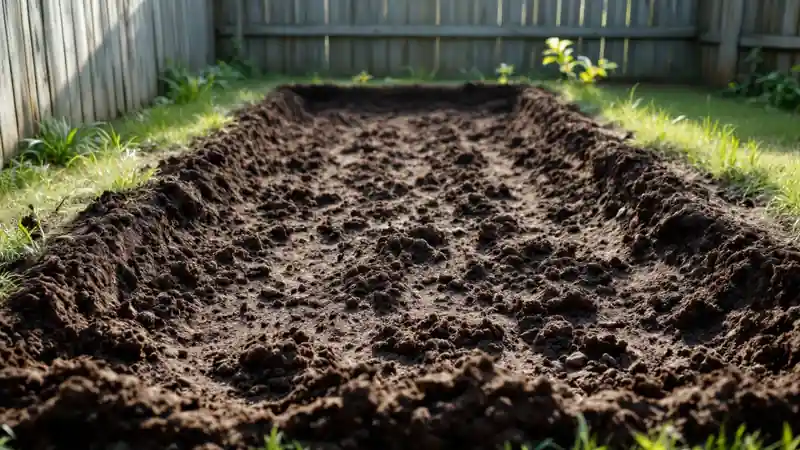
How to till soil: wait until a squeezed handful crumbles when pressed, spread 1 to 3 inches of compost, then till 6 to 8 inches deep for a garden or 4 to 6 for a lawn, going 1 to 2 inches deeper each pass.
Learning how to till soil comes down to three numbers: soil moisture, depth and compost volume, each sourced below to an extension publication or a maker spec. Two things the top results leave out: Troy-Bilt lists the same 7 inch maximum depth for its front-tine Colt and its rear-tine Pony, so tine position is not what sets depth, and in 5 of the 8 state one-call laws we read, garden tilling becomes regulated digging at 12 inches deep.
How deep should you till soil?
Depth follows the job, not the machine. Texas A&M AgriLife wants vegetable ground tilled at least 8 to 10 inches, while lawn guides from Ohio State and Penn State stop at 4 to 6 inches.
| Job | Till to | Compost spread first | Source |
|---|---|---|---|
| New vegetable bed | 8 to 12 in | 3 to 4 in | Oregon State EM 9308; at least 8 to 10 in: Texas A&M |
| Existing vegetable bed, yearly | 8 to 12 in | 1/4 to 1 in | Oregon State EM 9308 |
| New shrub or flower bed | 6 to 8 in | 3 to 4 in | Oregon State EM 9308 |
| General garden, any crop | 6 to 8 in | Not stated | Troy-Bilt operation tips |
| New lawn seedbed | 4 to 6 in | 1 to 2 in | Ohio State Buckeye Turf; Penn State (at least 4 in) |
| New lawn, lower compost rate | 6 in | 1/2 to 1 in | Oregon State EC 1561 |
| Upper limit for any bed | Under 12 in | No more than 4 in of organic layer | Bonnie Plants; Texas A&M |
If more than 2 inches of organic matter is called for, Penn State says to till in the first 2 inches, spread the rest and till again, because thicker layers do not mix evenly. For lawns, a deeper soil problem such as a hard layer below 6 inches is a compaction job, covered in our guide to planting grass seed on hard dirt.
Is your soil dry enough to till?
Test before every session. The University of Kentucky Cooperative Extension squeeze test: take a handful, squeeze it into a ball, then press it with your fingertips. If it crumbles, the soil is ready. If it holds together or smears, wait. A second check from the same source: drop the ball from about waist height; if it shatters, the soil is dry enough to work.
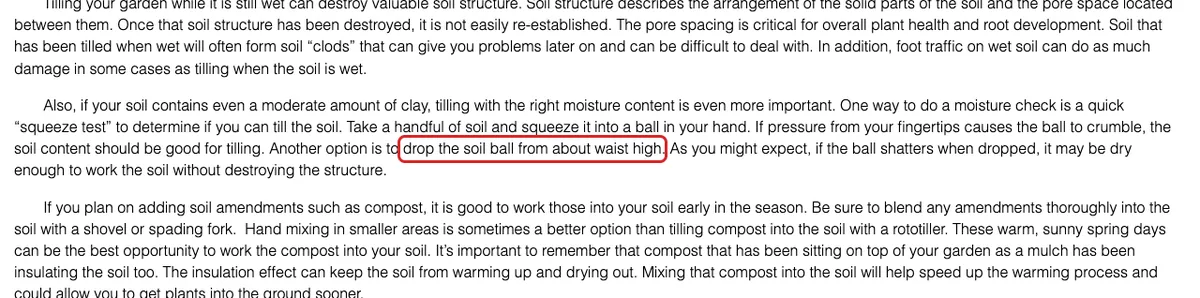
Wet tilling is the one mistake that lasts. Kentucky’s extension agent warns that soil tilled wet forms clods and that the lost structure is not easily rebuilt, and Oregon State EC 1561 adds that tilling wet soil speeds organic matter loss. After rain, Troy-Bilt says to wait a few days for the soil to become semi-dry. Too dry is a problem too: Troy-Bilt suggests watering a few days before tilling hard, dry ground, and a shallow first setting.
1Does a squeezed ball of soil hold together when you press it?
YesToo wet. Wait a few days after rain and test again (University of Kentucky, Troy-Bilt).
NoGo to the next question
2Is the area an existing lawn you want to keep?
YesDo not till. Core-aerate and topdress 1/4 to 1/2 inch of compost (Nebraska Extension).
NoGo to the next question
3Is living sod or a rhizome grass such as bermuda still on the area?
YesKill or remove the grass first; tilled pieces regrow (Troy-Bilt).
NoGo to the next question
4Will you dig 12 inches or deeper, or has nobody requested a locate?
YesRequest an 811 locate and wait for the marks (Call 811).
NoGo to the next question
5Is the ground rock hard and dry?
YesWater it a few days ahead and start at 1 to 2 inches deep (Troy-Bilt).
NoSpread compost and till: 6 to 8 inches for a garden, 4 to 6 for a lawn seedbed, going 1 to 2 inches deeper each pass.
Source: University of Kentucky Extension, Troy-Bilt, Nebraska Extension, Call 811
How to till soil in 9 steps
- Request a utility locate. Contact 811 a few business days ahead (Call 811), and check the depth rule for your state in the 811 table below.
- Remove sod and debris. Grass left in the soil wraps around tines and regrows as temperatures rise (Troy-Bilt). Kill or strip it first with one of the methods in how to kill grass before replanting, and rake out rocks and sticks.
- Test the soil. A soil test tells you whether to add lime or sulfur; Oregon State says lime works best mixed in during the same tillage as the compost.
- Run the squeeze test. Till only if the ball crumbles under fingertip pressure (University of Kentucky).
- Spread compost evenly at the depth in the table above: 1 to 2 inches for a lawn, 3 to 4 inches for a new bed (Oregon State EM 9308).
- Make the first pass shallow. Troy-Bilt says set the depth regulator only 1 to 2 inches deep on ground that has not been tilled for a while, then go 1 to 2 inches deeper with each pass.
- Cross the first lines. Till in parallel rows like mowing, then reset to the deepest setting and till at right angles to the first rows (Troy-Bilt).
- Rest, then finish. Water the worked soil and let it sit a day or two before the final deep pass (Troy-Bilt).
- Rake level and stop. Rake out roots and clods and grade lawns to slope away from the house, 2 to 5 percent per Ohio State. Penn State warns that over-tilling turns soil to powder that crusts.
On ground tilled every year, 1 or 2 passes usually mix and loosen the soil (Penn State); Ohio State says 2 to 3 passes are enough to blend compost into a lawn seedbed. Breaking new ground takes more: starting at 2 inches and adding 2 inches per pass, Troy-Bilt’s method reaches 8 inches on the 4th pass.
How deep can your tiller actually go?
The usual rule that front-tine machines dig 4 to 6 inches and rear-tine machines 6 to 10 is not what the spec sheets say. The makers’ own maximums:
| Machine | Type | Maximum tilling depth | Source |
|---|---|---|---|
| Mantis 7920 / 7924 | Mini tiller, 20 to 22.5 lb | 10 in | Mantis operating manual, Rev. G |
| BCS rear-tine tiller attachment | Two-wheel tractor, rear tines | 8 in (4 depth settings) | BCS America product page |
| Troy-Bilt Colt FT 21B-34M8766 | Front tine, 12 in tines | 7 in, with depth stake | Troy-Bilt product page |
| Troy-Bilt Pony 21A-492R766 | Rear tine, 12 in Bolo tines | 7 in, with depth stake | Troy-Bilt product page |
| Typical hand-operated tiller | Any walk-behind | 4 to 6 in in practice | Oregon State EC 1561 |
| Tractor-mounted rototiller | PTO-driven | Up to 8 in | Oregon State EC 1561 |
Expect less than the spec: Oregon State puts hand-operated tillers at 4 to 6 inches in practice, and Troy-Bilt has you reach depth in steps on untilled ground. Tine position mostly sets use: Troy-Bilt suggests a front-tine tiller for smaller, established beds and pitches the 16 inch wide rear-tine Pony at medium to large gardens. In clay, Oregon State calls a digging fork the gentlest tool; amendment rates are in how to improve clay soil, and tiller rental day rates are in our guide to planting grass seed.
How much compost should you till in?
Multiply area by depth: one inch over 1,000 sq ft is 83.3 cubic feet, or 3.1 cubic yards. Oregon State‘s shortcut is that one 1 cubic foot bag covers 12 sq ft at 1 inch, and Nebraska Extension puts one cubic yard at 325 sq ft at 1 inch.
- Compost (cubic yards)
- 1.85
- Compost (cubic feet)
- 50
- 1 cu ft bags
- 50
- 1.5 cu ft bags
- 34
- 2 cu ft bags
- 26
Default 200 sq ft at 3 inches: 1.85 cu yd, 50 cu ft, 50 one-cubic-foot bags, 34 bags of 1.5 cu ft or 25 bags of 2 cu ft. Math: sq ft x inches / 12 / 27 (Oregon State EM 9308 method).
| Area | Compost depth | Cubic yards | 1 cu ft bags | 1.5 cu ft bags |
|---|---|---|---|---|
| 200 sq ft bed | 1 in | 0.62 | 17 | 12 |
| 200 sq ft bed | 3 in | 1.85 | 50 | 34 |
| 1,000 sq ft lawn | 1 in | 3.09 | 84 | 56 |
| 1,000 sq ft lawn | 2 in | 6.17 | 167 | 112 |
| 800 sq ft new bed | 3 in | 7.41 | 200 | 134 |
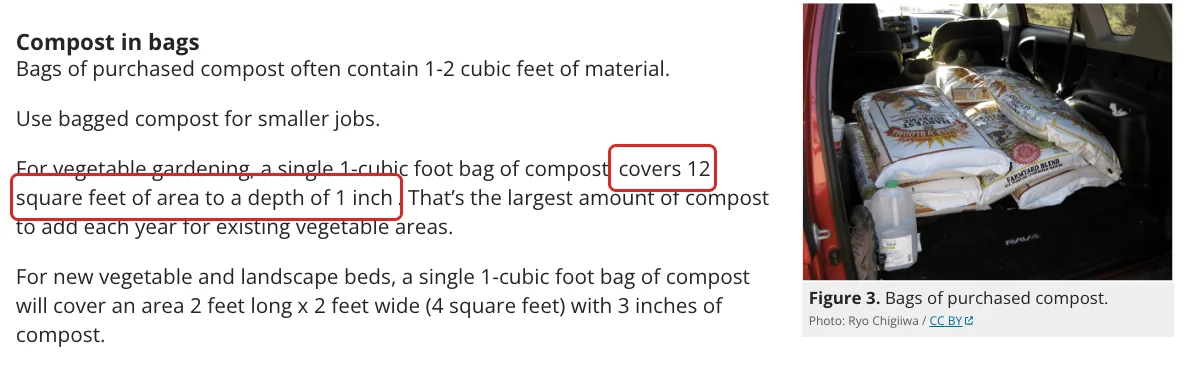
Past 1 cubic yard, bulk delivery usually beats bags; yard prices are in our topsoil cost guide, and compost vs mulch explains why the layer you till in should be compost, not wood mulch. Texas A&M caps any single addition at a 4 inch layer and says fresh manure should not go in; use composted manure at 30 to 40 lb per 100 sq ft.
Tilling suits in-ground beds only; for containers and raised beds, our guide to potting soil vs garden soil covers which bag to buy and how many a bed needs.
Do you need to call 811 before tilling?
Call anyway: Call 811 says some utilities sit just inches below the surface and that every project needs a request a few business days ahead. Whether the law requires it is a separate question, and in the 8 state codes we read the answer turns on depth and tool.
| State | What the statute says about tilling | Depth that triggers a locate | Statute |
|---|---|---|---|
| Minnesota | Only powered tools count as excavation; gardening excluded unless it disturbs soil 12 in or more | 12 in | Minn. Stat. 216D.01, subd. 5 |
| North Dakota | Gardening and landscaping excluded unless 12 in or more | 12 in | N.D. Cent. Code 49-23-01 |
| South Dakota | Tilling of soil and gardening to 12 in excluded | Over 12 in | S.D. Codified Laws 49-7A-1(4)(a) |
| Montana | Homeowner gardening excluded only in a previously established garden area, unless 12 in or more; homeowner landscaping counts if done with mechanized equipment | 12 in in an established garden; any depth on a new plot | Mont. Code Ann. 69-4-501(12) |
| Washington | Owner or occupant digging under 12 in on private noncommercial property is exempt from notice | 12 in | RCW 19.122.031(1)(b) |
| Texas | Excavate means powered equipment disturbing soil to 16 in or more | 16 in | Tex. Util. Code 251.002(5) |
| Iowa | Residential gardening excluded; no depth stated | None stated | Iowa Code 480.1(4)(b) |
| Missouri | Only agricultural tilling to 16 in excluded; garden tilling is not | Any depth | RSMo 319.015(8) |
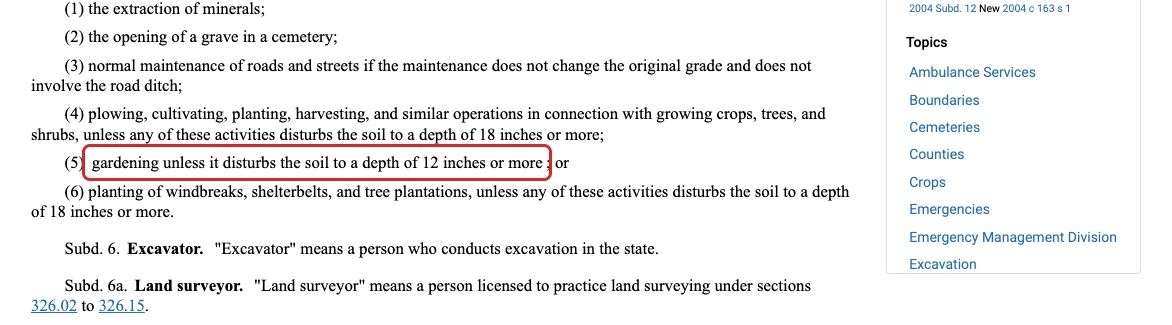
At typical garden depths of 6 to 10 inches, tilling an established plot stays under the legal threshold in 7 of these 8 states, though a 10 inch Mantis pass or Texas A&M’s 8 to 12 inch dig comes close to the 12 inch line. Missouri counts garden tilling at any depth, and Montana’s exclusion covers only a previously established garden area, so breaking a new plot there needs a locate at any depth.
This is general information, not legal advice. One-call laws change and some states add exemptions in other sections; confirm with your state’s 811 center before you dig.
What does tilling do to soil?
Tilling means turning and breaking up the top layer of soil to loosen it, bury residue and mix in amendments. The loosening is real, and so are four costs measured by soil scientists:
| Effect | Measured or stated finding | Source |
|---|---|---|
| Carbon loss | CO2 release right after moldboard plowing was nearly 100 times the untilled rate, and 2.4 times higher over the next 85 days | USDA ARS, Reicosky, Barnes loam, Minn. |
| Long-term organic matter | Intensive tillage and cropping cut soil carbon 30 to 50 percent; tilled soil decomposes organic matter faster | USDA ARS; NRCS Soil Quality sheets |
| Structure | Aggregate stability declines rapidly in clean-tilled soil and recovers under sod | NRCS Soil Quality: Aggregate Stability |
| Tillage pan | Repeated rototilling can compact soil just below tillage depth and kill earthworms | Oregon State EC 1561 |
| Weed flush | Even a brief flash of light during tillage triggers many buried weed seeds; plowing buries most seeds 4 to 6 in deep | eOrganic, Menalled; WSU Soil Health |
The weed flush can work for you. Washington State notes that most weeds emerge from the top inch and few from below 3 inches, so the stale seedbed method is to till, wait 7 to 14 days for weeds to sprout, then kill them with very shallow hoeing before planting.
When should you not till?
Skip the tiller when the squeeze ball holds together, on an existing lawn, and on any bed already in good tilth. For lawns, core aeration plus a 1/4 to 1/2 inch compost topdressing does the job without turning sod (Nebraska Extension); see how to aerate a lawn. For a new bed over grass, sheet mulching with cardboard kills the turf in place without turning the soil. Rhizome grasses such as bermuda resprout from tilled pieces, so kill them first, as how to kill grass before replanting compares the methods for each grass.
How we compiled this
In November 2026 we read 27 primary documents: 9 extension and university publications (Kentucky, Texas A&M, Oregon State x2, Ohio State, Penn State, Nebraska, Washington State, eOrganic), a USDA ARS study and the NRCS Soil Quality sheets, 6 tiller maker pages and manuals, Bonnie Plants’ tilling guide, the Call 811 site and 8 state one-call statutes. We did the volume arithmetic ourselves. We did not till test plots or test tillers; maximum depths are maker claims.
Frequently asked questions
Is it better to till soil when it’s wet or dry?
Neither extreme. Till when it is moist but not wet: a squeezed ball should crumble under your fingertips (University of Kentucky). Wet soil forms clods and loses structure; bone-dry hard ground is easier after watering a few days before (Troy-Bilt).
How do you till ground without a tiller?
Use a spade or digging fork. Texas A&M says turn each shovelful completely over to 8 to 12 inches, and Oregon State says a digging fork damages structure least, especially in clay. Hand digging reaches as deep as you dig, deeper than most walk-behind tillers.
What month should I till my garden?
When the soil passes the squeeze test, usually early spring before planting. Texas A&M suggests spading in winter so freezing and moisture mellow the soil, especially on ground worked for the first time.
What should I do after tilling the soil?
Rake it level, remove roots and clods, and let it rest a day or two before planting so amendments can settle (Troy-Bilt). Keep foot traffic off the bed; Kentucky’s extension notes that walking on wet soil can in some cases do as much damage as tilling it.
What are the downsides of tilling?
Faster organic matter loss, weaker soil aggregates, a compacted pan just below tillage depth and a flush of weed seedlings. A USDA ARS study measured 2.4 times more CO2 loss over 85 days after plowing than from untilled soil (Reicosky).
Sources
- University of Kentucky Cooperative Extension, Spring garden tilling (Ray Tackett), 2022. Accessed November 2026.
- Texas A&M AgriLife Extension, Soil Preparation, Checked November 2026. Accessed November 2026.
- Oregon State University Extension, How to use compost in gardens and landscapes, EM 9308, Checked November 2026. Accessed November 2026.
- Oregon State University Extension, Improving Garden Soils with Organic Matter, EC 1561, Checked November 2026. Accessed November 2026.
- Ohio State University, Buckeye Turf, Turfgrass establishment series: seedbed preparation, Checked November 2026. Accessed November 2026.
- Penn State Extension, Lawn Establishment, Checked November 2026. Accessed November 2026.
- Nebraska Extension in Lancaster County, Uses of compost in the landscape, Checked November 2026. Accessed November 2026.
- USDA Agricultural Research Service, Reicosky, long-term effect of moldboard plowing on tillage-induced CO2 loss, Publication record. Accessed November 2026.
- USDA NRCS, Soil Quality Information Sheets (organic matter, aggregate stability, compaction), Directives copy. Accessed November 2026.
- eOrganic (Menalled), Manage the weed seed bank: minimize deposits and maximize withdrawals, Checked November 2026. Accessed November 2026.
- Washington State University Soil Health, Watching the waltz: weed seeds and tillage, July 14, 2022. Accessed November 2026.
- Troy-Bilt, Do’s and Don’ts of Tilling, Checked November 2026. Accessed November 2026.
- Troy-Bilt, Garden tiller operation tips, Checked November 2026. Accessed November 2026.
- Troy-Bilt, Colt FT 208cc 24 in front tine tiller, 21B-34M8766, Checked November 2026. Accessed November 2026.
- Troy-Bilt, Pony garden tiller, 21A-492R766, Checked November 2026. Accessed November 2026.
- BCS America, Rear tine tiller attachment, Checked November 2026. Accessed November 2026.
- Mantis, 2-Cycle Tiller 7920/7924 operating manual, Rev. G, October 2022 upload. Accessed November 2026.
- Common Ground Alliance, Call 811, Checked November 2026. Accessed November 2026.
- Minnesota Legislature, Minn. Stat. 216D.01, Definitions, Current statute. Accessed November 2026.
- North Dakota Legislature, N.D. Cent. Code ch. 49-23, Current statute. Accessed November 2026.
- South Dakota Legislature, S.D. Codified Laws 49-7A-1, Current statute. Accessed November 2026.
- Montana Legislature, Mont. Code Ann. 69-4-501, Definitions, Current statute. Accessed November 2026.
- Washington State Legislature, RCW 19.122.031, Exempted activities, Current statute. Accessed November 2026.
- Texas Legislature, Utilities Code ch. 251, Underground Facility Damage Prevention, Current statute. Accessed November 2026.
- Iowa Legislature, Iowa Code 480.1, Definitions, Current statute. Accessed November 2026.
- Missouri Revisor of Statutes, RSMo 319.015, Definitions, Current statute. Accessed November 2026.