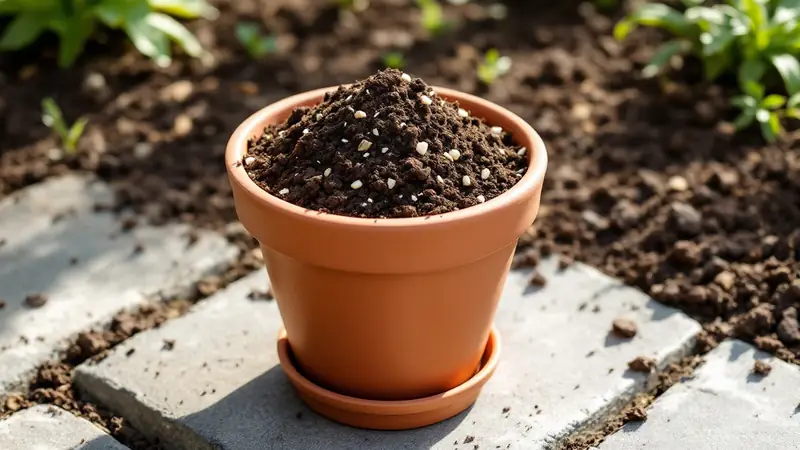
Garden soil vs potting soil: garden soil is mixed into in-ground beds; potting soil fills pots, window boxes and raised beds on pavement. Yard soil in a pot stays waterlogged after watering because of the perched water table, while potting mix drains and holds air.
The garden soil vs potting soil choice gets muddled because “garden soil” names two things. One is your yard: mineral soil at about 82.9 lb per cubic foot dry at the ideal 50 percent pore space (SDSU Extension, citing USDA NRCS). The other is the bag at the store: Miracle-Gro Garden Soil All Purpose prints 15 lb for 0.75 cubic foot, 20 lb per cubic foot, made from peat, forest products and compost. Miracle-Gro Potting Mix prints 12.6 lb for 25 dry quarts, about 13 lb per cubic foot, and adds perlite.
Both bags carry little or no mineral soil; our label-by-label comparison of topsoil and garden soil reads 9 of them, and potting soil vs potting mix covers the container labels. What changes the answer is the container. A 1980 paper in the Journal of Arboriculture by L. Art Spomer found that a little sand or perlite stirred into soil in a pot lowers its porosity until the amendment reaches about 10 volumes per 2.5 to 3 volumes of soil.
Where does each soil go?
Match the bag to what is under the roots: a drainage hole or pavement calls for potting mix; native ground calls for garden soil or topsoil blended into it. Rates come from 2 labels and 3 extension services.
| Planting | Use | Rate or recipe | Source |
|---|---|---|---|
| Pots, window boxes, hanging baskets | Potting mix | Fill the container; one 25 qt bag fills three 10 in pots | Miracle-Gro Potting Mix label |
| Large houseplant repotted rarely | Potting soil that contains some mineral soil | Keep pH 6.0 to 6.5 (soilless mixes: 5.5 to 6.0) | UConn Home & Garden Education |
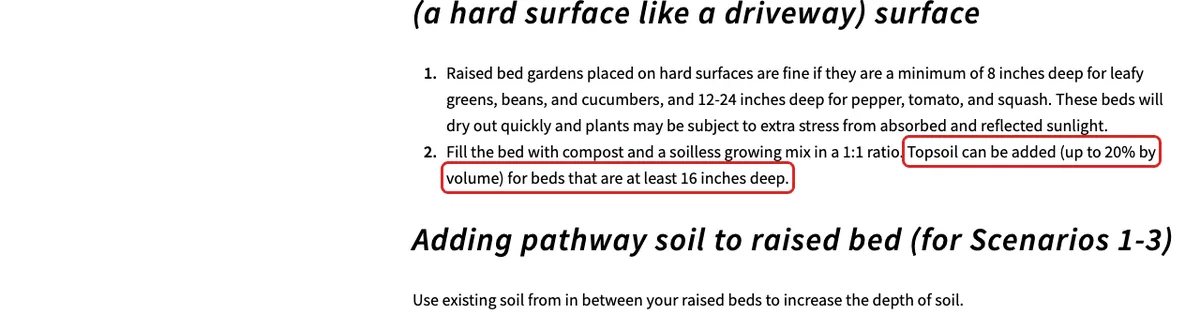
| Raised bed on a driveway or patio | Compost plus soilless mix, 1:1 | Topsoil up to 20 percent by volume, only in beds 16 in or deeper | University of Maryland Extension |
| Raised bed on soil, poor or clay ground | Compost plus topsoil, 1:2 or 1:1 | Or compost plus soilless mix, 1:1 | University of Maryland Extension |
| Raised bed on soil, general | Topsoil plus compost | About 70 percent topsoil, 30 percent compost | Iowa State Extension |
| Raised bed with bagged garden soil | Garden soil plus topsoil or native soil | Equal parts | Miracle-Gro Garden Soil label |
| Existing in-ground bed | Garden soil or compost | Spread 2 to 3 in, mix into the top 6 to 8 in | Miracle-Gro Garden Soil label |
| Shrub or perennial planting hole | Garden soil | Hole 2 times the root ball width; backfill 50:50 with native soil | Miracle-Gro Garden Soil label |
| Seed trays | Seed starting mix | Finer than potting soil; peat, perlite or vermiculite, coir | UC Cooperative Extension Colusa County |
1Is it a pot, window box, hanging basket or other container with a drainage hole?
YesPotting mix. Yard soil stays saturated near the bottom and compacts (Purdue HO-287-W, Spomer 1980, UConn).
NoGo to the next question
2Is it a raised bed sitting on concrete, pavers or a deck?
YesCompost and soilless mix 1:1; add topsoil only up to 20 percent, and only if the bed is 16 in or deeper (University of Maryland).
NoGo to the next question
3Is it a raised bed on open ground?
YesTopsoil and compost, about 70/30 or 2:1, worked into the soil below (Iowa State, University of Maryland); bagged garden soil goes in 1:1 with topsoil (Miracle-Gro label).
NoGo to the next question
4Are you starting seeds in trays or cells?
YesSeed starting mix, finer than potting soil (UC Cooperative Extension).
NoIn-ground bed: spread 2 to 3 in of garden soil or compost and mix it into the top 6 to 8 in of native soil (Miracle-Gro Garden Soil label).
The 60 percent topsoil, 30 percent compost, 10 percent potting soil blend that circulates on garden sites does not appear in the Maryland, Iowa State or label recipes above; Iowa State’s nearest is 70/30 topsoil and compost. Before buying any soil for an in-ground bed, a soil test from a land-grant lab shows whether the real limit is pH or nutrients, which more soil will not fix.
Why does yard soil stay wet in a pot?
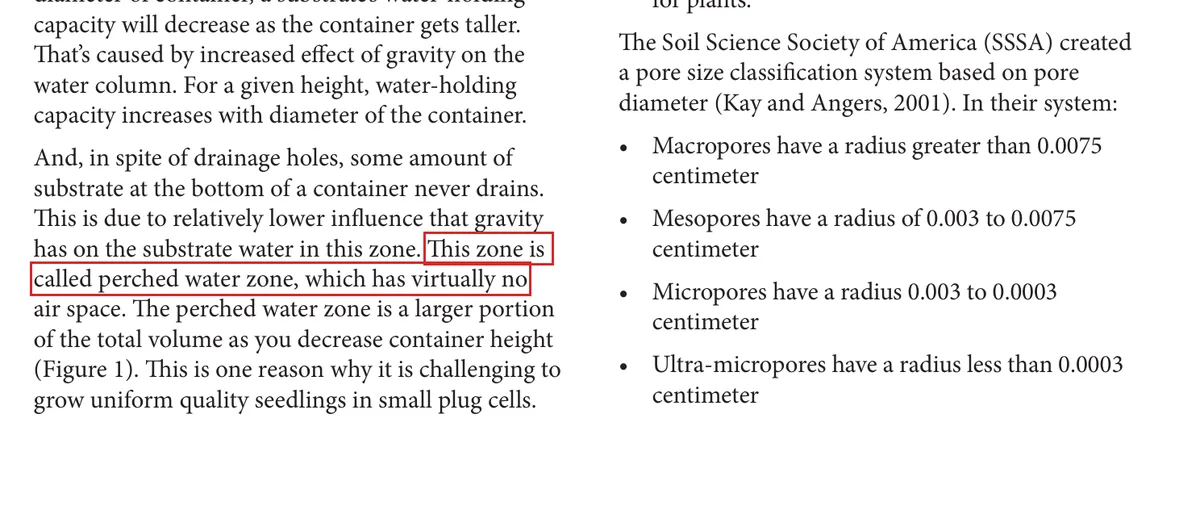
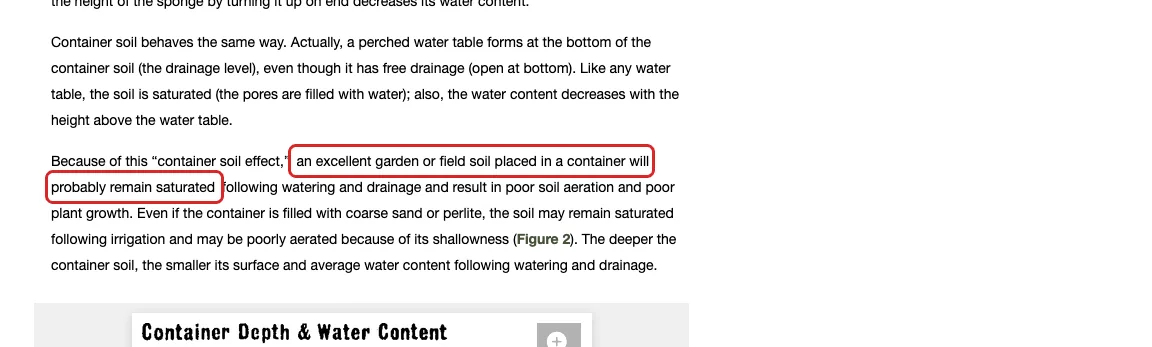
Gravity cannot pull all the water out of a short column of soil. Purdue Extension publication HO-287-W explains that, in spite of drainage holes, some soil at the bottom of every container never drains; that perched water zone has virtually no air space, and it takes up a larger share of the pot as the container gets shorter.
How tall that wet zone is depends on pore size. Spomer charted a silty clay loam in a 10 in (25 cm) deep container and found it essentially saturated through its entire depth after watering and drainage, while very coarse sand drained too far. Roots in that soil run short of oxygen.
Potting mixes fix this with big pores. Purdue puts the target at 20 to 25 percent air space after drainage. Its peat and perlite mix held air in about 23 percent of the pot’s volume; a peat, bark, perlite and vermiculite mix, about 17 percent. UConn adds the second problem: mineral soils do not hold up under repeated watering and will rapidly become very compacted in a container.
| Material | Weight, lb per cu ft | Total pore space | Air after watering, share of volume | Source |
|---|---|---|---|---|
| Potting mix (Miracle-Gro, as sold) | 13.0 | Not printed | Not printed | label: 12.6 lb per 25 dry qt |
| Peat and perlite mix | Not stated | 61.4% | 23.3% (38% of pores) | Purdue HO-287-W, Table 1 |
| Peat, bark, perlite and vermiculite | Not stated | 59.1% | 16.5% (28% of pores) | Purdue HO-287-W, Table 1 |
| Bagged garden soil (Miracle-Gro, as sold) | 20.0 | Not printed | Not printed; label says not for containers | label: 15 lb per 0.75 cu ft |
| Yard mineral soil at ideal density | 82.9 dry | 50% | Essentially none in a 10 in pot (silty clay loam) | SDSU / NRCS; Spomer 1980 |
| Loam, density that restricts roots | Above 112.1 dry | Below about 32% | Lower still | SDSU / NRCS Table 1 |
On a balcony or deck, weight matters too: dry yard soil at 82.9 lb per cubic foot is about 6.4 times the as-sold weight of potting mix.
Can you turn garden soil into potting soil?
Yes, but not with a handful of perlite. Spomer’s threshold is the minimum amendment before aeration improves at all: about 10 volumes of sand, perlite or calcined clay plus 2.5 to 3 volumes of soil, so roughly 77 to 80 percent amendment. Below it, the fine soil fills the gaps between the coarse particles and total porosity drops. Organic amendments such as peat and bark reach the threshold with less material.
- Screen the soil and pasteurize it: UF/IFAS says spread it in a tray and bake at 200°F for 20 minutes, stirring every 5 minutes. UConn describes sterilized commercial mixes as heated to about 180°F.
- Mix by volume. UF/IFAS’s soil-based recipe is 2 parts soil, 1 part peat moss, 1 part perlite and 1 part coarse sand, so soil is 40 percent of the blend. Use builder’s sand; UF warns that plaster and fine sands make a dense mix.
- Check the pH. UConn keeps soil-containing mixes at 6.0 to 6.5, against 5.5 to 6.0 for soilless ones; our guide on raising soil pH with lime covers the adjustment.
- Use the blend in deep containers or under top-heavy plants, where weight helps; small pots do better in a bagged peat or coir mix. Reusing last year’s mix is a separate question, covered in does potting soil go bad.
How much soil does a raised bed or pot need?
Volume is length times width times depth: a 4 by 8 ft bed is 32 sq ft, so 12 inches deep is 32 cubic feet, or 1.19 cubic yards. The Miracle-Gro garden soil label’s own chart assumes you mix it 50:50 with topsoil, so its 96 sq ft, 6 in raised bed calls for 32 bags of 0.75 cubic foot, half the 48 cubic feet the bed holds.
- Cubic feet
- 32.0
- Cubic yards
- 1.19
- 1.5 cu ft bags
- 22
- 2 cu ft bags
- 17
- Weight as potting mix, lb (13 lb/cu ft)
- 416
- Weight as yard soil, lb dry (82.9 lb/cu ft)
- 2,653
Default 4 x 8 ft bed (32 sq ft) at 12 inches: 32 cu ft, 1.19 cu yd, 22 bags of 1.5 cu ft or 16 of 2 cu ft; 416 lb as potting mix vs 2,653 lb as dry yard soil. Math: sq ft x inches / 12. Weights from the Miracle-Gro Potting Mix label and SDSU/NRCS.
| 4 x 8 ft bed depth | Cubic feet | Cubic yards | 1.5 cu ft bags | 2 cu ft bags | Weight if potting mix (13 lb/cu ft) | Weight if yard soil (82.9 lb/cu ft dry) |
|---|---|---|---|---|---|---|
| 6 in | 16.0 | 0.59 | 11 | 8 | 208 lb | 1,326 lb |
| 8 in | 21.3 | 0.79 | 15 | 11 | 277 lb | 1,769 lb |
| 12 in | 32.0 | 1.19 | 22 | 16 | 416 lb | 2,653 lb |
| 16 in | 42.7 | 1.58 | 29 | 22 | 555 lb | 3,537 lb |
For a bed on a hard surface, Maryland Extension sets depth by crop: at least 8 inches for leafy greens, beans and cucumbers, and 12 to 24 inches for peppers, tomatoes and squash. On open ground, roots continue into the soil below; Iowa State works the first few inches of mix into it so no distinct layer forms, and our guide on how to till soil sets the depth for that pass.
Pots are sold by gallon but mix is sold by dry quart. NIST Handbook 44, Appendix C sets a gallon at 231 cubic inches and a dry quart at 67.2006, so one cubic foot holds 25.7 dry quarts and a true gallon holds 3.44.
| Container (true gallons) | Dry quarts of mix | Cubic feet | 2 cu ft bags | Potting mix weight as sold |
|---|---|---|---|---|
| 1 gal | 3.4 | 0.13 | 1 fills about 15 pots | 1.7 lb |
| 3 gal | 10.3 | 0.40 | 1 fills about 5 pots | 5.2 lb |
| 5 gal (bucket size) | 17.2 | 0.67 | 1 fills about 3 pots | 8.7 lb |
| 10 gal | 34.4 | 1.34 | 1 | 17.4 lb |
| 15 gal | 51.6 | 2.01 | 2 | 26.1 lb |
| 25 gal | 85.9 | 3.34 | 2 | 43.4 lb |
What does each cost per cubic foot?
In Google Shopping listings captured November 12, 2026, Miracle-Gro garden soil ran $6.09 to $7.99 a cubic foot and Miracle-Gro potting mix $8.22 to $10.74, about 35 percent more.
| Product, bag size as listed | Listed price | Seller | Per cu ft |
|---|---|---|---|
| Miracle-Gro Garden Soil All Purpose, 1.5 cu ft | $9.14 | Supply Ontime | $6.09 |
| Miracle-Gro 1.5 cu ft Garden Soil | $10.98 | Instacart | $7.32 |
| Miracle-Gro 1.5 cu ft Garden Soil | $11.99 | Do it Best | $7.99 |
| Miracle-Gro Potting Mix (50 qt) | $15.99 | Burgaw Milling Company | $8.22 |
| Miracle-Gro Moisture Control All Purpose Potting Mix, 50 qt | $16.99 | Stones Ace | $8.74 |
| Miracle-Gro Moisture Control Potting Mix, 50 qt | $19.11 | Supply Ontime | $9.83 |
| Miracle-Gro Potting Mix All Purpose, 50 qt | $20.88 | Jamaica Hardware | $10.74 |
A 32 cubic foot bed costs about $195 to $256 in that garden soil, which the label cuts 1:1 with topsoil, or $263 to $344 in potting mix. Above about 1 cubic yard, bulk delivery usually wins; yard prices and the break-even are in our topsoil cost guide, and compost vs mulch covers buying the compost half.
What is the difference between Miracle-Gro potting soil and garden soil?
Read side by side, the two labels share a base of peat, processed forest products, coir or compost, sphagnum and a wetting agent. The potting mix adds perlite, which supplies the large pores, carries more fertilizer at 0.21-0.11-0.16 against 0.09-0.05-0.07, and weighs 13 lb per cubic foot against 20. The garden soil label says “for in-ground use” beside a not-for-containers icon.
How we compiled this
We read 2 Miracle-Gro labels, Spomer’s 1980 paper, 6 extension publications, the SDSU summary of NRCS bulk density limits and NIST Handbook 44 in November 2026, plus Google Shopping listings on November 12. We did not buy, weigh or grow anything; weights are as printed and volumes are our arithmetic.
Frequently asked questions
Can I use potting soil instead of garden soil?
Yes, in beds, at about 35 percent more per cubic foot; Spomer found a coarse container mix may hold over twice as much water in a pot as in the ground. Maryland Extension blends soilless mix 1:1 with compost for raised beds.
What happens if I use garden soil in a container?
It stays saturated and compacts, so roots run short of air; Spomer’s silty clay loam was essentially saturated through a 10 in pot. Bagged garden soil is lighter, but its label says not for containers.
Can I use garden soil for indoor plants?
Not straight from the yard. UConn recommends a potting soil that contains some mineral soil for large houseplants, kept at pH 6.0 to 6.5. If you blend your own, UF/IFAS bakes the soil at 200°F for 20 minutes first.
Can you mix potting soil and garden soil?
In beds, yes: the Miracle-Gro label pairs garden soil 1:1 with topsoil. In a pot, a little soil can clog the large pores; UF/IFAS’s soil-based recipe keeps soil at 40 percent with peat, perlite and sand.
Sources
- L. Art Spomer, Journal of Arboriculture 6(12), Container Soil Water Relations: Production, Maintenance, and Transplanting, 1980. Accessed November 2026.
- Purdue University Extension (Krishna Nemali), Understanding the Pores of a Soilless Substrate, HO-287-W, Checked November 2026. Accessed November 2026.
- University of Maryland Extension, Soil to Fill Raised Beds, Reviewed 2019 to 2026. Accessed November 2026.
- Iowa State University Extension, Yard and Garden, What would be a good soil mix for a raised bed?, Checked November 2026. Accessed November 2026.
- UConn Home & Garden Education Center, Potting Media, Checked November 2026. Accessed November 2026.
- UF/IFAS Extension, Solutions for Your Life, Homemade Potting Mix, Modified August 7, 2025. Accessed November 2026.
- UC Cooperative Extension, Colusa County, Bagged Soils, Checked November 2026. Accessed November 2026.
- South Dakota State University Extension, Bulk Density: An Indicator of Soil Health (NRCS Table 1), Checked November 2026. Accessed November 2026.
- NIST, Handbook 44 (2026), Appendix C, General Tables of Units of Measurement, 2026. Accessed November 2026.
- Miracle-Gro Lawn Products, Miracle-Gro Garden Soil All Purpose label, 0.75 cu ft, ©2016. Accessed November 2026.
- Miracle-Gro Lawn Products, Miracle-Gro Potting Mix label, 25 qt, ©2013. Accessed November 2026.
- Google Shopping, retailer listings for Miracle-Gro and Kellogg bagged soils, captured November 12, 2026. Accessed November 2026.