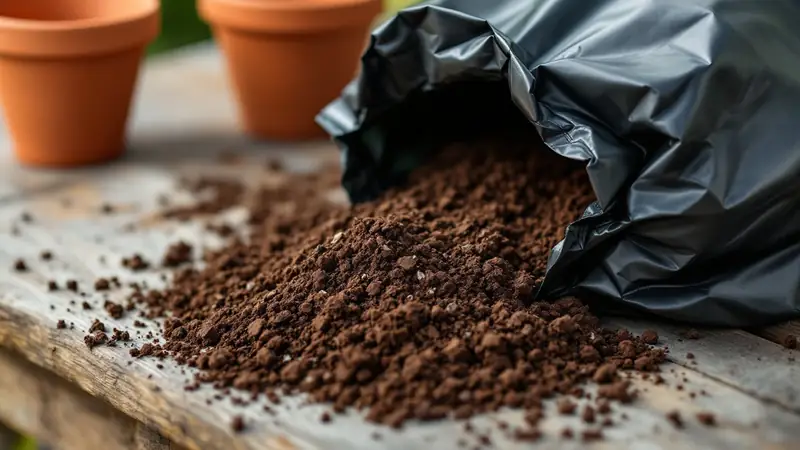
Does potting soil go bad? Not like food, but it ages. Makers say peat mix’s wetting agent fades about 9 months after manufacture (6 for bark mix), fertilizer runs down and lime raises pH. Mix without sour smell or gnats is usable.
Does potting soil go bad in a way that should stop you planting? Usually not. Top-ranking pages say unopened mix keeps 1 to 2 years; the companies that make it publish shorter limits for professional growers: Premier Tech, which makes PRO-MIX, says aging changes are “most noticeable” once unused mix is more than 9 to 12 months old, and Sun Gro, which makes Black Gold and Sunshine, tells growers to use potting mixes within 6 to 12 months of receipt.
What fails is 3 additives, not the peat: the wetting agent, the starter fertilizer and the limestone that sets pH. Bark and compost decompose faster than peat, so mixes built on them get 4 to 6 months. Most bagged “soil” is soilless anyway, as our topsoil vs garden soil label comparison shows from the bag panels, and the potting soil vs potting mix page sorts out the names.
What expires in a bag of potting mix, and when
Each window comes from a maker’s technical staff, an extension service or a product page. Retail “feeds up to” claims count from planting, not purchase.
Swipe the table sideways to see every column.
| Component or product | What changes | Stated window | Source |
|---|---|---|---|
| Wetting agent, peat-based mix | Microbes in the peat break it down; water ponds on top and dry pockets form | About 9 months after manufacture | Premier Tech, GrowerTalks, Sept. 2022 |
| Wetting agent, bark-based mix | Same process, faster | About 6 months after manufacture | Premier Tech, GrowerTalks, Sept. 2022 |
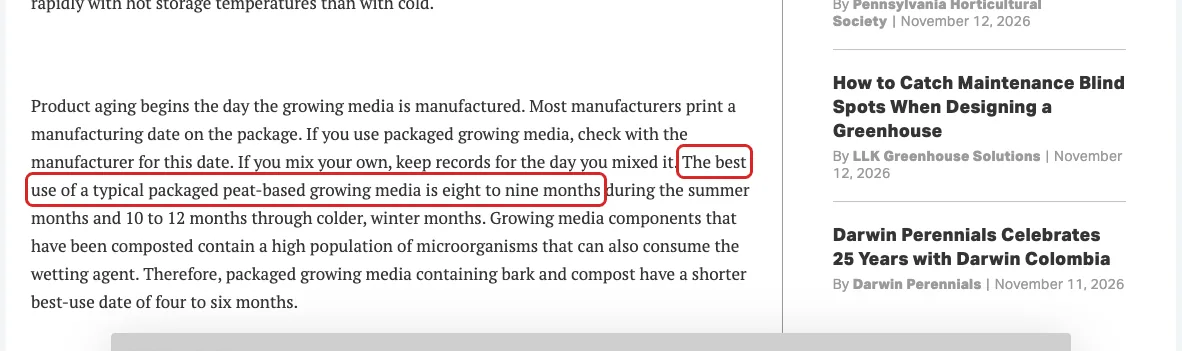
| Peat-based mix, best use, summer storage | Fertilizer draw-down, lime activation, wetting agent loss | 8 to 9 months | Premier Tech, Greenhouse Grower, Nov. 2012 |
| Peat-based mix, best use, winter storage | Same changes, slower in the cold | 10 to 12 months | Premier Tech, Greenhouse Grower, Nov. 2012 |
| Mix containing bark and compost | Composted parts carry more microbes that eat the wetting agent | 4 to 6 months | Premier Tech, Greenhouse Grower, Nov. 2012 |
| PRO-MIX peat-based media | Wetting agent biodegrades | Use within 9 to 12 months | Premier Tech via HortiDaily, June 2014 |
| PRO-MIX peat/bark-based media | Wetting agent biodegrades | Use within 6 months | Premier Tech via HortiDaily, June 2014 |
| Seed-starting (plug and propagation) mix | Fine mixes show aging first | Use within 6 months | Sun Gro, Greenhouse Grower, Feb. 2026 |
| Growing-on (potting) mix | Wetting agent, nutrients, pH | Use within 6 to 12 months | Sun Gro, Greenhouse Grower, Feb. 2026 |
| Professional mix with controlled-release fertilizer mixed in | Fertilizer releases inside the package | 1 week (most CRF makers) to 1 month | Sun Gro, Feb. 2026; Premier Tech, Nov. 2012 |
| Mycorrhizae in PRO-MIX | Spores tolerate freezing and heat | Viable up to 2 years | Premier Tech via HortiDaily, June 2014 |
| Starter fertilizer charge, professional mix, once planted | Taken up and leached | About 1 to 2 weeks | Premier Tech, Greenhouse Grower, Nov. 2012 |
| Fertilizer in a new retail bag, once planted | Used by plants, leached by watering | Generally 3 to 6 months | Oklahoma State Extension, 2023 |
| Miracle-Gro Potting Mix feed claim | Maker’s feeding claim | Up to 6 months | Miracle-Gro, checked Nov. 2026 |
| Miracle-Gro Organic Outdoor Potting Mix feed claim | Maker’s feeding claim | Up to 2 months | Miracle-Gro, checked Nov. 2026 |
| Scotts Premium Potting Soil feed claim | Maker’s feeding claim | Up to 4 months | ScottsMiracle-Gro, checked Nov. 2026 |
| Black Gold All Purpose Potting Mix feed claim | Maker’s feeding claim | Up to 6 months | Sun Gro, checked Nov. 2026 |
| PRO-MIX Premium Potting Mix feed claim | Maker’s feeding claim | Up to 9 months | Premier Tech, checked Nov. 2026 |
| pH of fresh, dry mix under 3 months old | Lime has not reacted yet | Close to pH 5.0 | Premier Tech, Greenhouse Grower, Nov. 2012 |
| pH after watering in, typical | Moisture breaks down the limestone | pH 5.2 to 5.8 | Premier Tech, GrowerTalks, Sept. 2022 |
| pH of mix 9 months or older | Lime keeps reacting | Close to pH 6.0 | Premier Tech, GrowerTalks, Sept. 2022 |
| pH of mix stored wet | Water seeps in and speeds the lime | Mid 6s or higher | Premier Tech, GrowerTalks, Sept. 2022 |
| Freezing in storage | No dramatic change in wettability, pH or EC | Thaw takes days to a week or more | Sun Gro, Greenhouse Grower, Feb. 2026 |
The clock starts at manufacture, not when you open the bag: “product aging begins the day the growing media is manufactured”, Premier Tech wrote in 2012, and hot storage speeds every change. Mix with fertilizer pellets blended in ages fastest, because the pellets release inside the moist bag; Premier Tech told growers to use it within 1 month.
How to find the date on the bag
Look for a printed date and time on the back or gusset. Premier Tech’s GrowerTalks article shows a PRO-MIX bale stamped 2022.06.16, read as year, month, day, so that bale was made on June 16, 2022. If you find only a lot code, or nothing, count from the day you bought it, and write that month on the bag.
Signs potting soil has gone bad, and what each one means
Eight of these 9 signs have a fix. Only disease carried over from a dead plant rules the mix out of pots.
| What you see | Likely cause | What to do | Usable? |
|---|---|---|---|
| Water beads or pools on top, then runs out the drain hole dry | Wetting agent consumed by microbes (about 9 months for peat mixes, 6 for bark) | Pre-wet in a tub with warm water and stir until it darkens, or blend 1 part compost or fresh mix into 3 parts old | Yes |
| White or gray fuzz on the surface when you open the bag | Saprophytic mold living on bark, peat or compost; Premier Tech says it does not harm plants | Break it up and spread the mix to dry for a day | Yes |
| Sour, rotten-egg or ammonia smell | Wet mix went anaerobic in a sealed bag, or organic fertilizer (horn or grain meal) is breaking down | Loosen and air it 2 to 3 days in the open; plant only once the smell is gone | Yes, once it smells earthy |
| Small black flies, or clear larvae with black heads | Fungus gnats; UC IPM says media that got wet or sat on soil before use can be infested | Pasteurize at 180°F for 30 minutes, or solarize until the center holds 158°F for 30 minutes | After heat treatment |
| Mix feels heavy, clumped, and has shrunk in the pot | Peat, bark and compost have decomposed, so air space is lost | Mix in fresh mix or compost at 1 part to 3 parts old; keep it for less demanding plants | Partly |
| New transplants sit still and stay pale for weeks | Fertilizer charge used up; microbes take nitrate and iron first | Feed at planting with a complete water-soluble fertilizer at label rate | Yes, with feeding |
| Bag sat in rain or snow, or water got inside | Lime reacted early; pH can reach the mid 6s and fertilizer has released | Test pH first; use for pH-tolerant plants such as geraniums, marigolds and pentas | Usually |
| Bag froze solid over winter | Freezing does not dramatically change wettability, pH or salts (Sun Gro) | Thaw indoors; allow up to a week before you fill pots | Yes |
| Mix came from a pot where a plant died of disease | Viruses, fungi and bacteria persist in the mix (Oklahoma State) | Do not reuse in containers; compost it or work it into garden beds | Not in pots |
The smell row needs a note. Germany’s substrate quality association, Gütegemeinschaft Substrate für Pflanzen, says a strong smell on opening is often organic fertilizer such as horn meal or grain meal being converted by microbes, “not indicative of poor quality”, and that loosening the mix and leaving it in open air for 2 or 3 days clears it. A bag that was stored wet and smells of rotten eggs has gone short of oxygen; give it the same airing.
Mold looks worse than it is. Premier Tech says the fuzz seen on opening a bag is saprophytic, living on dead bark, peat, compost or coir, and “they do not harm plants“; it needs humid, still air and rarely returns in a pot.
1Did it come from a pot where a plant died of disease, or that had weeds or insects last season?
YesDo not reuse it in containers. Add it to the compost pile or work it into garden beds (Oklahoma State Extension).
NoGo to the next question
2Do you see fungus gnats or their larvae in it?
YesHeat it first: 180°F held for 30 minutes (Penn State Extension), or closed black bags in sun until the center holds 158°F for 30 minutes (UC IPM).
NoGo to the next question
3Does it smell sour, like rotten eggs or ammonia?
YesSpread it out in open air for 2 to 3 days. Plant once it smells earthy again.
NoGo to the next question
4Is it more than about 9 months past the manufacturing date (6 months for bark or compost mixes), or did it get wet in storage?
YesUse it, but pre-wet it, feed from the first watering, and test pH if it got wet.
NoUse it as is. White fuzz on the surface is a saprophytic mold that Premier Tech says does not harm plants.
Source: Oklahoma State Extension (2023); Penn State Extension; UC IPM; Premier Tech (2012, 2022)
Why stored potting soil creeps up in pH
Peat is acidic, about pH 3.5 to 4.5, so makers add limestone to bring it to 5.5 to 6.2 (Premier Tech, 2012). Limestone needs water to react. A dry bag under 3 months old can test close to 5.0; once watered in, a typical mix settles at 5.2 to 5.8. After 9 months the reading can sit near 6.0, and a bag that took on water can climb to the mid 6s or higher.
Premier Tech lists geraniums, New Guinea impatiens, lisianthus, marigolds and pentas as crops that tolerate the higher pH of aged mix. Blueberries do not: their range in container media is 4.0 to 5.2 (University of Georgia), and our guide to lowering pH with sulfur gives the per-pot dose.
Test before you correct. Premier Tech warns that metal-probe meters pushed into mix often read near 7.0; its method is a paste of mix and distilled water sealed in a plastic bag, with readings on day 1, 3 and 7. Our soil test guide covers lab options, and raising pH the opposite fix.
Does unopened potting soil last longer than opened?
Sealed bags age too: the microbes that eat the wetting agent and fertilizer are already inside. The seal stops new water and insects. UC IPM says peat or any organic mix that becomes wet prior to use or has been stored on soil or uncovered can be infested with fungus gnats, which can produce a new generation in about 17 days, faster the warmer it is.
An opened bag kept dry, closed and off the ground ages at about the rate of a sealed one; one left in the rain does not. A 2- or 3-year-old bag is past every window in the table, so after the smell and gnat checks, plant as if it held no fertilizer or wetting agent.
How to store potting soil so it lasts
- Keep it dry. Sun Gro says moisture inside the mix leads to nutrient loss and can activate the liming agents, raising pH before you plant.
- Keep it cool and shaded. Sun Gro says heat and sun degrade the wetting agent and nutrients.
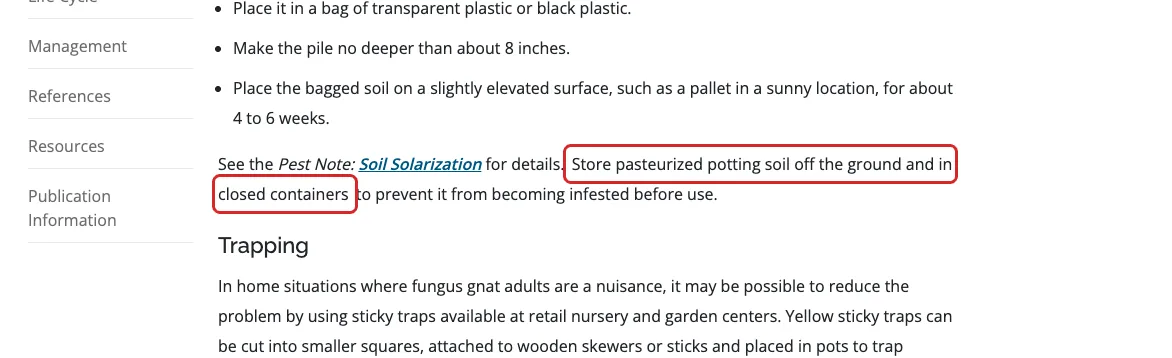
- Get it off the ground: a shelf, pallet or bin. UC IPM’s advice is to store potting soil off the ground and in closed containers.
- Close opened bags, or tip the mix into a lidded bin; Scotts suggests scrubbing a reused bin with 1 part bleach to 9 parts water and drying it first.
- Store it away from herbicides, insecticides and fertilizers; Sun Gro strongly discourages keeping them in the same space as mix.
- Freezing is fine. Premier Tech says you can allow stored mix to freeze; Sun Gro notes a frozen bag may take a week or more to thaw.
- Buy one season’s worth and use the oldest bag first.
Can you reuse potting soil?
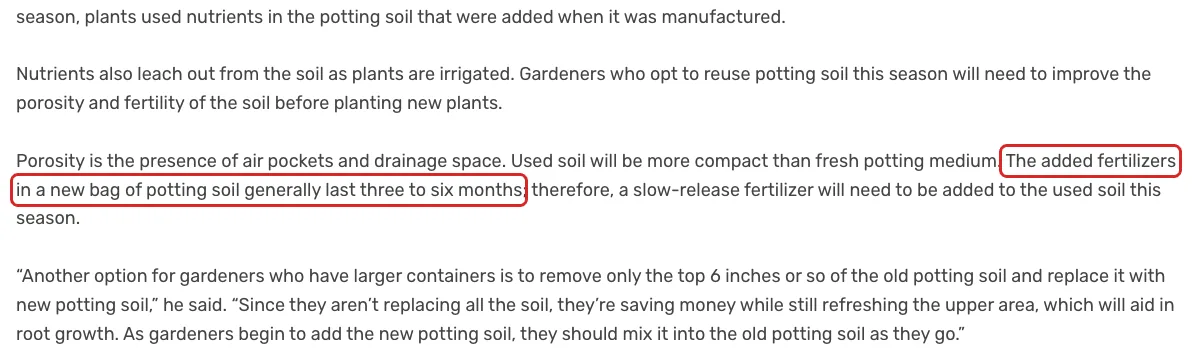
Yes, if last season’s plants were healthy. Oklahoma State Extension horticulturist David Hillock says to reuse it when plants showed no disease, but not after disease, weed or insect problems, because viruses, fungi and bacteria “remain in the potting soil long after the life of the plant”. Used mix is more compact, and its fertilizer generally lasted only 3 to 6 months.
To refresh a pot of healthy used mix:
- Tip it out, pull roots and debris, and break up clumps.
- For a large container, Hillock’s shortcut is to take out only the top 6 inches or so and replace it with new mix, blending as you go.
- Otherwise blend in compost or fresh mix. Scotts gives 1 part compost to 3 parts potting mix and warns that more compost can compact.
- Add a slow-release fertilizer at the rate on its label, since the original charge is gone.
- If gnats or damping-off were a problem, heat it: Penn State Extension says to hold potting soil at about 180°F for 30 minutes; UC IPM’s solarization guideline is 158°F or higher for 30 minutes at the coolest spot.
- Pre-wet it before planting, since the wetting agent is likely spent.
- Fresh mix or compost (quarts)
- 5
- 8-quart bags to buy
- 1
- Cubic feet
- 0.17
Default: a 5-gallon pot at 25 percent fresh needs 1.25 gallons, or 5 quarts, so one 8-quart bag. 1 gallon = 4 quarts = 0.1337 cubic foot.
UC IPM‘s home method: moist mix in clear or black plastic bags, no deeper than about 8 inches, on a pallet in full sun for 4 to 6 weeks. In warmer parts of California, soil inside black bags can pass 160°F. Add compost afterward, since heat kills helpful microbes too.
Mix you will not reuse can go on the compost pile or into garden beds, Oklahoma State says; our compost vs mulch guide covers where finished material goes. Beds tolerate its compact texture; pots need the open structure covered in garden soil vs potting soil.
How we compiled this
We read 16 primary documents in November 2026: 4 articles and 1 PDF by grower specialists at Premier Tech and Sun Gro; 5 extension and UC IPM pages; a German substrate quality association notice; and 5 maker product pages for retail feeding claims. We ran no storage or growing tests. Professional storage limits are applied to retail bags because the ingredients are the same; the pH value of 6.5 for wet-stored mix is our plotting of “mid sixes”.
Frequently asked questions
Can I use potting soil that is 2 years old?
Usually, yes. It is past every maker window (9 to 12 months for peat mixes), so treat it as unfertilized and hard to wet: check for sour smell and fungus gnats, pre-wet it, and feed from the first watering.
Is 3 year old potting soil still good?
As a base, yes, if it smells earthy and has no gnats. The wetting agent and starter fertilizer will be gone and, if water got in, pH may be in the mid 6s. Blend 1 part fresh mix to 3 parts old for pots.
Can Miracle-Gro potting soil go bad?
It ages like any peat mix. Miracle-Gro says its Potting Mix feeds for up to 6 months and its Organic Outdoor Potting Mix up to 2 months, counted from planting; we found no expiry date on its product pages as of November 2026.
Does potting soil go bad if it freezes?
No. Premier Tech says you can allow stored mix to freeze, and Sun Gro says freezing does not dramatically affect wettability, pH or salts. Allow up to 7 days for a frozen bag to thaw.
How often should you replace potting soil?
Refresh it every 1 to 2 seasons. Oklahoma State says mix from healthy plants can be reused once you restore porosity and fertility; replace it after disease, weeds or insects.
Sources
- Troy Buechel, Premier Tech, GrowerTalks, Addressing Aged Growing Media, September 2022. Accessed November 2026.
- Premier Tech Horticulture, Addressing Aged Growing Media (PDF reprint), September 2022. Accessed November 2026.
- Troy Buechel and Ed Bloodnick, Premier Tech, Greenhouse Grower, 10 Must-Know Growing Media Facts, November 16, 2012. Accessed November 2026.
- Harrison Meekins and Dan Jacques, Sun Gro Horticulture, Greenhouse Grower, Best Practices for Winter Storage and Handling of Growing Media, February 10, 2026. Accessed November 2026.
- Premier Tech Horticulture via HortiDaily, Mycorrhizae and biofungicide survival in packaged media, June 12, 2014. Accessed November 2026.
- Oklahoma State University Extension, Reusing potting soil, 2023. Accessed November 2026.
- Penn State Extension, Damping-off, undated. Accessed November 2026.
- University of California IPM, Fungus Gnats (Home and Landscape Pest Note), undated. Accessed November 2026.
- University of California IPM, Fungus Gnats (Floriculture and Ornamental Nurseries), undated. Accessed November 2026.
- University of California IPM, Soil Solarization for Gardens and Landscapes, undated. Accessed November 2026.
- Gütegemeinschaft Substrate für Pflanzen e.V., Potting soil with an unpleasant smell, undated. Accessed November 2026.
- ScottsMiracle-Gro, How to Store and Reuse Potting Soil, undated. Accessed November 2026.
- Miracle-Gro, Potting mix feeding table (Raised Bed Soil page), checked November 12, 2026. Accessed November 2026.
- ScottsMiracle-Gro, Scotts Premium Potting Soil, checked November 12, 2026. Accessed November 2026.
- Sun Gro Horticulture, Black Gold All Purpose Potting Mix, checked November 12, 2026. Accessed November 2026.
- Premier Tech, PRO-MIX Premium Potting Mix, checked November 12, 2026. Accessed November 2026.