Potting soil vs potting mix: in U.S. stores they are one product class. The industry standard files both under "Potting Soil/Mix," and 9 of the 11 container bags we read list no sand, silt, clay or loam. Buy by the ingredient panel, not the name.
Most answers to potting soil vs potting mix say potting soil contains real dirt and potting mix does not. The trade’s own paperwork disagrees. The Mulch & Soil Council Uniform Product Guidelines (revised September 2026) define a single category, "Potting Soil/Mix," in standard, premium and professional grades, with no soil-content test for either word. On the council’s certified product list (file dated April 11, 2024), 6 products named "Potting Soil" and 26 named "Potting Mix" carry the same "Certified Premium Potting Soils" mark.
So the useful question is what is in the bag. Below are the ingredient panels of 11 container products from 8 makers, the two that list a mineral soil ingredient, and the drainage physics that make a soilless blend the safer choice in a pot. For garden beds and grading, the labels on bagged topsoil and garden soil are compared in our topsoil vs garden soil label comparison.
What do the industry definitions say?
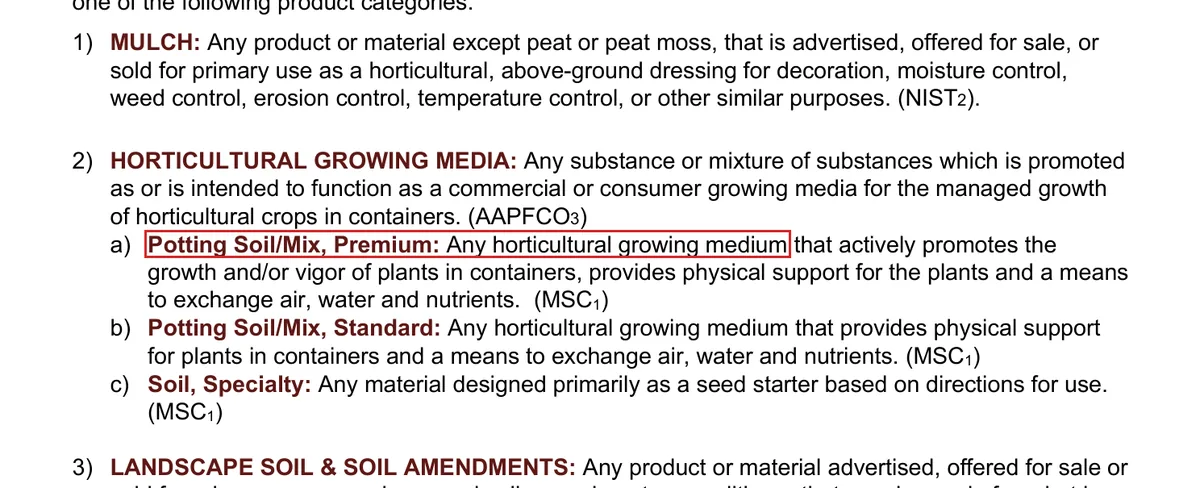
The Mulch & Soil Council (MSC) writes the voluntary label rules that certified brands must adopt. Its guidelines define horticultural growing media as anything sold to grow plants in containers, then grade it. The word "soil" carries almost no meaning by itself: the MSC repeats a NIST definition in which "soil" is any product, except peat or peat moss, sold for use as a growing medium, soil amendment or soil replacement.
| Term on the bag | What the definition requires | Source |
|---|---|---|
| Potting Soil/Mix, Standard | Supports plants in containers and exchanges air, water and nutrients | MSC UPG, Part II 2(b) |
| Potting Soil/Mix, Premium | Standard, plus actively promotes growth or vigor of container plants | MSC UPG, Part II 2(a) |
| Potting Soil/Mix, Professional | Premium medium with documented sales to commercial growers | MSC UPG glossary |
| Soilless | Without naturally occurring earth soil such as topsoil, mineral soil, clay and silt | MSC UPG glossary |
| Soil | Any product except peat or peat moss sold as a growing medium, amendment or soil replacement | MSC UPG, citing NIST |
| Potting soil (older MSC glossary) | Made primarily from natural materials such as bark, peat, humus, compost or manure; sand allowed as an additive | MSC glossary |
| Planting mix (older MSC glossary) | Made primarily from natural soils, peat, humus, compost or manure | MSC glossary |
| Specialty soil | Material designed primarily as a seed starter | MSC UPG, Part II 2(c) |
Two things follow. First, a bag called potting soil is not required to hold mineral soil; the MSC glossary built the term around bark, peat, humus, compost and manure. Second, the one consumer term in that glossary that names "natural soils" as a main ingredient is "planting mix," not potting soil. The glossary also sets the same pH window for potting soil and professional mix: 4.5 to 7.5, with soluble salts of 0 to 5.5 millimhos/cm.
What is in 11 bags sold as potting soil or potting mix?
We read each maker’s own ingredient statement: label scans posted with retailer listings, maker product pages, FoxFarm’s label text pages and one E.B. Stone safety data sheet. Miracle-Gro’s label wording changes by state; the Miracle-Gro Potting Mix label prints separate ingredient lists for California, Texas and Idaho, New Hampshire and Georgia, where forest products are 45 to 55 percent.
| Product (maker source) | Name says | Organic base | Aggregate | Wetting agent or yucca | Sand, silt, clay or loam listed? | Analysis (N-P-K) |
|---|---|---|---|---|---|---|
| Miracle-Gro Potting Mix | Mix | One or more of processed forest products, peat, coir, compost; sphagnum peat moss | Perlite | Wetting agent | No | 0.21-0.11-0.16 |
| Miracle-Gro Performance Organics All Purpose Container Mix | Mix | Sphagnum peat moss, processed forest products, compost | Perlite | Yucca (not called a wetting agent) | No | 0.19-0.03-0.03 |
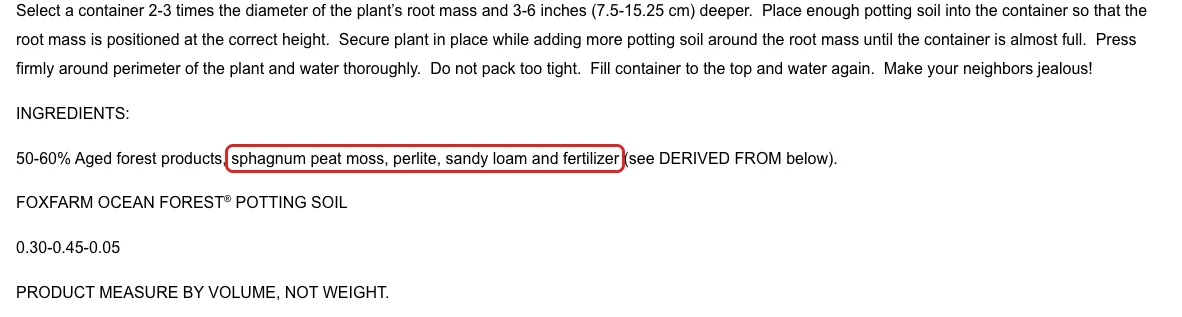
| FoxFarm Ocean Forest Potting Soil | Soil | 50 to 60% aged forest products, sphagnum peat moss (group also lists perlite, sandy loam, fertilizer) | Perlite | None listed | Yes: sandy loam | 0.30-0.45-0.05 |
| FoxFarm Happy Frog Potting Soil | Soil | 50 to 60% aged forest products, sphagnum peat moss (group also lists perlite, fertilizer) | Perlite | None listed | No | 0.30-0.30-0.05 |
| Espoma Organic Potting Mix | Mix | 60 to 70% processed forest products, sphagnum peat moss, humus | Perlite | Yucca extract (not called a wetting agent) | No | Not printed on maker page |
| PRO-MIX Premium Potting Mix (US) | Mix | Canadian sphagnum peat moss, peat humus | Perlite; polymer gel (US only) | None listed | No | Not printed on maker page |
| PRO-MIX Premium All Purpose Mix | Mix | Canadian sphagnum peat moss, peat humus | Perlite | None listed | No | None listed |
| Black Gold Natural & Organic Potting Mix | Mix | Bark, Canadian sphagnum peat moss, compost | Perlite; pumice or cinders | Organic wetting agent | No | 0.09-0.03-0.03 (MSC certified list) |
| Kellogg Patio Plus Premium Outdoor Potting Mix | Mix (MSC list: Potting Soil) | Aged recycled forest products, aged rice hulls, composted poultry manure, peat moss | Perlite; rice hulls | None listed | No | 0.30-0.10-0.10 |
| Great Gardens Professional Potting Mix | Mix | Sphagnum peat moss, processed forest products, compost | Perlite | Yucca (wetting agent) | No | 0.17-0.10-0.12 |
| E.B. Stone Edna’s Best Potting Soil | Soil | Fir bark, peat moss, redwood compost, mushroom compost | Volcanic pumice | Yucca saponin (not called a wetting agent) | Yes: sand | Not in SDS |
Only 2 of the 11 list a soil mineral. FoxFarm Ocean Forest Potting Soil names sandy loam inside its 50 to 60 percent group of forest products, peat moss, perlite and fertilizer, and the E.B. Stone Edna's Best Potting Soil safety data sheet lists sand among 15 ingredients. Both are sold for containers. The third "soil" bag, FoxFarm Happy Frog Potting Soil, lists no mineral soil at all.
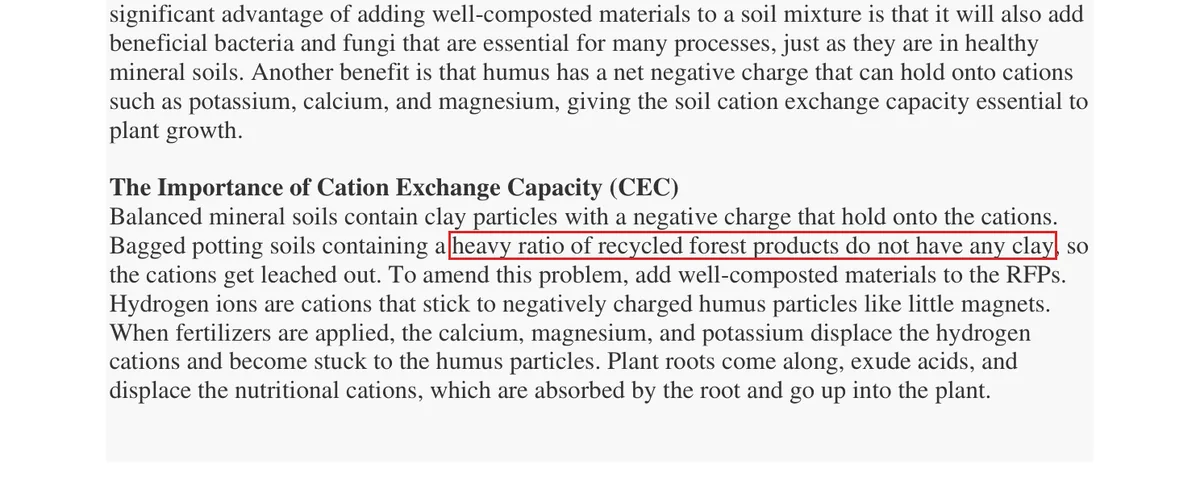
The names also cross over at the maker level. Kellogg sells Patio Plus as a "Premium Outdoor Potting Mix", while the MSC certified list carries it as "Patio Plus, All Natural Outdoor Potting Soil." Espoma calls its Organic Potting Mix "the ultimate potting soil" in its own product copy. A Washington State University Extension master gardener article sums up the shelf: the vast majority of bagged "potting soil" is ground wood and bark from recycled forestry products. The same article adds that bags heavy in those forest products have no clay to hold potassium, calcium and magnesium, so those nutrients leach unless well-composted material is mixed in.
What actually varies is the feeding. Six bags print a guaranteed analysis between 0.17 and 0.30 percent nitrogen. Miracle-Gro says its potting mix feeds for up to 6 months; Premier Tech claims up to 9 months for the PRO-MIX Premium Potting Mix with controlled-release fertilizer. Espoma tells buyers to feed at least monthly starting 2 weeks after planting. If you grow organically, the Miracle-Gro Potting Mix label lists polymer-coated ammonium nitrate and ammonium phosphate; the FoxFarm, Espoma, Kellogg and Black Gold panels list organic sources such as castings, guano, feather meal, kelp meal or "organic fertilizer" instead. How these numbers compare with lawn products is covered in our guide to reading the three numbers on a fertilizer bag.
None of the 11 panels lists vermiculite, the aggregate many guides name first. Perlite appears on 10; the MSC defines horticultural perlite as volcanic glass heated to about 1,600°F so it expands 13 times its volume. Black Gold adds pumice or cinders, Kellogg adds rice hulls, and E.B. Stone uses volcanic pumice alone. The compost several bags contain is the same material compared in compost vs mulch lab numbers, so a heavy compost share means more fines and more water held.
Why do containers need a soilless mix?
The reason is the perched water table. After you water a pot and it stops dripping, a layer at the bottom stays saturated no matter what the mix is. NC State researchers showed it with a sponge of 80 percent total porosity in the N.C. Flower Growers' Bulletin (August 1995): the same sponge held 4.2 percent air when stood 2 inches tall, 14.8 percent at 4.25 inches and 46.5 percent at 8.5 inches.
| Measure | Value | Source |
|---|---|---|
| Sponge air space at 2 / 4.25 / 8.5 in tall (80% total porosity) | 4.2% / 14.8% / 46.5% | NC State, Fonteno, Bailey and Nelson, 1995 |
| Air space in short vs tall plug cells, same 4 mixes | 1% to 3% vs 5% to 10% | NC State, 1995 |
| Effect of packing the mix into the pot | Air space cut in half or eliminated | NC State, 1995 |
| Air pore space below which root dieback and disease may follow | 15% to 20% | Ontario aeration porosity factsheet (OMAFRA-supported) |
| Desirable air pore space, container nursery production | 20% to 30% | Ontario factsheet |
A shallow pot behaves like the 2 inch sponge: most of its depth sits in the wet zone. Mineral soil makes that zone wetter: the WSU article puts silt particles at 0.002 to 0.05 mm and clay under 0.002 mm, and the fine pores between them hold water rather than air. That is why peat, bark and perlite blends dominate bags for pots, and why the NC State authors warn that packing a mix can eliminate air space. By the same height rule, a gravel layer in the bottom only shortens the column of mix above it, so the wet layer moves up rather than away. If your plant wants acidic conditions, check the panel for limestone, which Espoma, both PRO-MIX bags and FoxFarm Happy Frog (as dolomite lime) list, before you adjust pH with our sulfur rates for acid-loving plants.
How can you test the bag you bought?
You can measure air space at home with the method in the Ontario aeration porosity factsheet, using a pot of at least 1 liter (about 1 quart) with one drain hole:
- Pre-moisten the mix 12 to 24 hours ahead until a squeeze barely drips, then seal it in a bag overnight.
- Plug the drain hole, fill the empty pot to the brim with water and record that volume in mL (line A).
- Empty the pot, fill it with the moist mix packed as firmly as you would when potting, and scrape it level with the rim.
- Add water slowly, over up to an hour, until a thin film glistens on top; tap the sides to release bubbles.
- Pull the plug without tilting the pot, let it drain at least 15 minutes, and measure the water that runs out (line B).
- Air pore space = B divided by A, times 100. Under 15 to 20 percent is the factsheet’s warning zone; 20 to 30 percent is its target for nursery containers.
- Air pore space (%)
- 25.0
Air pore space = drained water / pot volume x 100. Default: 250 mL from a 1 liter pot = 25.0 percent, inside the 20 to 30 percent target; below 15 to 20 percent the Ontario factsheet warns of root dieback and disease.
Run the test on any bag that feels heavy or smells sour, and repeat it on mix you reuse: the Ontario factsheet notes that organic matter breaks into finer particles over a season, which plugs pore space. Whether an old bag is still usable is the subject of our sibling page on whether potting soil goes bad.
Which bag should you buy for pots, raised beds and seed starting?
1Are you starting seeds in cells or flats?
YesUse a seed-starting mix, the Mulch & Soil Council's separate 'specialty soil' class (for example Miracle-Gro Seed Starting Potting Mix, 0.03-0.03-0.03).
NoGo to the next question
2Is it going in a pot, window box or hanging basket?
YesPotting soil or potting mix, either name: buy the bag whose panel lists a peat, coir or bark base plus perlite or pumice and says it is for containers.
NoGo to the next question
3Are you filling a raised bed?
YesRaised bed soil or potting mix both work; the deeper column drains better. Compare cost per cubic foot on our garden soil vs potting soil page.
NoIn-ground bed: mix compost or garden soil into the existing ground instead of potting mix, and soil-test first.
For pots, window boxes and hanging baskets, either name works if the panel shows a peat, coir or bark base plus perlite or pumice and the bag says it is for containers. Raised beds hold a deeper soil column, so the perched water table matters less; the MSC certifies Miracle-Gro Raised Bed Soil and Bonnie Raised Bed Soil in the same premium class as potting mixes, and the cost trade-off for a full bed is worked out on our garden soil vs potting soil page. For seed trays, use a seed starter: the MSC lists Miracle-Gro Seed Starting Potting Mix (0.03-0.03-0.03) under its separate "specialty soils" class.
For in-ground beds, skip both. Potting mixes at about 13 lb per cubic foot (the Miracle-Gro label prints 12.6 lb for 25 quarts) are built to drain in a short column, not to blend into native ground, and a lab soil test tells you what the bed actually lacks. If you are deciding whether bagged material is soil at all, our sibling page on soil vs dirt defines the terms.
How we compiled this
On November 12, 2026 we read the ingredient statements of 11 container products from 8 makers: 3 label scans posted with retailer listings, 7 maker product or label-text pages and 1 safety data sheet. Definitions come from the Mulch & Soil Council guidelines (September 2026), its glossary and its certified product list (April 11, 2024 file). Drainage figures come from an NC State bulletin and an Ontario factsheet. We did not buy, weigh or test any product, and current bags may differ from older label scans.
Frequently asked questions
Should I use potting soil or potting mix?
For containers, use whichever bag lists a peat, coir or bark base plus perlite or pumice and says it is for containers. The MSC certifies both names in one class, and 9 of the 11 bags we read list no sand, silt, clay or loam.
What is the difference between Miracle-Gro potting soil and potting mix?
Every Miracle-Gro container product on the Mulch & Soil Council certified list is named Potting Mix, Container Mix or Soil, none Potting Soil; the same parent company sells Scotts Premium Potting Soil (0.07-0.01-0.03). Miracle-Gro Potting Mix prints 0.21-0.11-0.16 and lists forest products, peat, perlite and a wetting agent.
Can you use potting mix as potting soil?
Yes. In retail use they are the same product class: the Mulch & Soil Council defines one "Potting Soil/Mix" category, and makers such as Espoma and Kellogg use both words for the same bag.
Can you plant in just potting mix?
Yes, for containers. FoxFarm says Ocean Forest is ready to use right out of the bag, and Miracle-Gro’s directions start by filling the pot one third full. Plan to feed once the bag’s charge runs out: up to 6 months for Miracle-Gro Potting Mix by the maker’s claim.
Why not use Miracle-Gro potting soil?
The usual objections are its synthetic fertilizer (polymer-coated ammonium nitrate and ammonium phosphate on the label), which organic growers avoid, and a forest-product base that stays wet if overwatered. The Performance Organics label says to let the mix dry to the touch between waterings.
Sources
- Mulch & Soil Council, Uniform Product Guidelines for Horticultural Mulches, Growing Media & Landscape Soils, Revised September 2026. Accessed November 2026.
- Mulch & Soil Council, Glossary of terms and soil characteristics, Checked November 2026. Accessed November 2026.
- Mulch & Soil Council, Certified Premium, Standard and Specialty Soils list, File dated April 11, 2024. Accessed November 2026.
- Washington State University Extension, Skagit County, What’s in Your Bag of Potting Soil? (Bruce Lindsay), April 5, 2024. Accessed November 2026.
- NC State University, Properties of Greenhouse Substrates (Fonteno, Bailey, Nelson), N.C. Flower Growers’ Bulletin 40(4), August 1995. Accessed November 2026.
- Landscape Ontario, supported by OMAFRA, Determining the Aeration Porosity of Container Media, Checked November 2026. Accessed November 2026.
- Miracle-Gro Lawn Products, Miracle-Gro Potting Mix label, 25 qt, (c)2013 label scan. Accessed November 2026.
- ScottsMiracle-Gro, Miracle-Gro Potting Mix product page, Checked November 2026. Accessed November 2026.
- Miracle-Gro Lawn Products, Miracle-Gro Performance Organics All Purpose Container Mix label, Label scan. Accessed November 2026.
- FoxFarm Soil & Fertilizer Co., Ocean Forest Potting Soil label text, Checked November 2026. Accessed November 2026.
- FoxFarm Soil & Fertilizer Co., Ocean Forest Potting Soil product page, Checked November 2026. Accessed November 2026.
- FoxFarm Soil & Fertilizer Co., Happy Frog Potting Soil label text, Checked November 2026. Accessed November 2026.
- Espoma, Organic Potting Mix product page, Checked November 2026. Accessed November 2026.
- Premier Tech, PRO-MIX Premium Potting Mix, Checked November 2026. Accessed November 2026.
- Premier Tech, PRO-MIX Premium All Purpose Mix, Checked November 2026. Accessed November 2026.
- Sun Gro Horticulture, Black Gold Natural & Organic Potting Mix, Checked November 2026. Accessed November 2026.
- Kellogg Garden Products, Patio Plus Premium Outdoor Potting Mix, Checked November 2026. Accessed November 2026.
- Great Gardens Soil, Professional Potting Mix with Organic Fertilizer label, (c)2016 label scan. Accessed November 2026.
- E.B. Stone & Son, Edna’s Best Potting Soil safety data sheet, April 2020 upload. Accessed November 2026.