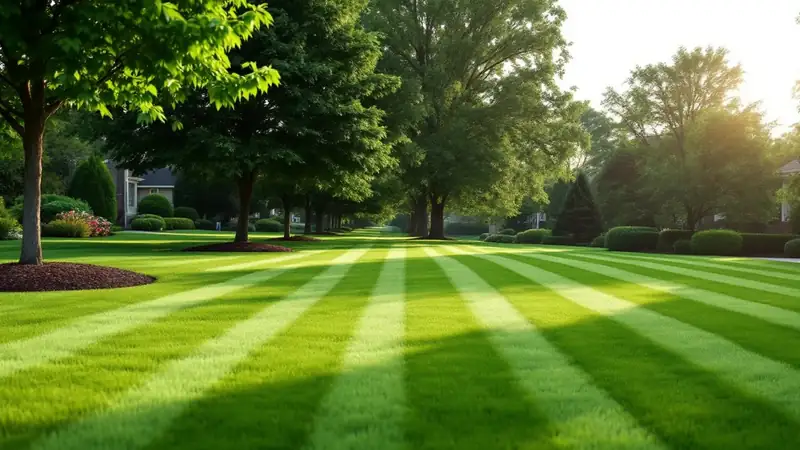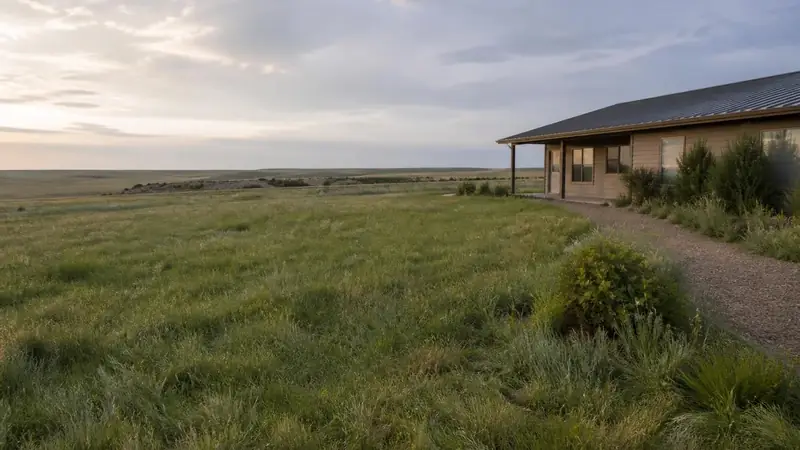
Buffalo grass is a native warm-season prairie grass for low-input, full-sun lawns on the Great Plains: mowed 2.5 to 4 inches or left unmowed, fed 2 lb nitrogen a year or less, and brown from mid-October to mid-May.
Key takeaways
- Buffalo grass (Bouteloua dactyloides) is native from western Minnesota and Montana south to Arizona and Louisiana, on clay soils that get 15 to 30 inches of rain a year (USDA NRCS plant guide).
- Its daily water use is similar to Kentucky bluegrass, but it roots 3 feet or deeper against 8 inches and stays green about 5 months instead of 8 in Nebraska, so established lawns need little irrigation (Nebraska Extension G1946).
- Seed at 1 to 2 lb of treated burs per 1,000 sq ft once soil reaches 60°F; Nebraska targets June 1 and stops after Aug. 15 in the east (G1946). Colorado State and USDA give a higher 3 to 5 lb broadcast rate (CSU 7.224).
- Mow home lawns at 2.5 to 4 inches or leave them unmowed at 4 to 8 inches, and apply no more than 2 lb of nitrogen per 1,000 sq ft a year, in June and July (K-State MF658).
- It is a poor choice with under 6 to 8 hours of direct sun, above about 6,500 feet, on sandy soil or with salinity over 6 to 8 mmhos/cm (MF658; CSU 7.224).
| Key number | Value | Source |
|---|---|---|
| Green season, Nebraska | Mid-May to mid-October (about 5 months) | UNL G1946 |
| Rooting depth | 3 ft or more (bluegrass: 8 in) | UNL G1946 |
| Seeding rate, lawn | 1 to 2 lb treated burs per 1,000 sq ft | UNL G1946; K-State MF658 |
| Soil temperature for germination | 60°F | UNL G1946 |
| Plug spacing | 12 to 18 in (Colorado); 24 in maximum (Nebraska) | CSU 7.224; UNL G1946 |
| Home-lawn mowing height | 2.5 to 4 in, or unmowed | K-State MF658; Texas A&M SCSC-PU-178 |
| Nitrogen ceiling | 2 lb per 1,000 sq ft per year | K-State MF658; UNL G1947 |
| Summer water to stay green | 1 to 2 in every 2 to 4 weeks | CSU 7.224 |
| Direct sun needed | 6 to 8 hours a day | K-State MF658 |
| Upper elevation | About 6,500 ft | CSU 7.224 |
What is buffalo grass, and where does it grow?
Buffalo grass (Bouteloua dactyloides, long sold as Buchloe dactyloides) is a warm-season, sod-forming grass native to the Great Plains. The USDA plant guide puts its range from western Minnesota to Montana, south to Arizona and east to Louisiana, mostly on clay soils that get 15 to 30 inches of rain a year (USDA NRCS Plant Guide, 2013).
It spreads by stolons that root at each node, and plants are usually one sex. Male plants send pollen spikes 3 to 8 inches above the leaves; female plants hold bur-shaped seed heads down in the canopy, and the vegetative lawn cultivars are solid stands of female plants (Nebraska Extension G1946).
What does buffalo grass look like?
A buffalo grass lawn is fine-textured and gray-green to blue-green in summer and straw to golden brown when dormant. The leaf blade is about 1/8 inch wide and 3 to 6 inches long, and unmowed plants stand 4 to 6 inches tall, per the USDA plant guide. Leaves curl downward, so an unmowed stand looks shorter than it is (Texas Parks and Wildlife).
In a seeded lawn the tell is the male flower stalk: a thin stem with 2 or 3 short, one-sided spikes standing above the turf in early summer (USDA NRCS). Kansas State lists the grass at 4 to 8 inches when left alone (K-State MF658, Nov. 2014).
| Identification feature | Buffalo grass | Source |
|---|---|---|
| Leaf blade | About 1/8 in wide, 3 to 6 in long, gray-green to blue-green, curling | USDA NRCS; TPWD |
| Height unmowed | 4 to 6 in (USDA); 4 to 8 in (Kansas) | USDA NRCS; MF658 |
| Spread | Above-ground stolons (runners) that root at the nodes | UNL G1946 |
| Male flowers | One-sided spikes on stems 3 to 8 in above the leaves | UNL G1946 |
| Female flowers | Burs partly hidden among the leaves near the ground | UNL G1946 |
| Dormant color | Straw to golden from the first hard frost to mid or late spring | CSU 7.224; TPWD |
Is Australian buffalo grass the same plant?
No. In Australia, “buffalo grass” means Stenotaphrum secundatum, the species U.S. growers call St. Augustinegrass, and Western Australia’s state herbarium lists “St. Augustine grass” as its alternative name (Florabase, WA Dept. of Biodiversity). Advice about Sir Walter or kikuyu-versus-buffalo comparisons therefore does not apply to the North American prairie grass on this page; our St. Augustine grass guide covers that plant, and the Turf & Trees section profiles the other U.S. lawn grasses.
Does buffalo grass really use less water?
Buffalo grass saves water mainly by going dormant and rooting deep, not by drinking less each day. Nebraska Extension says its evapotranspiration rate is similar to Kentucky bluegrass, but it roots 3 feet or more against 8 inches and grows for about 5 months against 8, so established Nebraska lawns need little irrigation (G1946).
Other sources state the saving more strongly. Colorado State University Extension says newer turf-type cultivars stay green on 50 to 75 percent less irrigation than Kentucky bluegrass (CSU Extension fact sheet 7.224). The USDA plant guide, summarizing Texas A&M lysimeter work, says buffalo grass showed the lowest average evapotranspiration of the warm- and cool-season turfgrasses compared, 4.8 mm (about 0.19 inch) a day (USDA NRCS, citing Kim and Beard 1988).
Both can be true. Daily use while green is in the bluegrass range in Nebraska’s measurements, and the seasonal total falls because buffalo grass is dormant from mid-October to mid-May there and pulls stored subsoil water from a deeper root zone (G1946). In a wet year the gap narrows; in a dry summer it widens, because bluegrass needs water to stay alive and buffalo grass can go brown and wait.
| Source | Summer watering advice for established buffalo grass | Region |
|---|---|---|
| Nebraska G1947 | No irrigation beyond rainfall after the establishment year in eastern and central Nebraska; some needed in the west. Most benefit from water in late July through August | Nebraska |
| K-State MF658 | A deep soak every 2 weeks in hot, dry weather; weekly in western Kansas drought only to keep color | Kansas |
| CSU 7.224 | 1 to 2 inches of rain or irrigation every 2 to 4 weeks to stay green; start in mid to late May only if spring is dry | Colorado Front Range |
| Texas Parks and Wildlife | Grows on natural rainfall over most of central, south, west and north Texas; poor on sandy, acidic east Texas soils and wet coastal sites | Texas |
| USDA NRCS plant guide | Native habitat receives 15 to 30 inches of rain a year; 1 to 2 inches every 2 to 4 weeks keeps lawns active | Great Plains |
Spring water is wasted on this grass. Nebraska says April and May irrigation will not bring buffalo grass out of dormancy and only feeds cool-season weeds, and Kansas State says spring watering benefits weeds more than the grass (G1947; MF658). Kansas State’s watering guide ranks buffalo grass as the lawn grass needing the least frequent irrigation (K-State MF2059). Our guide to the best time to water a lawn covers time of day and run times.
Trial data shows the gap is real once irrigation is cut. A Colorado State line-source trial kept acceptable quality with irrigation at 0.70 of reference evapotranspiration for Kentucky bluegrass, 0.60 for tall fescue and 0.30 for buffalo grass (Ervin, CSU, 1995). On Nebraska fairway plots, cool-season grasses needed 9.6 inches of irrigation in a season against 6.8 inches for buffalo grass, $642.32 against $455.07 an acre at Lincoln water rates (UNL Turf iNfo, Aug. 2017).
| Study | Buffalo grass | Comparison grass | Source |
|---|---|---|---|
| Texas A&M minilysimeters, Aug. 1982 | 5.3 mm/day (Texas Common) | 7.1 mm/day (Kentucky 31 tall fescue) | Kim and Beard, Crop Sci. 1988 |
| Colorado State line-source trial, 1993 to 1994 | 0.30 x reference ET | 0.70 Kentucky bluegrass; 0.60 tall fescue | Ervin, CSU, 1995 |
| UNL fairway plots, Lincoln | 6.8 in per season (60% ETo) | 9.6 in (bentgrass and bluegrass, 80% ETo) | UNL Turf iNfo, 2017 |
| UNL NebGuide | ET similar to bluegrass while green | Kentucky bluegrass | UNL G1946 |
Do water rebates cover buffalo grass lawns?
Some do, mostly in Colorado and Kansas, while Austin and two Southern California programs do not. Aurora Water’s GRIP pays $0.50 per sq ft for a water-wise grass landscape and names buffalograss as an approved grass, while Santa Monica’s Cash for Grass guide tells applicants not to install buffalo grass (Aurora Water; Santa Monica). Rules as read in October 2026:
| Program | Buffalo grass? | Rule as written | Source |
|---|---|---|---|
| Aurora Water GRIP, Colo. | Accepted | Approved warm-season grass; $0.50 per sq ft for a native or low-water grass landscape; 2026 residential manual | Program page; manual |
| City of Ellis, Kan. | Accepted | Eligible varieties include Buffalo, Bermuda and Zoysia; $1.00 per sq ft, $500 maximum per property | Turf packet, 2025 |
| City of Oakley, Kan. | Accepted | Buffalo Grass Rebate: utility credit for up to 50 percent of the cost; form requires improved varieties planted May 1 to Aug. 15 at 1.5 to 3.0 PLS lb per 1,000 sq ft | City page and form |
| Austin Water, Texas | Not now | Converting to buffalo, bermuda or zoysia is not eligible because savings are inconsistent; under review | Rebate FAQ |
| Santa Monica Cash for Grass, Calif. | Excluded | Do not install plants that look like turf grass, including buffalo grass; UC Verde listed as lawn-like | C4G guide, 9/2022 |
| SoCal Water$mart (MWD), Calif. | Excluded | Projects may not include live turf or turf-looking grasses; $2.00 per sq ft rebate | Terms and conditions |
Which buffalo grass cultivars are best for a lawn?
For a lawn in the central Plains, Legacy (plugs or sod) and Bowie (seed) led the most recent national trial; in north Texas, Density and 609 did best. In the 2002 National Buffalograss Test, rated 2003 to 2006 at nine sites, Bowie averaged 5.3 on a 1 to 9 scale and Legacy, Density and SWI-2000 5.1 (NTEP report 07-12).
Location changes the ranking more than the national average suggests. At Mead, Nebraska, Legacy scored 6.7 and Density 4.1; at Dallas, Density scored 5.9 and Legacy 4.8 (NTEP Table 3A; NTEP Table 2A). A gap of 0.4 or more in the all-site mean, or 0.5 to 0.7 at a single site, is statistically significant.
| Entry | Type | Quality, 9 sites | Quality, Mead NE | Quality, Dallas TX | Genetic color | Spring green-up | October color |
|---|---|---|---|---|---|---|---|
| Bowie | Seeded | 5.3 | 6.0 | 4.8 | 6.5 | 5.2 | 3.5 |
| Legacy | Vegetative | 5.1 | 6.7 | 4.8 | 7.2 | 4.9 | 3.6 |
| Density | Vegetative | 5.1 | 4.1 | 5.9 | 5.4 | 4.1 | 5.3 |
| SWI-2000 | Seeded | 5.1 | 5.8 | 4.8 | 6.5 | 5.0 | 3.5 |
| 378 | Vegetative | 5.0 | 6.3 | 4.6 | 6.9 | 4.6 | 3.1 |
| Bison | Seeded | 4.9 | 5.1 | 4.6 | 7.0 | 5.3 | 4.3 |
| NE 95-55 (experimental) | Vegetative | 4.9 | 6.4 | 4.6 | 7.2 | 5.3 | 3.7 |
| Tech Turf 1 (Frontier Turfallo) | Seeded | 4.7 | 3.1 | 4.6 | 5.5 | 3.7 | 5.0 |
| Texoka | Seeded | 4.5 | 4.8 | 4.5 | 6.4 | 5.0 | 4.1 |
| 609 | Vegetative | 4.4 | 4.1 | 5.2 | 6.7 | 4.3 | 5.6 |
| LSD (0.05) | 0.4 | 0.7 | 0.5 | 0.4 | 0.6 | 0.7 |
Prestige, UC Verde and Sundancer were never entered in an NTEP national test under those names, so no trial score exists to compare them with the table above (NTEP). For those three, the breeders’ and extension descriptions in the next table are the only primary record.
| Cultivar | How sold | Origin and release | Distinctive trait | Source |
|---|---|---|---|---|
| Legacy | Plugs or sod (female) | UNL, released 1997; Plant Patent PP11,194 | Darker, nearly blue-gray-green; top quality at Mead, Neb. | UNL Lancaster; PP11,194 |
| Prestige | Plugs or sod (female) | UNL, released 1997, on the market since 2003 | Earlier spring green-up, longer fall color, chinch bug resistance | UNL Lancaster |
| 609 | Plugs or sod (female) | UNL line NE 84-609; Plant Patent PP8,475 (1993) | May suffer winterkill in northern Colorado | PP8,475; CSU |
| Density | Plugs or sod (female) | Private selection from a Houston-area roadside; PP17,356 (2007) | Higher tiller density; best at Dallas | PP17,356; NTEP |
| UC Verde | Plugs only (diploid female) | UC Davis and UC Riverside breeding program | Fine stolons, short height; sold for zones 8b to 13b | UC Riverside; UC Verde seller |
| Cody | Seed | UNL, released 1995 | Benchmark seeded cultivar, good density and drought tolerance | UNL Lancaster |
| Bowie | Seed | UNL, released 2001 | Medium green, fine texture, early spring green-up | UNL Lancaster; NTEP |
| SWI-2000 | Seed | UNL release, 2006 | Similar to Bowie with higher seed yield | USGA Green Section Record, Feb. 2008 |
| Sundancer | Seed | UNL, released 2014 | Faster establishment, darker color, better density than other seeded entries | UNL, Fall 2014; UNL Lancaster |
| Texoka | Seed | Oklahoma, Kansas and Texas stations with USDA; 1970s | Thinner turf; lowest seeded quality in NTEP 2002 (4.5) | TPWD; NTEP |
Nebraska Extension’s short list for that state is Cody, Bowie and SWI-2000 from seed and Legacy and Prestige as plugs or sod (G1946). Colorado State says Texoka and Sharp’s Improved make a lesser-quality lawn and that the vegetative cultivars make the best one, at a higher price (CSU Extension).
Is UC Verde buffalo grass worth it in California?
UC Verde is the buffalo grass bred for California: a diploid female cultivar from the UC Davis and UC Riverside program, sold as plugs only, which UC Riverside researchers call expensive and slow to establish (UC Riverside). The seller lists 128-plug trays at $102.40, covering 128 sq ft at 12-inch spacing, for zones 8b to 13b (ucverde.com, Oct. 2026).
Check rebate rules before planting it to replace a lawn. The seller page claims up to 75 percent less water than traditional turf, but Santa Monica’s Cash for Grass guide lists UC Verde as a lawn-like plant that does not qualify, and the regional SoCal Water$mart program excludes turf-looking grasses (Santa Monica C4G guide, 9/2022; SoCal Water$mart terms).
Which buffalo grass grows best in Texas?
In north Texas trial plots, the vegetative cultivars Density (5.9) and 609 (5.2) beat every seeded entry, while Bowie, SWI-2000 and Legacy scored 4.8 at Dallas (NTEP Table 2A, 2003 to 2006). Texas Parks and Wildlife says buffalo grass grows on natural rainfall across central, south, west and north Texas but not on the sandy, acidic soils of east Texas or wet coastal sites (TPWD).
Should you plant buffalo grass seed, plugs or sod?
Seed is the cheapest way to start a buffalo grass lawn, at about $29 to $105 of seed per 1,000 sq ft in October 2026, but needs a full season. Plugs on 12-inch centers cost about $820 to $1,050 per 1,000 sq ft and can close in 6 to 12 weeks; sod gives instant cover at $0.85 per sq ft picked up in Nebraska.
| Seller (checked Oct. 19, 2026) | Product | Package and price | Unit price |
|---|---|---|---|
| Native American Seed | Buffalograss seed (cultivar not named) | 5 lb, $145.00 | $29.00 per lb |
| Stock Seed Farms | Cody seed | 3 lb, $109.50 | $36.50 per lb |
| Hancock Seed | Buffalograss seed (burs) | 25 lb, $899.99 | $36.00 per lb |
| Sharp Bros. Seed | Sharp’s Improved II seed | 4 lb, $209.00 | $52.25 per lb |
| Todd Valley Farms | Legacy, Prestige or UC Verde plugs | 70-cell tray, $69.95 | $1.00 per plug |
| High Country Gardens | Legacy, UC Verde or Prestige plugs | Tray of 70, $69.99 | $1.00 per plug |
| Sod Solutions | Legacy plugs | 72-count tray, $64.99 | $0.90 per plug |
| UC Verde | UC Verde plugs | 128-count tray, $102.40 | $0.80 per plug |
| Todd Valley Farms, Mead, Neb. | Buffalograss sod, picked up | $1.00 (under 350 sq ft) to $0.55 (8,000+ sq ft) | Per sq ft, 2026 list |
| Todd Valley Farms, Mead, Neb. | Buffalograss sod, installed | $2,400 flat under 2,500 sq ft; $0.96 to $0.66 per sq ft above | Per sq ft, 2026 list |
Sellers recommend more seed than the universities do. Native American Seed says 1 lb covers 300 sq ft, about 3.3 lb per 1,000, and Sharp Bros. says 4 lb per 1,000 for turf in the first year, against 1 to 2 lb from Nebraska and Kansas State (Native American Seed; Sharp Bros.; MF658). Our grass seed cost guide compares buffalograss with other species per pound.
| Worked example: 5,000 sq ft lawn | Inputs | Material cost |
|---|---|---|
| Seed, 1 lb per 1,000 sq ft (full turf in about 1.5 years) | 5 lb at $29.00 | $145 |
| Seed, 2 lb per 1,000 sq ft (one season) | 10 lb at $29.00 | $290 |
| Plugs, 18-inch centers (0.44 plugs per sq ft) | 2,222 plugs = 32 trays of 70 at $69.95 | $2,238 |
| Plugs, 12-inch centers (1 plug per sq ft) | 5,000 plugs = 72 trays of 70 at $69.95 | $5,036 |
| Sod, picked up (4,000 to 5,999 sq ft tier) | 5,000 sq ft at $0.65 | $3,250 plus delivery |
| Sod, installed by the farm | 5,000 sq ft at $0.81 | $4,050 |
The time cost runs the other way. Seed at 1 lb per 1,000 sq ft takes about 1.5 years to close (MF658); pre-rooted plugs on 12 to 18 inch centers can close in 6 to 12 weeks (CSU 7.224); sod is instant but may stay brown for 1 to 2 weeks. For labor and site-prep costs on a sodded lawn, see our sod installation cost guide, and for the general trade-offs, sod vs. seed.
How much buffalo grass seed per 1,000 sq ft?
Use 1 to 2 lb of treated buffalo grass burs per 1,000 sq ft for a lawn, the rate Nebraska and Kansas State give, and expect a full stand in one season at 1.5 to 2 lb (G1946; MF658). Colorado State and the USDA plant guide give 3 to 5 lb when broadcast, so the published range spans 1 to 5 lb.
| Source | Lawn seeding rate (lb per 1,000 sq ft) | Emergence | Soil temperature to start |
|---|---|---|---|
| Nebraska G1946 (2009) | 1 to 2 lb burs (trials: 1 to 3) | 5 to 10 days, treated seed | 60°F |
| K-State MF658 (2014) | 1 to 2 (1.5 to 2 for one season) | About 1 week in mid-June; 2 to 3 weeks in early spring | Plant late spring to early summer |
| Stock Seed Farms guide | 2 to 3 (70 to 105 seeds per sq ft) | 10 to 21 days | 55°F |
| CSU 7.224 | 3 to 5 | 7 to 21 days | Above 55°F |
| USDA NRCS plant guide (2013) | 3 to 5, broadcast | 7 to 21 days | Not stated |
| UC IPM (California) | Not stated | 14 to 30 days | Not stated |
Kansas State’s cost argument is worth running: at 1 to 2 lb per 1,000 sq ft, buffalo grass seed costs about the same per lawn as turf-type tall fescue sown at 6 to 8 lb, even though buffalo grass costs far more per pound (MF658). In the federal germination test, buffalo grass burs get a first count at 7 days and a final count at 14 days at alternating 68°F and 95°F (7 CFR 201.58).
How do you plant a buffalo grass lawn from seed?
Plant buffalo grass seed in late spring or early summer once soil reaches 60°F, at 1 to 2 lb of treated burs per 1,000 sq ft and 1/4 to 1/2 inch deep, then keep the surface damp for the first few weeks. Nebraska targets June 1 and stops seeding after Aug. 15 in the east of the state (G1946).
- Kill the existing lawn. Buffalo grass cannot be overseeded into actively growing bluegrass or fescue; strip it with a sod cutter or spray glyphosate (G1946). Stock Seed Farms uses two glyphosate applications 14 days apart, then prepares the seedbed 7 days after the second (Stock Seed).
- Loosen compacted ground. On sites packed by vehicles or traffic, Nebraska recommends chiseling or deep tilling 18 to 24 inches to promote deep roots (G1946).
- Firm the seedbed. It should be firm enough that your foot sinks no more than 1/2 inch; roll or water it to settle (G1946). Without a soil test, work in a starter fertilizer at 1 lb N per 1,000 sq ft.
- Wait for warm soil. Seed will not germinate below 60°F soil, usually after May 15 in eastern Nebraska and May 31 in the west (G1946). Kansas State prefers June and July on irrigated sites, or April and May where you rely on rain (MF658).
- Buy treated seed. Kansas State says treated (chilled or chemically treated) burs germinate faster and more evenly, and to check the label for the treatment method (MF658).
- Sow 1 to 2 lb of burs per 1,000 sq ft. Kansas State says 1.5 to 2 lb gives a full turf in one season and 1 lb takes about 1.5 years (MF658). Rake in both directions and roll.
- Plant 1/4 inch deep with irrigation, up to 1/2 inch where moisture is short (MF658). Nebraska’s drill limit is 3/4 inch (G1946).
- Water lightly and often at first: 1/4 to 1/2 inch after planting, then just enough to keep the surface damp, often more than once a day (G1946). Stock Seed’s schedule is daily in week 1, every other day in week 2 and every third day in week 3 (Stock Seed).
- Expect seedlings in 5 to 10 days from treated seed in Nebraska, about a week from mid-June plantings in Kansas, and 2 to 3 weeks from early-spring plantings (G1946; MF658).
- Mow weeds that top the seedlings at 2 to 3 inches, and hand-weed small areas (G1946). Colorado State says not to use a crabgrass preventer at seeding (CSU 7.224); Stock Seed allows Barricade 60 days and Pendulum 90 days after spring seeding (Stock Seed).
Do not seed late or dormant. Nebraska says unirrigated fall seeding usually fails because seedlings are killed by frost and winter drying, and that dormant seeding is rarely successful (G1946). Stock Seed’s rule of thumb is no planting within 75 days of your average first frost (Stock Seed). Germination timing by grass is compared in our grass seed germination guide.
How do you plant buffalo grass plugs?
Set buffalo grass plugs 12 to 18 inches apart after the last spring frost and at least 6 weeks before the first fall frost, per Colorado State, which says pre-rooted plugs can give full cover in 6 to 12 weeks (CSU 7.224). Nebraska’s limit is 24 inches on center, and 12 inches or less for a full stand in the first season (G1946).
Colorado State’s watering routine for new plugs is 3 to 5 short cycles a day, every 2 to 4 hours from 8 or 9 a.m., for 7 to 10 days, with starter fertilizer at planting and again 6 to 7 weeks later (CSU 7.224). Plugs often turn brown after planting, and sod can stay brown for 1 to 2 weeks while new roots form; if the soil has stayed moist, neither is dead.
How tall should you mow buffalo grass, or can you leave it unmowed?
Mow a buffalo grass lawn at 2.5 to 4 inches, or leave it unmowed at its natural 4 to 6 inches. Kansas State gives 2.5 to 4 inches for home lawns and 4 inches or more for low-maintenance grounds (MF658); Nebraska’s 2012 calendar says 3 to 4 inches all season (G2178); Texas A&M allows 2 inches to unmowed (SCSC-PU-178).
| Source (year) | Home lawn height | Other settings | Frequency note |
|---|---|---|---|
| Nebraska G1947 (2009) | 2.5 in | 0.5 to 1 in for golf fairways, improved cultivars only | Every 3 to 4 weeks in late spring and early fall; every 2 to 3 weeks in summer |
| Nebraska G2178 (2012) | 3.0 to 4.0 in | Same height all year | As needed; remove no more than 1/3 of the blade |
| K-State MF658 (2014) | 2.5 to 4 in | 1 in fairways; 4 in or more for parks; natural areas only a spring clean-up | Shorter turf needs more frequent mowing |
| Texas A&M SCSC-PU-178 (2022) | 2 in to unmowed (rotary) | 2 in minimum with a reel mower | Keep to the higher end where possible |
| Stock Seed Farms guide | 1.5 to 4 in | Mature height 4 to 6 in | Once a year to every 2 weeks |
The 2.5 inch figure in Nebraska’s 2009 NebGuide and the 3 to 4 inch range in its 2012 calendar come from the same university; the newer calendar, written by a different author team, is the one to follow in the Plains (G2178). Every source keeps the one-third rule: never cut more than a third of the leaf at one mowing (G1947).
What does an unmowed buffalo grass lawn look like?
An unmowed buffalo grass lawn is a soft, uneven mat 4 to 6 inches tall that lies over rather than standing upright. In seeded lawns, male flower stalks rise 3 to 8 inches above the leaves through summer, which is why Nebraska suggests a 3 to 4 inch cut to remove them, or leaving them and adding spring bulbs and wildflowers for a prairie look (G1946; G1947).
Female vegetative cultivars hold their seed heads inside the canopy, so they need less mowing to look even (G1947). Kansas State recommends only a spring clean-up mowing in natural areas and says not to burn dead foliage, which some city ordinances regulate or prohibit (MF658). Texas A&M’s mowing table lists natural areas as unmowed (SCSC-PU-178).
How much fertilizer does a buffalo grass lawn need?
An established buffalo grass lawn needs 0 to 2 lb of nitrogen per 1,000 sq ft a year, applied in June and July. Kansas State calls 1 lb about right and 2 lb the maximum (MF658); Nebraska says not to exceed 2 lb (G1947). Feeding earlier, or more, grows weeds rather than grass.
| Source | Nitrogen per 1,000 sq ft per year | Timing |
|---|---|---|
| K-State MF658 | 0 to 3/4 lb low maintenance; 1 lb average; 2 lb high (maximum) | June after stolon growth starts; second dose mid-July if needed; split anything over 1 lb |
| Nebraska G1947 | 1/2 to 1 lb per application for low to medium maintenance; never over 2 lb a year | June 15 to July 15, split a month apart; quick-release urea responds better |
| Nebraska G2178 | 0.75 to 1.0 lb per application, two applications | April 15 to May 1 (with preemergence) or June, plus July; 25 to 50 percent slow-release N |
| CSU 7.224 | 1 lb late May to mid-June and 1 lb late July (little gain above 2 lb) | Iron for chlorosis on high-pH soils |
| USDA NRCS plant guide | 1 to 2 lb in late spring plus a July application; over 2 lb does not help | With excess water, more N increases weeds |
The two Nebraska documents disagree on fertilizer type: the 2009 NebGuide favors quick-release sources such as urea, while the 2012 calendar asks for products with 25 to 50 percent slow-release nitrogen, and Kansas State recommends controlled release (G1947; G2178; MF658). Kansas State also warns against routine 10-10-10 or 13-13-13, because surplus phosphorus favors broadleaf weeds.
| Worked example: 5,000 sq ft lawn, 1 lb N per 1,000 sq ft | Value |
|---|---|
| Nitrogen needed (5 x 1 lb) | 5 lb N |
| Product: 46-0-0 urea (46% N) | 5 / 0.46 = 10.9 lb of product |
| Product: 30-0-10 lawn fertilizer (30% N) | 5 / 0.30 = 16.7 lb of product |
| K-State annual ceiling (2 lb x 5) | 10 lb N a year, in two June/July doses |
What are the downsides of buffalo grass?
The downsides of buffalo grass are a long brown season, poor shade and traffic tolerance, slow and weedy establishment, and limits on soil and elevation. Nebraska’s lawns are green only from about mid-May to mid-October (G1946), and Colorado State says the grass is a poor choice above roughly 6,500 feet (CSU 7.224).
| Limit | Threshold | Source |
|---|---|---|
| Shade | Needs 6 to 8 hours of direct sun (Kansas); fails with more than half a day of heavy shade (Colorado) | K-State MF658; CSU 7.224 |
| Elevation | Poor above about 6,500 ft; 6,500 to 7,000 ft only on sunny south or west exposures | CSU 7.224 |
| Salinity | Not suited above 6 to 8 mmhos/cm | CSU 7.224 |
| Soil | Not for sandy, wet or poorly drained soils; best on clay and loam | K-State MF658 |
| Traffic | Not for small lawns or fields with traffic that is both concentrated and constant | CSU 7.224 |
| Green season | About 5 months (mid-May to mid-Oct.) vs about 8 for Kentucky bluegrass in Nebraska | Nebraska G1946 |
| Herbicide injury | No 2,4-D products above 75°F (Nebraska) or 85°F (Kansas) | G1947; MF658 |
Why do weeds take over buffalo grass?
Weeds win when buffalo grass is managed like bluegrass. Kansas State lists four causes: light, frequent watering; early-season fertilizer and water; very short mowing; and excess fertilizer (MF658). Colorado State adds that unirrigated buffalo grass goes dormant most summers and is prone to weed invasion while brown (CSU 7.224).
Nebraska lists Dimension (dithiopyr), Barricade (prodiamine) and Pendulum (pendimethalin) as labeled for buffalo grass, with spring preemergence at 55°F soil temperature, and quinclorac (Drive) for crabgrass after emergence (G1947). Glyphosate goes on only when the lawn is fully dormant: Nebraska says no spraying from Feb. 15 until two weeks after the first 25°F freeze (G1947). Our crabgrass guide covers preemergence timing in more detail.
Herbicide labels are legal documents: confirm that buffalograss is listed on the label of the exact product before you apply it, and follow its rate and temperature limits. This page is general information, not pesticide-application advice.
Is buffalo grass better than bermuda grass or blue grama?
Buffalo grass beats bermuda grass on water and nitrogen where rainfall is 15 to 30 inches a year, and bermuda beats it on traffic tolerance and recovery. In a Texas trial summarized by USDA, buffalo grass survived at 85 to 98 percent after 3 years against 5 to 35 percent for bermudagrass (USDA NRCS). Blue grama is the fallback for higher, sandier sites.
| Trait | Buffalo grass | Blue grama | Bermuda grass (common) | Source |
|---|---|---|---|---|
| Growth habit | Sod-forming, stolons | Usually a bunchgrass; forms sod under heavy grazing in the north | Stolons and rhizomes; invades beds | UNL G1946; USDA BOGR2 guide; UF/IFAS LH007 |
| Unmowed height | 4 to 6 in | 6 to 24 in | Not grown unmowed as a lawn | USDA BODA2; USDA BOGR2 |
| Lawn mowing height | 2.5 to 4 in (K-State); 2 in to unmowed (Texas) | Low-maintenance turf such as golf roughs | 1.5 to 4 in rotary | MF658; SCSC-PU-178; USDA BOGR2 |
| Elevation | Poor above about 6,500 ft | 3,500 to 7,000 ft in New Mexico; reported at 10,000 ft | n/a | CSU 7.224; USDA BOGR2 |
| Soil | Clay and loam; not sandy | Sandy to clayey, less vigor on true sands or clays | n/a | MF658; USDA BOGR2 |
| Seeds per pound | About 50,000 | 700,000 to 800,000 | n/a | USDA BODA2; USDA BOGR2 |
| Wear tolerance | Poor where traffic is both concentrated and constant | n/a | Excellent wear, drought and salt tolerance | CSU 7.224; UF/IFAS LH007 |
| Water use | Lower ET than common bermudagrass under the same conditions | Drought tolerant | Higher ET than buffalo grass | USDA BODA2, citing Beard and Kim 1989 |
| 3-year survival, Texas native vs non-native trial | 85 to 98% | n/a | 5 to 35% | USDA BODA2, citing McAfee and Leps 2001 |
Nebraska notes that blue grama is sometimes mixed into buffalo grass, and that its seed stalks add interest in an unmowed native setting (G1946). The full bermuda profile, including cultivar trial scores, is in our bermuda grass guide; for shady or cooler lawns, compare zoysia grass and tall fescue.
Should you plant a buffalo grass lawn?
Plant buffalo grass if the lawn gets 6 to 8 hours of direct sun, sits below about 6,500 feet on clay or loam, and you accept a brown lawn from October to May. Skip it for shade, sand, salty soil or daily concentrated traffic, per Kansas State and Colorado State (MF658; CSU 7.224).
| If your situation is | Do this | Why (source) |
|---|---|---|
| Under 6 hours of direct sun | Choose a shade-tolerant grass such as tall fescue or zoysia | K-State asks for 6 to 8 hours (MF658) |
| Above about 6,500 ft | Use blue grama or a cool-season lawn | CSU 7.224; blue grama grows to 7,000 ft and beyond (USDA) |
| Sandy soil or soil salinity over 6 to 8 mmhos/cm | Do not plant buffalo grass | MF658; CSU 7.224 |
| Small lawn with constant, concentrated foot traffic | Bermuda grass handles wear better | CSU lists this as a poor buffalo grass site (CSU 7.224); UF/IFAS rates bermuda wear tolerance excellent (LH007) |
| You need full cover this season | Lay sod, or plant pre-rooted plugs 12 inches apart or closer by June | G1946; CSU 7.224 |
| Large area, lowest material cost | Seed 1.5 to 2 lb of treated burs per 1,000 sq ft in June | One-season stand per MF658 |
| You want an even, mowed look with no seed stalks | Plant a female vegetative cultivar (plugs or sod) | G1947 |
| Rainfall under 15 in a year with no irrigation | Expect summer dormancy; budget 1 to 2 in of water every 2 to 4 weeks to keep it green | USDA; CSU 7.224 |
1Does the lawn get less than 6 hours of direct sun?
YesPlant a shade-tolerant grass instead (K-State MF658).
NoGo to the next question
2Is the site above about 6,500 feet?
YesUse blue grama or a cool-season grass (CSU 7.224; USDA).
NoGo to the next question
3Is the soil sandy, poorly drained or salty (over 6 to 8 mmhos/cm)?
YesDo not plant buffalo grass (K-State MF658; CSU 7.224).
NoGo to the next question
4Will the lawn take constant, concentrated traffic?
YesPlant bermuda grass for wear tolerance (CSU 7.224).
NoGo to the next question
5Do you need full cover this season?
YesLay sod, or plant pre-rooted plugs 12 inches apart or closer by June (UNL G1946).
NoGo to the next question
6Do you want no seed stalks and a mowed look?
YesPlant a female vegetative cultivar from plugs or sod (UNL G1947).
NoSeed 1.5 to 2 lb of treated burs per 1,000 sq ft in June once soil reaches 60°F (K-State MF658; UNL G1946).
Source: K-State MF658; CSU Extension 7.224; Nebraska Extension G1946 and G1947; USDA NRCS plant guides
Which buffalo grass claims don’t match the extension sources?
Eight common buffalo grass claims need a qualifier when checked against land-grant publications: the water saving, the establishment water, the seeding rate, the sun requirement, the no-mow promise, pest-free status, fertilizer response and spring watering. Nebraska, for example, measures daily water use similar to bluegrass, while Colorado State reports 50 to 75 percent less irrigation (G1946; CSU 7.224).
| Claim | What the primary source says | Source |
|---|---|---|
| “Buffalo grass uses a fraction of the water bluegrass uses” | Daily evapotranspiration is similar to bluegrass; the saving comes from 3 ft roots and a 5-month season | Nebraska G1946 |
| “It barely needs water to get started” | Establishment takes as much water as bluegrass or tall fescue, occasionally more | CSU 7.224 |
| “Sow 3 to 5 lb per 1,000 sq ft” | Colorado and USDA say 3 to 5 lb broadcast; Nebraska and Kansas say 1 to 2 lb of treated burs | CSU; USDA; G1946; MF658 |
| “4 to 6 hours of sun is enough” | Texas Parks and Wildlife says 4 to 6 hours; Kansas State says 6 to 8 hours of direct sun | TPWD; MF658 |
| “You never have to mow it” | Seeded lawns grow male flower stalks 3 to 8 in above the leaves; mow at 3 to 4 in to remove them, or accept the prairie look | G1946; G1947 |
| “No natural diseases or pests” (Native American Seed product page) | Nebraska names a grass mealybug, buffalograss webworm and buffalograss chinch bug as the most serious pests, and Bipolaris leaf spot as the most problematic disease | Nebraska G1947 |
| “Does not respond to fertilizer” (same page) | Color and growth improve with fertilizer, with little gain above 2 lb N per 1,000 sq ft a season | CSU 7.224 |
| “Water in spring to green it up” | April and May water does not break dormancy and grows cool-season weeds | Nebraska G1947 |
How we compiled this
We compiled this page in October 2026 from 43 documents: 26 university, USDA, federal, state and trial sources (extension publications from Nebraska, Kansas State, Colorado State, Texas A&M, UF/IFAS and UC IPM, two USDA NRCS plant guides, the NTEP 2002 buffalograss test and its data tables, three plant patents and six breeding or water-use reports), 7 municipal rebate documents and 10 seller pages or price lists checked on Oct. 19, 2026. We did not grow, test or price any grass ourselves. Seed, plug and sod totals are our arithmetic from the posted prices, shown in the worked table; seller claims are labeled as such and checked against the university sources.
Frequently asked questions
Is buffalo grass good for a lawn?
Buffalo grass is good for a sunny, low-traffic lawn on clay or loam in the Plains and Southwest, below about 6,500 feet. It needs 2 lb of nitrogen a year or less and little summer water, but it is brown from mid-October to mid-May in Nebraska and fails in shade or sand (Nebraska G1946; CSU 7.224).
Is buffalo grass better than Bermuda grass?
Buffalo grass is better for low water and low nitrogen: USDA reports 85 to 98 percent survival after 3 years in a Texas trial against 5 to 35 percent for bermudagrass (USDA NRCS). Bermuda is better for heavy traffic and fast recovery; UF/IFAS rates its wear tolerance excellent (UF/IFAS LH007).
Which is better, kikuyu or buffalo grass?
That comparison is Australian, and the Australian “buffalo grass” is Stenotaphrum secundatum, which Americans call St. Augustinegrass (Florabase). The North American buffalo grass, Bouteloua dactyloides, is a different plant, a native of the Great Plains with different care rules, covered on this page; our St. Augustine guide covers the Australian one.
Does buffalo grass come back every year?
Yes. Buffalo grass is a perennial that goes dormant after the first fall freeze and greens up again in spring, around mid-May in Nebraska, several weeks after bluegrass and tall fescue (G1946; K-State MF658). Watering in April does not wake it sooner (G1947).
Does buffalo grass spread quickly?
Buffalo grass spreads by stolons, but not as aggressively as bermudagrass, per Kansas State (MF658). Pre-rooted plugs on 12 to 18 inch centers can close in 6 to 12 weeks in Colorado (CSU 7.224), and seed sown at 1 lb per 1,000 sq ft takes about 1.5 years to form a solid turf (MF658).
Why is buffalo grass seed so expensive?
The seed forms in hard burs held low in the canopy, which makes it slow to harvest, and the bur slows germination unless it is chilled or chemically treated. USDA reports dryland seed yields of about 216 lb per acre in eastern Kansas and 300 to 1,000 lb under irrigation (USDA NRCS plant guide); our grass seed cost guide lists current bag prices.
Sources
- University of Nebraska-Lincoln Extension, G1946, Establishing Buffalograss Turf in Nebraska, May 2009. Accessed October 2026.
- University of Nebraska-Lincoln Extension, G1947, Management of Buffalograss Turf in Nebraska, 2009. Accessed October 2026.
- University of Nebraska-Lincoln Extension, G2178, Buffalograss Management Calendar, August 2012. Accessed October 2026.
- Colorado State University Extension, Fact sheet 7.224, Buffalograss Lawns, Current online edition. Accessed October 2026.
- K-State Research and Extension, MF658, Buffalograss Lawns, November 2014. Accessed October 2026.
- K-State Research and Extension, MF2059, Watering Your Lawn, Current PDF. Accessed October 2026.
- USDA Natural Resources Conservation Service, Plant Guide: Buffalograss, Bouteloua dactyloides (BODA2), September 2013. Accessed October 2026.
- USDA Natural Resources Conservation Service, Plant Guide: Blue Grama, Bouteloua gracilis (BOGR2), Edited June 2007. Accessed October 2026.
- Texas A&M AgriLife Extension, SCSC-PU-178, Mowing Recommendations for Warm-Season Turfgrass Lawns, May 2022. Accessed October 2026.
- Texas Parks and Wildlife Department, Wildscapes: Buffalograss, Current web page. Accessed October 2026.
- UF/IFAS Extension, LH007, Bermudagrass for Florida Lawns, Current EDIS edition. Accessed October 2026.
- UC Statewide IPM Program, UC Guide to Healthy Lawns: Seed germination rates, Current web page. Accessed October 2026.
- Electronic Code of Federal Regulations, 7 CFR 201.58, Substrata, temperature, duration of test, Current as of October 2026. Accessed October 2026.
- Stock Seed Farms, Establishment and Management Guide for Buffalograss, Current web page. Accessed October 2026.
- Native American Seed, Buffalograss (product page), Page as of October 2026. Accessed October 2026.
- Western Australian Herbarium, Florabase, Stenotaphrum secundatum (Walter) Kuntze, Buffalo Grass, Current profile. Accessed October 2026.
- National Turfgrass Evaluation Program (NTEP), 2002 National Buffalograss Test, final report NTEP No. 07-12 (2003 to 2006 data), 2007. Accessed October 2026.
- NTEP, Appendix table: turfgrass quality summary, 2002 buffalograss test, 2003 to 2006 data. Accessed October 2026.
- NTEP, Table 2A, quality by month at Dallas, Texas, 2003 to 2006 data. Accessed October 2026.
- NTEP, Table 3A, quality by month at Mead, Nebraska, 2003 to 2006 data. Accessed October 2026.
- NTEP, Table 6A, genetic color ratings, 2003 to 2006 data. Accessed October 2026.
- NTEP, Table 7A, spring green-up ratings, 2003 to 2006 data. Accessed October 2026.
- NTEP, Table 17A, fall color (October) ratings, 2003 to 2006 data. Accessed October 2026.
- Nebraska Extension in Lancaster County, Buffalograss Selection and Establishment, May 28, 2024. Accessed October 2026.
- U.S. Patent and Trademark Office via Google Patents, Plant Patent PP11,194, buffalograss ‘NE86-61’ (Legacy), Granted Feb. 1, 2000. Accessed October 2026.
- U.S. Patent and Trademark Office via Google Patents, Plant Patent PP8,475, buffalograss ‘609’, Granted Nov. 23, 1993. Accessed October 2026.
- U.S. Patent and Trademark Office via Google Patents, Plant Patent PP17,356, buffalograss ‘Density’, Granted Jan. 16, 2007. Accessed October 2026.
- USGA Green Section Record (Shearman), Buffalograss breeding at UNL, with release table, February 2008. Accessed October 2026.
- UNL Center for Grassland Studies (Amundsen), The Next Generation of Buffalograss Cultivars (Sundancer), Fall 2014. Accessed October 2026.
- UC Riverside Turfgrass Research, UC Verde buffalograss establishment and traffic study, Current PDF. Accessed October 2026.
- Colorado State University Extension, Best Turf Varieties for Colorado, Current online edition. Accessed October 2026.
- Colorado State University (Ervin), M.S. thesis: irrigation requirements of Kentucky bluegrass, tall fescue and buffalograss, Spring 1995. Accessed October 2026.
- Crop Science (Kim and Beard), hosted by UNL, Comparative Turfgrass Evapotranspiration Rates and Associated Plant Morphological Characteristics, 1988. Accessed October 2026.
- UNL Turfgrass Science, Turf iNfo: buffalograss irrigation savings, Aug. 10, 2017. Accessed October 2026.
- UC Verde (seller), UC Verde plugs, 128 count (product and price page), Price checked Oct. 19, 2026. Accessed October 2026.
- Todd Valley Farms, 2026 Retail Sod Price List, Effective February 2026. Accessed October 2026.
- Todd Valley Farms, Online store: buffalograss plug trays, Price checked Oct. 19, 2026. Accessed October 2026.
- High Country Gardens, Buffalo grass plugs (collection and price page), Price checked Oct. 19, 2026. Accessed October 2026.
- Sod Solutions, Legacy Buffalo Grass Plugs (product and price page), Price checked Oct. 19, 2026. Accessed October 2026.
- Stock Seed Farms, Cody Buffalograss (product and price page), Price checked Oct. 19, 2026. Accessed October 2026.
- Sharp Bros. Seed, Sharp’s Improved II Buffalograss (product and price page), Price checked Oct. 19, 2026. Accessed October 2026.
- Hancock Seed, Buffalograss Seed (product and price page), Price checked Oct. 19, 2026. Accessed October 2026.
- City of Aurora, Aurora Water, Grass Replacement Incentive Program (GRIP), 2026 program. Accessed October 2026.
- City of Aurora, Aurora Water, GRIP Residential Manual 2026, 2026. Accessed October 2026.
- City of Ellis, Kansas, Turf and/or Xeriscaping Rebate Program packet, June 2025. Accessed October 2026.
- City of Oakley, Kansas, Rebate and Reimbursement Programs (Buffalo Grass Rebate), Form updated Sept. 19, 2023. Accessed October 2026.
- Austin Water, WaterWise Landscaping Rebate FAQs, Current web page. Accessed October 2026.
- City of Santa Monica, Cash for Grass Rebate Program guide, September 2022. Accessed October 2026.
- Metropolitan Water District, SoCal Water$mart, Turf Replacement Terms and Conditions, Current web page. Accessed October 2026.