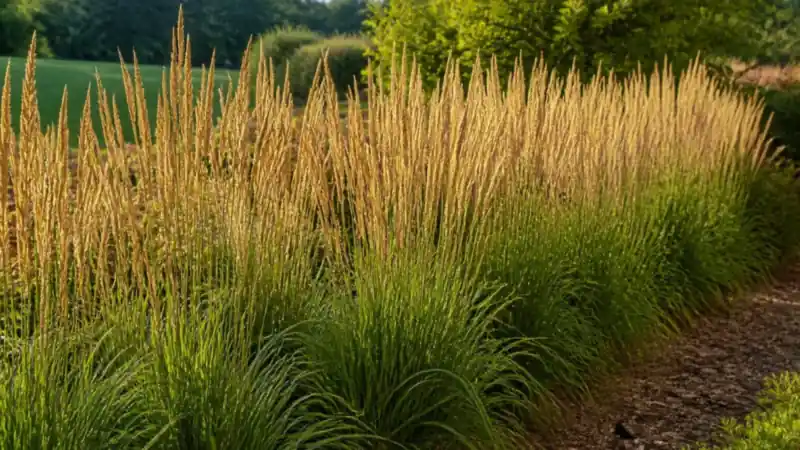
Karl Foerster grass (Calamagrostis x acutiflora ‘Karl Foerster’) is a seed-sterile, cool-season feather reed grass: 5 to 6 ft tall in bloom, 2 to 3 ft wide, reliable in USDA zones 4 to 7, cut back every late winter.
Key takeaways
- In Chicago Botanic Garden’s zone 5b trial (minimum four years), ‘Karl Foerster’ measured 66 in tall and 40 in wide and earned its top four-star rating (CBG, Fine Gardening, Oct. 2023).
- Zone listings run from 3 (UW-Madison Extension) to 11 (Proven Winners); the North Carolina grower Hoffman Nursery lists 4 to 7, and Walters Gardens lists 4 to 8.
- The hybrid “rarely sets fertile seed” (CBG), and Missouri Botanical Garden calls its seed sterile, so it does not reseed; Korean feather reed grass does, and CBG put it on its removal list.
- Cut it to about 6 inches in late winter, before new shoots (Purdue Extension); published advice ranges from cutting to the ground (MoBot) to leaving one-third of the plant (NC State).
- Rust is the recurring disease: the PNW Plant Disease Management Handbook (rev. March 2026) lists three Puccinia species on ‘Karl Foerster’ in Oregon and Washington.
- Listed prices on Oct. 29, 2026 ran from $13.85 for a 3.5 in pot to $83 for a 1.6 gal Monrovia plant; a 20 ft row at 24 in spacing takes 10 plants.
66 in tall in bloom, measured (CBG trial, zone 5b)
40 in wide after 4+ years (CBG trial)
Zones 4 to 7 reliable (Hoffman, New Moon)
2001 Perennial Plant of the Year (PPA)
| Attribute | Value | Source |
|---|---|---|
| Botanical name | Calamagrostis x acutiflora ‘Karl Foerster’, a hybrid of C. arundinacea and C. epigejos | MoBot |
| Growth cycle | Cool-season: grows most in spring below 75 °F, holds color through summer | NC State |
| Bloom | Early to mid summer (early June in North Carolina); plumes about 11 in long | NC State; CBG trial |
| Height in bloom | 66 in measured; 5 to 6 ft published | CBG; UW-Madison |
| Width | 40 in measured; 2 to 3 ft published | CBG; Proven Winners |
| USDA zones | 4 to 7 reliable; listings run from 3 to 11 | Hoffman; New Moon |
| Spacing | 24 to 36 in on center | Proven Winners; Great Garden Plants |
| Annual cutback | To about 6 in, late winter or very early spring | UW-Madison; Purdue |
| Award | 2001 Perennial Plant of the Year, the first ornamental grass to win | Perennial Plant Association; Hoffman |
| Price per plant | $13.85 (3.5 in pot) to $83 (1.6 gal), listed prices | 7 sellers, checked Oct. 29, 2026 |
How big does Karl Foerster grass grow?
Karl Foerster grass grows a 2 to 3 ft clump of leaves with flower stalks to 5 or 6 ft. The best measured figure comes from Chicago Botanic Garden, where plants grown at least four years in zone 5b averaged 66 inches tall and 40 inches wide, wider than the 1 to 2 ft many plant tags print (Hawke, CBG, 2023).
Width is the number to plan around. NC State’s Plant Toolbox lists 1 to 1.5 ft and Walters Gardens 2 ft, but CBG’s trial plants reached 40 inches on alkaline clay loam with minimal care, closer to the 2 to 3 ft spread Proven Winners prints. CBG’s Richard Hawke writes that the flower stalks make up about two-thirds of the plant’s height.
| Source | Leaf clump | Height in bloom | Width | Type of figure |
|---|---|---|---|---|
| Chicago Botanic Garden trial | not reported | 66 in | 40 in | Measured, zone 5b, 4+ years |
| UW-Madison Extension | 2 to 3 ft | 5 to 6 ft | under 2 ft | Published range |
| Purdue Extension | 2 to 3 ft | to 5 ft | not given | Published range |
| Missouri Botanical Garden | to 3 ft | 3 to 5 ft | 1.5 to 2.5 ft | Published range |
| NC State Extension | not given | 3 to 5 ft | 1 to 1.5 ft | Published range |
| University of Minnesota Extension | not given | 5 ft | 2 ft | Published figure |
| Hoffman Nursery | 2 ft | 6 ft | not given | Grower spec |
| Monrovia | 2 ft | 6 ft | 2 ft | Grower spec |
| Walters Gardens | not given | 5 ft | 2 ft | Grower spec |
| Proven Winners | not given | 4 to 6 ft | 2 to 3 ft | Brand spec |
Height depends on soil fertility, not just zone. UW-Madison says fertilizer may be needed for maximum height in infertile soil, and New Moon Nursery says low fertility gives shorter plants. Run a soil test before feeding: CBG’s grass evaluation warns that fertilizing grasses makes them lush and floppy.
What zones does Karl Foerster grass grow in?
Most lists put Karl Foerster grass in USDA zones 4 or 5 through 8 or 9, where average annual extreme lows run from minus 30 °F to 30 °F (USDA Plant Hardiness Zone Map). Two wholesale growers, Hoffman Nursery and New Moon Nursery, call it reliable only in zones 4 to 7; New Moon says plants survive in 8 and 9 but need cold winters.
| Source | Coldest zone | Warmest zone | Type of source |
|---|---|---|---|
| UW-Madison Extension | 3 | 9 | University extension |
| Hoffman Nursery (N.C.) | 4 | 7 | Wholesale grower |
| New Moon Nursery (N.J.) | 4 | 7 | Wholesale grower; says plants survive in 8 and 9 but are not reliable south of 7 |
| University of Minnesota Extension | 4 | 8 | University extension |
| Walters Gardens (Mich.) | 4 | 8 | Wholesale propagator; carries the Proven Winners perennial line |
| Great Garden Plants | 4 | 8 | Retail nursery |
| Monrovia | 4 | 9 | Grower and retailer |
| Missouri Botanical Garden | 5 | 9 | Botanical garden |
| NC State Extension | 5 | 9 | University extension |
| High Country Gardens | 5 | 8 | Retail nursery |
| Nature Hills Nursery | 5 | 9 | Retail nursery |
| Proven Winners | 5 | 11 | Consumer plant brand |
The outliers sit at both ends. Proven Winners’ consumer page lists zones 5 to 11, while Walters Gardens, the wholesale nursery whose catalog carries the Proven Winners perennial line, lists 4 to 8 for the same plant. Zone 11 means winter lows of 40 to 50 °F, and NC State says the grass suffers in hot, humid or wet summers. Zone 3 (minus 40 to minus 30 °F) appears only on the UW-Madison page.
Our read: treat zones 4 to 7 as the reliable band, plant zone 8 with afternoon shade, and trial two or three plants before committing a full row in zone 3. Six of the 12 sources list zone 4 as the coldest, including University of Minnesota Extension; five list zone 5.
Where is the best place to plant Karl Foerster grass?
Plant Karl Foerster grass in full sun, 6 or more hours a day, in moist soil that drains; it also takes heavy clay, wet spots and dry spells once established. Missouri Botanical Garden lists it for rain gardens and as tolerant of wet soil, erosion, black walnut and urban conditions. In shade it flowers less and its foliage flops.
| Site factor | What the sources say | Source |
|---|---|---|
| Sun | Full sun (6+ hours); in part sun (2 to 6 hours) expect fewer flowers and floppier foliage | NC State; MoBot |
| Hot-summer climates | Afternoon shade helps in places like St. Louis and the South | MoBot; CBG |
| Soil texture | Does well in heavy clay, unlike many ornamental grasses; tolerates compacted soil | UW-Madison; Hoffman |
| Moisture | Medium to wet; relatively drought tolerant once established | MoBot; UW-Madison |
| Soil pH | Acid (below 6.0) through alkaline (above 8.0) | NC State |
| Other tolerances | Black walnut, erosion, urban conditions; salt tolerant per Walters | MoBot; Walters Gardens |
| Animals | Highly resistant to deer and rabbit grazing; voles and gophers can feed on grass roots | NC State; CBG Issue 43 |
| Containers | Works in patio pots and as a vertical accent in narrow spaces | UW-Madison; MoBot |
Plant in fall if you can. The culture notes in CBG’s 2023 reed grass report call fall the best planting time and say early spring usually works too; loosen the roots of root-bound nursery plants at planting. Monrovia says to water deeply and regularly through the first growing season, then water when the top 2 inches of soil are dry.
For a long row, a single drip line with an emitter at each plant meets that first-season schedule without wetting the leaves, which matters because CBG advises minimizing overhead irrigation to keep grass diseases such as rust down; our drip irrigation setup guide covers emitter sizing. Mulch the bed 2 to 3 inches deep, the band extension services give for beds, using our mulch calculator for the order.
How far apart should you plant Karl Foerster grass, and what will a row cost?
Space Karl Foerster grass 24 to 36 inches apart, the range Proven Winners and Great Garden Plants print, or about 17 inches for a dense mass: High Country Gardens says a flat of 9 plants covers 18 sq ft, or 2 sq ft per plant. A 20 ft row at 24 inches takes 10 plants.
The arithmetic: plants in a row equal row length in inches divided by spacing, rounded up, with the end plants set half a spacing in from each end. For a bed on a square grid, plants per 100 sq ft equal 14,400 divided by the spacing squared. The cost columns multiply the 20 ft count by the price ranges in the price table below.
| Spacing on center | Plants per 20 ft row | Plants per 100 sq ft | 20 ft row, 3.5 in pot to quart ($10.38 to $19.99) | 20 ft row, 1 gallon ($15.95 to $29.95) |
|---|---|---|---|---|
| 17 in (High Country Gardens density (9 plants per 18 sq ft)) | 240 ÷ 17 = 14.1, so 15 | 14,400 ÷ 289 = 49.8, so 50 | $155.70 to $299.85 | $239.25 to $449.25 |
| 18 in (dense screen) | 240 ÷ 18 = 13.3, so 14 | 14,400 ÷ 324 = 44.4, so 45 | $145.32 to $279.86 | $223.30 to $419.30 |
| 24 in (Proven Winners and Great Garden Plants low end) | 240 ÷ 24 = 10.0, so 10 | 14,400 ÷ 576 = 25.0, so 25 | $103.80 to $199.90 | $159.50 to $299.50 |
| 30 in (middle of the printed range) | 240 ÷ 30 = 8.0, so 8 | 14,400 ÷ 900 = 16.0, so 16 | $83.04 to $159.92 | $127.60 to $239.60 |
| 36 in (Proven Winners and Great Garden Plants high end) | 240 ÷ 36 = 6.7, so 7 | 14,400 ÷ 1,296 = 11.1, so 12 | $72.66 to $139.93 | $111.65 to $209.65 |
- Plants needed
- 10
Plants = row length in inches ÷ spacing per row, rounded up. Cost uses the unrounded count. Spacing from Proven Winners and Great Garden Plants; prices checked Oct. 29, 2026.
A tight row works as a seasonal screen, not a year-round one. Hawke writes that feather reed grass planted tightly makes “an excellent screen” for seasonal privacy, but the stalks come down at the late-winter cutback and regrow from 6 inches. At CBG’s measured 40-inch width, clumps on 24-inch centers overlap; at 36 inches they stay separate. For a screen that stays up in winter, compare the evergreens in our fast-growing trees ranking.
| Seller | Pot size | Listed price | Sale or volume price | Source |
|---|---|---|---|---|
| American Meadows | 3.5 in pot | $13.85 | $10.38 on sale; $9.35 each for 36; out of stock | product page |
| High Country Gardens | 5 in deep pot | $14.99 | $10.49 on sale; $9.45 each for 36 | product page |
| Great Garden Plants | 1 quart | $15.99 | $2.00 off each at 24 or more | product page |
| Plants Express (Calif.) | 1 gallon | $15.95 | 5 gallon also listed | product page |
| Nature Hills Nursery | 1 quart | $19.99 | #1 container also listed | product page |
| Garden Goods Direct | 1 gallon | $29.95 | shown as sale price during a 20% off sitewide sale | product page |
| Monrovia | #1 (0.75 gal) | $46.00 | home delivery price | product page |
| Monrovia | #2 (1.6 gal) | $83.00 | home delivery price | product page |
Pot size drives the price more than the seller does. Small mail-order pots ran $13.85 to $19.99 at list, 1-gallon plants $15.95 to $29.95, and Monrovia’s home-delivered #1 and #2 containers $46 and $83. Installed by a crew, our landscaping cost model puts a 1-gallon perennial at about $14 to $34 including labor.
When should you cut back Karl Foerster grass, and how short?
Cut Karl Foerster grass back once a year in late winter or very early spring, before new shoots appear, to about 6 inches (UW-Madison Extension; Purdue). It is a cool-season grass that starts growing early, so a late cut clips the new leaves. Leaving it standing through winter keeps the upright plumes for winter interest.
| Source | Cut to | When |
|---|---|---|
| Missouri Botanical Garden | The ground | Late winter, just before new spring shoots |
| Monrovia | The ground | Late winter, just before new shoots |
| New Moon Nursery | The ground | Late winter, before new growth |
| Great Garden Plants | The ground | Late winter, just before new shoots |
| High Country Gardens | 3 in | Late spring |
| CBG Issue 43 (all grasses) | About 4 in | Late fall to early winter, or late winter to early spring |
| CBG, Hawke (reed grasses) | 6 in or less | By late winter |
| UW-Madison Extension | About 6 in | Late winter or very early spring |
| Purdue Extension | About 6 in | Late winter or early spring |
| NC State Extension | Leave about one-third of the plant | Early spring; warns harsh cutting can be detrimental |
Nine of the 10 sources cut to 6 inches or lower, and at least seven time the cut for late winter. NC State’s one-third is the outlier; High Country Gardens’ late-spring date runs late for a grass that NC State says grows most while temperatures stay below 75 °F. Our recommendation is 3 to 6 inches in late winter.
- Wait for late winter and check the base of the clump; cut before the new shoots emerge (MoBot).
- Put on heavy gloves and long sleeves: CBG warns that grass leaf margins can be razor-sharp and irritate skin.
- Cut the clump to 3 to 6 inches with hand pruners or hedge shears, the tools CBG lists for a clump this size.
- Rake out the cut stems. If the clump had rust last season, bin them rather than compost them, as a Minnesota Extension Master Gardener advised in an Ask Extension answer (2016).
- Mark your calendar for division: CBG suggests every 5 to 7 years for grasses with hollow centers, and Great Garden Plants every 4 to 5 years.
Does Karl Foerster grass spread or reseed?
Karl Foerster grass does not reseed in the garden. Missouri Botanical Garden, UW-Madison and NC State call its seed sterile, and CBG’s Richard Hawke says the hybrid “rarely sets fertile seed.” Clumps widen slowly: NC State says it spreads slowly by rhizomes, and CBG measured 40-inch clumps after four years. Korean feather reed grass, by contrast, can self-sow.
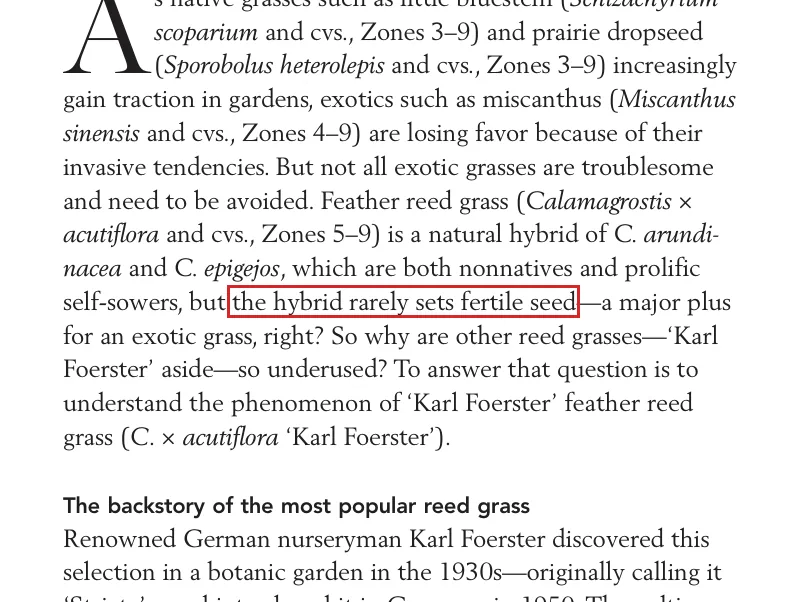
Hawke notes that both parents, C. arundinacea and C. epigejos, are prolific self-sowers; the hybrid’s seed sterility is why University of Illinois Extension (May 2026) says “thus far it has not exhibited signs of invasiveness.” The University of Arizona Campus Arboretum record lists it as benign and non-spreading.
Buy plants or divide a clump rather than sowing seed; the University of Arizona record says the hybrid cannot be propagated by seed. Divide every 4 to 7 years, in fall or spring (UW-Madison):
- Divide in early spring before new leaves emerge, or in fall; if the clump is already growing, cut it back by one-third first (CBG Issue 43).
- Split the crown with a sharpened spade or axe, and replant healthy divisions right away (CBG Issue 43).
- Set each division at its old depth and water it in on the first-season schedule above.
- Expect large fall divisions to flower the next spring and small ones to need a second growing season (UW-Madison).
What are the common problems with Karl Foerster grass?
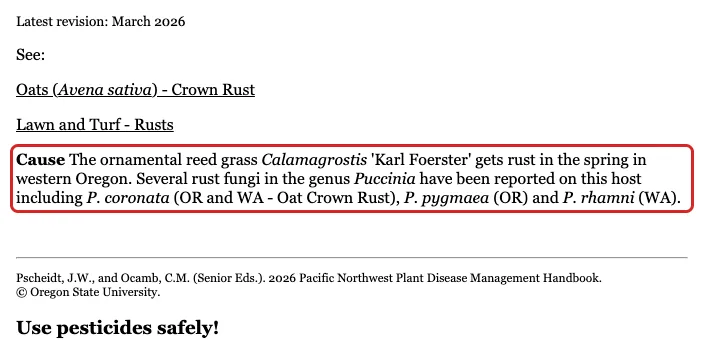
Karl Foerster grass has one recurring disease, rust, and three cultural problems: flopping in shade, short growth in poor soil and a dying center in old clumps. The Pacific Northwest Plant Disease Management Handbook (rev. March 2026) records rust on ‘Karl Foerster’ in spring in western Oregon, caused by fungi in the genus Puccinia.
| Problem | What triggers it | What to do | Source |
|---|---|---|---|
| Rust: Puccinia coronata (Ore., Wash.), P. pygmaea (Ore.), P. rhamni (Wash.) | Prolonged rain; hot, humid or wet summers; shade and overhead watering | Full sun, well-drained soil, water at the base; cut and bin infected foliage | PNW Handbook; NC State; CBG Issue 43 |
| Flopping stems | Shade; heavy rain or wind | Move to full sun; rain-flattened stems return upright once dry | MoBot; UW-Madison |
| Short plants | Low soil fertility | Test soil first; feed lightly only if low, since feeding grasses causes flop | UW-Madison; New Moon; CBG Issue 43 |
| Dead center | Old, undivided clumps | Divide every 4 to 7 years | CBG 2023; Great Garden Plants |
| Weak growth in the South | Zone 8 to 9 heat and humidity | Afternoon shade, or a warm-season grass | NC State; New Moon; CBG 2023 |
| Nursery pests | Aphids, leaf spot, spider mites, tar spot listed for container production | Inspect plants at purchase | Hoffman Nursery |
Shade and wet weather raise the rust risk. CBG’s 2018 grass evaluation recorded severe rust on ‘Overdam’ grown in a shaded bed from 2009 to 2012, and wholesale grower Hoffman Nursery calls ‘Karl Foerster’ “very susceptible to rust” in container production. In the 2016 Minnesota case, the volunteer said late-season rust after heavy rain needs no treatment and the clump usually regrows clean.
This page is general information. If you use a fungicide on ornamental grass rust, the product label is the law: use only a product whose label lists the plant and the disease, at the label rate.
Karl Foerster vs Overdam, Avalanche, Eldorado and Korean feather reed grass: which should you pick?
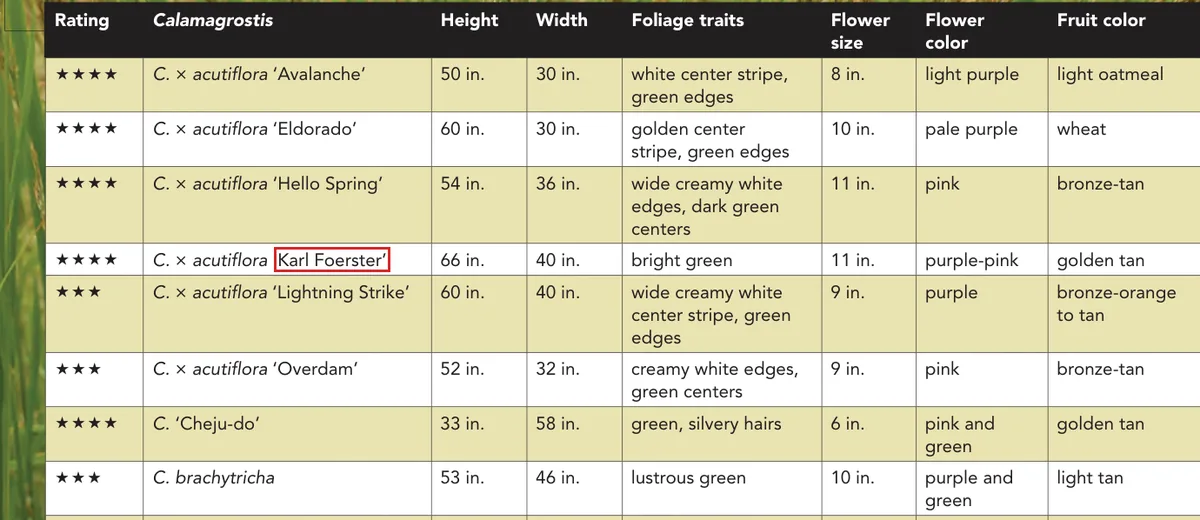
Pick ‘Karl Foerster’ for height and the best trial record, and ‘Avalanche’ or ‘Eldorado’ for striped leaves on the same upright form. In Chicago Botanic Garden’s trials of 11 reed grasses since 2018, ‘Karl Foerster’, ‘Avalanche’, ‘Eldorado’, ‘Hello Spring’ and ‘Cheju-do’ earned four stars; ‘Overdam’, ‘Lightning Strike’ and Korean feather reed grass earned three (CBG, 2023).
| Plant | CBG rating | Measured height x width | Leaves | Flower color and plume length | Other source notes |
|---|---|---|---|---|---|
| ‘Karl Foerster’ | 4 of 4 (excellent) | 66 x 40 in | bright green | purple-pink, 11 in | First ornamental grass named Perennial Plant of the Year, 2001 (Hoffman) |
| ‘Eldorado’ | 4 of 4 (excellent) | 60 x 30 in | golden center stripe, green edges | pale purple, 10 in | Same vertical habit as ‘Karl Foerster’ (CBG) |
| ‘Avalanche’ | 4 of 4 (excellent) | 50 x 30 in | white center stripe, green edges | light purple, 8 in | Shortest C. x acutiflora cultivar in the trial; MoBot lists 2 to 4 ft (MoBot) |
| ‘Hello Spring’ | 4 of 4 (excellent) | 54 x 36 in | wide creamy white edges | pink, 11 in | Plumes opened on the first day of summer; bulked up faster than ‘Overdam’ (CBG) |
| ‘Cheju-do’ | 4 of 4 (excellent) | 33 x 58 in | green with silvery hairs | pink and green, 6 in | Mounded, not upright; zones 5 to 8 (CBG) |
| ‘Lightning Strike’ | 3 of 4 (good) | 60 x 40 in | wide creamy white center stripe | purple, 9 in | Larger than ‘Avalanche’ (CBG) |
| ‘Overdam’ | 3 of 4 (good) | 52 x 32 in | creamy white edges, green centers | pink, 9 in | 48 x 38 in and severe rust in CBG’s shade bed, 2009 to 2012 (CBG Issue 43) |
| Korean feather reed grass (C. brachytricha) | 3 of 4 (good) | 53 x 46 in | lustrous green | purple and green, 10 in; blooms Sept. to Nov. (MoBot) | Can self-sow; on CBG’s removal list; grows in light to medium shade (CBG) |
| C. epigejos (a parent species) | 2 of 4 (fair) | 52 x 24 in | medium green | purple-green, 11 in | Prolific self-sower (CBG) |
| ‘Stricta’ | Not rated | 1 to 2 ft taller than ‘Karl Foerster’ (NC State) | green | Flowers about 2 weeks later (NC State) | Often mislabeled as ‘Karl Foerster’ in nurseries (NC State) |
Korean feather reed grass is the one to weigh carefully. It blooms September to November rather than June and grows in light to medium shade, but CBG’s report says reports of self-sowing range from minimal to aggressive and the garden removed it; Plant Select also notes it may reseed. Pull seedlings, especially near water.
The ‘Stricta’ label adds confusion. NC State treats ‘Stricta’ as a separate clone that grows 1 to 2 ft taller and flowers about 2 weeks later, while Hawke writes that Karl Foerster originally called his own selection ‘Stricta’ before it was renamed in his honor. Buy from a grower that labels the plant Calamagrostis x acutiflora ‘Karl Foerster’.
What plants go well with Karl Foerster grass?
Purple coneflower and Russian sage are the companions named most often: each appears in 3 of the 5 grower and garden sources we compiled. Late-summer bloomers suit the grass because its plumes turn buff by late summer (NC State); UW-Madison Extension names Coreopsis, Echinacea, Liatris and Rudbeckia.
| Companion plant | Named by | Sources naming it |
|---|---|---|
| Purple coneflower (Echinacea purpurea) | UW-Madison; Chicago Botanic Garden blog; New Moon Nursery | 3 |
| Russian sage (Perovskia atriplicifolia) | CBG blog; Monrovia; High Country Gardens | 3 |
| Black-eyed Susan (Rudbeckia, incl. R. fulgida var. fulgida) | UW-Madison; New Moon | 2 |
| Aster (incl. ‘Raydon’s Favorite’) | Monrovia; New Moon | 2 |
| Coreopsis; Liatris | UW-Madison | 1 each |
| Leichtlin’s lily (Lilium leichtlinii) | CBG blog | 1 |
| Arkansas blue star (Amsonia hubrichtii) | New Moon | 1 |
| Spirea, potentilla, shrub rose | Monrovia | 1 each |
| Artemisia ‘Powis Castle’ | High Country Gardens | 1 |
Mix rather than line up. After trialing 11 reed grasses, Hawke calls a stark line of this columnar grass “soulless after the thousandth encounter” and suggests small to large masses, or pairing with looser perennials or bushy shrubs. CBG’s Evening Island, designed by Oehme, van Sweden and Associates, uses ‘Karl Foerster’ as a cornerstone grass, and the garden suggests breaking its sweeps with Russian sage, purple coneflower or Leichtlin’s lily (CBG blog).
Is Karl Foerster grass right for your yard?
Karl Foerster grass fits a sunny site in zones 4 to 7 that needs a narrow, upright accent or a seasonal screen, wet clay included. Skip it, or pick another grass, where shade is heavy, summers are hot and humid, or the plan calls for natives: Illinois Extension names junegrass, little bluestem and sideoats grama.
| If your situation is | Do this | Why (source) |
|---|---|---|
| Zone 4 to 7, 6+ hours of sun | Plant ‘Karl Foerster’ 24 to 36 in apart | Four-star CBG rating; zones 4 to 7 per Hoffman and New Moon |
| Zone 3 (minus 40 to minus 30 °F) | Trial 2 or 3 plants before a full row | Only UW-Madison lists zone 3; the other 11 sources stop at zone 4 or 5 |
| Zone 8 or 9 with hot, humid summers | Give afternoon shade, or plant a warm-season grass such as pink muhly | NC State: suffers in hot, humid summers; New Moon: not reliable south of zone 7 |
| Under 6 hours of sun | Expect flop; consider Korean feather reed grass and pull its seedlings | MoBot; CBG removal list for Korean |
| Wet clay, rain garden or pond edge | ‘Karl Foerster’ suits it | MoBot lists wet soil and rain gardens; UW-Madison notes clay |
| You want striped leaves | ‘Avalanche’ (50 in) or ‘Eldorado’ (60 in) over ‘Overdam’ | Four stars vs three; ‘Overdam’ had severe rust in shade (CBG) |
| Native plants required | Little bluestem (zones 3 to 9, 2 to 4 ft) or junegrass; ‘Thin Man’ Indiangrass in the dry West | MoBot; Illinois Extension; Plant Select |
| You need a winter screen | Use evergreens; this grass is cut to 6 in each late winter | UW-Madison; Hawke calls it a seasonal screen |
| Replacing pampas grass in the Northwest | ‘Karl Foerster’ is a named non-invasive stand-in | Washington agencies, in our pampas grass guide |
1Does the spot get less than 6 hours of direct sun?
YesExpect fewer plumes and flopping (MoBot). For light shade, Korean feather reed grass grows there but can self-sow (CBG).
NoGo to the next question
2Is your winter colder than zone 4 (below minus 30 °F)?
YesTrial 2 or 3 plants first; only UW-Madison lists zone 3.
NoGo to the next question
3Are you in zone 8 or warmer with hot, humid summers?
YesGive afternoon shade and watch for rust, or choose a warm-season grass such as pink muhly (NC State; New Moon).
NoGo to the next question
4Does the plan require native plants?
YesUse little bluestem or junegrass; in the dry West, 'Thin Man' Indiangrass (Illinois Extension; Plant Select).
NoGo to the next question
5Do you want striped leaves?
YesChoose 'Avalanche' or 'Eldorado', both four-star in CBG's trial.
NoPlant 'Karl Foerster' 24 to 36 inches apart (17 to 18 inches for a dense screen) and cut it to about 6 inches each late winter.
Source: Decision table above: CBG 2023, MoBot, NC State, New Moon, Illinois Extension, Plant Select
For more cool- and warm-season grass profiles, browse our Turf and Trees hub.
How we compiled this
We compiled 33 primary documents in October 2026: 13 extension, botanical garden and trial records, 6 grower spec sheets, 7 retail price listings checked Oct. 29, 2026, and plant pages from the Perennial Plant Association, USDA and Plant Select. We did not grow or test plants: measured sizes and ratings are Chicago Botanic Garden’s, and plant counts and costs are our arithmetic from the published spacing and prices.
| Document type | Count | Examples |
|---|---|---|
| University extension plant records | 7 | UW-Madison, NC State (3 pages), Minnesota, Purdue, Illinois |
| Botanical garden records and trials | 6 | Missouri Botanical Garden (5 records), Chicago Botanic Garden trials 2018 and 2023 |
| Disease handbook and extension Q&A | 2 | PNW Plant Disease Management Handbook (rev. March 2026); Ask Extension #356470 |
| Grower spec sheets | 6 | Hoffman, Walters, New Moon, Monrovia, Proven Winners, Plant Select |
| Retail price listings | 7 | American Meadows, High Country Gardens, Great Garden Plants, Nature Hills, Plants Express, Garden Goods Direct, Monrovia |
| Reference maps, awards and records | 5 | USDA zone map, Perennial Plant Association, University of Arizona arboretum, CBG blog, Plant Select brachytricha page |
Frequently asked questions
Do you cut down Karl Foerster grass in the fall?
You can, but most sources wait. Chicago Botanic Garden allows a late-fall cut for grasses, yet UW-Madison, Purdue and Missouri Botanical Garden time it for late winter, just before new shoots appear. Leaving the stalks up keeps the golden plumes through winter and, per CBG, gives wildlife shelter. Cut to about 6 inches either way.
What happens if you don’t cut back Karl Foerster grass?
The clump survives, but new spring leaves grow up through last year’s tan stalks, so it looks streaked into summer. Cutting late is the other risk: UW-Madison says to cut in late winter or very early spring to avoid damaging new growth on this early-starting, cool-season grass. Old clumps also die out in the center and need division every 4 to 7 years.
Does feather reed grass come back every year?
Yes. ‘Karl Foerster’ is a long-lived perennial (UW-Madison) that regrows from its crown each spring in its hardiness range, which most sources put at USDA zones 4 or 5 through 8 or 9. Chicago Botanic Garden’s trial plants came back for at least four winters in zone 5b with minimal care and earned a four-star rating.
Is feather reed grass invasive?
‘Karl Foerster’ is not known to be invasive: Missouri Botanical Garden calls its seed sterile, and University of Illinois Extension said in May 2026 that it has not shown signs of invasiveness. Korean feather reed grass (C. brachytricha) is different; Chicago Botanic Garden put it on its removal list because it can self-sow.
Does Karl Foerster grass like sun or shade?
Sun. NC State and Missouri Botanical Garden list full sun, 6 or more hours a day, and say flowering and upright form decline as shade increases. Some afternoon shade helps in hot-summer places such as St. Louis and the South. Korean feather reed grass tolerates light to medium shade (CBG), but it can self-sow.
Can you grow Karl Foerster grass from seed?
No. The hybrid is seed-sterile; the University of Arizona Campus Arboretum notes it cannot be propagated by seed, and nurseries propagate it by division. CBG says it rarely sets fertile seed, and any seedling would not be the ‘Karl Foerster’ clone. Buy plants, or divide an existing clump in spring or fall.
When should you plant feather reed grass?
Fall is best and early spring usually works, according to the culture notes in Chicago Botanic Garden’s 2023 reed grass report. Several mail-order sellers, including High Country Gardens and American Meadows, ship it only in fall. Water deeply through the first growing season, then when the top 2 inches of soil are dry (Monrovia).
How far apart should I plant Karl Foerster grass?
Plant it 24 to 36 inches apart on center, per Proven Winners and Great Garden Plants. For a dense mass or screen, go to about 17 or 18 inches: High Country Gardens says 9 plants cover 18 sq ft. A 20 ft row takes 14 plants at 18 inches, 10 at 24 inches and 7 at 36 inches.
Sources
- Chicago Botanic Garden (Richard Hawke), High-ranking Reed Grasses: plant trial results, Fine Gardening, October 2023, Oct. 2023; trials since 2018. Accessed October 2026.
- Chicago Botanic Garden, Plant Evaluation Notes Issue 43: An Evaluation Study of Hardy Ornamental Grasses, 2018. Accessed October 2026.
- Chicago Botanic Garden, Karl Foerster: The Plant, The Myth, The Legend (blog), 2018. Accessed October 2026.
- Missouri Botanical Garden, Plant Finder: Calamagrostis x acutiflora ‘Karl Foerster’, Current. Accessed October 2026.
- Missouri Botanical Garden, Plant Finder: Calamagrostis x acutiflora ‘Overdam’, Current. Accessed October 2026.
- Missouri Botanical Garden, Plant Finder: Calamagrostis x acutiflora ‘Avalanche’, Current. Accessed October 2026.
- Missouri Botanical Garden, Plant Finder: Calamagrostis brachytricha, Current. Accessed October 2026.
- Missouri Botanical Garden, Plant Finder: Schizachyrium scoparium (little bluestem), Current. Accessed October 2026.
- NC State Extension, Plant Toolbox: Calamagrostis x acutiflora ‘Karl Foerster’, Current. Accessed October 2026.
- NC State Extension, Plant Toolbox: Calamagrostis arundinacea (Korean feather reed grass), Current. Accessed October 2026.
- University of Wisconsin-Madison Extension, Feather Reed Grass, Calamagrostis x acutiflora ‘Karl Foerster’, Updated 2025. Accessed October 2026.
- University of Illinois Extension, Taking a look at Feather Reed Grass, May 11, 2026. Accessed October 2026.
- University of Minnesota Extension, Plant Search: Karl Foerster Feather Reed Grass, Current. Accessed October 2026.
- Purdue University, Ornamental Grass Named Perennial of the Year for 2001, 2001; page modified 2017. Accessed October 2026.
- Oregon State University, Pacific Northwest Plant Disease Management Handbook: Ornamental Grass-Rust, Revised March 2026. Accessed October 2026.
- eXtension Foundation, Ask Extension #356470: Karl Forester diseases, Aug. 2016. Accessed October 2026.
- University of Arizona Campus Arboretum, Calamagrostis x acutiflora ‘Karl Foerster’, Current. Accessed October 2026.
- Perennial Plant Association, Past Perennial Plants of the Year, Current. Accessed October 2026.
- USDA Agricultural Research Service, 2023 USDA Plant Hardiness Zone Map, 2023. Accessed October 2026.
- Hoffman Nursery, Calamagrostis x acutiflora ‘Karl Foerster’, Current. Accessed October 2026.
- Walters Gardens, Calamagrostis acutiflora ‘Karl Foerster’, Current. Accessed October 2026.
- New Moon Nursery, Calamagrostis x acutiflora ‘Karl Foerster’, Current. Accessed October 2026.
- Proven Winners, Karl Foerster Feather Reed Grass, Current. Accessed October 2026.
- Monrovia, Foerster’s Feather Reed Grass (prices), Oct. 29, 2026. Accessed October 2026.
- High Country Gardens, Karl Foerster Feather Reed Grass (price), Oct. 29, 2026. Accessed October 2026.
- American Meadows, Karl Foerster Feather Reed Grass (price), Oct. 29, 2026. Accessed October 2026.
- Great Garden Plants, Karl Foerster Feather Reed Grass (price, spacing), Oct. 29, 2026. Accessed October 2026.
- Nature Hills Nursery, Karl Foerster Feather Reed Grass (price), Oct. 29, 2026. Accessed October 2026.
- Plants Express, Karl Foerster Grass (price), Oct. 29, 2026. Accessed October 2026.
- Garden Goods Direct, Karl Foerster Feather Reed Grass (price), Oct. 29, 2026. Accessed October 2026.
- Plant Select, A Native Alternative to Karl Foerster Grass, 2026. Accessed October 2026.
- Plant Select, Calamagrostis brachytricha, 2026. Accessed October 2026.