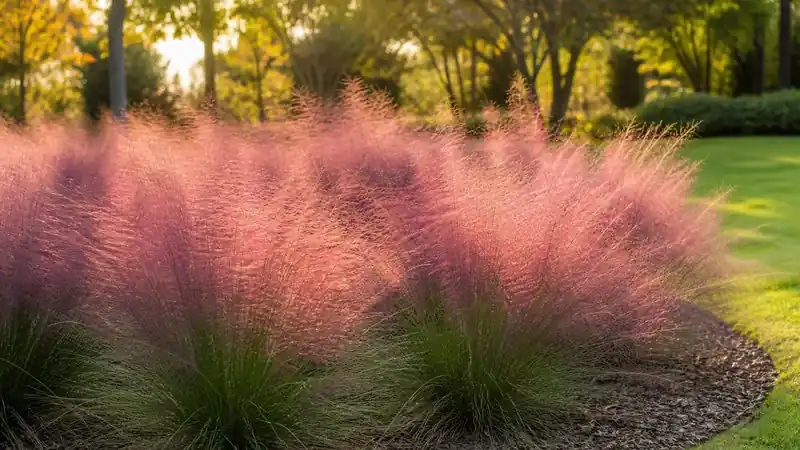
Pink muhly grass (Muhlenbergia capillaris) is a native clump grass, 2 to 3 ft tall, with pink fall plumes to 4 ft. Plant it in full sun and well-drained soil, 24 to 36 in apart, in zones 6 to 9.
Key takeaways
- Size: foliage reaches 2 to 3 ft and the plumes add about a foot, to 4 ft in bloom (NC State Extension; Hoffman Nursery); UF/IFAS records flower stalks up to 5 ft (UF/IFAS Gardening Solutions).
- Zones: published cold limits run from zone 5a (NC State Plant Toolbox) to zone 7 (UF/IFAS FPS-415); Texas A&M AgriLife rates the species for zones 6 to 9 (AgriLife Today, Oct. 2022).
- Spacing: UF/IFAS sets 24 to 36 in between plants (FPS-415). At 24 in on a square grid that is 0.25 plants per sq ft, or 50 plants for a 10 by 20 ft bed.
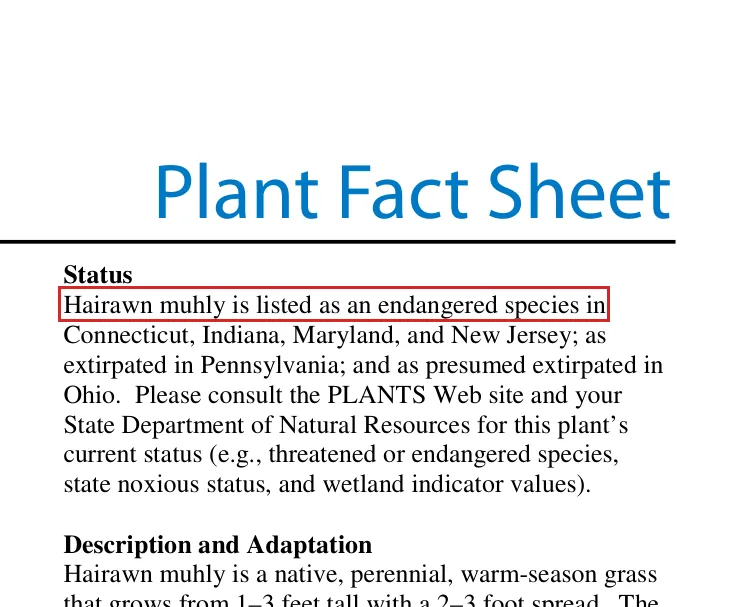
- Not invasive in the U.S.: it is native to 26 states plus D.C. (NC State) and clumps without rhizomes (USDA NRCS fact sheet, 2010). At the north edge of its range it is listed as endangered in Connecticut, Indiana, Maryland and New Jersey, and as extirpated in Ohio and Pennsylvania.
- Main pest: the muhlygrass mealybug, Stemmatomerinx acircula, now recorded in Florida, North Carolina, South Carolina and, since 2024, Texas (Texas A&M HORT-PU-296).
- Price: a 1-gallon pot listed at $15.95 to $29.95 at five online nurseries on Oct. 29, 2026; 3-gallon pots ran $48.95 to $69.95 (Plants Express; Garden Goods Direct).
2 to 3 ft foliage, 4 ft in bloom (NC State, Hoffman Nursery)
24 to 36 in apart in beds (UF/IFAS FPS-415)
Sept. to Nov. bloom window (Missouri Botanical Garden)
$15.95 to $29.95 per 1-gallon pot (5 sellers, Oct. 29, 2026)
What is pink muhly grass?
Pink muhly grass is Muhlenbergia capillaris, a warm-season bunchgrass in the grass family (Poaceae). USDA PLANTS lists it under the symbol MUCA2 with the common name hairawn muhly and records it as native to the lower 48 states and Puerto Rico. Gardeners also call it Gulf muhly, purple muhly, hairgrass and muhlygrass; all of these names point to the same species.
The native range runs from Massachusetts to Kansas and south to Florida and Texas, mostly on prairies, pine barrens and open woods (Missouri Botanical Garden Plant Finder). NC State’s Plant Toolbox lists it in 26 states plus D.C., and also in the Bahamas, Cuba, Guatemala, Mexico and Puerto Rico.
NC State lists Muhlenbergia sericea, sold as purple muhly or sweetgrass, as the plant most often confused with it (NC State), and UF/IFAS calls muhly grass very similar to M. filipes (FPS-415). The sweetgrass form is the one used for Gullah coiled baskets in South Carolina, Georgia and northeast Florida (Florida Native Plant Society). It is often sold as the native swap for pampas grass, which Washington lists as a Class C noxious weed; see our pampas grass guide.
| Trait | Published figure | Source |
|---|---|---|
| Botanical name and USDA symbol | Muhlenbergia capillaris (Lam.) Trin.; MUCA2 | USDA PLANTS |
| Native status | Native, lower 48 states and Puerto Rico; no federal noxious or invasive listing | USDA PLANTS |
| Foliage height | 2 to 3 ft | NC State |
| Height in bloom | 4 ft; flower stalks up to 5 ft | Hoffman Nursery; UF/IFAS |
| Width | 2 ft 4 in to 3 ft | NC State |
| Leaf length | 18 to 36 in | UF/IFAS FPS-415 |
| Plume (panicle) length | Up to 12 in | Missouri Botanical Garden |
| Bloom | September to November | Missouri Botanical Garden |
| Light | Full sun, 6 or more hours of direct sun | NC State |
| Soil pH range in USDA data | 5.8 to 6.8 | USDA PLANTS characteristics |
| Salt tolerance | High salinity tolerance | USDA NRCS fact sheet |
| Seeds per pound | 1,400,000 | USDA PLANTS characteristics |
| Spacing | 24 to 36 in | UF/IFAS FPS-415 |
How big does pink muhly grass get?
Pink muhly grass usually grows 2 to 3 ft tall and about as wide, and the fall plumes lift the plant to roughly 4 ft. NC State, Missouri Botanical Garden and UF/IFAS Gardening Solutions all give 2 to 3 ft for the clump, while Hoffman Nursery, a wholesale grower in Rougemont, North Carolina, lists 3 ft without bloom and 4 ft with it.
The spread between sources comes from what each one measures. UF/IFAS separates the 2 to 3 ft clump from flower stalks that reach up to 5 ft (Gardening Solutions), and the USDA NRCS fact sheet gives 1 to 3 ft for the plant with seed stalks of 2 to 5 ft (NRCS, 2010). Missouri Botanical Garden adds that the plant “generally grows taller with consistent moisture” (MBG).
| Source | Foliage height (ft) | Height in bloom (ft) | Width (ft) | Link |
|---|---|---|---|---|
| NC State Plant Toolbox | 2 to 3 | Not given | 2.3 to 3 | NC State |
| Missouri Botanical Garden | 2 to 3 | Not given | 2 to 3 | MBG |
| UF/IFAS Gardening Solutions | 2 to 3 | Up to 5 | Up to 3 | UF/IFAS |
| UF/IFAS FPS-415 | 3 to 4 | Not given | About as wide | UF/IFAS |
| Texas A&M AgriLife | 1.5 to 3 | Not given | 2 to 3 | AgriLife |
| LSU AgCenter | 3 to 4 (average) | Not given | 3 to 4 | LSU AgCenter |
| USDA NRCS fact sheet | 1 to 3 | 2 to 5 (seed stalks) | 2 to 3 | NRCS |
| Hoffman Nursery | 3 | 4 | Not given | Hoffman |
For planning, use a 3 by 3 ft footprint in an irrigated bed and 2 by 2 ft on dry, lean soil. LSU AgCenter’s 3 to 4 ft average is the high outlier (LSU AgCenter, 2021).
What zones does pink muhly grass grow in?
Pink muhly grass is reliably hardy in USDA zones 6 to 9, the band Texas A&M AgriLife and Monrovia use. Sources disagree at the cold end: NC State lists zone 5a, UF/IFAS starts at zone 7, and the USDA PLANTS database gives a minimum temperature of 7°F, which is zone 7b on the USDA Plant Hardiness Zone Map.
| Source | Zones or cold limit published | Coldest winter low it implies (PHZM) | Link |
|---|---|---|---|
| NC State Plant Toolbox | 5a to 9b | minus 20 to minus 15°F | NC State |
| Missouri Botanical Garden | 5 to 11 | minus 20 to minus 10°F | MBG |
| University of Arkansas Extension | Tolerates minus 15°F | Zone 5b (minus 15 to minus 10°F) | UA Extension, 2001 |
| Annie’s Annuals (seller) | 5 to 11 | minus 20 to minus 10°F | Annie’s Annuals |
| Texas A&M AgriLife | 6 to 9 | minus 10 to 0°F | AgriLife, 2022 |
| Monrovia, Regal Mist | 6 to 9 | minus 10 to 0°F | Monrovia |
| Emerald Coast Growers, Fast Forward | 6 to 10 | minus 10 to 0°F | ECG |
| Monrovia, Plumetastic | 7 to 10 | 0 to 10°F | Monrovia |
| UF/IFAS FPS-415 | 7 to 11 | 0 to 10°F | UF/IFAS |
| USDA PLANTS characteristics | Minimum temperature 7°F | Zone 7b (5 to 10°F) | USDA PLANTS |
Two facts argue for caution below zone 6. Plant Select, the Colorado plant-introduction program, writes that Gulf muhly “is not as drought-tolerant or cold hardy” as its UNDAUNTED ruby muhly (Muhlenbergia reverchonii), which it rates for zones 5 to 10. And the wild populations at the north end of the range are scarce: Connecticut, Indiana, Maryland and New Jersey list it as endangered, and Ohio and Pennsylvania list it as extirpated, according to each state’s official rare-plant list.
In zone 6, plant in spring so roots have a full season before the first winter; Hoffman Nursery advises that fall plantings go in “at least a month before first frost” (Hoffman Nursery). In zones 7 to 11, UF/IFAS lists the planting month as year round (FPS-415).
Is pink muhly grass invasive, and will it spread?
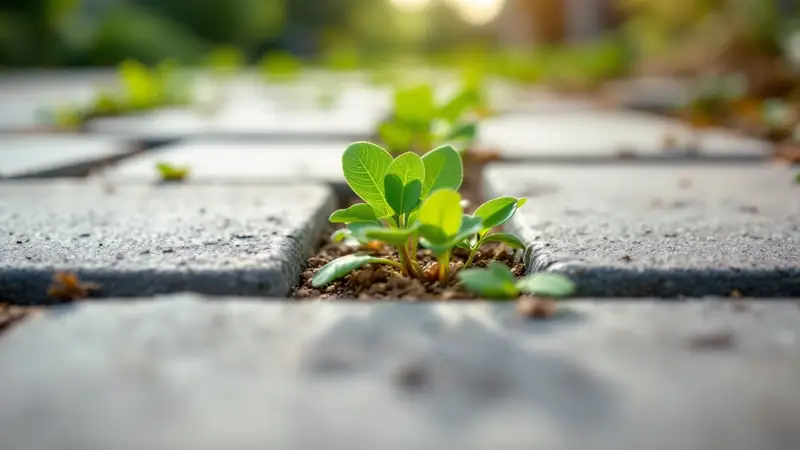
No U.S. agency lists pink muhly grass as invasive or noxious. USDA PLANTS shows no noxious or invasive status, UF/IFAS rates it “not known to be invasive” (FPS-415), and the clump does not spread by rhizomes or stolons (USDA NRCS). It does drop seed, and seedlings can appear in gravel and paving cracks.
The seed is the only way it moves. The Florida Native Plant Society says it “readily self seeds” into cracks in rocks or pavement, while the USDA PLANTS characteristics table rates its seed spread rate as slow (USDA PLANTS). University of Arkansas Extension found that it “does not seem to become weedy when planted in the garden” (UA Extension).
At the north edge of its range the plant is scarce, not weedy: the 2010 USDA NRCS fact sheet listed it as endangered in four states and extirpated in two, and the state lists checked in October 2026 still say the same.
| State | Status on the official list | List and date | Source |
|---|---|---|---|
| Connecticut | E, endangered (as long-awn hairgrass) | CT DEEP Endangered, Threatened and Special Concern Plants, effective Aug. 5, 2015 | CT DEEP |
| Indiana | SE, state endangered; state rank S1 (long-awn hairgrass) | Indiana DNR, Endangered, Threatened, and Extirpated Plants of Indiana, Oct. 29, 2025, p. 9 | Indiana DNR |
| Maryland | Endangered throughout Maryland (long-awn hairgrass) | COMAR 08.03.08.05, endangered plant species list | COMAR 08.03.08.05 |
| New Jersey | Endangered (long-awned smoke grass) | N.J.A.C. 7:5C-5.1, Endangered Plant Species List | N.J.A.C. 7:5C-5.1 |
| Ohio | X, presumed extirpated (long-awn hair grass) | ODNR Rare Native Ohio Plants, 2024-25 Status List, effective Dec. 26, 2024, p. 15 | Ohio DNR |
| Pennsylvania | Pennsylvania Extirpated (short muhly) | 17 Pa. Code § 45.11 | 17 Pa. Code § 45.11 |
Abroad, South Korea’s Ministry of Environment classes it as an “Ecosystem Hazard Class 2” plant for long-term monitoring, yet a 2-year greenhouse study pairing it with 17 native Korean species found no significant drop in their canopy cover or aboveground biomass (Byun, Ecosphere, July 2023).
Next to a natural area, cut the plumes once they fade in late fall, before the seed drops, if you want no seedlings; NC State gives September through November for the seed (NC State).
How far apart should you plant pink muhly grass?
Space pink muhly grass 24 to 36 in apart, the range in UF/IFAS fact sheet FPS-415. At 24 in on a square grid each plant covers 4 sq ft, so you need 25 plants per 100 sq ft; at 36 in each covers 9 sq ft and you need about 11. Offset (triangular) rows at the same spacing take about 15.5 percent more plants.
Other sources sit inside that band. LSU AgCenter and Humboldt Botanical Garden both use 2 ft for massed plantings (LSU AgCenter; UC Master Gardeners blog). The USDA PLANTS planting density of 11,000 to 18,000 plants per acre works out to 0.25 to 0.41 plants per sq ft, or 19 to 24 in apart (USDA PLANTS). Hoffman Nursery warns that tight masses invite tar spot, so leave “adequate spacing for good air circulation” (Hoffman Nursery).
| Spacing (on center) | Sq ft per plant (spacing in ft, squared) | Plants per sq ft | Plants per 100 sq ft | Plants for a 10 x 20 ft bed, square grid (rounded up) | Same bed, offset rows (x 1.155, rounded up) |
|---|---|---|---|---|---|
| 18 in (near USDA high density) | 2.25 | 0.444 | 44.4 | 89 | 103 |
| 24 in (UF/IFAS low end; LSU) | 4 | 0.25 | 25 | 50 | 58 |
| 30 in | 6.25 | 0.16 | 16 | 32 | 37 |
| 36 in (UF/IFAS high end) | 9 | 0.111 | 11.1 | 23 | 26 |
Worked example: a 10 by 20 ft bed is 200 sq ft. At 24 in, 200 ÷ (2 × 2) = 50 plants. At $15.95 to $29.95 per 1-gallon pot (Oct. 29, 2026 listings below), the plants cost $797.50 to $1,497.50 before shipping. Stretch to 36 in and the count drops to 200 ÷ 9 = 22.2, so 23 plants and $366.85 to $688.85, with a 2 to 3 season wait for the clumps to close the gaps.
For a single row, divide the row length by the spacing and add one: a 30 ft border at 24 in takes 30 ÷ 2 + 1 = 16 plants.
- Plants needed
- 50
Plants = area x (144 / spacing in inches squared), x 1.155 for offset rows, rounded up. Prices are the low and high online listings in this guide, before shipping and tax.
How do you plant and care for pink muhly grass?
Plant pink muhly grass in full sun with at least 6 hours of direct light, in soil that drains, with the crown level with the soil surface. Water it until it roots in, then mostly leave it alone: Texas A&M AgriLife says the species prefers low-fertility sites, and UF/IFAS calls it drought tolerant once established.
- Pick the site. Give it 6 or more hours of direct sun (NC State); it tolerates light shade but blooms best in full sun (AgriLife).
- Fix drainage. On extremely sandy, rocky or clay soil, mix in about 20 percent compost (AgriLife); on heavy clay, plant on a raised mound (UC Master Gardeners). Check pH first with a soil test.
- Time it. Spring in zone 6; fall works in warmer zones if the plant goes in at least a month before first frost (Hoffman Nursery).
- Set the depth. Keep the crown at grade, with no soil or mulch on top of it (AgriLife).
- Mulch around, not over. AgriLife suggests double-shredded hardwood around the plants; our mulch calculator converts bed area and depth into cubic yards.
- Water to establish. Water new plants until established, then only in long droughts (UF/IFAS); a drip line with one emitter per plant covers the first season.
- Feed lightly or not at all. UF/IFAS and LSU AgCenter allow one spring feeding as growth starts; the USDA NRCS advises fertilizing only to soil test results (NRCS).
| Soil factor | What the source says | Source |
|---|---|---|
| pH, USDA data | 5.8 to 6.8; calcium carbonate tolerance low | USDA PLANTS |
| pH, NRCS | “A low tolerance for high pH soils” | NRCS fact sheet |
| pH, extension | Acid, neutral or alkaline (above 8.0) all acceptable; “pH adaptable” | NC State; AgriLife |
| Salt | High salinity tolerance; moderate salt spray (FNPS) | NRCS; FNPS |
| Wet soil | Tolerates extended flooding (UF/IFAS) vs “does not like wet feet” (UC) | UF/IFAS; UC Master Gardeners |
When should you cut back pink muhly grass?
Cut pink muhly grass back once a year in late winter or early spring, before new green blades appear. Hoffman Nursery cuts 3 to 4 in above the crown to protect the growing points, and Texas A&M AgriLife leaves about 6 in. Never shear it after early August, or you remove that fall’s flower stalks.
| Source | When | How low | Link |
|---|---|---|---|
| UF/IFAS Gardening Solutions | Late winter, before the spring flush | To the ground | UF/IFAS |
| UF/IFAS FPS-415 | Spring, before new growth (optional) | To the ground | UF/IFAS |
| Hoffman Nursery | Early spring; height trims only until early August | 3 to 4 in above the crown | Hoffman |
| Texas A&M AgriLife | While still dormant | To the crown, about 6 in above the ground | AgriLife |
| LSU AgCenter | Late winter or early spring | Trim dead blades; leave the dormant clump for birds over winter | LSU AgCenter |
| USDA NRCS (meadow stands) | Late winter | Burn or mow to remove old residue | NRCS |
For home beds the Hoffman height is the safe middle: 3 to 4 in protects the growing points, while cutting to the ground, as UF/IFAS allows, suits Florida winters better than zone 6 freezes.
How often should you divide pink muhly grass?
Divide pink muhly grass every 3 to 4 years, or sooner if the center of the clump dies out or flowering drops. LSU AgCenter says overcrowding cuts flower numbers and suggests dividing about every three years in fall or early spring; the USDA NRCS adds that clumps should not be split while they are flowering.
| Month | Task | Source |
|---|---|---|
| February to March | Cut back 3 to 4 in above the crown before new growth | Hoffman |
| March to April | Divide crowded clumps; plant new pots in zone 6 | LSU AgCenter; NRCS |
| April to May | Optional light feeding as growth starts; scout for mealybugs on new growth | UF/IFAS; Texas A&M |
| June to early August | Last window to trim for height without losing flowers | Hoffman |
| July to November | Mealybug infestations show; check leaves and crowns | Texas A&M |
| September to November | Bloom; collect seed with a comb in late fall | MBG; NRCS |
| December to January | Leave plumes standing for winter interest and bird cover | LSU AgCenter |
Which pink muhly grass varieties can you buy?
Five named selections of pink muhly grass are in the trade: ‘White Cloud’, Regal Mist (‘Lenca’), Plumetastic (‘Irvine’), Fast Forward and the hybrid ‘Pink Flamingos’. They differ mainly in flower color, bloom timing and zone rating. Fast Forward starts flowering in August, while Plumetastic blooms 3 to 5 weeks after Regal Mist, according to their growers.
| Variety (cultivar name) | Flower and timing | Size | Zones | Origin | Source |
|---|---|---|---|---|---|
| Species, M. capillaris | Pink to pinkish-red, September to November | 2 to 3 ft; 4 ft in bloom | 5 to 11 (sources vary) | Native, eastern and central U.S. | MBG; Hoffman |
| ‘White Cloud’ | White; blooms shortly after the pink species | More upright and a bit taller than the species | Not stated by grower | Selected by Superior Trees, Lee, Florida | Hoffman Nursery |
| Regal Mist (‘Lenca’) | Pink-red, late summer to fall | 4 ft tall, 3 ft wide in bloom | 6 to 9 | Selected by Ron Gass, Mountain States Wholesale Nursery, Arizona | Monrovia |
| Plumetastic (‘Irvine’) | Purple, 3 to 5 weeks later than Regal Mist | 2 to 3 ft; 4 ft in bloom | 7 to 10 | Found at Orange County Great Park, Irvine, California | Monrovia |
| Fast Forward | Pink-purple from August (late July in warm areas) | 36 in | 6 to 10 | Emerald Coast Growers selection | Emerald Coast Growers; MBG |
| ‘Pink Flamingos’ (M. capillaris x M. lindheimeri) | Bright pink, September to October | 3 to 4 ft tall, 2 to 3 ft wide | 6a to 10b | Found at Peckerwood Garden, Hempstead, Texas | NC State |
Hoffman Nursery reports that ‘White Cloud’ “appears to be more resistant to tar spot” than the species, and NC State lists it as tar spot resistant (Hoffman; NC State).
How do other muhly grasses compare?
Five other Muhlenbergia species fill gaps the pink muhly cannot. UNDAUNTED ruby muhly takes zone 5 and alkaline clay, Lindheimer muhly and bamboo muhly give 4 to 6 ft of height for screens, deergrass suits dry Western sites, and sweetgrass (M. sericea) handles salt spray and wet coastal soils from North Carolina to Texas.
| Species | Common name | Height | Zones | Native range | Source |
|---|---|---|---|---|---|
| M. capillaris | Pink muhly, Gulf muhly | 2 to 3 ft; 4 ft in bloom | 5a to 9b (NC State) | Massachusetts to Kansas, south to Florida and Texas | NC State |
| M. sericea | Purple muhly, sweetgrass | 3 to 4 ft | 7a to 11b | Coastal AL, FL, GA, LA, MS, NC, SC, TX | NC State |
| M. lindheimeri | Lindheimer muhly | 2 to 5 ft | 6a to 9b | Texas and northeast Mexico | NC State |
| M. reverchonii UNDAUNTED (‘PUND01S’) | Ruby muhly, seep muhly | 15 to 18 in; 30 in in flower | 5 to 10 | Central Oklahoma to central Texas | Plant Select; MBG |
| M. rigens | Deergrass | To 5 ft in bloom; clumps to 6 ft across | Not given in the guide | Northern California south to New Mexico, Texas and Mexico | USDA NRCS plant guide |
| M. dumosa | Bamboo muhly | 4 to 6 ft; up to 5 ft wide | Not given on the page | Arizona and northwestern Mexico | UF/IFAS |
What are the problems with pink muhly grass?
Pink muhly grass has two real pests: the muhlygrass mealybug and the fungal disease tar spot. The rest of its problems are site problems: too much shade cuts flowering, a cut after early August removes the plumes, and a clump left undivided for more than 3 to 4 years can die out in the middle.
The muhlygrass mealybug (Stemmatomerinx acircula) is a gray insect slightly under 1/8 in long, covered in white fluff and filaments up to twice its body length (NC State Extension, 2022). It is native to Florida and has turned up in North Carolina, South Carolina and Texas, most likely moved on nursery stock, where a 2024 College Station collection was confirmed by the USDA as a new state record (Texas A&M HORT-PU-296, Aug. 2024).
- Inspect pots before buying; mealybugs live in roots and crowns as well as on leaves (Texas A&M).
- Scout from spring green-up through fall; infestations usually show from mid-summer to late fall.
- Cut off and bag infested foliage; remove badly declining plants (UF/IFAS Escambia County).
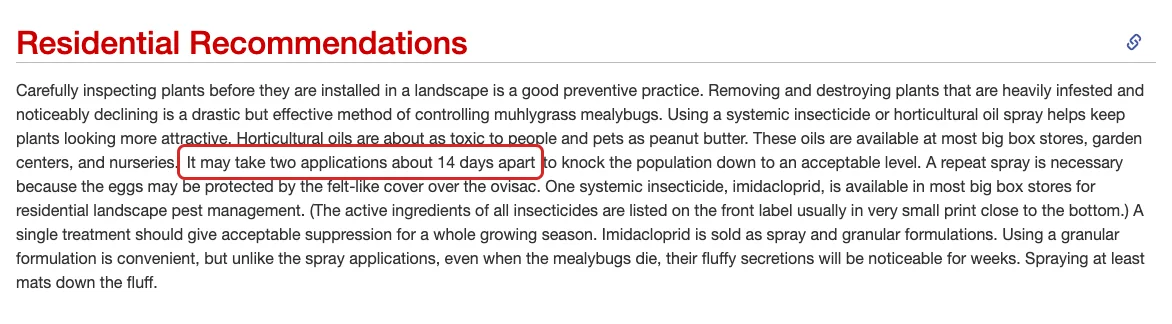
- Spray horticultural oil only in cool weather, not at about 85°F or above (Texas A&M), and plan on two applications about 14 days apart (NC State).
- Texas A&M also lists insecticidal soap, azadirachtin, pyrethrins, imidacloprid and acephate. Use only a product whose EPA-registered label lists ornamentals and mealybugs; the label is the law.
This page is general information, not pesticide advice. If a crew treats muhly grass for a client, most states require a commercial applicator license; see our pesticide applicator license guide.
Tar spot is caused by a Phyllachora fungus; Hoffman Nursery flags it “especially in heat of summer” and spaces plants for air circulation to prevent it (Hoffman Nursery). Hoffman also lists aphids and rust among possible pests in production, and the USDA NRCS notes aphids on the blooms during early seed development, which lady beetles help control (NRCS).
| Pros | Cons | Source |
|---|---|---|
| Native to 26 states plus D.C.; no U.S. invasive listing | Self-seeds into gravel and paving cracks | NC State; FNPS |
| High salt tolerance for coastal and roadside beds | Mealybugs spreading through the nursery trade (FL, NC, SC, TX) | NRCS; Texas A&M |
| Deer browse rated low | Tar spot in crowded plantings in summer heat | USDA PLANTS; Hoffman |
| Low fertility needs; one cut a year | Brown and dormant from late fall to spring | AgriLife; LSU AgCenter |
| Blooms September to November | Fewer flowers with under 6 hours of sun | MBG; NC State |
What grows well with pink muhly grass?
Pink muhly grass pairs best with plants that share its full sun, lean soil and fall peak. NC State lists little bluestem and switchgrass as plants that fill the same niche, and its own photo records show muhly beside rattlesnake master and blue mistflower. ‘White Cloud’ muhly extends the show because it blooms slightly later.
| Companion | Why it works | Source |
|---|---|---|
| Little bluestem (Schizachyrium scoparium) | Same sun and soil; copper fall color under pink plumes | NC State |
| Switchgrass (Panicum virgatum) | Taller backdrop, same niche | NC State |
| Rattlesnake master (Eryngium yuccifolium) | Pictured with muhly in a Moore County, NC planting | NC State photo record |
| Blue mistflower (Conoclinium coelestinum) | Blue fall flowers against pink plumes | NC State photo record |
| ‘White Cloud’ muhly | Blooms slightly later, so the show runs longer | Hoffman Nursery |
| Groundcover juniper | Low evergreen bed to interplant clumps | UA Extension |
For a taller upright grass behind muhly in colder zones, see our guide to Karl Foerster feather reed grass. For an evergreen edging along the front of the bed, monkey grass (liriope) stays green while muhly is dormant. More plant and lawn profiles are in our Turf and Trees section.
How much does pink muhly grass cost?
A 1-gallon pink muhly grass costs $15.95 to $29.95 at five online nurseries checked on Oct. 29, 2026, and a 3-gallon costs $48.95 to $69.95. ‘White Cloud’ runs $18 to $52.95 per 1-gallon pot. Shipping is the swing cost: Plants Express charges from $29.95 for packaged shipping, and Trees.com ships free over $99.
Swipe the table sideways to see every column.
| Seller | Plant | Pot size | Listed price | Link |
|---|---|---|---|---|
| Annie’s Annuals | Pink muhly | 4-inch pot | $14.99 | listing |
| Plants Express | Pink muhly | 1 gallon | $15.95 | listing |
| Native Gardeners | Gulf muhly ‘Pink’ | 1 gallon | $16.00 | listing |
| Trees.com | Pink muhly (sale; list $33.95) | 1 gallon | $22.95 | listing |
| PlantingTree | Pink muhly | 1 gallon | $25.95 | listing |
| Garden Goods Direct | Pink muhly | 1 gallon | $29.95 | listing |
| Native Gardeners | Gulf muhly ‘Pink’ | 2 gallon | $34.00 | listing |
| Plants Express | Pink muhly | 5 gallon | $39.95 | listing |
| PlantingTree | Pink muhly | 3 gallon | $48.95 | listing |
| Garden Goods Direct | Pink muhly | 3 gallon | $69.95 | listing |
| Native Gardeners | ‘White Cloud’ | 1 gallon | $18.00 | listing |
| Native Gardeners | ‘White Cloud’ | 3 gallon | $45.00 | listing |
| PlantingTree | ‘White Cloud’ | 1 gallon | $52.95 | listing |
| PlantingTree | ‘White Cloud’ | 3 gallon | $77.95 | listing |
| Native Gardeners | ‘Pink Flamingo’ | 5 gallon | $45.00 | listing |
Pot size moves the price more than the seller: a 3-gallon costs 1.9 times the 1-gallon at PlantingTree ($48.95 against $25.95) and 2.3 times at Garden Goods Direct ($69.95 against $29.95).
Installed, our landscaping cost guide puts a 1-gallon plant at about $14 to $34, at 14 to 20 plants an hour; state wage rates are in our labor cost table.
What do popular pink muhly grass guides get wrong?
Several popular pink muhly grass guides repeat claims that the primary sources do not support: zone 5 hardiness, a 10-year lifespan, surface-sown seed and a pH ceiling of 7.0. The USDA’s own data also conflicts with extension services on drought tolerance. The table sets each claim beside the primary source.
| What some guides say | What the primary source says | Source |
|---|---|---|
| Hardy to zone 5, to minus 15°F (The Spruce, Sept. 2026) | UF/IFAS rates it from zone 7, AgriLife from zone 6; Plant Select says Gulf muhly is less cold hardy than ruby muhly | UF/IFAS; AgriLife; Plant Select |
| Seeds need light: sow on the surface; sprouts in about two weeks (The Spruce) | Direct-seed 1/8 in deep; no cold treatment needed; air-dry seed 5 to 10 days after collection | USDA NRCS fact sheet |
| A long-lived perennial that lasts about 10 years (The Spruce) | USDA PLANTS rates lifespan “Short”; NC State calls it long-lived; neither gives a number of years | USDA PLANTS; NC State |
| Does not grow well above pH 7.0 (The Spruce) | USDA PLANTS gives pH 5.8 to 6.8, but NC State lists alkaline soils above 8.0 as acceptable; test before planting | USDA PLANTS; NC State |
| Native to the Southern U.S. (Monrovia product page) | Native from Massachusetts to Kansas, south to Florida and Texas | MBG; USDA PLANTS |
| Fast-growing (Trees.com product page) | Growth rate medium (NC State) or moderate (USDA PLANTS) | NC State; USDA PLANTS |
| Drought tolerant (nearly every source) | USDA PLANTS characteristics rate drought tolerance “Low”; the USDA NRCS fact sheet calls it drought-tolerant, so the PLANTS entry is the outlier | USDA PLANTS; NRCS |
Which muhly grass should you plant?
Pick pink muhly grass when the bed gets 6 or more hours of sun, drains well and sits in zones 6 to 9. Outside those limits, a related muhly usually fits better: UNDAUNTED ruby muhly for zone 5 and alkaline clay, Lindheimer or bamboo muhly for a taller screen, and ‘White Cloud’ where tar spot has been a problem.
| If your situation is | Do this | Why (source) |
|---|---|---|
| Zone 5 or colder | Plant UNDAUNTED ruby muhly (M. reverchonii) instead | Rated zones 5 to 10; Gulf muhly is less cold hardy (Plant Select) |
| Zone 6 | Plant in spring; choose Regal Mist, Fast Forward or ‘Pink Flamingos’, not Plumetastic | Regal Mist 6 to 9, Fast Forward 6 to 10, ‘Pink Flamingos’ 6a to 10b; Plumetastic 7 to 10 (Monrovia; ECG; NC State) |
| Fewer than 6 hours of direct sun | Choose a shade-tolerant groundcover or sedge instead | Best floral display needs full sun, 6 or more hours (NC State) |
| Soil pH above 7.5 or alkaline clay | Plant UNDAUNTED ruby muhly or test and amend first | USDA PLANTS pH 5.8 to 6.8 for M. capillaris; ruby muhly thrives in alkaline clay (Plant Select) |
| Coastal salt spray, dunes or wet sand | Plant the species or sweetgrass (M. sericea) | High salinity tolerance (NRCS); sweetgrass is salt spray and wet soil tolerant (NC State) |
| Hot, humid site with tar spot history | Plant ‘White Cloud’ at 36 in spacing | More resistant to tar spot; air flow cuts infection (Hoffman) |
| You want flowers in August | Plant Fast Forward | Flowering begins in August, late July in warm climates (ECG) |
| You need a 4 to 6 ft screen | Plant Lindheimer muhly or bamboo muhly | 2 to 5 ft (NC State); 4 to 6 ft (UF/IFAS) |
| Zones 6 to 9, full sun, drained soil | Plant the species or Regal Mist, 24 to 36 in apart | Spacing per UF/IFAS FPS-415 |
1Is the site in USDA zone 5 or colder?
YesPlant UNDAUNTED ruby muhly (M. reverchonii), rated zones 5 to 10 (Plant Select).
NoGo to the next question
2Does the bed get fewer than 6 hours of direct sun?
YesPick a shade-tolerant plant; muhly needs full sun to flower well (NC State).
NoGo to the next question
3Is the soil alkaline clay or above pH 7.5?
YesPlant UNDAUNTED ruby muhly, or test and amend first (USDA PLANTS pH 5.8 to 6.8).
NoGo to the next question
4Has tar spot hit grasses on this site before?
YesPlant 'White Cloud' at 36 in spacing (Hoffman Nursery).
NoGo to the next question
5Is the site in zone 6?
YesPlant in spring: Regal Mist, Fast Forward or 'Pink Flamingos' (Monrovia, ECG, NC State).
NoPlant the species or Regal Mist 24 to 36 in apart in spring or early fall (UF/IFAS FPS-415).
Source: Plant Select, NC State, USDA PLANTS, Hoffman Nursery, Monrovia, UF/IFAS
How we compiled this
In October 2026 we compiled extension publications (NC State, UF/IFAS, Texas A&M, LSU AgCenter, University of Arkansas, UC Master Gardeners), USDA PLANTS and NRCS documents, six official state rare-plant lists or regulations, one peer-reviewed study, four grower or plant-program pages and 15 retail listings checked Oct. 29, 2026. We did not grow or test plants; sizes and zones are as published, and plant counts are our arithmetic from the published spacing.
| Question | Short answer | Source |
|---|---|---|
| Size | 2 to 3 ft; 4 ft in bloom | NC State |
| Zones | 6 to 9 reliably; 5 to 11 claimed | AgriLife |
| Spacing | 24 to 36 in; 25 plants per 100 sq ft at 24 in | UF/IFAS |
| Cut back | Late winter, 3 to 4 in above the crown | Hoffman |
| Invasive | No U.S. listing; self-seeds lightly | UF/IFAS |
| Price | $15.95 to $29.95 per 1-gallon pot | Seller listings, Oct. 29, 2026 |
Frequently asked questions
What are the problems with muhly grass?
Two pests: the muhlygrass mealybug, now recorded in Florida, the Carolinas and Texas, and tar spot, a Phyllachora fungus of crowded plantings in summer heat (Texas A&M; Hoffman Nursery). Under 6 hours of direct sun also cuts flowering (NC State).
What are the pros and cons of pink muhly grass?
Pros: native to 26 states plus D.C., high salt tolerance, low deer browse, low fertility needs and one cut a year. Cons: brown and dormant from late fall to spring, light self-seeding into gravel, and mealybugs and tar spot in the Southeast (NC State; USDA PLANTS; Texas A&M).
Will pink muhly grass spread?
Not by roots. The USDA NRCS says it clumps without stolons or rhizomes, so a clump widens slowly to about 3 ft. It spreads by seed: the Florida Native Plant Society says it readily self-seeds into rock and pavement cracks, though USDA PLANTS rates seed spread as slow.
Does pink muhly grass come back every year?
Yes, where it is hardy. It goes dormant and brown in winter and regrows from the crown in spring (LSU AgCenter). Texas A&M rates it for zones 6 to 9; in zone 5 the crown may not survive, which is why Plant Select steers zone 5 gardeners to ruby muhly.
Does white muhly grass need full sun?
Yes. ‘White Cloud’ is a selection of the same species, so it shares the 6-hour full-sun need NC State gives Muhlenbergia capillaris. Hoffman Nursery adds that it grows more upright and a bit taller, blooms slightly later and resists tar spot better.
What happens to pink muhly grass in winter?
The plumes fade from pink to tan by late fall and stay on through winter, and the leaves turn copper as the plant goes dormant (USDA NRCS; Missouri Botanical Garden). LSU AgCenter suggests leaving it for bird cover until a late-winter trim.
Do deer eat pink muhly grass?
Rarely. NC State calls it highly resistant to deer grazing, Texas A&M AgriLife calls it deer resistant, and USDA PLANTS rates its palatability to browsing animals as low. No source calls it deer proof, so new transplants may still be nibbled.
Sources
- NC State Extension, Muhlenbergia capillaris, Extension Gardener Plant Toolbox, Current. Accessed October 2026.
- NC State Extension, Muhlenbergia ‘Pink Flamingos’, Plant Toolbox, Current. Accessed October 2026.
- NC State Extension, Muhlenbergia sericea, Plant Toolbox, Current. Accessed October 2026.
- NC State Extension, Muhlenbergia lindheimeri, Plant Toolbox, Current. Accessed October 2026.
- NC State Extension, Muhlygrass Mealybug, PDIC factsheet, Aug. 31, 2022; reviewed Oct. 3, 2022. Accessed October 2026.
- UF/IFAS, Muhly Grass, Gardening Solutions, Current. Accessed October 2026.
- UF/IFAS, Bamboo Muhly, Gardening Solutions, Current. Accessed October 2026.
- UF/IFAS EDIS, Gilman, Klein and Hansen, Muhlenbergia capillaris Muhly Grass (FPS-415), Original Oct. 1999; current edition. Accessed October 2026.
- UF/IFAS Extension Escambia County, Muhly Grass Pest, Apr. 22, 2016; updated Nov. 30, 2017. Accessed October 2026.
- Texas A&M AgriLife Today, Gulf muhly named new Texas Superstar plant, Oct. 27, 2022. Accessed October 2026.
- Texas A&M AgriLife Extension, Marshall, Brown and Arnold, Muhlygrass Mealybug (HORT-PU-296), Aug. 2024. Accessed October 2026.
- LSU AgCenter, Muhly grass adds class, texture to landscapes, 2021. Accessed October 2026.
- University of Arkansas Division of Agriculture, Plant of the Week: Muhly Grass (Hairy Awn Muhly), Oct. 26, 2001. Accessed October 2026.
- UC Master Gardeners, Coastal Gardener blog, Pink Muhly Grass, Current. Accessed October 2026.
- USDA NRCS, Kirk and Belt, Plant Fact Sheet: Hairawn Muhly, Nov. 2010. Accessed October 2026.
- USDA NRCS, Plant Guide: Deergrass, Muhlenbergia rigens, Current. Accessed October 2026.
- USDA PLANTS Database, Muhlenbergia capillaris (MUCA2) profile, Current. Accessed October 2026.
- USDA PLANTS Database, Muhlenbergia capillaris characteristics, Current. Accessed October 2026.
- USDA Agricultural Research Service, Plant Hardiness Zone Map, 2023. Accessed October 2026.
- Byun, C., Competition between pink muhly grass and native plant species: Is it really a harmful invasive species? Ecosphere, July 2023. Accessed October 2026.
- Missouri Botanical Garden, Muhlenbergia capillaris, Plant Finder, Current. Accessed October 2026.
- Missouri Botanical Garden, Muhlenbergia capillaris ‘Fast Forward’, Plant Finder, Current. Accessed October 2026.
- Missouri Botanical Garden, Muhlenbergia reverchonii UNDAUNTED, Plant Finder, Current. Accessed October 2026.
- Florida Native Plant Society, Muhlenbergia capillaris, Current. Accessed October 2026.
- Plant Select, UNDAUNTED ruby muhly, Current. Accessed October 2026.
- Hoffman Nursery, Muhlenbergia capillaris, Current. Accessed October 2026.
- Hoffman Nursery, Muhlenbergia capillaris ‘White Cloud’, Current. Accessed October 2026.
- Monrovia, Regal Mist Pink Muhly Grass, Current. Accessed October 2026.
- Monrovia, Plumetastic Pink Muhly Grass, Current. Accessed October 2026.
- Emerald Coast Growers, Muhlenbergia capillaris Fast Forward (72 cells), Current. Accessed October 2026.
- Connecticut DEEP, Endangered, Threatened and Special Concern Plants, Effective Aug. 5, 2015. Accessed October 2026.
- Indiana DNR, Division of Nature Preserves, Endangered, Threatened, and Extirpated Plants of Indiana, Oct. 29, 2025. Accessed October 2026.
- Code of Maryland Regulations, via Cornell LII, COMAR 08.03.08.05, Endangered Species of Plants, Current. Accessed October 2026.
- New Jersey Administrative Code, via Cornell LII, N.J.A.C. 7:5C-5.1, Endangered Plant Species List, Current. Accessed October 2026.
- Ohio DNR, Division of Natural Areas and Preserves, Rare Native Ohio Plants, 2024-25 Status List, Effective Dec. 26, 2024. Accessed October 2026.
- Pennsylvania Code, 17 Pa. Code § 45.11, Pennsylvania Extirpated, Current. Accessed October 2026.
- Annie’s Annuals, Muhlenbergia capillaris, 4-inch pot listing, Oct. 29, 2026. Accessed October 2026.
- Plants Express, Pink Muhly Grass listing, Oct. 29, 2026. Accessed October 2026.
- Native Gardeners, Gulf Muhly ‘Pink’, ‘White Cloud’ and Pink Flamingo listings, Oct. 29, 2026. Accessed October 2026.
- Trees.com, Pink Muhly Grass listing, Oct. 29, 2026. Accessed October 2026.
- PlantingTree, Pink Muhly Grass and White Cloud listings, Oct. 29, 2026. Accessed October 2026.
- Garden Goods Direct, Pink Muhly Grass listing, Oct. 29, 2026. Accessed October 2026.