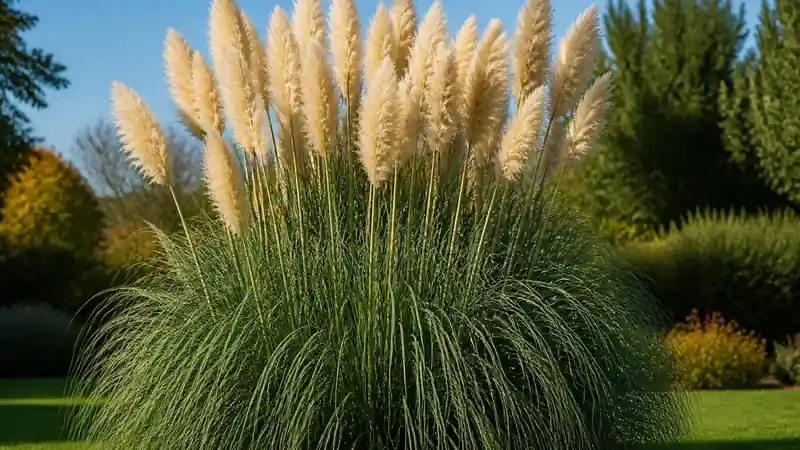
Pampas grass (Cortaderia selloana) is a 6 to 12 ft South American clump grass, reliably hardy in zone 8: legal in most states, but rated invasive in California and a Class C noxious weed in Washington.
Key takeaways
- Washington lists both pampas grass and jubata grass as Class C noxious weeds (WAC 16-750-015), and Oregon puts jubata grass on its “B” list, which bans its sale, transport and propagation statewide (OAR 603-052-1200). No Cortaderia is on the federal noxious weed list (7 CFR 360.200).
- Washington counted a mean of 416,399 seeds per escaped pampas grass plant, with a range of 54,567 to 840,905 (Washington State Noxious Weed Control Board); Cal-IPC puts the figure at up to 100,000 seeds per plume (Cal-IPC).
- Female cultivars are not sterile: a female plant sets seed when a hermaphrodite plant is within pollen range (NWCB), and a 2007 genetic study traced invasive California populations to landscape plantings (Okada et al., Molecular Ecology).
- University of Georgia Extension rates common pampas grass hardy in zone 8 and only marginal in zones 6 and 7 (UGA Circular 983, reviewed 2017). The “hardy pampas grass” sold for colder zones is usually Ravenna grass, an Oregon “A” weed.
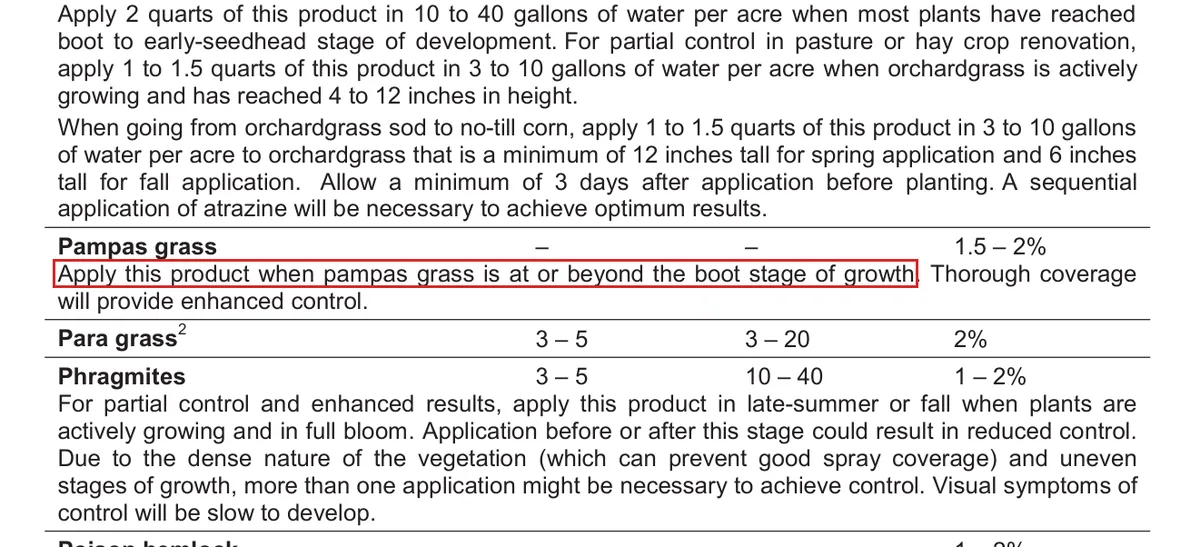
- The Roundup master label (EPA Reg. No. 524-475) lists pampas grass at a 1.5 to 2 percent hand-held spray, applied at or beyond the boot stage (EPA-accepted label, Oct. 2016); a UC Davis trial found digging gave 98 to 100 percent control (DiTomaso et al., 2008).
What is pampas grass?
Pampas grass is Cortaderia selloana, a perennial bunch grass from Argentina, Brazil and Uruguay that forms a tussock of saw-edged leaves topped by 1 to 3 ft plumes in late summer (NWCB). Plants are either female or hermaphrodite; the hermaphrodites act as pollen sources, so growers call them male. USDA PLANTS lists it as introduced in the lower 48 states (USDA PLANTS, COSE4).
| Fact | Figure | Source |
|---|---|---|
| Height | 6 to 12 ft (NC State); 10 ft tall and 6 ft wide at maturity (UGA) | NC State; UGA C983 |
| Leaf blades | Up to 6.6 ft long, with sharp toothed margins | NWCB |
| Plume length | 1 to 3 ft | NWCB |
| Stems (culms) | 6.6 to 13.1 ft (2 to 4 m) | NWCB |
| Seeds per plume | Up to 100,000 | Cal-IPC |
| Seeds per escaped plant | Mean 416,399; range 54,567 to 840,905 | NWCB |
| Wind dispersal | Reported up to 20 miles | Thurston County NWCB, 2016 |
| Seed life | About 9 to 12 months (Cal-IPC handbook); under 6 months (Oregon State) | Weed Workers’ Handbook; OSU |
| Plant life | Over a decade | CDFW; Weed Workers’ Handbook |
| Arrival in California | 1848, Santa Barbara nurseries | CDFW |
| Spacing in a planting | About 10 ft apart | NC State |
Three other plumed grasses share the name. Jubata grass (Cortaderia jubata) is the species behind most West Coast infestations; USDA PLANTS calls it purple pampas grass (USDA PLANTS, COJU2), and Oregon’s profile lists pink pampas grass as another of its names (ODA). Ravenna grass (Tripidium ravennae) and some Miscanthus are sold as hardy pampas grass (Denver Botanic Gardens).
| Trait | Pampas grass (C. selloana) | Jubata grass (C. jubata) | Ravenna grass, “hardy pampas” (Tripidium ravennae) | Source |
|---|---|---|---|---|
| Seed without pollination | No: needs pollen from a hermaphrodite plant | Yes: all plants female, seed by apomixis | Self-seeds in warm climates | NWCB; NWCB jubata; NWCB Ravenna |
| Immature plume color | White (female) or white-violet (male) | Deep violet, fading pink to tan | Pink at first, then silver | OSU; NC State |
| Plume height above leaves | 0 to 3 ft (female); 0 to 6 ft (male) | 3 to 6 ft | Plumes on stalks to 13 ft | OSU; NWCB |
| Bloom on the California coast | Late August, mostly September | Late July into September | Late summer | Pacific Horticulture; NC State |
| USDA zones | Reliable in 8; marginal in 6 and 7 | Coastal, frost-moderated sites | 5a to 9b | UGA; Cal-IPC; NC State |
| Status in Oregon | Not listed | “B” weed, quarantined | “A” weed, quarantined | OAR 603-052-1200 |
| Status in Washington | Class C (2015) | Class C (2015) | Class B (2017) and on the quarantine list | WAC 16-750-015; WAC 16-752-610 |
Is pampas grass invasive, and where is it regulated?
Pampas grass is invasive in parts of the United States, mostly the West Coast and Hawaii. Cal-IPC rates both Cortaderia species High in California (Cal-IPC), Washington lists both as Class C noxious weeds, Oregon quarantines jubata grass, and UF/IFAS does not recommend pampas grass in Florida. UGA Extension says it is not invasive in the Southeast.
Regulation and advice differ. A quarantine, like Oregon’s, makes selling, moving or propagating the plant illegal. Washington’s Class C listing lets counties choose whether to require control; King County does not require owners to remove pampas grass but encourages it (King County). California has no CDFA rating for C. selloana, so the California Department of Fish and Wildlife asks gardeners not to plant it rather than banning it (CDFW).
| State or level | Pampas grass (C. selloana) | Jubata grass (C. jubata) | What it means for a homeowner | Source |
|---|---|---|---|---|
| Federal | Not listed | Not listed | No federal restriction on either species | 7 CFR 360.200 |
| California | Cal-IPC High; no CDFA rating; CDFW “Don’t Plant Me” list | Cal-IPC High | Advice, not a ban; Burpee and Wilson Bros Gardens do not ship pampas grass to CA | Cal-IPC; CDFW |
| Oregon | Not on the state list | “B” weed; quarantined statewide | Jubata grass cannot be sold, moved or propagated; Portland requires eradication | OAR 603-052-1200; City of Portland |
| Washington | Class C noxious weed, listed 2015 | Class C noxious weed, listed 2015 | Control is up to each county; neither species is on the WAC 16-752 quarantine list | WAC 16-750-015; WAC 16-752-610 |
| Hawaii | Not on the HDOA chapter 4-68 list; HPWRA score 24, High Risk | On the chapter 4-68 list for all islands; HPWRA 26, High Risk | Island invasive species committees ask owners to report plants and not cut or move them | HAR ch. 4-68; HISC; OISC |
| Florida | UF/IFAS: predicted invasive, not recommended | Not assessed | Extension advises against planting | UF/IFAS Assessment; UF/IFAS Gardening Solutions |
| Texas | Not on the TDA noxious and invasive plant list | Not listed | Legal to sell; TexasInvasives.org tracks it as invasive | TDA list via TexasInvasives; TexasInvasives.org |
| South Carolina | On SC-EPPC’s list of plants reported invasive in natural areas | Not listed | Council list, not a regulation | SC-EPPC list via Invasive Plant Atlas |
| Georgia | Not on the GA-EPPC list; UGA: not invasive in the Southeast | Not listed | Planting is recommended with siting cautions | GA-EPPC list via Invasive Plant Atlas; UGA C983 |
| North Carolina | NC State tags it weedy and invasive in some areas | Not listed | Extension advice only | NC State |
| Arizona | Northern Arizona guide: aggressive, hard to eradicate | Not listed | Guidance only | Northern Arizona Invasive Plants guide |

Hawaii is where secondary guides go furthest. One national gardening magazine says Hawaii banned pampas grass outright, and the Hawaii Invasive Species Council labels both species “Hawaii Noxious Weed (HAR 68)” (HISC). The rule text hosted by the Hawaii Department of Agriculture lists Cortaderia jubata for all islands and does not list C. selloana (HAR chapter 4-68, list adopted June 18, 1992). Oahu’s committee asks residents not to cut or pull plants but to report them so crews can bag the seed (OISC).
Are dwarf or “sterile” pampas grass cultivars safe to plant?
Dwarf and female pampas grass cultivars are smaller, not seedless. Female plants set seed whenever a hermaphrodite plant is within pollen range (NWCB), and Monrovia says its Ivory Feathers dwarf “is not considered sterile” (Monrovia, Oct. 2026). A 2007 study of 698 invasive and 275 cultivated plants points to landscape plantings as probable sources of California’s invasions (Okada et al., 2007).
The history explains the risk. California nurseries once sold only female plants propagated by division, which set no seed without pollen (Pacific Horticulture); Thurston County reports that some nurseries later raised pampas grass from seed, which put male plants into landscapes (Thurston County NWCB). Herbarium records show C. selloana spread at twice the rate of the all-female jubata grass once it took off in the 1940s (Lambrinos, Journal of Ecology, 2001).
| Cultivar | Size | Hardiness | Seed claim and what sources say | Source |
|---|---|---|---|---|
| ‘Pumila’ (dwarf) | 5 to 7 ft (UGA); foliage 4 to 5 ft (Wilson Bros) | Zone 6 (UGA); 7a to 11 (Wilson Bros) | Some sellers call it sterile; we found no published seed test. Female clones seed if pollinated | UGA; Wilson Bros |
| Ivory Feathers (Monrovia) | Foliage 3 to 5 ft by 4 to 6 ft; plumes 8 to 10 ft | 7 to 11 | Maker: “not considered sterile,” little to no viable seed | Monrovia |
| ‘Gold Band’ | 4 to 6 ft, golden-striped leaves | Zone 8 | No seed claim found | UGA |
| ‘Monvin’ (Sun Stripe) | Yellow-striped leaves | Zone 8 | No seed claim found | UGA |
| ‘Sundale Silver’ | To 10 ft | Zone 8 | Thurston County lists both ‘Sundale Silver’ and ‘Sunning Dale Silver’ among varieties sold | UGA; Thurston |
| ‘Silver Comet’ | To 8 ft, white-striped | Zone 8 | No seed claim found | UGA |
| ‘Andes Silver’ | Plumes to 7 ft | Zone 6 | No seed claim found | UGA |
| ‘Patagonia’ | Plumes to 7 ft above blue-gray foliage | Zone 6 | No seed claim found | UGA |
| ‘Pink Feather’ | Large pink-blushed plumes | Zone 8 | Pink color is not proof of species: jubata grass is also sold as pink pampas | UGA; ODA |
| ‘Bertini’ | Under 4 ft | Zone 7 | No seed claim found | UGA |
Oregon State’s test for an existing plant is practical: look for seedlings on bare ground nearby each year. If none appear, Oregon State says the plant can stay; if they do, remove the pampas grass (Oregon State University Extension). Buying seed, sold online as pampas grass seeds, adds risk because UGA notes seed-grown plants can be male and you cannot tell until they flower (UGA C983).
How big does pampas grass get, and in which zones does it grow?
Pampas grass grows 6 to 12 ft tall in full sun and survives reliably where winter lows stay above about 10 °F, USDA zone 8 and warmer. UGA calls it marginal in zones 6 and 7 (UGA C983), and an Illinois Extension educator writes that true pampas grass “does not grow in our climate” (Illinois Extension). Seller ranges start at zone 7, one zone colder than UGA’s rating.
| Source | Zones stated | Coldest average winter low in that range (USDA PHZM) | Source link |
|---|---|---|---|
| UGA Extension | Hardy in 8; marginal in 6 and 7 | Zone 8: 10 to 20 °F; zone 6: minus 10 to 0 °F | UGA C983 |
| NC State Plant Toolbox | 6a, 6b, 7b to 10b (7a not listed) | Zone 6a: minus 10 to minus 5 °F | NC State |
| Monrovia, Ivory Feathers | 7 to 11 | Zone 7: 0 to 10 °F | Monrovia |
| Wilson Bros, white and ‘Pumila’ | 7a to 11 (“some sources say 6” for ‘Pumila’) | Zone 7a: 0 to 5 °F | Wilson Bros |
| Trees.com | 7 to 10, “hardy down to 10 °F” | Zone 7: 0 to 10 °F | Trees.com |
| Burpee, pink pampas | 7 to 10 | Zone 7: 0 to 10 °F | Burpee |
| Illinois Extension | Does not grow in the Illinois River region; Ravenna grass is hardy in 5 to 9 | Zone 5: minus 20 to minus 10 °F | Illinois Extension |
Site it like a small tree. UGA wants full sun or at least a half day of direct light and warns against planting near buildings because dead foliage is a fire hazard (UGA). Oregon’s jubata grass profile calls the dry build-up a fire hazard (ODA), and the Hawaii council gives both species a weed fire-risk score of 0.72 (HISC). Give each clump about 10 ft (NC State); evergreen options for a living privacy screen are compared in our fastest-growing trees guide.
When and how should you cut back pampas grass?
Cut pampas grass back once a year in late winter, before new growth starts: University of Arkansas Extension says late February to early March, down to a mound about 4 to 5 inches high (UA Division of Agriculture). If green shoots have already started, cut just above them. Skipping a year leaves a mass of dry leaves that UGA flags as a fire hazard.
| Source | When to cut | How low | Source link |
|---|---|---|---|
| University of Arkansas Extension | Late February to early March, every year | Mound of 4 to 5 inches; above new shoots if already up | UA Division of Agriculture |
| UGA Extension | Late winter, before the new growing season | Close to ground level | UGA C983 |
| Denver Botanic Gardens | Not before February | Cut back hard | Denver Botanic Gardens |
| Monrovia (Ivory Feathers) | Late winter, before new growth emerges | Hard prune old foliage to the ground | Monrovia |
| NC State (Ravenna grass) | Late winter to early spring | To the ground | NC State |
- Pick the date: late February to early March in Arkansas; Denver Botanic Gardens waits until February so the plumes carry through winter (Denver Botanic Gardens).
- Dress for the leaves: leather gloves, long sleeves and eye protection. NWCB notes the leaf margins have teeth that cut skin.
- Cut the clump to 4 to 5 inches with hedge shears, loppers or a power pruner (UGA); Arkansas notes some owners use a chainsaw because the base is tough.
- Pull back the old growth first to find the new shoots, and cut above them if they are already up.
- Feed lightly: UGA suggests a light broadcast of a complete fertilizer such as 8-8-8 or 10-10-10 after pruning (UGA).
- Bag the cut plumes rather than composting them, because plumes cut before maturity can still ripen seed (Thurston County).
How do you get rid of pampas grass?
Get rid of pampas grass by bagging every plume, cutting the leaves down and digging out the whole crown; a UC Davis trial found digging controlled 98 to 100 percent of jubata grass of every size (DiTomaso, Drewitz and Kyser, Invasive Plant Science and Management, 2008). Where digging is not practical, spot-spray glyphosate on regrowth, then check twice a year for resprouts.
- Bag the plumes first, including immature ones still in their sheath, because cut stalks can mature seed (Cal-IPC Weed Workers Handbook).
- Pull seedlings and clumps under 3 ft by grasping the base and jerking out the crown (UC Master Gardeners).
- For bigger clumps, cut leaves to near ground level with a Pulaski, Swedish brush ax or chainsaw. The handbook warns the chainsaw is slow and risky because the grass clogs the guard.
- Chop the root mass into 4 to 5 inch squares with the ax side of a Pulaski and hoe out the pieces, or pull a clump near a road with a choker cable and a truck hitch (Weed Workers Handbook).
- For established stands, Oregon State says crews expose the crown with string trimmers or chainsaws, then dig with an excavator or backhoe (OSU).
- Turn dug crowns upside down with the main root mass several inches off the soil, or bag them; crowns left on moist soil re-root.
- Cover bare soil with mulch or plant competitors, because disturbed bare ground is where seedlings start (NWCB); the cubic yards for a 3-inch layer are in our mulch calculator.
- Check twice a year for resprouts and seedlings (Thurston County); Oregon State plans for 2 to 3 years of follow-up.
| Method (UC Davis jubata grass trial) | Control | When | Notes | Source |
|---|---|---|---|---|
| Digging with a Pulaski | 98 to 100% | June 1998, all plant sizes | Most labor; disturbs soil | DiTomaso et al., 2008 |
| Glyphosate, low-volume, 8% product (2.4% ae) | Over 98% on large plants | Early summer and fall 2002 | Cheapest effective treatment: $0.28 per large plant (2007 prices, $20 an hour labor) | DiTomaso et al., 2008 |
| Glyphosate, spray-to-wet, 2% product (0.6% ae) | 94 to 100% (2000); 74 to 75% (2002) | Early summer best | The usual California method; $0.10 more per plant than low-volume | DiTomaso et al., 2008 |
| Glyphosate by ropewick, 33 to 100% product | About 95% on large plants | Early summer or fall | Most selective, more costly | DiTomaso et al., 2008 |
| Imazapyr, 4% product, fall | 84% (2002) | Fall | Inconsistent between years; authors call it uneconomical | DiTomaso et al., 2008 |
| Fluazifop, best rate | 62% or less (2002) | Fall or early summer | Grass-selective; erratic | DiTomaso et al., 2008 |
| Chainsaw alone or chainsaw plus glyphosate, large plants | No better than 85% | Cut June, spray fall | Authors judge it impractical for large plants | DiTomaso et al., 2008 |
| Burning or grazing | No long-term control | Any | Plants resprout quickly | UC Master Gardeners |
If you spray, the label sets the rate. The Roundup master label, EPA Reg. No. 524-475, lists pampas grass in its perennial-weed tables at a 1.5 to 2 percent hand-held solution and says to apply “when pampas grass is at or beyond the boot stage of growth,” with thorough coverage (EPA-accepted master label, submitted Oct. 17, 2016, p. 114). Thurston County offers an alternative: cut the clump first, then spray the regrowth once it is a couple of feet tall; it reports fall treatments as somewhat more effective.
| Clump footprint | Plan area (3.1416 x radius squared) | Spray-to-wet solution at 1,860 L/ha (0.58 fl oz per sq ft) | Concentrate at 1.5% | Concentrate at 2% |
|---|---|---|---|---|
| 3 ft across | 7.1 sq ft | 4.1 fl oz (0.03 gal) | 0.06 fl oz | 0.08 fl oz |
| 6 ft across | 28.3 sq ft | 16.5 fl oz (0.13 gal) | 0.25 fl oz | 0.33 fl oz |
| 10 ft across | 78.5 sq ft | 45.9 fl oz (0.36 gal) | 0.69 fl oz | 0.92 fl oz |
| Per gallon of mix | Not applicable | 128 fl oz | 1.92 fl oz | 2.56 fl oz |
Vinegar is not on any of these lists. NC State Extension says vinegar products only burn the foliage of perennial weeds and grasses (NC State Extension, 2018), and Oregon State names glyphosate, fluazifop and imazapyr as the home-use actives that work (OSU). What acetic acid does kill is covered in our vinegar weed killer guide. Spraying someone else’s pampas grass for pay requires a license in most states; see our pesticide applicator license guide.
This page is general information, not pesticide advice. The label is the law: read the whole label of the product you buy, follow its rate and site directions, and check state and local rules before spraying near water.
What does pampas grass cost to buy or remove?
A pampas grass plant cost $14.95 to $79.97 at four U.S. retailers checked on Oct. 28, 2026, from a single Burpee plant to a 3-gallon pot from Wilson Bros Gardens. Removal costs are rarely published: the only dated per-plant figure we found is the UC Davis trial’s $0.28 to $0.38 spray cost per large jubata grass plant in 2007 dollars.
| Item | Size | Price (Oct. 28, 2026) | Does not ship to | Source |
|---|---|---|---|---|
| Burpee Pink Pampas Cortaderia | 1 plant (pot size not stated) | $14.95 | AK, CA, CO, HI and U.S. territories | Burpee |
| Pike Nurseries, Monrovia Ivory Feathers | 2 gallon | $34.99 | Store pickup, Georgia | Pike Nurseries |
| Trees.com Plume Pampas Grass | 3 gallon | $50.95 ($40.76 with a sitewide code) | AK, AZ, HI | Trees.com |
| Wilson Bros Gardens White Pampas Grass | 3 gallon | $79.97 (2 or more: $74.85 each) | AK, CA, HI | Wilson Bros |
| Wilson Bros Gardens Dwarf White Pampas (‘Pumila’) | 3 gallon | Out of stock | AK, CA, HI | Wilson Bros |
| Low-volume glyphosate spray, large clump (research) | 1 sq m of plant | $0.28 per plant (2007) | Not applicable | DiTomaso et al., 2008 |
| Spray-to-wet glyphosate, large clump (research) | 1 sq m of plant | $0.38 per plant (2007) | Not applicable | DiTomaso et al., 2008 |
| Landscaping worker median wage | Per hour | $18.82 (May 2025) | Not applicable | BLS OEWS 37-3011 |
Three things move a removal bill: clump size, whether a machine can reach it and whether the crew hauls the debris. Oregon State says established stands often need an excavator or backhoe (OSU). Payroll alone for a three-person crew runs $57.48 to $87.12 an hour before equipment and overhead, according to our landscaping labor cost by state data. Some public programs cut the cost: Portland offers free help with required jubata grass removal (City of Portland), and Oahu’s committee removes reported plants (OISC).
What can you plant instead of pampas grass?
State agencies name regional stand-ins: giant wildrye in California (CDFW), ‘Karl Foerster’ feather reed grass or giant needle grass in Washington (NWCB), muhly grass or Fakahatchee grass in Florida (UF/IFAS), and giant sacaton in Colorado (Denver Botanic Gardens). None of these appears on the state noxious weed lists checked for this page.
| Region | Alternative | Why the agency suggests it | Source |
|---|---|---|---|
| California | Giant wildrye (Elymus condensatus) | Native, drought tolerant, spreads slowly, seeds feed birds | CDFW |
| Washington, Oregon | Calamagrostis x acutiflora ‘Karl Foerster’; giant needle grass (Stipa gigantea) | Non-invasive alternatives named by the state weed board and King County | NWCB; King County |
| Florida | Muhly grass; Fakahatchee grass | Native grasses UF/IFAS recommends instead | UF/IFAS |
| Texas | Lindheimer’s muhly (Muhlenbergia lindheimeri) | Listed as an alternative on the TexasInvasives pampas grass record | TexasInvasives.org |
| Colorado and the Southwest | Giant sacaton (Sporobolus wrightii) | Native, long-lived, Plant Select pick, no irrigation once established in Denver | Denver Botanic Gardens |
| Hawaii | Species from the Plant Pono list | OISC asks owners to replace pampas grass with non-invasive plants | OISC |
For the Southeast, pink muhly grass is the usual swap for a pink plume; spacing, cultivars and cutting dates are in our pink muhly grass guide. For an upright 5 ft screen in colder zones, both Washington agencies suggest the sterile hybrid in our Karl Foerster feather reed grass profile. Cal-IPC notes pampas grass was first planted in California partly for erosion control (Cal-IPC); for a bank or slope, see what extension services plant instead in our erosion control methods guide. Other grass profiles are indexed on our Turf and Trees hub.
What do popular guides get wrong about pampas grass?
Four claims recur in popular guides and do not match the primary sources: that sterile cultivars are safe, that Hawaii banned the plant, that Oregon lists pampas grass, and that burning removes it. Oregon’s quarantine names jubata grass, not C. selloana (OAR 603-052-1200), and UC Master Gardeners report that plants resprout after burning (UCCE).
| Common claim | What the primary source says | Source |
|---|---|---|
| Grow a sterile cultivar to stop spread | Monrovia says Ivory Feathers is not considered sterile; female clones set seed when pollinated | Monrovia; NWCB |
| Hawaii has banned pampas grass | The HDOA-hosted chapter 4-68 list names C. jubata, not C. selloana | HAR ch. 4-68 |
| Pampas grass is a noxious weed in Oregon and Washington | Washington lists both species as Class C; Oregon lists only jubata grass (“B”) | WAC 16-750-015; OAR |
| Controlled burns eliminate pampas grass | Burning and grazing do not give long-term control; plants resprout | UC Master Gardeners |
| Pampas grass is hardy in zone 6 | UGA: marginal in 6 and 7; reliable in 8 | UGA C983 |
| Hardy pampas grass is a cold-tolerant pampas | It is usually Ravenna grass, an Oregon “A” weed and Washington Class B, quarantined plant | NC State; WAC 16-752-610 |
Should you plant, keep or remove pampas grass?
Plant pampas grass only in zone 8 or warmer, away from the West Coast, Hawaii and natural areas. Keep an existing plant if no seedlings appear around it, and remove it if they do (OSU). In Oregon, a plant that turns out to be jubata grass falls under the state quarantine; Portland residents must remove it.
| If your situation is | Do this | Why (source) |
|---|---|---|
| You live on the California, Oregon or Washington coast, or in Hawaii | Do not plant either Cortaderia; choose a regional alternative | Cal-IPC High; WA Class C; OR quarantine; Hawaii High Risk scores (Cal-IPC, WAC, OAR, HISC) |
| The plumes open deep violet in late July and sit 3 to 6 ft above the leaves | Treat it as jubata grass: in Oregon do not move, sell or propagate it; report it in Portland | OAR 603-052-1200; City of Portland |
| You see seedlings on bare ground near an existing clump | Remove the parent plant and the seedlings | Oregon State Extension |
| No seedlings after a full season, and you are in zone 8 or warmer outside the West Coast | Keep it; cut back in late February to early March | OSU; UA Division of Agriculture |
| Seedling or clump under 3 ft | Pull or dig out the whole crown | UC Master Gardeners; NWCB |
| Clump over 3 ft that a shovel cannot lift | Bag plumes, cut foliage, chop the crown in 4 to 5 inch blocks, or spray regrowth at 1.5 to 2% glyphosate per the label | Weed Workers Handbook; EPA Reg. No. 524-475 |
| You garden in zone 6 or colder | Skip true pampas grass; avoid Ravenna grass in OR and WA | UGA C983; OAR; WAC 16-752-610 |
| You will spray a client’s plants | Hold the state pesticide applicator license first | State licensing rules |
1Are you on the California, Oregon or Washington coast, or in Hawaii?
YesDo not plant; pick a regional alternative such as giant wildrye or 'Karl Foerster' (CDFW, NWCB).
NoGo to the next question
2Do the plumes open deep violet in late July, 3 to 6 ft above the leaves?
YesLikely jubata grass: in Oregon it is quarantined; do not move or sell it, and report it in Portland (OAR 603-052-1200).
NoGo to the next question
3Are seedlings coming up on bare ground near the clump?
YesRemove the parent and the seedlings; bag every plume first (Oregon State).
NoGo to the next question
4Are you in zone 7 or colder?
YesSkip true pampas grass, which UGA rates reliable only in zone 8; do not substitute Ravenna grass in OR or WA.
NoGo to the next question
5Is the clump under 3 ft across?
YesPull or dig out the whole crown (UC Master Gardeners).
NoKeep it: cut back to 4 to 5 inches in late February to early March, and check for seedlings each year.
Source: Oregon State Extension, UGA C983, OAR 603-052-1200, CDFW, NWCB, UC Master Gardeners
How we compiled this
In October 2026 we read 5 state and federal rule texts (WAC 16-750-015, WAC 16-752-610, OAR 603-052-1200, HAR chapter 4-68 and 7 CFR 360.200), the EPA-accepted Roundup master label 524-475, 3 peer-reviewed papers, more than 25 extension, agency and invasive-council pages, and 6 maker and retailer pages checked Oct. 28, 2026. We did not grow, test or remove any plants. Cultivar seed claims are the sellers’ own, and the control percentages come from a jubata grass trial, which we apply to pampas grass because both are treated the same way in the sources cited.
| Question | Short answer | Source |
|---|---|---|
| Legal to plant? | Yes in most states; jubata grass is quarantined in Oregon | OAR |
| Reliable zones | 8 and warmer | UGA |
| Cut back | Late Feb. to early March, to 4 to 5 in | UA |
| Best removal | Dig the crown: 98 to 100% control | DiTomaso 2008 |
| Label spray rate | 1.5 to 2% hand-held, at or past boot stage | EPA 524-475 |
Frequently asked questions
What are the downsides of pampas grass?
Its saw-toothed leaves cut skin, its dry foliage is a fire hazard, and it needs a hard cut every late winter. Where male and female plants grow together, one plant can release hundreds of thousands of seeds, which is why Washington lists it as a Class C noxious weed (NWCB).
Does pampas grass have to be cut back every year?
Yes, for a tidy plant. University of Arkansas Extension cuts it to a 4 to 5 inch mound every year in late February to early March, before new growth starts (UA Division of Agriculture). Uncut, old leaves pile up in the clump, and UGA warns that dry material is a fire hazard.
Does pampas grass like sun or shade?
Sun. UGA Extension says it grows and flowers best in full sun, or at least a half day of direct light (UGA C983). NC State lists 6 or more hours of sun, with part shade of 2 to 6 hours tolerated; expect fewer plumes in shade.
Does pampas grass come back every year?
Yes, where it is hardy. It is a perennial that regrows from its crown each spring and can live over a decade (CDFW). UGA rates it reliable in zone 8 and only marginal in zones 6 and 7, where a cold winter can kill the crown.
Why is pampas grass illegal?
Pampas grass itself is not illegal anywhere we checked. Its look-alike jubata grass is: Oregon bans its sale, transport and propagation (OAR 603-052-1200). Burpee and Wilson Bros Gardens will not ship pampas grass to California, and all three mail-order sellers we checked exclude Hawaii.
Does vinegar kill pampas grass?
No. NC State Extension says vinegar products only burn the foliage of perennial weeds and grasses (NC State Extension), and pampas grass regrows from its crown. Oregon State lists glyphosate, fluazifop and imazapyr as the home-use actives that work; digging out the crown needs no spray.
Is pampas grass hardy in zone 5?
No. UGA rates true pampas grass marginal even in zones 6 and 7, and an Illinois Extension educator writes that it does not grow in the Illinois River region (Illinois Extension). Hardy pampas grass sold for zone 5 is usually Ravenna grass, which Oregon and Washington regulate.
Can dried pampas grass decor spread seeds?
It can. Thurston County names plumes used in decorative arrangements as one way the plant spreads (Thurston County NWCB). UGA suggests cutting plumes as soon as they emerge, before they mature and shed, and spraying them with hairspray. Bag old wreaths for the trash.
Sources
- Washington State Legislature, WAC 16-750-015, State noxious weed list: Class C noxious weeds (effective Jan. 1, 2026), 2026. Accessed October 2026.
- Washington State Legislature, WAC 16-752-610, Noxious weed seed and plant quarantine: regulated articles, Effective Feb. 7, 2026. Accessed October 2026.
- Oregon Administrative Rules, via Cornell LII, OAR 603-052-1200, Quarantine; Noxious Weeds, Current rule. Accessed October 2026.
- Hawaii Department of Agriculture, HAR Title 4, Chapter 68, Noxious Weed Rules (list adopted June 18, 1992), 1992 list. Accessed October 2026.
- eCFR, 7 CFR 360.200, Designation of noxious weeds, Current. Accessed October 2026.
- U.S. EPA Pesticide Product Label System, Roundup master label, EPA Reg. No. 524-475 (submitted Oct. 17, 2016), 2016. Accessed October 2026.
- DiTomaso, Drewitz and Kyser, Jubatagrass (Cortaderia jubata) Control Using Chemical and Mechanical Methods, Invasive Plant Science and Management 1(1):82-90, 2008. Accessed October 2026.
- Okada, Ahmad and Jasieniuk, Microsatellite variation points to local landscape plantings as sources of invasive pampas grass in California, Molecular Ecology, 2007. Accessed October 2026.
- Lambrinos, The expansion history of a sexual and asexual species of Cortaderia in California, USA, Journal of Ecology 89:88-98, 2001. Accessed October 2026.
- Washington State Noxious Weed Control Board, Pampas grass, Cortaderia selloana, Current page. Accessed October 2026.
- Washington State Noxious Weed Control Board, Jubata grass, Cortaderia jubata, Current page. Accessed October 2026.
- Washington State Noxious Weed Control Board, Ravenna grass, Saccharum ravennae, Current page. Accessed October 2026.
- Thurston County Noxious Weed Control Agency, Pampas Grass fact sheet, 2016. Accessed October 2026.
- King County Noxious Weed Control Program, Pampas grass identification and control, Current page. Accessed October 2026.
- California Department of Fish and Wildlife, Invasive to Avoid: Pampas Grass, Current page. Accessed October 2026.
- California Invasive Plant Council, Cortaderia selloana profile, Current page. Accessed October 2026.
- California Invasive Plant Council, Cortaderia jubata profile, Current page. Accessed October 2026.
- California Invasive Plant Council, Weed Workers’ Handbook: Pampas grass and jubata grass, Handbook. Accessed October 2026.
- UC Master Gardeners, The Coastal Gardener, Pampas (Jubata) Grass: Beauty? No it is a Beast!, Current page. Accessed October 2026.
- Oregon State University Extension, How to Manage Jubatagrass and Pampasgrass, Current page. Accessed October 2026.
- Oregon Department of Agriculture, Jubata grass weed profile, Profile. Accessed October 2026.
- City of Portland Environmental Services, Jubata grass, Required Eradication List, Current page. Accessed October 2026.
- Hawaii Invasive Species Council, Pampas grass (Cortaderia jubata, Cortaderia selloana), Current page. Accessed October 2026.
- Oahu Invasive Species Committee, Pampas grass, Current page. Accessed October 2026.
- University of Georgia Extension, Circular 983, Pampas Grass (Pennisi and Dorn), Reviewed Aug. 7, 2017. Accessed October 2026.
- NC State Extension, Cortaderia selloana, Plant Toolbox, Current page. Accessed October 2026.
- NC State Extension, Tripidium ravennae, Plant Toolbox, Current page. Accessed October 2026.
- NC State Extension, Are There Alternatives to Glyphosate for Weed Control in Landscapes?, 2018. Accessed October 2026.
- UF/IFAS, Pampas grass, Gardening Solutions, Current page. Accessed October 2026.
- UF/IFAS, Assessment of Non-Native Plants: Cortaderia selloana, Updated Jan. 23, 2026. Accessed October 2026.
- University of Arkansas Division of Agriculture, Pampas grass pruning, Current page. Accessed October 2026.
- University of Illinois Extension, Hardy Pampas Grass (Ferree), Nov. 5, 2017. Accessed October 2026.
- Denver Botanic Gardens, Will the real Pampas Grass please stand up? (Kelaidis), Jan. 24, 2013. Accessed October 2026.
- Pacific Horticulture, Pampas Grasses: One a Weed and One a Garden Queen (Madison), Article. Accessed October 2026.
- Texas Invasive Species Institute, Cortaderia selloana record and TDA noxious weed list, Current page. Accessed October 2026.
- Texas Department of Agriculture list, via TexasInvasives.org, TDA Noxious Weed List (4 TAC 19.300), Current list. Accessed October 2026.
- Invasive Plant Atlas of the United States, South Carolina Exotic Pest Plant Council list, Current list. Accessed October 2026.
- Invasive Plant Atlas of the United States, Georgia Exotic Pest Plant Council list, Current list. Accessed October 2026.
- Northern Arizona Invasive Plants, A Northern Arizona Homeowner’s Guide: Pampas Grass, 2024. Accessed October 2026.
- USDA NRCS PLANTS Database, Cortaderia selloana (COSE4) and Cortaderia jubata (COJU2), Current. Accessed October 2026.
- USDA ARS, Plant Hardiness Zone Map, 2023 map. Accessed October 2026.
- Monrovia, Ivory Feathers Dwarf Pampas Grass, Oct. 2026. Accessed October 2026.
- Retailers, Burpee, Trees.com, Wilson Bros Gardens and Pike Nurseries product pages, Checked Oct. 28, 2026. Accessed October 2026.
- U.S. Bureau of Labor Statistics, OEWS 37-3011 Landscaping and Groundskeeping Workers, May 2025. Accessed October 2026.