The fastest growing trees for U.S. yards are hybrid poplar, at 4 to 6 feet a year (USDA Forest Service), then Leyland cypress and Thuja ‘Green Giant’ at 3 to 4 feet. Most trade that speed for weak wood.
25 in. or more of height a year is “fast” (Dirr, via Arbor Day Foundation)
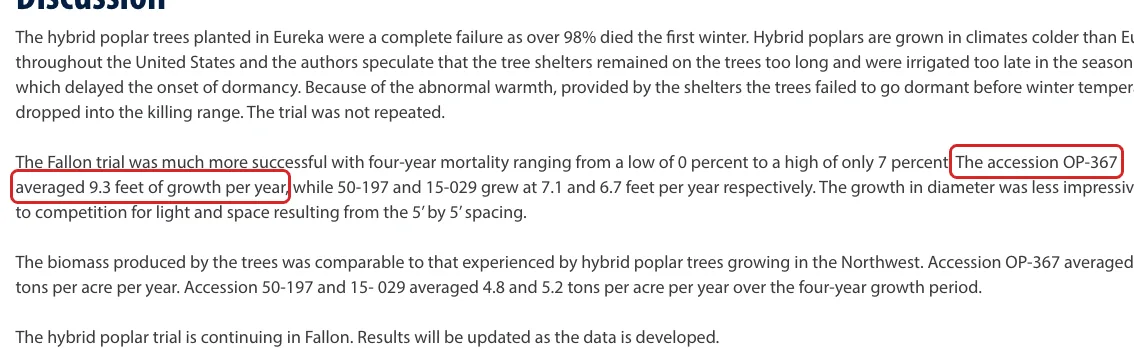
9.3 ft a year: best hybrid poplar clone in an irrigated Nevada trial (UNR Extension)
30 ft at 30 years: the original Thuja ‘Green Giant’ (U.S. National Arboretum)
4,800 lbf/in² green bending strength of willow wood, vs 8,300 for pin oak (USDA Wood Handbook)
Key takeaways
- Hybrid poplar is the fastest yard tree with a federal growth figure: early height growth averages 4 to 6 feet a year, and first-year growth runs 3 to 8 feet (USDA Forest Service, Silvics of North America).
- Leyland cypress grows 3 to 4 feet a year when young (UF/IFAS fact sheet ST671) but NC State gives it a 20 to 50 year life and lists incurable cankers and root rots (NC State Extension).
- Retail claims of 3 to 5 feet a year for Thuja ‘Green Giant’ describe the best years: the U.S. National Arboretum lists the clone at 30 feet after 30 years (USNA release sheet).
- Among trees extension services rate as fast, pin oak and northern red oak have the strongest wood, 8,300 lbf/in² green modulus of rupture, against 4,800 for willow (USDA Wood Handbook, Table 5-3b).
- Callery (Bradford) pear, a rapid grower, can no longer be sold in Ohio (since January 7, 2023), Pennsylvania or South Carolina (since October 1, 2024), and Missouri follows on January 1, 2029 (Ohio Adm. Code 901:5-30-01; Missouri SB 105).
Most lists of fast-growing trees repeat nursery claims with no source and no downside. This one ranks 16 species by the growth figures that U.S. Forest Service silvics chapters and land-grant extension fact sheets publish, then adds what the lists leave out: wood strength from the Forest Products Laboratory, lifespan, root problems, planting distance and the state rules that now ban several fast growers from sale. Prices are on our tree planting cost guide.
Which trees grow the fastest?
Hybrid poplar grows fastest, at 4 to 6 feet a year early in life according to the USDA Forest Service silvics chapter on poplar hybrids. Weeping willow, dawn redwood, tulip poplar, Leyland cypress and Thuja ‘Green Giant’ follow at about 3 to 4.7 feet a year in published figures. Silver maple, river birch and pin oak average closer to 2 feet a year over the long run.
The table ranks each tree by the highest growth figure a primary source publishes for it. Where a source gives only a category (“rapid” or “fast”), the tree sits below those with numbers. Hardiness zones follow the 2023 USDA Plant Hardiness Zone Map, which uses 1991 to 2020 winter lows in 10°F zones.
Swipe the table sideways to see every column.
| Rank | Tree | Published growth rate | Mature height, spread | USDA zones | Lifespan | Size and zone source |
|---|---|---|---|---|---|---|
| 1 | Hybrid poplar (Populus crosses) | 4 to 6 ft early; 3 to 8 ft first year (Silvics); 6.7 to 9.3 ft in an irrigated trial (UNR) | 40 to 60 ft tall, 20 to 35 ft wide | 3 and warmer | Not stated | NDSU Tree Handbook |
| 2 | Tulip poplar (Liriodendron tulipifera) | 4.7 ft a year for stump sprouts, first 6 years (Silvics) | 80 to 120 ft, 30 to 60 ft | 4a to 9b | Up to 300 years | NC State |
| 3 | Dawn redwood (Metasequoia glyptostroboides) | About 4 ft a year: one Virginia tree reached 120 ft in 30 years (Arbor Day) | 62 to 100 ft, 15 to 25 ft | 4a to 8b | Not stated | NC State |
| 4 | Leyland cypress (x Hesperotropsis leylandii) | 3 to 4 ft young (UF/IFAS); 50 ft in 15 years (NC State) | 60 to 70 ft, 10 to 15 ft | 6a to 10b | 20 to 50 years | NC State |
| 5 | Thuja ‘Green Giant’ | 3 to 4 ft in optimal conditions (NC State); 30 ft at 30 years (USNA) | 40 to 60 ft, 12 to 18 ft | 5 to 7 (USNA); 5a to 8b (NC State) | 40 to 60 years | NC State |
| 6 | Weeping willow (Salix babylonica) | 3 ft a year; 3 to 8 ft by cultivar (Arbor Day) | 30 to 50 ft, 30 to 50 ft | 6a to 8b (NC State); 2 to 9A (UF/IFAS) | About 30 years | UF/IFAS ST576 |
| 7 | Quaking aspen (Populus tremuloides) | 2 to 3 ft a year (Arbor Day) | 20 to 50 ft, 10 to 30 ft | 1a to 6b | About 50 years per stem | NC State |
| 8 | Pin oak (Quercus palustris) | 2.5 ft a year average (Arbor Day) | 50 to 70 ft, 40 to 60 ft | 4a to 8b | Not stated | NC State |
| 9 | Baldcypress (Taxodium distichum) | 40 to 50 ft in 15 to 25 years, or 1.6 to 3.3 ft a year (UF/IFAS) | 60 to 80 ft, 25 to 35 ft | 5A to 10B | 400 to 600 years in old stands | Silvics |
| 10 | Silver maple (Acer saccharinum) | 81 ft at 43 years in Ontario plantations, or 1.9 ft a year (Silvics) | 60 to 80 ft, 40 to 60 ft | 3A to 9B | 130 years or more | UF/IFAS ST048 |
| 11 | River birch (Betula nigra) | 1.5 to 2 ft a year (Arbor Day) | 40 to 50 ft, 25 to 35 ft | 4A to 9A | 30 to 40 years in urban sites | UF/IFAS ST094 |
| 12 | Eastern cottonwood (Populus deltoides) | “Fastest-growing commercial forest species in North America” (Silvics) | 75 to 100 ft, 35 to 60 ft | 3a to 9b | Up to 70 years | NC State |
| 13 | Red maple, incl. ‘October Glory’ (Acer rubrum) | Fast (UF/IFAS); rapid (NC State); no ft figure | 60 to 75 ft, 25 to 35 ft; ‘October Glory’ 40 to 50 ft | 4A to 9B; ‘October Glory’ 5A to 8B | Seldom over 150 years | UF/IFAS ST041 |
| 14 | American sycamore (Platanus occidentalis) | Fast (UF/IFAS); no ft figure | 75 to 90 ft, 50 to 70 ft | 4B to 9A | Not stated | UF/IFAS ST484 |
| 15 | Eastern white pine (Pinus strobus) | Rapid (NC State); open-grown trees average 16 in. a year at ages 10 to 20, up to 54 in. (Silvics) | 50 to 80 ft, 20 to 40 ft | 3a to 8b | Commonly 200 years | NC State |
| 16 | Nuttall oak (Quercus texana) | Rapid (NC State); no ft figure | 40 to 80 ft, 30 to 60 ft | 6a to 9b | Not stated | NC State |
Three of the numbers carry caveats. The dawn redwood figure is one tree, not a species average. The tulip poplar figure is for sprouts from cut stumps, which outgrow seedlings because the old root system feeds them. The weeping willow range is the Arbor Day Foundation‘s cultivar spread; it lists Salix babylonica itself at 3 feet a year.
How fast is “fast” for a tree?
A fast-growing tree adds 25 inches or more of height a year, a medium grower 13 to 24 inches and a slow grower 12 inches or less, in the scale from Michael Dirr’s Manual of Woody Landscape Plants that the Arbor Day Foundation published. Every tree in the ranking clears 25 inches in at least some years.
The bigger gap is between best-year and long-run rates. The same Silvics chapter that gives hybrid poplar 4 to 6 feet a year early says mean annual height growth falls to 3 to 4.5 feet after 10 to 20 years. NC State says quaking aspen grows rapidly for its first 10 to 20 years and then slows (NC State Extension).
| Number | Value | Source |
|---|---|---|
| “Fast” growth threshold | 25 in. or more a year | Dirr, via Arbor Day Foundation (archived page) |
| Hybrid poplar, early height growth | 4 to 6 ft a year | USDA FS Silvics, Demeritt (1990) |
| Hybrid poplar, after 10 to 20 years | 3 to 4.5 ft a year | USDA FS Silvics |
| Best clone, irrigated Nevada trial (OP-367) | 9.3 ft a year | University of Nevada, Reno Extension |
| Leyland cypress, young trees | 3 to 4 ft a year | Clemson HGIC |
| Thuja ‘Green Giant’, original clone | 30 ft at 30 years | U.S. National Arboretum |
| Establishment period, zones 4 and 5 | About 12 months per inch of trunk diameter | Iowa State Extension |
Why do headline growth rates beat what a yard tree does?
Headline rates come from ideal conditions. The University of Nevada, Reno hybrid poplar trial that produced 9.3 feet a year for clone OP-367 irrigated every 2 weeks and ran fertilizer, weed and rodent control on 5 by 5 foot spacing (UNR Extension). Close spacing pushes trees upward, so trial heights overstate what one yard tree will do.
| Tree | What retail and summary pages commonly say | What the primary source says | Source |
|---|---|---|---|
| Thuja ‘Green Giant’ | 3 to 5 ft a year | “30 feet at 30 years”; NC State: 3 to 4 ft “in optimal conditions”; JC Raulston Arboretum reports 2 to 4 ft | USNA; NC State Extension Gardener |
| Leyland cypress | 3 to 5 ft a year | NC State: “up to 3 feet per year” in early years; UF/IFAS: 3 to 4 ft | NC State; UF/IFAS |
| Hybrid poplar | 5 to 8 ft a year | Early height growth averages 4 to 6 ft; 6.7 to 9.3 ft only under trial irrigation and fertilization | Silvics; UNR |
| Weeping willow | Up to 8 ft a year | Salix babylonica: 3 ft a year; trees usually short-lived to about 30 years | Arbor Day; UF/IFAS |
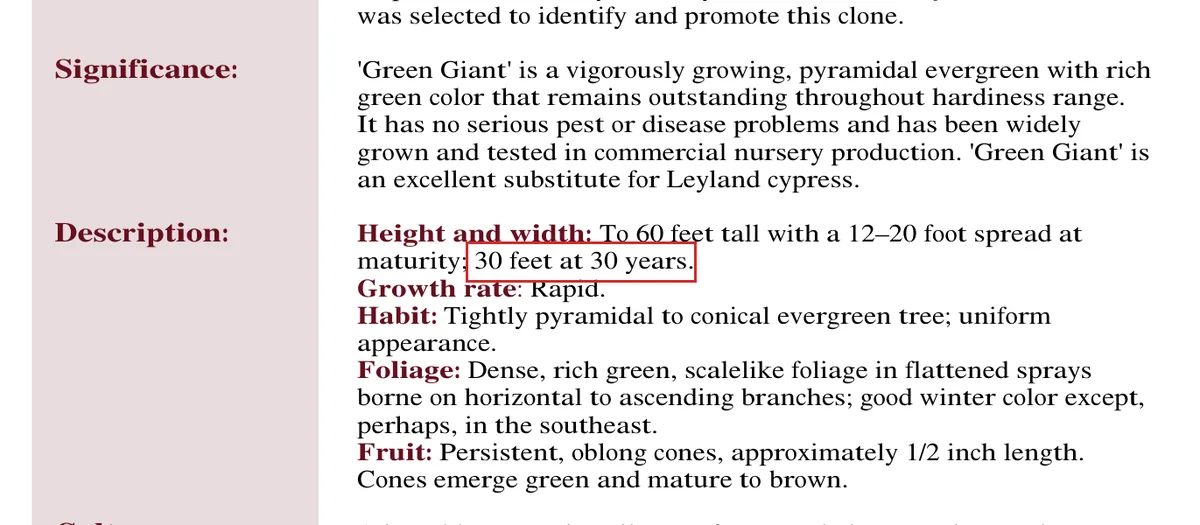
The arboretum’s Green Giant figure describes the original tree, received from Denmark in 1967 and grown at the U.S. National Arboretum in Washington, D.C. Thirty feet in 30 years works out to 1 foot a year on average, a third of the 3-foot best-year figure. Both can be true: young screens put on 3 feet in good years, then slow as they near mature height.
What is the strongest fast-growing tree?
Pin oak and northern red oak have the strongest wood of the trees extension services rate as fast: 8,300 lbf/in² green modulus of rupture in the USDA Forest Products Laboratory Wood Handbook (2021), the same as white oak. Red maple follows at 7,700. Willow, white pine, aspen and cottonwood sit at 4,800 to 5,300.
Modulus of rupture measures how much bending load a small, knot-free stick of wood carries before it snaps. It does not capture weak branch unions, so the table pairs it with the University of Florida IFAS breakage rating for each tree and the root warnings extension services publish. NC State rates both pin oak and northern red oak as rapid growers.
Swipe the table sideways to see every column.
| Tree | Green modulus of rupture (lbf/in²) | Specific gravity (green) | UF/IFAS breakage rating | Failure or root note (Source) |
|---|---|---|---|---|
| Weeping willow | Willow, black: 4,800 | 0.36 | Susceptible to breakage at the crotch or in the wood | Keep away from water and sewer lines (UF/IFAS) |
| Eastern white pine | 4,900 | 0.34 | Not rated | Blister rust “usually fatal” (NC State) |
| Quaking aspen | 5,100 | 0.35 | Not rated | Hypoxylon canker kills 1 to 2 percent of aspen a year east of the Rockies (Silvics) |
| Eastern cottonwood (a hybrid poplar parent) | 5,300 | 0.37 | Not rated | Poplar branches “break when stressed by wind or snow” (Missouri Botanical Garden) |
| Silver maple | 5,800 | 0.44 | Susceptible to breakage | Roots invade drains and water lines (Silvics) |
| Tulip poplar (yellow-poplar) | 6,000 | 0.40 | Resistant, though the sheet says the soft wood is “reportedly subject to storm damage” | “Weak-wooded and susceptible to limb breakage” (NC State) |
| American sycamore | 6,500 | 0.46 | Resistant | Anthracnose in wet, cool springs (UF/IFAS) |
| Baldcypress | 6,600 | 0.42 | Resistant | Hurricane winds “rarely overturn them” (Silvics) |
| Red maple | 7,700 | 0.49 | Susceptible (species); resistant (‘October Glory’) | UF/IFAS ST041; ST046 |
| Pin oak | 8,300 | 0.58 | Not rated | NC State: rapid growth |
| Northern red oak | 8,300 | 0.56 | Not rated | NC State: rapid growth |
| River birch | Not tested | Not tested | Resistant | Short-lived (30 to 40 years) in many urban settings (UF/IFAS) |
| Leyland cypress | Not tested | Not tested | Resistant | “Large specimens tend to topple over” (NC State) |
How long does it take a fast-growing tree to reach 20 feet?
A 6-foot hybrid poplar can reach 20 feet in about 3.3 to 4.5 years, and a Leyland cypress or Thuja ‘Green Giant’ in about 4.5 to 5.7 years, if they grow at their published best-year rates after one year of establishment. At the arboretum’s long-run Green Giant pace of 1 foot a year, the same tree needs 15 years.
The arithmetic: years = establishment years + (20 feet minus planted height) ÷ feet per year. Iowa State Extension puts establishment at about 12 months per inch of trunk diameter in zones 4 and 5, so a 1-inch tree spends about one year rooting in. The model assumes no height gain in that year, which is conservative.
| Tree | Planted height | Establishment (years) | Growth (ft/yr, source table) | Years of growth for 14 ft | Years to 20 ft |
|---|---|---|---|---|---|
| Hybrid poplar | 6 ft | 1 | 4 to 6 | 14 ÷ 6 = 2.3 to 14 ÷ 4 = 3.5 | 3.3 to 4.5 |
| Leyland cypress | 6 ft | 1 | 3 to 4 | 14 ÷ 4 = 3.5 to 14 ÷ 3 = 4.7 | 4.5 to 5.7 |
| Thuja ‘Green Giant’ (optimal) | 6 ft | 1 | 3 to 4 | 3.5 to 4.7 | 4.5 to 5.7 |
| Weeping willow | 6 ft | 1 | 3 | 4.7 | 5.7 |
| Quaking aspen | 6 ft | 1 | 2 to 3 | 4.7 to 7.0 | 5.7 to 8.0 |
| Pin oak | 6 ft | 1 | 2.5 | 5.6 | 6.6 |
| Baldcypress | 6 ft | 1 | 1.6 to 3.3 | 4.2 to 8.8 | 5.2 to 9.8 |
| Silver maple | 6 ft | 1 | 1.9 | 7.4 | 8.4 |
| River birch | 6 ft | 1 | 1.5 to 2 | 7.0 to 9.3 | 8.0 to 10.3 |
| Thuja ‘Green Giant’ (30-year average) | 6 ft | 1 | 1.0 | 14.0 | 15.0 |
The check against a real record holds up. NC State reports Leyland cypress reaching 50 feet in 15 years, about 3.3 feet a year (NC State Extension), inside the model’s 3 to 4 foot band. UF/IFAS puts baldcypress at 40 to 50 feet in 15 to 25 years (UF/IFAS), which is where its wide range comes from.
What is the fastest-growing tree for privacy?
Leyland cypress and Thuja ‘Green Giant’ are the fastest evergreen screens, both rated 3 to 4 feet a year when young. Green Giant is the safer pick in zones 5 to 7: the U.S. National Arboretum calls it “an excellent substitute for Leyland cypress,” which NC State says suffers incurable cankers and root rots and lives 20 to 50 years.
| Factor | Leyland cypress | Thuja ‘Green Giant’ | Source |
|---|---|---|---|
| Growth when young | 3 to 4 ft a year | 3 to 4 ft a year (optimal); more than 3 ft once established | Clemson HGIC; NC State; UGA |
| Mature size | 60 to 70 ft tall, 10 to 15 ft wide | 40 to 60 ft tall, 12 to 18 ft wide | NC State; NC State |
| USDA zones | 6a to 10b | 5 to 7 (USNA); 5a to 8b (NC State) | NC State; USNA |
| Spacing advised by extension | At least 15 ft apart | 15 ft apart in the row | UGA Extension; UGA CAES |
| Main disease risk | Seiridium and Botryosphaeria canker; Armillaria and Phytophthora root rot | No serious pest or disease problems | NC State; USNA |
| Lifespan | 20 to 50 years | 40 to 60 years | NC State |
Close planting is the usual mistake. UGA Extension says Leylands planted close together for a faster screen invite disease and decline, and advises at least 15 feet between trees (UGA Extension, Towns and Union counties). NC State’s Pender County office warns that fast growers “are typically weak wooded and short lived” (NC State Extension).
Count trees with this rule: trees = (row length ÷ spacing, rounded up) + 1. The table shows what spacing does to a 100-foot property line.
| Row length | Spacing | Calculation | Trees needed |
|---|---|---|---|
| 100 ft | 15 ft (UGA advice) | 100 ÷ 15 = 6.7, round up to 7, plus 1 | 8 |
| 100 ft | 12 ft | 100 ÷ 12 = 8.3, round up to 9, plus 1 | 10 |
| 100 ft | 8 ft (common retail advice) | 100 ÷ 8 = 12.5, round up to 13, plus 1 | 14 |
If the screen has to work on day one, a 6-foot fence does what no tree can; compare prices in our fence installation cost guide.
Pampas grass is sometimes planted as a fast screen, but it is a Class C noxious weed in Washington; check the state rules in our pampas grass guide before you plant it.
How far from a house should you plant a fast-growing tree?
Plant large fast growers at least 20 feet from walls and 50 feet from power lines, per Mississippi State University Extension. Colorado State’s stricter rule is two-thirds of mature height from any structure (CSU PlantTalk 1120): about 40 to 53 feet for a silver maple that matures at 60 to 80 feet.
| Tree | Mature height | MSU minimum from walls | CSU two-thirds-height rule | Root note (Source) |
|---|---|---|---|---|
| Tulip poplar | 80 to 120 ft | 20 ft | 53 to 80 ft | Limb breakage in high winds or ice (NC State) |
| Silver maple | 60 to 80 ft | 20 ft | 40 to 53 ft | Roots grow into septic fields and broken sewer pipes (UF/IFAS) |
| Leyland cypress | 60 to 70 ft | 20 ft | 40 to 47 ft | Shallow roots; large trees topple (NC State) |
| Red maple | 60 to 75 ft | 20 ft | 40 to 50 ft | Large surface roots (UF/IFAS) |
| Hybrid poplar | 40 to 60 ft | 20 ft | 27 to 40 ft | Roots spread as far as the tree is tall (NDSU) |
| Thuja ‘Green Giant’ | 40 to 60 ft | 20 ft | 27 to 40 ft | No root warning in USNA or NC State sheets |
| River birch | 40 to 50 ft | 20 ft | 27 to 33 ft | No root warning in UF/IFAS sheet |
| Weeping willow | 30 to 50 ft | 15 to 20 ft | 20 to 33 ft | Roots spread about 3 times the trunk-to-canopy-edge distance (UF/IFAS) |
Sewer advice is consistent across extension services. Virginia Tech’s Tree Steward Manual says willows, poplars and silver maples “can be destructively invasive near water or sewer pipes” (Virginia Tech). NC State’s Union County office adds that roots “cannot create cracks in your sewer pipe,” only exploit existing gaps (NC State Extension), so a tight pipe matters as much as the species.
A fast tree planted too close tends to end as a removal job; see what that costs in our tree removal cost guide and the stump grinding price guide.
Which fast-growing trees are banned from sale?
As of October 2026, Callery (Bradford) pear, which NC State rates a rapid grower, is banned from sale in Ohio, Pennsylvania and South Carolina, with Illinois (2028) and Missouri (2029) phasing it out. Tree-of-heaven, Chinese tallow, Siberian elm and Russian olive, all rapid growers per NC State, appear on other state lists.
| State | Fast growers restricted | Rule | What it does |
|---|---|---|---|
| Ohio | Callery pear, tree-of-heaven, Siberian elm, Russian olive | Ohio Adm. Code 901:5-30-01 | No sale, propagation or distribution; Callery pear exemption ended January 7, 2023 |
| Pennsylvania | Callery pear, tree-of-heaven | PDA noxious weed list, Class B | Cannot be sold, transported, planted or propagated; Callery pear added in December 2021 (51 Pa.B. 7711) |
| South Carolina | Callery (Bradford) pear, Russian olive | S.C. Code Regs. 27-135, State Plant Pest List | Sale illegal from October 1, 2024 (Clemson HGIC) |
| Illinois | Callery pear, tree-of-heaven | Exotic Weeds Act, 525 ILCS 10 | Callery pear rules take effect January 1, 2028 (University of Illinois Extension, Oct. 2025) |
| Missouri | Callery pear (all cultivars) | SB 105 (2025), RSMo 263.070 | Nursery dealers may not sell it on or after January 1, 2029 |
| Indiana | Tree-of-heaven | 312 IAC 18-3-25 | Enforceable since April 18, 2020; Callery pear not listed |
| Texas | Chinese tallow | 4 Tex. Admin. Code §19.300 | Selling, distributing or importing it is an offense |
| Florida | Chinese tallow | Fla. Admin. Code 5B-57.007 | Noxious weed; moving or releasing it requires a permit |
| Colorado | Russian olive | 8 CCR 1203-5, Part 9.0 | May not be sold as nursery stock |
For buyers searching “fast growing trees Ohio” or “fast growing trees South Carolina,” the practical rule is to skip any listing for Bradford, Cleveland Select, Aristocrat or Chanticleer pear; all are Pyrus calleryana cultivars listed by NC State Extension, and Missouri’s law names “all varieties and cultivars” (Missouri SB 105). Texas buyers can match species to their county with the Texas A&M Texas Tree Planting Guide.
This page is general information, not legal advice. State plant lists change; confirm with the agency linked for your state before you buy, sell or plant.
Can you make a newly planted tree grow faster?
Water and mulch speed growth; fertilizer usually does not. Iowa State Extension says it is “generally not necessary to fertilize newly planted trees,” and recommends fertilizing only if growth is poor 2 to 3 years after planting. Steady water through the establishment period, about 12 months per inch of trunk diameter, matters most.
- Water at least once a week, 1 to 2 gallons per inch of trunk diameter each time, through the first growing seasons (University of Illinois Extension).
- Spread 2 to 4 inches of wood chips or shredded bark, keeping mulch at least 6 inches from the trunk (Iowa State Extension). Our mulch calculator sizes the order.
- Skip fertilizer in year 1. If leaves are sparse or yellow-green 2 to 3 years after planting, apply an all-purpose fertilizer at the start of the second growing season at the label rate (Iowa State Extension).
- Prune only competing leaders, narrow crotches, crossing, broken or diseased branches and suckers (Iowa State Extension); structural pruning prices are in our tree trimming cost guide.
- Keep grass and string trimmers off the root zone: mulch rings reduce turf competition and trunk damage, per the same Iowa State guidance.
Which fast-growing tree fits your yard?
Match the tree to the job and the site before the growth rate. For a screen in zones 5 to 7, plant Thuja ‘Green Giant’ 15 feet apart; for wet soil, baldcypress or river birch; for long-lived shade within a decade, pin oak or northern red oak. Keep willows, silver maple and poplars at least 20 feet from the house and sewer lines.
For a seasonal screen under 6 feet rather than a tree, a row of feather reed grass at 24 inches on center takes 10 plants per 20 feet; see our Karl Foerster grass guide for spacing and costs.
| If your situation is | Do this | Why (source) |
|---|---|---|
| Spot is within 20 ft of the house, a septic field or a sewer line | Skip willows, silver maple, poplars and cottonwood; choose a small tree | MSU 20 ft minimum for large trees; VT and UF/IFAS root warnings (MSU) |
| You need a year-round screen in zones 5 to 7 | Thuja ‘Green Giant’, 15 ft apart | Rated 3 to 4 ft a year; no serious pests (USNA; UGA) |
| You need a screen in zones 8b to 10b | Leyland cypress at least 15 ft apart, with good drainage; expect 20 to 50 years | NC State; UGA |
| Soil stays wet or floods | Baldcypress (zones 5A to 10B), river birch (4A to 9A) or red maple | UF/IFAS lists tolerance of wet soil or extended flooding (ST620; ST094) |
| You want shade within 10 years and a tree that lasts | Pin oak or northern red oak (zones 4a to 8b) | Rapid growth (NC State) and 8,300 lbf/in² wood (Wood Handbook) |
| You want a temporary windbreak or woodlot, not a yard specimen | Hybrid poplar, expecting cankers and a short useful life | Cytospora and other cankers (Silvics) |
| You live in Ohio, Pennsylvania or South Carolina | Do not buy Callery (Bradford) pear; it cannot legally be sold | State rules in the ban table above |
1Is the spot within 20 feet of the house, a septic field or a sewer line?
YesSkip willows, silver maple, poplars and cottonwood; choose a small tree.
NoGo to the next question
2Do you need a year-round screen in zones 5 to 7?
YesPlant Thuja 'Green Giant' 15 feet apart.
NoGo to the next question
3Do you need a screen in zones 8b to 10b?
YesPlant Leyland cypress at least 15 feet apart on well-drained soil.
NoGo to the next question
4Does the soil stay wet or flood?
YesChoose baldcypress, river birch or red maple.
NoGo to the next question
5Do you want shade within 10 years from a long-lived tree?
YesChoose pin oak or northern red oak in zones 4a to 8b.
NoGo to the next question
6Is this a temporary windbreak or woodlot?
YesHybrid poplar works; expect cankers and a short useful life.
NoPick from the ranking table by USDA zone, and check your state sale-ban list first.
How we compiled this
In October 2026 we compiled growth rates, sizes, zones, lifespans and breakage ratings for 16 species from 63 documents: 8 USDA Forest Service Silvics chapters, the Forest Products Laboratory Wood Handbook, the U.S. National Arboretum release sheet, 39 extension publications from 12 universities, 9 state rules or notices and 5 other references such as Arbor Day pages. We did not grow, measure or test trees. Where sources disagree, both figures appear.
Frequently asked questions
What tree grows 5 feet per year?
Hybrid poplar is the tree that grows about 5 feet a year. The USDA Forest Service puts early height growth at 4 to 6 feet a year and first-year growth at 3 to 8 feet (Silvics). North Dakota State says hybrid poplars “may grow five or more feet every year” (NDSU Extension), and an irrigated Nevada trial clone averaged 9.3 feet.
What is the quickest growing tree for privacy?
Leyland cypress and Thuja ‘Green Giant’ both grow 3 to 4 feet a year when young, per Clemson and NC State extension. Green Giant is the lower-risk choice in zones 5 to 7 because the U.S. National Arboretum reports no serious pest or disease problems, while Leyland cypress is prone to incurable cankers. Space either about 15 feet apart, per UGA Extension.
How long does it take a tree to grow 20 feet tall?
About 3.3 to 4.5 years for a 6-foot hybrid poplar, 4.5 to 5.7 years for Leyland cypress or Green Giant at best-year rates, and 8 to 10 years for river birch, counting one year of establishment for a 1-inch trunk (Iowa State Extension). A tree growing 1 foot a year needs about 15 years.
What is the strongest fastest growing tree?
Pin oak and northern red oak, both rated rapid growers by NC State Extension, have green modulus of rupture of 8,300 lbf/in² in the USDA Wood Handbook, about 1.7 times black willow at 4,800. Among rated trees, UF/IFAS lists baldcypress, American sycamore, river birch and October Glory red maple as resistant to breakage.
Is Fast Growing Trees the same company as Trees.com?
Yes. The Trees.com homepage states “Fast Growing Trees is now Trees.com!” and its page title reads “Trees.com (formerly FastGrowingTrees.com),” as of October 2026 (Trees.com). The company name in searches for fastest growing trees often refers to that online nursery rather than to a type of tree. We have no business relationship with it.
Do fast-growing trees have invasive roots?
Some do. UF/IFAS says silver maple roots grow into septic drain fields and broken sewer pipes, and willow roots spread about 3 times the distance from trunk to canopy edge. Virginia Tech names willows, poplars and silver maples. NC State notes roots only enter pipes that already leak (NC State Extension).
Sources
- USDA Forest Service, Silvics of North America, Poplar Hybrids (Demeritt), 1990. Accessed October 2026.
- USDA Forest Service, Silvics of North America, Silver Maple, 1990. Accessed October 2026.
- USDA Forest Service, Silvics of North America, Yellow-Poplar, 1990. Accessed October 2026.
- USDA Forest Service, Silvics of North America, Eastern Cottonwood, 1990. Accessed October 2026.
- USDA Forest Service, Silvics of North America, Baldcypress, 1990. Accessed October 2026.
- USDA Forest Service, Silvics of North America, Red Maple, 1990. Accessed October 2026.
- USDA Forest Service, Silvics of North America, Quaking Aspen, 1990. Accessed October 2026.
- USDA Forest Service, Silvics of North America, Eastern White Pine, 1990. Accessed October 2026.
- USDA Forest Products Laboratory, Wood Handbook: Wood as an Engineering Material, FPL-GTR-282, Table 5-3b, 2021. Accessed October 2026.
- U.S. National Arboretum, Thuja ‘Green Giant’ release sheet, 1999. Accessed October 2026.
- USDA ARS, 2023 USDA Plant Hardiness Zone Map: How to Use the Maps, 2023. Accessed October 2026.
- University of Nevada, Reno Extension, Hybrid poplar trials in Nevada, Trials 1998 to 2003. Accessed October 2026.
- North Dakota State University Extension, Fast-Growing Shade Trees (Kalb), Undated. Accessed October 2026.
- North Dakota State University, Tree Handbook: Hybrid Poplar, Undated. Accessed October 2026.
- UF/IFAS Extension, Silver Maple, ST048, Current edition. Accessed October 2026.
- UF/IFAS Extension, Leyland Cypress, ST671, Current edition. Accessed October 2026.
- UF/IFAS Extension, Weeping Willow, ST576, Current edition. Accessed October 2026.
- UF/IFAS Extension, River Birch, ST094, Current edition. Accessed October 2026.
- UF/IFAS Extension, Baldcypress, ST620, Current edition. Accessed October 2026.
- UF/IFAS Extension, Red Maple, ST041, Current edition. Accessed October 2026.
- UF/IFAS Extension, ‘October Glory’ Red Maple, ST046, Current edition. Accessed October 2026.
- UF/IFAS Extension, American Sycamore, ST484, Current edition. Accessed October 2026.
- UF/IFAS Extension, Tuliptree, ST363, Current edition. Accessed October 2026.
- NC State Extension Gardener Plant Toolbox, Thuja ‘Green Giant’, Current. Accessed October 2026.
- NC State Extension Gardener, Green Giant Stands Tall Among Evergreens, Undated. Accessed October 2026.
- NC State Extension Gardener Plant Toolbox, Leyland cypress, Current. Accessed October 2026.
- NC State Extension Gardener Plant Toolbox, Silver maple, tulip poplar, dawn redwood, quaking aspen, pin oak, northern red oak, eastern cottonwood, white pine, Nuttall oak, Callery pear, tree-of-heaven pages, Current. Accessed October 2026.
- Arbor Day Foundation, The Fastest Fast Growing Trees, June 2010. Accessed October 2026.
- Arbor Day Foundation (Internet Archive copy), Growth rate definitions, after Dirr, Captured July 29, 2015. Accessed October 2026.
- Missouri Botanical Garden, Trees: Not Recommended, Undated. Accessed October 2026.
- Iowa State University Extension, Care of Newly-Planted Trees, Current. Accessed October 2026.
- University of Illinois Extension, New Tree Care information sheet, Undated. Accessed October 2026.
- Mississippi State University Extension, Yard Tree Placement and Risk Assessment, P4026, Current. Accessed October 2026.
- Colorado State University Extension, PlantTalk 1120: Tree Placement Tips, Current. Accessed October 2026.
- Virginia Tech, Tree Steward Manual, chapter 4, Current. Accessed October 2026.
- NC State Extension, Union County, Tree Roots and Sewer Lines, Current. Accessed October 2026.
- NC State Extension, Pender County, Great Evergreens for Screens and Hedges, Current. Accessed October 2026.
- UGA CAES, Fast-growing, pest-free Green Giant draws acclaim, Undated. Accessed October 2026.
- UGA Extension, Towns and Union counties, Leyland Cypress, June 2023. Accessed October 2026.
- Clemson HGIC, Leyland Cypress, Current. Accessed October 2026.
- Ohio Administrative Code, 901:5-30-01, Invasive plant species, Effective Feb. 13, 2023. Accessed October 2026.
- Pennsylvania Department of Agriculture, Controlled Plant and Noxious Weed Lists, Current. Accessed October 2026.
- Pennsylvania Bulletin, 51 Pa.B. 7711, addition of Callery pear to the noxious weed list, December 11, 2021. Accessed October 2026.
- Clemson Department of Plant Industry, South Carolina State Plant Pest List, Current. Accessed October 2026.
- Clemson HGIC, Bradford Pear and Elaeagnus to be Banned from Sale in South Carolina, July 20, 2021. Accessed October 2026.
- Missouri General Assembly, SB 105, truly agreed and finally passed, 2025. Accessed October 2026.
- University of Illinois Extension, Illinois regulations regarding invasive plant species, October 2025. Accessed October 2026.
- Indiana DNR, Terrestrial Plant Rule, 312 IAC 18-3-25, September 2024. Accessed October 2026.
- Texas Administrative Code, 4 TAC 19.300, noxious and invasive plants, Amended 2013. Accessed October 2026.
- Florida Administrative Code, 5B-57.007, Noxious Weed List, Effective Sept. 28, 2020. Accessed October 2026.
- Colorado Department of Agriculture, 8 CCR 1203-5, nursery rules, Current. Accessed October 2026.
- Texas A&M AgriLife Extension, Texas Tree Planting Guide, Current. Accessed October 2026.
- Trees.com, Homepage, October 2026. Accessed October 2026.