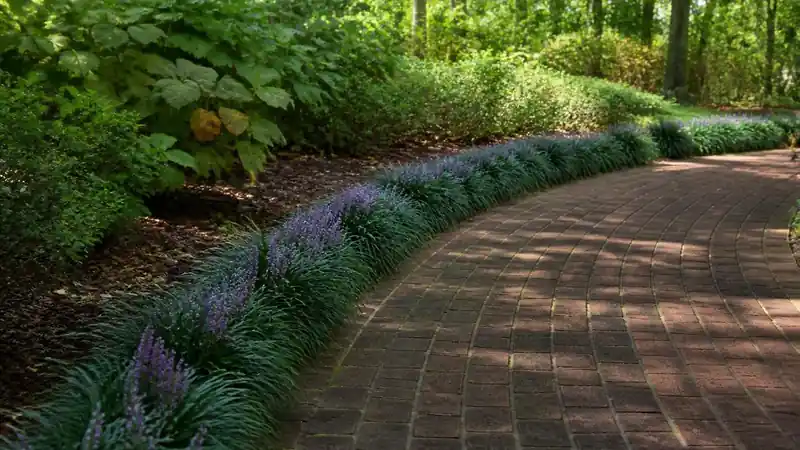
Monkey grass is two lilyturfs, not true grasses: clumping Liriope muscari, used for edging, and running Liriope spicata, a groundcover listed as invasive in Georgia and Tennessee. Both grow about 1 to 1.5 ft tall.
Key takeaways
- Two species share the name: Liriope muscari clumps and spreads slowly by short stolons; Liriope spicata runs by rhizomes into adjacent turf (Missouri Botanical Garden; UF/IFAS FPS-350). Mondo grass, Ophiopogon japonicus, has leaves about 1/8 in wide (UF/IFAS).
- Invasive listings: Georgia’s council list (September 2023) includes both species (GISC); Tennessee ranks L. spicata an Emerging Threat (TN-IPC); UF/IFAS rates both Moderate Risk/Evaluate across Florida (UF/IFAS Assessment).
- Spacing: UF/IFAS gives 12 to 18 in for ‘Variegata’, 18 to 24 in for ‘Evergreen Giant’ and 6 to 12 in for L. spicata (FPS-349; FPS-348; FPS-350). A 50 ft single-row border at 12 in takes 51 plants.
- Cut back before new growth: late January on the South Carolina coast, by mid-February upstate, with a mower at its highest setting (Clemson HGIC 1108).
- Price on Oct. 29, 2026: $2.80 per plant in a 54-pack of 3-inch pots to $21.95 for a 1-gallon pot across five online sellers (Plants by Mail; PlantingTree).
- Pets: the ASPCA lists Liriope muscari as non-toxic to dogs, cats and horses (ASPCA).
1 to 1.5 ft tall and wide (NC State, L. muscari)
12 to 18 in apart for edging (UF/IFAS FPS-349)
Zones 5 to 10 for L. muscari, 4 to 10 for L. spicata (NC State, MBG)
$2.80 to $21.95 per plant (5 sellers, Oct. 29, 2026)
What is monkey grass?
Monkey grass is the common name for Liriope muscari and Liriope spicata, evergreen perennials in the asparagus family (Asparagaceae) from China, Taiwan, Japan and Vietnam. NC State Extension notes that it resembles an ornamental grass but is not a true grass. The same name is applied to mondo grass, Ophiopogon japonicus, which UF/IFAS Gardening Solutions says is often confused with liriope.
LSU AgCenter publication P3940 (August 2024) adds the names big blue lilyturf and border grass and notes that liriope was moved from the lily family to the asparagus family (LSU AgCenter). Both species have fleshy, tuberous roots and late-summer flower spikes followed by black berries that last into winter (NC State). The Turf and Trees hub lists our other plant guides.
| Trait | Liriope muscari (clumping) | Liriope spicata (creeping) | Source |
|---|---|---|---|
| Height | 1 to 1.5 ft | 6 in to 1.5 ft | NC State; NC State |
| Width | 1 to 1.5 ft | 1 to 2 ft | NC State; NC State |
| Leaf width | About 1 in (NC State, MBG); 3/8 to 1/2 in (Clemson) | About 1/4 in | MBG; Clemson |
| How it spreads | Clumps; short stolons | Rhizomes; spreads indefinitely | MBG; Clemson |
| USDA hardiness zones | 5 to 10 | 4 to 10 | NC State; MBG |
| Bloom | Purple spikes 6 to 8 in, August to September | Pale lavender to white, partly hidden in the leaves | NC State; MBG |
| Light | Full sun to deep shade | Partial to deep shade | NC State; NC State |
| Spacing | 12 to 18 in (‘Variegata’) | 6 to 12 in | UF/IFAS FPS-349; FPS-350 |
| Foot traffic | Little tolerance | Will not tolerate regular traffic | MBG; UF/IFAS |
| USDA PLANTS record | No species profile found (Oct. 2026) | LISP10, introduced in the lower 48 | USDA PLANTS |
What is the difference between mondo grass and monkey grass?
Mondo grass (Ophiopogon japonicus) has narrower leaves, flowers hidden in the foliage and blue fruit; monkey grass (liriope) has wider leaves and flower spikes held above them. Missouri Botanical Garden gives mondo leaves to 3/16 in wide on plants 8 to 12 in tall, against liriope leaves to 1 in wide on plants 12 to 18 in tall. UF/IFAS notes both get sold as monkey grass.
| Feature | Monkey grass (L. muscari) | Creeping monkey grass (L. spicata) | Mondo grass (O. japonicus) | Source |
|---|---|---|---|---|
| Leaf width | To 1 in | To 1/4 in | 1/8 to 3/16 in | MBG; UF/IFAS |
| Height | 12 to 18 in | 9 to 15 in | 8 to 12 in | MBG; MBG; MBG |
| Flowers | Violet-purple spikes above the leaves, Aug. to Sept. | Pale lavender to white, partly hidden | White to lilac, short racemes hidden in the leaves, June to July | MBG; MBG |
| Fruit | Shiny black berries | Blue-black berries | Pea-sized blue berries | NC State; NC State |
| Spread | Short stolons, clumps | Rhizomes, fast | Stolons, slow | MBG; NC State |
| Hardiness zones | 5 to 10 | 4 to 10 | 6 to 10 (NC State); 7 to 10 (MBG) | NC State; MBG |
| Foot traffic | Little tolerance | Not regular traffic | Resists foot traffic | MBG; UF/IFAS; NC State |
| UF/IFAS Florida assessment | Moderate Risk/Evaluate | Moderate Risk/Evaluate | Not a problem species | UF/IFAS; UF/IFAS |
Mondo suits paths and stepping stones: NC State says it resists foot traffic and, used as shade turf, should be mowed once a year (NC State). MBG rates it only to zone 7, two zones short of liriope.
Is monkey grass invasive?
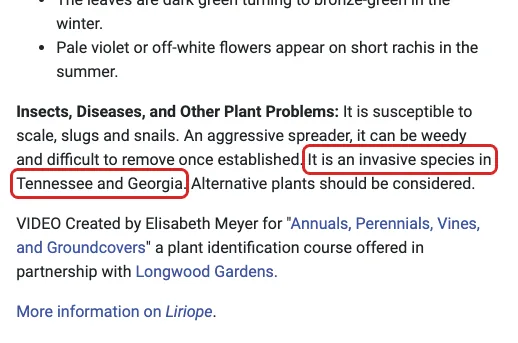
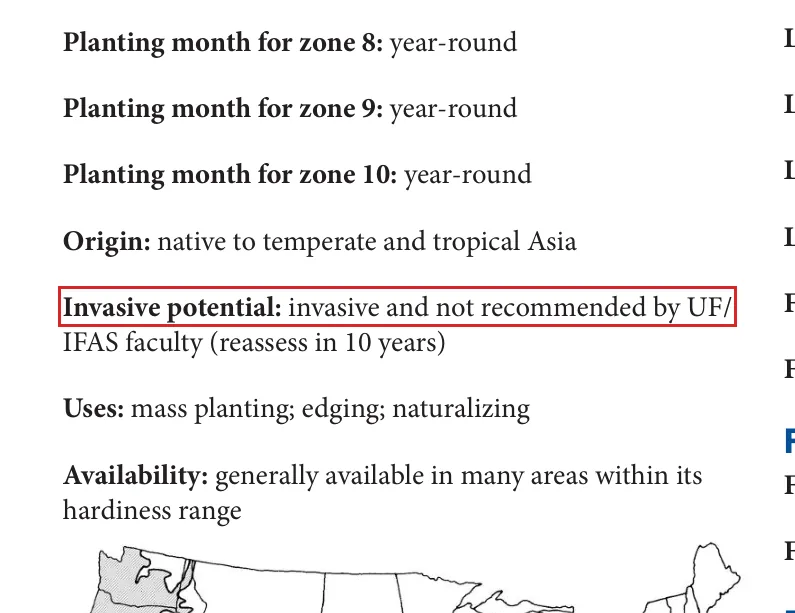
Creeping monkey grass, Liriope spicata, is the species most often listed as invasive: NC State calls it invasive in Tennessee and Georgia, and UF/IFAS fact sheet FPS-350 marks it “invasive and not recommended.” Clumping Liriope muscari spreads slowly by short stolons, yet Georgia’s council lists it too. USDA PLANTS shows no noxious or invasive status for L. spicata and has no L. muscari profile.
| Where | Listing body | Liriope spicata | Liriope muscari | Date | Source |
|---|---|---|---|---|---|
| Georgia | Georgia Invasive Species Council plant list | Listed (creeping liriope) | Listed (monkeygrass) | Updated Sept. 2023 | GISC |
| Tennessee | TN Invasive Plant Council, Natural Areas list | Emerging Threat: reported in fewer than 10 counties | Not listed | Current list | TN-IPC |
| Florida | UF/IFAS Assessment of Non-native Plants | Moderate Risk/Evaluate, north, central, south; assessment complete | Moderate Risk/Evaluate; assessment incomplete | Pages updated Oct. 19, 2026 and Nov. 7, 2025 | UF/IFAS; UF/IFAS |
| Florida | UF/IFAS fact sheets FPS-350, FPS-349 (rev. Oct. 2023) | “Invasive and not recommended by UF/IFAS faculty” | “Not known to be invasive” (‘Variegata’) | Current editions | FPS-350; FPS-349 |
| United States | USDA PLANTS Database | Introduced, lower 48; no noxious or invasive status | No species profile found | Checked Oct. 2026 | USDA PLANTS |
To tell which one you have, look at the habit. University of Arkansas Extension says L. muscari makes a clump that gets bigger each year, while L. spicata “is a runner which produces lots of small plants, but no large clumps,” and that a 20-year-old planting of the runner would have blanketed the yard (UAEX). Runner leaves are also narrower, about 1/4 in.
If you keep L. spicata, contain it. UF/IFAS and NC State both suggest a bed surrounded by hardscape or an edging or root barrier 18 inches deep (FPS-350; NC State). For new plantings, NC State lists three native sedges as alternatives: Carex cherokeensis, Carex grayi and Carex laxiculmis (NC State).
Where will monkey grass grow, and does it come back every year?
Liriope muscari is rated for USDA zones 5 to 10 and Liriope spicata for zones 4 to 10 by NC State and Missouri Botanical Garden, so both return every year across most of the lower 48. Both are evergreen in the South, but MBG says L. muscari foliage “declines considerably” in cold-winter areas such as St. Louis, which is one reason to cut it back each winter.
| Source | Liriope muscari | Liriope spicata | Mondo grass |
|---|---|---|---|
| NC State Extension | 5a to 10b | 4a to 10b | 6a to 10b |
| Missouri Botanical Garden | 5 to 10 | 4 to 10 | 7 to 10 |
| UF/IFAS EP600; FPS-350 | 6 to 10 | 6 through 10 | Not rated |
| Morton Arboretum | Not rated | 4 to 10 | Not rated |
Light sets growth rate more than survival. NC State rates liriope from full sun to deep shade (under 2 hours of direct sun) but says growth in near-full shade is slow, with elongated leaves (NC State). Clemson HGIC 1108 says flowers are produced most freely in sun.
Hot, full sun is the limit in the Deep South: UF/IFAS says ‘Variegata’ and L. spicata can yellow and melt out in full sun (FPS-349; FPS-350). ‘Evergreen Giant’ prefers sun (EP600) but browns at the tips in the hottest areas (FPS-348).
Soil should be acidic to neutral and well drained; NC State gives a pH under 6.0 to 8.0 (NC State), and Clemson says liriope “will not take wet feet.” A lab test confirms pH before planting a long border, and our soil test guide lists what the reports include.
Which monkey grass variety should you plant?
Choose by height, leaf color and sun. Clemson’s HGIC 1108 lists ‘Big Blue’ at 12 to 15 in with less tendency to spread by stolons, ‘Evergreen Giant’ at 18 to 24 in, and ‘Silvery Sunproof’ as the variegated form that withstands sun best. For a running groundcover, ‘Silver Dragon’ is a variegated L. spicata that reaches 12 to 16 in (Clemson).
| Cultivar | Species | Mature height | Leaf | Flower | Note | Source |
|---|---|---|---|---|---|---|
| ‘Big Blue’ | L. muscari | 12 to 15 in | Green | Lavender | Less tendency to spread by stolons; MBG gives 1 to 2 ft | Clemson; MBG |
| ‘Variegata’ | L. muscari | 10 to 15 in | White to yellow edges | Lavender | Can melt out in heat (UF/IFAS) | Clemson; FPS-349 |
| ‘Silvery Sunproof’ | L. muscari | 12 to 15 in | Striped white and yellow | Purple | Takes sun better than most variegated forms | Clemson |
| ‘Evergreen Giant’ | L. muscari | 18 to 24 in | Stiff, green | White (Clemson); lilac purple (UF/IFAS) | Especially susceptible to crown rot | Clemson; EP600 |
| ‘Monroe’s White’ | L. muscari | 12 to 15 in | Green | White | Best in shade; slower growth | Clemson |
| ‘Royal Purple’ | L. muscari | 12 to 15 in | Green | Deep purple | None listed | Clemson |
| ‘Webster Wideleaf’ | L. muscari | 12 to 15 in | Widest leaf of any cultivar | Lavender | None listed | Clemson |
| ‘Emerald Goddess’ | L. muscari | 16 to 20 in | Green | Lavender | None listed | Clemson |
| ‘Samantha’ | L. muscari | 12 to 15 in | Green | Pink | None listed | Clemson |
| ‘Super Blue’ | L. muscari (seller listing) | Up to 20 in | Blue-green | Violet | Seller calls it more sun tolerant; up to 20 in | Plants by Mail |
| ‘Silver Dragon’ | L. spicata | 12 to 16 in | Green and white | Lavender | Less dense than most lilyturf | Clemson |
| ‘Franklin Mint’ | L. spicata | 12 to 15 in | Green | Pale lavender | None listed | Clemson |
Flower spikes add a few inches to these foliage heights. Sources split on ‘Evergreen Giant’ flower color, white per Clemson and NC State and lilac purple per UF/IFAS FPS-348, so check the tag if color matters.
How far apart should you plant monkey grass for a border?
Plant clumping monkey grass about 12 in apart for an edge: Clemson says about 1 ft, and UF/IFAS gives 12 to 18 in for ‘Variegata’ and 18 to 24 in for ‘Evergreen Giant’. A single row needs one plant per foot at 12 in spacing, plus one for the end. Creeping L. spicata goes 6 to 12 in apart (UF/IFAS FPS-350).
| Spacing on center | Plants per linear ft (1 row) | Plants for a 50 ft row | Plants per 100 sq ft (square grid) | Who gives this spacing |
|---|---|---|---|---|
| 6 in | 2 | 101 | 400 | L. spicata, low end (FPS-350) |
| 8 in | 1.5 | 76 | 225 | Not a published spacing; shown for dense edging |
| 12 in | 1 | 51 | 100 | Clemson; FPS-349 low end; FPS-350 high end |
| 15 in | 0.8 | 41 | 64 | Not a published spacing; midpoint |
| 18 in | 0.67 | 34 | 45 | FPS-349 high end; ‘Evergreen Giant’ centers (FPS-348) |
| 24 in | 0.5 | 26 | 25 | ‘Evergreen Giant’ high end (FPS-348) |
Leave a 6 to 12 in buffer, edged or mulched, between the border and the lawn so running grasses such as bermudagrass cannot grow into the row, as University of Arkansas Extension advises (UAEX). Our bermuda grass guide explains why its runners invade beds.
- Test drainage and pH; NC State lists acidic to neutral soil, and Clemson says liriope will not take wet feet (Clemson).
- Mark the row 6 to 12 in back from the lawn edge, the UAEX buffer width.
- Set plants 12 in on center for a standard edge, crowns level with the soil; Clemson warns against planting too deeply.
- Water to keep the soil moist through the first year, then weekly only in summer droughts (NC State; Clemson).
- Mulch between plants but keep it off the crowns, which Clemson links to crown rot. Our mulch calculator converts bed size to cubic yards.
- Feed lightly in early spring with a slow-release fertilizer, scattered so granules do not lodge between leaves (NC State; Clemson).
Worked example: a 50 ft border along one side of a walk, one row at 12 in on center, takes 600 / 12 + 1 = 51 plants. The table below prices that row at the Oct. 29, 2026 listings.
| Scenario | Plants | Pot | Price per plant | Plant cost before shipping and tax |
|---|---|---|---|---|
| 50 ft border, 1 row, 12 in | 51 | 3-inch pots, 54-pack | $2.80 | $150.99 (one 54-pack; 3 spares) |
| 50 ft border, 1 row, 12 in | 51 | 4-inch pot | $3.99 | $203.49 |
| 50 ft border, 1 row, 12 in | 51 | 1-gallon pot | $12.99 to $21.95 | $662.49 to $1,119.45 |
| Same row, contractor-installed | 51 | 1-gallon pot | $14 to $34 installed | $714 to $1,734 |
| 100 sq ft of L. spicata, 12 in grid | 100 | 4-inch pot | $3.99 | $399.00 |
| 100 sq ft of L. muscari, 18 in grid | 45 | 1-gallon pot | $12.99 to $21.95 | $584.55 to $987.75 |
- Plants needed (before end plants)
- 50
Plants = length x 12 / spacing in inches x rows, rounded up; add 1 plant per row for the end plant. Prices are the low and high online listings in this guide, before shipping and tax.
How much does monkey grass cost?
On Oct. 29, 2026, monkey grass listed at $2.80 per plant in a 54-pack of 3-inch pots, $3.99 to $7.99 for a 4-inch pot, about $18 for a 2.5-quart pot and $12.99 to $21.95 for a 1-gallon pot across five online sellers, before shipping and tax. Pot size moves the price far more than the cultivar does.
Swipe the table sideways to see every column.
| Seller | Plant | Size | Listed price | Per plant | Source |
|---|---|---|---|---|---|
| Plants by Mail | ‘Big Blue’, ‘Variegated’, ‘Super Blue’ | 54-pack, 3-inch pots | $150.99 | $2.80 | listing |
| Plants by Mail | ‘Big Blue’, ‘Variegated’, ‘Super Blue’ | 18-pack, 3-inch pots | $52.99 | $2.94 | listing |
| Pike Nursery | ‘Big Blue’ | 4-inch pot | $3.99 | $3.99 | listing |
| Pike Nursery | Creeping liriope (L. spicata) | 4-inch pot | $3.99 | $3.99 | listing |
| Eureka Farms | ‘Big Blue’ (sale; listed $9.99) | 4-inch pot | $7.99 | $7.99 | listing |
| Plants by Mail | ‘Variegated’, ‘Super Blue’ | 2.5-quart pot | $17.98 | $17.98 | listing |
| Plants by Mail | ‘Big Blue’ | 2.5-quart pot | $17.99 | $17.99 | listing |
| Pike Nursery | ‘Big Blue’ | 1-gallon pot | $12.99 | $12.99 | listing |
| Eureka Farms | ‘Big Blue’, 12-pack | 1-gallon pots | $169.00 | $14.08 | listing |
| Eureka Farms | ‘Big Blue’ (sale; listed $19.99) | 1-gallon pot | $16.99 | $16.99 | listing |
| PlantingTree | ‘Variegated’ | 1-gallon pot | $17.95 | $17.95 | listing |
| Trees.com | ‘Variegata’ (sale; listed $27.95) | 1-gallon pot | $17.95 | $17.95 | listing |
| PlantingTree | ‘Big Blue’ | 1-gallon pot | $21.95 | $21.95 | listing |
| Plants by Mail | Mondo grass, dwarf mondo grass | 2.5-quart pot | $17.96 | $17.96 | listing |
| Plants by Mail | Mondo grass, dwarf mondo grass | 18-pack, 3-inch pots | $52.99 | $2.94 | listing |
Three things move the bill. Pot size: a 3-inch plug in a 54-pack costs $2.80, a 1-gallon pot up to $21.95, about 7.8 times as much. Bulk: Eureka Farms’ 12-pack brings a 1-gallon ‘Big Blue’ from $16.99 to $14.08. Labor: our landscaping cost model puts installed 1-gallon plants at $14 to $34 each.
When and how do you cut back monkey grass?
Cut monkey grass back once a year in late winter, before new leaves emerge: late January on the South Carolina coast and by mid-February upstate (Clemson HGIC 1108), February in North Carolina (NC State) and late February in Arkansas (UAEX). Use a mower at its highest setting with sharp blades, and keep the blade above the crowns.
| Region | When | How low or how | Source |
|---|---|---|---|
| Coastal South Carolina | Late January | Mower at highest cutting height; about 3 in where anthracnose is present | Clemson HGIC 1108 |
| Upstate South Carolina | By mid-February | Same | Clemson HGIC 1108 |
| North Carolina | Each February, before new growth | Cut back the tops | NC State |
| Arkansas | Late February, before new growth | Almost to the soil line | UAEX |
| Missouri | Late winter to early spring | To the ground; mow large plots on a high mower setting | MBG |
| Florida | Each spring, before new growth | Mow the bed | UF/IFAS FPS-350 |
- Check the crowns for new shoots. If they are already up, trim old leaves by hand around them instead of mowing (UAEX).
- Sharpen the mower blade and set the deck to its highest position (Clemson). Our blade sharpening guide covers the bevel and balance check.
- Mow or shear the old foliage; on a narrow edging row, hand shears or a string trimmer held level do the same job.
- Rake out and bag the clippings. Clemson says the anthracnose fungus overwinters in dead foliage and that cleanup helps control scale.
- If scale was present, spray a 2 percent horticultural oil, 5 tablespoons per gallon of water, after pruning (Clemson); NC State advises two treatments two weeks apart for fern scale (NC State).
Cutting late clips the new leaf tips for the whole summer (FPS-350; UAEX); cutting in fall can lead to winter damage, and skipping the cut leaves plants “bedraggled all season” (UAEX).
What problems does monkey grass get?
Leaf and crown rot is the serious one: Phytophthora palmivora yellows leaves from the base, and UF/IFAS and Clemson say fungicides only slow it because they leach from soil within weeks. Anthracnose causes reddish-brown leaf-tip spots after wet weather, and fern scale leaves yellow spots. ‘Evergreen Giant’ is especially susceptible to crown rot (UF/IFAS EP600; LSU AgCenter Pub. 3189).
| Problem | Cause | What you see | When | What to do | Source |
|---|---|---|---|---|---|
| Leaf and crown rot | Phytophthora palmivora (water mold) | Leaves yellow from the base; base turns brown and watery; leaves pull free | Late spring to early fall; worst in standing water | Remove and discard plants; mefenoxam, fosetyl-Al and phosphites only suppress it, often for 4 to 6 weeks | UF/IFAS EP600; LSU 3189 |
| Anthracnose | Colletotrichum species (fungus) | Reddish-brown spots on leaf tips and margins | After rain or overhead watering; leaves wet 4 to 6 hours | Cut to about 3 in in late winter, remove debris, stop overhead and late-day watering | UF/IFAS EP600; Clemson |
| Root rots | Fusarium, Rhizoctonia solani | Lower leaves die first; plant declines from the bottom up | Wet, warm soil; plants set too deep | Raise or drain the bed; cut irrigation in rainy periods | UF/IFAS EP600 |
| Southern blight | Sclerotium rolfsii (fungus) | Wilt; soft brown rot at the soil line; white threads with tiny sclerotia | Spreads in water, soil and on tools; survives in soil indefinitely | Remove plants; clean tools; fungicides prevent but do not cure | UF/IFAS EP600 |
| Scale | Six scale species; fern scale (Pinnaspis aspidistrae) and proteus scale most common | Yellow or reddish spots; white male armor on leaves | Crawlers hatch in spring and summer | Cut back and clean up; 2% horticultural oil, two sprays two weeks apart | Clemson; NC State |
| Root-knot nematodes | Root-knot nematodes (Meloidogyne) | Yellowing, thin plants; galled roots | Sandy soils | No chemical control on existing plants; replace soil when replanting | UF/IFAS EP600 |
| Slugs and snails | Mollusks | Ragged holes in leaves | Damp, shady beds | Monitor; no serious threat listed | NC State; MBG |
Most of these start with water: LSU AgCenter says crown rot is worst where water stands and is favored by overcrowding and deep planting (Pub. 3189). For a diagnosis, NC State directs readers to their county Extension center (NC State).
How do you get rid of monkey grass?
Removing creeping monkey grass takes digging plus follow-up sprays over more than one season. University of Arkansas Extension advises tilling or digging out the crowns, waiting for regrowth, spraying the young growth with glyphosate, then spraying again 2 weeks later and repeating as needed (UAEX).
- Confirm the species: runners with no large clumps point to L. spicata (UAEX).
- Cut the tops, then till or dig the bed and pull out crowns and roots with a heavy lawn rake (UAEX).
- Wait for new shoots to appear.
- Spot-spray the regrowth with a glyphosate product such as Roundup Weed & Grass Killer Concentrate Plus (EPA Reg. No. 71995-29: glyphosate 18 percent, diquat 0.73 percent), shielding nearby plants as its label directs (EPA label, April 2022).
- Wait 2 weeks and spray again; repeat through the season (UAEX).
- Replant: the 71995-29 label allows ornamental flowers, trees and shrubs 1 day after application and lawn grasses 3 days after.
| Method | What it kills | Follow-up | Source |
|---|---|---|---|
| Dig or till, rake out crowns | Crowns and most roots; fragments resprout | Repeat as shoots appear | UAEX |
| Glyphosate spot spray (e.g., EPA Reg. No. 71995-29) | Leaves, crowns and roots of any plant it wets | Respray regrowth after 2 weeks; ornamentals replantable 1 day after | EPA label; UAEX |
| Vinegar or other contact sprays | Green leaves only, not roots or rhizomes | Regrowth expected | UC IPM |
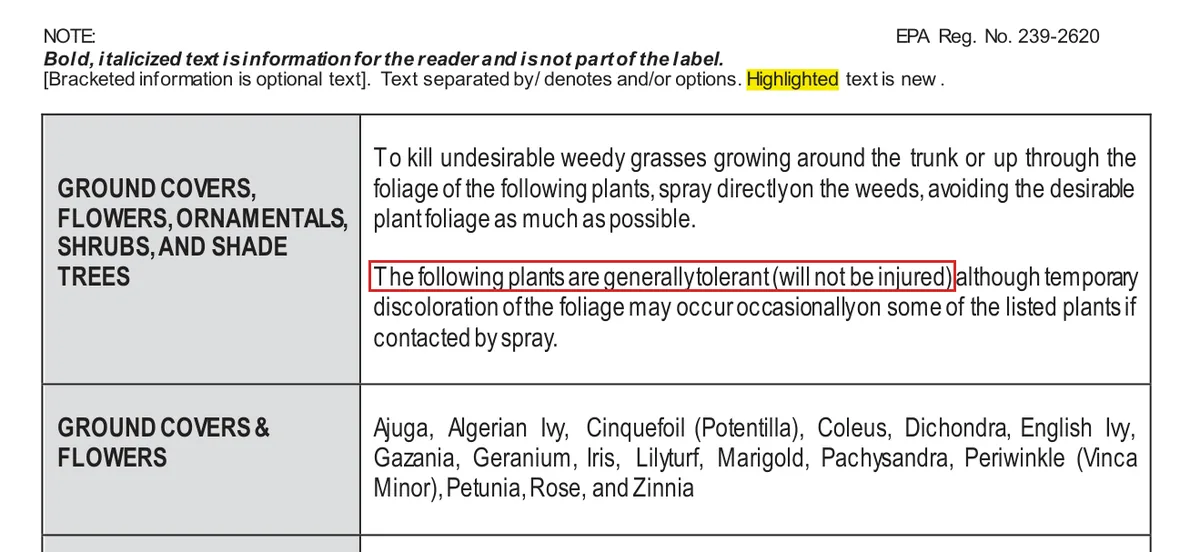
| Fluazifop grass killer (EPA Reg. No. 239-2620) | Grasses only; label lists lilyturf as tolerant | Use to clean grass out of a bed you are keeping | EPA label |
Vinegar is a contact product. UC IPM says contact herbicides, acetic acid among them, burn green leaves but “do not affect the roots or rhizomes” of bermudagrass (UC IPM), and liriope regrows from tuberous roots and rhizomes the same way. Our vinegar weed killer guide covers what those products do kill.
The label is the law: the products named here are examples, not endorsements, and each use must match the current label for your state.
How do you kill grass growing in monkey grass?
Use a grass-only herbicide. The label for Ortho Grass-B-Gon Garden Grass Killer (EPA Reg. No. 239-2620, fluazifop-P-butyl 0.48 percent, accepted Oct. 28, 2024) lists lilyturf among ground covers that are generally tolerant, and calls for 2 applications 7 days apart on established bermudagrass (EPA label). It does not control sedges or broadleaf weeds.
Virginia Tech’s turf program says fluazifop and sethoxydim will not injure non-grass plants “such as liriope, daylily, and hosta” (Virginia Tech). UAEX adds that no broadleaf weed killer is safe over liriope, so pull or hoe broadleaf weeds by hand. Contractors who spray for hire usually need a state license; our applicator license guide lists the rules.
Is monkey grass right for your yard?
Monkey grass fits shaded or mixed-light edges in zones 5 to 10 where nobody walks on it and the soil drains. Pick clumping L. muscari for borders, keep running L. spicata to hardscape-bound beds, and look at native sedges or mondo grass in Georgia, Tennessee or anywhere next to woodland, where state lists flag liriope (GISC; TN-IPC).
| If your situation is | Do this | Why (source) |
|---|---|---|
| You want a crisp edge along a walk or bed | Plant L. muscari (‘Big Blue’, ‘Variegata’) 12 to 18 in apart | UF/IFAS calls L. spicata unsuitable for edging because it spreads too quickly (FPS-350) |
| You need to cover a shaded slope inside hardscape or an 18 in barrier | L. spicata at 6 to 12 in | Rhizomes fill fast; contain with an 18 in deep edging (NC State) |
| The bed is in Georgia or Tennessee, or borders woods | Skip L. spicata; consider Carex cherokeensis, C. grayi or C. laxiculmis | GISC lists both liriopes; TN-IPC lists L. spicata (GISC) |
| You garden in USDA zone 4 | Only L. spicata is rated; weigh its spread first | NC State and MBG rate L. muscari to zone 5 (MBG) |
| People or dogs walk across it | Use mondo grass or lawn instead | MBG: little tolerance for foot traffic; NC State: mondo resists it (NC State) |
| Hot full sun in Florida or the Gulf Coast | Avoid ‘Variegata’; use ‘Evergreen Giant’ only where drainage is excellent | FPS-349 melt-out; EP600 crown-rot susceptibility (UF/IFAS) |
| Wet or poorly drained soil | Plant something else | Clemson: will not take wet feet; crown rot worst where water stands (Clemson) |
| Dogs or cats graze the yard | L. muscari is acceptable | ASPCA: non-toxic to dogs, cats and horses (ASPCA) |
1Is the soil wet or poorly drained?
YesPlant something else; liriope will not take wet feet and crown rot is worst where water stands (Clemson; LSU AgCenter).
NoGo to the next question
2Will people or dogs walk across it?
YesUse mondo grass or lawn; NC State says mondo resists foot traffic, and MBG gives liriope little tolerance.
NoGo to the next question
3Is the site in Georgia or Tennessee, or next to woodland?
YesSkip L. spicata; consider native Carex cherokeensis, C. grayi or C. laxiculmis (NC State; GISC; TN-IPC).
NoGo to the next question
4Is the site in USDA zone 4?
YesOnly L. spicata is rated; contain it with an 18 in deep barrier or choose another plant (NC State; MBG).
NoGo to the next question
5Do you want a crisp edge along a walk or bed?
YesPlant clumping L. muscari ('Big Blue', 'Variegata') 12 to 18 in apart (UF/IFAS FPS-349).
NoGo to the next question
6Is it a shaded slope bounded by hardscape?
YesPlant L. spicata 6 to 12 in apart behind an 18 in deep edging (UF/IFAS FPS-350).
NoPlant L. muscari about 12 in apart and cut it back each late winter (Clemson HGIC 1108).
Source: UF/IFAS, NC State, Clemson, MBG, GISC, TN-IPC; accessed Oct. 2026
For a bare slope, our erosion control guide compares planted cover with mats and riprap. Behind a sunny liriope edge, a fall-blooming grass works; our pink muhly grass guide covers its spacing.
What do popular guides get wrong about monkey grass?
Popular guides often merge the two species and round off the limits. Extension sources show that L. spicata is the invasive one, that mondo grass used as turf gets mowed, that no extension source rates liriope past zone 10, and that the ASPCA lists L. muscari as non-toxic (ASPCA).
| Common guide claim | What the primary source says | Source |
|---|---|---|
| Monkey grass is one plant | Two Liriope species with different spread, plus Ophiopogon japonicus sold under the same name | UF/IFAS; MBG |
| All liriopes do well from filtered sun to full shade | NC State rates full sun to deep shade; UF/IFAS says ‘Variegata’ and L. spicata can melt out in hot sun | NC State; FPS-349 |
| Grows in zones 4 to 11 | Extension and garden sources stop at zone 10 (NC State 10b; MBG 10; UF/IFAS 10) | NC State; FPS-350 |
| Mondo grass never needs mowing | NC State says mondo used as a shade turf alternative should be mowed yearly | NC State |
| Monkey grass is toxic to cats and dogs | ASPCA and LSU’s vet school list L. muscari as non-toxic; NC State flags only low-severity caution with no known cases | ASPCA; LSU; NC State |
| Liriope leaves are up to 1/2 in wide | Sources disagree: about 1 in (NC State, MBG, LSU AgCenter) versus 3/8 to 1/2 in (Clemson) | NC State; Clemson |
| Plant liriope in fall | UF/IFAS lists container planting year-round in zones 7 to 10 | FPS-349 |
How we compiled this
We compiled this page in October 2026 from 33 primary documents: extension fact sheets from NC State, UF/IFAS, Clemson, the University of Arkansas and LSU AgCenter; Missouri Botanical Garden and Morton Arboretum plant records; invasive-plant lists for Georgia, Tennessee and Florida; USDA PLANTS; two EPA-accepted labels; and two pet toxicity lists. Prices are five sellers’ online listings on Oct. 29, 2026. We did not grow, test or photograph any plants.
| Source type | Count | Examples |
|---|---|---|
| Extension and university publications | 18 | NC State Plant Toolbox, UF/IFAS FPS-348 to 350 and EP600, Clemson HGIC 1108, UAEX, LSU AgCenter P3940 and Pub. 3189, Virginia Tech, UC IPM |
| Botanical gardens | 5 | Missouri Botanical Garden (4 records), Morton Arboretum |
| Invasive lists and databases | 6 | GISC, TN-IPC, UF/IFAS Assessment (3 species), USDA PLANTS |
| Pesticide labels | 2 | EPA Reg. Nos. 239-2620 and 71995-29 |
| Pet toxicity lists | 2 | ASPCA, LSU School of Veterinary Medicine |
| Price listings | 15 rows | Plants by Mail, Pike Nursery, Eureka Farms, PlantingTree, Trees.com |
Frequently asked questions
Is monkey grass toxic to dogs?
No. The ASPCA lists Liriope muscari (turf lily) as non-toxic to dogs, cats and horses (checked October 2026), and LSU’s School of Veterinary Medicine agrees. NC State tags the genus with low-severity poison characteristics but says no cases are known. The ASPCA entry names L. muscari; LSU’s entry covers liriope.
Does monkey grass come back every year?
Yes. Monkey grass is an evergreen perennial: L. muscari is rated for USDA zones 5 to 10 and L. spicata for zones 4 to 10 (NC State; Missouri Botanical Garden). In cold-winter areas the leaves brown and decline, so cut them back in late winter and new leaves replace them in spring.
What is monkey grass good for?
Edging walks and beds, groundcover under trees, and slope cover. NC State rates it from full sun to under 2 hours of direct sun, drought and deer tolerant, moderately salt tolerant, and a lawn alternative only where foot traffic is occasional and light. Clemson lists massed plantings on slopes and banks, and Missouri Botanical Garden lists erosion among the conditions it tolerates.
Will vinegar kill monkey grass?
Not permanently. Vinegar products are contact herbicides; UC IPM says contact herbicides burn green leaves but do not affect roots or rhizomes, and liriope regrows from tuberous roots and rhizomes. University of Arkansas Extension recommends digging plus repeat glyphosate sprays on regrowth 2 weeks apart instead.
Is liriope Florida friendly?
UF/IFAS rates both Liriope muscari and Liriope spicata Moderate Risk/Evaluate in north, central and south Florida, and its FPS-350 fact sheet calls L. spicata invasive and not recommended. Mondo grass, Ophiopogon japonicus, is rated not a problem species, so it is the safer grass-like edging in Florida.
How fast does monkey grass spread?
By species. UF/IFAS says L. muscari forms clumps until well established several years after planting, and a single ‘Evergreen Giant’ can reach 24 in wide by suckering. L. spicata spreads quickly by rhizomes; Clemson says it spreads indefinitely, which is why UF/IFAS suggests an 18 in deep barrier.
Sources
- NC State Extension, Liriope, Extension Gardener Plant Toolbox, Current. Accessed October 2026.
- NC State Extension, Liriope muscari, Plant Toolbox, Current. Accessed October 2026.
- NC State Extension, Liriope spicata, Plant Toolbox, Current. Accessed October 2026.
- NC State Extension, Ophiopogon japonicus, Plant Toolbox, Current. Accessed October 2026.
- NC State Extension, Fern Scale Insect, PDIC factsheet, March 3, 2018; reviewed Dec. 8, 2022. Accessed October 2026.
- UF/IFAS, Gilman, Klein and Hansen, Liriope spicata Creeping Lilyturf (FPS-350), Revised October 2023. Accessed October 2026.
- UF/IFAS, Gilman, Klein and Hansen, Liriope muscari ‘Variegata’ Variegated Lilyturf (FPS-349), Revised October 2023. Accessed October 2026.
- UF/IFAS, Gilman, Klein and Hansen, Liriope muscari ‘Evergreen Giant’ (FPS-348), Revised October 2023. Accessed October 2026.
- UF/IFAS, Popenoe, Warwick and Norman, Key Plant, Key Pests: Lilyturf (Liriope muscari) (ENH1336, EP600), March 2021; revised December 2025. Accessed October 2026.
- UF/IFAS Gardening Solutions, Border Grasses, Current. Accessed October 2026.
- UF/IFAS Gardening Solutions, Plant ID: Mondo Grass, Current. Accessed October 2026.
- UF/IFAS Assessment of Non-Native Plants, Liriope spicata, Updated Oct. 19, 2026. Accessed October 2026.
- UF/IFAS Assessment of Non-Native Plants, Liriope muscari, Updated Nov. 7, 2025. Accessed October 2026.
- UF/IFAS Assessment of Non-Native Plants, Ophiopogon japonicus, Updated Oct. 20, 2025. Accessed October 2026.
- Clemson Cooperative Extension, Liriope (HGIC 1108), Updated Aug. 19, 2019. Accessed October 2026.
- University of Arkansas Division of Agriculture, Reference desk: Liriope, Current. Accessed October 2026.
- University of Arkansas Division of Agriculture, Reference desk: Monkey Grass, Current. Accessed October 2026.
- LSU AgCenter, Abdi, Ground Covers for the Garden: Liriope (P3940), Aug. 7, 2024. Accessed October 2026.
- LSU AgCenter, Ferrin, Leaf and Crown Rot of Liriope (Pub. 3189), July 2011. Accessed October 2026.
- Missouri Botanical Garden, Liriope muscari, Plant Finder, Current. Accessed October 2026.
- Missouri Botanical Garden, Liriope muscari ‘Big Blue’, Plant Finder, Current. Accessed October 2026.
- Missouri Botanical Garden, Liriope spicata, Plant Finder, Current. Accessed October 2026.
- Missouri Botanical Garden, Ophiopogon japonicus, Plant Finder, Current. Accessed October 2026.
- The Morton Arboretum, Creeping lily-turf, Current. Accessed October 2026.
- USDA NRCS PLANTS Database, Liriope spicata (LISP10) profile, Current. Accessed October 2026.
- Georgia Invasive Species Council, Invasive Plants list, Updated September 2023. Accessed October 2026.
- Tennessee Invasive Plant Council, Invasive Plants of Tennessee lists, Current. Accessed October 2026.
- U.S. EPA, Grass-B-Gon Grass Killer Formula II label, EPA Reg. No. 239-2620, Accepted Oct. 28, 2024. Accessed October 2026.
- U.S. EPA, Roundup Weed & Grass Killer Concentrate Plus label, EPA Reg. No. 71995-29, Accepted April 6, 2022. Accessed October 2026.
- Virginia Tech Turfgrass, Derr, Grass control in an ornamental bed, Current. Accessed October 2026.
- UC IPM, Bermudagrass, Pest Notes, Current. Accessed October 2026.
- ASPCA Animal Poison Control, Turf Lily (Liriope muscari), Current. Accessed October 2026.
- LSU School of Veterinary Medicine, Toxic plants: Liriope, Current. Accessed October 2026.
- Plants by Mail, Liriope and mondo grass collection listings; Super Blue Liriope, Oct. 29, 2026. Accessed October 2026.
- Pike Nursery, Big Blue Liriope and Creeping Liriope listings, Oct. 29, 2026. Accessed October 2026.
- Eureka Farms, Liriope muscari Big Blue listing, Oct. 29, 2026. Accessed October 2026.
- PlantingTree, Big Blue Liriope and Variegated Liriope listings, Oct. 29, 2026. Accessed October 2026.
- Trees.com, Variegated Liriope Plant listing, Oct. 29, 2026. Accessed October 2026.