How to kill weeds between pavers: pull or scrape out each weed, kill survivors with a spot spray, flame or boiling water, and refill the joint. In a 3-year paver trial, glyphosate kept joints clean 131 days; heat and brushing 44 to 61.
Every guide to killing weeds between pavers lists the same tools. What none of the top results shows is how long each one lasts. Researchers in Wageningen, the Netherlands (Vermeulen, Verwijs and Kempenaar, 2006) treated a concrete-tile footpath for 3 seasons, 2003 to 2005, and logged how many days passed before weeds covered 5 to 25 percent of the joints again. That clock, two Belgian joint-filler studies and the polymeric sand data sheets set the order of this page.
The short version of the trial: one glyphosate spot spray held for 120 to 141 days and 1 to 2 rounds covered a March to mid-November season, while brushing, flaming and hot water each needed 3 to 6 rounds. The non-chemical methods work; they just have to be repeated about every 6 to 9 weeks, and a joint left full of grit undoes all of them.
Why weeds keep coming back in the same joints
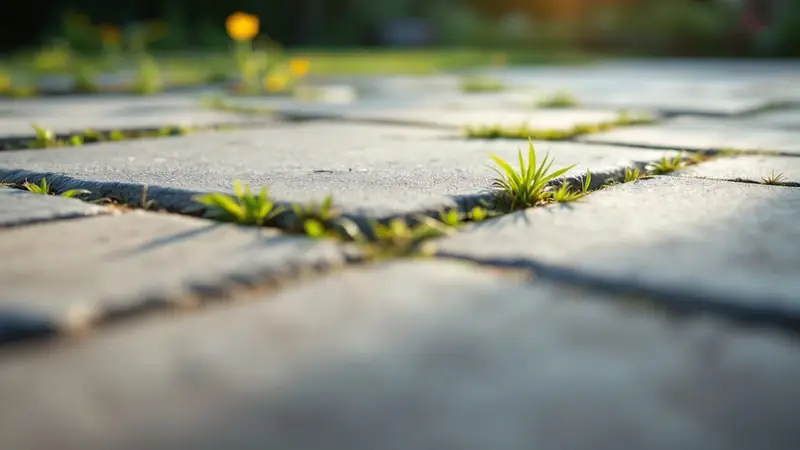
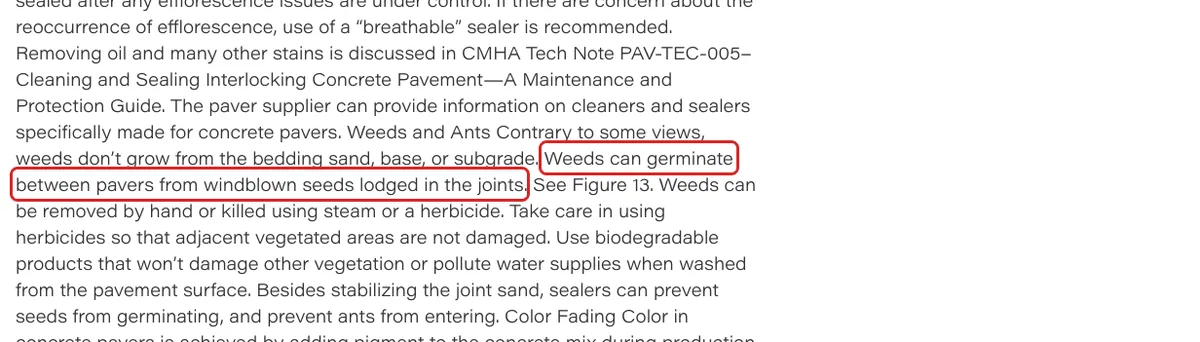
The weeds are not growing up through your base. The Concrete Masonry and Hardscapes Association (CMHA) maintenance bulletin PAV-TEC-006 says weeds do not grow from the bedding sand, base or subgrade: they germinate from windblown seeds lodged in the joints, and can be removed by hand or killed with steam or an herbicide. Unilock gives the same mechanism: seedlings take hold where joint sand has washed out. Our explainer on where weed seeds come from covers the wind, bird and seed-bank routes in.
What the seed lands in decides the rest. In a 2-year rain-shelter paving trial in Flanders, Belgium (De Cauwer and others, Weed Research, 2013), plots with wide joints and joint filler polluted with organic matter grew more weeds, a more permeable bedding layer raised weed cover, and coarse fillers and a sodium silicate sand grew less than fine sand. So the dirt and leaf litter packed into the top of a joint is the seedbed, and CMHA’s trigger for refilling is joint sand that has dropped more than 1/2 inch (12 mm) below the paver top.
Which method keeps pavers weed-free the longest?
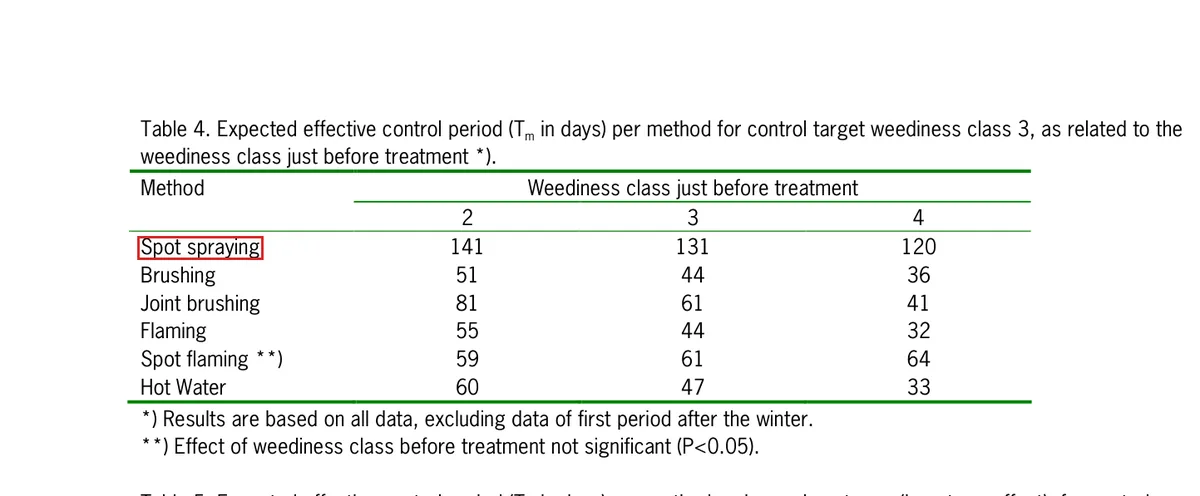
The table ranks each method on the questions that decide the choice: does it kill the root, how long did the trial footpath stay acceptable, how many rounds a season it took, and what it does to pavers and joint sand. Days are the Wageningen trial’s effective control period at weediness class 3 (5 to 25 percent of joints covered), with the range running from a lightly to a moderately weedy start.
| Method | Kills roots? | Days until weeds returned | Rounds per Mar 1 to Nov 15 season | Risk to pavers or joints | Source |
|---|---|---|---|---|---|
| Glyphosate spot spray | Yes: moves from leaf to root; complete kill in 1 to 2 weeks, some perennials 4+ weeks (EPA Reg. No. 71995-29 label) | 120 to 141 | 1 to 2 | None to pavers; kills any plant it drifts onto | Vermeulen 2006, tables 4 and 6; 71995-29 label |
| Deep joint brushing (narrow steel brush in the joint) | Removes plants and the dirt they root in | 41 to 81 | 3 to 5 | Removes some joint sand; top up after | Vermeulen 2006 |
| Spot flaming (flame on each weed) | Top growth; perennials regrow | 59 to 64 | 3 to 4 | Fire risk near mulch, fences, dry grass | Vermeulen 2006 |
| Hot water | Top growth; 2-leaf seedlings often die | 33 to 60 | 3 to 6 | None | Vermeulen 2006 |
| Flaming the whole surface | Top growth | 32 to 55 | 3 to 5 | Fire risk | Vermeulen 2006 |
| Surface brushing | Top growth and loose debris | 36 to 51 | 4 to 6 | Light sand loss | Vermeulen 2006 |
| Hand pulling, weeding knife | Only if the root comes out; repeated top removal weakens taproots | Not measured | As weeds appear | None | RHS |
| Pelargonic acid or ammonium nonanoate spray | No: contact burn within hours; no root uptake or soil residual | Not measured | Repeat as regrowth appears | Kills any plant it touches | NC State Extension |
| Vinegar (acetic acid) | No: contact burn | Not measured | Repeat | Acids can dull or etch limestone, travertine, marble | Natural Stone Institute |
| Pressure washing | Blasts out plants with the joint fill | Not measured | Then re-sand | Joint sand loss is a listed cause of failure | CMHA PAV-TEC-006 |
Three results change what a homeowner should do. Deep joint brushing, a narrow steel brush run only in the joints, needed 1 to 2 fewer rounds than surface brushing, which is the field version of scraping joints out with a paver knife. Spot flaming, heat on each weed with more for bigger ones, held 59 to 64 days however weedy the path was. And hot water and flaming got better each year, from 44 to 51 days and 40 to 49 days between 2003 and 2005, as the weed stock ran down.
Fall cleanup buys spring time. The path was brushed clean before every winter, and how clean it was set the first spring treatment: from March 1, flaming held 110 days after a clean fall (class 2) but 37 after a weedy one (class 4), and hot water 92 against 26. Our dose pages for boiling water on weeds and propane flame weeding cover how much heat each pass needs; this page does not repeat them.
Read the numbers as a ranking, not a promise. The trial path carried fewer than 20 walkers a day, sat in the Dutch climate on 0.3 m (12 in.) tiles, and every pass was dosed to kill over 95 percent of top growth. For flaming, the authors say that dose was probably higher than in practice, so real-world rounds may run higher. A busier or sunnier patio will differ.
Step by step: clearing a weedy paver joint
This sequence follows CMHA’s maintenance bulletin and the RHS hard-surface advice, and it works the same whether you finish with heat or a spray. Polymeric sand needs dry pavers and dry joints (Gator data sheet), so refill on a dry day after the weeds are out.
- Measure the joint. Push a ruler into a few joints. If the sand sits more than 1/2 inch (12 mm) below the paver top, plan to refill after weeding (CMHA PAV-TEC-006).
- Cut and lever out the weeds. Run a weeding or block-paving knife along the joint to sever roots and lever plants out, and use a dandelion weeder on taproots (RHS). Scrape out the dark grit layer with the plants.
- Brush the joints. A paving brush with angled wire bristles scrubs seedlings, moss and debris out of joints. Sweep the debris off the patio, not into a bed.
- Treat what survived. Seedlings: boiling water or a flame pass. Perennials with roots under the pavers, such as bermudagrass or nutsedge: a glyphosate product whose label lists patios, applied in warm, sunny weather (the label says above 60°F for best results) and given 1 to 2 weeks, or 4+ weeks for some perennials, before you judge it (EPA Reg. No. 71995-29).
- Brush out the dead plants once they are brown and dry, so their roots and litter do not become the next seedbed.
- Refill. Top up shallow joints with dry joint sand (ASTM C144 or similar, per CMHA PAV-TEC-002). For polymeric sand, clear the old fill to at least 1 1/2 in. deep first: CMHA says polymeric sand is not recommended for topping up.
- Stabilize or seal (optional). CMHA notes that joint stabilizers and sealers reduce the potential for weeds; a liquid stabilizer should penetrate at least 3/4 in. (20 mm) into the joint sand (PAV-TEC-005).
Herbicides labeled for patios: what the labels allow
The label is the law: whatever product you buy, its EPA registration number, rates and restrictions govern, and every accepted label is searchable in EPA’s Pesticide Product Label System. The four product types sold for hardscape split on two questions, whether the chemical reaches roots and whether it stays in the soil. Products named below are examples of each type from EPA-stamped labels, not recommendations.
| Type | Actives (example label) | Reaches roots? | Rain | How long, and the key restriction | Source |
|---|---|---|---|---|---|
| Glyphosate + diquat concentrate | Glyphosate 18%, diquat 0.73% (EPA Reg. No. 71995-29) | Yes, glyphosate | Rain after 10 or 30 min does not wash it off | No soil claim; complete kill 1 to 2 weeks | EPA label, Apr. 2022 |
| Glyphosate + imazapic + diquat, “up to 12 months” | 18%, 1.6%, 0.73% (EPA Reg. No. 71995-49) | Yes | Rainproof in 30 min | Up to 12 months; spray the whole area; not over root zones of desirable plants; plant 12 months after | EPA label, Nov. 2025 |
| Pelargonic acid + imazapic ready-to-use | 2% and 0.017% (EPA Reg. No. 239-2782) | Contact plus soil residual | Rain 1 hour later does not wash it off | Max 2 applications a year, 4 months apart; groundwater advisory; replant after 4 months | EPA label, May 2025 |
| Pelargonic acid or ammonium nonanoate (Scythe, Axxe) | Spot spray at 3 to 10% or 6 to 15% v/v | No | Apply in warm, dry weather | No soil residual; older perennials survive | NC State Extension |
The residual products are the ones that can hurt something you cannot see. The 71995-49 label is not for use over the root zones of trees, shrubs or other desirable plants, and the 239-2782 label says not to spray next to a fence if wanted plants grow on the other side and carries a surface water advisory for runoff for several months. A patio poured or laid over a maple’s roots is exactly that case. For glyphosate itself, our pages on which Roundup labels kill lawn grass and how long glyphosate stays in soil sort the brand’s look-alike bottles.
Timing matters on hardscape because runoff has nowhere to soak in. The 71995-29 label advises spraying in calm weather with no rain predicted for 24 hours so it does not wash off the treatment area into drains. Our guide on whether to spray weeds before or after rain covers rainfast windows by active ingredient.
This page is general information, not pesticide or legal advice. Read and follow the full label of any product you use, and check your state’s rules before applying any herbicide for hire. Questions about a product can go to the National Pesticide Information Center.
Salt, vinegar and pressure washers: what they do to pavers
Salt is less of a paver problem than the top results suggest, and more of a soil problem. Concrete pavers made to ASTM C936 must pass the ASTM C1645 freeze-thaw test for de-icing salt, and CMHA calls rock salt the least damaging de-icer for concrete (PAV-TEC-006). The sodium and chloride wash off the patio into the lawn or bed beside it, which is where the damage shows; our salt dose and soil math gives about 0.4 g per seedling as a spot dose.
Vinegar is the one to keep off stone. The Natural Stone Institute warns that products containing vinegar or other acids may dull or etch calcareous stone, which includes limestone, travertine and marble pavers. On concrete pavers, CMHA’s cleaning bulletin notes that strong acids change paver color slightly and that acidic runoff can harm grass (PAV-TEC-005). Household 5 percent vinegar mostly kills weeds in their first 2 weeks, per our vinegar strength comparison; the kitchen alternative is checked in does baking soda kill weeds.
A pressure washer kills nothing; it removes the plant and the joint fill together. CMHA describes professional cleaning at 1,000 to 4,000 psi, says a low angle and a wide nozzle reduce the risk of dislodging joint sand, and lists pressure washing among the causes of joint sand loss (PAV-TEC-005, PAV-TEC-006). Alliance Gator tells owners to wash polymeric joints with a hose set to shower at normal building pressure, typically 80 psi (Gator Maxx G2 data sheet, May 2025). Use the washer only on a day you plan to re-sand.
Preventing weeds by joint type
Which prevention works depends on what fills the joint. The table pulls the joint specifications from 3 CMHA bulletins and 2 polymeric sand data sheets, and pairs each with the step that keeps seeds from rooting and the mistake that brings them back.
| Joint type | Spec | What keeps weeds out | What brings them back | Source |
|---|---|---|---|---|
| Standard concrete pavers, sand joints | 1/16 to 3/16 in. wide; ASTM C144-type joint sand | Keep joints full; top up when sand drops 1/2 in.; optional stabilizer or sealer | Polymeric sand as a top-up | PAV-TEC-002, 006 |
| Polymeric sand joints | 1/8 in. (Gator) or 1/16 in. (Techniseal) minimum width; 1 1/2 in. minimum depth; finished 1/8 in. below the top or chamfer | Sweep grit out of that 1/8 in. recess; wash with a hose at about 80 psi | Pressure washing; installing on damp joints | Gator G2, HP NextGel |
| Wide joints: flagstone, tumbled pavers | Up to 4 in. (both makers); HP NextGel is ideal to 1 in. | Stabilized fill, or plant the joints on purpose | Plain fine sand, which grows the most weeds in wide joints | De Cauwer 2013, Techniseal |
| Pavers over a concrete slab (overlay) | Up to 2 in. with Gator G2; 2 in. drain holes every 10 ft | Rain-safe 24 hours after activation, against 15 minutes on a standard base | Skipping the drain holes, which keeps joints wet | Gator G2 |
| Permeable pavers | ASTM No. 8, 89 or 9 stone in the joints | Vacuum out sediment; CMHA’s cleaning step uses a vacuum able to remove 1 in. of joint stone | Polymeric sand over large-void stone (Gator says do not) | PAV-TEC-018, Gator |
| Mortared joints | Rigid mortar or jointing compound | Chisel out loose pointing and refill with dry mortar mix or a ready-made compound | Walking on it before it hardens | RHS |
Does polymeric sand prevent weeds?
In the lab, mostly yes. A Flemish growth-chamber study of 13 joint fillers (De Cauwer and others, Weed Research, 2014) found seedling emergence and weed biomass lowest in polymeric bound sand, iron slag sand and most sodium silicate fillers, even with compost mixed in at up to 80 percent by volume. Plain white sand suppressed weeds only until it was polluted with organic matter.
In the yard, the makers claim less than people expect. Alliance Gator’s data sheet says the product helps prevent weeds and will not cause or prevent moss, and both data sheets require the finished joint to sit at least 1/8 in. below the paver top or chamfer. That recess collects grit and seeds, so a polymeric joint still sprouts surface weeds if it is never swept. Techniseal wants the joint dry for 24 to 48 hours before rain, though it can take unexpected rain after 60 minutes (HP NextGel TDS).
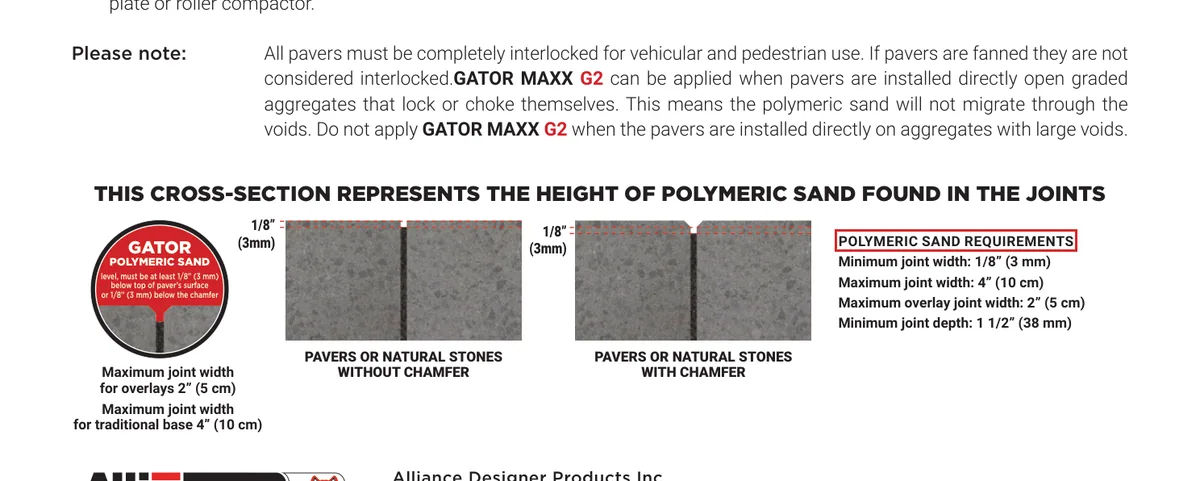
Re-sanding takes more sand than most people buy. A 50 lb bag of Gator Maxx G2 covers 65 to 85 sq ft of narrow joints (1/8 to 3/8 in.) on 2 3/8 in. pavers but only 22 to 42 sq ft of 3/4 to 1 1/4 in. joints; Techniseal lists 60 to 120 and 25 to 40 sq ft. At the $41 to $42 a bag in our paver patio cost build, a 200 sq ft narrow-joint patio is 3 to 4 bags. The calculator uses each maker’s low-coverage figure.
- 50 lb bags (round up)
- 3.1
- Pounds of sand
- 154
Default: 200 sq ft of narrow joints with Gator Maxx G2 = 3.1 bags (154 lb); at Gator's high-end 85 sq ft per bag it is 2.4. Coverage figures assume 2 3/8 in. pavers and joints cleared to at least 1 1/2 in. deep (Gator TDS May 2025; Techniseal TDS Jan. 2023).
What goes under the pavers does not stop joint weeds. Unilock says never to put plastic under pavers because it keeps joints wet and promotes weeds, and CMHA treats geotextile as an optional soil separation layer over clay, saturated or freeze-thaw soils (PAV-TEC-002), not a weed barrier.
Which method fits the weed in your joints?
Run the questions in order; the first yes gives the method. The flow uses the same thresholds as the tables: the 1/2 in. refill line, label root-zone limits and the trial’s 44 to 61 day re-treatment interval.
1Is it moss, algae or liverwort in a shaded, damp joint?
YesScrub it out with a wire brush. Gator's data sheet says polymeric sand will not prevent moss; fix slope (CMHA recommends 2 percent) and shade-side drainage.
NoGo to the next question
2Is the joint sand more than 1/2 inch below the paver top?
YesPull or scrape the weeds, then refill the joint. CMHA's refill line is 1/2 in.; killing the weed alone leaves the seedbed.
NoGo to the next question
3Is it a perennial with a taproot or runners (dandelion, bermudagrass, nutsedge)?
YesDig it with a weeding knife or dandelion weeder, or spot spray a glyphosate product labeled for patios and allow 1 to 2 weeks, 4+ for some perennials. Heat and contact sprays burn the top only.
NoGo to the next question
4Do tree or shrub roots run under or beside the pavers?
YesSkip residual 'up to 12 months' products: label 71995-49 bars use over the root zones of desirable plants. Use heat or a contact spray.
NoSeedlings in full joints: boiling water, a flame pass or a contact spray, repeated every 44 to 61 days (Wageningen trial), then brush the joints clean before winter.
Source: Vermeulen 2006; CMHA PAV-TEC-006; EPA labels 71995-29 and 71995-49; Alliance Gator TDS
How we compiled this
On Nov. 14, 2026 we read the Wageningen pavement trial report in full, the Weed Research abstracts of De Cauwer and others (2013, 2014), CMHA tech notes PAV-TEC-002, 005, 006 and 018, the Alliance Gator and Techniseal data sheets, three EPA-accepted herbicide labels, NC State Extension, Natural Stone Institute and RHS guidance, and the top 3 ranking pages. Day counts are the trial’s own regression estimates; we did not treat any pavers. Bag counts are our arithmetic from the makers’ coverage figures.
Frequently asked questions
How do I permanently get rid of weeds between pavers?
Nothing is permanent, because new seed blows in every season. The longest gap in the Wageningen trial was 120 to 141 days from a glyphosate spot spray. Between treatments, keep joints full to within 1/2 in. of the top and swept, or switch to a stabilized or polymeric joint.
Will vinegar kill weeds between pavers?
Young ones, on contact: household 5 percent vinegar mostly kills weeds in their first 2 weeks, and roots survive. Keep it off limestone, travertine and marble, which the Natural Stone Institute says acids can dull or etch.
Does vinegar, Dawn and salt really kill weeds?
It burns top growth, but the salt stays. Concrete pavers are tested for de-icing salt under ASTM C936, so the risk is to soil and plants the runoff reaches; our salt page puts a spot dose at about 0.4 g per seedling.
Does polymeric sand prevent weeds?
It resists rooting: in a 2014 growth-chamber study polymeric bound sand had among the lowest weed emergence of 13 fillers. The finished joint sits 1/8 in. below the paver top, and grit in that recess still sprouts unless it is swept.
What can I put under pavers to stop weeds?
Nothing under the pavers stops joint weeds, because CMHA PAV-TEC-006 says they germinate from seed in the joints, not from the base. Unilock warns against plastic, which keeps joints wet. Fill the joints well instead.
Does boiling water kill weeds between pavers?
It kills top growth and small seedlings. In the trial, hot water held 33 to 60 days per round and needed 3 to 6 rounds from March to mid-November, about the same as flaming.
Sources
- Vermeulen, Verwijs and Kempenaar, Plant Research International, Wageningen, Effectiveness of weed control methods on pavement, 2006. Accessed November 2026.
- De Cauwer and others, Weed Research, Reduced weed growth with different paving constructions, 2013. Accessed November 2026.
- De Cauwer and others, Weed Research, Effectiveness of water permeable joint filling materials for weed prevention in paved areas, 2014. Accessed November 2026.
- Concrete Masonry and Hardscapes Association, PAV-TEC-006: Operation and Maintenance Guide for Interlocking Concrete Pavement, rev. 2022. Accessed November 2026.
- Concrete Masonry and Hardscapes Association, PAV-TEC-005: Cleaning, Sealing and Joint Sand Stabilization of Interlocking Concrete Pavement, rev. 2022. Accessed November 2026.
- Concrete Masonry and Hardscapes Association, PAV-TEC-002: Construction of Interlocking Concrete Pavements, rev. 2022. Accessed November 2026.
- Concrete Masonry and Hardscapes Association, PAV-TEC-018: Construction of Permeable Interlocking Concrete Pavement Systems, rev. 2022. Accessed November 2026.
- Alliance Designer Products, Gator Maxx G2 polymeric sand technical data sheet, May 6, 2025. Accessed November 2026.
- Techniseal, HP NextGel Jointing Sand technical data sheet, Jan. 24, 2023. Accessed November 2026.
- U.S. EPA PPLS, Roundup Weed & Grass Killer Concentrate Plus, EPA Reg. No. 71995-29, accepted label, Apr. 6, 2022. Accessed November 2026.
- U.S. EPA PPLS, Roundup Max Control 365, EPA Reg. No. 71995-49, accepted label, Nov. 21, 2025. Accessed November 2026.
- U.S. EPA PPLS, GC SLWK RTU (Scotts), EPA Reg. No. 239-2782, accepted label, May 16, 2025. Accessed November 2026.
- NC State Extension, Scythe (pelargonic acid) and Axxe (ammonium nonanoate), herbicide factsheet, current page. Accessed November 2026.
- Natural Stone Institute, Care and cleaning of natural stone, current page. Accessed November 2026.
- Royal Horticultural Society, Weeds on hard surfaces, current page. Accessed November 2026.
- Unilock, How to kill weeds between pavers, current page. Accessed November 2026.