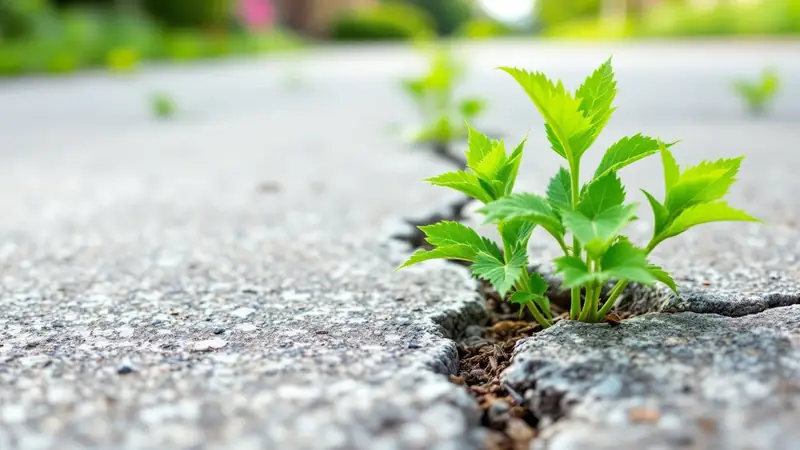
Where do weeds come from? Mostly from seed already in your soil: farm soils hold thousands of weed seeds per square foot, and digging or thin grass lets them sprout. The rest blow in, ride in on birds, mowers, soil or seed, or creep underground.
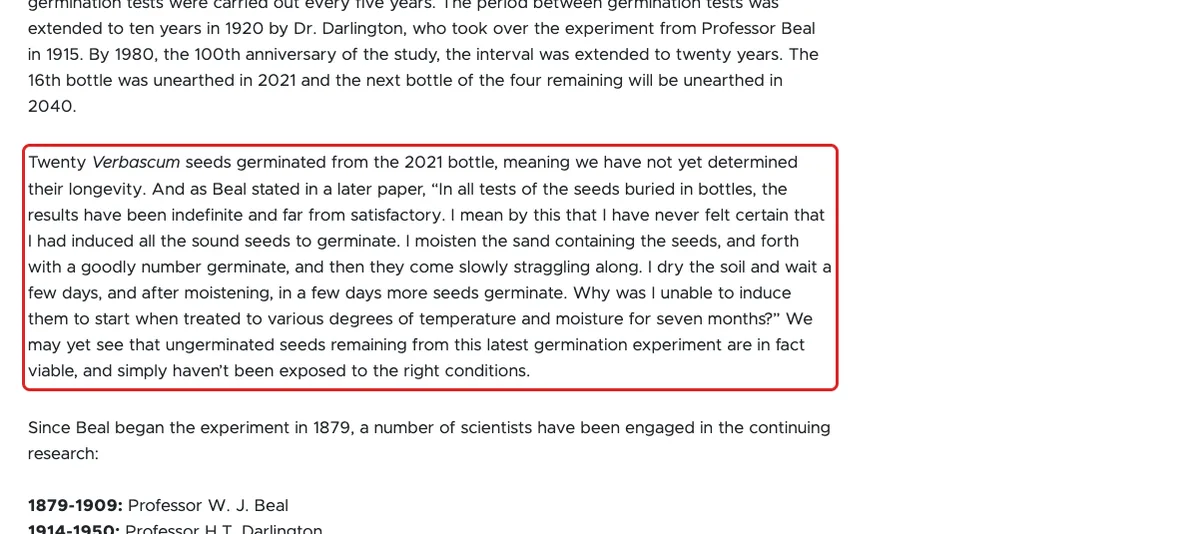
The short answer to where do weeds come from is: usually from below. Agricultural soils can hold thousands of viable weed seeds per square foot (eOrganic, Menalled), and in most studies only 1 to 30 percent of that bank sprouts in a given year (Iowa State Extension). The rest waits. In April 2021 Michigan State researchers dug up the 16th bottle of William Beal’s 1879 burial experiment, and 20 of its 50 mullein (Verbascum) seeds germinated after 141 years in the ground (Beal Botanical Garden, MSU).
Which route brought a weed decides what stops it. The table sorts 10 common weeds by seed count, how long the seed or tuber survives in soil and how it travels, each from a university or USDA source, so you can tell a weed that was waiting in your soil from one that arrived this season. Most guides list the routes; none of the top results put numbers on them.
| Weed | Seeds or tubers per plant | Survival in soil | How it travels | Most likely origin | Source |
|---|---|---|---|---|---|
| Common dandelion | 50 to 150 seed heads a year, about 250 seeds each | 1 to 5 years; most seedlings come from recently shed seed | Wind: a model put 99.5% within 11 yards, 0.01% past 1,083 yards | Arrived: a nearby plant, usually last season | Cornell Weed Science |
| Large crabgrass | More than 100,000 from one large plant | At least 3 years | Seed only; no rhizomes or stolons | Seed bank from last summer’s plants | UC IPM |
| Common purslane | Up to 240,000 | Can germinate after 5 to 40 years | Seed; mature mats drop thousands on the soil surface | Seed bank | UC IPM |
| Common lambsquarters | More than 70,000 | About 3% of seeds (the brown ones) germinate readily; black seeds are more dormant | Emerges best from 0.1 inch deep, rarely below 1 inch | Seed bank lifted by digging | Purdue GWC-11 |
| Moth mullein | Not reported in our sources | 20 of 50 seeds germinated after 141 years (2021 dig) | Seed | Seed bank | Beal Botanical Garden, MSU |
| Field bindweed | About 550 | Up to 60 years | Rhizomes spread a plant more than 10 feet in a season; roots reach 20 feet | Roots, old seed, or contaminated seed | UC IPM |
| Yellow nutsedge | 1 tuber gave 1,900 shoots and 6,900 tubers in a year (Minnesota) | Tubers 1 to 3 years, mostly in the top 6 inches | Rhizomes and tubers; seed has very low viability | Underground, or tubers in hauled soil | eOrganic; UC IPM |
| Horseweed (marestail) | Not reported in our sources | Not reported in our sources | Seeds caught 41 to 140 m up; one event can exceed 500 km | Arrived on the wind | Shields et al., Weed Science 2006 |
| Giant ragweed | Not reported in our sources | Not reported in our sources | Nightcrawlers buried about 70% of surface seed, about 130 per burrow | Seed moved and buried by earthworms | Ohio State CFAES |
| Pigweeds (Amaranthus) | Not reported in our sources | About 19% of bird-feed pigweed seed could germinate | Found in 94 of 98 bird feed bags; ducks and geese carry seed up to 1,800 miles | Bird feed or migrating birds | GROW, University of Missouri research |
The seed bank: weeds that were already in your soil
Every weed that sets seed pays into a bank you cannot see. One large crabgrass plant can exceed 100,000 seeds (UC IPM), common purslane up to 240,000 (UC IPM) and common lambsquarters more than 70,000 (Purdue GWC-11). Most of it does not sprout in year 1: in an Iowa State burial trial, 5 percent of waterhemp seed emerged the first year against 40 percent of woolly cupgrass (Iowa State).
Two long burial experiments show how long the wait can be. In the Duvel experiment started in 1902 at Arlington, Virginia, seed of 107 crop and weed species was buried at 8, 22 and 42 inches; 36 species still grew after 39 years, while 22 of 31 cultivated species were dead after 20 years, most of them after 1 year (USDA Agriculture Handbook 506, p. 209). Beal’s bottles, buried in 1879, are dug every 20 years now; the next comes out in 2040 (MSU).
The bank shrinks only when nothing new goes in. In a Nebraska study, weed seed banks fell to 5 percent of their starting density after 5 years of allowing no weeds to seed, then climbed back to 90 percent of the original after one uncontrolled year (Burnside et al. 1986, summarized by eOrganic). Removing weeds before they flower is the one step that works on every species in the table. The calculator shows what a few plants left to seed add.
Frost does not reset the bank either: the annuals that die in the winter, such as crabgrass and purslane, have already dropped their seed, up to 240,000 per purslane plant by UC IPM’s count.
Purslane adds a second route: Cornell’s weed profile says an uprooted plant can re-root or finish its seed without touching soil, which is why our plan for getting rid of purslane bags every pulled plant.
- Seeds produced
- 1,000,000
- Seedlings in 1 year if 1% emerge
- 10,000
- Seedlings in 1 year if 30% emerge
- 300,000
Default: 10 large crabgrass plants can add about 1,000,000 seeds; at the 1 to 30 percent yearly emergence range Iowa State reports, that is 10,000 to 300,000 seedlings in a year. Per-plant counts are published maximums or averages for well-grown plants; shaded or mowed plants make far fewer.
Why weeds pop up right after you dig, till or add soil
Many small weed seeds need a flash of light to break dormancy, and turning soil supplies it. USDA Agricultural Research Service weed scientist Douglas Buhler tilled Minnesota plots in total darkness; small-seeded broadleaf weeds including common lambsquarters, common ragweed, pigweed and smartweed emerged generally 50 to 60 percent less, with cuts as large as 80 percent (Agricultural Research, December 1995). Later trials were less consistent, and a 2022 Washington State review calls the night-tillage results inconsistent (WSU Soil Health).
Depth does the rest. Common lambsquarters emerges best from about 0.1 inch and rarely from below 1 inch (Purdue GWC-11), while plowing leaves most seeds 4 to 6 inches down (eOrganic). Digging a bed lifts years of buried seed into that top inch, which is why a fresh bed turns green with seedlings. Our guide to tilling soil covers the stale-seedbed method that uses this flush, and the mulch depth trials for weed control show what a covering layer blocks.
Bought soil and compost can bring their own bank. Colorado State University Extension says composting kills weed seed only if the pile heats above 145°F and is turned regularly, and that few home piles get that hot (CSU Extension). Ask a supplier whether the material was heat-processed, and at what temperature, before it goes under seed or new sod.
Seeds that arrive: wind, birds, worms and mowers
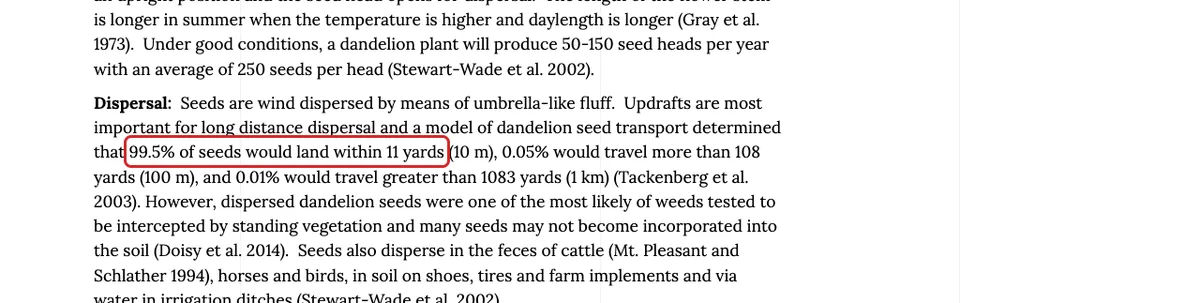
A dandelion makes 50 to 150 seed heads a year averaging 250 seeds each (Cornell Weed Science). A seed-transport model found 99.5 percent land within 11 yards of the parent, 0.05 percent pass 108 yards and 0.01 percent pass 1,083 yards. Dandelion seed lasts only 1 to 5 years in soil and most seedlings come from recently shed seed, so a new dandelion usually came from a plant nearby last season. Whether it counts as a weed at all is laid out in our page on whether a dandelion is a weed.
Lighter seed goes much farther. Researchers flying radio-controlled planes over southern Delaware in September 2005 caught horseweed seeds 41 to 140 meters up, in the layer of air where winds often top 20 meters per second, and concluded one dispersal event can easily carry them more than 500 km, about 310 miles (Shields et al., Weed Science, 2006).
Birds move seed two ways. University of Missouri weed scientist Kevin Bradley found pigweed seed in 94 of 98 bags of bird feed across 22 brands, up to 6,500 Amaranthus seeds in a 2.2 pound portion, with about 19 percent able to germinate (GROW, 2026). A ring of weeds under a feeder is usually the feed. His research also found some seeds survive passage through ducks and geese, which can drop them up to 1,800 miles from where they fed.
Earthworms and mowers move seed short distances. Ohio State researchers found nightcrawlers buried about 70 percent of giant ragweed seed that reached the soil surface, an average of 130 seeds per burrow (Ohio State CFAES). University of Maryland agronomists note that mowing can blow seed out of a weedy patch or carry it on mower parts, and advise cleaning mowers between sites (UMD Agronomy News, 2022); mowing before seed heads open avoids both.
Seed you buy: how much weed seed a lawn seed bag may carry
Lawn seed is allowed some weed seed, and the tag must say how much. Pennsylvania’s seed law caps weed seed in cool-season lawn and turf seed at 1 percent by weight, limits undesirable grass seed to 0.50 percent of the labeled weight and requires restricted noxious weed seeds to be listed under their own heading (3 Pa.C.S. § 7104(b)(2)). Other states write their own limits, so read your tag rather than assume.

Do the arithmetic before you buy. A 25 lb bag labeled 0.30 percent weed seed holds 0.075 lb, about 34 grams, of weed seed; at the 1 percent Pennsylvania ceiling the same bag could hold 0.25 lb, about 113 grams. Our grass seed cost guide reads every line of the tag, including crop seed and inert matter.
Contaminated seed has moved weeds before. UC IPM says field bindweed most likely reached the United States as a contaminant in farm and garden seed, and it was documented in California in 1884 (UC IPM).
Weeds that spread underground
Some weeds need no seed at all. Yellow nutsedge forms tubers on rhizomes as deep as 8 to 14 inches, most in the top 6 inches; they survive 1 to 3 years, sprout once soil stays above 43°F, and mature tubers can resprout more than 3 times (UC IPM). One tuber produced 1,900 shoots and 6,900 tubers in a year in Minnesota (Tumbleson and Kommedahl 1961, cited by eOrganic). Timing for herbicides is in our nutsedge control guide.
Field bindweed roots reach 20 feet, and one plant can spread more than 10 feet in a growing season from rhizomes (UC IPM). A patch that returns in the same spot every year, or widens from the edge, came from roots, not new seed, and pulling the top only resets it. The creeping lawn weeds and how to tell them apart are in our common lawn weeds identification chart.
Our guide on how to get rid of bindweed turns those root numbers into a 3-year plan: cut the regrowth every 12 to 21 days, spray in late summer or fall, and stop every flower from setting seed.
Why weeds fill thin grass first
Grass cover decides whether the seed bank sees light. In NC State trials at the Lake Wheeler Turfgrass Field Lab, tall fescue mowed at 1, 2, 3 and 4 inches had 95, 48, 13 and 0 percent crabgrass cover by mid-September (NC State TurfFiles). Same soil, same seed bank; the canopy made the difference.
Shade also cuts how much seed the escapes make: small weeds overshadowed by a good crop canopy may have less than 1 percent of the seed-forming capacity of plants in full sun (eOrganic). For a lawn, that means mowing at the top of your grass’s recommended range (crabgrass cover was 13 percent at 3 inches and 0 at 4 inches in the NC State trial) and overseeding thin areas in their planting window.
Feeding helps those seedlings close the gaps, but fertilizer does not kill weeds on its own: in Wisconsin lawn plots, unfertilized turf still carried 29 percent weed cover in its third and fourth years.
Every route, the evidence and what blocks it
| Route | Example weeds | Evidence | What blocks it | Source |
|---|---|---|---|---|
| Soil seed bank | Purslane, lambsquarters | Thousands of seeds per sq ft in farm soil; 1 to 30% emerge a year | Stop seed set; disturb soil less; mulch beds | eOrganic; Iowa State |
| Digging and tilling | Lambsquarters, pigweed | Dark tillage cut emergence 50 to 60% (up to 80%) in USDA trials | Hoe shallow; plant or mulch soon after digging | USDA ARS |
| Wind | Dandelion, horseweed | 99.5% of dandelion seed within 11 yards; horseweed past 500 km | Dense turf; remove flowers before the puffball opens | Cornell; Shields 2006 |
| Bird feed | Pigweeds | Pigweed seed in 94 of 98 bags | Pull seedlings under feeders before they flower | GROW |
| Earthworms | Giant ragweed | About 70% of surface seed buried | Remove plants before seed drops | Ohio State |
| Mowers | Any weed with mature seed heads | Seed blown from patches or carried on mower parts | Mow before seed heads form; clean the deck between sites | UMD |
| Lawn seed | Whatever the tag lists | Pennsylvania allows up to 1% weed seed by weight | Read weed seed % and the noxious weed line | 3 Pa.C.S. § 7104 |
| Compost and soil | Any | Seed survives unless the pile tops 145°F and is turned | Ask whether it was heat-processed | CSU Extension |
| Roots and tubers | Nutsedge, bindweed | 1 tuber to 6,900 tubers in a year | Remove sprouts repeatedly; dig the whole root | eOrganic; UC IPM |
| Thin turf | Crabgrass | 95% cover at 1 in. mowing vs 0% at 4 in. | Mow high; overseed thin areas | NC State |
Answer four questions and you can usually name the route. The flow below runs them in order; herbicide choices by weed are in our lawn weed killer comparison, and paver joints, a mix of wind-blown seed and sand, are covered in how to kill weeds between pavers.
1Did it come up within weeks of digging, tilling or spreading new soil or compost?
YesSeed bank or hauled-in seed: light and shallow depth trigger buried seed (USDA ARS; Purdue). Hoe shallow and cover the soil.
NoGo to the next question
2Is it in a patch under or near a bird feeder?
YesBird feed: pigweed seed turned up in 94 of 98 feed bags (GROW). Pull seedlings before they flower.
NoGo to the next question
3Does the plant return in the same spot each year, or spread from the patch edge?
YesRoots, rhizomes or tubers (nutsedge, bindweed): remove sprouts repeatedly or dig the whole root (UC IPM).
NoGo to the next question
4Did it appear in a newly seeded lawn, spread evenly through the new grass?
YesCheck the seed tag's weed seed % and noxious weed line (3 Pa.C.S. 7104).
NoGo to the next question
5Does it have a fluffy, wind-carried seed head (dandelion, horseweed, sowthistle)?
YesWind: most dandelion seed lands within 11 yards of the parent (Cornell). Thicken the turf and remove flowers early.
NoSeed bank under thin turf: crabgrass cover fell from 95 to 0 percent as tall fescue mowing height rose from 1 to 4 inches (NC State). Mow higher and overseed.
Source: USDA ARS; Purdue GWC-11; GROW; UC IPM; 3 Pa.C.S. 7104; Cornell; NC State TurfFiles
How we compiled this
On November 14, 2026 we read 21 primary sources: 2 long-term burial records (Beal, via Michigan State; Duvel, via USDA Agriculture Handbook 506), 3 peer-reviewed or agency research reports, 12 university extension publications and news releases, 1 state seed statute (3 Pa.C.S. § 7104) and 3 summaries of named field studies, checking each figure against the page that states it. Dispersal distances are model or trap results, not measurements in home lawns. We did not grow, count or test anything ourselves.
Frequently asked questions
Do weeds grow on their own?
Not from nothing. Every weed starts from a seed, a tuber or a root piece. Most come from seed already in the soil: farm soils can hold thousands of viable weed seeds per square foot (eOrganic), and buried mullein seed still germinated after 141 years at Michigan State.
Do weeds grow back if you cut them?
Annuals cut before they flower cannot add seed, but perennials regrow from what is underground. Mature yellow nutsedge tubers can resprout more than 3 times (UC IPM), and field bindweed roots reach 20 feet.
Why are weeds so hard to get rid of?
Because the seed bank outlasts one season of work. A Nebraska study cut seed banks to 5 percent in 5 years, and one uncontrolled year put them back to 90 percent (eOrganic). Purslane seed can germinate after 5 to 40 years.
Does cutting weeds make them spread?
It can once seed heads are mature: mowing can blow seed out of a patch or carry it on mower parts (University of Maryland). Mow or pull before flowers open, and clean the deck after mowing a weedy area.
Is it better to pull weeds or kill them?
Pull or hoe annual seedlings, keeping the cut shallow: lambsquarters emerges from the top 1 inch, so deep digging raises more seed (Purdue). Tubers and deep roots usually need repeated removal or a labeled herbicide; see our lawn weed killer guide.
Sources
- Michigan State University, Beal Botanical Garden, Beal Seed Experiment, Current page (2021 dig). Accessed November 2026.
- MSU Today, MSU plant biologists shed light on 144-year-old seedy mystery, Nov. 6, 2023. Accessed November 2026.
- USDA (Justice and Bass), Principles and Practices of Seed Storage, Agriculture Handbook 506, Buried Seed Experiments, p. 209, 1978. Accessed November 2026.
- eOrganic (F. Menalled), Manage the weed seed bank: minimize deposits and maximize withdrawals, Current page. Accessed November 2026.
- Iowa State University Extension (Buhler and Hartzler), Fate of weed seeds in the soil, Undated article, 1994 to 1998 trial. Accessed November 2026.
- USDA ARS, Agricultural Research magazine, Nightmare in tilling fields: a horror for weed pests, December 1995. Accessed November 2026.
- Washington State University Soil Health, Watching the waltz: weed seeds and tillage, July 14, 2022. Accessed November 2026.
- Purdue University (Glyphosate, Weeds and Crops series), GWC-11, Biology and Management of Common Lambsquarters, Undated PDF. Accessed November 2026.
- Cornell University Weed Science, Weed profile: Dandelion, Current page. Accessed November 2026.
- Shields, Dauer, VanGessel and Neumann, Weed Science 54(6), Horseweed (Conyza canadensis) seed collected in the planetary boundary layer, December 2006. Accessed November 2026.
- GROW (Getting Rid Of Weeds), Crisis at the bird feeder: Palmer and waterhemp move west through contaminated seed, 2026. Accessed November 2026.
- Ohio State University CFAES, Perplexing worm behavior may play role in weed survival, Archived news release. Accessed November 2026.
- University of Maryland Agronomy News, Mowing: a casually thought of integrated weed management tool, March 23, 2022. Accessed November 2026.
- Pennsylvania General Assembly, 3 Pa.C.S. § 7104, Labeling requirements (seed), Current statute. Accessed November 2026.
- Colorado State University Extension, Making compost, Current page. Accessed November 2026.
- UC IPM, Pest Notes: Field bindweed, Current page. Accessed November 2026.
- UC IPM, Pest Notes: Nutsedge, Current page. Accessed November 2026.
- eOrganic, Yellow nutsedge (Cyperus esculentus) profile, Current page. Accessed November 2026.
- UC IPM, Pest Notes: Common purslane, Current page. Accessed November 2026.
- UC IPM, Pest Notes: Crabgrass, Current page. Accessed November 2026.
- NC State Extension TurfFiles, Mowing height impacts weed populations, April 20, 2015, updated Oct. 27, 2025. Accessed November 2026.