How to prepare soil for sod: test it a month ahead, kill and strip old turf, grade it away from the house, loosen the subsoil, bring topsoil to 3 to 6 inches, mix in lime and starter fertilizer, then firm it 0.5 inch below walks.
Most of what decides whether sod roots happens before the pallets arrive, so how to prepare soil for sod is really a list of numbers to hit: a sample depth, a slope, a soil depth, a fertilizer rate, a firmness test and a height at the sidewalk. The top-ranked guides for this search give those numbers without saying whose they are, and they disagree. We lined up 11 primary documents, from Purdue Extension AY-28-W and NC State AG-69 to the Turfgrass Producers International guideline specifications, a state highway spec and the model building code. They agree on the order of work. They split on 3 numbers: how deep the topsoil should be (3 to 8 inches), how steep the grade should be (1 to 5 percent), and how far below a walk the soil should sit (0.5 or 1 inch). The table shows each step with the number to hit and the range across sources.
| Step | Number to hit | Range across sources | Why | Source |
|---|---|---|---|---|
| 1. Soil test | Sample the top 4 to 6 in at 10+ spots, at least 1 month before | 3 to 6 in (NC State samples 3 to 4) | Lime and phosphorus are mixed in before the sod covers the soil | Purdue AY-28-W |
| 2. Kill and clear | Repeat glyphosate 2 to 4 weeks apart for perennial grasses; no other herbicide within 2 months | Not covered by the specs | Preemergence herbicides can stop sod rooting | Purdue |
| 3. Rough grade | Fall of 6 in in the first 10 ft from the house; then about 2% (1 ft in 50 ft) | 1% to 5% | Standing water kills new sod and wets foundations | IRC R401.3; Purdue |
| 4. Loosen subsoil | Scarify at least 2 in before topsoil goes on | 2 to 4 in | Bonds the new soil to the old so water does not perch at the seam | TPI guideline, Sec. I.E; WA Ecology |
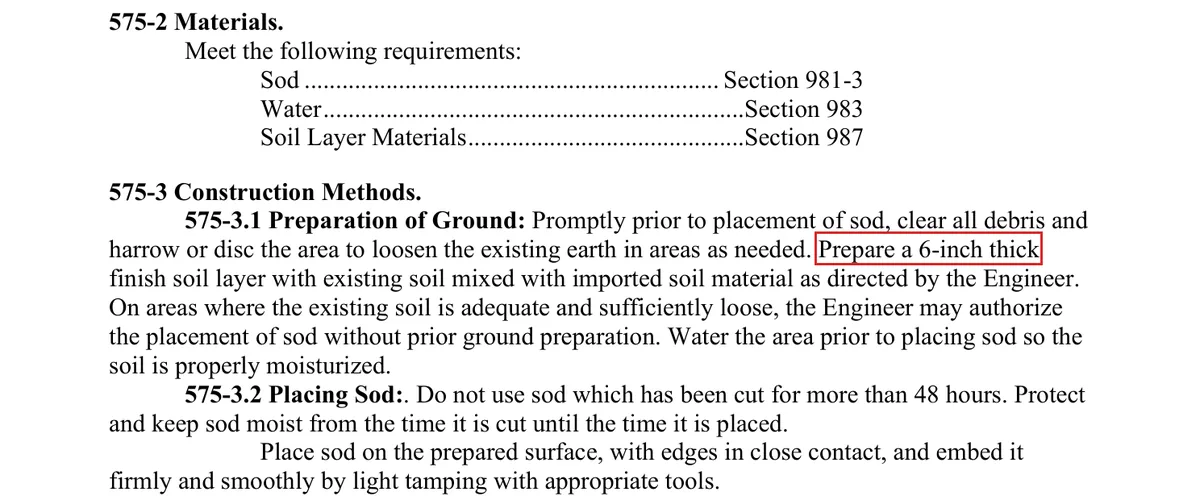
| 5. Topsoil depth | 6 in (Purdue’s worked volume: about 19 cu yd per 1,000 sq ft) | 3 to 8 in | Deeper soil holds more water between irrigations | Purdue; FDOT 575-3.1 |
| 5. Compost | 1 to 3 cu yd per 1,000 sq ft, mixed 6 to 8 in deep | 1 cu yd to 1.75 in | Only where organic matter is low (test it) | Purdue; NC State |
| 7. Lime and fertilizer | Per soil test; mixed into the top 4 to 6 in | 2 to 8 in | Granules touching sod roots can burn them | TPI, Sec. III.C; Purdue |
| 7. Starter fertilizer | 0.5 to 1.0 lb N and at least 1.0 lb P2O5 per 1,000 sq ft | Same where stated | Phosphorus drives the first roots | Purdue |
| 8. Firmness | Footprints no deeper than 0.5 in | 0.5 in to no visible prints | Soft soil settles into dips after the sod is down | Purdue; NC State |
| 8. Height at walks | Soil about 0.5 in below walks and drives | 0.5 to 1 in | Leaves room for the soil on the sod (0.5 to 0.75 in) | Purdue; FDOT 575-3.2 |
| 9. Moisture | Lightly moist, not muddy, a few days before delivery | All that state it agree | Sod on hot, dry soil roots slowly even if watered after | Purdue; NC State |
| 9. Timing | Install within 24 h of harvest | 24 to 48 h | Stacked sod heats and yellows on the pallet | Purdue; FDOT 575-3.2 |
If grass is still growing where the sod will go, read why not to lay over it in our guide on laying sod over existing grass. This page gives quantities; installed prices are in our sod installation cost breakdown.
How to prepare soil for sod, step by step
1. Test the soil at least 4 weeks ahead
Purdue asks for samples from the upper 4 to 6 inches at 10 or more spots, mixed in a plastic bucket and air-dried, at least one month before the sod goes down, so the results return in time to mix in what they call for (Purdue AY-28-W). If you will bring in topsoil, test that too. Order the routine test plus organic matter, the pair UGA’s Forsyth County agent recommends for sod beds (UGA Extension, March 2024); state lab fees and what each test covers are in our soil test guide.
Read the report against three lines. Purdue treats pH 6.0 to 7.5 as the optimum range for turf and limes below 6.0. Turfgrass Producers International’s guideline, as reprinted by Sod Solutions, sets imported topsoil at pH 5.5 to 7.5 and soluble salts no higher than 500 ppm (TPI guideline specifications, Sec. II.B). Washington’s stormwater soil rule asks for 5 percent organic matter in turf areas (Washington Ecology BMP T5.13 guidelines).
2. Kill perennial weeds, then strip the old turf
Purdue names creeping bentgrass and quackgrass as perennial grasses to control before any sod goes down. Its answer is glyphosate, sprayed again 2 to 4 weeks apart because one pass will not give complete control and repeat passes reach over 95 percent, and it warns against any other herbicide within 2 months before sodding because some preemergence products reduce sod rooting. Follow the product label for the rate and the replant wait: the label is the law. Spray, smother and sod-cutter methods are compared in our guide on how to kill grass before replanting.
Where the perennial is quackgrass, our guide on how to kill quackgrass lists the label rates, the 3-leaf timing for each repeat spray and the wait before you till or lay sod.
Then clear the bed. The TPI guideline clears the top 4 inches of stones over 1 inch across, roots, wire and grade stakes (TPI Sec. III.D). Purdue adds that buried stumps decay into depressions. Call 811 a few business days before trenching or regrading.
3. Rough-grade so water runs away from the house
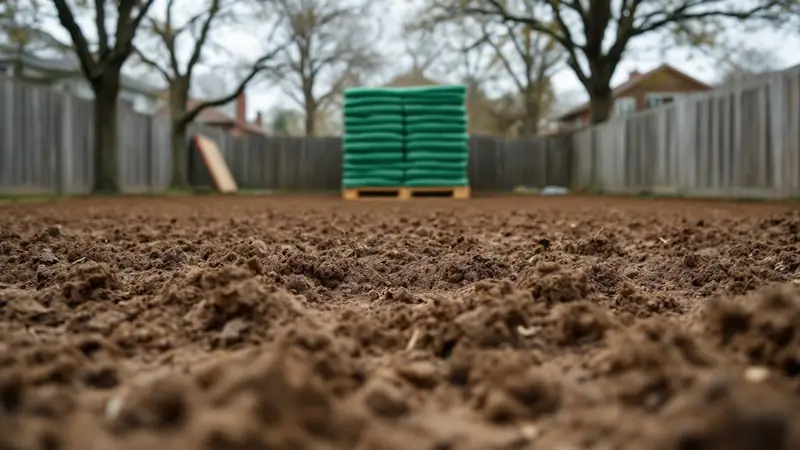
Set the slope before any topsoil goes down. If a lot of soil has to move, NC State says to strip the existing topsoil (usually 4 to 8 inches), shape the subsoil, then spread the topsoil back (NC State AG-69). Next to the house, the model building code governs: IRC section R401.3 requires the grade to fall at least 6 inches within the first 10 feet, which is a 5 percent slope.
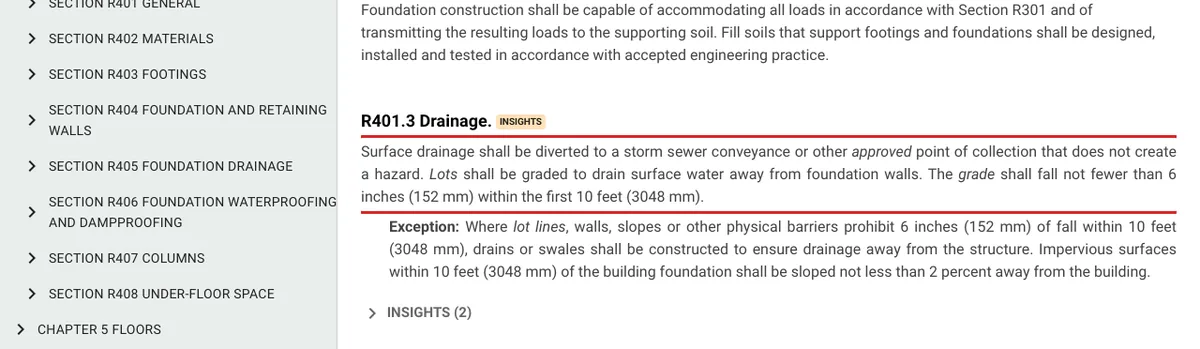
Past those 10 feet, extension guidance is gentler. Purdue suggests a 1-foot drop in 50 feet (2 percent) for at least 15 feet, NC State asks for 2 to 3 percent, and Illinois Extension says 1 to 2 percent. Two of the top three text results for this search quote only 1 to 2 percent; at the foundation that leaves 2.4 inches of fall where the code asks for 6. Purdue’s upper limit for a mowable lawn is a 1-foot drop every 4 feet. Our guide on how to level a lawn shows how to measure fall with stakes and a string line.
Purdue allows one week for the regraded soil to settle before final grading, and warns that tilling under a tree cuts a large share of its surface roots.
4. Loosen compacted subsoil before adding anything
New-construction lots are often packed subsoil. Spreading topsoil straight onto it creates two layers that water and roots cross badly. The TPI guideline scarifies the graded subsoil at least 2 inches deep just before topsoil is dumped; Washington’s rule goes further and loosens at least 4 inches below its 8-inch amended layer, for 12 inches of uncompacted soil (BMP T5.13). Till only when the soil is not wet: Purdue and Illinois both warn that working wet soil damages structure. Our guide on tilling soil has the moisture test and tiller depths.
5. Bring the topsoil to depth
This is where sources disagree most. The TPI guideline asks for at least 3 inches after firming where irrigation is installed and 5 to 6 inches where it is not. Illinois Extension and the Florida Department of Transportation call for 6 inches, Purdue sizes its topsoil example at 6 inches (about 19 cubic yards per 1,000 sq ft; the arithmetic gives 18.5), and Washington’s stormwater rule requires 8 inches at 5 percent organic matter for turf.
| Standard | Minimum soil depth under sod | Applies to |
|---|---|---|
| TPI guideline (Sod Solutions reprint), Sec. II.C | 3 in after firming | Sites with irrigation installed |
| TPI guideline, Sec. II.C | 5 to 6 in | Sites without irrigation |
| Purdue AY-28-W, step 6 | 6 in (its worked volume, about 19 cu yd per 1,000 sq ft) | Home lawns, especially low-fertility sites |
| Illinois Extension | 6 in or more of prepared soil | Home lawns, seed or sod |
| FDOT Section 575-3.1, FY 2026-27 | 6-in finish soil layer | Highway sodding, existing soil mixed with imported soil |
| Washington Ecology BMP T5.13 | 8 in settled, 5% organic matter | Western Washington sites under the stormwater manual |
Which to follow? With an irrigation system and decent native loam, 3 to 4 inches of firmed topsoil meets the industry floor. Without irrigation, or on packed builder subsoil, plan on 6. The FDOT spec shows the cheaper route too: its 6-inch layer is existing soil mixed with imported soil, not 6 inches of new soil on top (FDOT 575-3.1).
Compost is the other lever. Purdue mixes 1 to 3 cubic yards per 1,000 sq ft into the native soil 6 to 8 inches deep when it lacks organic matter; NC State uses 1 to 2 cubic yards on heavy clay or very sandy soil. That is only 0.3 to 1 inch of compost on the surface before tilling. Washington’s pre-approved turf rate is heavier: 1.75 inches of compost tilled into 6.25 inches of soil, about 5.4 cubic yards per 1,000 sq ft.
- Cubic yards
- 18.52
- Cubic feet
- 500
- 0.75 cu ft bags
- 667
Default: 1,000 sq ft at 6 inches needs 18.52 cubic yards (1,000 x 6 / 324), which Purdue rounds to about 19. Depths are as placed; loose topsoil settles, so add a margin for firmed depth. Volume only: prices are in our topsoil cost guide.
The calculator uses one rule: a cubic yard covers 324 sq ft at 1 inch, so cubic yards equal area times depth in inches divided by 324. Depths are as placed; loose screened topsoil settles, so order to the firmed depth plus a margin. Bulk prices per yard and per load are in our topsoil cost guide.
6. Put in drains and irrigation after the rough grade
Purdue’s order is rough grade, then drainage and irrigation, then final grade, because grading equipment damages installed heads. It places drain lines 6 to 18 inches deep and irrigation pipe 12 to 18 inches deep, below the frost line and normal tillage depth. Fill any trench line that sinks: Purdue says to fill low spots that hold water after irrigation or rain before sodding.
Purdue’s 12 to 18 inches is deeper than the 6 inches Texas and Florida require for small pipe; our guide to how deep sprinkler lines should be sets the code and installer figures side by side.
7. Mix in lime and starter fertilizer
Spread what the soil test calls for and mix it in before the sod goes down; afterward Purdue caps lime spread on top of turf at 50 lb per 1,000 sq ft per application. The TPI guideline incorporates fertilizer and lime into the top 4 inches and says not to lay sod directly on fertilizer granules. Purdue mixes lime and organic amendments into the top 4 to 6 inches, NC State into 6 to 8, and UGA’s agent tills lime and organic matter 2 to 4 inches deep. Lime rates by soil type are in our lawn lime guide.
For starter fertilizer, Purdue’s target at establishment is 0.5 to 1.0 lb of nitrogen and at least 1.0 lb of phosphate (P2O5) per 1,000 sq ft, raised to 1.5 lb of phosphate when soil-test phosphorus is low (0 to 13 ppm). If you skipped the test, the TPI guideline’s fallback is 0.5 lb nitrogen, 1.0 lb phosphate and 1.0 lb potash per 1,000 sq ft plus 50 to 100 lb of ground limestone; NC State’s no-test lime rate is 45 to 50 lb. Illinois Extension notes many Illinois soils already hold enough phosphorus, so starter fertilizer only pays where the test shows a shortage.
| Fertilizer analysis | Product per 1,000 sq ft | Nitrogen supplied | Phosphate (P2O5) | Potash (K2O) | Against Purdue’s 0.5 to 1.0 lb N |
|---|---|---|---|---|---|
| 5-10-10 (NC State’s example starter) | 10.00 lb | 0.50 lb | 1.00 lb | 1.00 lb | Inside |
| 10-20-10 | 5.00 lb | 0.50 lb | 1.00 lb | 0.50 lb | Inside |
| 18-24-12 | 4.17 lb | 0.75 lb | 1.00 lb | 0.50 lb | Inside |
| 12-12-12 | 8.33 lb | 1.00 lb | 1.00 lb | 1.00 lb | Inside |
| 0-46-0 (triple superphosphate) | 2.17 lb | 0.00 lb | 1.00 lb | 0.00 lb | Below (no N) |
Phosphorus is regulated in some states. Minnesota bans phosphorus fertilizer on turf except with a qualifying soil test, on golf courses, or when an owner is first establishing turf by seed or sod, and then only during the first growing season (Minn. Stat. 18C.60, subd. 2(b)(2)). Check your state’s rule before buying a starter bag; our guide on how to add phosphorus to soil compares the phosphate sources.
8. Final-grade, firm the bed and check the height at walks
Rake until the surface is smooth and the crumbs are no bigger than a marble; NC State says pea-gravel size is better. Then firm it. Purdue’s test: the bed should be firm enough to walk on with only the top 0.5 inch loose, and footprints deeper than 0.5 inch mean more watering or rolling. NC State wants no visible footprints at all. A light roller pass is enough.
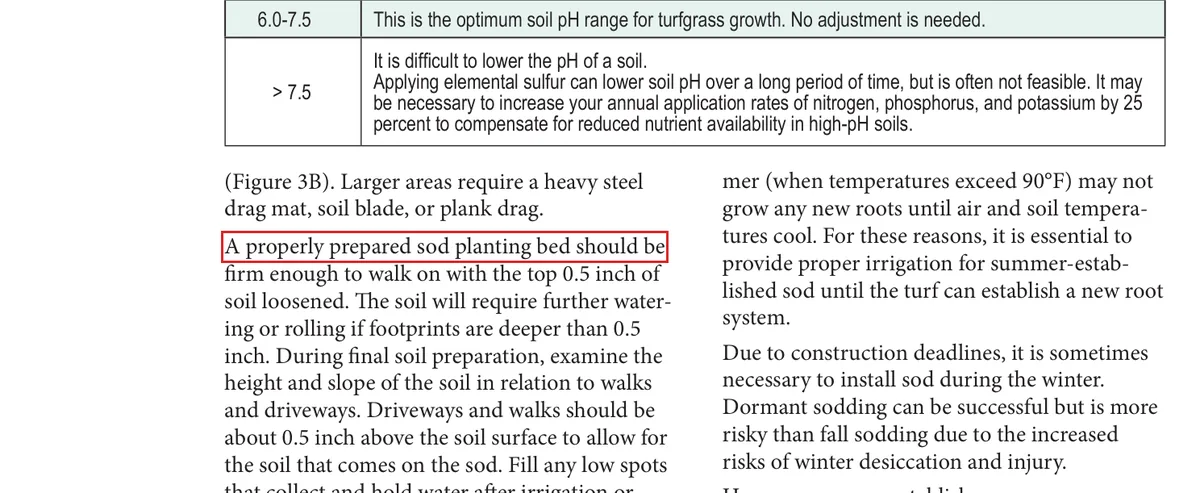
Now the height at hard edges. Purdue sets walks and drives about 0.5 inch above the soil surface; the top-ranked sod-farm guide for this search says about 1 inch. The difference is the soil on the sod, which Purdue puts at 0.5 to 0.75 inch thick and the TPI guideline at 0.60 inch plus or minus 0.25. The Florida DOT spec sets the finished sod, not the soil, 1 inch below pavement (FDOT 575-3.2). Here is where each choice leaves the sod’s soil layer:
| Bare soil set below the walk | Soil on the sod | Where the sod’s soil surface ends up |
|---|---|---|
| 0.5 in (Purdue) | 0.50 in | Flush with the walk |
| 0.5 in (Purdue) | 0.75 in | 0.25 in above the walk |
| 1.0 in (top-ranked sod-farm guide) | 0.50 in | 0.50 in below the walk |
| 1.0 in (top-ranked sod-farm guide) | 0.75 in | 0.25 in below the walk |
| 1.50 to 1.75 in (FDOT sod 1 in below pavement) | 0.50 to 0.75 in | 1.0 in below the pavement |
Our read: use Purdue’s 0.5 inch along walks and drives you mow across, so the mower deck rides level and edges do not scalp. Use 1 inch where a driveway or patio drains toward the lawn, so the turf edge does not dam runoff on the pavement, the same 1 inch FDOT uses along roadway pavement.
9. Moisten the soil and time the delivery
Water the bed so it is lightly moist, not muddy, when the sod arrives. NC State says irrigating several days before delivery is usually enough; Purdue warns that sod laid on hot, dry soil roots slowly even when watered right after. Florida’s 2018 highway spec limited ground preparation to what could be sodded within 72 hours (FDOT Section 575, July 2018); its FY 2026-27 version still has crews water the prepared area before placing sod.
Then book the sod for a day you can lay all of it. Purdue calls for sod delivered and installed within 24 hours of harvest, the TPI guideline for harvest and delivery within 24 hours, University of Minnesota Extension says cut no more than 24 hours before delivery and laid within a day after, NC State says to unroll it if it cannot go down within 48 hours, and FDOT rejects sod cut more than 48 hours earlier. Warm-season sod will not root until soil stays above 55°F for several weeks (NC State), so hold spring bermudagrass or zoysia orders until then.
If you plan to collect it yourself, check the truck before you book: University of Tennessee Extension puts a 50-square-yard slab pallet at 2,000 lb or more, and our table of sod pallet weights by farm shows Texas and Florida pallets running heavier.
Is your soil ready for sod? A 6-question check
Run these in order the day before delivery; the first yes tells you what to fix. Thresholds are from Purdue, NC State and IRC R401.3.
1Is any living grass or perennial weed still in the bed?
YesStop. Kill it (repeat glyphosate 2 to 4 weeks apart per the label) and strip it before going on.
NoGo to the next question
2Does the ground fall less than 6 inches in the first 10 feet from the house?
YesRegrade first: IRC R401.3 asks for 6 inches of fall, then about 2 percent beyond.
NoGo to the next question
3Is there less than 3 inches of loose topsoil over hard subsoil?
YesScarify the subsoil 2 inches or more, then add topsoil to 3 inches firmed (irrigated) or 6 inches (no irrigation).
NoGo to the next question
4Is your soil test missing, or does it call for lime or phosphorus you have not mixed in?
YesSpread and incorporate it into the top 4 to 6 inches now; sod must not lie on fertilizer granules.
NoGo to the next question
5Do footprints sink deeper than 0.5 inch?
YesWater to settle it or roll lightly, then rake the top 0.5 inch loose.
NoGo to the next question
6Is the soil more than about 1 inch below, or level with, the edge of walks and drives?
YesAdjust it to 0.5 inch below (Purdue) or 1 inch where pavement drains onto the lawn.
NoReady: moisten the bed lightly 1 to 3 days ahead and book sod harvested within 24 hours of laying.
Source: Purdue AY-28-W, NC State AG-69, TPI guideline, IRC R401.3
Prep calendar, counted back from sod day
| When | Work | Number that governs it | Source |
|---|---|---|---|
| 4+ weeks before | Soil test, including any imported topsoil | At least 1 month for results | Purdue |
| 4 to 2 weeks before | Kill perennial grasses | Repeat glyphosate 2 to 4 weeks apart; no other herbicide within 2 months | Purdue |
| 2 to 1 weeks before | Strip turf, clear debris, rough-grade, loosen subsoil | 6 in of fall in the first 10 ft; scarify 2 in or more | IRC R401.3; TPI |
| 1 week before | Let the grade settle; install drains and irrigation | 1 week of settling | Purdue |
| 3 to 5 days before | Spread topsoil, compost, lime and starter; till in; final grade; firm | Footprints 0.5 in or less | Purdue; NC State |
| 1 to 3 days before | Moisten the bed | Moist, not muddy | NC State |
| Sod day | Lay sod harvested within 24 hours; roll; water | 24 hours from harvest | Purdue; UMN |
How we compiled this
We read 11 primary documents in November 2026: Purdue Extension AY-28-W (May 2013), NC State Extension AG-69 (July 2021), Turfgrass Producers International’s guideline specifications as reprinted by Sod Solutions, Florida DOT Section 575 (FY 2026-27 and July 2018), the 2021 International Residential Code section R401.3, Illinois, Minnesota and UGA Extension pages, Washington Ecology’s BMP T5.13 guidelines (2010) and Minnesota Statutes 18C.60. We also read the 3 top-ranked text pages for this search to see which numbers they give. Volumes and fertilizer amounts are our arithmetic from those figures. We did not test soil or install sod. The full comparison is in the dataset.
Frequently asked questions
What should I put down before laying sod?
Whatever your soil test calls for, mixed in rather than left on top: lime if pH is below 6.0, a starter fertilizer supplying 0.5 to 1.0 lb of nitrogen and about 1.0 lb of phosphate per 1,000 sq ft, and 1 to 3 cubic yards of compost per 1,000 sq ft if organic matter is low (Purdue AY-28-W). The TPI guideline says not to lay sod directly on fertilizer granules.
Can I just lay sod over dirt?
Only over dirt that has been loosened, graded and firmed. The TPI guideline scarifies subsoil at least 2 inches before adding topsoil, and Purdue wants a bed firm enough that footprints sink no more than 0.5 inch. Purdue also warns that a sharp change in texture between the soil on the sod and the soil below slows water, air and roots, and suggests core aeration no sooner than 2 months after laying where that happens.
Do I need topsoil before laying sod?
Not if you already have 3 to 6 inches of loose, fertile soil over the subsoil. Add it on stripped or builder-graded lots: the TPI guideline’s minimum is 3 inches after firming with irrigation and 5 to 6 inches without, Illinois and FDOT call for 6 inches, and Purdue sizes its topsoil at 6. Six inches over 1,000 sq ft is about 18.5 cubic yards.
Is 2 inches of topsoil enough for sod?
Not as a layer on hard ground. Two inches sits below every minimum in the documents we read (3 to 8 inches). It can work if you till those 2 inches into the loosened soil beneath, which is how the FDOT spec builds its 6-inch finish layer from existing and imported soil (FDOT 575-3.1).
Should I till the ground before sod?
Loosen it, yes, unless it is already loose. Purdue mixes amendments into the top 4 to 6 inches and compost 6 to 8 inches deep, and UGA’s agent tills 2 to 4 inches. Without a tiller, NC State’s hand method for small areas is to loosen the top 4 to 6 inches with a rake, hoe or shovel, or 2 to 3 inches where soil resists hand tools. Do not till wet soil.
Should you soak the ground before laying sod?
Moisten it, do not soak it. NC State says irrigating several days before delivery is usually enough, and Purdue schedules that watering far enough ahead to avoid a muddy site. The soil should be moist under the surface but firm enough to walk on when the first strip goes down.
Sources
- Purdue Extension (A. Patton), AY-28-W, Establishing a Lawn from Sod, May 2013. Accessed November 2026.
- NC State Extension, AG-69, Carolina Lawns: A Guide to Maintaining Quality Turf in the Landscape, July 2, 2021. Accessed November 2026.
- Turfgrass Producers International, reprinted by Sod Solutions, Guideline Specifications to Turfgrass Sodding (EMPIRE Turf edition), Reprint posted May 2022. Accessed November 2026.
- Florida Department of Transportation, Section 575, Sodding (REV 12-16-24), FY 2026-27 maintenance specifications, FY 2026-27. Accessed November 2026.
- Florida Department of Transportation, Section 575, Sodding (REV 10-15-15), July 2018 maintenance specifications, July 2018. Accessed November 2026.
- International Code Council, 2021 International Residential Code, Chapter 4, Section R401.3 Drainage, 2021 edition. Accessed November 2026.
- University of Illinois Extension, Preparing Lawn Soil and Site, Undated web page. Accessed November 2026.
- University of Minnesota Extension (S. Bauer, B. Mugaas, B. Pedersen), Seeding and sodding home lawns, Reviewed 2024. Accessed November 2026.
- UGA Extension Forsyth County (H. Kolich), Soil preparation essential for sod success, March 1, 2024. Accessed November 2026.
- Washington State Department of Ecology, Guidelines and Resources for Implementing Soil Quality and Depth BMP T5.13, 2010 edition. Accessed November 2026.
- Minnesota Legislature, Office of the Revisor of Statutes, Minn. Stat. 18C.60, Phosphorous Turf Fertilizer Use Restrictions, Current statute. Accessed November 2026.