How to add phosphorus to soil: test first, and add it only below 25 ppm Bray-P1, 18 ppm Olsen or 50 ppm Mehlich-3. Then mix a water-soluble source like triple superphosphate (0-46-0) into the root zone; bone meal and rock phosphate need pH below 7.
Before you work out how to add phosphorus to soil, check whether it is short at all. Soil-test surveys of Twin Cities lawns found 70 to 80 percent testing very high, above 25 ppm Bray-P1 (Minnesota Department of Agriculture report to the Legislature, 2007), and Auburn’s records show more than 40 percent of Alabama garden soils very high or excessive (Alabama Extension, ANR-0479). Below are the lab cutoffs, the pounds of phosphate each reading calls for, and 12 phosphorus options compared by grade, pH limit and price per pound of phosphate, checked November 14, 2026.
Step 1: Read the phosphorus line on your soil test
Labs use different extractants, and each gives a different number for the same soil. University of Minnesota labs run Bray-P1 when soil pH is 7.4 or lower and Olsen above 7.4 (Rosen, Bierman and Eliason, UMN 2008); many Eastern labs report Mehlich-3. Find the method name next to the phosphorus value on your report, then read across the matching column. Our guide to getting a lawn or garden soil test covers labs, fees and sampling depth.
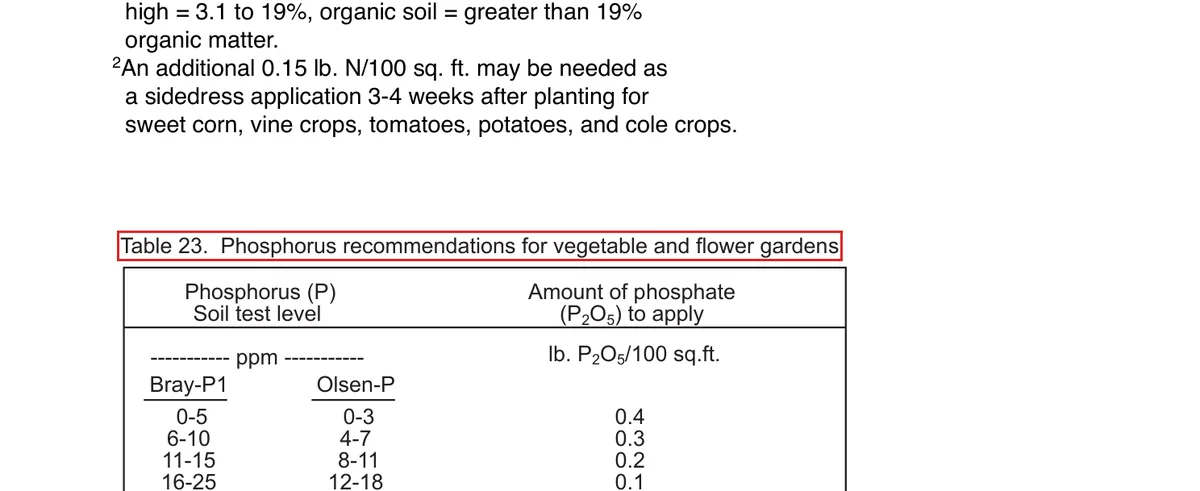
| Your soil test reads (ppm) | What it means | Established lawn, lb P2O5 per 1,000 sq ft a year | New lawn before seed or sod, lb P2O5 per 1,000 sq ft | Vegetable and flower garden, lb P2O5 per 100 sq ft | Trees and shrubs, lb P2O5 per 100 sq ft |
|---|---|---|---|---|---|
| Bray-P1 0 to 5, or Olsen 0 to 3 | Low | 1.0 | 5 | 0.4 | 0.2 |
| Bray-P1 6 to 10, or Olsen 4 to 7 | Medium | 1.0 | 5 | 0.3 | 0.1 |
| Bray-P1 11 to 15, or Olsen 8 to 11 | High (lower half) | 0.5 | 2 | 0.2 | 0.05 |
| Bray-P1 16 to 25, or Olsen 12 to 18 | High (upper half) | 0.5 | 2 | 0.1 | 0.05 |
| Bray-P1 over 25, or Olsen over 18 | Very high | 0 (phosphorus-free grade) | 1 | 0 | 0 |
| Mehlich-3 over 50 (turf) | No phosphorus needed | 0 | 1.0 from a starter grade (UNL) | n/a | n/a |
Cutoffs are not universal. Oregon State calls Bray-P1 below 20 ppm low and 40 to 100 ppm high (OSU EC 1478, Table 2), where Minnesota and Iowa State put very high at anything over 25 (Iowa State Yard and Garden). For turf, Rutgers researchers list sufficiency as 16 to 30 ppm Bray-P1, 13 to 28 ppm Olsen or 27 to 54 ppm Mehlich-3, and note a 21 ppm Mehlich-3 minimum from the MLSN guidelines (McNally, Elmore and Murphy, GCM, April 2024).
If pH is far off, fix it before buying phosphorus. Maine’s organic crops specialist recommends correcting pH and retesting before treating a slightly low phosphorus reading, because aluminum binds phosphorus in acid soil and calcium binds it in alkaline soil (MOFGA, Sideman, 2011). Colorado State puts peak availability at pH 6.0 to 7.0 (CSU Extension, Phosphorus Fertilizers). Raise acid soil with lime at the rate your buffer pH calls for; lower alkaline beds with elemental sulfur.
Phosphorus sources compared: grade, pH limit and price per pound
The middle number on a bag is percent phosphate (P2O5), not elemental phosphorus. Penn State converts it with % P2O5 × 0.44 = % P, so a 0-46-0 bag is about 20 percent phosphorus (Penn State Extension, updated Sept. 19, 2025). Lab recommendations are written in pounds of P2O5, so divide by the middle number and skip the conversion. Our lawn fertilizer guide explains the full label.
| Source | Grade (N-P2O5-K2O) | Availability and pH limit | lb of product per 1 lb P2O5 | Price checked Nov. 14, 2026 | Cost per lb P2O5 |
|---|---|---|---|---|---|
| Triple superphosphate (TSP) | 0-46-0 | Water-soluble; works at any pH, then fixes over time | 2.2 | $42.50 / 50 lb, Hummert | $1.85 |
| Monoammonium phosphate (MAP) | 11-52-0 | Water-soluble; adds 0.21 lb N per lb P2O5 | 1.9 | $44.00 / 50 lb, The Mill | $1.69 |
| Diammonium phosphate (DAP) | 18-46-0 | Water-soluble; adds 0.39 lb N per lb P2O5 | 2.2 | $35.99 / 50 lb, Copley Feed | $1.56 |
| Lawn starter fertilizer (Scotts Turf Builder Starter) | 24-25-4 | Ammonium phosphate source on the label; adds about 1 lb N per lb P2O5 | 4.0 | $40.49 / 15 lb, scottsmiraclegro.com | $10.80 |
| Bone meal (Down To Earth) | 3-15-0 | Below pH 7 only (CSU) | 6.7 | $55.95 / 25 lb, Down To Earth Eugene | $14.92 |
| Bone meal, small box (Down To Earth) | 3-15-0 | Below pH 7 only (CSU) | 6.7 | $17.95 / 5 lb, Down To Earth Eugene | $23.93 |
| Soft rock phosphate (Calphos) | 0-3-0 available | Acid soil only; not available above pH 7 (CSU) | 33 | $49.95 / 50 lb, Down To Earth Eugene | $33.30 |
| Soft rock phosphate, small box (Down To Earth) | 0-3-0 available | Acid soil only | 33 | $15.95 / 5 lb, Down To Earth Eugene | $106.33 |
| Dairy manure compost | about 1-1-2 (22 lb P2O5 per ton) | Raised Olsen P at pH 7.8 in CSU trial; 3 to 6 months | 91 | About $30 a ton (CSU, undated) | $1.36 by our arithmetic (CSU prints $6.60) |
| Poultry manure, dry | 3-5-2 | Slow; over weeks to years | 20 | Not priced | n/a |
| Composted yard waste | 1.3-0.4-0.4 | Slow; over weeks to years | 250 | Not priced | n/a |
| Spent coffee grounds | 0.06% P (about 0.14% P2O5) | Negligible phosphorus | about 730 | Free | n/a |
The spread is about 68 to 1. A pound of phosphate from DAP costs $1.56; the same pound from a 5 lb box of rock phosphate costs $106.33, because the label guarantees only 3 percent available phosphate. MOFGA puts rock phosphate’s available share at 1 to 3 percent of its total phosphorus and calls bone meal very expensive for the amount of phosphorus available (MOFGA). Bone meal and rock phosphate also carry 18 percent calcium by label, which matters more on the soils covered in our sibling page on how to add calcium to soil.
Step 2: Turn the recommendation into pounds of product
The arithmetic is one division: pounds of P2O5 recommended ÷ (middle number ÷ 100) = pounds of product. Minnesota’s bulletin adds that 2 cups of dry fertilizer weigh about 1 pound (UMN 2008, p. 17), and Down To Earth’s labels say 2 cups of its bone meal and 1½ cups of its rock phosphate weigh about 1 pound.
| Job | Recommendation | Arithmetic | Product to spread | Cost at Nov. 2026 prices |
|---|---|---|---|---|
| 400 sq ft vegetable garden, Bray-P1 8 ppm | 0.3 lb P2O5 per 100 sq ft = 1.2 lb | 1.2 ÷ 0.46 | 2.6 lb TSP (about 5 cups) | $2.22 of a $42.50 bag |
| Same garden, bone meal, soil pH 6.5 | 1.2 lb P2O5 | 1.2 ÷ 0.15 | 8 lb bone meal (about 16 cups) | $17.90 at $14.92 per lb P2O5 |
| 5,000 sq ft new lawn, Olsen 10 ppm | 2 lb P2O5 per 1,000 sq ft = 10 lb | Starter at its label rate, 15 lb, gives 3.75 lb; 6.25 ÷ 0.46 for the rest | 15 lb of 24-25-4 plus 13.6 lb TSP | $40.49 plus about $11.55 |
| 5,000 sq ft established lawn, Bray-P1 15 ppm | 0.5 lb P2O5 per 1,000 sq ft = 2.5 lb | 2.5 ÷ 0.46 | 5.4 lb TSP, after core aeration | about $4.62 |
| Same lawn, Bray-P1 30 ppm | 0 | n/a | A phosphorus-free grade such as 32-0-4 | $0 on phosphorus |
The new-lawn row shows a trap. Scotts’ starter at its label rate puts down only 0.75 lb of P2O5 per 1,000 sq ft; reaching Minnesota’s 2 lb with starter alone would take 8 lb of product per 1,000 sq ft, 2.7 times the label rate, and about 1.9 lb of nitrogen with it. Topping up with TSP supplies the phosphorus without the extra nitrogen. With no soil test before seeding, Nebraska suggests 1.0 lb P2O5 per 1,000 sq ft from a starter grade (UNL turf); our overseeding guide has the seeding-day steps.
- Product (lb)
- 2.17
- Product (oz)
- 35
- Product (cups, at about 2 cups per lb)
- 4.3
Default: 1,000 sq ft at 1.0 lb P2O5 with triple superphosphate needs 2.17 lb (about 4.3 cups). Garden rates are per 100 sq ft in Minnesota's table and are entered here per 1,000 sq ft. Cup volume uses UMN's 2 cups per lb; Down To Earth rock phosphate is about 1.5 cups per lb.
Step 3: Put it where the roots will grow
Phosphorus barely moves in soil: NDSU calls its movement deeper into the profile extremely slow (NDSU H1824), and MOFGA’s rule is that roots have to grow to the phosphorus, not the other way round (MOFGA). Placement decides whether roots ever reach it.
- New gardens and beds: broadcast the full amount and work it into the top 4 to 6 inches before planting, in fall or spring (UMN 2008, p. 31). Down To Earth’s bone meal label says 2.5 to 5 lb per 100 sq ft mixed into the top 3 inches.
- Rows of vegetables: band it 2 inches below the seed at planting, which Oregon State says gives the best results (OSU EC 1503).
- New lawns: work starter or TSP into the top 4 to 6 inches before seeding or sodding (NDSU H1824). The sibling page on how to prepare soil for sod covers grading.
- Established lawns: spread right after core aeration in late summer or early fall so granules fall into the holes (UMN 2008, p. 25). Our page on how to aerate a lawn gives core spacing.
- Trees and shrubs: dig the hole 1½ ft deeper than the roots will sit, mix quick-release P into the bottom 1 ft, add 6 inches of unfertilized soil, then plant (UMN 2008, p. 37).
- Transplants: Down To Earth’s label calls for 1 to 2 tablespoons of bone meal per hole, mixed in and watered (label).
Bone meal, rock phosphate or manure: which works at your pH?
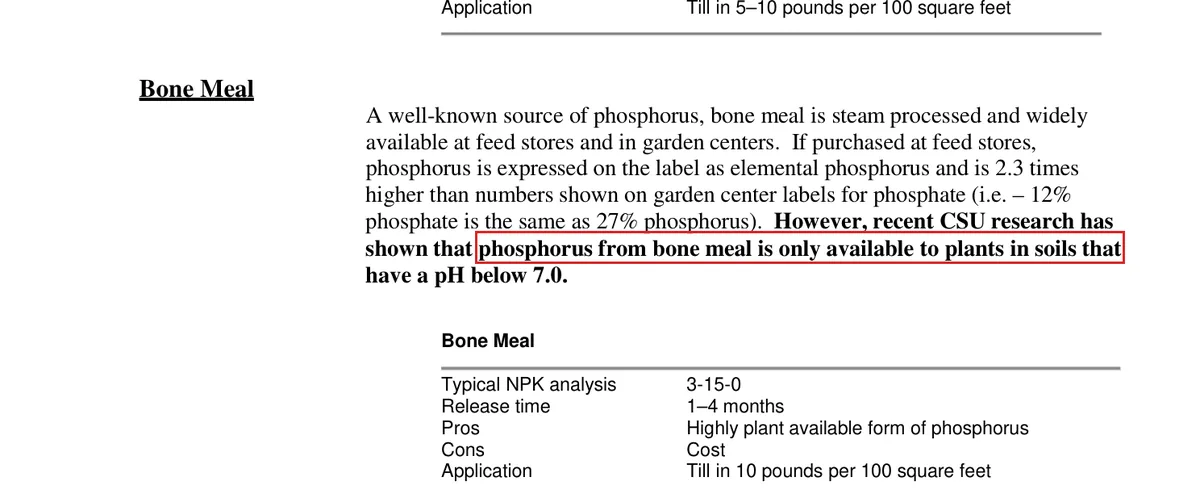
Organic phosphorus has to dissolve before roots can take it up, and soil pH decides whether it does. Colorado State says bone meal should go on soil below pH 7 and that rock phosphate is not readily available to plants above pH 7, because soil acidity is what converts both to plant-available phosphate (CSU Extension). Colorado’s Master Gardener manual puts it more bluntly: CSU research found bone meal phosphorus available to plants only in soils below pH 7.0 (CMG GardenNotes, Soils manual, p. 84). Most Colorado soils run pH 7.0 to 7.8.
In a 2-year Colorado State trial on a certified organic cucumber field at pH 7.8, rock phosphate at 160 lb P2O5 per acre left Olsen P at 8.9 ppm, statistically no different from the 6.4 ppm unfertilized control, and cucumber yield was 15,682 lb per acre against 17,860. Raw dairy manure at the same rate reached 15.9 ppm (CSU, Table 2).
| Treatment (lb P2O5 per acre) | Olsen P after 2 years (ppm) | Cucumber yield (lb per acre) |
|---|---|---|
| No phosphorus (control) | 6.4 | 17,860 |
| Raw dairy manure, 80 | 7.7 | 20,038 |
| Raw dairy manure, 160 | 15.9 | 27,443 |
| Composted dairy manure, 80 | 8.0 | 31,799 |
| Composted dairy manure, 160 | 11.6 | 30,056 |
| Vermicompost, 80 | 11.1 | 23,522 |
| Vermicompost, 160 | 9.7 | 31,799 |
| Rock phosphate, 80 | 7.1 | 16,553 |
| Rock phosphate, 160 | 8.9 | 15,682 |
On acid soil the picture flips. Oregon State’s garden table still lists rock phosphate at 5 lb per 100 sq ft and bone meal at 4 lb per 100 sq ft when Bray-P1 is under 25 ppm in western Oregon, and the same amounts for Olsen P under 10 ppm in alkaline eastern Oregon (OSU EC 1503, Table 4C), which the Colorado State result argues against on soil above pH 7. Manure and compost add phosphorus whether you need it or not: MOFGA warns that heavy compost users can push soil phosphorus past what crops absorb, and our page comparing compost and mulch gives the yearly depths.
Lawns: 9 states restrict phosphorus fertilizer
Minnesota law bars phosphorus fertilizer on turf unless a soil or tissue test from the last 3 years shows a shortage, the lawn is in its first growing season from seed or sod, or the site is a golf course under certified staff (Minn. Stat. §18C.60, subd. 2). Our lawn fertilizer guide tabulates the other state rules we read, including Wisconsin, New York, New Jersey, Maryland, Virginia and Vermont.
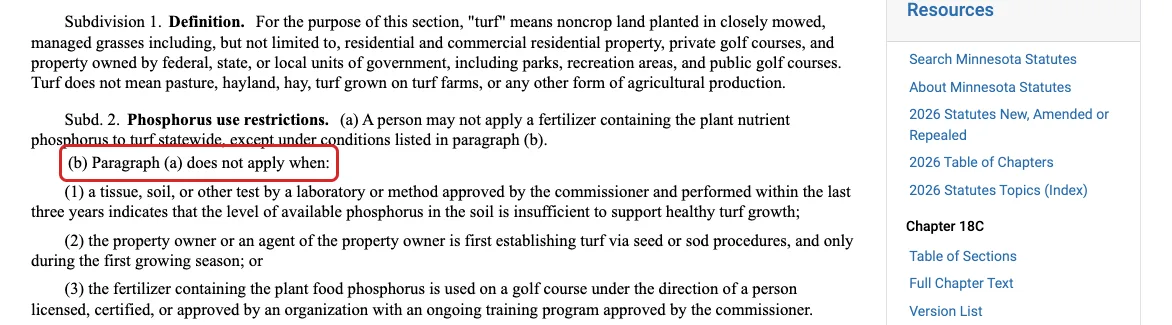
The test exemption is the lawful route to adding phosphorus to an established lawn in those states: keep the lab report, follow its P2O5 rate, and use a 0 middle number on every other feeding. NDSU also tells North Dakota homeowners, where no law applies, to avoid balanced 10-10-10 on established lawns because it carries too much phosphorus (NDSU H1824).
Signs of phosphorus shortage, and what looks the same
Short plants are stunted, leaves may turn purple, and flowering is delayed (MOFGA); Iowa State describes stunting and reddish growth (Iowa State). Cold soil causes the same purpling: MOFGA advises waiting until soil reaches 60°F before setting out tomato transplants. A purple seedling in April is weak evidence; a lab number is strong evidence.
Too much phosphorus has its own symptoms. Alabama Extension links excessive phosphorus, especially above pH 6.5, to zinc and iron deficiencies that show as yellow striping and pale young leaves (Alabama Extension). WSU’s Linda Chalker-Scott notes that high phosphorus stops roots from forming mycorrhizal partnerships (WSU, The Myth of Beneficial Bone Meal). Where the test reads very high, Alabama recommends a no-phosphorus grade such as 15-0-15, or 33-0-0 plus 0-0-60; our page on adding nitrogen to soil lists phosphorus-free nitrogen sources.
1Do you have a lab soil test from the last 3 years?
Yes
NoTest first. In Minnesota and several other states it is also the legal condition for phosphorus on an established lawn (Minn. Stat. 18C.60).
2Is phosphorus over 25 ppm Bray-P1, 18 ppm Olsen or 50 ppm Mehlich-3?
YesAdd none. Use a grade with 0 as the middle number (UMN 2008; UNL). New lawns may still get 1 lb P2O5 per 1,000 sq ft of starter.
NoGo to the next question
3Is soil pH below 5.5 or above 7.5?
YesCorrect pH first and retest; aluminum or calcium is tying up phosphorus (MOFGA; CSU).
NoGo to the next question
4Is soil pH 7.0 or higher?
YesUse TSP, MAP, DAP, starter or manure compost. Skip bone meal and rock phosphate (CSU).
NoGo to the next question
5Do you want an organic source?
YesBone meal at the lab's P2O5 rate divided by 0.15, mixed into the top 3 to 6 inches.
NoUse TSP (0-46-0): lab P2O5 rate divided by 0.46, worked into the root zone or spread after core aeration.
Source: University of Minnesota Extension (2008); Colorado State Extension; MOFGA; Minn. Stat. 18C.60
Common phosphorus advice, checked against the source
| What top-ranking pages say | What the primary source says | Source |
|---|---|---|
| Phosphorus is most available at pH 7 to 7.5 | Peak availability is pH 6.0 to 7.0; at pH 7.5 and above calcium binds it | Colorado State |
| Bone meal phosphorus is 12 to 24 percent and immediately available | Labels guarantee 15 percent available phosphate (3-15-0); it needs soil below pH 7 to dissolve | Down To Earth label; CSU |
| Rock phosphate includes basalt, granite and rhyolite | Rock phosphate is a mined phosphate ore: 75 percent of the rock phosphate used in the U.S. is surface mined in Florida | Minnesota Department of Agriculture phosphorus guide, p. 7 |
| High-phosphorus bloom boosters act quickly to produce blooms | Phosphorus is a mineral, not a growth regulator; high levels stop mycorrhizae forming. Over 25 ppm Bray-P1, apply 0 | WSU (Chalker-Scott); UMN 2008 |
How we compiled this
In November 2026 we read 13 extension publications from 10 universities (Minnesota, NDSU, Iowa State, Oregon State, Nebraska, Colorado State, Penn State, WSU, Auburn and Texas A&M), a GCM research article and a MOFGA column, 2 Minnesota Department of Agriculture documents, Minn. Stat. §18C.60, 2 product labels and 8 retail listings checked November 14, 2026. Rates come from lab recommendation tables; prices are single dated listings, not averages, and exclude shipping. We did not test any soil or product.
Frequently asked questions
What is the fastest way to add phosphorus to soil?
Use a water-soluble source such as MAP (11-52-0), DAP (18-46-0) or triple superphosphate (0-46-0) and place it in the root zone: banded 2 inches below seed (OSU EC 1503) or mixed into the top 4 to 6 inches. Bone meal and rock phosphate are slow and need soil below pH 7.
Do coffee grounds add phosphorus to soil?
Very little. One analysis found 0.06 percent phosphorus (Texas A&M AgriLife), so supplying 1 lb of P2O5 would take roughly 730 lb of grounds. Oregon State says the small amounts of phosphorus and other nutrients in grounds are not sufficient to meet plant needs (OSU Extension).
What is the best homemade phosphorus fertilizer?
Manure-based compost is the most practical free source: Colorado State reports about 22 lb P2O5 per ton of dairy manure compost, and composted manure raised soil phosphorus at pH 7.8 where rock phosphate did not (CSU). Add it only if a soil test shows phosphorus below the high range.
What depletes phosphorus in soil?
Harvest removal, erosion and fixation. Alabama Extension estimates garden crops remove about 30 lb P2O5 per acre a year (ANR-0479); soil particles carry phosphorus off in runoff; and aluminum in acid soil or calcium above pH 7.5 lock it into forms roots cannot use (CSU).
Can you put too much phosphorus on your lawn?
Yes. Above 25 ppm Bray-P1 or 18 ppm Olsen, Minnesota recommends a fertilizer with 0 as the middle number (UMN 2008), and excess phosphorus can induce zinc and iron deficiency and run off into lakes. Several states ban it on established lawns without a soil test.
Sources
- Minnesota Department of Agriculture, Report to the Legislature: Effectiveness of the Minnesota Phosphorus Lawn Fertilizer Law, March 2007. Accessed November 2026.
- Alabama Cooperative Extension System (Auburn University), Excessive Phosphorus in Garden Soils, from The Alabama Vegetable Gardener, ANR-0479, Feb. 26, 2019; reviewed Oct. 2021. Accessed November 2026.
- University of Minnesota Extension (Rosen, Bierman and Eliason), Soil Test Interpretations and Fertilizer Management for Lawns, Turf, Gardens, and Landscape Plants, 2008. Accessed November 2026.
- NDSU Extension (Zuk and McGinnis), H1824, Interpreting the NDSU Soil Test Analysis for Managing Turfgrass, Revised April 2023. Accessed November 2026.
- Iowa State University Extension, How to Interpret Soil Test Results, Current page. Accessed November 2026.
- Oregon State University Extension (Horneck, Sullivan, Owen and Hart), EC 1478, Soil Test Interpretation Guide, Revised July 2019, reviewed 2023. Accessed November 2026.
- Oregon State University Extension, EC 1503, Fertilizing Your Garden: Vegetables, Fruits, and Ornamentals, Current page. Accessed November 2026.
- University of Nebraska-Lincoln Turfgrass Science, Soil Testing Turf Areas, Current page. Accessed November 2026.
- Golf Course Management (McNally, Elmore, J. Murphy and S. Murphy, Rutgers), How do phosphorus and soil pH affect bluegrass and bentgrass?, April 2024. Accessed November 2026.
- Colorado State University Extension, Phosphorus Fertilizers for Organic Farming Systems, Current page. Accessed November 2026.
- Colorado State University Extension, Colorado Master Gardener program (Whiting), CMG GardenNotes, Soils manual (GN-210), Bone Meal entry, January 2020 PDF. Accessed November 2026.
- Maine Organic Farmers and Gardeners Association (Sideman), Managing Soil Phosphorus, Summer 2011. Accessed November 2026.
- Penn State Extension (Landschoot), How Much Phosphorus and Potassium Are Really in Your Fertilizer?, Updated Sept. 19, 2025. Accessed November 2026.
- Washington State University (Chalker-Scott), The Myth of Beneficial Bone Meal, Undated fact sheet. Accessed November 2026.
- Minnesota Revisor of Statutes, Minn. Stat. §18C.60, Phosphorus turf fertilizer use restrictions, Current law. Accessed November 2026.
- Minnesota Department of Agriculture, Phosphorus guide (phosphorusguide_0.pdf), Current PDF. Accessed November 2026.
- Down To Earth Fertilizer, Bone Meal 3-15-0 label and application rates, Viewed Nov. 14, 2026. Accessed November 2026.
- Down To Earth Fertilizer, Rock Phosphate 0-3-0 label and application rates, Viewed Nov. 14, 2026. Accessed November 2026.
- Texas A&M AgriLife Extension, Travis County, Grounds in the Garden, Current page. Accessed November 2026.
- Oregon State University Extension, Coffee grounds boost soil health, help control slugs, News article. Accessed November 2026.
- Hummert International, Triple Super Phosphate 0-46-0, 50 lb listing, $42.50, Nov. 14, 2026. Accessed November 2026.
- The Mill, 11-52-0 Monoammonium Phosphate (MAP), 50 lb listing, $44.00, Nov. 14, 2026. Accessed November 2026.
- Copley Feed, Diammonium Phosphate (DAP) 18-46-0, 50 lb listing, $35.99, Nov. 14, 2026. Accessed November 2026.
- scottsmiraclegro.com, Scotts Turf Builder Starter Food for New Grass, 15 lb listing, $40.49, Nov. 14, 2026. Accessed November 2026.
- Down To Earth Home, Garden and Gift, Down To Earth Bone Meal 3-15-0, 25 lb listing, $55.95, Nov. 14, 2026. Accessed November 2026.
- Down To Earth Home, Garden and Gift, Down To Earth Bone Meal 3-15-0, 5 lb listing, $17.95, Nov. 14, 2026. Accessed November 2026.
- Down To Earth Home, Garden and Gift, Calphos 0-3-0, 50 lb listing, $49.95, Nov. 14, 2026. Accessed November 2026.
- Down To Earth Home, Garden and Gift, Down To Earth Rock Phosphate 0-3-0, 5 lb listing, $15.95, Nov. 14, 2026. Accessed November 2026.