How to add potassium to soil: confirm a lab test reads low, then spread the lab’s pounds of potash (K2O) as muriate of potash (0-0-60) or sulfate of potash (0-0-50); on lawns, keep each pass to 1 lb K2O per 1,000 sq ft.
Before you decide how to add potassium to soil, read the potassium line on a lab report, because the published cutoffs run from 37 to 200 ppm. Turf researchers put the minimum at 37 ppm by the Mehlich-3 test (MLSN guideline; PACE Turf) and Kentucky calls a turf response unlikely above 40 ppm (UK AGR-249, 2020), while Minnesota’s garden table keeps adding potash up to 200 ppm (University of Minnesota, 2008). Below are those cutoffs side by side, the pounds of potash each reading calls for, and 11 potassium options compared, with 8 retail listings priced per pound of K2O on Nov. 16, 2026: from $1.00 for bulk muriate of potash to $307.50 for kelp meal.
Step 1: Check whether your soil is actually low in potassium
Labs use different extractants and different calibrations, so a number only means something next to its own scale. Find the method name beside the potassium value (Mehlich-3, ammonium acetate or the lab’s own test), then read the matching row. Our guide to getting a lawn or garden soil test covers lab fees, sampling depth and why home kits miss potassium.
| Program | Test method | Add potassium when K reads | Stop adding when K reads | Source |
|---|---|---|---|---|
| MLSN (PACE Turf and Asian Turfgrass Center) | Mehlich-3 | Below 37 ppm | 37 ppm and up: no K needed for turf | GCSAA MLSN sheet |
| University of Kentucky, turf | Mehlich-3 | 40 ppm or lower, and only if the turf looks poor | Over 40 ppm: response unlikely | AGR-249 (2020) |
| University of Nebraska, turf | Mehlich-3 | Below 40 ppm (40 to 80 is the target) | Over 80 ppm: no K fertilizer | UNL turf soil testing |
| University of Minnesota, lawns and trees | Lab ppm K (Table 7) | 0 to 150 ppm, rate falling as K rises | Over 150 ppm: none | UMN Tables 7, 16, 28 |
| University of Minnesota, gardens | Lab ppm K | 0 to 200 ppm, rate falling as K rises | Over 200 ppm: none | UMN Table 24 |
| Oregon State, wood ash as the K source | OSU lab ppm K | Below 300 ppm | Over 600 ppm: no ash for 5 years | OSU EC 1503, Table 4B |
| MOFGA (Maine organic growers) | Share of cation exchange capacity | Below 2% of CEC | 2 to 4% of a CEC of 5 or more is good | Sideman, MOFGA, 2011 |
For a lawn on native loam or clay, the turf numbers are the ones to trust: Kentucky says most of its soils hold so much potassium that soil-test calibrations for turf could not be validated, and that acceptable-looking turf needs no added K regardless of the test (AGR-249). Sand is the exception. Minnesota warns that potassium leaches out of sands and loamy sands, which tend to test low (UMN 2008).
How much potash the lab will ask for
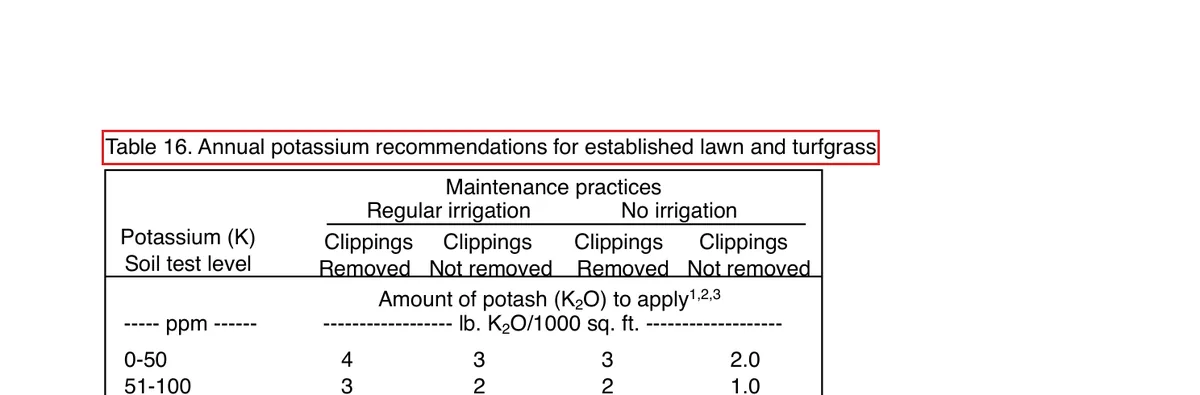
| Soil test K (ppm, UMN scale) | Established lawn, irrigated, clippings returned (lb K2O per 1,000 sq ft a year) | Established lawn, not irrigated, clippings returned | New lawn before seed or sod (lb K2O per 1,000 sq ft) | Vegetable and flower garden (lb K2O per 100 sq ft) | Trees, shrubs and fruit (lb K2O per 100 sq ft) |
|---|---|---|---|---|---|
| 0 to 50 (low) | 3 | 2 | 6 (2 on sand) | 0.4 | 0.20 |
| 51 to 100 (medium) | 2 | 1 | 4 (2 on sand) | 0.3 | 0.10 |
| 101 to 150 (high) | 1 | 0.5 | 2 | 0.2 | 0.05 |
| 151 to 200 | 0 | 0 | 0 | 0.1 | 0 |
| Over 200 | 0 | 0 | 0 | 0 | 0 |
Potassium sources compared: grade, salt index and cost per pound of potash
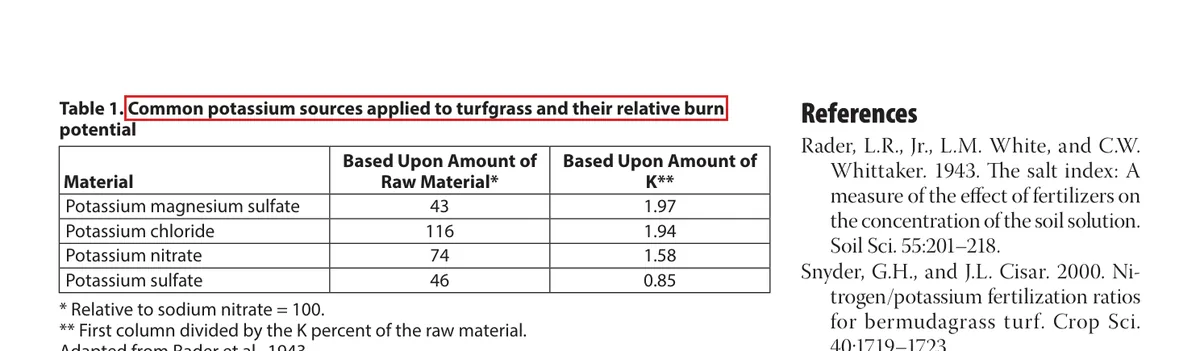
The last number on a fertilizer bag is percent potash (K2O), not elemental potassium. Penn State converts it with % K2O × 0.83 = % K, so 0-0-60 is about 50 percent potassium (Penn State Extension), but lab rates are already written in pounds of K2O, so divide by the last number and skip the conversion. The lawn fertilizer label guide explains the other two numbers, and the same divide-by-the-grade method sets phosphate rates in how to add phosphorus to soil.
| Source | Grade (N-P2O5-K2O) | Salt index (per unit K2O) | What else it adds | lb of product per 1 lb K2O | Price checked Nov. 16, 2026 | Cost per lb K2O |
|---|---|---|---|---|---|---|
| Muriate of potash (potassium chloride), Andersons | 0-0-60 | 116 (1.94) | Chloride | 1.7 | $29.99 / 50 lb, Standish Milling | $1.00 |
| Muriate of potash, Espoma small bag | 0-0-60 | 116 (1.94) | Chloride | 1.7 | $12.49 / 6 lb, The Mill | $3.47 |
| Sulfate of potash (potassium sulfate) | 0-0-50 | 46 (0.85) | About 17 to 18% sulfur | 2.0 | $43.81 / 50 lb, Steve Regan Co. | $1.75 |
| Langbeinite (K-Mag, Sul-Po-Mag), Down To Earth | 0-0-22 | 43 (1.97) | 11% magnesium, 22% sulfur | 4.5 | $89.95 / 50 lb, Down To Earth Eugene (store pickup) | $8.18 |
| Langbeinite, Down To Earth small box | 0-0-22 | 43 (1.97) | 11% magnesium, 22% sulfur | 4.5 | $17.95 / 5 lb, Down To Earth Eugene | $16.32 |
| Potassium nitrate | 13.7-0-46 | 74 (1.58) | 13.7% nitrate nitrogen | 2.2 | $89.00 / 50 lb, Hummert | $3.87 |
| Greensand (glauconite) | 0-1-6 label | n/a | Iron; releases K over 4 to 5 years (UMD) | 17 | $29.99 / 5 lb, Gardener’s Supply | $99.97 |
| Kelp meal, Down To Earth | 1-0.1-2 | n/a | Organic nitrogen | 50 | $123.00 / 20 lb, Down To Earth Eugene | $307.50 |
| Hardwood fireplace ash | 3.6 to 8.9% K2O, 6% average | n/a; about 22% salt (Na) in LSU tests | Raises pH: 25 to 59% CCE (UNH) | 17 at 6% | Free from your own stove | $0 |
| Horse manure, as spread | 0.70-0.25-0.60 | n/a | Organic matter | 167 | Usually free locally | n/a |
| Coffee grounds | 0.6% K (about 0.7% K2O) | n/a | 2.28% nitrogen | 139 | Free | n/a |
Muriate of potash is the cheapest potassium by a wide margin, and Kentucky calls it the most common turf source for that reason, but its salt index of 116 makes it the hottest. The same publication puts sulfate of potash at less than half the burn potential and suggests it for turf already under stress (AGR-249). Langbeinite costs about 5 to 9 times as much per pound of potash as bulk sulfate of potash in the table, and MOFGA’s organic crops specialist says to use it only when the soil also needs magnesium (MOFGA). Salt burn from all fertilizers is covered in can you over-fertilize your lawn.
Step 2: Convert the lab’s K2O rate into pounds of product
Divide the recommended pounds of K2O by the product’s potash percentage, then multiply by your area in thousands of square feet. Minnesota’s own example: 0.3 lb K2O per 100 sq ft from 0-0-60 is 0.3 ÷ 0.6 = 0.5 lb of product, and 3 lb K2O per 1,000 sq ft is 5 lb (UMN 2008). LSU’s lawn series uses the same two steps for a 5,000 sq ft lawn at 0.5 lb K2O: 2.5 lb K2O, or 25 lb of a 10 percent product (LSU AgCenter).
| Input | Value | Rule or source |
|---|---|---|
| Lawn size | 5,000 sq ft | Example |
| Soil test K | 80 ppm, irrigated, clippings returned | Medium row, UMN Table 16 |
| Annual rate | 2 lb K2O per 1,000 sq ft | UMN Table 16 |
| Total potash needed | 2 × 5 = 10 lb K2O | Rate × area in 1,000s |
| Product, sulfate of potash 0-0-50 | 10 ÷ 0.50 = 20 lb | Divide by the last number |
| Per-pass limit | 1 lb K2O per 1,000 sq ft = 10 lb product per pass | UMN: no more than 1 lb K2O at once |
| Schedule | 2 passes of 10 lb, each with a scheduled nitrogen feeding | UMN Table 16 note; Kentucky pairs K with N |
| Cost at the table price | 20 lb × $0.88 = $17.52 | $43.81 ÷ 50 lb, checked Nov. 16, 2026 |
- Product (lb)
- 1.67
- Product (oz)
- 27
Default: 1,000 sq ft at 1 lb K2O with muriate of potash needs 1.67 lb. Garden rates are per 100 sq ft in Minnesota's table and are entered here per 1,000 sq ft. Split any lawn total above 1 lb K2O per 1,000 sq ft into separate passes.
Step 3: Put it where the roots are, in passes the turf can take
Minnesota says potassium is relatively immobile in loams and clays but leaches through sand, so placement depends on texture (UMN 2008). The steps below follow those rules.
- Lawns on loam or clay: spread right after core aeration so granules fall into the holes; Minnesota names this as the most effective method on finer-textured soils. Our core aeration guide covers timing.
- Any lawn: keep each pass to 1 lb K2O per 1,000 sq ft (1.7 lb of 0-0-60 or 2 lb of 0-0-50); higher rates can burn grass, especially in a blend that also carries nitrogen (UMN Table 16, note 2). Water muriate of potash in right after spreading (AGR-249).
- Sand and loamy sand: split the annual rate into regular small passes alongside nitrogen, and incorporate no more than 2 lb K2O per 1,000 sq ft before seeding or sodding (UMN 2008).
- New lawns and new beds: mix the full preplant rate into the top 4 to 6 inches before seeding, sodding or planting; Minnesota calls preplant P and K very important in new perennial plantings because both are relatively immobile. Minnesota’s Table 12 gives the preplant rates.
- Gardens: band potassium about 3 inches deep beside the row, or broadcast and work it in, and keep it from touching roots (OSU EC 1503).
- Timing: apply close to active growth. MOFGA says potash spread in fall for spring crops will mostly be gone by spring (MOFGA), and Kentucky says autumn “winterizer” potassium is not likely to benefit its turf, citing research that linked extra autumn K on bentgrass to more spring disease (AGR-249). Our lawn fertilizing calendar sets the nitrogen dates to pair it with.
Wood ash, manure and kitchen scraps: how much potassium they really add
Wood ash is the most concentrated free source of potash. LSU AgCenter tested fireplace ash at 3.6 percent K2O for hickory, 4.5 percent for oak and 8.9 percent for a hardwood and softwood mix, 6 percent on average, with liming power of at least 20 percent of pure lime (LSU AgCenter). At 6 percent, 1 lb of K2O takes about 17 lb of ash, which is already Wisconsin’s yearly ceiling of 15 to 20 lb per 1,000 sq ft, about one 5-gallon pail (UW-Madison Extension).
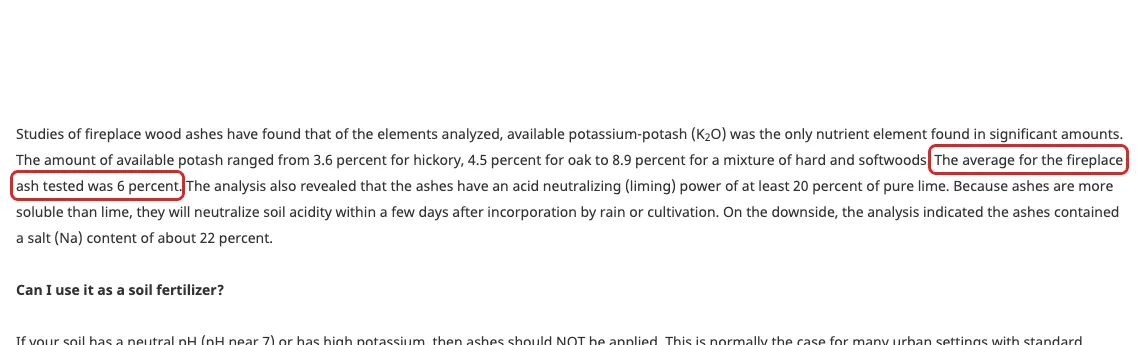
That cap is why ash fails on soil that only needs potassium. Oregon State says skip it at pH 7.0 or above and on blueberries, rhododendrons and azaleas, and limits gardens to 1 to 1.5 lb per 100 sq ft when K tests below 300 ppm on its scale (OSU EC 1503). If your pH also needs to come up, raising soil pH converts ash into a lime equivalent; if pH is already 7.0 or higher, use sulfate of potash instead.
Manure and compost add potassium slowly because the concentration is low. Oregon State’s manure table runs from 0.44 percent K2O in dairy manure to 1.00 percent in sheep manure as spread, so a lawn-sized dose of 1 lb K2O per 1,000 sq ft needs 100 to 227 lb of manure (OSU EC 1503, Table 1). That makes manure a soil builder that happens to carry potash. Returning grass clippings recycles potassium too, which is why Minnesota cuts each lawn rate by 0.5 to 1 lb when clippings stay down.
Kitchen scraps barely register. Coffee grounds test at 0.6 percent potassium (Texas A&M AgriLife, Travis County), so 1 lb of K2O would take about 139 lb of grounds. UC Master Gardeners say bananas or peels put straight into the garden tie up nitrogen as they rot and belong in the compost pile (UC ANR Master Gardeners). Epsom salt is magnesium sulfate, listed by Minnesota at 10 percent magnesium and 13 percent sulfur with no potash at all (UMN Table 8).
Does extra potassium make a lawn tougher?
Not once the soil has enough. Beth Guertal reviewed five turf studies in Golf Course Management and found that in four of them, potassium fertilization did not improve wear or cold tolerance; added K raised leaf tissue K without changing color, quality or carbohydrate reserves in Tifgreen bermudagrass (GCM, November 2021). A Rutgers trial on annual bluegrass did see better winter survival, but the lowest K rate gave the benefit and more K added nothing.
An older UC Riverside trial pushed N to K2O ratios from 1:0 to 1:3 on a sand-based perennial ryegrass field for 14 months and found no significant effect on wear tolerance, crown mass or root mass (Green et al., UC Riverside, 1994). Kentucky’s practical rule follows from that research: on native soil apply K at half the nitrogen rate or less, as little as one-tenth, and treat a 1:1 N to K ratio as a sand putting green practice (AGR-249).
Signs of low potassium, and signs you have added too much
Low potassium shows first on older leaves, because the plant moves K to new growth: yellowing between veins and brown, scorched tips and edges (LSU AgCenter; MOFGA). Confirm with a test before spending money. On lawns, yellowing also comes from nitrogen, iron and water problems, which a K test will not catch.
Too much potassium crowds out other cations. Minnesota warns that heavy K on sandy soils already low in magnesium can induce a magnesium deficiency (UMN 2008), and MOFGA notes that potassium, calcium and magnesium compete for uptake, which is why adding calcium to soil starts from the same test; potassium chloride or sulfate also leaves salt behind, and Nebraska advises against large applications of high-salt-index K fertilizers on turf (UNL). The flow below runs the same checks in order.
1Do you have a lab soil test from the last 3 years?
Yes
NoTest first. Every cutoff and rate on this page is tied to a lab method.
2Is K over 40 ppm Mehlich-3 on a lawn, or over 150 ppm on Minnesota's lawn scale?
YesAdd none. Extra K did not improve wear or cold tolerance in 4 of 5 turf studies (GCM 2021; UK AGR-249).
NoGo to the next question
3Is soil pH 7.0 or higher?
YesUse sulfate of potash (0-0-50) at the lab K2O rate x 2. No wood ash (OSU EC 1503).
NoGo to the next question
4Does the test also show low magnesium?
YesUse langbeinite (0-0-22) at the lab K2O rate x 4.5 (MOFGA).
NoGo to the next question
5Is soil pH below 6.0 and do you have clean hardwood ash?
YesWood ash, up to 15 to 20 lb per 1,000 sq ft a year: about 1 lb K2O at 6% (LSU; UW-Madison).
NoMuriate of potash (0-0-60) at the lab K2O rate x 1.7, no more than 1 lb K2O per 1,000 sq ft per lawn pass, watered in. Switch to sulfate of potash if the turf is already stressed (AGR-249).
| If your situation is | Use | Why (source) |
|---|---|---|
| No soil test in the last 3 years | Test first | Every program above sets rates by test level |
| Mehlich-3 K over 40 ppm and the lawn looks fine | Add none | AGR-249; MLSN 37 ppm |
| Low K and pH below 6.0 | Lime first, or use wood ash within 15 to 20 lb per 1,000 sq ft | UK AGR-249 recommends pH 6.5; Wisconsin ash cap |
| Low K and pH 7.0 or higher | Sulfate of potash; no ash | OSU EC 1503 |
| Low K and low magnesium | Langbeinite (0-0-22) | MOFGA; UF/IFAS SS318 |
| Low K, need nitrogen too | Potassium nitrate or a lawn grade with a high last number | UMN Table 8; Kentucky |
| Low K, cheapest fix, healthy turf | Muriate of potash, 1 lb K2O per pass, watered in | AGR-249; UMN Table 16 |
How we compiled this
In November 2026 we read 15 extension and research documents from 14 institutions (Minnesota, Kentucky, Nebraska, Oregon State, Penn State, NC State, UF/IFAS, LSU, Wisconsin, UNH, Maryland, Texas A&M, UC Riverside and UC ANR), plus the MLSN guideline, a GCM research review and a MOFGA column. Prices are 8 single retail listings checked Nov. 16, 2026, not averages, shipping and tax excluded. We did not test any soil or product.
Frequently asked questions
What is the fastest way to add potassium to soil?
Use a water-soluble salt: sulfate of potash (0-0-50) or muriate of potash (0-0-60). MOFGA calls potassium sulfate very soluble and langbeinite’s nutrients available immediately (MOFGA). Spread the lab’s K2O rate divided by 0.50 or 0.60, at most 1 lb K2O per 1,000 sq ft per lawn pass. Greensand and granite dust take years.
What is a homemade source of potassium for plants?
Hardwood ash: LSU measured an average of 6 percent K2O in fireplace ash (LSU AgCenter). It also raises pH, so use it only on acid soil and stay under 15 to 20 lb per 1,000 sq ft a year (UW-Madison Extension). Compost made with banana peels and other scraps adds smaller amounts.
Do coffee grounds add potassium to plants?
A little. Texas A&M AgriLife lists coffee grounds at 0.6 percent potassium (Travis County Extension), less than one-eightieth of the potassium in muriate of potash, so they work as a compost ingredient rather than a potassium fertilizer.
Does Epsom salt have potassium?
No. Epsom salt is magnesium sulfate, about 10 percent magnesium and 13 percent sulfur (UMN 2008, Table 8). If a test shows both potassium and magnesium low, langbeinite (0-0-22 with 11 percent magnesium) supplies both.
Can you put too much potassium on your lawn?
Yes. Minnesota caps each pass at 1 lb K2O per 1,000 sq ft because higher rates can burn grass, and warns that heavy potassium on sandy soil can induce magnesium deficiency (UMN 2008). Above 80 ppm Mehlich-3, Nebraska recommends no potassium at all (UNL).
When should I add potassium to my lawn?
With your regular nitrogen feedings, in the growing season. Kentucky recommends applying K with N so both stop together, and says extra autumn “winterizer” potassium is not likely to help (AGR-249).
Sources
- University of Minnesota Extension (Rosen, Bierman and Eliason), Soil Test Interpretations and Fertilizer Management for Lawns, Turf, Gardens, and Landscape Plants, 2008. Accessed November 2026.
- University of Kentucky Cooperative Extension (Shaddox and Munshaw), AGR-249, Potassium for Kentucky Turfgrasses, February 2020. Accessed November 2026.
- GCSAA, from PACE Turf and Asian Turfgrass Center, MLSN: Minimum Levels for Sustainable Nutrition guideline, IPM Planning Guide sheet. Accessed November 2026.
- PACE Turf, MLSN guidelines and how to use them, Current page. Accessed November 2026.
- University of Nebraska-Lincoln Turfgrass Science, Soil Testing Turf Areas, Current page. Accessed November 2026.
- Oregon State University Extension (Hart and McNeilan), EC 1503, Fertilizing Your Garden: Vegetables, Fruits and Ornamentals, Published 2000, reviewed 2025. Accessed November 2026.
- Maine Organic Farmers and Gardeners Association (Sideman), Potassium, Fall 2011. Accessed November 2026.
- Penn State Extension, How Much Phosphorus and Potassium Are Really in Your Fertilizer?, Current page. Accessed November 2026.
- NC State Extension, 2025 North Carolina Agricultural Chemicals Manual, Chapter IV, Table 4-11, April 2, 2025. Accessed November 2026.
- UF/IFAS Extension, SS318, Potassium-magnesium sulfate entry, PDF. Accessed November 2026.
- Golf Course Management (Guertal), Potassium and turfgrass stress, November 2021. Accessed November 2026.
- University of California, Riverside (Green, Merino, Cockerham and Gibeault), Increased Potassium Fertilizations for Enhanced Stress Resistance of Perennial Ryegrass Grown on a Sand Root Zone Sports Field, October 28, 1994. Accessed November 2026.
- LSU AgCenter, Fireplace Ashes on Your Soil, Current page. Accessed November 2026.
- LSU AgCenter, Louisiana Home Lawn Series: Potassium, Current page. Accessed November 2026.
- University of Wisconsin-Madison Extension, Using Wood Ash in the Home Garden, Current page. Accessed November 2026.
- University of New Hampshire Extension, Guide to Using Wood Ash as an Agricultural Soil Amendment, Current page. Accessed November 2026.
- University of Maryland Extension, Garden Fertilizer Basics, Updated May 21, 2025. Accessed November 2026.
- Texas A&M AgriLife Extension, Travis County, Grounds in the Garden, Current page. Accessed November 2026.
- UC ANR Master Gardeners, Great Gardening Myths, Part 1, Current page. Accessed November 2026.
- Standish Milling, Andersons Potash 0-0-60, 50 lb listing, $29.99, Nov. 16, 2026. Accessed November 2026.
- The Mill, Espoma Potash 0-0-60, 6 lb listing, $12.49, Nov. 16, 2026. Accessed November 2026.
- Steve Regan Co., Sulfate of Potash 0-0-50, 50 lb listing, $43.81, Nov. 16, 2026. Accessed November 2026.
- Down To Earth Home, Garden and Gift, Langbeinite Kmag 0-0-22, 50 lb listing, $89.95, Nov. 16, 2026. Accessed November 2026.
- Down To Earth Home, Garden and Gift, Langbeinite Kmag 0-0-22, 5 lb listing, $17.95, Nov. 16, 2026. Accessed November 2026.
- Hummert International, Potassium Nitrate Crystal 13.7-0-46, 50 lb listing, $89.00, Nov. 16, 2026. Accessed November 2026.
- Gardener’s Supply Company, Greensand 0-1-6 Fertilizer, 5 lb listing, $29.99, Nov. 16, 2026. Accessed November 2026.
- Down To Earth Home, Garden and Gift, Kelp Meal 1-0.1-2, 20 lb listing, $123.00, Nov. 16, 2026. Accessed November 2026.