How to add calcium to soil: get a lab test first, because calcium deficiency is rare at pH 6.2 to 7.2. Low pH: mix in lime. Normal pH but low calcium: gypsum, about 1 to 2 lb per 100 sq ft. Blossom-end rot: water evenly.
Most advice on how to add calcium to soil starts with products. Start with the soil report instead. Colorado State’s soil lab says calcium deficiencies are rare when pH is 6.2 to 7.2 (CSU Soil Test Interpretation), the University of Arkansas calls deficiency very unlikely when pH is kept in the recommended range (FSA-2118), and Wisconsin has seen crop deficiency only on sandy soils below pH 5.0 (UW-Madison Extension). The top-ranked guides for this search list 6 to 9 calcium sources with no soil-test number and no rate per square foot. This page gives the lab thresholds from 6 sources, the percent calcium and price per pound of calcium for 6 labeled products, and a calculator that turns a ppm shortfall into pounds.
Does your soil actually need calcium?
A routine lab report gives extractable calcium in ppm or pounds per acre, and the cut-off depends on the extraction method, so read your number against your own lab’s scale. Arkansas notes that 1 ppm equals about 2 lb per acre for a sample from the top 6 inches (FSA-2118); that rule converts Georgia’s per-acre figures below. If you have no report yet, our guide to getting a lawn and garden soil test lists state lab fees and what each test includes.
| Source | Test method | Calcium level that reads low | What else the source says |
|---|---|---|---|
| Univ. of Arkansas, FSA-2118 | Mehlich-3 | 400 ppm or less (general guideline; the lab issues no calcium recommendation) | Sands usually test below 400 to 500 ppm, clays above 2,500 ppm; deficiency very unlikely if pH is in range |
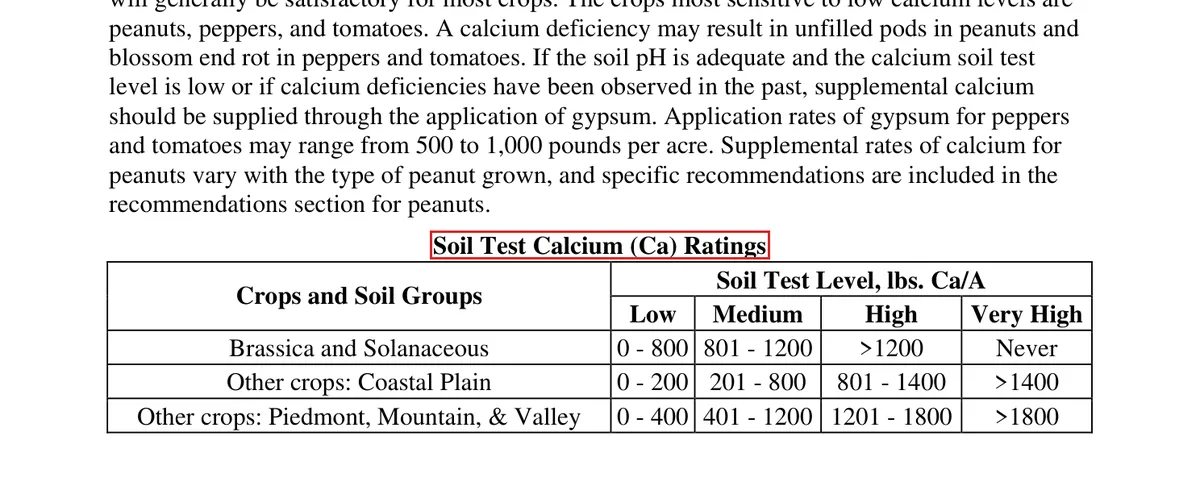
| Univ. of Georgia, Soil Test Handbook SB 62 | Mehlich-1, lb per acre | Tomato, pepper, cabbage family: 0 to 800 lb/acre (about 0 to 400 ppm) | Medium is 801 to 1,200 lb/acre; if pH is adequate and calcium low, gypsum at 500 to 1,000 lb/acre |
| Univ. of Georgia, SB 62 | Mehlich-1, lb per acre | Other crops: 0 to 200 lb/acre Coastal Plain, 0 to 400 lb/acre Piedmont and mountains (about 100 and 200 ppm) | With pH at the recommended level, calcium is generally satisfactory for most crops |
| UW-Madison Extension | Wisconsin routine test | Potato responses below 300 ppm on sands, 500 ppm on medium and heavy soils | Exchangeable calcium usually 500 to 5,000 ppm; crop deficiency seen only on sands below pH 5.0 |
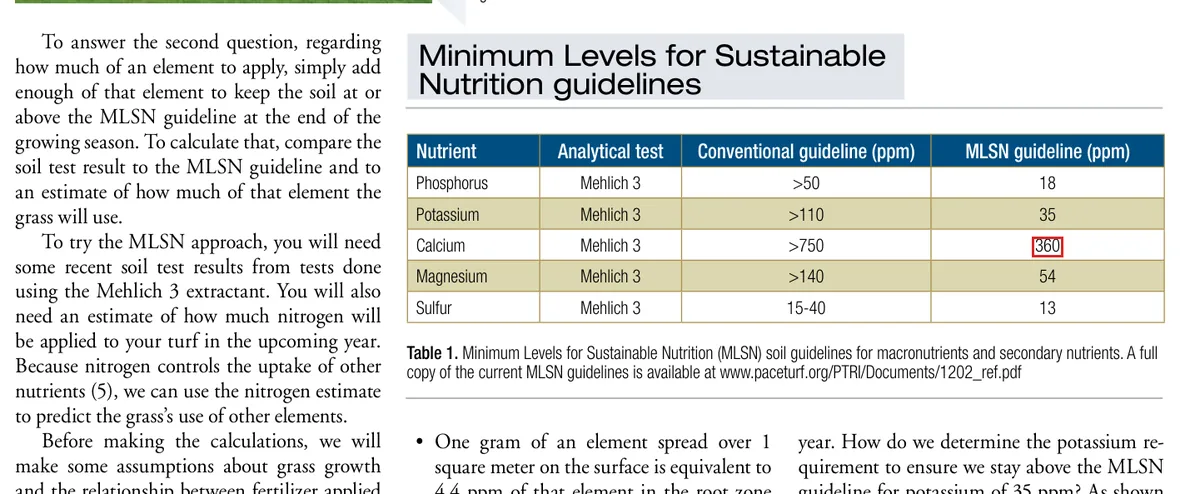
| Woods, Stowell and Gelernter, GCM, Jan. 2014 | Mehlich-3, turf | 360 ppm (MLSN minimum) | Conventional turf guideline listed as above 750 ppm |
| Colorado State Soil, Water and Plant Testing Lab | Percent of cation saturation | No ppm cut-off; optimum 65 to 75% of saturation | Deficiency rare at pH 6.2 to 7.2; above 85% saturation may mean calcareous soil |
| NC State Extension (Averre and others, 2013) | Not applicable | Not determined for blossom-end rot | Lime per the soil report, usually to pH 6.5 to 6.8 |
Lawns need less than garden charts suggest. Turf researchers Micah Woods, Larry Stowell and Wendy Gelernter built the MLSN guideline from more than 1,500 soil samples under well-performing turf on low-CEC soils, and set calcium at 360 ppm Mehlich-3, under half the conventional 750 ppm (Golf Course Management, January 2014). If a lawn report shows low pH, lime at the buffer-pH rate in our lime for lawn guide brings the calcium with it.
Skip any calcium saturation target that your lab does not tie to a crop response. One farm-input seller tells growers to hold calcium at 70 to 80 percent base saturation (Midwestern BioAg), the base cation saturation ratio (BCSR) idea credited to William Albrecht. In a 2021 Agronomy Journal survey of 51 land-grant soil fertility scientists, 78 percent agreed BCSR has no scientific merit and none disagreed (Culman and others, 2021). Wisconsin trials found soil Ca:Mg ratios from 0.8 to 5.0 had no effect on alfalfa or corn yields when pH was near neutral (UW-Madison).
Is blossom-end rot a calcium problem?
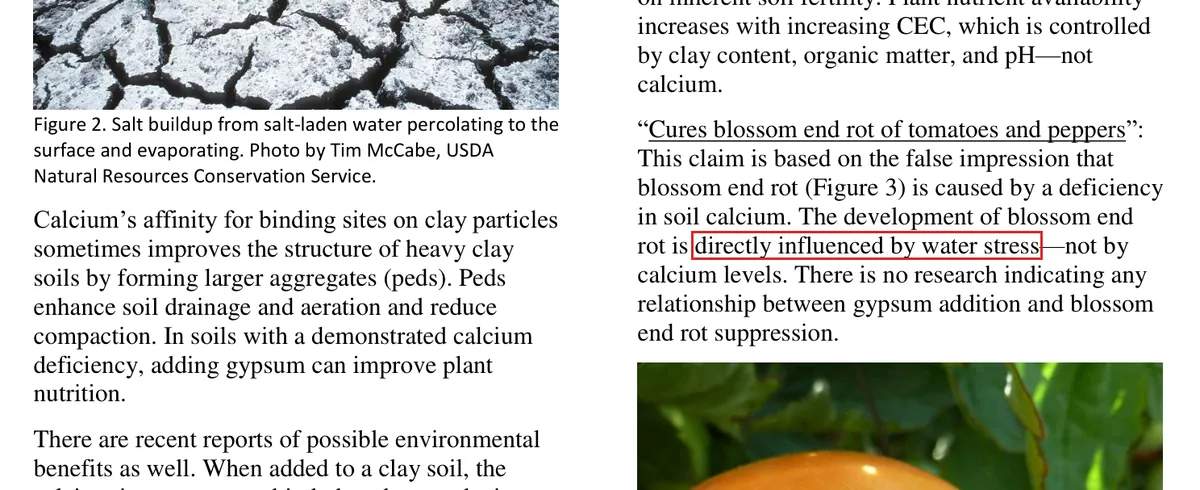
Rarely a soil one. Washington State University’s FS307E says blossom-end rot is directly influenced by water stress, not calcium levels, and that no research links gypsum to fewer cases. Illinois Extension’s Ken Johnson writes that the issue is usually how well plants absorb calcium, and that foliar calcium does not help much because it does not move into the fruit well (Illinois Extension, June 2021). Penn State says eggshells in the planting hole are not supported by research (Penn State Extension).
- Water about 1 inch a week from rain or irrigation (NC State, Illinois). Drip lines give the steadiest moisture; our guide to setting up drip irrigation covers emitters and run times.
- Do not let plants go into the night water-stressed: Utah State says that is when developing fruit get their share of calcium (USU Extension).
- Mulch to even out soil moisture; how deep mulch should be gives depths by material.
- Add calcium only if a test reads low. Georgia’s rate is gypsum at 500 to 1,000 lb per acre, which NC State puts at 1 to 2 lb per 100 sq ft, applied several months before planting (NC State).
1Is your only sign blossom-end rot on tomatoes or peppers, with no soil test?
YesFix water first: about 1 inch a week, mulch, no night-time water stress (NC State, Utah State). Test before adding calcium.
NoGo to the next question
2Does the soil fizz in vinegar, or read pH 7.5 or higher?
YesAdd no calcium: the soil already holds free calcium carbonate (NDSU).
NoGo to the next question
3Is soil pH below your plants' target, about 6.0 to 6.5 for most?
YesLime at the lab's buffer-pH rate: calcitic if magnesium is adequate, dolomitic if it is low. It adds calcium as it raises pH.
NoGo to the next question
4Is pH in range but calcium below your lab's low line (for example, 400 ppm or less on Mehlich-3 in Arkansas)?
YesGypsum at the lab rate or about 1 to 2 lb per 100 sq ft (NC State). It adds calcium without changing pH.
NoCalcium is adequate. Add none, and recheck it on your next routine soil test.
Source: Arkansas FSA-2118, NC State Extension, Utah State Extension, NDSU H1824, WSU FS307E
Calcium sources compared: percent calcium, pH effect and price
Pick by pH first. Carbonates (lime, oyster shell, eggshell) and wood ash raise pH; gypsum and calcium nitrate add calcium without liming. Percent calcium then sets how many pounds you spread, and the last column turns each bag’s shelf price into dollars per pound of calcium, checked Nov. 14, 2026.
| Product | Calcium | Also supplies | pH effect | Label rate per 100 sq ft | Price, Nov. 14, 2026 | $ per lb of calcium |
|---|---|---|---|---|---|---|
| Down To Earth Garden Lime (calcitic) | 34% | CCE 90% | Raises | 1 to 1.5 lb for new beds; 3 to 10 lb to raise pH | $12.59 / 5 lb | $7.41 |
| Down To Earth Oyster Shell | 35% | None listed | Raises slowly | 2.5 to 5 lb mixed into top 3 in. | $19.99 / 5 lb | $11.42 |
| Down To Earth Dolomite Lime | 23.5% | 9.5% magnesium; CCE 98.2% | Raises | 1 to 1.5 lb beds; 2.5 to 5 lb lawns | $12.59 / 5 lb | $10.71 |
| Down To Earth Garden Gypsum | 21% | 17% sulfur | None (label: will not affect acidity) | 2.5 to 5 lb beds; 5 to 10 lb lawns | $13.39 / 5 lb | $12.75 |
| Hi-Yield Ammonium Calcium Nitrate 15-0-0 | 19% | 15% nitrogen | Not a liming material | 1 tbsp per plant, every 2 to 3 weeks | $9.99 / 3.25 lb | $16.18 |
| Down To Earth Bone Meal 3-15-0 | 18% | 3% nitrogen, 15% phosphate | Not listed | 2.5 to 5 lb mixed into top 3 in. | $19.99 / 5 lb | $22.21 |
| Ground eggshell (Iowa trials) | 28 to 36.5% as received | 1.2 to 7.4% nitrogen | Raises; slower than aglime at first | No label rate | Free | n/a |
| Wood ash (UNH) | About 25% | About 5% potassium | Raises (25 to 59% CCE) | 2 lb or less (20 lb per 1,000 sq ft cap) | Free | n/a |
If pH is low, lime is the calcium source. Wisconsin’s aglime carries 300 to 400 lb of calcium per ton, and liming to the right pH adds far more calcium than crops remove, 50 to 100 lb per acre (UW-Madison). Choose calcitic lime unless the test also shows low magnesium, and size the rate from buffer pH, which our guide on how to raise soil pH tabulates for beds and lawns.
Gypsum answers how to add calcium to soil without raising pH: Down To Earth’s label says it will not affect soil acidity, and WSU FS307E adds that it can leach potassium, magnesium, iron and manganese, so use it only when calcium is low and pH is in range. Its other job, displacing sodium in sodic clay, is covered in how to improve clay soil.
Calcium nitrate is the fast choice and the easiest to overdo, since each pound carries 0.15 lb of nitrogen. Hi-Yield’s label rate is 1 tablespoon per plant, at least 2 inches from the stem, repeated every 2 to 3 weeks and applied below 85°F to avoid burn. Sized to close a 100 ppm calcium gap on 100 sq ft, it would deliver about 3.6 lb of nitrogen per 1,000 sq ft, over three times the 1 lb quick-release ceiling in our over-fertilizing guide.
Bone meal supplies 0.83 lb of phosphate for every pound of calcium (15 percent versus 18 percent on the Down To Earth label), so save it for soil that also tests low in phosphorus; how to add phosphorus to soil covers that test.
Oyster shell and eggshell are calcium carbonate, so they act like slow lime. In Iowa State’s field trials only 1 to 2 percent of ground eggshell passed a 60-mesh screen against 67 to 68 percent of the aglime, and pH rose more slowly at first (Holmes and others, 2011). Penn State says whole shells can take decades to break down and pulverized pieces a few years (Penn State).
How much calcium to add: calculator and worked example
If your lab printed a gypsum or lime rate, use it. If it gave only a ppm number below its low line, the calculator sizes the amount on paper: 1 ppm in a 6-inch layer is about 2 lb per acre (Arkansas FSA-2118), or 0.046 lb of calcium per 1,000 sq ft. It assumes every pound added stays extractable, so treat the answer as an estimate to check against the label, not a prescription.
- Product (lb)
- 2.19
- Product (oz)
- 35
- Product (kg)
- 0.99
Default: 100 sq ft, 100 ppm short, mixed 6 inches deep needs about 0.46 lb of calcium, or 2.19 lb of 21% gypsum. Uses 1 ppm = 2 lb per acre in the top 6 inches (Arkansas FSA-2118). Calcium nitrate is left out because a calcium-sized dose overloads nitrogen. Your lab's printed rate and the product label override this tool.
| Product | Calcium | Pounds for a 100 sq ft bed, 100 ppm short, 6 in. | Label rate per 100 sq ft | Side effect |
|---|---|---|---|---|
| Down To Earth Garden Gypsum | 21% | 2.19 lb | 2.5 to 5 lb | No pH change |
| Down To Earth Garden Lime | 34% | 1.35 lb | 1 to 1.5 lb (new beds) | Raises pH |
| Down To Earth Oyster Shell | 35% | 1.31 lb | 2.5 to 5 lb | Raises pH slowly |
| Down To Earth Dolomite Lime | 23.5% | 1.95 lb | 1 to 1.5 lb (new beds) | Raises pH, adds magnesium |
| Down To Earth Bone Meal | 18% | 2.55 lb | 2.5 to 5 lb | Adds 0.38 lb phosphate |
| Hi-Yield calcium nitrate | 19% | 2.42 lb | 1 tbsp per plant | Adds 0.36 lb nitrogen: too much |
The labels land in the same range. Down To Earth’s 2.5 to 5 lb of gypsum per 100 sq ft works out to about 114 to 229 ppm in the top 6 inches on paper, and Georgia’s 500 to 1,000 lb per acre of 21 percent gypsum to about 52 to 105 ppm. Mix gypsum, lime and shell into the top 3 to 6 inches before planting. On lawns, Down To Earth’s dolomite and gypsum labels say results may improve when applied after aeration; water it in.
How we compiled this
We read 15 primary documents in November 2026: lab and extension publications from Arkansas, Georgia, Wisconsin, Colorado State, NC State, Illinois, Utah State, Washington State, Penn State, Iowa State and UNH, a 2014 Golf Course Management research article and a 2021 Agronomy Journal paper, plus 6 maker labels from Down To Earth and Hi-Yield. Prices are single retail listings checked Nov. 14, 2026. We ran no soil tests or trials; the calculator and worked example are arithmetic from those figures.
Frequently asked questions
What is the fastest way to add calcium to soil?
A soluble source. Calcium nitrate is side-dressed and watered in per its label, and Wisconsin notes gypsum is more soluble than limestone (UW-Madison). Lime and shells work over months. Foliar sprays reach leaves, but Illinois Extension says the calcium does not move into fruit well.
Will crushed eggshells add calcium to soil?
Slowly. Eggshells are 94 to 97 percent calcium carbonate (Iowa State), but Penn State says whole shells can take decades to break down and pulverized ones a few years. Grind them to powder or compost them, and expect a small pH rise rather than a quick calcium fix.
Does adding calcium to soil increase pH?
Only when the calcium comes as a carbonate or oxide: lime, oyster shell, eggshell or wood ash. Gypsum and calcium nitrate add calcium without liming; WSU FS307E says gypsum does not change soil pH.
Can you put too much calcium in your garden?
Yes. WSU says excess gypsum can leach potassium, magnesium, iron and manganese, and Colorado State’s lab reads calcium saturation above 85 percent as a sign of calcareous soil. Too much lime overshoots pH; if a test reads above 7.5, see how to make soil acidic with sulfur.
What plants need the most calcium?
Georgia’s soil test handbook names peanuts, peppers and tomatoes as the crops most sensitive to low calcium, and gives tomatoes, peppers and the cabbage family a higher low line, 800 lb per acre, than other crops at 200 to 400 lb (UGA SB 62).
Sources
- Washington State University Extension (L. Chalker-Scott, R. Guggenheim), FS307E, Gypsum Use in Home Gardens and Landscapes, Undated fact sheet. Accessed November 2026.
- University of Illinois Extension (K. Johnson), Tomato gardeners beware; blossom end rot can be prevented, June 28, 2021. Accessed November 2026.
- NC State Extension (C. Averre, P. Shoemaker, E. Hinchliffe), Blossom-End Rot of Tomato, Pepper, and Watermelon, December 16, 2013. Accessed November 2026.
- Utah State University Extension, Utah Vegetable Production Guide: Blossom End Rot, Undated web page. Accessed November 2026.
- Penn State Extension (M. J. R. Gibson), Coffee Grounds and Eggshells: Garden Myths vs Facts, Updated September 24, 2026. Accessed November 2026.
- University of Arkansas Division of Agriculture, FSA-2118, Understanding the Numbers on Your Soil Test Report, Current PDF. Accessed November 2026.
- University of Georgia (D. Kissel, L. Sonon, eds.), Special Bulletin 62, Soil Test Handbook for Georgia (Soil Test Interpretation for Calcium), Current PDF. Accessed November 2026.
- University of Wisconsin-Madison Division of Extension, Should Calcium Be Applied to Wisconsin Soils?, Undated web article. Accessed November 2026.
- M. Woods, L. Stowell, W. Gelernter, Golf Course Management, Just what the grass requires: Using minimum levels for sustainable nutrition, January 2014. Accessed November 2026.
- Colorado State University Soil, Water and Plant Testing Laboratory, Soil Test Interpretation, October 2022 text, file dated 2026. Accessed November 2026.
- S. Culman and others, Agronomy Journal 113:5623 to 5634, Base cation saturation ratios vs. sufficiency level of nutrients: A false dichotomy in practice, August 2021. Accessed November 2026.
- Holmes, Sawyer, Kassel and Ruiz Diaz, Crop Management, Using Ground Eggshells as a Liming Material in Corn and Soybean Production, November 2011. Accessed November 2026.
- NDSU Extension, H1824, Interpreting the NDSU Soil Test Analysis for Managing Turfgrass, Current PDF. Accessed November 2026.
- UNH Cooperative Extension, Guide to Using Wood Ash as an Agricultural Soil Amendment, Current web page. Accessed November 2026.
- Midwestern BioAg (cited as the claim compared), Selecting the Right Calcium Source for Your Soil, Undated web page. Accessed November 2026.
- Down To Earth Distributors, Garden Lime product label and directions, November 2026. Accessed November 2026.
- Down To Earth Distributors, Dolomite Lime product label and directions, November 2026. Accessed November 2026.
- Down To Earth Distributors, Garden Gypsum product label and directions, November 2026. Accessed November 2026.
- Down To Earth Distributors, Oyster Shell product label and directions, November 2026. Accessed November 2026.
- Down To Earth Distributors, Bone Meal 3-15-0 product label and directions, November 2026. Accessed November 2026.
- Voluntary Purchasing Groups (Hi-Yield), Ammonium Calcium Nitrate 15-0-0, 3.25 lb label (32128), Label code 102023. Accessed November 2026.
- Arbico Organics, Down To Earth Garden Lime, Dolomite Lime, Garden Gypsum and Bone Meal 5 lb listings, Prices checked Nov. 14, 2026. Accessed November 2026.
- The Old Farmer’s Almanac Store, Down To Earth Oyster Shell 5 lb listing, Price checked Nov. 14, 2026. Accessed November 2026.
- Standard Feed and Seed, Hi-Yield Calcium Nitrate 3.25 lb listing, Price checked Nov. 14, 2026. Accessed November 2026.