How to kill quackgrass: spray its leaves when shoots are 6 to 10 inches tall, with glyphosate in lawns (then reseed) or a grass-only killer such as sethoxydim or fluazifop in beds, then treat the regrowth again before it has 4 leaves.
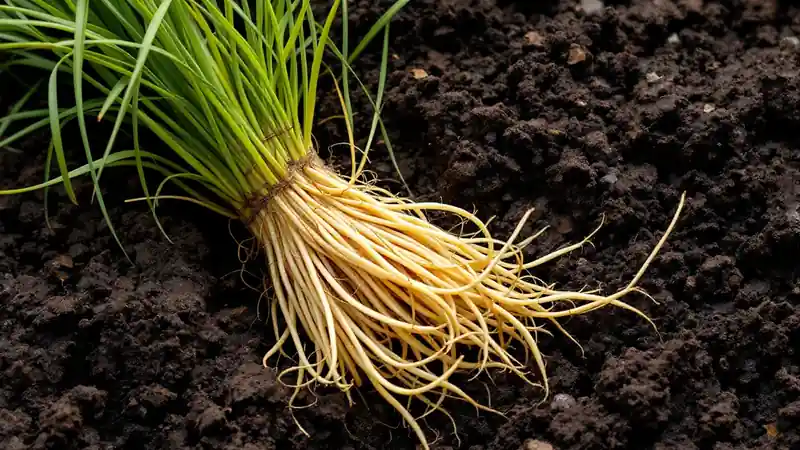
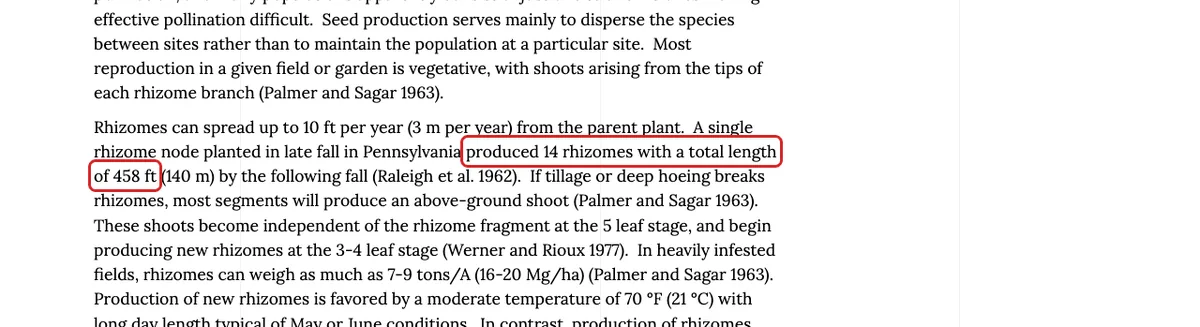
How to kill quackgrass is a question about rhizomes, not leaves. Cornell weed science records a single rhizome node, planted in late fall in Pennsylvania, that grew 14 rhizomes with a total length of 458 feet by the next fall, and most rhizome segments broken by hoeing send up a new shoot. Pulling the tops resets the plant. Killing it means draining or poisoning that underground network, and the leaf count on the regrowth tells you when.
Today’s top results are Reddit, Facebook and YouTube threads plus 3 extension fact sheets, and none names an EPA Reg. No., a label rate or a trigger for the second round. Below, every method is set by site, every repeat is timed to the 3-leaf stage when rhizome reserves bottom out (Håkansson and Wallgren 1976, cited by Cornell), and 12 labels are checked, including 2 popular lawn products that do not list quackgrass at all. For the other grassy weeds that get mistaken for it, our lawn weed identification chart covers the full set.
This page summarizes pesticide labels and extension guidance; it is not a recommendation of any product. The label is the law: read the current label of the exact product you buy, and check whether your state requires a pesticide applicator license before anyone treats a property for pay.
Is it quackgrass? Check the auricles and the rhizomes
Pull a leaf down and look where the blade meets the stem. Quackgrass (Elymus repens, listed in older guides as Agropyron repens or Elytrigia repens) has a pair of narrow auricles that clasp the stem like claws, blades 0.12 to 0.4 inch wide, and white rhizomes with pointed tips (Cornell). Purdue turf scientists say clasping auricles plus rhizomes leave few other options, and that patches stand out as ashy blue-green.
| Grass | Auricles | Rhizomes | Life cycle | Other clue | Source |
|---|---|---|---|---|---|
| Quackgrass | Narrow, clasping, claw-like | Yes: white, sharp tips | Cool-season perennial | Flat spike 2 to 8 in. long, wheat-like | Cornell; Purdue |
| Tall fescue | Blunt; do not wrap the stem | No: clump-forming | Cool-season perennial | Coarse clumps in finer lawns | Cornell |
| Annual and perennial ryegrass | Can look like quackgrass’s | No: lifts out as a clump | Annual or perennial | Spike similar to quackgrass | Cornell; Oregon State |
| Smooth brome | None; sheath closed | Yes | Perennial | Rhizomes without auricles | Cornell |
| Crabgrass | None; membranous ligule 1 to 1.5 mm | No: tillers root at nodes | Summer annual, dies after frost | 3 to 5 finger-like spikes | Iowa State; Penn State |
The calendar separates the two most confused weeds. Crabgrass is a warm-season annual that shows up later and turns reddish-brown and dies after the first fall frost, while quackgrass is green early in spring and returns from the same rhizomes every year (Iowa State Yard and Garden; Penn State Extension). Crabgrass has its own preemergent program in our crabgrass control guide; none of it touches an established quackgrass patch.
Why does pulling quackgrass fail? The rhizome numbers
Each figure below comes from a university fact sheet or the research it cites. Read across a row and the reason a garden fork fails becomes concrete: the visible plant is the smaller part, and the part left in the soil is built to restart.
| Rhizome fact | Number | What it means for you | Source |
|---|---|---|---|
| Growth from one node | 14 rhizomes, 458 ft total, in 1 year | A missed 1-inch piece can be a new patch by next fall | Cornell (Raleigh et al. 1962) |
| Spread | Up to 10 ft per year; more than 1 in. per day | A once-a-year bed edge will not hold the line | Cornell; UVM |
| Depth | Mostly top 4 in. of untilled sod; down to 8 in.; shoots can rise from 10 in. | Dig and lift at least 8 in. deep | Cornell (Lemieux et al. 1993) |
| Share of plant underground | Rhizomes plus roots: 60 to 70% of plant weight | Mowing removes the minority of the plant | UVM |
| Dormant buds | About 90% of rhizome buds stay dormant until the soil is disturbed | Each cut or till wakes a new batch | Maine fact sheet (Duval) |
| Drying | Rhizomes regrow after losing up to 60% of their water | Pieces raked onto soil must dry completely in hot weather | Cornell (Reidy and Swanton 1994) |
| Cold | Killed below 20 °F, but only when exposed on the surface | Winter does not kill rhizomes under soil or snow | Cornell |
| Bud lifespan | Viability falls fast in year 1; 2 years for all to die | Plan on 2 seasons of checking after the last green leaf | Cornell (Lemieux et al. 1993) |
| Shade | Rhizome formation stops only when light is cut 97% | Any covering must be fully opaque | Cornell (Palmer and Sagar 1963) |
| Seed | 25 to 40 seeds per stem, many sterile | Seed spreads it between yards; rhizomes hold the patch | UMN Extension; Cornell |
The leaf count on new shoots is the clock for every method on this page. Rhizome reserves are lowest when a shoot has 3 leaves, rhizome-fed shoots start new rhizomes at 3 to 4 leaves, and a shoot no longer needs its fragment at 5 leaves (Cornell, citing Werner and Rioux 1977). UVM Extension turns that into a rule: dig or till again before regrowth has more than 4 leaves, and several repetitions usually kill the stand.
What kills quackgrass but not grass?
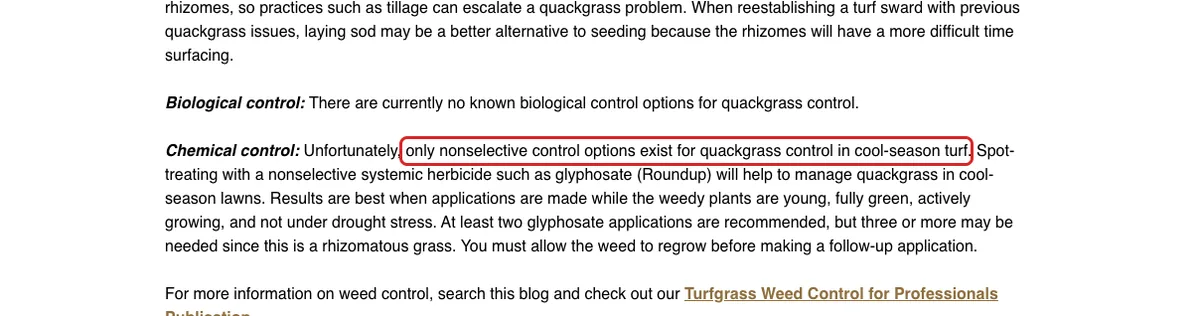
In a Kentucky bluegrass, tall fescue or perennial ryegrass lawn, nothing sold for home use removes quackgrass selectively. Purdue’s answer is that only nonselective options exist in cool-season turf: spot-treat with glyphosate at least twice, 3 or more times for this rhizomatous grass, and let the weed regrow before each follow-up (Purdue Turfgrass Science). UMN Extension lists the same 2 actives, glyphosate and glufosinate, and adds that preemergents do nothing to an established patch.
Two lawn herbicides people try are not labeled for it. The Tenacity label (mesotrione, EPA Reg. No. 100-1267) and the Drive XLR8 label (quinclorac, 7969-272) do not mention quackgrass in their 20 and 13 pages, and 2,4-D leaves grasses alone, as our label-by-label answer on whether 2,4-D kills grass shows. The Certainty label (sulfosulfuron, 59639-226) lists quackgrass for suppression or partial control only, in pure Kentucky bluegrass, at 1.25 to 2.0 oz per acre, and says its cool-season directions are not intended for residential turf.
The fine fescue exception
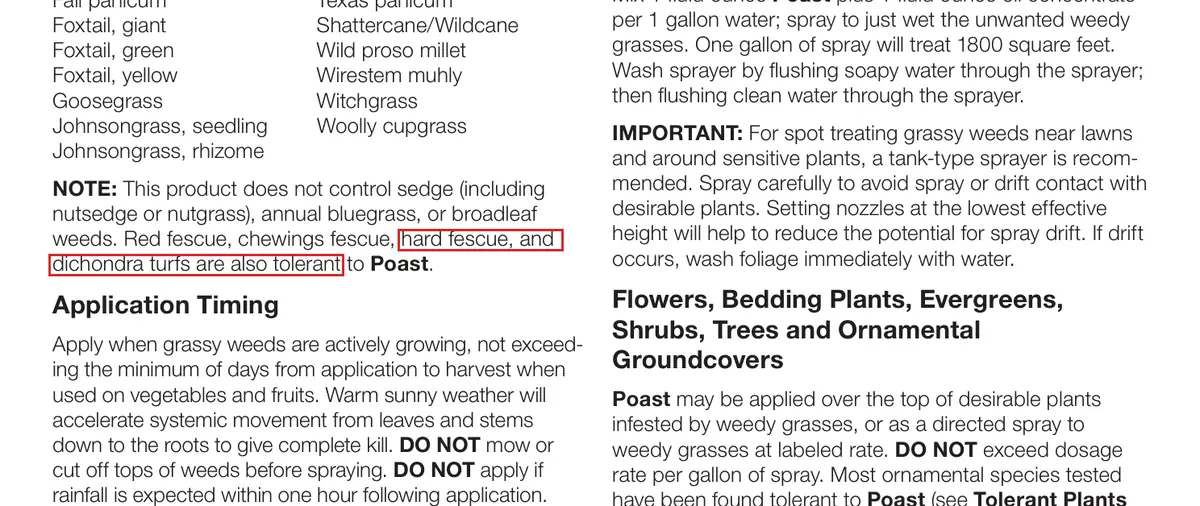
Shade lawns of red, Chewings or hard fescue are the one lawn type with a selective option. The residential directions on the Poast label (sethoxydim 18%, EPA Reg. No. 7969-58) list quackgrass among the grasses it kills and state that red, Chewings and hard fescue turfs are tolerant. The professional Fusilade II Turf and Ornamental label (fluazifop-P-butyl 24.5%, 100-1084) allows 8 to 16 fl oz per acre over fine fescue, repeated after 28 days, says only fine fescues tolerate those rates, and warns that complete control may take sequential sprays over 1 to 2 seasons.
Quackgrass control plan by site
The grass you want to keep decides the product. Grass-only herbicides (fluazifop, sethoxydim, clethodim) are safe over most flowers, shrubs and listed vegetables but kill bluegrass, ryegrass and tall fescue; glyphosate kills everything green it touches. The table sets the method for 6 sites, and the flow below it asks the same questions in order.
| Where it grows | Method | Product type (label) | Timing and repeats | Source |
|---|---|---|---|---|
| Kentucky bluegrass, tall fescue or ryegrass lawn | Spot-kill, then reseed or sod | Glyphosate: 2.5 fl oz per gal, 1 gal per 300 sq ft (71995-25) | Respray anything green after 7 days; at least 2 rounds; till or rake 3 days after the last | 71995-25; Purdue |
| Fine fescue lawn | Over-the-top grass killer | Sethoxydim (7969-58); fluazifop, professional (100-1084) | Poast allows a second spray; Fusilade every 28 days | 7969-58; 100-1084 |
| Flower and shrub beds | Grass killer over the top or directed | Fluazifop ready-to-use (239-2620); sethoxydim (7969-58) | 239-2620: 2 sprays 7 days apart for quackgrass; dies in 1 to 4 weeks | 239-2620 |
| Vegetable garden | Grass killer on listed crops, or cultivate | Sethoxydim residential directions (7969-58) | Harvest waits: green beans 15 days, tomato and pepper 20, head lettuce, onion and potato 30; never near sweet corn | 7969-58 |
| Ground you will replant | Kill, wait, then till | Glyphosate 41%, 2% hand-sprayer solution (524-475) | Spray at 8 in. or more (3 to 4 leaves); wait at least 3 days before tillage | 524-475 |
| Anywhere you will not spray | Exhaust or smother | Rototiller; opaque tarp | 2 tilling passes about 21 days apart in dry soil, up to 4 in wet soil; tarp at least 6 months, 1 m past the patch | Maine fact sheet |
1Does the grass have clasping, claw-like auricles and white rhizomes?
YesIt is quackgrass: go to the next question.
NoProbably not quackgrass. Check crabgrass, tall fescue and ryegrass in the ID table before treating.
2Is it in a Kentucky bluegrass, tall fescue or ryegrass lawn?
YesSpot spray glyphosate (2.5 fl oz per gal on 71995-25), respray green areas after 7 days, plan 2 to 3 rounds, then reseed or sod 3 or more days after the last spray.
NoGo to the next question
3Is it in a red, Chewings or hard fescue lawn?
YesSethoxydim residential directions (7969-58) list these fescues as tolerant; a professional can use fluazifop (100-1084) at 8 to 16 fl oz per acre every 28 days.
NoGo to the next question
4Is it in a flower or shrub bed?
YesGrass killer over the top: fluazifop ready-to-use 239-2620 twice, 7 days apart, or sethoxydim 7969-58. Keep it off ornamental grasses.
NoGo to the next question
5Is it in a vegetable garden?
YesSethoxydim on listed crops only, observing harvest waits (tomato 20 days, head lettuce 30), or till every time regrowth reaches 3 leaves.
NoGround you will replant or will not spray: kill with glyphosate at 8 in. or more and till 3 or more days later, or cover with opaque plastic for at least 6 months, 1 m past the patch.
Source: Labels 71995-25, 7969-58, 100-1084, 239-2620; Purdue; Maine fact sheet
In the lawn: spot-kill and reseed
- Confirm clasping auricles and white rhizomes using the ID table, so you do not kill tall fescue clumps that only need digging out.
- Skip 1 mowing before spraying, as the 71995-25 lawn-replacement directions say; the Roundup PRO label (524-475) times quackgrass sprays to plants at least 8 inches tall at the 3- to 4-leaf stage.
- If the soil is dry, water the day before and 2 to 3 days after spraying (71995-25).
- Mix 2.5 fl oz of 50.2% glyphosate concentrate per gallon and cover 300 sq ft per gallon. Check the active-ingredient line first: Roundup Weed & Grass Killer4 (71995-64) lists quackgrass but contains triclopyr, fluazifop and diquat, not glyphosate, and allows a repeat only after 28 days.
- After 7 days, respray anything still green. Purdue plans for 2 rounds and often 3 or more, each on fresh regrowth.
- Wait at least 3 days after the last spray, rake out the dead material, then seed or sod. Purdue suggests sod over seed where quackgrass was, because rhizomes have a harder time surfacing through it.
- Walk the area the next spring and the one after: Cornell gives buds 2 years to die out.
Glyphosate’s soil behavior and the brand-name switch are covered in our page on whether Roundup kills grass, and the spray, smother and sod-cutter options for a whole-lawn redo are compared in how to kill grass before replanting. Nimblewill and creeping bentgrass get the same spot-kill answer in cool-season lawns; see how-to-get-rid-of-nimblewill.
In flower beds and vegetable gardens
Grass killers work slowly on purpose. The Grass-B-Gon Grass Killer Formula II label (fluazifop-P-butyl 0.48%, 239-2620) calls for 2 applications 7 days apart on established quackgrass and says treated grass yellows and dies in 1 to 4 weeks, so green blades 3 days later are not a failure. Do not mow or cut the tops before spraying, both 239-2620 and 7969-58 say, and Poast needs 1 rain-free hour. Keep these products off ornamental grasses; the Poast label names them among plants that may be damaged.
In a vegetable garden, the label decides. Poast’s residential directions allow over-the-top or directed sprays on listed crops at 1 fl oz of product plus 1 fl oz of oil concentrate per gallon, 1 gallon per 1,800 sq ft, with a second spray on every listed crop except peanut, root vegetables and strawberry, and no use near sweet corn (7969-58). The fluazifop concentrates sold for beds, EH 951 Grass Herbicide (2217-751) and Acme Ornamec (33955-559), forbid use on ornamentals harvested for food within 1 year. Bed-specific problems such as lawn grass creeping in from the edge are covered in our flower bed weed control plan.
Which herbicide labels list quackgrass, and at what rate?
We read 12 labels in EPA’s Pesticide Product and Label System. Nine list quackgrass; the table gives each one’s rate, the plant height the label wants, and its repeat rule. The last 3 rows are the lawn products people reach for that will not do the job.
Swipe the table sideways to see every column.
| Product | EPA Reg. No. | Active ingredient | Quackgrass rate | Plant height | Repeat rule |
|---|---|---|---|---|---|
| Roundup Weed & Grass Killer Super Concentrate | 71995-25 | Glyphosate 50.2% | 2.5 fl oz per gal; 1 gal per 300 sq ft | Actively growing | Respray green areas after 7 days; till 3 days after |
| Roundup PRO / ULTRA (professional) | 524-475 | Glyphosate 41% | 2% hand-sprayer solution; 2 to 3 qt per acre where no tillage follows | 8 in. or taller, 3 to 4 leaves | At least 3 days before tillage |
| Roundup Weed & Grass Killer4 Concentrate | 71995-64 | Triclopyr 2.5%, fluazifop 2.0%, diquat 1.5% | 6 fl oz per gal; 1 gal per 300 sq ft | Not stated for quackgrass | 28 days between sprays; kills lawn grass too |
| Grass-B-Gon Grass Killer Formula II (ready to use) | 239-2620 | Fluazifop-P-butyl 0.48% | Wet the foliage | Actively growing | 2 sprays 7 days apart for quackgrass |
| Poast, residential directions (also sold as Grass Beater II, 7969-58-4) | 7969-58 | Sethoxydim 18% | 1 fl oz plus 1 fl oz oil concentrate per gal; 1 gal per 1,800 sq ft | Grasses up to 1 ft | Second spray allowed except peanut, root crops, strawberry |
| Poast, farm directions | 7969-58 | Sethoxydim 18% | 1.5 pt per acre, then 1.0 pt (Midwest, South, Northeast) | Up to 8 in. | At least 14 days apart; cultivate 7 to 14 days after |
| EH 951 Grass Herbicide | 2217-751 | Fluazifop-P-butyl 1.7% | 9 fl oz per 1,000 sq ft broadcast; 10 fl oz per gal spot | 6 to 10 in. | Max 26.5 fl oz per 1,000 sq ft per year |
| Acme Ornamec | 33955-559 | Fluazifop-P-butyl 1.7% | 10 fl oz per gal; 1 gal per 1,000 to 1,200 sq ft | 6 to 10 in. | Max 26.5 fl oz per 1,000 sq ft per year |
| Fusilade II Turf and Ornamental (professional) | 100-1084 | Fluazifop-P-butyl 24.5% | 16 to 24 fl oz per acre (0.4 to 0.6 fl oz per 1,000 sq ft) in beds | 6 to 10 in. | Fine fescue turf: 8 to 16 fl oz per acre, every 28 days |
| Envoy Plus (professional, V-10137 1 EC) | 59639-132 | Clethodim 12.6% | 12 to 32 fl oz per acre (0.3 to 0.8 fl oz per 1,000 sq ft) in ornamentals | 4 to 8 in. | Repeat if regrowth occurs |
| Certainty (professional) | 59639-226 | Sulfosulfuron 75% | 1.25 to 2.0 oz per acre, pure Kentucky bluegrass | Not stated | Suppression or partial control only; not for residential turf |
| Tenacity | 100-1267 | Mesotrione 40% | Quackgrass not on label | None | None |
| Drive XLR8 | 7969-272 | Quinclorac 18.92% | Quackgrass not on label | None | None |
The calculator converts a label rate into what you measure. Default: 1,000 sq ft at the 71995-25 rate takes 8.33 fl oz of concentrate, in about 3.3 gallons of spray. Worked example: 500 sq ft of beds at the Poast residential rate (1 fl oz per 1,800 sq ft) takes 0.28 fl oz, about 1.7 teaspoons, plus the same amount of oil concentrate.
- Concentrate to measure (fl oz)
- 8.33
- Same amount in teaspoons
- 50.0
Default: 1,000 sq ft at the 71995-25 rate takes 8.33 fl oz (about 50 teaspoons). Worked example: 500 sq ft at the Poast residential rate takes 0.28 fl oz, about 1.7 teaspoons, plus the same amount of oil concentrate. Rates from the EPA-stamped labels on this page, read November 2026; your container's label overrides this tool.
How to get rid of quackgrass without chemicals
Every non-chemical method works by starving or drying the rhizomes, and every one fails if done once. Oregon State says cultivation used alone will spread quackgrass, and UMN Extension says tillage can make it worse. Done on the 3-leaf schedule, the same tools win.
- Small, new patch: dig in moist soil and lift the rhizomes whole. Dig again whenever regrowth appears and before it has more than 4 leaves; several repetitions usually kill the stand (UVM).
- Larger bed: rototill 4 to 6 inches deep in hot, dry weather, then again before new shoots reach 5 inches. Studies on heavily infested English sites found 2 passes about 21 days apart enough in dry soil, and up to 4 in wet soil (Maine fact sheet).
- Dry spell: loosen the soil without chopping the rhizomes, rake them to the surface and turn them every few days so most dry out before the next rain (Cornell). Partly dried pieces survive.
- Smother: lay opaque plastic for a full season, at least 6 months, extending 1 meter (about 3 feet) beyond the patch. Straw or wood chips work only about 12 inches (30 cm) deep, because rhizomes colonize settling mulch (Maine fact sheet).
- Solarize: in the hottest part of summer, seal clear plastic over the patch for 6 weeks, then rototill and sow a winter grain or green manure crop (Maine fact sheet).
- Close the gap: a dense, healthy lawn is the first defense, per Purdue and UMN; in gardens, plant immediately so crops shade the soil.
Cardboard and a few inches of wood chips do not stop quackgrass the way they stop lawn grass; our page on whether mulch will kill grass explains why rhizome grasses push through. UMN Extension names proper composting among the ways to keep quackgrass seeds and rhizomes out of a lawn, so bag dug rhizomes for the trash.
Where quackgrass guides disagree
Several widely read numbers do not match the research. The table puts each claim next to the university source, so you can see which one to plan around.
| Question | One source says | The research or extension source says | Plan around |
|---|---|---|---|
| How deep are the roots? | “Can grow 6 to 8 feet deep” (Roundup.com) | Rhizomes reach about 8 in.; most sit in the top 4 in. (Cornell) | Digging 8 in. deep reaches nearly all of it |
| How far does it spread in a year? | Up to 5 ft in a season (Roundup.com); 1.5 m (Maine) | Up to 10 ft per year (Cornell; UVM); rhizomes up to 11 ft long (UMN) | Treat a margin, then watch 10 ft out |
| How many seeds? | Up to 25 per plant (Roundup.com) | 25 to 40 per stem (UMN; Cornell) | Mow before seedheads form |
| Is hand pulling worth it? | “Don’t waste your time” (Roundup.com) | Small, recent patches: digging plus monitoring may be enough if repeated before 4 leaves (UVM; Oregon State) | Dig small patches; spray or tarp big ones |
| Do preemergents help? | Prodiamine is on Oregon State’s list of home-use actives (Oregon State) | Not recommended; established quackgrass grows through them (UMN) | Skip preemergents for quackgrass |
| Does mowing do anything? | Mowing will not suppress its spread (Oregon State) | Repeated mowing after harvest cut rhizome production in a field study (Cornell, Ringselle et al. 2015) | Mowing weakens it, never removes it |
| Does it tolerate shade? | Does not tolerate shade (Oregon State) | Slightly shade tolerant; rhizomes form until light is cut 97% (Cornell) | Covers must block all light |
| Will 2 to 3 in. of mulch keep it out? | Can help prevent it in beds (Roundup.com) | Organic mulch works only about 12 in. deep (Maine) | Use opaque plastic or fabric under mulch |
When is the best time to spray quackgrass?
Spray when the grass is actively growing, unstressed and tall enough to absorb a dose: 6 to 10 inches on the fluazifop labels (100-1084, 2217-751, 33955-559), up to 8 inches on the Poast farm directions, and 8 inches or more at 3 to 4 leaves on 524-475. Oregon State favors spring or fall sprays and notes that spraying after flowering helps kill the roots. Poast’s directions add that fall sprays cut the reserves rhizomes store for winter.
Do not count on winter to finish the job. Cornell reports that quackgrass is highly frost tolerant, green leaves often survive northern winters, and rhizome bud numbers can keep rising above 32 °F, so it advises control late into fall (Cornell). Cool weather, drought and heat stress slow grass killers, per the Poast label, and Oregon State says to skip spraying when rain is expected within 24 hours.
How we compiled this
We read 12 EPA-stamped labels from the Pesticide Product and Label System and 8 extension, university and manufacturer pages (Cornell weed science, UMN, Purdue, Oregon State, UVM, the Maine organic fact sheet, Iowa State, Penn State, plus Roundup.com for its claims) on Nov. 20, 2026. Biology figures are as published by those sources, which cite the field research named in the tables. Label rates come from the PDFs themselves. We did not test any product or method.
Frequently asked questions
What kills quackgrass permanently?
Glyphosate sprayed on actively growing leaves, repeated on the regrowth: Purdue plans for at least 2 rounds and often 3 or more. Without herbicide, repeated digging or tilling before regrowth has 4 leaves, or opaque plastic left down at least 6 months.
Can you kill quackgrass without killing grass?
Not in Kentucky bluegrass, tall fescue or ryegrass lawns: Purdue says only nonselective options exist in cool-season turf. Fine fescue lawns are the exception, since the Poast (sethoxydim) and Fusilade II (fluazifop) labels list red, Chewings and hard fescue as tolerant.
How do you get rid of quackgrass naturally?
Starve the rhizomes. Dig or till every time new shoots reach 3 leaves, rake rhizomes up to dry in hot weather, or smother the patch under opaque plastic for a full season, extending about 3 feet past its edge.
Does quackgrass come back every year?
Yes. It is a cool-season perennial that regrows from rhizomes each spring, and Cornell says rhizome buds take 2 years to die out after the last green growth.
Does quinclorac or Tenacity kill quackgrass?
Neither label lists it. The Drive XLR8 (quinclorac, 7969-272) and Tenacity (mesotrione, 100-1267) labels do not mention quackgrass, so use glyphosate spot treatments in cool-season lawns.
Does tilling spread quackgrass?
Once, yes: Oregon State says cultivation used alone spreads it. Repeated every time regrowth reaches 3 leaves, tilling exhausts it; 2 passes about 21 days apart were enough in dry soil, up to 4 in wet soil.
Sources
- U.S. EPA PPLS (Monsanto), Roundup Weed & Grass Killer Super Concentrate master label, EPA Reg. No. 71995-25, Jan. 28, 2021. Accessed November 2026.
- U.S. EPA PPLS (Bayer CropScience), Roundup ULTRA / Roundup PRO master label, EPA Reg. No. 524-475, Oct. 18, 2016. Accessed November 2026.
- U.S. EPA PPLS (Monsanto), Roundup Weed & Grass Killer4 Concentrate master label, EPA Reg. No. 71995-64, June 5, 2023. Accessed November 2026.
- U.S. EPA PPLS (The Scotts Company), Grass-B-Gon Grass Killer Formula II label, EPA Reg. No. 239-2620, Oct. 28, 2024. Accessed November 2026.
- U.S. EPA PPLS (BASF), Poast Herbicide label, including residential directions, EPA Reg. No. 7969-58, Dec. 3, 2020. Accessed November 2026.
- U.S. EPA PPLS (PBI-Gordon), EH 951 Grass Herbicide label, EPA Reg. No. 2217-751, Sept. 25, 2026. Accessed November 2026.
- U.S. EPA PPLS (PBI-Gordon), Acme Ornamec Herbicide label, EPA Reg. No. 33955-559, Feb. 3, 2026. Accessed November 2026.
- U.S. EPA PPLS (Syngenta), Fusilade II Turf and Ornamental Herbicide label, EPA Reg. No. 100-1084, July 15, 2026. Accessed November 2026.
- U.S. EPA PPLS (Valent), V-10137 1 EC Herbicide (Envoy Plus) label, EPA Reg. No. 59639-132, Apr. 6, 2026. Accessed November 2026.
- U.S. EPA PPLS (Valent), Certainty Turf Herbicide label, EPA Reg. No. 59639-226, Nov. 7, 2024. Accessed November 2026.
- U.S. EPA PPLS (Syngenta), Tenacity label, EPA Reg. No. 100-1267, Sept. 28, 2022. Accessed November 2026.
- U.S. EPA PPLS (BASF), Drive XLR8 Herbicide label, EPA Reg. No. 7969-272, Nov. 1, 2019. Accessed November 2026.
- Cornell University, Weed Science (CALS), Weed Profiles: Quackgrass, current page. Accessed November 2026.
- University of Minnesota Extension, Quackgrass, reviewed 2024. Accessed November 2026.
- Purdue University Turfgrass Science (A. Patton, Q. Law), Quackgrass, page modified May 4, 2026. Accessed November 2026.
- Oregon State University, Solve Pest Problems, How to Manage Quackgrass, updated Apr. 3, 2026. Accessed November 2026.
- UVM Extension Vermont Vegetable and Berry Program, Quackgrass, current page. Accessed November 2026.
- Maine Department of Agriculture (J. Duval, with D. Cloutier), Quackgrass (Elytrigia repens) Control Methods in Organic Agriculture, fact sheet PDF, undated. Accessed November 2026.
- Iowa State University Extension, Yard and Garden, How do I tell the difference between crabgrass and quackgrass?, current page. Accessed November 2026.
- Penn State Extension, Lawn and Turfgrass Weeds: Smooth Crabgrass and Large Crabgrass, current page. Accessed November 2026.
- Roundup (Bayer), What Is Quackgrass and How Do I Control It?, current page, cited for its claims. Accessed November 2026.