How to kill Virginia buttonweed: start spraying in April or May while growth is tender, repeat every 2 to 6 weeks into summer, and plan on 2 seasons. Celsius WG or metsulfuron suit St. Augustine and centipede; 3-way 2,4-D mixes suit tall fescue.
How to kill Virginia buttonweed is a question of repetition more than product choice. In a 1979 Mississippi State trial on common bermudagrass, one spray of 2,4-D at 1 lb per acre gave 47.5 percent control at 9 days and 0 percent by day 30; four sprays 2 to 3 weeks apart still held 47.5 percent at day 86. LSU AgCenter research says it often takes 4 applications to keep this weed in check, and Clemson HGIC plans for 2 years.
Here is the catch none of the top-ranking guides spell out: no single product label allows 4 buttonweed sprays a year. The 3-way 2,4-D lawn labels we read cap broadcast use at 2 per year, 30 days apart, and the Celsius WG label caps a lawn at 4.8 g per 1,000 sq ft a year while listing buttonweed at 3.2 g, which is 1.5 full-rate sprays. A 4-spray season is a relay between products, matched to your grass. If you still need to confirm the weed, compare it with other summer perennials in our lawn weed identification guide.
This page summarizes EPA labels and university research; it does not endorse any product. The label is the law: read the current label of the exact product you buy, and check whether your state requires a pesticide applicator license for lawn care before anyone sprays a lawn for pay.
Is it Virginia buttonweed or poorjoe?
Check the leaf width and whether the stems root. Virginia buttonweed (Diodia virginiana) is a perennial with leaves up to 1 inch wide that roots at the nodes; poorjoe, also sold as rough buttonweed (Diodia teres), is an annual with leaves 2 to 6 mm wide, per the University of Missouri weed ID guide. Poorjoe dies at frost, so a fall cleanup handles it; Virginia buttonweed needs the program below.
| Feature | Virginia buttonweed (Diodia virginiana) | Poorjoe (Diodia teres) | Source |
|---|---|---|---|
| Life cycle | Perennial; taproots carry it through winter | Annual | UGA B1397; Missouri |
| Leaves | Opposite, stalkless, lance-shaped, 1.25 to 2.5 in long and up to 1 in wide; slightly thick | Opposite, linear, 3/4 to 1 1/2 in long and 2 to 6 mm wide | NC State; Missouri |
| Leaf color | Often mottled yellow from a virus by late summer; reddish margins or purpling under stress | Green | UGA B1397; Clemson; Mississippi State |
| Flowers | White, tubular, 4 petals in a star, about 1/2 in across, sometimes pink-streaked; June to November | Small, white, 4-parted, usually 1 per leaf axil | NC State; Missouri |
| Stems | Prostrate, to 2 ft, root at the nodes; rhizomes found several feet deep | Hairy, spreading or upright; no rooting at nodes | NC State; UT W147; Go Botany |
| Seed | Above-ground and below-ground self-pollinating flowers; buoyant fruit float in runoff | Seed only | UT W147 |
| Where it wins | Wet, poorly drained or overwatered turf; tolerates mowing at 1/2 in | Roadsides and pastures, not high-maintenance turf | UGA B1397; MAFES Bulletin 937 |
Why does one spray never finish it?
Because most of the plant is below the mower and below the spray. University of Tennessee publication W147 describes deep taproots, rhizomes several feet down, underground flowers that set seed, and stem pieces from mowing that root into new plants. Clemson adds that leaves harden by late summer, when “older Virginia buttonweed plants are much more tolerant of selective herbicides.”
The Mississippi State bulletin shows what that looks like on a rating sheet. Plots were 3 by 20 ft of common bermudagrass mowed at 0.5 inch, sprayed from July 18, 1979, and rated on a 0 to 100 scale. The 2,4-D-only rows below are an old, single-site data set, but they are the only published time course we found, and they match the advice in every current extension guide: sprays must overlap before regrowth starts.
| 2,4-D at 1 lb/acre, spray days | 9 days | 15 days | 30 days | 51 days | 72 days | 86 days |
|---|---|---|---|---|---|---|
| 1 spray (day 1) | 47.5% | 12.5% | 0% | 0% | 0% | 0% |
| 2 sprays (days 1 and 30) | 47.5% | 10.0% | 17.5% | 10.0% | 0% | 0% |
| 3 sprays (days 1, 15, 30) | 50.0% | 57.5% | 75.0% | 60.0% | 37.5% | 27.5% |
| 4 sprays (days 1, 15, 30, 51) | 52.5% | 62.5% | 72.5% | 67.5% | 65.0% | 47.5% |
| 1 spray at 4 lb/acre | 90.0% (turf injury 25% or more) | 17.5% | 0% | 0% | 0% | 0% |
- 1 spray
- 2 sprays, days 1 and 30
- 3 sprays, days 1, 15, 30
- 4 sprays, days 1, 15, 30, 51
Source: Coats, Jordan and McGregor, MAFES Bulletin 937, Table 1 (1985) Same numbers as the table above. Common bermudagrass fairway mowed at 0.5 in, Tupelo, Miss.; first spray July 18, 1979; 2,4-D alone, not a modern 3-way mix.
Show the numbers
| 1 spray | 2 sprays, days 1 and 30 | 3 sprays, days 1, 15, 30 | 4 sprays, days 1, 15, 30, 51 | |
|---|---|---|---|---|
| 9 days | 47.50% | 47.50% | 50% | 52.50% |
| 15 days | 12.50% | 10% | 57.50% | 62.50% |
| 30 days | 0% | 17.50% | 75% | 72.50% |
| 51 days | 0% | 10% | 60% | 67.50% |
| 72 days | 0% | 0% | 37.50% | 65% |
| 86 days | 0% | 0% | 27.50% | 47.50% |
Two lessons carry over to today’s products. A 30-day gap, the shortest interval on current 3-way lawn labels, let plants recover between sprays in this trial; the same bulletin found 2,4-D + mecoprop + dicamba averaged about 20 percent better than 2,4-D alone. And quadrupling the dose was not a shortcut: 4 lb per acre hit 90 percent at day 9 with unacceptable bermudagrass injury, then fell to 0 by day 30. Our page on whether 2,4-D kills lawn grass lists the per-grass limits that make high rates a bad trade.
Which herbicides kill Virginia buttonweed?
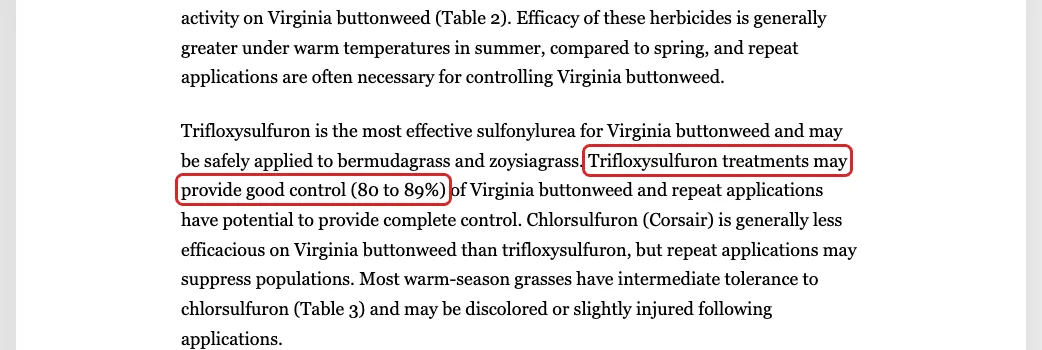
The ALS-inhibitor combinations rate highest. UGA Bulletin 1397 (Patrick McCullough, reviewed June 11, 2024) rates Celsius and Tribute Total good to excellent and says single Celsius applications have given 80 to 100 percent control. Trifloxysulfuron (Monument) is its most effective single sulfonylurea at 80 to 89 percent, on bermuda and zoysia only. Plain metsulfuron rates only poor to fair, though Mississippi State and LSU trials rate it higher.
Swipe the table sideways to see every column.
| Active ingredient | Example product | UGA rating | Other published result | Source |
|---|---|---|---|---|
| thiencarbazone + iodosulfuron + dicamba | Celsius WG | Good to excellent | Performed best with metsulfuron in LSU AgCenter trials | UGA B1397; LSU |
| thiencarbazone + foramsulfuron + halosulfuron | Tribute Total | Good to excellent | Sequential 3.2 oz/acre 4 to 6 weeks later for regrowth; bermuda and zoysia only | UGA B1397 |
| trifloxysulfuron | Monument | Fair to good | 80 to 89%, repeat sprays can give complete control; UT: 0.56 oz/acre twice, 4 weeks apart | UGA B1397; UT W147 |
| flazasulfuron | Katana | Not rated | 3 sprays (at 0, 3 and 6 weeks) above 93% at 10 weeks in Tifway bermuda | Hutto et al., Weed Technology 22(2), 2008 |
| metsulfuron + sulfentrazone | Blindside | Good | Two sprays beat metsulfuron alone; second spray 21 days after the first | UGA B1397; Clemson |
| metsulfuron | Manor, MSM Turf | Poor to fair | Repeat sprays 70 to 79% (UGA); good to excellent in Mississippi State trials | UGA B1397; Mississippi State |
| triclopyr + clopyralid | Confront | Good | 80% at 10 weeks; 2 pt/acre repeated injures bermuda, use 1 pt | Hutto et al. 2008; UT W147 |
| fluroxypyr + 2,4-D + dicamba | Escalade 2 | Good | Fluroxypyr at 140 g/ha or more: 80% or better through 10 weeks | Kelly and Coats, Weed Technology 14(3), 2000 |
| quinclorac + 2,4-D + dicamba + sulfentrazone | Q4 Plus | Good | Not safe on centipede or St. Augustine (UGA Table 3) | UGA B1397 |
| 2,4-D + MCPP + dicamba (3-way) | Trimec, Weed B Gon, others | Fair to good | About 20% better than 2,4-D alone; often 4 sprays a season | MAFES 937; LSU |
| chlorsulfuron | Corsair | Poor to fair | UT: 3 oz/acre twice, 4 weeks apart | UGA B1397; UT W147 |
| dicamba | Banvel and others | Fair | Adds activity when mixed with sulfonylureas | UGA B1397 |
| 2,4-D alone | Many | Not rated | 1 lb/acre rarely exceeded 50% | MAFES 937 |
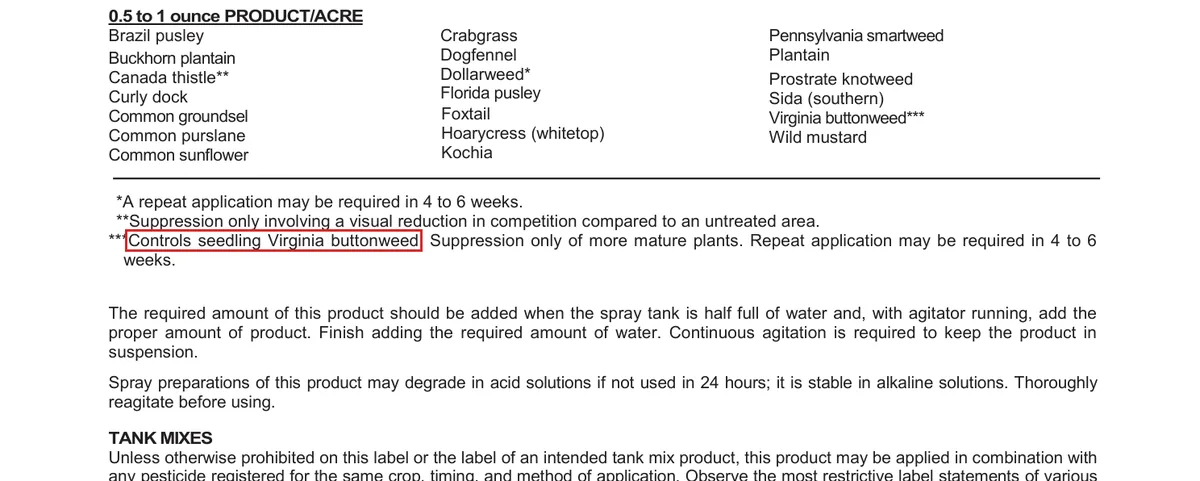
Mississippi State and UGA disagree on metsulfuron, and the Manor label (EPA Reg. No. 228-373) settles what it promises: control of seedling Virginia buttonweed, “suppression only of more mature plants,” with a repeat in 4 to 6 weeks. That is why every southern extension program starts in spring, when LSU’s Ron Strahan says perennial plants emerge in early April and seedlings come up around the mother plants.
What does each label allow on your grass?
We read 8 current or most recent EPA-stamped labels that name Virginia buttonweed. The rows below give the buttonweed rate and the yearly limit, which together decide how many sprays you can make. Grass exclusions matter as much: four of the 2,4-D products bar Floratam St. Augustine by name, and no ALS herbicide here is labeled for tall fescue.
| Product (EPA Reg. No., label date) | Active ingredients | How it lists Virginia buttonweed | Rate for buttonweed | Repeat and yearly limit | Lawn grasses (exclusions) |
|---|---|---|---|---|---|
| Celsius WG (432-1507), Sept. 1, 2021 | thiencarbazone, iodosulfuron, dicamba | Controlled; may need a second spray | 3.2 g (0.113 oz) per 1,000 sq ft in 1 gal water | Second spray 2 to 4 weeks later; max 4.8 g per 1,000 sq ft per 365 days | St. Augustine, bermuda, centipede, zoysia (no bahia, tall fescue or other cool-season) |
| Manor (228-373), May 10, 2019 | metsulfuron | Seedlings controlled; mature plants suppressed | 0.5 to 1 oz product per acre (0.33 to 0.65 g per 1,000 sq ft) | Repeat in 4 to 6 weeks; centipede max 0.5 oz per acre per spray | St. Augustine, bermuda, zoysia, centipede, buffalo; Kentucky bluegrass and fine fescue at lower rates (bahia: severe injury) |
| Image consumer concentrate (73342-4), Aug. 30, 2024 | imazaquin | Listed; more than one spray may be needed | 4 fl oz per 1,000 sq ft | Second spray 6 weeks later; max 2 per year (8 fl oz per 1,000 sq ft) | Bermuda, St. Augustine, buffalo, zoysia, centipede (may injure tall fescue) |
| SpeedZone Southern EW (2217-1031), Aug. 9, 2024 | 2,4-D, dichlorprop-p, dicamba, carfentrazone | Listed | 0.7 to 1.5 fl oz per 1,000 sq ft on warm-season grass | 2 broadcast per year, 30 days apart; spot sprays at 30-day intervals | Warm-season grasses including centipede and St. Augustine (not Floratam or Bitterblue) |
| Trimec Classic (2217-543), Apr. 2, 2014 | 2,4-D, mecoprop-p, dicamba | Listed | 1.2 to 1.5 fl oz per 1,000 sq ft (cool-season, common bermuda, zoysia, bahia) | 2 broadcast and 2 spot per year, 30 days apart; no broadcast above 90°F | Spot-spray only in centipede and St. Augustine; not Floratam; not St. Augustine at green-up |
| BioAdvanced Southern Weed Killer for Lawns (92564-4), June 25, 2026 | 2,4-D, mecoprop-p, dicamba | Listed | 1 fl oz per gal per 500 sq ft (bahia, centipede, St. Augustine); 2 fl oz on bermuda, zoysia, fescue | 2 per year, 30-day interval | Not Floratam, carpetgrass or dichondra |
| Ortho Weed B Gon Weed Killer for Lawns Concentrate (239-2744), Aug. 23, 2023 | 2,4-D, mecoprop-p, dicamba | Listed | 1 fl oz per 1,000 sq ft (centipede, St. Augustine); 2 fl oz (bermuda, zoysia, bahia); 4 fl oz (cool-season) | 2 per year, 30 days apart; not above 90°F (hybrid bermuda 85°F) | Not Floratam in Florida |
| Certainty Turf (59639-226), Nov. 7, 2024 | sulfosulfuron | Suppression or partial control for 4 to 6 weeks | 1.25 oz product per acre | Label suggests a tank mix with a broadleaf herbicide labeled for buttonweed | Warm-season turf |
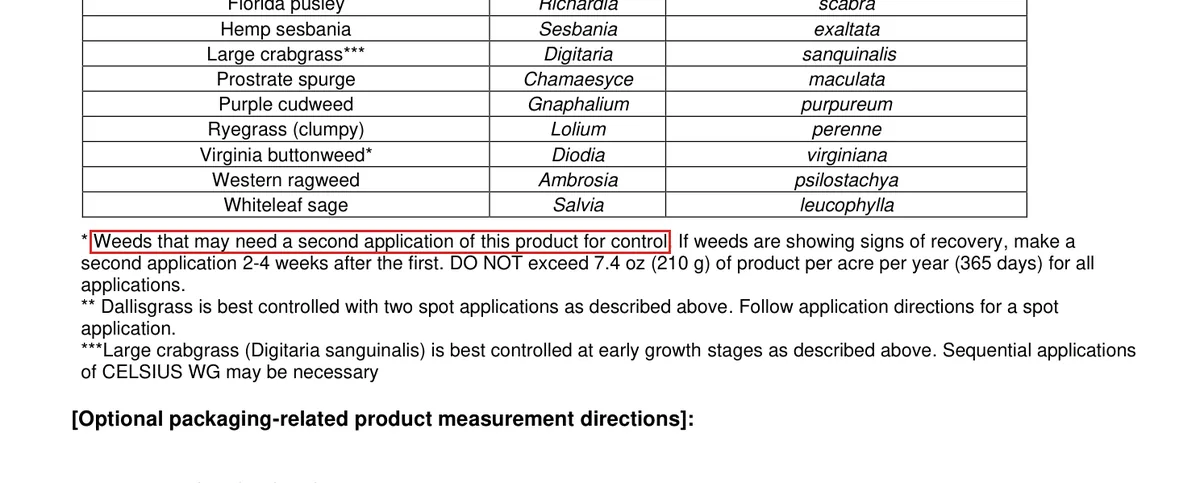
The Celsius numbers are where most programs go wrong. Two full buttonweed-rate sprays (3.2 g + 3.2 g = 6.4 g per 1,000 sq ft) exceed the 4.8 g yearly cap, so the label allows one full spray and one at half rate, or two at 2.4 g. Clemson’s 4 to 6 week repeat is longer than the label’s 2 to 4 weeks; follow the label. Each Celsius packet holds 6.4 g, enough for 2,000 sq ft at 3.2 g.
| Celsius WG on a 5,000 sq ft lawn | Grams per 1,000 sq ft | Grams for 5,000 sq ft | Packets (6.4 g) |
|---|---|---|---|
| Spray 1, buttonweed rate | 3.2 | 16.0 | 2.5 |
| Spray 2, 2 to 4 weeks later (what the cap leaves) | 1.6 | 8.0 | 1.25 |
| Season total | 4.8 (label maximum) | 24.0 | 3.75 |
| Two full-rate sprays (not allowed) | 6.4 | 32.0 | 5.0 |
Temperature decides the order of the relay. Clemson says metsulfuron and Celsius are safe above 85°F, while 2,4-D products may injure centipede and St. Augustine above 85°F, and the 3-way labels stop broadcast use at 90°F. That makes spring the 2,4-D window and summer the Celsius or metsulfuron window. Fertilizer timing and grass-specific limits are on our centipede grass care page and our St. Augustine cultivar guide.
1Has buttonweed replaced most of the grass in the patch?
YesSpot-spray 3% glyphosate on the patch only (Clemson), then sod a couple of weeks after the last spray.
NoGo to the next question
2Is the lawn tall fescue or another cool-season grass?
YesA 3-way 2,4-D + MCPP + dicamba mix at the cool-season rate in spring, twice, 30 days apart; skip summer-stressed fescue. No Celsius, Monument or Tribute Total (UGA: not safe).
NoGo to the next question
3Is it Floratam or Bitterblue St. Augustine?
YesSkip the 2,4-D lawn mixes that exclude it. Celsius WG at 3.2 g per 1,000 sq ft after green-up, then 1.6 g 2 to 4 weeks later; metsulfuron or Image for later regrowth.
NoGo to the next question
4Is it other St. Augustine, or centipede?
YesApril to May under 85°F: 3-way spot sprays at the southern rate, 30 days apart. Above 85°F: Celsius, or metsulfuron (centipede: no more than 0.5 oz Manor per acre per spray).
NoGo to the next question
5Is it bermuda or zoysia?
YesSpring 3-way mix twice, then Celsius in summer; a licensed applicator can use trifloxysulfuron (Monument), rated 80 to 89% by UGA.
NoBahiagrass: avoid Celsius and metsulfuron (Manor warns of severe injury); use a 3-way lawn product that lists bahia, at its southern-lawn rate, twice a season.
- Product per spray (mL)
- 118.3
- Product per spray (teaspoons)
- 24.0
- Product per spray (fl oz)
- 4.00
Default: 1,000 sq ft at the Image rate takes 118.3 mL (4 fl oz). Worked example: 5,000 sq ft of centipede at the Ortho 239-2744 rate takes 147.9 mL (5 fl oz). Rates from the EPA labels on this page, read Nov. 21, 2026. Celsius and Manor are dry products weighed in grams; see the Celsius budget table.
A two-season spray program by lawn grass
Every row below fits inside the label limits in the product table and follows the 2023 LSU AgCenter weed management guide (Publication 1565): 3-way products on newly emerged buttonweed from mid to late April while it is under 85°F, then metsulfuron or Celsius every 4 to 6 weeks in heavy infestations. UGA’s tolerance ratings (Table 3 of Bulletin 1397) set the off-limits column.
| Lawn grass | April to May, under 85°F | June to August, over 85°F | Do not use (UGA Table 3 or label) | Sprays per season |
|---|---|---|---|---|
| St. Augustine (not Floratam or Bitterblue) | 3-way spot spray at the southern-lawn rate, twice, 30 days apart; not during green-up | Celsius 3.2 g then 1.6 g per 1,000 sq ft, or metsulfuron 0.5 to 1 oz/acre with a repeat in 4 to 6 weeks | Monument, Tribute Total, Q4 Plus, Confront | 4 |
| Floratam St. Augustine | Celsius 3.2 g per 1,000 sq ft as plants emerge (Clemson allows Celsius during green-up) | Celsius 1.6 g, then metsulfuron or Image as needed | 3-way mixes that exclude Floratam (all four 2,4-D labels in the product table) | 3 to 4 |
| Centipede | 3-way spot spray at the low rate, or Celsius | Celsius, or metsulfuron at no more than 0.5 oz/acre per spray (Manor) | Monument, Tribute Total, Q4 Plus, Confront | 4 |
| Bermuda or zoysia | 3-way mix (Trimec Classic 1.2 to 1.5 fl oz per 1,000 sq ft on common bermuda), twice | Celsius, or a licensed applicator’s Monument or Tribute Total | Confront on bermuda (UGA: not safe; UT: repeat 2 pt/acre sprays injure it) | 4 |
| Tall fescue | 3-way mix at the cool-season rate, twice; pros: Escalade 2 or Confront | Skip sprays while fescue is under summer stress | Celsius, Monument, Tribute Total, chlorsulfuron (UGA: not safe) | 2 to 3 |
- Spray when plants are young and actively growing, after mowing, and inside the label’s temperature limit: 90°F for the 3-way labels. SpeedZone Southern EW is rainfast in 3 hours, and its label suggests irrigating 24 hours before and after a spray in dry weather.
- Add a nonionic surfactant at 0.25 percent by volume (about 2 teaspoons per gallon, per Clemson) to metsulfuron, as UGA and the Manor label direct. The Celsius label allows one where weed pressure is high but bars adjuvants above 90°F.
- Rate each patch 2 weeks after spraying. Regrowth from the crown means the next spray is due; Celsius allows it at 2 to 4 weeks, metsulfuron at 4 to 6.
- Stop selective sprays in late summer. LSU’s Strahan says single late-season sprays have not worked on mature plants; mark the patches and restart in April.
- In fall, after seed starts, LSU’s Maria Ferguson calls hand removal the most effective step: bag the plants so seed does not drop.
- Repeat the program the next spring. Clemson’s 2-year estimate assumes no fresh fragments arrive from untreated edges.
Do mowing, water and drainage matter?
Yes, because buttonweed is a wet-site weed that a mower spreads. Clemson says the weed tolerates mowing at 1/2 inch and that stem pieces root under moist conditions; LSU’s Strahan warns that pointing the discharge toward beds can start new patches there. UGA suggests removing clippings while buttonweed is present, which our guide to what to do with grass clippings treats as a short-term exception to mulching them.
Water deeply and only when the lawn shows its first drought stress, which UGA says lowers the soil moisture this weed needs. Core aerate during active growth to relieve compaction, as both UGA and Clemson advise, using the timing in our lawn aeration guide. Where water stands after storms, a drain fixes the cause; our French drain build guide sizes the trench. The same wet spots grow dollarweed, which the Image and Manor labels also list; see how to get rid of dollarweed.
Where buttonweed has replaced the grass, selective sprays have nothing left to protect. Clemson’s route is a 3 percent glyphosate spot spray on the patch, then sod a couple of weeks after the last spray; our page on whether Roundup kills grass covers the wait before replanting. Hand pulling alone fails: UGA and Clemson both say root and stem pieces left behind resprout, and UF/IFAS EP141 says digging the roots out takes a small shovel.
How we compiled this
On Nov. 21, 2026 we read 8 EPA-stamped product labels that list Virginia buttonweed (from the EPA Pesticide Product Label System), the Southern Ag atrazine lawn label, 7 extension publications (UGA, Clemson, LSU AgCenter x4, Mississippi State, Tennessee, UF/IFAS), 3 peer-reviewed or experiment-station trials (MAFES Bulletin 937, Weed Technology 2000 and 2008 abstracts) and 3 identification references. We did not test any product. Control figures are quoted as published; grams-per-1,000 sq ft conversions and the Celsius budget are our arithmetic. Product names are examples from those sources, not endorsements.
Frequently asked questions
What is the best thing to kill Virginia buttonweed?
For St. Augustine, centipede, bermuda or zoysia, UGA rates Celsius (thiencarbazone, iodosulfuron and dicamba) good to excellent, with single sprays at 80 to 100 percent. On bermuda and zoysia, trifloxysulfuron reached 80 to 89 percent. On tall fescue, 3-way 2,4-D mixes or Escalade 2 are the options. Every one needs repeat sprays.
Does atrazine kill Virginia buttonweed?
Not by label. The Southern Ag Atrazine lawn label (EPA Reg. No. 19713-567-829, March 30, 2022) lists Florida betony, dollarweed, annual bluegrass and others but not Virginia buttonweed, and none of the UGA, Clemson, LSU, Mississippi State or Tennessee programs uses atrazine for it.
What is the best Virginia buttonweed killer for St. Augustine grass?
Celsius WG or metsulfuron in summer, since LSU reports both are tolerated by St. Augustine even in hot weather. Celsius lists buttonweed at 3.2 g per 1,000 sq ft with a 4.8 g yearly cap. Spring 3-way sprays work on non-Floratam St. Augustine; Floratam owners should skip the 2,4-D labels that exclude it.
Is there a pre-emergent for Virginia buttonweed?
Not a reliable one. UGA says most preemergence herbicides give under 70 percent control and none stop plants growing from roots or stem pieces; indaziflam, isoxaben and oxadiazon may stop seedlings, but results are inconsistent. Mississippi State rates preemergents only fair.
Does MSM kill Virginia buttonweed?
It controls seedlings and suppresses older plants, according to the Manor metsulfuron label (228-373), which calls for a repeat in 4 to 6 weeks at 0.5 to 1 oz per acre. UGA rates repeat sprays at 70 to 79 percent; Mississippi State trials rated it good to excellent. Blindside (metsulfuron + sulfentrazone) rated better.
How do you kill Virginia buttonweed naturally?
Fix the wet soil and dig. Water deeply and less often, aerate compacted turf, raise the mowing height, bag clippings and dig plants with a small shovel to get the roots (UF/IFAS). Expect regrowth from missed fragments; no organic product appears in any extension program we read.
Sources
- University of Georgia Extension (McCullough), Virginia Buttonweed Identification and Control in Turfgrass, Bulletin 1397, Reviewed June 11, 2024. Accessed November 2026.
- Clemson Cooperative Extension HGIC (Williamson), Virginia Buttonweed, HGIC 2333, Revised Aug. 27, 2021. Accessed November 2026.
- LSU AgCenter, Control of Virginia Buttonweed, Current page. Accessed November 2026.
- LSU AgCenter (Ferguson), To Manage Virginia Buttonweed, Start Now, Aug. 14, 2026. Accessed November 2026.
- LSU AgCenter (Strahan), Virginia Buttonweed: No. 1 Weed Problem of Southern Lawns, Current page. Accessed November 2026.
- LSU AgCenter, 2023 Louisiana Suggested Chemical Weed Management Guide, Lawn and Turf, Publication 1565, 2023. Accessed November 2026.
- Mississippi State University Extension (McCurdy), Virginia Buttonweed Control, Current page. Accessed November 2026.
- University of Tennessee Extension (Breeden and Brosnan), Virginia Buttonweed (Diodia virginiana), W147, Feb. 2009. Accessed November 2026.
- Mississippi Agricultural and Forestry Experiment Station (Coats, Jordan and McGregor), Field Evaluation of Postemergence Herbicides for Virginia Buttonweed Control in Turf, Bulletin 937, April 1985. Accessed November 2026.
- Kelly and Coats, Weed Technology 14(3): 591 to 595, Virginia Buttonweed (Diodia virginiana) Control with Pyridine Herbicides (abstract), Sept. 2000. Accessed November 2026.
- Hutto, Brecke and Unruh, Weed Technology 22(2): 351 to 353, Comparison of Flazasulfuron to Pyridine Herbicides for Virginia Buttonweed Control (abstract), June 2008. Accessed November 2026.
- UF/IFAS Extension, Weed Management Guide for Florida Lawns, ENH884/EP141, Revised Dec. 2024. Accessed November 2026.
- NC State Extension Gardener Plant Toolbox, Diodia virginiana, Current page. Accessed November 2026.
- University of Missouri, Poorjoe, Mizzou WeedID, Current page. Accessed November 2026.
- Native Plant Trust, Go Botany: Diodia virginiana, Current page. Accessed November 2026.
- U.S. EPA PPLS (Bayer), Celsius WG Herbicide label, EPA Reg. No. 432-1507, Sept. 1, 2021. Accessed November 2026.
- U.S. EPA PPLS (Nufarm), Manor Selective Herbicide label, EPA Reg. No. 228-373, May 10, 2019. Accessed November 2026.
- U.S. EPA PPLS (AMBRANDS), Image Herbicide Consumer Concentrate label, EPA Reg. No. 73342-4, Aug. 30, 2024. Accessed November 2026.
- U.S. EPA PPLS (PBI-Gordon), SpeedZone Southern EW (EH-1620) label, EPA Reg. No. 2217-1031, Aug. 9, 2024. Accessed November 2026.
- U.S. EPA PPLS (PBI-Gordon), Trimec Classic Broadleaf Herbicide label, EPA Reg. No. 2217-543, Apr. 2, 2014. Accessed November 2026.
- U.S. EPA PPLS (SBM Life Science), BioAdvanced Southern Weed Killer for Lawns Concentrate label, EPA Reg. No. 92564-4, June 25, 2026. Accessed November 2026.
- U.S. EPA PPLS (Scotts), Ortho Weed B Gon Weed Killer for Lawns Concentrate (WBG 553) label, EPA Reg. No. 239-2744, Aug. 23, 2023. Accessed November 2026.
- U.S. EPA PPLS (Valent), Certainty Turf Herbicide label, EPA Reg. No. 59639-226, Nov. 7, 2024. Accessed November 2026.
- Southern Agricultural Insecticides, Atrazine lawn label, EPA Reg. No. 19713-567-829, March 30, 2022. Accessed November 2026.