How to get rid of dollarweed: cut irrigation to one deep watering when the grass wilts, then spray a herbicide labeled for your grass. In a University of Florida trial, daily watering kept 30 percent dollarweed cover; wilt-based weekly watering, 6 percent.
How to get rid of dollarweed is mostly a question about your sprinkler timer. In a 3-year University of Florida field study published in Weed Science in 2006, St. Augustine plots watered daily averaged 30 percent dollarweed cover, plots soaked weekly only after the grass wilted averaged 6 percent, and plots left until severe wilt averaged 2 percent, all with no herbicide.
The spray half of the plan has a trap the top results skip. Floratam, which UF/IFAS calls the most widely produced and used St. Augustinegrass in Florida, is excluded by name on two 3-way labels that list dollarweed, BioAdvanced Southern Weed Killer for Lawns (EPA Reg. No. 92564-4) and Trimec Classic (2217-543), and UF says it is not tolerant of atrazine applied above 85°F, 5 degrees below the atrazine label’s own 90°F limit. The tables below pair 7 product labels with the grass each one allows. For a side-by-side with other wet-soil weeds, start with our lawn weed identification chart.
This page summarizes EPA labels and university research; it is not a product endorsement or legal advice. The label is the law: read the current label of the exact product you buy, and check whether your state requires a pesticide applicator license before anyone treats a lawn for pay.
Is it dollarweed? Look where the stalk meets the leaf
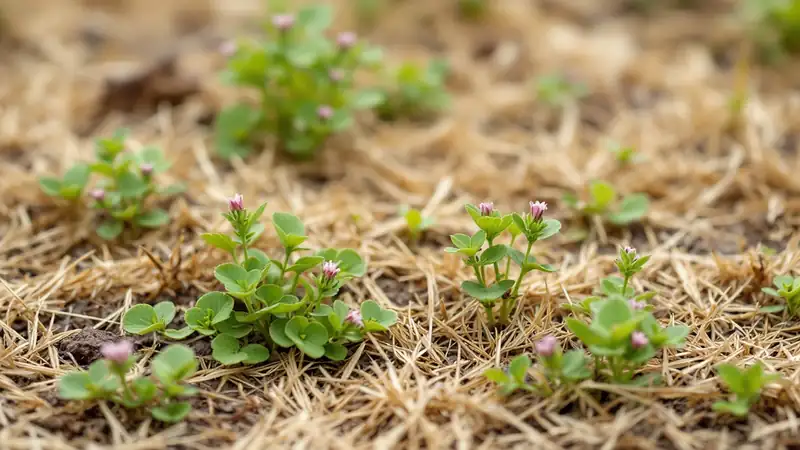
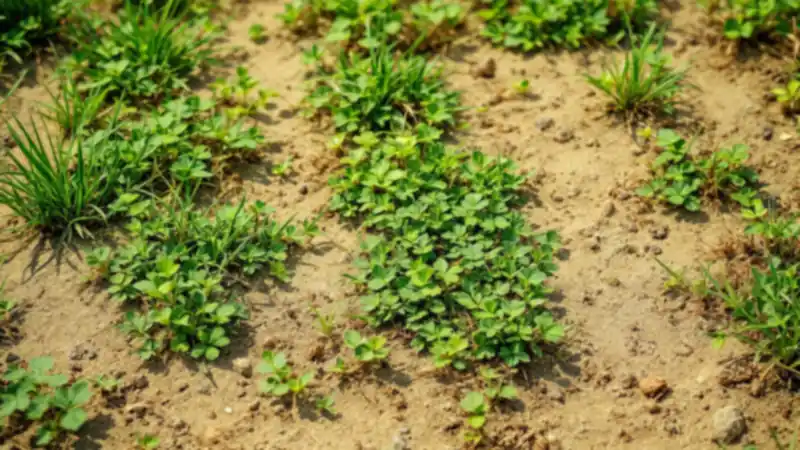
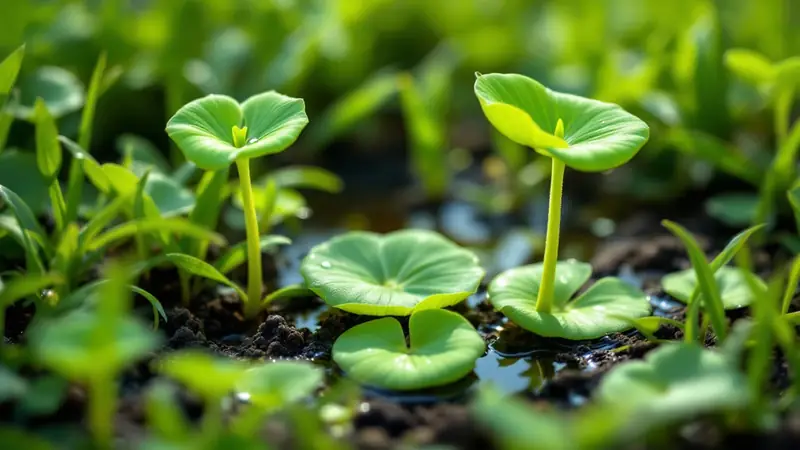
Turn a leaf over. Dollarweed (Hydrocotyle spp., also called pennywort) has a round, waxy, scalloped leaf with the stalk joined at the center like an umbrella, one leaf per stalk, 1 to 2 inches across per Clemson HGIC 2317. Dichondra, the usual lookalike, has a smooth C-shaped or kidney-shaped leaf with the stalk at the notch on the edge (Mississippi State Publication 4126). Mississippi State lists 6 Hydrocotyle species in that state, including H. umbellata and H. bonariensis.
Dollarweed spreads by seed, rhizomes and tubers, and UF/IFAS Gardening Solutions says a pulled plant regrows unless every white rhizome comes out with it. UF/IFAS publication EP634 calls it a reliable indicator of wet environments, the reason the next two sections are about water.
Why your watering schedule grows dollarweed
Busey and Johnston ran the University of Florida trial on St. Augustinegrass, crossing 3 irrigation regimes with 3 mowing heights and 3 fertilizer rates. The irrigation split is the one that moved dollarweed, and it moved it 15-fold.
| Irrigation treatment | How it was run | Dollarweed cover, 3-year average | Other weeds |
|---|---|---|---|
| Daily | Water every day to replace evapotranspiration | 30% | Lower than under severe wilt |
| Conditional weekly | Once a week, soaking the root zone only if the grass had wilted | 6% | Lower than under severe wilt |
| Severely wilted | Soak the root zone only after severe wilt | 2% | Highest of the 3, except dollarweed and mat lippia |
| Mowing 2.5, 3.5 or 4.5 in (64, 89, 114 mm) | Crossed with every irrigation regime | Effects reported only for weeds other than dollarweed | Shortest height had least other-weed cover in 2003 |
| 0, 2.9 or 5.7 lb N per 1,000 sq ft per year (0, 14, 28 g/m²) | Crossed with every irrigation regime | Effects reported only for weeds other than dollarweed | Highest rate had least other-weed cover in 2002 |
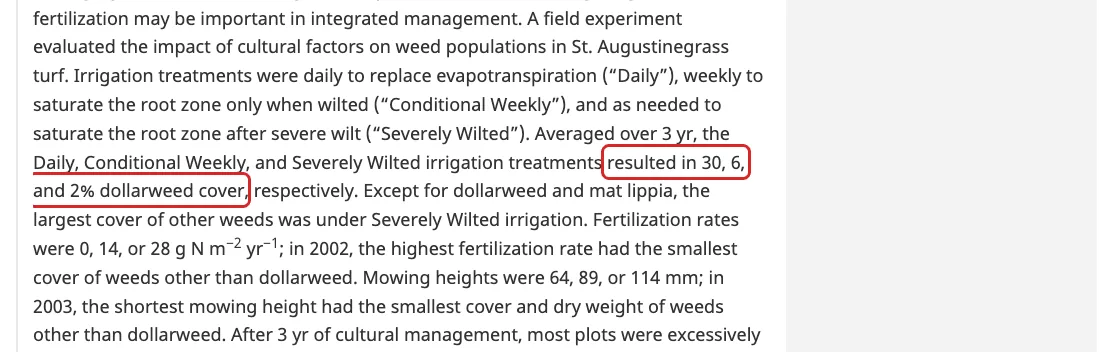
The abstract adds a limit: after 3 years without herbicides, turf quality in every combination was unacceptable. Drying the lawn out is step one, not the whole fix. Busey told Turf magazine in April 2009 that irrigation management plus herbicides worked best, that mowing and fertilizer changes did not, and that Florida dollarweed dies back in summer and regrows in fall.
UF/IFAS publication LH025 names the mechanism: a controller left on one schedule all year overwaters, and overwatering “promotes the growth of certain weed species such as dollarweed and sedges.” Sedges get the same fix in our nutsedge control guide.
What watering schedule starves dollarweed?
Water by the grass, not the calendar. LH025 says to apply 1/2 to 3/4 inch only when blades fold lengthwise, turn blue-gray or hold footprints, then wait for those signs again; after 1/2 to 3/4 inch of rain, skip the cycle. Its table gives how many days St. Augustine with 6-inch roots can go between waterings with no rain. Set beside Florida’s watering rules, the legal maximum is often more water than the grass needs.
| Season | UF/IFAS days between waterings: Pensacola | Gainesville | Miami | St. Johns River WMD days allowed (homes) | What to set |
|---|---|---|---|---|---|
| Winter | 8 to 28 | 7 to 23 | 3 to 10 | 1 per week (Eastern Standard Time) | 1/2 to 3/4 in only after wilt; many weeks none |
| Spring | 3 to 11 | 3 to 9 | 2 to 7 | 2 per week from the second Sunday in March | 1 cycle when blades fold, up to 3/4 in |
| Summer | 1 to 5 | 1 to 5 | 1 to 4 | 2 per week | Rain sensor on; skip after 1/2 in of rain |
| Fall | 2 to 9 | 2 to 8 | 2 to 6 | 2 per week, then 1 after the first Sunday in November | Cut back before the fall spray |
Rules by district differ. St. Johns River caps each watering day at 3/4 inch and 1 hour per zone and bans irrigation from 10 a.m. to 4 p.m. The South Florida Water Management District year-round rule (Chapter 40E-24, Florida Administrative Code) allows 2 or 3 days a week by local ordinance, with the same 10 a.m. to 4 p.m. ban, and says lawns need 1 to 1.5 inches a week in summer. Those are ceilings. Our guide to the best time to water a lawn covers run times by sprinkler type.
A patch that stays wet while the rest of the lawn wilts points to overspray, a leak or a low spot. Our guide on adjusting sprinkler heads fixes overspray, a French drain handles runoff, and a rain sensor skips cycles after a storm.
Which dollarweed killer is labeled for your grass?
Every product below lists dollarweed or pennywort on its label. Choose by the grass list, the heat limit and the Floratam line. Rates are per 1,000 sq ft unless noted; mL figures are our conversions.
| Product (EPA Reg. No.) | Active ingredient | Lawn grasses on the label | Dollarweed rate | Repeat and yearly cap | Heat and other limits | Label |
|---|---|---|---|---|---|---|
| Southern Ag Atrazine St. Augustine Weed Killer (19713-567-829) | Atrazine 4% | St. Augustine, centipede | 8.6 fl oz (254 mL) | Max 2 applications a year | Not above 90°F; summer use spot only; not on sand or loamy sand over a shallow water table | Label rev. Mar. 30, 2022 |
| Image Consumer Concentrate (73342-4) | Imazaquin | Bermuda, St. Augustine, buffalo, centipede, zoysia | 4 fl oz (118 mL) | Second spray at 6 weeks; max 8 fl oz a year | Water in within 1 to 7 days; not on tall fescue or new lawns; kill takes 3 to 5 weeks | EPA, Aug. 30, 2024 |
| Martin’s Dollarweed Killer / TopShot (53883-345) | Metsulfuron-methyl 25% | Kentucky bluegrass, fine fescue, bermuda, centipede, zoysia (Meyer, Emerald), St. Augustine | 1.8 mL ampule per 2,500 sq ft (0.72 mL) | Not stated | Not where tree roots reach; do not oversaturate | EPA, Apr. 9, 2014 |
| Manor (228-373) | Metsulfuron-methyl 60% | St. Augustine, bermuda, buffalo, zoysia; centipede at 0.5 oz/acre max; bluegrass, fine fescue | 0.5 to 1 oz product per acre (0.33 to 0.65 g) | Repeat in 4 to 6 weeks | Not on bahia or turf under 1 year old; no shrubs or trees planted for 1 year | EPA, May 10, 2019 |
| Celsius WG (432-1507) | Thiencarbazone + iodosulfuron + dicamba | St. Augustine, bermuda, centipede, zoysia | 2.4 g (0.085 oz) plus 0.25% nonionic surfactant | Second spray in 2 to 4 weeks; max 4.8 g a year | Labeled for licensed commercial applicators; not on bahia or cool-season grass; no adjuvant above 90°F | EPA, Sept. 1, 2021 |
| BioAdvanced Southern Weed Killer for Lawns (92564-4) | 2,4-D + mecoprop-p + dicamba | St. Augustine, centipede, bahia at 1 fl oz per 500 sq ft; bermuda, zoysia at 2 fl oz | 2 fl oz (59 mL) southern grasses; 4 fl oz (118 mL) bermuda, zoysia | Spot-treat survivors at 30 days; max 2 broadcasts a year | Not on Floratam, carpetgrass or dichondra; spray when the day stays under 90°F | EPA, June 25, 2026 |
| Trimec Classic (2217-543) | 2,4-D + mecoprop-p + dicamba | Cool-season grasses, bermuda, bahia, zoysia; spot only in St. Augustine and centipede | 1.2 to 1.5 fl oz (35 to 44 mL) common bermuda, zoysia | Max 2 broadcasts a year, 30 days apart | Not on Floratam; not on St. Augustine during green-up; no broadcast above 90°F | EPA, Apr. 2, 2014 |
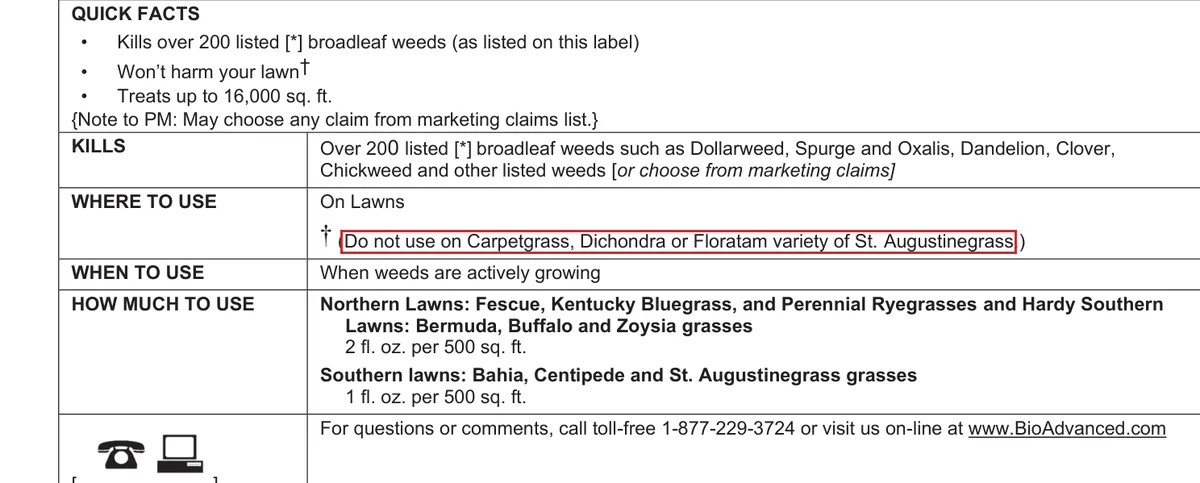
Floratam lawns keep 3 label-backed routes: atrazine on a day that stays under 85°F (the UF/IFAS LH010 limit), Image at 4 fl oz per 1,000 sq ft, or metsulfuron, such as a TopShot ampule per 2,500 sq ft. BioAdvanced Southern’s label allows other St. Augustine cultivars, such as Palmetto or CitraBlue, at 1 fl oz per 500 sq ft. Cultivars are compared in our St. Augustine grass care guide, and why 2,4-D injures St. Augustine has its own page.
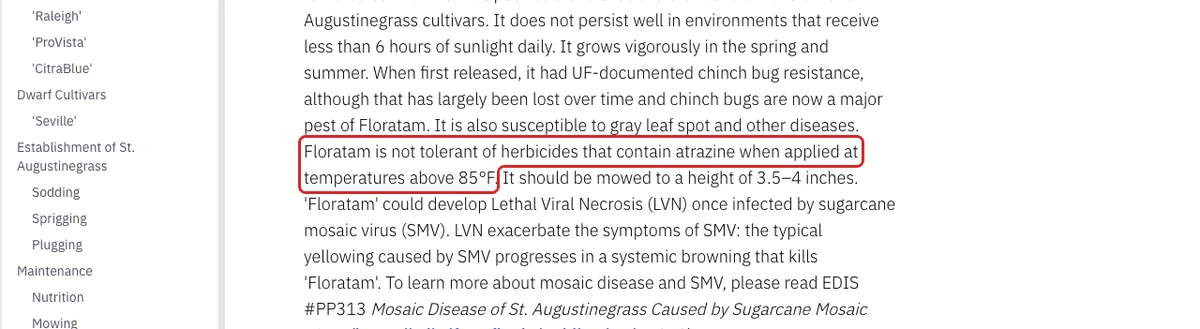
Atrazine is the product most guides name first for St. Augustine, and the evidence for it on established dollarweed is thin. LSU AgCenter calls metsulfuron the most effective dollarweed herbicide. Busey told Turf magazine in 2009 that he found atrazine products ineffective on dollarweed, and a 2026 greenhouse study in the Weed Control Journal found atrazine not viable for postemergence control while 2,4-D at 335 g ae per hectare and dicamba at 240 g were highly efficient. Mississippi State files atrazine under preemergence with some control: let it stop new plants and metsulfuron or imazaquin kill old ones.
1Is the controller set to run every day or every other day?
YesFix the water first: 1/2 to 3/4 inch only when blades fold or turn blue-gray (UF/IFAS LH025), rain sensor on, leaks and low spots repaired. Spray after the lawn is on that schedule.
NoGo to the next question
2Only a few plants, or plants in a flower bed?
YesDig them with every white rhizome (UF/IFAS); in beds, spot-spray 3% glyphosate behind a cardboard shield (Clemson) and mulch about 3 inches (Mississippi State).
NoGo to the next question
3Is the lawn Floratam St. Augustine?
YesAtrazine (19713-567-829) only on days under 85°F, Image (73342-4) at 4 fl oz per 1,000 sq ft, or one TopShot ampule (53883-345) per 2,500 sq ft. Skip BioAdvanced Southern and Trimec Classic: both labels exclude Floratam.
NoGo to the next question
4Another St. Augustine cultivar, or centipede?
YesThe same three, or BioAdvanced Southern at 1 fl oz per 500 sq ft below 90°F. On centipede, Manor no more than 0.5 oz per acre.
NoGo to the next question
5Bermuda or zoysia?
YesBioAdvanced Southern at 2 fl oz per 500 sq ft, Image, metsulfuron, or Celsius by a licensed applicator. Clemson limits atrazine on bermuda to fully dormant turf and rates it not registered on zoysia.
NoGo to the next question
6Bahia?
YesA 3-way such as BioAdvanced Southern at 1 fl oz per 500 sq ft. Manor and Celsius labels exclude bahia, and TopShot lists bahiagrass as a weed it controls.
NoTall fescue: a 3-way mix only; Clemson rates atrazine, imazaquin and Celsius as not registered on or damaging to tall fescue.
- Product per spray (mL)
- 254.3
- Product per spray (teaspoons)
- 51.6
- Product per spray (fl oz)
- 8.60
Default: 1,000 sq ft at the atrazine rate takes 254.3 mL (8.6 fl oz). Worked example: 5,000 sq ft of centipede at the BioAdvanced Southern rate takes 295.7 mL (10 fl oz); with TopShot, 3.6 mL (2 ampules). Rates from the labels on this page, read Nov. 21, 2026. Manor and Celsius are dry products weighed in grams; see the product table.
Default: 1,000 sq ft at the atrazine rate takes 254 mL (8.6 fl oz). Worked example: 5,000 sq ft of centipede at the BioAdvanced Southern rate takes 296 mL (10 fl oz); TopShot takes 2 ampules (3.6 mL).
When to spray dollarweed, and how many times
- Switch to the wilt-based schedule before the first spray: Busey told Turf magazine metsulfuron was ineffective where the turf area stayed wet.
- Spray in fall as dollarweed regrows, Busey’s best timing in Florida, or in late spring after full green-up (Clemson), on days under 85°F for Floratam and 90°F for other grasses.
- Skip spring green-up. Clemson bars postemergence sprays on warm-season lawns until they are fully green, except Celsius; Trimec Classic forbids St. Augustine at green-up.
- Repeat on the label interval: Celsius 2 to 4 weeks, BioAdvanced spot sprays 30 days, Manor 4 to 6 weeks, Image 6 weeks; atrazine twice a year at most.
- Water Image in within 1 to 7 days, and do not mow right before or for 48 hours after; for leaf-absorbed products, check our timing for spraying weeds before or after rain.
- Plug bare spots with your lawn grass once dollarweed dies, after the label gap: 1 1/2 months after Image; BioAdvanced Southern allows seeding at 3 to 4 weeks. Our patchy grass repair guide covers plugging.
Plan on more than one spray: Mississippi State calls complete eradication impractical, and the Image, Manor and Celsius labels all flag dollarweed as needing repeat treatment. Image also lists Virginia buttonweed, covered in how to kill Virginia buttonweed.
Pulling dollarweed and clearing it from flower beds
Hand removal works where plants are few. Mississippi State calls periodic hand removal often the most effective control for homeowners. UF/IFAS says to lift every white rhizome, and Clemson notes plants also emerge from tubers, so loosen the soil with a trowel and lift the runners instead of pulling leaves.
In beds, Clemson suggests spot-spraying a 3 percent glyphosate solution with a cardboard shield held in front of ornamentals, and Mississippi State suggests a mulch layer of about 3 inches. Atrazine, metsulfuron and dicamba can be taken up by shrub roots, so UF/IFAS ENH884 says not to apply them over ornamental root zones. More bed options are in our flower bed weed control guide.
How we compiled this
On Nov. 21, 2026 we read 7 product labels (6 EPA-stamped PDFs from the EPA Pesticide Product and Label System plus the maker’s atrazine label), the abstract of Busey and Johnston (Weed Science, 2006) and a 2026 Weed Control Journal abstract, 9 extension publications (UF/IFAS LH025, LH010, EP634, ENH884, EP580 and Gardening Solutions; Clemson HGIC 2317; Mississippi State 4126; LSU AgCenter), and 2 Florida water management district rule pages. Milliliter, gram and pound conversions are our arithmetic. We did not test any product or treat any lawn.
Frequently asked questions
What is the best dollarweed killer?
The one labeled for your grass. LSU AgCenter names metsulfuron (TopShot, Manor) the most effective; Image works on St. Augustine, centipede, bermuda and zoysia; 3-way mixes suit bermuda, zoysia and bahia. On Floratam, skip 3-way labels that exclude it and keep atrazine under 85°F.
Will vinegar kill dollarweed?
It burns the leaves, not the rhizomes. UF/IFAS EP580 says perennial weeds such as dollarweed quickly regrow after acetic acid and other contact herbicides. It also browns the lawn grass it touches; see our vinegar weed killer page.
Will 2,4-D kill dollarweed?
Yes, in mixes. Trimec Classic and BioAdvanced Southern list it, and a 2026 greenhouse study rated 2,4-D highly efficient at 335 g ae per hectare. St. Augustine and centipede take only the reduced southern rate, and Floratam is excluded on both labels.
How do you get rid of dollarweed naturally?
Water less and dig. In the UF trial, weekly watering only after wilt cut dollarweed cover from 30 to 6 percent with no herbicide. Lift plants with their white rhizomes, fix drainage, and plug bare spots with your lawn grass. Expect regrowth from missed runners.
Is dollarweed the same as pennywort?
Yes. Both names mean Hydrocotyle, round-leaved perennials with the stalk at the leaf center; Mississippi State lists 6 species, including H. umbellata. Dichondra, the lookalike, has its stalk at the leaf notch.
Sources
- Busey, P. and Johnston, D.L., University of Florida, Impact of cultural factors on weed populations in St. Augustinegrass turf, Weed Science 54(5): 961 to 967, Oct. 2006. Accessed November 2026.
- UF/IFAS Extension, Watering Your Florida Lawn, ENH9/LH025, Reviewed Oct. 2025. Accessed November 2026.
- UF/IFAS Extension (Trenholm et al.), St. Augustinegrass for Florida Lawns, ENH5/LH010, Revised July 2024, reviewed Oct. 2025. Accessed November 2026.
- UF/IFAS Extension, Weeds as Indicators of Soil Conditions in Lawns and Landscapes, EP634, 2022. Accessed November 2026.
- UF/IFAS Extension (Unruh, Petelewicz et al.), Weed Management Guide for Florida Lawns, ENH884/EP141, Revised Dec. 2024. Accessed November 2026.
- UF/IFAS Extension (Marble, Neal, Senesac), Use of Glyphosate and Herbicide Alternatives for Weed Control in Florida Landscape Planting Beds, EP580, Jan. 2020. Accessed November 2026.
- UF/IFAS Gardening Solutions, Dollarweed, Current page. Accessed November 2026.
- Clemson Cooperative Extension HGIC, Dollarweed, HGIC 2317, Revised July 12, 2021. Accessed November 2026.
- Mississippi State University Extension (McCurdy), Dollarweed Control in Mississippi Lawns and Ornamentals, Publication 4126, POD-07-25. Accessed November 2026.
- LSU AgCenter, Dollarweed, Current page. Accessed November 2026.
- St. Johns River Water Management District, Watering restrictions, Current page. Accessed November 2026.
- South Florida Water Management District, Landscape Watering Restrictions (Chapter 40E-24, F.A.C.), Current page. Accessed November 2026.
- Turf magazine, Dollarweed Control (interview with Phil Busey), Apr. 1, 2009. Accessed November 2026.
- Maciel, C.D.G. et al., Chemical control of dollarweed from residential lawns, Weed Control Journal 25: e202600899, Aug. 2026. Accessed November 2026.
- Southern Agricultural Insecticides, Atrazine St. Augustine Weed Killer label, EPA Reg. No. 19713-567-829, Mar. 30, 2022. Accessed November 2026.
- U.S. EPA, 2025 Pesticide Maintenance Fee Product List, companies 8596 to 34688, Dec. 2024. Accessed November 2026.
- U.S. EPA PPLS (Central Garden and Pet), Image Herbicide Consumer Concentrate label, EPA Reg. No. 73342-4, Aug. 30, 2024. Accessed November 2026.
- U.S. EPA PPLS (Control Solutions), Martin’s Dollarweed Killer / TopShot label, EPA Reg. No. 53883-345, Apr. 9, 2014. Accessed November 2026.
- U.S. EPA PPLS (Nufarm), Manor Selective Herbicide label, EPA Reg. No. 228-373, May 10, 2019. Accessed November 2026.
- U.S. EPA PPLS (Bayer), Celsius WG Herbicide label, EPA Reg. No. 432-1507, Sept. 1, 2021. Accessed November 2026.
- U.S. EPA PPLS (PBI-Gordon), Trimec Classic Broadleaf Herbicide label, EPA Reg. No. 2217-543, Apr. 2, 2014. Accessed November 2026.
- U.S. EPA PPLS (SBM Life Science), BioAdvanced Southern Weed Killer for Lawns Concentrate label, EPA Reg. No. 92564-4, June 25, 2026. Accessed November 2026.