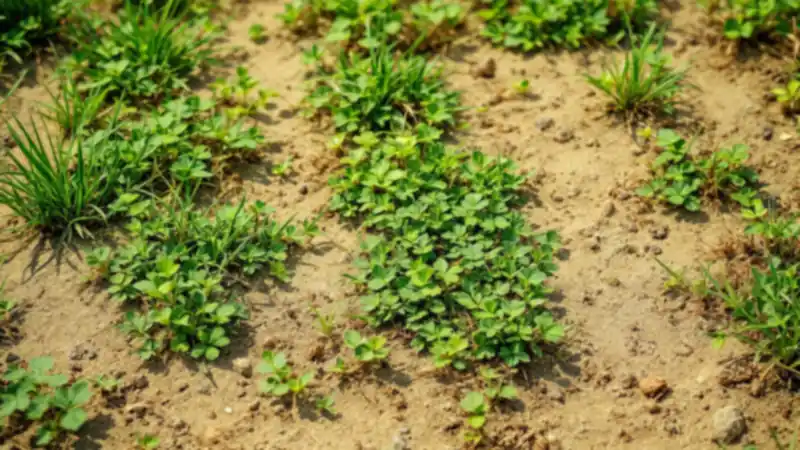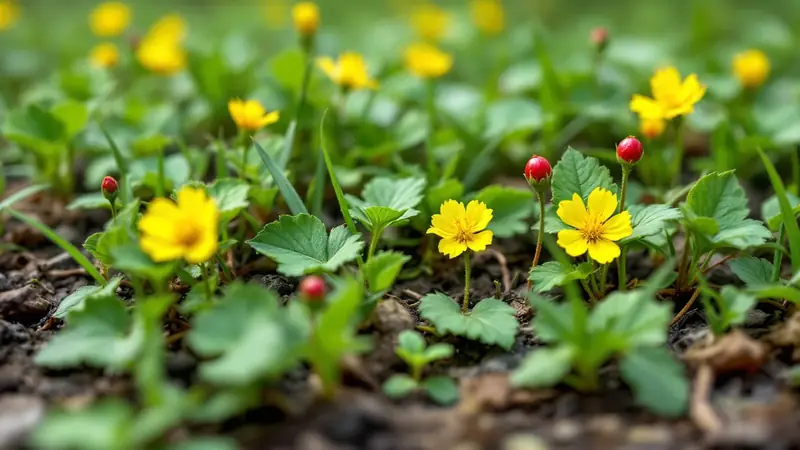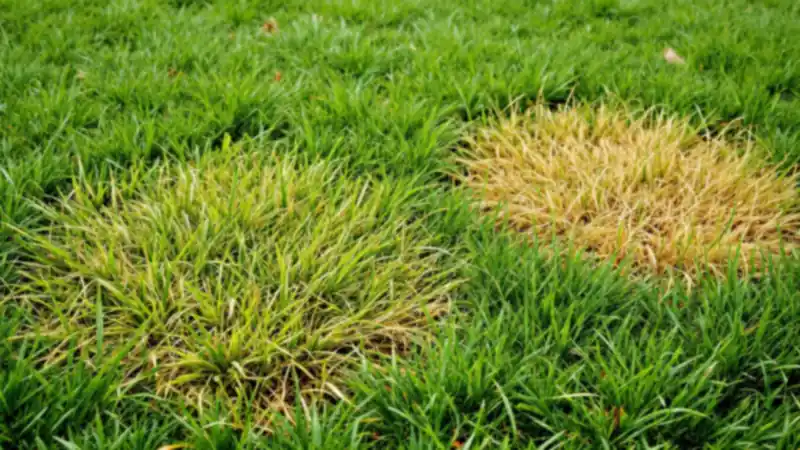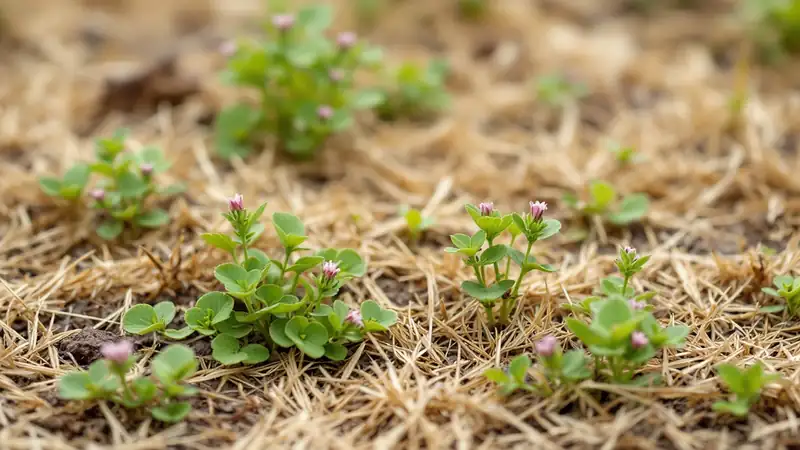
How to get rid of henbit: put down a preemergent labeled for henbit, such as dithiopyr or prodiamine, in early to mid-September, then spray a 3-way herbicide in late October or November on a day above 50°F. Spraying flowering henbit in spring rarely kills it.
How to get rid of henbit is a calendar problem. Henbit (Lamium amplexicaule) is a winter annual: it sprouts in fall, sits small through winter, flowers around April, drops seed and dies in the heat. Kansas State Extension says that if chemical control waits until spring, “effectiveness is usually very limited”; its fall plan is a preemergent in early to mid-September or a broadleaf spray in late October to early November.
The top-ranking product pages say one plant can drop 2,000 seeds, and Scotts says to treat it in spring. The university figures run from 40 to 200 seeds a plant (UW-Madison Extension) to 200 to 2,000 (Cornell weed profile), and the timing table below pins each step to a month, a soil or air temperature and an EPA registration number. Purple deadnettle, the look-alike, gets the same plan; our lawn weed identification chart covers the other winter weeds.
This page summarizes EPA labels and extension research; it is not a product endorsement or legal advice. The label is the law: read the current label of the product you buy, and check whether your state requires a pesticide applicator license before anyone treats a lawn for pay.
Henbit or purple deadnettle: which one is it?
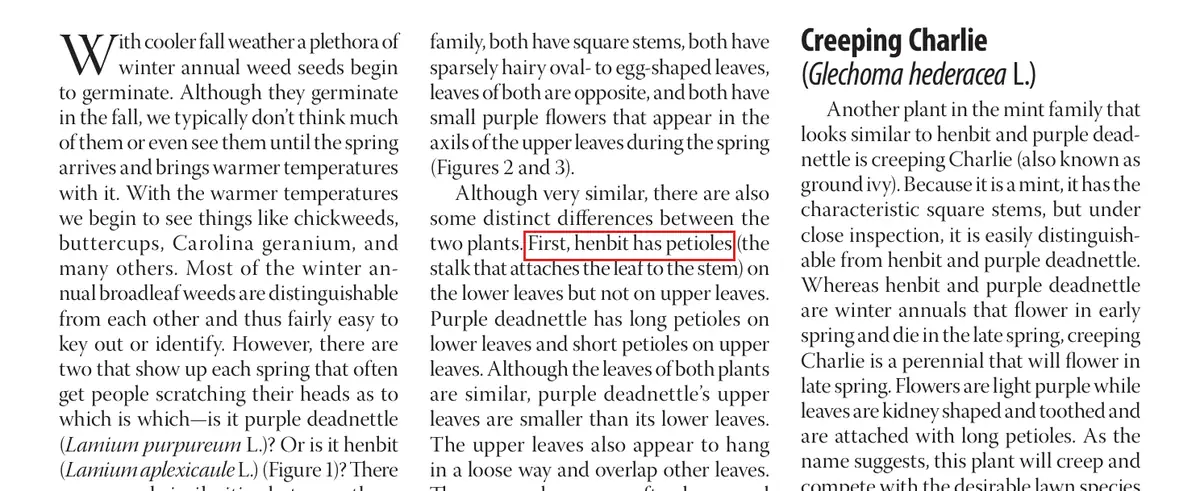
Look at the top leaves. University of Kentucky AGR-226 says henbit has petioles on the lower leaves but not the upper ones, while purple deadnettle has stalks on every leaf and a red or purple hue up top. Both have square stems and purple flowers in April, and both die by early summer, so the plan below covers both.
| Trait | Henbit | Purple deadnettle | Ground ivy (creeping Charlie) | Source |
|---|---|---|---|---|
| Latin name | Lamium amplexicaule | Lamium purpureum | Glechoma hederacea | Purdue; UK AGR-226 |
| Life cycle | Winter annual; some spring germination | Winter annual | Perennial | UK AGR-226; Cornell |
| Upper leaves | No stalk; round, scalloped, fan-shaped, clasping the stem almost all the way around | Short stalks; triangular, maroon or purple, drooping and overlapping | Kidney-shaped, toothed, long stalks | Cornell; UK AGR-226 |
| Stems | Downward-pointing hairs; 4 to 16 in | Hairless to lightly hairy, hollow; 4 to 20 in | Creeping, rooting runners | Cornell |
| Flowers | 6 to 10 per leaf pair, 0.5 to 0.75 in; lower ones stay closed and self-pollinate | 3 to 6 per leaf pair, 0.5 to 0.7 in, partly hidden by leaves | Light purple, late spring | Cornell; UK AGR-226 |
| Roots at stem nodes | Sources differ: Cornell, UW-Madison and NC State say stems can root; UMD lists a fibrous root that does not creep | Yes, mats root at the nodes | Yes | UW-Madison; UMD |
| Seeds per plant | 200 to 2,000 typical | About 600; 27,000 without competition | Creeps and competes for space | Cornell; UK AGR-226 |
| Control timing | Fall preemergent or fall spray | Same | Perennial; flowers in late spring | UK AGR-226 |
If the stems creep and root and the plant is still flowering in May, it is ground ivy, a perennial with a different calendar: our guide on what kills creeping charlie has the fall trial data.
How many seeds does henbit drop, and how long do they last?
Usually fewer than the 2,000 the product pages quote, but they last. Henbit also seeds without opening a flower: Cornell notes that the lower whorls carry closed, self-pollinating flowers.
Swipe the table sideways to see every column.
| Measure | Value | Context | Source |
|---|---|---|---|
| Seeds per plant | 40 to 200 | Plant total | UW-Madison Extension |
| Seeds per plant | Up to 200 | Plant total | Clemson HGIC |
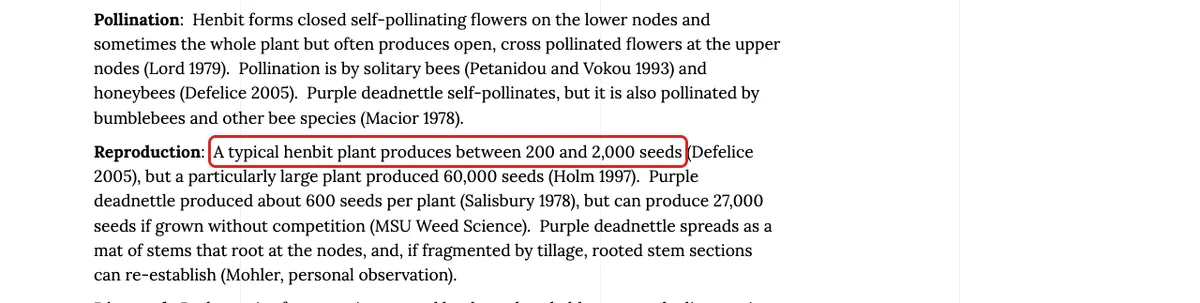
| Seeds per plant | 200 to 2,000; one large plant 60,000 | Typical range; maximum | Cornell (Defelice 2005; Holm 1997) |
| Seeds per plant | 2,000, no source given | Product and sod-seller pages | Scotts, Roundup, Sod Solutions (ranking pages) |
| Seed life in soil | Up to 5 years | Viability | UW-Madison; Clemson HGIC |
| Seed life under sod | 20 to 50% alive after 20 years | Undisturbed grass | Cornell (Chancellor 1986) |
| Seed loss in stirred soil | 43 to 60% a year | Soil stirred 3 times a year, 5 years | Cornell (Roberts and Bodrell 1983) |
| Germination after summer | 41°F to 86/68°F day/night | Any temperature in that range | Cornell (Baskin) |
| Germination after winter cold | Only below 68/50°F | Why spring flushes stay small | Cornell (Baskin) |
| Emergence depth | Top 1 in; a few from 2.5 in | Mulch and turf cover block it | Cornell (MSU) |
| Cold tolerance | Down to 18°F, with some damage | Frost will not clear it | Cornell (Cici and Van Acker 2011) |
| Flower to seed shed | Peak shed within a month of first flowers | Michigan, mid-May | Cornell (Hill et al. 2014) |
| Shade | Sources differ: shade-intolerant (Cornell); shade encourages it (Clemson) | Thin, wet turf is the common thread | Cornell; Clemson HGIC 2321 |
- 43% lost a year
- 60% lost a year
Source: Our arithmetic on Cornell CALS Weed Profile, Deadnettles (Roberts and Bodrell 1983: 43 to 60% loss a year in soil stirred 3 times a year) Same numbers as the seed rows in the table above. Undisturbed sod keeps far more: 20 to 50% of henbit seed was alive after 20 years (Chancellor 1986, via Cornell).
Show the numbers
| 43% lost a year | 60% lost a year | |
|---|---|---|
| Start | 100% | 100% |
| Year 1 | 57% | 40% |
| Year 2 | 32.50% | 16% |
| Year 3 | 18.50% | 6.40% |
| Year 4 | 10.60% | 2.60% |
| Year 5 | 6% | 1% |
The chart is our arithmetic on Cornell’s 43 to 60 percent yearly loss in cultivated soil: after 3 years, 6 to 19 percent of the seed is left. A lawn is not stirred, and the sod study kept 20 to 50 percent alive for 20 years, so plan on repeating the fall program; the chickweed control plan runs on the same calendar.
When should you spray henbit, and when does the preemergent go down?
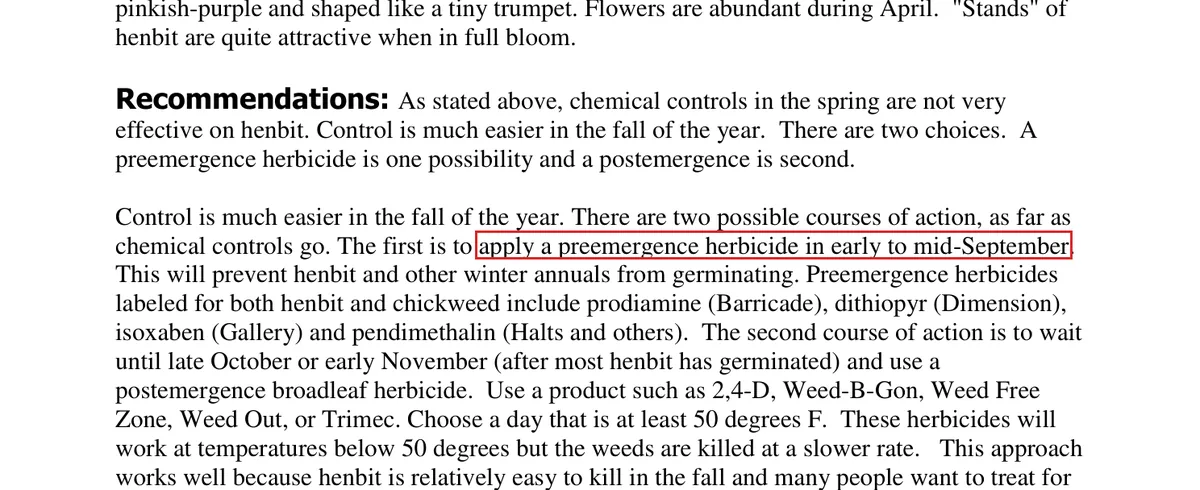
Start in late summer. UGA Bulletin 978 times the fall preemergent to nights of 65 to 70°F, Aug. 15 to Sept. 15 in north Georgia and Sept. 1 to 15 in south Georgia. Ohio State wants winter annuals up before a fall spray, usually by early November, with air in the 40s and 50s and soil in the 50s (Ohio State, 2025).
| When | What to do | Product (EPA Reg. No.) | Source |
|---|---|---|---|
| Mid-August to mid-September (nights 65 to 70°F) | Preemergent before seed sprouts; water in 0.5 in | Dimension 2EW, dithiopyr (62719-542); Greenview Green Power, dithiopyr 0.13% (961-392); Barricade 4FL, prodiamine (100-1139); Gallery SC, isoxaben (62719-658) | UGA B-978; K-State |
| Late September to October | Seedlings emerge; skip overseeding where a preemergent went down | Waits: Gallery 60 days; Greenview 12 weeks; Dimension 3 months; Barricade 4 to 12 months by rate | Labels linked below |
| Late October to early November (day at least 50°F) | Spray small plants with a 3-way | Ortho Weed B Gon (239-2744); BioAdvanced Southern (92564-4) | K-State; UK AGR-226 |
| Late November to December (South; above 50°F) | 3-way on warm-season lawns | Same, at the reduced warm-season rate | UGA B-978, p. 11 |
| November to mid-February | Dormant warm-season lawns | Atrazine (19713-567-829) on St. Augustine, centipede; Image, imazaquin (73342-4) after first killing frost on bermuda, zoysia, centipede, buffalo | UGA B-978; Image label |
| February to early March | Spot-spray survivors before they bloom | 3-way; Celsius WG (432-1507), licensed applicators only, safe at green-up | K-State; Clemson HGIC 2321 |
| Late March to April (flowering) | Do not spray: pull, or mow and bag before seed | None; bees are working the flowers | Purdue Extension (Upham); UW-Madison |
| May to June | Plants die in the heat; mark the patches | Next preemergent in September | Clemson HGIC |
Spring is where most advice goes wrong. A K-State specialist, quoted by Purdue Extension in April 2023, says spraying flowering henbit is usually “a waste of time and money”: plants get burned back but rarely killed. Our page on which weeds die in winter explains why winter annuals look worst just before they quit.
1Do the stems creep along the ground, root as they go, and keep flowering into May?
YesThat is ground ivy (creeping Charlie), a perennial: spray it Sept. 1 to Nov. 1 with a label that lists ground ivy, not the winter-annual plan.
NoGo to the next question
2Is it in a flower or vegetable bed?
YesPull it while small and bag it, then mulch 3 inches (Clemson HGIC 2321); shield any glyphosate spot spray from ornamentals.
NoGo to the next question
3Is it flowering now (late March to April)?
YesDo not spray: pull, or mow and bag before seed sets, then put down a dithiopyr, prodiamine or isoxaben preemergent the next mid-August to mid-September.
NoGo to the next question
4Is it August or early September, before seedlings show?
YesPreemergent now, nights 65 to 70°F (UGA B-978): Dimension 2EW (62719-542), Greenview 961-392, Barricade 4FL or Gallery SC. Skip it if you plan to overseed this fall.
NoGo to the next question
5Is the lawn dormant St. Augustine, centipede or bermuda in winter?
YesAtrazine (19713-567-829) at 8.6 fl oz per 1,000 sq ft on St. Augustine or centipede; Image (73342-4) at 4 fl oz per 1,000 sq ft on dormant bermuda, zoysia, centipede or buffalo.
NoLate October to early November, on a day of at least 50°F: a 3-way such as Ortho 239-2744 at 4 fl oz per 1,000 sq ft on cool-season grass (2 fl oz on bermuda and zoysia, 1 fl oz on centipede and St. Augustine, never Floratam).
What kills henbit without killing the grass?
Dicamba, or a mix that contains it. The PNW Weed Management Handbook table rates henbit intermediate to resistant to 2,4-D alone and susceptible to dicamba and to mixes, and Clemson’s turf guide calls dicamba “often effective on weeds not controlled by 2,4-D such as henbit” (McCarty, Clemson, 2016).
| Active ingredient | Henbit rating | What it means |
|---|---|---|
| 2,4-D alone | I to R | Often survives a straight 2,4-D product |
| Dicamba | S | Do not spray over tree and shrub roots (UMD) |
| MCPP (mecoprop) | I | Works best in a mix |
| Mixes with triclopyr | S | Triclopyr injures most warm-season grasses |
| Mixes without triclopyr | S | The usual 2,4-D + MCPP + dicamba 3-way |
Our guide to whether 2,4-D kills lawn grass lists which grasses tolerate these mixes. All 10 labels below list henbit; your grass decides which ones you can use.
| Product (EPA Reg. No.) | Active ingredient | Lawn grasses and rate | Limits | Who applies |
|---|---|---|---|---|
| Dimension 2EW (62719-542) | Dithiopyr; preemergent | Cool- and warm-season turf: max 0.73 fl oz (4.4 tsp) per 1,000 sq ft per application, 2.2 fl oz a year | Fall use late August to November; no reseeding for 3 months | Homeowner directions on label; commercial only in New York |
| Greenview Green Power Crabgrass Prevention and Control (961-392) | Dithiopyr 0.13% granules; preemergent | Listed cool- and warm-season grasses: 2.2 to 3.1 lb per 1,000 sq ft North, 3.4 to 4.5 lb South | Fall use needs a spring repeat; no reseeding for 12 weeks | Homeowner |
| Barricade 4FL (100-1139) | Prodiamine; preemergent | Established turf; rates per acre | Henbit: apply in late summer, fall or winter before it germinates; 4 to 12 months before overseeding by rate and region | Professional per-acre product |
| Gallery SC (62719-658) | Isoxaben; preemergent | Established cool- and warm-season turf: henbit at 0.3 fl oz (10 mL) per 1,000 sq ft | Needs 0.5 in of rain or irrigation within 21 days; no overseeding for 60 days | General-use label; per-acre rates with 1,000 sq ft equivalents |
| Ortho Weed B Gon Weed Killer for Lawns Concentrate (239-2744) | 2,4-D, mecoprop-p, dicamba | Per 1,000 sq ft: cool-season 4 fl oz; bahia, common bermuda, zoysia 2 fl oz; centipede, St. Augustine 1 fl oz. Not Floratam | 2 applications a year, 30 days apart; not above 90°F | Homeowner |
| BioAdvanced Southern Weed Killer for Lawns (92564-4) | 2,4-D, mecoprop-p, dicamba | Per 500 sq ft: fescue, bluegrass, ryegrass, bermuda, buffalo, zoysia 2 fl oz; bahia, centipede, St. Augustine 1 fl oz. Not Floratam | Spray when the day stays under 90°F | Homeowner |
| Image Herbicide (73342-4) | Imazaquin | Dormant bermuda, buffalo, centipede, zoysia: 4 fl oz per 1,000 sq ft. Not St. Augustine for winter weeds | After the first killing frost; max 8 fl oz per 1,000 sq ft a year | Homeowner |
| Southern Ag Atrazine St. Augustine Weed Killer (19713-567-829) | Atrazine | St. Augustine, centipede: 8.6 fl oz per 1,000 sq ft | 2 applications a year; not above 90°F (UF/IFAS: 85°F on Floratam) | Homeowner |
| Celsius WG (432-1507) | Thiencarbazone, iodosulfuron, dicamba | St. Augustine, bermuda, centipede, zoysia: henbit at 1.6 g per 1,000 sq ft. Not bahia or cool-season grass | Max 4.8 g per 1,000 sq ft a year | Licensed commercial applicators only |
| Manor (228-373) | Metsulfuron-methyl | Listed turf: henbit at 0.33 to 0.5 oz per acre | Not above 85°F; overseed after 8 weeks | Professional per-acre product |
St. Augustine has the shortest list: both 3-way labels exclude Floratam, Image rules out St. Augustine for winter weeds, and UF/IFAS LH010 says Floratam is injured by atrazine above 85°F. Our St. Augustine grass guide lists the other limits by cultivar.
Celsius WG is labeled for licensed commercial applicators only; Barricade 4FL and Manor carry per-acre rates written for professionals (Clemson HGIC 2321 says the same of metsulfuron). A preemergent also stops grass seed: if the lawn needs fall overseeding, skip it that year and rely on the October spray.
- Product per application (mL)
- 118.3
- Product per application (teaspoons)
- 24.0
- Product per application (fl oz)
- 4.00
Default: 1,000 sq ft at the Ortho 239-2744 cool-season rate takes 118.3 mL (4 fl oz). Worked example: 5,000 sq ft of tall fescue takes 107.9 mL (3.65 fl oz) of Dimension 2EW in September and 591.5 mL (20 fl oz) of 239-2744 in late October; 3,000 sq ft of centipede takes 763.0 mL (25.8 fl oz) of atrazine. Rates from the labels on this page, read Nov. 24, 2026. Greenview granules are weighed in pounds and Celsius WG in grams (licensed applicators only).
Default: 1,000 sq ft of cool-season lawn at the Ortho 239-2744 rate takes 118.3 mL (4 fl oz). Worked example: 5,000 sq ft of tall fescue takes 3.65 fl oz (107.9 mL) of Dimension 2EW in September and 20 fl oz (591.5 mL) of 239-2744 in late October; 3,000 sq ft of centipede takes 25.8 fl oz (763.0 mL) of atrazine in winter.
Should you pull henbit, and what about flower beds?
Yes, while it is small. Clemson HGIC says young henbit has a shallow taproot that pulls easily, but mature plants grow a fibrous root system that is harder to remove. Pull before the April bloom and bag the plants: UW-Madison says stem pieces left on moist soil can root.
In beds, Clemson HGIC 2321 calls a 3-inch mulch layer ideal (the seed needs light, per Clemson) and lists glyphosate as a shielded spot spray around ornamentals; see how deep mulch should be by material.
Is henbit edible, and should you leave it for bees?
It is edible. NC State Extension lists the leaves, stems and flowers as edible, with a slightly sweet, peppery taste, and Cornell notes that grazing on henbit can cause rare, reversible nerve problems in sheep, cattle and horses. Do not pick it from a lawn that has been sprayed.
Henbit is an early source of nectar and pollen for honeybees and bumblebees (UW-Madison; Clemson HGIC). The fall plan avoids that conflict: you spray in October, months before the flowers open.
Why does henbit keep coming back?
Thin, wet turf. UK AGR-226 ties it to bare spots from disease, moles and summer weeds and prescribes 2 to 3 lb of nitrogen per 1,000 sq ft a year, applied in fall on cool-season grass, mowing at 2.5 to 4 inches and deep, infrequent summer watering. Clemson HGIC holds warm-season lawns to 1 inch of water a week and says to fill the bare patches after the kill.
How we compiled this
On Nov. 24, 2026 we read 10 herbicide labels (9 EPA-stamped copies from EPA’s Pesticide Product Label System and 1 registrant label), the PNW handbook susceptibility table, and extension publications from Kentucky, Kansas State, Cornell, UW-Madison, Clemson, Purdue, Maryland, NC State, Iowa State, Georgia, Ohio State and UF/IFAS. We did not run trials or test products. The seed-bank chart and the calculator are arithmetic on the published rates.
Frequently asked questions
How do you get rid of henbit without killing grass?
Use a product whose label lists henbit and your grass: a 3-way of 2,4-D, MCPP and dicamba, at the reduced rate on centipede and St. Augustine (never Floratam), or atrazine on those two. Spray in late October or November.
What is the best herbicide to kill henbit?
A mix with dicamba: the PNW handbook rates henbit susceptible to dicamba and 3-way mixes. For prevention, dithiopyr, prodiamine and isoxaben labels list henbit.
Does 2,4-D kill henbit?
Not reliably on its own: the PNW handbook rates henbit intermediate to resistant to 2,4-D alone. Dicamba covers the gap, which is why 3-way mixes work.
Is henbit poisonous to people?
NC State Extension lists its leaves, stems and flowers as edible. The toxicity note in the sources we read is for livestock: Cornell says grazing on henbit can cause rare, reversible nerve problems in sheep, cattle and horses.
How do you get rid of henbit in the winter?
In the South, spray dormant lawns: atrazine on St. Augustine and centipede from November to mid-February, or Image on dormant bermuda, zoysia, centipede or buffalograss after the first killing frost (UGA B-978; Image label). In the North, wait for a March day above 50°F, before bloom.
Sources
- Kansas State University Extension (Upham), Henbit and Chickweed (Problem sheet), Updated Oct. 30, 2023. Accessed November 2026.
- University of Kentucky (Munshaw and Barrett), Identification and Control of Henbit and Purple Deadnettle, AGR-226, Dec. 2016. Accessed November 2026.
- Cornell CALS Weed Science, Weed Profiles: Deadnettles (henbit and purple deadnettle), Current page. Accessed November 2026.
- UW-Madison Extension (Mahr), Henbit, Lamium amplexicaule, Revised May 14, 2026. Accessed November 2026.
- Clemson HGIC (Judy and Williamson), Henbit, HGIC 2321, Updated Aug. 13, 2021. Accessed November 2026.
- Clemson HGIC (Jordan), Weed of the Month: Henbit, Current page. Accessed November 2026.
- Clemson HGIC (Davenport), Purple Deadnettle and Henbit Control in Lawns, Current page. Accessed November 2026.
- Purdue Botany and Plant Pathology (Zimmer), Henbit and purple deadnettle: common winter annual weeds in Indiana, Dec. 13, 2021. Accessed November 2026.
- Purdue Extension, DeKalb County, Henbit and Chickweed in Lawns, April 2023. Accessed November 2026.
- University of Maryland Extension, Henbit, Current page. Accessed November 2026.
- NC State Extension Gardener Plant Toolbox, Lamium amplexicaule, Current page. Accessed November 2026.
- NC State Extension, Henbit (turf weed publication), Current page. Accessed November 2026.
- Iowa State Integrated Crop Management, Henbit, Current page. Accessed November 2026.
- University of Georgia Extension, Weed Control in Home Lawns, Bulletin 978, 2025 edition. Accessed November 2026.
- Ohio State University (Gardner), Broadleaf Weed Control Update 2025, July 2025. Accessed November 2026.
- Pacific Northwest Weed Management Handbook, Susceptibility of Broadleaf Weeds in Turf to Common Herbicides, Current table. Accessed November 2026.
- Clemson University (McCarty), Turfgrass Weed Control, Pest Management Handbook, 2016. Accessed November 2026.
- UF/IFAS Extension (Trenholm et al.), St. Augustinegrass for Florida Lawns, ENH5/LH010, Revised July 2024. Accessed November 2026.
- U.S. EPA PPLS, Dimension 2EW, EPA Reg. No. 62719-542, July 2, 2021. Accessed November 2026.
- U.S. EPA PPLS, Greenview Green Power Crabgrass Prevention and Control, EPA Reg. No. 961-392, Dec. 10, 2025. Accessed November 2026.
- U.S. EPA PPLS, Barricade 4FL, EPA Reg. No. 100-1139, Feb. 21, 2024. Accessed November 2026.
- U.S. EPA PPLS, Gallery SC, EPA Reg. No. 62719-658, May 8, 2017 (label text Mar. 13, 2017). Accessed November 2026.
- U.S. EPA PPLS, Ortho Weed B Gon Weed Killer for Lawns Concentrate, EPA Reg. No. 239-2744, Aug. 23, 2023. Accessed November 2026.
- U.S. EPA PPLS, BioAdvanced Southern Weed Killer for Lawns, EPA Reg. No. 92564-4, June 25, 2026. Accessed November 2026.
- U.S. EPA PPLS, Image Herbicide, EPA Reg. No. 73342-4, Aug. 30, 2024. Accessed November 2026.
- Southern Agricultural Insecticides, Atrazine St. Augustine Weed Killer label, EPA Reg. No. 19713-567-829, Mar. 30, 2022. Accessed November 2026.
- U.S. EPA PPLS, Celsius WG, EPA Reg. No. 432-1507, Sept. 1, 2021. Accessed November 2026.
- U.S. EPA PPLS, Manor, EPA Reg. No. 228-373, May 10, 2019. Accessed November 2026.