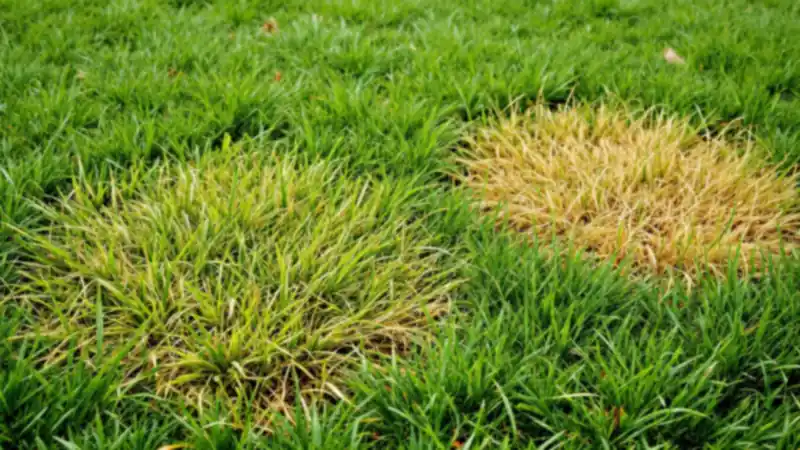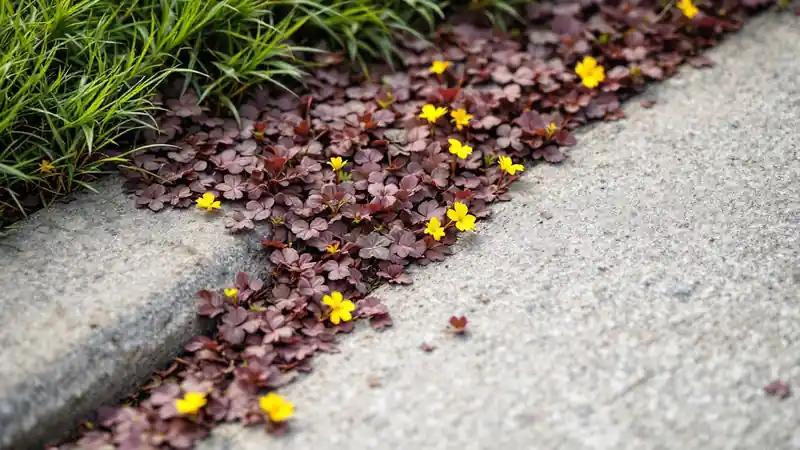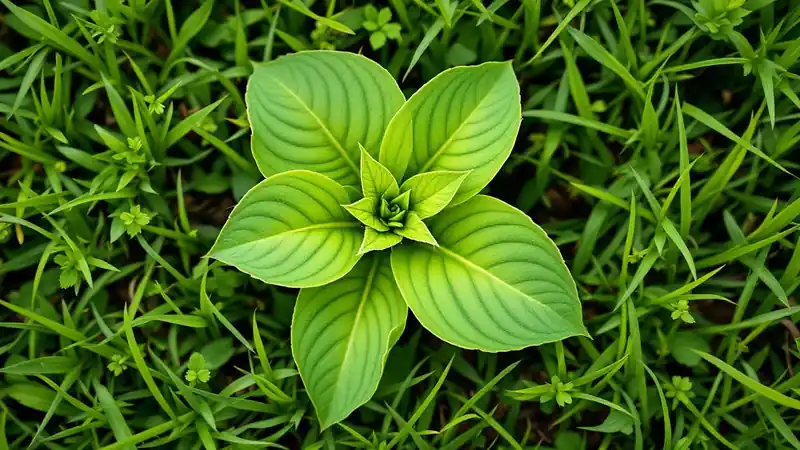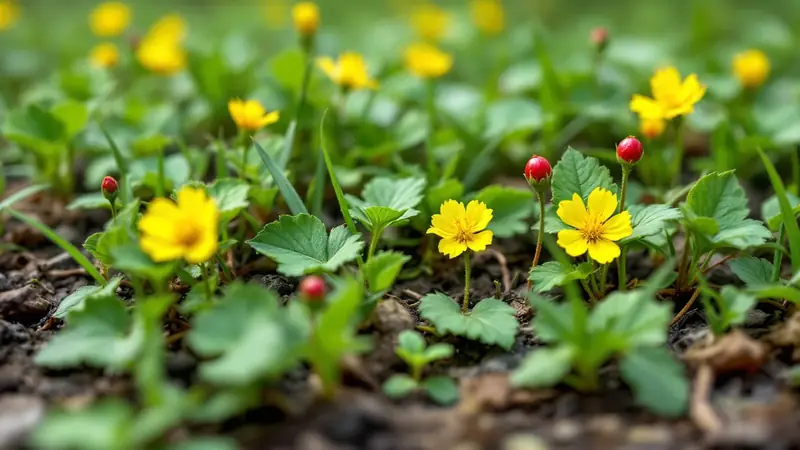
How to get rid of mock strawberry: pull small patches with every runner while the soil is moist, then spot-spray a 2,4-D, MCPP and dicamba lawn product whose label lists it in fall, repeat after 2 weeks, and thicken shaded, damp turf.
How to get rid of mock strawberry (Potentilla indica, formerly Duchesnea indica) starts with a 10-second check: yellow flowers and upright fruit. White flowers and hanging fruit mean native wild strawberry instead, and 5 leaflets usually mean common cinquefoil. Mock strawberry is a perennial whose runners root at every node, so University of Maryland Extension pairs pulling in moist soil with an autumn spot spray. It creeps through damp shade much like ground ivy, and our page on killing creeping charlie with fall triclopyr covers that neighbor.
The top results name products without checking them. We read 14 lawn herbicide labels for the words "mock strawberry": 5 list it, all 2,4-D mixes, while the triclopyr "chickweed, clover and oxalis" sprays sold for similar creeping weeds do not. Neither graded university chart rates any lawn-safe spray Excellent on it: the best grade is Good, 80 to 89 percent control in Arkansas MP44 (2026). For a wider weed lineup, see our lawn weed identification chart.
This page summarizes EPA labels and university publications; it is not a product endorsement or legal advice. The label is the law: read the current label of the product you buy, check local rules (Montgomery County, Maryland, bars most synthetic lawn pesticides, per UMD), and check whether your state requires a pesticide applicator license before treating lawns for pay.
Is it mock strawberry, wild strawberry or cinquefoil?
Look behind the flower or fruit. Mock strawberry has leafy green bracts with 3 teeth that stick out past the sepals, a trait UMD, Illinois Wildflowers and the Missouri Department of Conservation all describe. Without flowers, leaf teeth help: rounded on mock strawberry, sharp-pointed on wild strawberry (NC State TurfFiles).
| Trait | Mock strawberry | Wild strawberry | Common cinquefoil | Barren strawberry | Source |
|---|---|---|---|---|---|
| Latin name | Potentilla indica (syn. Duchesnea indica) | Fragaria virginiana | Potentilla simplex | Waldsteinia fragarioides | UMD; UMD; MoBot |
| Origin | Asia; MDC status: invasive | Native, eastern North America | Native (Maryland statewide) | Native, eastern North America | MDC; MoBot; UMD |
| Flower | Yellow, 5 petals, about 3/4 in | White, 5 petals; April to May | Yellow, 5 petals, about 1/2 in | Yellow, 5 petals, 3/4 in | NC State; MoBot; UMD; MoBot |
| Leaflets | 3, rounded teeth; leaves 1/2 to 2 in wide | 3, sharp-pointed teeth, hairier on top | Mostly 5 on mature plants (3 or 5) | 3, wedge-shaped, 1 to 2 in | NC State; UMD; UMD |
| Bracts behind flower | Large, 3-toothed, longer than sepals | Simpler, tapering | Not a key trait | Not a key trait | UMD; MDC |
| Fruit | Red, under 1/2 in, red seeds stick out; bland and dry | Red, juicy, sweet; seeds sit flush | Dry achene, no berry | Dry one-seeded achene, inedible | UMD; Go Botany; MoBot |
| Fruit position | Held upright | Hangs down | No fleshy fruit | No fleshy fruit | UMD; Illinois Wildflowers |
| Spreads by | Above-ground stolons rooting at nodes | Runners | Stolons and short rhizomes | Rhizomes just below the soil | UMD; UMD; MoBot |
| Height | 4 to 8 in; flowers to about 2 1/2 in | 3 to 9 in | 4 to 6 in | To 6 in | NC State; MDC; MoBot |
Two of the lookalikes are native and worth sparing. UMD notes that at least 3 rare to uncommon mining bees in Maryland collect pollen only from Potentilla flowers such as common cinquefoil (UMD Extension, Oct. 2026), and wild strawberry is a native groundcover hardy to USDA Zones 4 to 9 per Missouri Botanical Garden. A lawn spray that lists mock strawberry kills those too.
Is mock strawberry poisonous?
No source we read calls it poisonous. UMD says the fruit is edible but not flavorful or juicy, NC State's Plant Toolbox calls it bland and dry and tags the plant non-toxic for cats, dogs and horses, and Illinois Wildflowers notes small bees and flower flies visit the flowers. The bigger risk is pet or child contact with a fresh herbicide spray; the Spectracide and Preen labels below say to keep people and pets off treated areas until the spray has dried.
What kills mock strawberry without killing grass?
Dicamba-containing mixes, graded Good at best (80 to 89 percent on the Arkansas scale). In the 2026 Arkansas MP44 postemergence chart, 2,4-D alone rates Fair (70 to 79 percent) on mock strawberry, while dicamba and the triclopyr plus clopyralid premix rate Good. Georgia's chart grades 2,4-D alone Poor and the 2,4-D, MCPP and dicamba three-way Good, and Ohio State recommends the three-way combination, timed in fall.
| Active ingredient(s) | Arkansas MP44, 2026 | Georgia SB48, 2022 to 2023 | Ohio State, 2022 | LSU AgCenter (warm-season) |
|---|---|---|---|---|
| 2,4-D alone | F (70 to 79%) | P (under 50%) | Only as part of the 3-way | Not listed alone |
| 2,4-D + MCPP + dicamba (3-way) | Not rated as this mix; 2,4-D + dichlorprop + dicamba G | G (70 to 90%) | Recommended combination; fall timing | Yes, all 4 grasses |
| Dicamba alone | G (80 to 89%) | Not rated | Only as part of the 3-way | Not listed alone |
| Triclopyr | Triclopyr + clopyralid G | No rating | Not marked | Not listed |
| Metsulfuron | No data | Not in home chart | Not listed | Yes (and with dicamba or sulfentrazone) |
| Thiencarbazone + iodosulfuron + dicamba | No data | Not in home chart | Not listed | Yes (licensed applicators only) |
| Bentazon | Not rated | P | Not listed | Not listed |
| Glyphosate (kills grass too) | G | Not in home chart | Not listed | Not listed |
| Chelated iron (Fiesta granular, high rate) | Not rated | Not rated | Not rated | UMD trial, 2025: 22 to 56% one week after the 2nd spray |
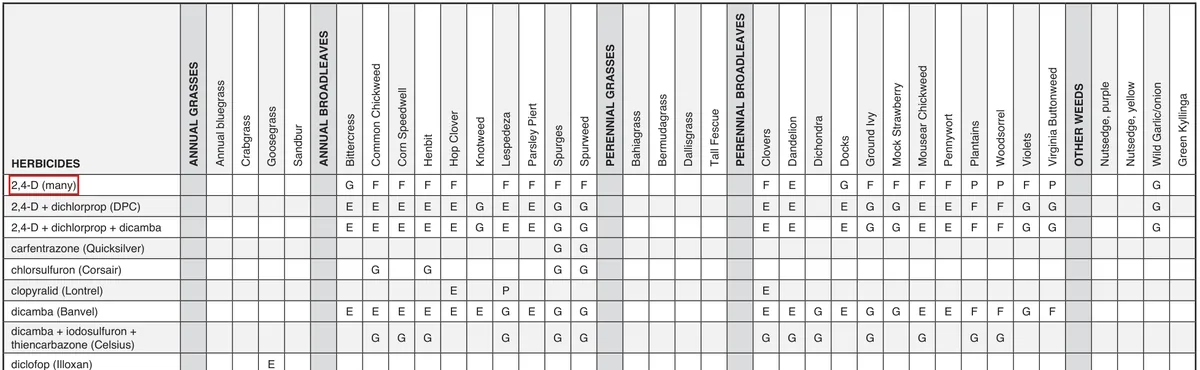
Skip 2,4-D-only sprays for this weed; our explainer on what 2,4-D does and does not kill shows the same pattern on other broadleaf weeds. UMD's own list adds triclopyr, but neither consumer triclopyr label we read names mock strawberry, so for a triclopyr-only spray the maker makes no claim on this weed.
Non-synthetic options are weak. In UMD's 2025 plots, the high rate of granular chelated iron gave 22 to 56 percent control one week after the second application, and later ratings were not taken (FS-2026-0806, May 2026). Household vinegar burns leaves but leaves the crown, as our page on horticultural vinegar as a weed killer explains, and an Ask Extension expert notes that only agricultural-strength acetic acid has much effect.
Which lawn weed killers list mock strawberry on the label?
Five consumer labels name it, and each is a 2,4-D mix. A label that does not list the weed makes no control claim for it. Grass limits still decide which product you can use: the BioAdvanced quinclorac mix (92564-42) is barred from St. Augustine, centipede and bahia, and none of the five allows Floratam St. Augustine.
Swipe the table sideways to see every column.
| Product (EPA Reg. No.) | Active ingredients | Lists mock strawberry? | Lawn grasses and rate |
|---|---|---|---|
| Spectracide Weed Stop for Lawns Concentrate2 (9688-342-8845) | 2,4-D, MCPP-p, dicamba, sulfentrazone | Yes: “Indian mock strawberry” and “Mock strawberry” | Hose-end: 4 fl oz per 1,000 sq ft on bluegrass, fescue, ryegrass, zoysia; 2 fl oz on bahia, bentgrass, bermuda, centipede; 1.5 fl oz on St. Augustine (not Floratam or Bitterblue) |
| Spectracide Weed Stop for Lawns3 RTU (9688-341-8845) | Same 4 actives, ready to use | Yes | Spot spray; 32 fl oz treats up to 250 sq ft |
| BioAdvanced Weed Killer for Lawns / Southern Weed Killer for Lawns Concentrate (92564-4) | 2,4-D, MCPP-p, dicamba | Yes: “Strawberry, India mock” | 2 fl oz per 500 sq ft on cool-season grasses, bermuda, buffalo, zoysia; 1 fl oz per 500 sq ft on bahia, centipede, St. Augustine (not Floratam) |
| BioAdvanced All-in-One Lawn Weed & Crabgrass Killer (92564-42) | 2,4-D, quinclorac, dicamba | Yes: “India Mock Strawberry” | Bluegrass, ryegrass, fescue, zoysia, bentgrass, buffalo, bermuda; not bahia, centipede or any St. Augustine |
| Preen Lawn Weed Killer concentrate (2217-540-961) | 2,4-D, MCPP-p, dicamba | Yes: “Strawberry, India mock” | 1 to 1.2 fl oz in 3/4 gal per 190 sq ft (bahia, bermuda, bluegrass, fescue, ryegrass, zoysia); per 380 sq ft on centipede and St. Augustine; not Floratam in Florida |
| Ortho Weed B Gon Weed Killer for Lawns Concentrate (239-2744) | 2,4-D, MCPP-p, dicamba | No (lists wild strawberry) | Up to 4 fl oz per 1,000 sq ft |
| Trimec Classic (2217-543) | 2,4-D, MCPP-p, dicamba | No (lists wild strawberry) | Rates per acre and per 1,000 sq ft |
| SpeedZone Broadleaf Herbicide (2217-833) | Carfentrazone, 2,4-D, MCPP-p, dicamba | No (lists wild strawberry) | Rates per acre and per 1,000 sq ft |
| Ortho Weed B Gon Chickweed, Clover & Oxalis Killer (239-2491) | Triclopyr | No | Cool-season grasses, buffalo, zoysia |
| Bonide Chickweed, Clover & Oxalis Killer (228-336-4) | MCPA, triclopyr, dicamba | No | Per label |
| Turflon Ester Ultra (62719-566) | Triclopyr | No | Rates per acre |
| Celsius WG (432-1507) | Thiencarbazone, iodosulfuron, dicamba | No | Warm-season turf; licensed commercial applicators only |
| Manor (228-373) | Metsulfuron | No | Per-acre rates |
| Image Herbicide (73342-4) | Imazaquin | No | Warm-season turf |
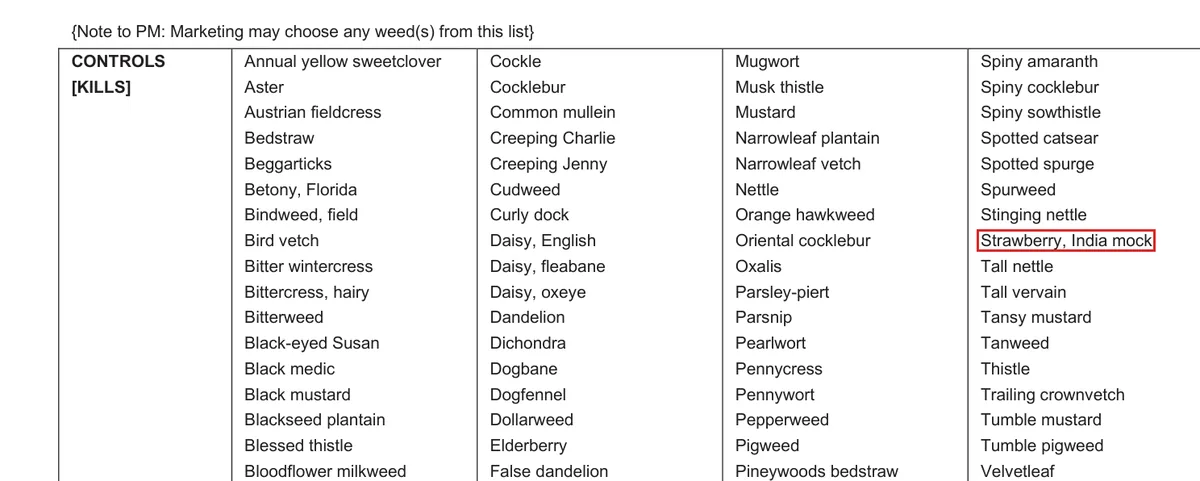
If clover, chickweed or oxalis share the patch, the triclopyr products still earn a place; our page on chickweed control by species and lawn grass sorts those labels. For mock strawberry alone, the 3-way with dicamba carries both the label claim and the Good ratings.
1Are the flowers white, or does the ripe fruit hang down?
YesNative wild strawberry (Fragaria virginiana). Keep it as a groundcover or pull it; a lawn spray that lists mock strawberry kills it too.
NoGo to the next question
2Do most mature leaves have 5 leaflets with sharp teeth and no red fruit?
YesCommon cinquefoil, a native that specialist mining bees use (UMD). Pull or tolerate it rather than spraying.
NoGo to the next question
3Is it in a flower or vegetable bed?
YesPull with the runners in moist soil, then mulch. Keep lawn sprays out of beds; glyphosate (MP44: G) only on mock strawberry leaves, never where banned.
NoGo to the next question
4Is it a few plants or a patch under about 10 sq ft?
YesHand pull after rain, crown and every rooted runner, and recheck in 2 weeks.
NoGo to the next question
5Is the lawn St. Augustine or centipede?
YesBioAdvanced 92564-4 at 1 fl oz per 500 sq ft, or Spectracide 9688-342-8845 at 1.5 fl oz (St. Augustine) or 2 fl oz (centipede) per 1,000 sq ft. Never on Floratam; 92564-42 is not allowed on either grass.
NoCool-season, bermuda or zoysia lawn: spot-spray in fall with a 2,4-D, MCPP and dicamba product that lists mock strawberry (for example 92564-4 at 2 fl oz per 500 sq ft), day between 45 and 90°F, repeat after 2 weeks if it regrows, then overseed 3 to 4 weeks later.
Source: UMD Extension; Arkansas MP44 2026; EPA labels 92564-4, 92564-42, 9688-342-8845
- Concentrate per spray (mL)
- 118.3
- Concentrate per spray (teaspoons)
- 24.0
- Concentrate per spray (fl oz)
- 4.00
Default: 1,000 sq ft at the Spectracide 4 fl oz rate takes 118.3 mL (4 fl oz). Worked examples: 2,500 sq ft of centipede with 92564-4 takes 147.9 mL (5 fl oz); 600 sq ft of bluegrass with Preen takes 93.4 mL (3.2 fl oz). Rates read from the labels on Nov. 24, 2026; Spectracide's hose-end sprayer meters the rate itself.
Default: 1,000 sq ft of bluegrass or fescue at the Spectracide 4 fl oz rate takes 118.3 mL (4 fl oz) of concentrate. Worked examples: 2,500 sq ft of centipede with BioAdvanced 92564-4 at 1 fl oz per 500 sq ft takes 147.9 mL (5 fl oz); 600 sq ft of bluegrass with Preen at 1 fl oz per 190 sq ft takes 93.4 mL (3.2 fl oz). Rates come from the labels above.
How do you remove a mock strawberry patch, step by step?
Work in fall for the spray and any time the soil is moist for pulling. UMD says to spot-treat in autumn, and Ohio State times mock strawberry sprays for fall.
- Confirm the ID: yellow flower, 3-toothed bracts, upright fruit. Mature cinquefoil usually shows 5 leaflets (UMD).
- Pull small patches after rain. Lift each plant at the crown and follow every runner, since stolons root at the nodes and seedlings start runners at about 5 leaves (UMD). Bag the plants; any rooted node left behind starts over.
- Mow 2 to 3 days before spraying, and spray when the day is 45 to 90°F with no rain forecast for 24 hours (Spectracide 9688-342-8845 label). Preen's label says not to water within 24 hours; our page on spraying weeds before or after rain has the drying times by product type.
- Spot-spray the patch at the label rate for your grass, using a coarse spray. Keep dicamba off the root zone of trees and shrubs (UMD).
- Wait at least 2 weeks before a second spray on regrowth, and stop at 2 broadcast applications a year (Spectracide and Preen labels).
- Reseed bare spots 3 to 4 weeks after spraying (Spectracide label). For cool-season lawns, our guide to overseeding a thin lawn in fall gives seed rates.
- If a patch covers most of an area, UMD says stripping the sod may be the practical fix. In beds, pull and mulch, or spot-treat with glyphosate (MP44: Good) on mock strawberry leaves only; glyphosate is banned on lawns in Baltimore City (UMD).
Why does mock strawberry keep coming back?
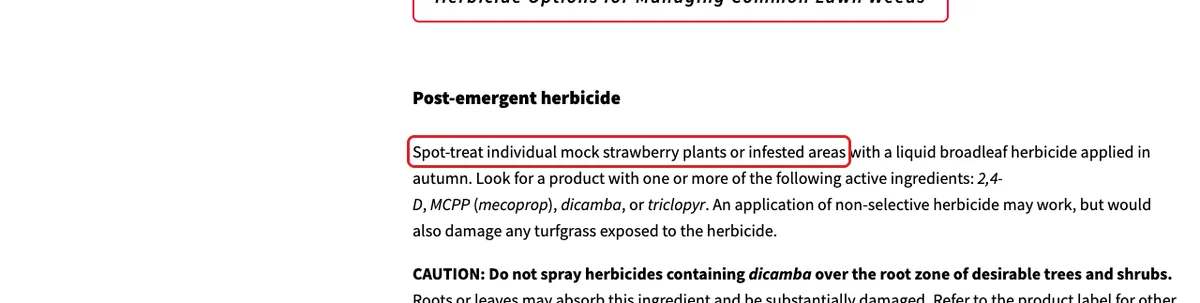
Because it wins where grass is weak. UMD says it outcompetes turf without enough sun and in spots that stay damp or are over-irrigated, and it grows low enough to escape the mower. NC State's TurfFiles profile gives the cultural fix in one line: improve surface drainage, aerate when needed and water infrequently.
Shade is the usual root cause. A 2025 pot study in Slovenia found that light and nutrients increased its growth and that ground ivy, native there, outcompeted it (Kreća et al., Plants 2025), so a dense lawn is the long-term defense. Even shade-tolerant turf needs 2 to 4 hours of direct sun, per our ranking of grass that grows in shade; below that, native wild strawberry, at 3 to 9 inches tall with a 1 to 2 foot spread (MoBot), is a groundcover swap that keeps the strawberry look.
How we compiled this
On Nov. 24, 2026 we read 14 lawn herbicide labels (10 EPA-stamped copies from EPA's Pesticide Product Label System and 4 marketed labels: 2 Spectracide, 1 Preen and 1 Bonide via WSU's PICOL database, plus EPA copies of 3 Chemsico registrations) and searched each for "mock strawberry" and "India mock." We compared 3 university herbicide-response charts (Arkansas 2026, Georgia 2022, Ohio State 2022), LSU's warm-season list, a 2026 UMD iron trial and 9 extension and botanical ID pages. We did not run trials or test products; the calculator multiplies label rates by area.
Frequently asked questions
Should I pull a mock strawberry?
Yes, while the patch is small and the soil is moist. UMD says pulling or digging works early in an infestation and for young plants, and seedlings start runners at about 5 leaves, so pull early. Get the crown and each rooted runner, or the nodes regrow.
Can you eat mock strawberries?
They are edible but bland. UMD calls the fruit, typically under 1/2 inch wide, not flavorful or juicy, and NC State describes it as bland and dry. Make sure of the ID first: yellow flower, upright fruit.
Are mock strawberries invasive?
The Missouri Department of Conservation lists its status as invasive, and UMD calls it a non-native weed found throughout Maryland. It came from Asia as an ornamental and spreads by stolons and seed.
What are the benefits of mock strawberries?
Small ones. Illinois Wildflowers notes small bees and flower flies visit the flowers, and NC State says it tolerates mowing as a groundcover. Native wild strawberry offers the same look with sweet fruit for wildlife.
How do you get rid of mock strawberry naturally?
Pull it in moist soil, fix drainage and shade, and overseed. Chelated iron gave 22 to 56 percent control one week after a second high-rate application in UMD's 2025 trial, short of the Good ratings for dicamba mixes.
Is fall the best time to kill mock strawberry?
Yes for sprays. UMD advises autumn spot treatments and Ohio State lists fall as the timing for mock strawberry. Spray while it is green and the day stays between 45 and 90°F.
Sources
- University of Maryland Extension, Indian Mock Strawberry, Updated Nov. 19, 2026. Accessed November 2026.
- University of Maryland Extension (Nichols), Efficacy of Chelated Iron in Turf Weed Control, FS-2026-0806, May 2026. Accessed November 2026.
- University of Maryland Extension, Common Cinquefoil: Identification and Management, Updated Oct. 27, 2026. Accessed November 2026.
- NC State Extension (Yelverton), Indian Mock Strawberry, TurfFiles, Current page. Accessed November 2026.
- NC State Extension Gardener Plant Toolbox, Potentilla indica, Current page. Accessed November 2026.
- Illinois Wildflowers, Mock Strawberry (Duchesnea indica), Current page. Accessed November 2026.
- Missouri Department of Conservation, Indian Strawberry (Mock Strawberry), Field Guide, Current page. Accessed November 2026.
- LSU AgCenter, Indian Mock Strawberry, Louisiana Home Lawn Series, Current page. Accessed November 2026.
- University of Arkansas Cooperative Extension, MP44, 2026 Arkansas Recommended Chemicals for Weed and Brush Control, Turf chapter, 2026 edition (file dated Dec. 2025). Accessed November 2026.
- University of Georgia Extension, Special Bulletin 48, Georgia Pest Management Handbook 2022 to 2023 Home and Garden Edition, Turf chapter, Dec. 2021. Accessed November 2026.
- The Ohio State University, BuckeyeTurf, Weed Management handout, Recommended Herbicides for Broadleaf Weed Control, July 2022. Accessed November 2026.
- Missouri Botanical Garden, Plant Finder: Fragaria virginiana, Current page. Accessed November 2026.
- Missouri Botanical Garden, Plant Finder: Waldsteinia fragarioides, Current page. Accessed November 2026.
- Native Plant Trust, Go Botany, Potentilla simplex, Current page. Accessed November 2026.
- Kreća, Šajna and Šipek, Plants (Basel), Response of the Invasive Alien Plant Duchesnea indica to Different Environmental and Competitive Settings, May 22, 2025. Accessed November 2026.
- Ask Extension, Mock Strawberry Invasion #782272, Feb. 2022. Accessed November 2026.
- Spectrum Brands (United Industries), Spectracide Weed Stop for Lawns Concentrate2 label, EPA Reg. No. 9688-342-8845, Sept. 2022 label. Accessed November 2026.
- U.S. EPA PPLS (Chemsico), Chemsico Lawn Weed Killer Concentrate label, EPA Reg. No. 9688-342, June 4, 2018. Accessed November 2026.
- Spectrum Brands (United Industries), Spectracide Weed Stop for Lawns3 RTU label, EPA Reg. No. 9688-341-8845, Feb. 2024 label. Accessed November 2026.
- U.S. EPA PPLS (SBM Life Science), Lawn Herbicide JD Concentrate (BioAdvanced Weed Killer for Lawns) label, EPA Reg. No. 92564-4, June 25, 2026. Accessed November 2026.
- U.S. EPA PPLS (SBM Life Science), Lawn Herbicide 2Q (BioAdvanced All-in-One Lawn Weed & Crabgrass Killer) label, EPA Reg. No. 92564-42, Feb. 23, 2024. Accessed November 2026.
- Lebanon Seaboard Corporation, Preen Lawn Weed Killer label, EPA Reg. No. 2217-540-961, Marketed label. Accessed November 2026.
- U.S. EPA PPLS (Scotts), WBG 553 Concentrate (Ortho Weed B Gon Weed Killer for Lawns) label, EPA Reg. No. 239-2744, Aug. 23, 2023. Accessed November 2026.
- U.S. EPA PPLS (Scotts), Ortho Brush-B-Gon / Weed B Gon Chickweed, Clover & Oxalis Killer label, EPA Reg. No. 239-2491, Aug. 6, 2024. Accessed November 2026.
- WSU PICOL (Bonide), Chickweed Clover & Oxalis Killer label, EPA Reg. No. 228-336-4, Current WA label. Accessed November 2026.
- U.S. EPA PPLS (PBI-Gordon), Trimec Herbicide label, EPA Reg. No. 2217-543, Apr. 2, 2014. Accessed November 2026.
- U.S. EPA PPLS (PBI-Gordon), Speed Zone Broadleaf Herbicide label, EPA Reg. No. 2217-833, Mar. 25, 2025. Accessed November 2026.
- U.S. EPA PPLS (Dow AgroSciences), Turflon Ester Ultra label, EPA Reg. No. 62719-566, Mar. 21, 2019. Accessed November 2026.
- U.S. EPA PPLS (Bayer), Celsius WG label, EPA Reg. No. 432-1507, Sept. 1, 2021. Accessed November 2026.
- U.S. EPA PPLS (Nufarm), Manor Selective Herbicide label, EPA Reg. No. 228-373, May 10, 2019. Accessed November 2026.
- U.S. EPA PPLS (AMBRANDS), Image Herbicide label, EPA Reg. No. 73342-4, Aug. 30, 2024. Accessed November 2026.
- U.S. EPA PPLS (Chemsico), EH-1460 Herbicide label, EPA Reg. No. 9688-268, July 30, 2024. Accessed November 2026.
- U.S. EPA PPLS (Chemsico), Chemsico Lawn Weed Killer Plus Crabgrass RTU label, EPA Reg. No. 9688-337, Mar. 4, 2024. Accessed November 2026.