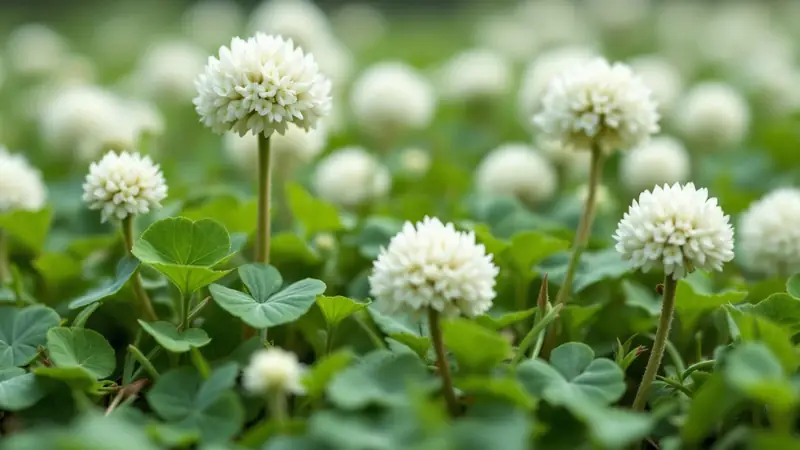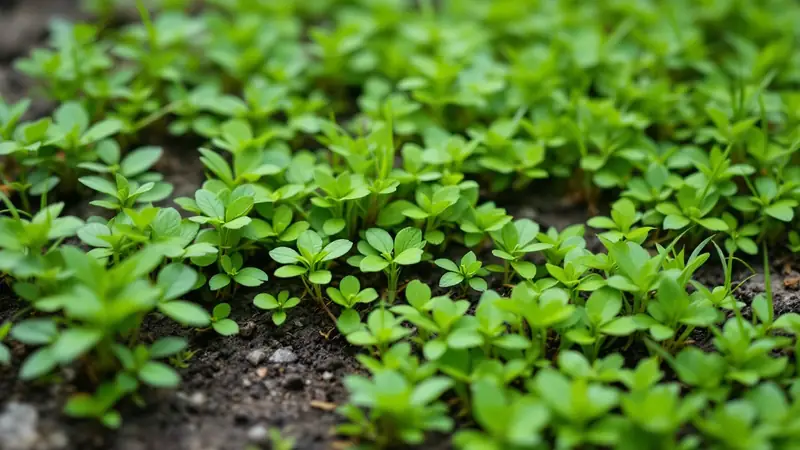
How to get rid of chickweed: spray a lawn herbicide with dicamba, MCPP, triclopyr or fluroxypyr in fall while plants are small, then apply a preemergent in late summer. 2,4-D alone rates resistant. Hairy mouseear chickweed is perennial and needs the fall spray most.
How to get rid of chickweed starts with which chickweed you have. Common chickweed (Stellaria media) is a smooth winter annual that dies by mid spring; mouseear chickweed (Cerastium fontanum ssp. vulgare) is a hairy perennial that, per Rutgers fact sheet FS385, persists into late spring or even summer. The PNW Weed Management Handbook susceptibility table rates common chickweed resistant to 2,4-D used alone and mouseear intermediate to resistant, while dicamba rates susceptible on both.
None of the top-ranking pages split the two species or measure a spray. Rutgers plots in 2005 did: 60 days after an April 28 spray, mouseear control ran from 70 percent for 2,4-D plus triclopyr to 99 percent for 2,4-D plus fluroxypyr plus dicamba. Below, 9 labels are sorted by lawn grass and by the chickweed each lists. For henbit and the other cool-season weeds, see our lawn weed identification chart.
This page summarizes EPA labels and university research; it is not a product endorsement or legal advice. The label is the law: read the current label of the exact product you buy, and check whether your state requires a pesticide applicator license before anyone treats a lawn for pay.
Common or mouseear chickweed: which one is in your lawn?
Hold a stem to the light. UC IPM says common chickweed has one line of hairs on the stem and smooth leaves; mouseear is hairy all over, with dark or gray-green leaves up to 3/4 inch long (Maine BPC).
| Trait | Common chickweed | Mouseear chickweed | Source |
|---|---|---|---|
| Latin name | Stellaria media | Cerastium fontanum ssp. vulgare (formerly C. vulgatum) | UMD Extension |
| Life cycle | Winter annual; can act as a short-lived perennial | Perennial; evergreen in winter | Penn State; UMD |
| Hairs | Smooth leaves; one line of hairs along the stem | Soft hairs on leaves and stems | UC IPM |
| Leaves | Bright green, oval, pointed tip, 1/2 to 1 1/2 in; lower leaves stalked | Dark or gray-green, oval, up to 3/4 in, stalkless | Maine BPC; NC State |
| Flower | 0.1 to 0.3 in; 5 split white petals set inside 5 larger green sepals | About 1/4 in; petals about as long as, or slightly shorter than, the hairy sepals | Cornell; UMD |
| Roots at stem nodes | Sources differ: Cornell yes, in moist soil; UMD no | Yes | Cornell; UMD |
| When it quits | Dies by mid spring | Persists into late spring or summer; hot, dry spells can kill it | Rutgers FS385; UMD |
| Germination window | Autumn, from seed shed in spring | Late summer to early spring; summer too where irrigated | UMD |
| Control priority | Fall spray or late-summer preemergent; spring spraying is often wasted | Fall spray, repeat if needed, preemergent for seedlings | Nebraska Extension; Penn State |
How many seeds does one chickweed plant drop?
Usually hundreds to a few thousand. Cornell weed scientists put a typical plant at 500 to 3,000 seeds, with very large plants reaching 13,000 to 15,000, and UC IPM Pest Notes 74129 gives about 800 for a plant growing without competition. A top-ranking product page says 25,000; we found no university source for that, so the table uses Cornell’s range.
| Number | What it measures | What it changes | Source |
|---|---|---|---|
| 500 to 3,000 seeds | Typical plant; 13,000 to 15,000 on very large plants | Removing plants before flowering beats cleanup after | Cornell |
| About 800 seeds | One plant without competition | Same lesson, lower estimate | UC IPM |
| 7 to 8 years | Time for the soil seed bank to be 95% depleted | Expect seedlings for years after the last plant seeds | UC IPM |
| 10+ years | Seed viability in soil | Same | UMD |
| 54 to 68°F | Best germination temperature | Preemergent goes down before soil cools into this band | UC IPM; Cornell |
| Above 86°F | No germination | Summer is a lull, not a cure | Cornell |
| 0.4 in; rarely below 2 in | Best and near-maximum emergence depth | Mulch and undisturbed soil keep seed too deep or dark | Cornell |
| 6 weeks + 2 weeks | Emergence to flower, then flower to ripe seed | A 5 to 6 week window before the first seed | Cornell; UC IPM |
| 3 to 4 generations a year | Where moisture allows | One cleanup in spring is not enough in irrigated beds | Cornell |
| 1.5% of daylight | Shade it can still flower and seed in | Shade alone will not starve it out | Cornell |
| pH 5.2 to 8.2 | Range it grows well in | Liming will not remove it | Cornell |
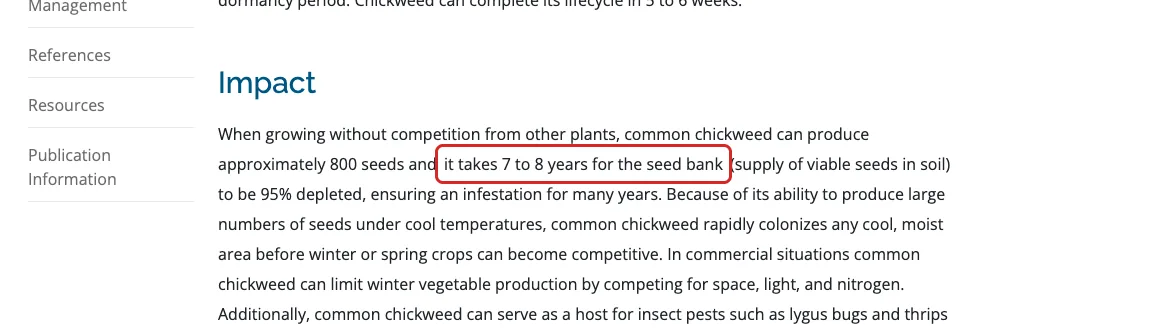
The seed bank is why the plan takes 2 or more seasons: Cornell reports viability falling only 19 to 30 percent a year in undisturbed soil. Timing for other lawn weeds is in our guide to which weeds die in winter.
Henbit runs on the same fall calendar with one twist: Cornell’s weed profile says henbit seed that has been through winter cold only sprouts below 68/50°F, and our guide on how to get rid of henbit turns that into a September preemergent and a late-October spray.
What kills chickweed in a lawn without killing the grass?
A broadleaf herbicide with dicamba, MCPP (mecoprop), triclopyr or fluroxypyr. Penn State Extension names dicamba, MCPP and fluroxypyr for common chickweed, Rutgers FS385 lists 2,4-D as weak on chickweed, and Illinois Extension recommends MCPP for it. UC IPM flags two that do not work.
| Active ingredient | Common chickweed | Mouseear chickweed | Note | Source |
|---|---|---|---|---|
| 2,4-D alone | R | I to R | Kills dandelion and plantain, not chickweed | PNW |
| Dicamba | S | S | Soil activity: keep off tree and shrub root zones | PNW; UMD |
| MCPP (mecoprop) | S to I | S to I | UC IPM: controls chickweed; safest on bentgrass | PNW; UC IPM |
| Mixtures with triclopyr | S | S | Triclopyr injures bermuda and other warm-season grasses | PNW; UC IPM |
| Mixtures without triclopyr | S | S | The usual 2,4-D + MCPP + dicamba 3-way | PNW |
| Fluroxypyr (in mixes) | Named by Penn State | 92 to 99% with 2,4-D and dicamba (Rutgers) | Rated on mouseear in the trial below | Penn State; Rutgers 2007 |
| Carfentrazone alone | Does not control | Not rated | Fast burn on other weeds; sold in mixes such as SpeedZone | UC IPM |
| Oxadiazon (preemergent) | Does not control | Not rated | A crabgrass preemergent that skips chickweed | UC IPM |
So skip straight 2,4-D. Our guide to whether 2,4-D kills lawn grass lists which grasses tolerate those mixes, and the lawn weed killer comparison sorts the other active ingredients by weed.
How well did the mixes work on mouseear chickweed?
McCullough and Hart sprayed perennial ryegrass at Adelphia, New Jersey, in 2005 (Rutgers Turfgrass Proceedings 2007): 4 replicates, air and soil at 62/50°F on April 14 and 62/57°F on April 28, no turf injury.
| Spray date | Treatment (actives) | Rate, pt/acre | Mouseear control at 14 days | At 60 days |
|---|---|---|---|---|
| April 14 | Chaser (2,4-D + triclopyr) | 3.0 | 5% | 79% |
| April 14 | 2,4-D + fluroxypyr + dicamba acid | 3.0 | 8% | 99% |
| April 14 | 2,4-D ester + Turflon Ester (triclopyr) + Banvel (dicamba) | 1.5 + 0.5 + 0.2 | 11% | 95% |
| April 14 | Same 3 products, higher rates | 2.0 + 0.75 + 0.25 | 18% | 99% |
| April 14 | Triplet SF (2,4-D + MCPP + dicamba) | 3.5 | 8% | 79% |
| April 28 | Chaser (2,4-D + triclopyr) | 3.0 | 12% | 70% |
| April 28 | Millennium Ultra (2,4-D + clopyralid + dicamba) | 2.7 | 18% | 74% |
| April 28 | 2,4-D + fluroxypyr + dicamba acid | 3.0 | 30% | 99% |
| April 28 | Triplet SF (2,4-D + MCPP + dicamba) | 3.5 | 21% | 92% |
| Both | Untreated | None | 0% | 0% |
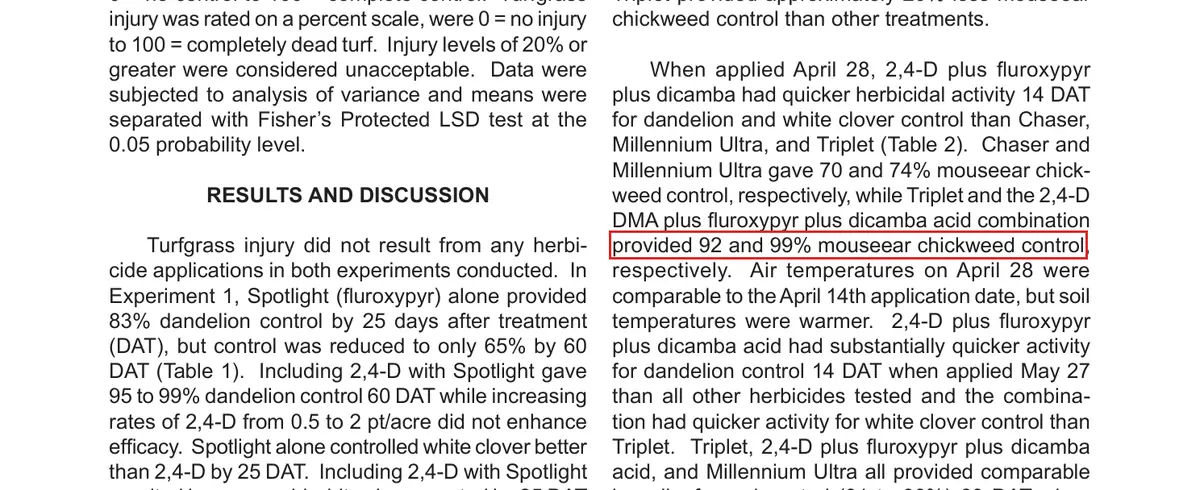
At 14 days nothing had passed 30 percent, so judge a mouseear spray at 6 to 8 weeks, not 2. Only 2,4-D plus fluroxypyr plus dicamba hit 99 percent on both dates. Millennium Ultra contains clopyralid, which Penn State says to keep off residential lawns.
Which chickweed killer is labeled for your grass?
Your grass picks the product. The triclopyr concentrate excludes bermuda, St. Augustine, centipede and bahia; 3-way mixes allow warm-season grasses at a half or quarter rate. All 9 labels list common chickweed; 8 list mouseear in some form.
| Product (EPA Reg. No.) | Actives | Chickweeds listed | Lawn grasses and rate | Limits | Who applies |
|---|---|---|---|---|---|
| Ortho Weed B Gon Chickweed, Clover & Oxalis Killer for Lawns Concentrate (239-2491) | Triclopyr TEA 8.0% | Common, mouseear | Buffalo, fescues, Kentucky bluegrass, ryegrass, zoysia: 1 fl oz in 1 gal water per 200 sq ft. Not bahia, bermuda, centipede, kikuyu, St. Augustine | Below 90°F; repeat after 2 to 3 weeks; max 5.4 fl oz per 100 sq ft a year | Homeowner |
| Ortho Weed B Gon Weed Killer for Lawns Concentrate (239-2744) | 2,4-D, mecoprop-p, dicamba | Common, mouseear | Per 1,000 sq ft: cool-season 4 fl oz; bahia, common bermuda, zoysia 2 fl oz; centipede, St. Augustine 1 fl oz (not Floratam in Florida) | 2 applications a year, 30 days apart; not above 90°F; no rain expected within 24 hours | Homeowner |
| BioAdvanced Southern Weed Killer for Lawns Concentrate (92564-4) | 2,4-D, mecoprop-p, dicamba | Common, mouseear | Per 500 sq ft: fescue, bluegrass, ryegrass, bermuda, buffalo, zoysia 2 fl oz; bahia, centipede, St. Augustine 1 fl oz. Not Floratam | Spray when the day stays under 90°F | Homeowner |
| Image Herbicide (73342-4) | Imazaquin | Common, mouseear (winter weed list) | Dormant bermuda, buffalo, centipede, zoysia: 4 fl oz per 1,000 sq ft. No St. Augustine for winter weeds | After the first killing frost; max 8 fl oz per 1,000 sq ft a year | Homeowner |
| Southern Ag Atrazine St. Augustine Weed Killer (19713-567-829) | Atrazine | Common, mouseear | St. Augustine, centipede: 8.6 fl oz per 1,000 sq ft | 2 applications a year; not above 90°F (UF/IFAS: 85°F on Floratam); no overseeding for 6 months | Homeowner |
| Trimec Classic (2217-543) | 2,4-D, mecoprop-p, dicamba | Common, mouseear | Cool-season, common bermuda, bahia, zoysia: 1.2 to 1.5 fl oz per 1,000 sq ft; St. Augustine and centipede spot-spray only; not Floratam | 2 broadcast applications a year, 30 days apart | Lawn care operators and landscape personnel |
| Celsius WG (432-1507) | Thiencarbazone, iodosulfuron, dicamba | Common at 1.6 g per 1,000 sq ft; mouse-ear at 2.4 g | St. Augustine, bermuda, centipede, zoysia. Not bahia or any cool-season grass | Max 4.8 g per 1,000 sq ft a year | Licensed commercial applicators only |
| Barricade 4FL (100-1139), preemergent | Prodiamine | Common; mouseear from seed only | Established cool- and warm-season turf; rates written per acre | Common chickweed: apply in late summer, fall or winter before it germinates | Professional per-acre product |
| Manor (228-373) | Metsulfuron-methyl | Common only | Kentucky bluegrass, fine fescue and listed warm-season grasses; rates per acre | Penn State names metsulfuron for mouseear, but this label does not list it | Professional per-acre product |
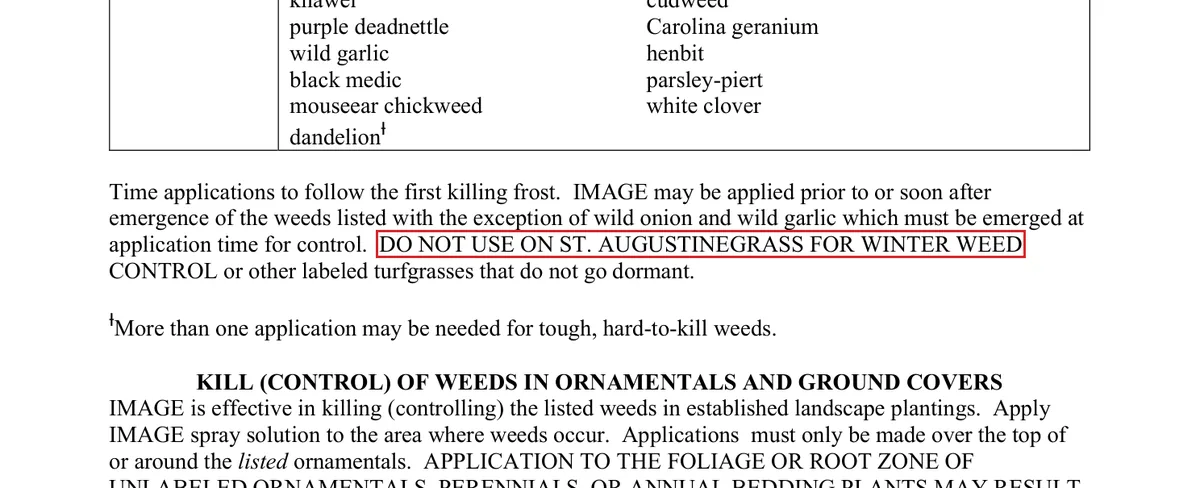
St. Augustine gets the narrowest list: Image rules it out for winter weeds, both 3-way homeowner labels exclude Floratam, and UF/IFAS LH010 says Floratam is injured by atrazine above 85°F. Our St. Augustine grass guide lists limits by cultivar; the same exclusions apply when getting rid of dollarweed.
Celsius WG is labeled for application by licensed commercial applicators only, and it prints Cerastium glomeratum, which UC IPM names as sticky chickweed, beside the words mouse-ear chickweed. Trimec Classic is written for lawn care operators; Barricade 4FL and Manor carry per-acre rates.
1Is it in a flower or vegetable bed rather than the lawn?
YesPull or hoe while the soil is dry and plants are small, carry the stems away (they re-root), then mulch 2 to 3 inches (UC IPM; Clemson HGIC). Keep lawn herbicides out of beds.
NoGo to the next question
2Are the leaves and stems covered in soft hairs (mouseear chickweed)?
YesTreat it as a perennial: a fall spray with dicamba plus MCPP or fluroxypyr (2,4-D + fluroxypyr + dicamba gave 99 percent at 60 days in Rutgers plots), judged after 6 to 8 weeks, plus a preemergent in late summer for seedlings.
NoGo to the next question
3Is the lawn St. Augustine or centipede?
YesAtrazine (19713-567-829) at 8.6 fl oz per 1,000 sq ft, or a 3-way at the low rate (239-2744: 1 fl oz per 1,000 sq ft; 92564-4: 1 fl oz per 500 sq ft). Neither 3-way on Floratam; atrazine on Floratam only below 85°F (UF/IFAS).
NoGo to the next question
4Is it dormant bermuda, zoysia or buffalograss?
YesImage (73342-4) at 4 fl oz per 1,000 sq ft after the first killing frost, or 239-2744 at 2 fl oz per 1,000 sq ft on common bermuda or zoysia.
NoGo to the next question
5Is common chickweed already flowering in April or May?
YesIt dies by mid spring (Rutgers FS385): pull or mow and bag it before seed ripens, then put down prodiamine or isoxaben from late August to September.
NoCool-season lawn in fall: Ortho 239-2491 (triclopyr) at 1 fl oz per gallon per 200 sq ft, or a 3-way such as 239-2744 at 4 fl oz per 1,000 sq ft, while plants are small and the day stays under 90°F.
- Product per spray (mL)
- 118.3
- Product per spray (teaspoons)
- 24.0
- Product per spray (fl oz)
- 4.00
Default: 1,000 sq ft at the Ortho 239-2744 cool-season rate takes 118.3 mL (4 fl oz). Worked example: 3,000 sq ft of tall fescue with Ortho 239-2491 takes 443.6 mL (15 fl oz) in 15 gallons of water; 5,000 sq ft of centipede with atrazine takes 1,271.7 mL (43 fl oz). Rates from the labels on this page, read Nov. 21, 2026. Celsius WG is weighed in grams and is for licensed applicators only.
Default: 1,000 sq ft of cool-season lawn at the Ortho 239-2744 rate takes 118.3 mL (4 fl oz) of concentrate. Worked example: 3,000 sq ft of tall fescue with the Ortho triclopyr concentrate (239-2491) takes 15 fl oz (443.6 mL), mixed 1 fl oz per gallon, so 15 gallons of spray; 5,000 sq ft of centipede with atrazine takes 43 fl oz (1,271.7 mL). Rates from the labels above.
When should you spray chickweed, and when does the preemergent go down?
Fall, for both. Nebraska Extension says spring sprays on winter annuals like common chickweed are usually not justified, and Rutgers FS385 says they are easy to kill in fall but hard at maturity in spring.
- Late August to September, before soil cools to 68°F: a preemergent. Barricade 4FL (prodiamine) says late summer, fall or winter before germination; Rutgers FS385 names isoxaben, and Illinois Extension dithiopyr and pendimethalin. Not where you are seeding: Barricade 4FL needs 4 to 12 months before overseeding, by rate; see our overseeding guide.
- October to November, while seedlings are small: spray a listed product at your grass rate, under 90°F. Water a dry lawn first; skip mowing 1 to 2 days either side (239-2491).
- After the first killing frost in the South: Image on dormant bermuda, zoysia, buffalo or centipede; atrazine on St. Augustine or centipede.
- 6 to 8 weeks later: re-spray survivors within label limits (2 to 3 weeks apart for 239-2491, 30 days for 3-ways).
- Late March to April: common chickweed flowers (Rutgers FS385). Pull it, or mow and bag it, before seed ripens; spray only mouseear, which lasts into summer.
How do you get rid of chickweed in a garden bed?
By hand and with mulch: UC IPM tells home gardeners to rely on nonchemical methods first.
- Pull or hoe while plants are small and the soil is dry (UC IPM); carry pulled plants away, since stems re-root on moist soil.
- Stir the top 1 to 2 inches 2 to 4 times in the month after digging a bed (Cornell).
- Mulch at least 2 inches (UC IPM) or 3 inches of coarse mulch (Clemson HGIC): the seeds need light. See how deep mulch should be by material.
- Solarize empty beds under clear plastic in late summer (UC IPM).
- Before sowing small seeds, flame a stale seedbed (Cornell).
For beds too large to weed by hand, UC IPM lists glyphosate, glufosinate and diquat as spot sprays; all three are nonselective and injure any plant they touch.
Why does chickweed keep coming back in the same spots?
Thin turf, shade and wet soil. Rutgers FS385 says the seedlings typically do not survive in a dense lawn; NC State says shade and frequent watering encourage chickweed, and UMD names compacted, poorly drained sites.
Raise the mower (Clemson HGIC: it thrives in closely mowed lawns), water deeply and less often (UC IPM), and do not overfeed: Cornell found its seed output rises with nitrogen. In shade, overseed from our list of grasses that grow in shade, and skip the lime: Cornell puts the growing range of chickweed at pH 5.2 to 8.2.
How we compiled this
On Nov. 21, 2026 we read 9 EPA-stamped herbicide labels (8 from EPA’s Pesticide Product Label System, 1 marketed label from the registrant), the 2005 Rutgers field trial in the 2007 Rutgers Turfgrass Proceedings, the PNW handbook susceptibility table, and extension publications from UC IPM, Cornell, UMD, Penn State, NC State, Rutgers, Nebraska, Illinois, Clemson, Maine and UF/IFAS. We did not run trials or test products. Ratings and rates are quoted from those documents; the calculator multiplies label rates by area.
Frequently asked questions
What is the best herbicide to kill chickweed?
One whose label lists chickweed and your grass. On cool-season lawns, a triclopyr product or a 2,4-D, MCPP and dicamba mix; on St. Augustine and centipede, atrazine or a 3-way at the 1 fl oz rate. For mouseear chickweed, 2,4-D plus fluroxypyr plus dicamba reached 99 percent in Rutgers plots.
Will 2,4-D kill chickweed?
Not on its own. The PNW handbook rates common chickweed resistant to 2,4-D alone and mouseear intermediate to resistant. Mixed with dicamba and MCPP it works: both mix columns rate the two chickweeds susceptible.
When’s the best time to spray for chickweed?
October to November, while seedlings are small. Rutgers FS385 says winter annuals are easy to kill in fall and hard at maturity in spring, when common chickweed is about to die anyway. Mouseear chickweed persists into summer, so a spring spray still pays off on it.
Will Roundup kill chickweed?
Yes, and the grass with it. UC IPM lists glyphosate as a nonselective herbicide that injures most plants it touches, so use it only as a shielded spot spray in beds or bare ground. Our page on whether Roundup kills grass has the regrowth and reseeding waits.
Should I pull mouse ear chickweed?
Yes, for a few plants, with the rooted stems. It is a perennial whose creeping stems reach about 20 inches and root at the nodes (UC IPM; Penn State), so pieces left on moist soil can grow back. For a lawn-wide mat, spray in fall; pulling does not reach the seed already in the soil.
Is chickweed edible?
Common chickweed is: Clemson HGIC says it can be added to salads or cooked. Cornell notes it may hold toxic nitrate levels on nitrogen-rich soil. Never eat it from a treated lawn: the Ortho chickweed label (239-2491) says not to use it on or around edible crops.
Sources
- UC Statewide IPM Program (Wilen), Pest Notes: Chickweeds, UC ANR Publication 74129, Current page. Accessed November 2026.
- UC Statewide IPM Program, Mouseear Chickweed, Weed Identification Gallery, Current page. Accessed November 2026.
- UC Statewide IPM Program, Integrated Weed Management, Turfgrass Pest Management Guidelines, Current page. Accessed November 2026.
- Cornell CALS Weed Science, Weed Profiles: Common chickweed, Current page. Accessed November 2026.
- University of Maryland Extension, Chickweeds: Identification and Management, Current page. Accessed November 2026.
- Penn State Extension, Lawn and Turfgrass Weeds: Common Chickweed, Current page. Accessed November 2026.
- Penn State Extension, Perennial Weeds: Mouseear Chickweed, Current page. Accessed November 2026.
- NC State Extension, Mouseear Chickweed, TurfFiles weed profile, Current page. Accessed November 2026.
- Maine Board of Pesticides Control, Chickweed, Current page. Accessed November 2026.
- Clemson Cooperative Extension HGIC, Common Chickweed (Stellaria media), Current page. Accessed November 2026.
- Rutgers Cooperative Extension, FS385, Broadleaf Weed Control in Cool Season Lawns, Current page. Accessed November 2026.
- PNW Weed Management Handbook, Susceptibility of Broadleaf Weeds in Turf to Common Herbicides, Current edition. Accessed November 2026.
- McCullough, P. and Hart, S., Rutgers, New Options for Broadleaf Weed Control in Residential Turfgrass, Rutgers Turfgrass Proceedings 2007, pp. 207 to 211, Dec. 2007 (2005 trial). Accessed November 2026.
- University of Nebraska-Lincoln, Lawn Care Pro Series: Broadleaf weed control, 2012. Accessed November 2026.
- University of Illinois Extension, Home, Yard and Garden Pest Newsletter, Springtime Broadleaf Weed Control in Turf, Current page. Accessed November 2026.
- UF/IFAS Extension (Trenholm et al.), St. Augustinegrass for Florida Lawns, ENH5/LH010, Revised July 2024, reviewed Oct. 2025. Accessed November 2026.
- U.S. EPA PPLS (Scotts/Ortho), Ortho Weed B Gon Chickweed, Clover & Oxalis Killer label, EPA Reg. No. 239-2491, Aug. 6, 2024. Accessed November 2026.
- U.S. EPA PPLS (Scotts/Ortho), Ortho Weed B Gon Weed Killer for Lawns label, EPA Reg. No. 239-2744, Aug. 23, 2023. Accessed November 2026.
- U.S. EPA PPLS (SBM Life Science), BioAdvanced Southern Weed Killer for Lawns Concentrate label, EPA Reg. No. 92564-4, June 25, 2026. Accessed November 2026.
- U.S. EPA PPLS (Central Garden and Pet), Image Herbicide label, EPA Reg. No. 73342-4, Aug. 30, 2024. Accessed November 2026.
- Southern Agricultural Insecticides, Atrazine St. Augustine Weed Killer label, EPA Reg. No. 19713-567-829, Mar. 30, 2022. Accessed November 2026.
- U.S. EPA PPLS (PBI-Gordon), Trimec Classic Broadleaf Herbicide label, EPA Reg. No. 2217-543, Apr. 2, 2014. Accessed November 2026.
- U.S. EPA PPLS (Bayer), Celsius WG Herbicide label, EPA Reg. No. 432-1507, Sept. 1, 2021. Accessed November 2026.
- U.S. EPA PPLS (Syngenta), Barricade 4FL label, EPA Reg. No. 100-1139, Feb. 21, 2024. Accessed November 2026.
- U.S. EPA PPLS (Nufarm), Manor Selective Herbicide label, EPA Reg. No. 228-373, May 10, 2019. Accessed November 2026.