How to get rid of goosegrass: dig out young plants, spray a postemergent labeled for your lawn grass before plants tiller, and put down a second preemergent 6 to 8 weeks after the crabgrass one, because goosegrass sprouts 3 to 4 weeks later.
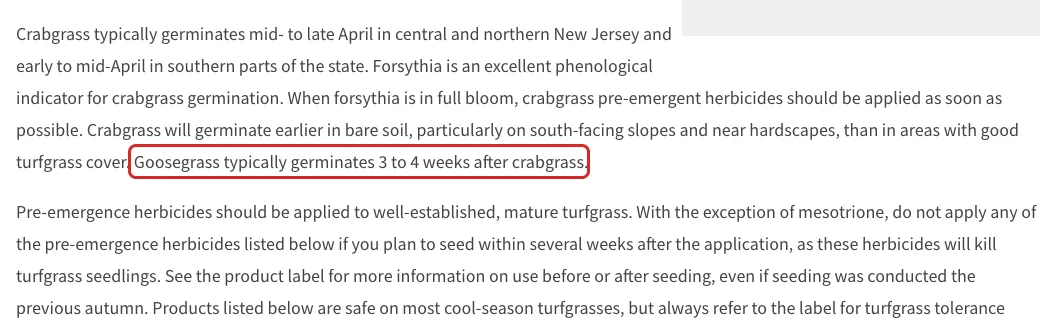
How to get rid of goosegrass comes down to timing more than product choice. Goosegrass (Eleusine indica) is a summer annual that starts to emerge 3 to 4 weeks after crabgrass (Penn State Extension; Rutgers FS1309) and keeps coming up into August, so a single spring crabgrass preventer often runs out while it is still germinating. If you are not sure which weed you have, the short contrast below and our identification chart of common lawn weeds will settle it; for the crabgrass side of the lawn, our guide to crabgrass as a summer annual covers its own 55°F trigger.
The top results for this search are a golf course article, a lawn-product maker’s page, a sod company’s page, Reddit threads and YouTube clips. We read the labels behind the products they name and found two things none of them puts in front of a homeowner. Oxadiazon (Ronstar), the preemergent Rutgers, Penn State and USGA rate highest on goosegrass, carries the line “Not for Use in Turfgrass on Residential Properties” on its current Ronstar FLO label, EPA Reg. No. 101563-125. And quinclorac, the active in most crabgrass killers, does not control goosegrass at all (Rutgers; UGA Bulletin 1462). The 16-row table below sorts what is left by lawn grass, growth stage and who may legally apply it.
This page summarizes pesticide labels and published research; it is not a recommendation of any product. The label is the law: read the current label of the exact product you buy, and check whether your state requires a licensed applicator to use it.
Is it goosegrass or crabgrass?
Goosegrass is sometimes sold as “silver crabgrass” (the Acclaim Extra label lists it by both names), but it is a different genus with a different control list. Check the center of the plant first: goosegrass stems are flattened and silvery white where they meet, and the leaves are folded in the bud, while crabgrass leaves are rolled (Rutgers FS1309).
| Mark | Goosegrass | Crabgrass | Source |
|---|---|---|---|
| Center of the plant | Flattened, silvery white stem bases radiating like spokes | Round stems, often purple at the base (smooth crabgrass) | Penn State; Rutgers |
| Leaf in the bud | Folded | Rolled | Rutgers FS1309 |
| Leaf blade | 1/4 to 1/2 in. wide, 2 to 10 in. long, prominent midvein, dark green | Lime green, coarse; large crabgrass is hairy | Penn State; Rutgers |
| Ligule | Membrane 1 to 1.5 mm, jagged and split in the center | Membrane, no split | Penn State |
| Seedhead | 2 to 7 zipper-like spikes from one point, often 1 or 2 more just below | Finger-like spikes leaving the stem at different points | Penn State; UF/IFAS AG483; Rutgers |
| Starts to emerge | 3 to 4 weeks after crabgrass; soil about 60 to 65°F | About 55°F soil, 24-hour mean, 3 or 4 days | USGA; NC State |
| Postemergent quinclorac (Drive XLR8) | No control | Controls crabgrass above 0.75 lb a.i. per acre | Rutgers FS1309 |
Why does a crabgrass preventer miss goosegrass?
Crabgrass starts germinating when the 24-hour mean soil temperature holds about 55°F for 3 or 4 days (NC State TurfFiles, 2024). Goosegrass needs more heat: about 60 to 65°F near the surface, and some research adds a swing of about 25°F between day and night (USGA Green Section Record, March 2025). UF/IFAS uses 60°F for 24 consecutive hours as the start signal, and Penn State says the goosegrass preemergent must be down before the daily maximum at 2 inches reaches 62 to 65°F (UF/IFAS SS-AGR-488; Penn State).
| Event | Crabgrass | Goosegrass | Source |
|---|---|---|---|
| Soil temperature trigger | About 55°F, 24-hour mean, 3 or 4 days | 60 to 65°F near the surface; 60°F for 24 hours (UF) | NC State; USGA; UF/IFAS |
| Plant signal | Forsythia in full bloom: apply as soon as possible | 4 to 6 weeks after forsythia full bloom, once highs reach 80°F for a few days | Rutgers; USGA |
| Florida calendar for the preemergent | Not given separately | Week of March 1 (south), March 15 (central), April 1 (north) | UF/IFAS AG483 |
| How long emergence lasts | Germinates through August in New Jersey | April through at least August in Tennessee | Rutgers; USGA |
| Starts to tiller (New Jersey, no preemergent) | Mid to late June | Early to mid July | Rutgers FS1309 |
| Seeds per plant | Thousands | 50,000 to 140,000 (UF); up to 120,000 (USGA) | UF/IFAS; USGA |
| Does dithiopyr kill emerged seedlings? | Yes, up to 1 tiller | No | Penn State |
Here is how the gap plays out with a homeowner product. The Greenview dithiopyr crabgrass preventer label (EPA Reg. No. 961-392) lists goosegrass and promises up to 4 months of control at its higher rate. Spread it on March 15 at forsythia bloom and the best case ends about July 15. In Tennessee, goosegrass emergence runs from April through at least August (USGA), so 6 weeks or more of new seedlings arrive after the barrier fades, and in a hot, wet summer soil microbes break the herbicide down faster still (Rutgers).
How do you stop goosegrass before it comes up?
Use two preemergent applications, not one. Penn State and Rutgers both put the second one 6 to 8 weeks after the crabgrass application, and UF/IFAS says the stand-alone preemergents sold to homeowners are limited to dithiopyr, pendimethalin and prodiamine products (Penn State; Rutgers; UF/IFAS AG483).
- First application at crabgrass timing. Apply when the 24-hour soil mean nears 55°F or forsythia is in full bloom. Water in with about 0.5 inch within 2 days; more can push the herbicide below the germination zone (UF/IFAS).
- Second application 6 to 8 weeks later. For dithiopyr, Rutgers cites the label’s goosegrass program: 0.25 lb a.i. per acre before crabgrass emerges, then 0.5 lb a.i. per acre 6 to 8 weeks later, which gave moderate goosegrass control in Rutgers trials (Rutgers FS1309).
- Stay under the yearly cap. On residential turf, pendimethalin is limited to one 2.0 lb a.i. per acre application or two of 1.0 to 1.5 lb (Rutgers). Split the label’s annual maximum rather than doubling it.
- Do not seed for at least 8 weeks. The Greenview dithiopyr label bars applying it within 8 weeks before seeding and delays reseeding 12 weeks after a fall application (EPA Reg. No. 961-392). Mesotrione (Tenacity) is the exception that can go down at seeding, giving 2 to 4 weeks of goosegrass prevention (Rutgers).
- Skip weed and feed for this weed. UF/IFAS says fertilizer and herbicide pre-blends have limited goosegrass activity because fertilizer timing does not match goosegrass germination (UF/IFAS AG483).
If the same spots fail every year after prodiamine or dithiopyr, suspect resistance. UGA has confirmed goosegrass in Georgia that prodiamine and pendimethalin no longer control (UGA B1462), and USGA lists confirmed goosegrass resistance in 9 herbicide groups, from Group 1 (fenoxaprop, fluazifop) to Group 22 (paraquat) (USGA, 2025).
Oxadiazon works best, but not on home lawns
Rutgers found oxadiazon at 2.0 to 3.0 lb a.i. per acre gave significantly more goosegrass control than prodiamine or dithiopyr, and USGA calls it the industry standard (Rutgers; USGA). The Ronstar FLO label classes it as a Restricted Use Pesticide and limits it to golf courses, parks, athletic fields and sod farms, for sale to certified applicators only, with a 60-day minimum between applications and, on golf courses, 30 percent of managed turf a year.
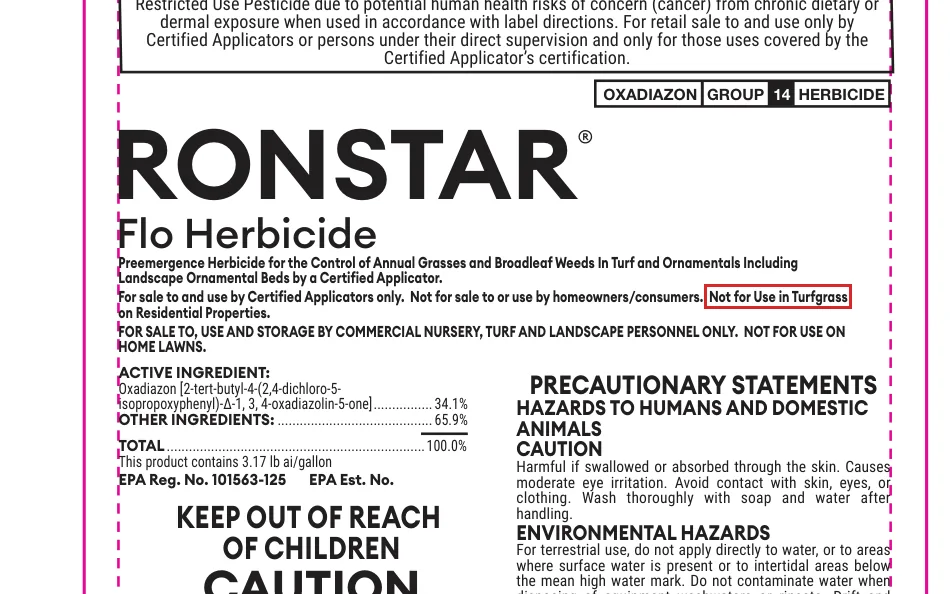
Penn State says the same for granular oxadiazon in Pennsylvania: very good goosegrass control, but it cannot be used on residential properties (Penn State). A lawn care company spraying a client’s yard is still on residential property, so ask any contractor which active ingredient they plan to use; our state-by-state pesticide applicator license guide shows who must hold a license to apply it.
Which herbicide kills goosegrass without killing your lawn?
Match the label to your lawn grass before anything else. Bermudagrass and the cool-season grasses have the most options; St. Augustinegrass and bahiagrass have almost none a homeowner can buy, and UF/IFAS says the homeowner postemergents with goosegrass activity in Florida all contain sulfentrazone (UF/IFAS AG483).
Swipe the table sideways to see every column.
| Product (EPA Reg. No.) | Active ingredient | Pre or post | Lawn grasses on the label | Goosegrass rate and stage | Measured or stated result | Who can buy it |
|---|---|---|---|---|---|---|
| Ronstar FLO (101563-125) | Oxadiazon (Group 14) | Pre | Dormant bermudagrass, St. Augustinegrass, zoysiagrass on golf courses, parks, athletic fields, sod farms; not home lawns | 1.85 to 2.8 fl oz per 1,000 sq ft (2.0 to 3.0 lb a.i. per acre); 60 days between applications | More goosegrass control than prodiamine or dithiopyr at 2.0 to 3.0 lb a.i. (Rutgers) | Certified applicators only |
| Dimension 2EW (62719-542) | Dithiopyr (Group 3) | Pre | Cool- and warm-season turf | 0.25 lb a.i. per acre, then 0.5 lb a.i. 6 to 8 weeks later (Rutgers, citing the label) | Moderate goosegrass control; no effect on emerged goosegrass (Rutgers; Penn State) | Professional |
| Greenview Green Power Crabgrass Prevention and Control (961-392) | Dithiopyr 0.13% on fertilizer | Pre | All major cool- and warm-season lawn grasses | Label rate by region; up to 4 months of control | Goosegrass listed on the label | Homeowner |
| Prodiamine products (Barricade and generics) (Label not read) | Prodiamine (Group 3) | Pre | Most lawn grasses (UF/IFAS tolerance table) | 0.75 to 1.0 lb a.i. per acre single rate (Rutgers); second application 6 to 8 weeks after the first for goosegrass (Penn State) | Good in Pennsylvania (Penn State); resistant goosegrass confirmed in Georgia (UGA) | Homeowner and professional |
| Pendimethalin products (Pendulum, Scotts Halts) (Label not read) | Pendimethalin (Group 3) | Pre | Most lawn grasses (UF/IFAS) | Residential: one 2.0 lb a.i. per acre or two of 1.0 to 1.5 lb (Rutgers) | Good in Pennsylvania (Penn State) | Homeowner and professional |
| Acclaim Extra (432-950) | Fenoxaprop (Group 1) | Post | Kentucky bluegrass, perennial ryegrass, fine and tall fescue, zoysiagrass, creeping bentgrass | 13 fl oz per acre untillered to 39 at 4 to 5 tillers; spot 0.30 to 0.46 fl oz per gal | 65 to 68% in moist soil, 10% in dry soil (Shekoofa et al. 2020) | Professional |
| Pylex (7969-327) | Topramezone (Group 27) | Post | Cool-season grasses, centipedegrass; bermudagrass for goosegrass only at 0.5 to 0.75 fl oz per acre once; not St. Augustinegrass, zoysiagrass, bahiagrass | 1.0 fl oz per acre to 2 tillers; 1.5 fl oz at 2 to 4 tillers | Over 90% on ACCase-resistant goosegrass at 1.5 fl oz per acre in Georgia (UGA) | Professional; residential lawns on label |
| Roundup For Lawns Crabgrass Destroyer Ready-To-Use (71995-70) | Topramezone (Group 27) | Post | Kentucky bluegrass, fine fescue, perennial ryegrass, tall fescue only | Ready to use; max 1 gal per 1,000 sq ft per application, 2 a year | Goosegrass listed on the label; no trial found | Homeowner |
| Revolver (101563-53) | Foramsulfuron (Group 2) | Post | Bermudagrass, zoysiagrass; home lawns listed | 0.4 to 0.6 fl oz per 1,000 sq ft, 2 applications 6 to 21 days apart; lower rate at 1 to 3 leaves | 87% in moist soil, 14% in dry soil (Shekoofa et al. 2020) | Professional |
| Tribute Total (101563-147) | Thiencarbazone + foramsulfuron + halosulfuron (Group 2) | Post | Bermudagrass, zoysiagrass; residential and commercial lawns | 3.2 oz per acre with MSO and AMS; repeat in 4 to 6 weeks | Controls up to early tiller stage (label); 93 to 95% in moist soil (Shekoofa et al. 2020) | Professional |
| SpeedZone EW (2217-1053) | 2,4-D + MCPP + dicamba + carfentrazone (Groups 4, 14) | Post | Kentucky bluegrass, perennial ryegrass, tall fescue, bentgrass (not greens), bermudagrass, zoysiagrass | 4 to 5 pints per acre; second application 30 days later | 49 to 71% in moist soil (Shekoofa et al. 2020); 2 sprays needed at 3 to 5 tillers (Penn State) | Professional |
| Metribuzin (Sencor 75) + topramezone (Label not read) | Metribuzin (Group 5) + topramezone | Post | Bermudagrass only, with injury risk (UF/IFAS) | Sencor 4 oz + Pylex 0.25 oz per acre, sequential (USGA) | Over 80% on mature goosegrass at 6 weeks, about 65% at 10 weeks, with severe bermudagrass injury for 2 to 3 weeks, in Florida (FTGA 2023) | Professional |
| Sulfentrazone homeowner products (Image All-in-One, Bonide Sedge Ender and others) (Label not read) | Sulfentrazone (Group 14) mixes | Post | Varies: UF/IFAS rates Image All-in-One damaging to St. Augustinegrass and the Bonide mixes “some injury” on St. Augustinegrass and zoysiagrass | Label rate | Seedlings only; efficacy declines once plants tiller (UF/IFAS) | Homeowner |
| Drive XLR8 and other quinclorac products (7969-272) | Quinclorac (Group 4) | Post | Cool-season grasses, bermudagrass, zoysiagrass | None for goosegrass | Does not control goosegrass (Rutgers; UGA) | Homeowner and professional |
| Celsius WG (101563-141) | Thiencarbazone + iodosulfuron + dicamba | Post | Bermudagrass, zoysiagrass, St. Augustinegrass, centipedegrass, buffalograss | None for goosegrass | Goosegrass does not appear in the label’s weed lists | Professional |
| MSMA (EPA page) | Monosodium methanearsonate | Post | Golf courses, sod farms, highway rights-of-way only | Spot treatments of 100 sq ft, 25% of a course a year | Residential lawn use cancelled in 2009 (EPA) | Not for lawns |
The table corrects one claim in the current results: a seed company page calls Celsius WG one of the most reliable goosegrass postemergents, but goosegrass does not appear anywhere in the text of the Celsius WG label we searched, and UF/IFAS leaves it out of its goosegrass tables. For crabgrass in the same lawn, our comparison of crabgrass killers that will not kill your grass sets 9 labels side by side.
1Only a few plants, or plants with no side shoots yet?
YesSlice each crown out with a knife or trowel and fill the gap with seed or sod; goosegrass cannot regrow without its crown (UF/IFAS AG483).
NoGo to the next question
2Is the lawn Kentucky bluegrass, ryegrass or fescue?
YesTopramezone (Pylex 7969-327; homeowner Crabgrass Destroyer 71995-70) or fenoxaprop (Acclaim Extra 432-950) at the stage rate, in moist soil; repeat in 2 to 3 weeks if plants have tillered.
NoGo to the next question
3Is it bermudagrass or zoysiagrass?
YesRevolver (101563-53) twice, 6 to 21 days apart, or Tribute Total (101563-147) before early tiller; on bermudagrass only, one Pylex spray at 0.5 to 0.75 fl oz per acre with 2 to 4 weeks of bleaching. Zoysiagrass also takes Acclaim Extra.
NoGo to the next question
4Is it centipedegrass?
YesPylex at 1 to 1.5 fl oz per acre with crop oil; check for regrowth after 3 weeks (UGA B1462). No oxadiazon on centipedegrass.
NoSt. Augustinegrass or bahiagrass: sulfentrazone homeowner products on seedlings only, hand removal, or a licensed applicator (Recognition plus Fusilade II under a Section 2(ee) recommendation on St. Augustinegrass, per UF/IFAS). Then plan two preemergents next spring.
Source: Product labels on this page; UF/IFAS SS-AGR-488; UGA B1462
Why spray before the third tiller?
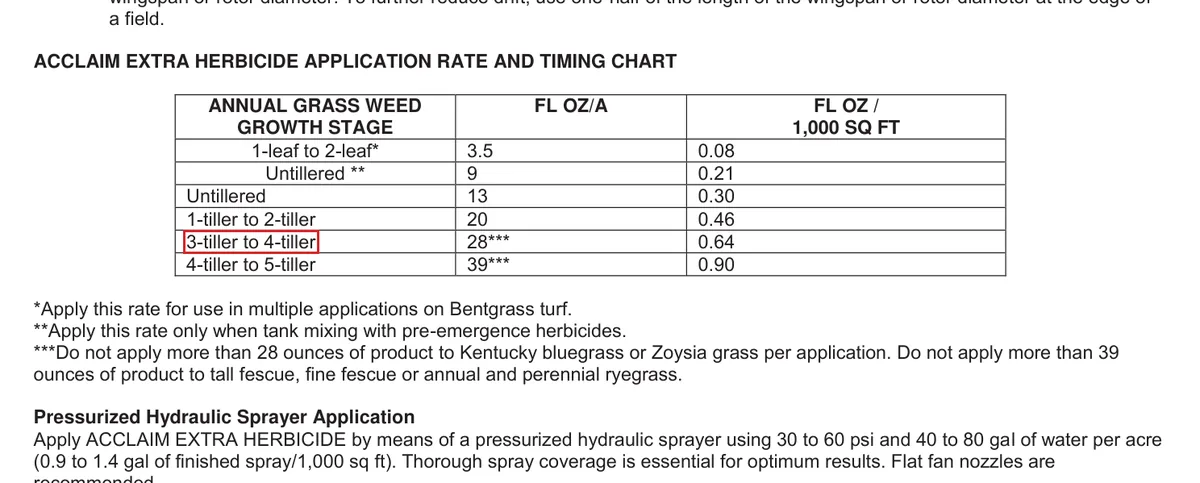
The postemergent labels tie the goosegrass rate to growth stage. A seedling grows 4 to 6 leaves and then starts side shoots (tillers); UF/IFAS puts tillering after six or more leaves, and Rutgers says plants are still easy at 1 to 2 tillers but quickly get hard after that, and above 7 tillers “very tough to control” (UF/IFAS; Rutgers). The Acclaim Extra rate chart shows the cost of waiting: 3 times the product per acre at 4 to 5 tillers as at the untillered stage.
| Goosegrass stage | Acclaim Extra (fl oz per acre) | Acclaim Extra (fl oz per 1,000 sq ft) | Pylex (fl oz per acre) | Tribute Total |
|---|---|---|---|---|
| 1 to 2 leaves | 3.5 (bentgrass only, repeated) | 0.08 | 0.25 controls leaf stage (Rutgers) | Controls |
| Untillered | 13 | 0.30 | 1.0 | Controls |
| 1 to 2 tillers | 20 | 0.46 | 1.0 | Controls up to early tiller |
| 3 to 4 tillers | 28 (max for Kentucky bluegrass, zoysiagrass) | 0.64 | 1.5 | Not claimed |
| 4 to 5 tillers | 39 (tall fescue, fine fescue, ryegrass only) | 0.90 | 1.5; over 1.0 controls any stage (Rutgers) | Not claimed |
Plan on bleaching with topramezone. The Pylex label warns of 2 to 4 weeks of bermudagrass discoloration at its goosegrass rate, and treated goosegrass turns white for 7 to 14 days before it dies (Pylex label; Rutgers). USGA adds that chlorothalonil fungicide sprayed near the same time reduces Pylex goosegrass control (USGA).
Use the calculator for the amount to measure. Pick the product and stage, enter the area in thousands of square feet, and it returns fluid ounces and milliliters. At the default 1,000 sq ft and Acclaim Extra on untillered goosegrass, that is 0.30 fl oz (about 8.9 mL); the same area at 1 to 2 tillers takes 0.46 fl oz.
- Product (fl oz)
- 0.300
- Product (mL)
- 8.9
Default: 1,000 sq ft of untillered goosegrass with Acclaim Extra takes 0.30 fl oz (8.9 mL). Rates from the labels linked on this page, read November 2026; per-1,000 values are the label's own or the per-acre rate divided by 43.56. Adjuvants are extra; your container's label overrides this tool.
Should you water before spraying goosegrass?
Yes, if the soil is dry. In a 2018 University of Tennessee glasshouse study, every postemergent tested controlled 24 percent or less of goosegrass growing in soil under 12 percent moisture by volume, against 49 to 95 percent at 12 to 20 percent moisture (Shekoofa et al., Scientific Reports, 2020). UF/IFAS suggests a moisture meter reading above 12 percent before a foramsulfuron spray (UF/IFAS).
| Herbicide (rate per hectare) | Control in soil under 12% moisture | Control at 12 to 20% moisture | Control above 20% moisture |
|---|---|---|---|
| Foramsulfuron (Revolver), 44 g | 14% | 87% | 87% |
| Thiencarbazone + foramsulfuron + halosulfuron (Tribute Total), 22 + 45 + 67 g | 20% | 95% | 93% |
| Fenoxaprop (Acclaim Extra), 144 g | 10% | 65% | 68% |
| Topramezone (Pylex), 24 g | 24% | 55% | 48% |
| Carfentrazone + 2,4-D + MCPP + dicamba (SpeedZone), 28 + 857 + 269 + 78 g | 13% | 49% | 71% |
Labels build this in. SpeedZone EW says to spray goosegrass 12 to 48 hours after irrigation or rain and not to water for 3 to 4 hours after, while Roundup For Lawns Crabgrass Destroyer bars irrigation for 24 hours after and mowing from 2 days before to 2 days after. Our page on whether to spray weeds before or after rain lists the rainfast times for the common lawn labels.
Can you pull goosegrass, and how do you stop it coming back?
Yes, while it is young. Goosegrass cannot regrow once the crown (the central growing point) is removed; UF/IFAS says a pocketknife works on small plants and a shovel on larger ones, cutting the roots under the crown (UF/IFAS AG483). Mature plants grow a central taproot that resists pulling, and because seeds keep germinating all summer, Rutgers expects several rounds of hand removal (Rutgers). Bag plants that have seedheads: one plant can carry up to 120,000 seeds (USGA).
Then fix why it grew there. Goosegrass is an indicator of compacted soil and heavy traffic, and USGA cites research showing up to 90 percent less goosegrass growth in a dense turf canopy than in bare soil or a divot (USGA). Rutgers and USGA both say to core aerate compacted areas even after a preemergent, because aerating does not break the herbicide barrier (Rutgers). Our step-by-step on how to core aerate a lawn covers plug depth and spacing.
- Cool-season lawns: overseed thin patches in late summer or early fall so new grass fills the gaps the goosegrass leaves at frost (Rutgers); our guide to overseeding a lawn has seeding rates. Keep the preemergent off those areas.
- Mow high: Rutgers recommends the top of the range, typically 3 to 5 inches for cool-season grasses, and UGA suggests 3 inches or more for tall fescue (Rutgers; UGA B1462).
- Water deep and infrequently: light, frequent watering keeps the surface moist for goosegrass seedlings, whose roots are shallower than the lawn’s (USGA).
- Reroute traffic: worn paths, sidelines and driveway edges are where goosegrass starts; a stepping-stone path or moved gate cuts the compaction at the source (UF/IFAS).
Does Roundup, MSMA or a natural spray work?
Glyphosate kills goosegrass and any lawn grass it touches, so use it only on cracks, gravel and beds, or to kill a patch you will reseed; our page on whether Roundup kills grass covers replanting intervals. Goosegrass has also evolved glyphosate resistance in some populations (Group 9 in the USGA resistance list).
MSMA, the old goosegrass standard, has been cancelled for residential lawns, parks and athletic fields since 2009; it remains only for golf courses, sod farms and highway rights-of-way, as 100 sq ft spot treatments on no more than 25 percent of a course a year (U.S. EPA). For organic programs, Rutgers says corn gluten meal rarely gives acceptable control under heavy pressure and organic sprays are non-selective (Rutgers).
How we compiled this
In November 2026 we read 11 herbicide labels (EPA-stamped PDFs or current Envu copies), EPA’s MSMA page, 5 extension publications from UF/IFAS, Penn State, Rutgers, UGA and NC State, the USGA Green Section Record guide of March 2025, one peer-reviewed study and one Florida trial summary. Percent control figures are the researchers’ visual ratings; we sprayed and tested nothing. Rows marked “label not read” rest on the extension source named. Prices are left out because these products sell through distributors at changing prices.
Frequently asked questions
What is the best goosegrass killer?
It depends on the lawn grass the label allows. On bermudagrass and zoysiagrass, Tribute Total controlled 93 to 95 percent in moist soil in a Tennessee study; on cool-season lawns, topramezone (Pylex, or Roundup For Lawns Crabgrass Destroyer for homeowners) controls tillered plants. Before seeding, oxadiazon prevents it best but is barred on home lawns.
Should I pull goosegrass?
Yes, when there are only a few plants and they are young. Remove the whole crown with a knife or trowel, since goosegrass cannot regrow without it. Pulling gets harder once the central taproot forms, and seedlings keep emerging into August, so check again every few weeks.
How do you kill goosegrass without killing grass?
Spray a selective herbicide whose label lists both goosegrass and your lawn grass, before the plants pass 2 tillers, in moist soil. Revolver and Tribute Total fit bermudagrass and zoysiagrass, Pylex and Acclaim Extra fit cool-season lawns, and Pylex fits centipedegrass.
Does Roundup kill goosegrass?
Glyphosate Roundup kills goosegrass and the lawn grass around it. Roundup For Lawns Crabgrass Destroyer is a different product: its active ingredient is topramezone, it lists goosegrass, and its label allows it only on Kentucky bluegrass, fine fescue, perennial ryegrass and tall fescue.
Will 2,4-D kill goosegrass?
2,4-D is a broadleaf herbicide and is not a goosegrass treatment on its own. One 2,4-D product labeled for goosegrass is SpeedZone EW, a 4-way mix with carfentrazone, at 4 to 5 pints per acre; it rated 49 to 71 percent in moist soil in a Tennessee study.
Are goosegrass and crabgrass the same?
No. Both are summer annual grasses, but goosegrass has a flattened silvery center and folded leaves, germinates 3 to 4 weeks later at warmer soil, and is not controlled by quinclorac, the active ingredient in most crabgrass killers.
Sources
- USGA Green Section Record, A Guide to Goosegrass Control (Petrovsky and Elmore), Vol. 63, Issue 4, March 8, 2025. Accessed November 2026.
- UF/IFAS Extension, SS-AGR-488, Identification, Biology, and Management of Goosegrass in Florida Turfgrasses, February 2025. Accessed November 2026.
- Penn State Extension, Lawn and Turfgrass Weeds: Goosegrass, June 6, 2025. Accessed November 2026.
- Rutgers Cooperative Extension, FS1309, Crabgrass and Goosegrass Identification and Control in Cool-Season Turfgrass for Professionals, Current page. Accessed November 2026.
- University of Georgia Extension, Bulletin 1462, Controlling Crabgrass and Goosegrass with Resistance to Sethoxydim and Other ACCase-Inhibitors in Georgia Turf, Reviewed 2024. Accessed November 2026.
- NC State TurfFiles, When to Apply Preemergent Herbicides for Turfgrasses (Yelverton), Feb. 8, 2024. Accessed November 2026.
- Scientific Reports, Shekoofa, Brosnan, Vargas, Tuck and Elmore, Environmental effects on efficacy of herbicides for postemergence goosegrass control, 10:20579, 2020. Accessed November 2026.
- Florida Turf Digest, Petelewicz, McLoughlin, Williams and Schiavon, Evaluation of Herbicides for Postemergent Control of Goosegrass in Bermudagrass Turf, pp. 14 to 17, Summer 2023. Accessed November 2026.
- U.S. EPA, Monosodium Methanearsonate (MSMA), an Organic Arsenical, Current page. Accessed November 2026.
- Envu, Ronstar FLO Herbicide label, EPA Reg. No. 101563-125, Current label. Accessed November 2026.
- U.S. EPA PPLS, Revolver Herbicide label, EPA Reg. No. 101563-53, Nov. 20, 2024. Accessed November 2026.
- Envu, Tribute Total Herbicide label, EPA Reg. No. 101563-147, Current label. Accessed November 2026.
- Envu, Celsius WG Herbicide label, EPA Reg. No. 101563-141, Label leaflet 2023. Accessed November 2026.
- U.S. EPA PPLS, Pylex Herbicide label, EPA Reg. No. 7969-327, Sept. 12, 2018. Accessed November 2026.
- U.S. EPA PPLS, Roundup For Lawns Crabgrass Destroyer Ready-To-Use label, EPA Reg. No. 71995-70, June 5, 2025. Accessed November 2026.
- U.S. EPA PPLS, Acclaim Extra Herbicide label, EPA Reg. No. 432-950, Aug. 24, 2016. Accessed November 2026.
- U.S. EPA PPLS, SpeedZone EW (EH-1681) label, EPA Reg. No. 2217-1053, June 29, 2023. Accessed November 2026.
- U.S. EPA PPLS, Greenview Green Power Crabgrass Prevention and Control label, EPA Reg. No. 961-392, Dec. 10, 2025. Accessed November 2026.
- U.S. EPA PPLS, Dimension 2EW label, EPA Reg. No. 62719-542, July 2, 2021. Accessed November 2026.
- U.S. EPA PPLS, Drive XLR8 Herbicide label, EPA Reg. No. 7969-272, Nov. 1, 2019. Accessed November 2026.