The grass that grows in shade best is fine fescue (creeping red, Chewings, hard) in the North and St. Augustinegrass or Zorro zoysia in the South. Even these need 2 to 4 hours of direct sun a day; below 2 hours, plant a groundcover.
Every grass that grows in shade is a sun plant that tolerates less of it, so the real question is how much less. Extension services answer in hours of direct sun, and their minimums run from 2 hours (Illinois Extension) to 6 (Nebraska Extension). Three university trials answer in daily light integral (DLI), the moles of usable light that land on a square meter in a day, and they rank cultivars, not just species. In Texas A&M plots mowed at 2 inches, Zorro zoysia held acceptable summer quality on 11.75 mol, Palmetto St. Augustine on 15.5 and TifGrand bermuda needed 32.05 (Wherley, Chen and Jessup, 2017).
The ranking below sets both measures side by side for 14 lawn grasses. A second table turns the Texas A&M minimums into shade levels, so you can see which grasses held up under 50, 70 and 90 percent shade cloth and which did not.
Grasses that grow in shade, ranked by the light they need
Tiers come from the fewest hours of direct sun a land-grant source states for each grass; DLI figures order grasses within a tier where a trial measured them. Mississippi State’s order agrees on the ends: bermudagrass needs the most light of all maintained turfgrasses, red fescue the least, and St. Augustinegrass is the most shade-tolerant warm-season grass (MSU P2892).
Swipe the table sideways to see every column.
| Rank | Tier (direct sun) | Grass | Cultivars with shade data | Least direct sun a source states | Summer minimum DLI, mol/m²/day | Where it is a lawn grass | Sources |
|---|---|---|---|---|---|---|---|
| 1 | A: about 2 to 4 hours | Fine fescues | Creeping red, Chewings, hard | At least 2 hours, and that gives a thin stand (Illinois); listed for heavy shade (Penn State) | No lawn DLI trial found | North and upper transition zone; not the coastal plain (NC State) | Illinois; Penn State |
| 2 | A: about 2 to 4 hours | Rough bluegrass (Poa trivialis) | Sabre | Heavy shade, but only on soil that stays moist (Penn State) | No lawn DLI trial found | North; wet shade only | Penn State |
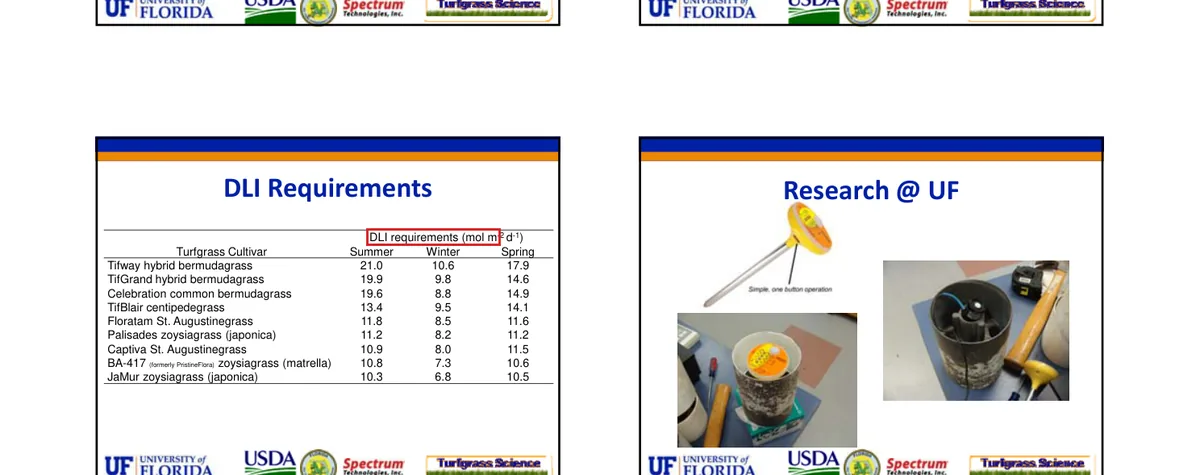
| 3 | A: about 2 to 4 hours | St. Augustinegrass, shade-rated cultivars | Palmetto, Captiva, Amerishade, CitraBlue | About 4 hours of direct sun, or a full day of good filtered light (Mississippi State); 4 to 6 hours for the species and about 5 for Palmetto (Texas A&M) | Captiva 10.9 (UF greenhouse); Palmetto 15.5 at a 2 in mowing height (Texas A&M field) | Gulf and South Atlantic coasts | MSU P2892; Texas A&M EHT-144; UF/IFAS; Texas A&M (Wherley) |
| 4 | A: about 2 to 4 hours | Manila zoysia (Zoysia matrella) | Zorro, Zeon, BA-417 | No hours stated; rated good (Mississippi State) | Zorro 11.75 and Zeon 13.25 at 2 in (Texas A&M); BA-417 10.8 (UF) | South and transition zone | MSU P2892; Texas A&M (Wherley); UF/IFAS |
| 5 | B: about 4 to 6 hours | Japanese zoysia (Zoysia japonica) | JaMur, Palisades, Empire; Meyer weaker | No hours stated; rated good (Mississippi State); Meyer and Emerald only fair (Clemson) | JaMur 10.3 and Palisades 11.2 (UF); JaMur 16.45 and Palisades 15.8 at 2 in (Texas A&M); Meyer 27.8 at fairway height (Arkansas) | South and transition zone | MSU P2892; Clemson HGIC 1202; UF/IFAS; Texas A&M (Wherley); Arkansas (Russell) |
| 6 | B: about 4 to 6 hours | Tall fescue | Grande 3, PST-5TRN, Stealth, Xanadu led the NTEP shade plot | Grows well with as little as 5 hours (Clemson); medium shade (Penn State, NC State) | No lawn DLI trial found | Transition zone, Piedmont, Midwest | Clemson HGIC 1202; Penn State; NC State |
| 7 | B: about 4 to 6 hours | Kentucky bluegrass | Glade, Bensun | Light shade only (Penn State) | No lawn DLI trial found | North | Penn State |
| 8 | B: about 4 to 6 hours | Centipedegrass | TifBlair | Full sun to partial shade, not heavy shade (NC State); fair shade tolerance (Clemson) | TifBlair 13.4 (UF) | Southeast, acid soils | NC State; Clemson HGIC 1215; UF/IFAS |
| 9 | C: 6 hours or more | St. Augustinegrass, Floratam | Floratam | At least 6 hours of direct sun to grow consistently (Texas A&M) | 11.8 (UF) | Central and south Florida, south Texas | Texas A&M EHT-144; UF/IFAS |
| 10 | C: 6 hours or more | Bahiagrass | Argentine, Pensacola | Rated poor (Mississippi State); 4 of 6 (NC State) | No lawn DLI trial found | Florida and the Gulf coast | MSU P2892; NC State |
| 11 | C: 6 hours or more | Bermudagrass, improved for shade | Celebration, Latitude 36, TifGrand | Shown promise in moderate shade but are “by no means shade tolerant” (Mississippi State) | Celebration 19.6 and TifGrand 19.9 (UF); Celebration 23.8, Latitude 36 25.55, TifGrand 32.05 at 2 in (Texas A&M) | South | MSU P2892; UF/IFAS; Texas A&M (Wherley) |
| 12 | D: not for shade | Bermudagrass, standard | Tifway, common | Needs the most light of all maintained turfgrasses (Mississippi State); shade 1 of 6 (NC State) | Tifway 21.0 (UF), 28.6 at 2 in (Texas A&M); common 26.8 at fairway height (Arkansas) | South | MSU P2892; NC State; UF/IFAS; Texas A&M (Wherley); Arkansas (Russell) |
| 13 | D: not for shade | Perennial ryegrass | Any | Survives only 1 or 2 seasons in shade (Nebraska Extension) | No lawn DLI trial found | North; sold as a nurse grass in mixes | Nebraska Extension |
| 14 | D: not for shade | Buffalograss | Any | Rated very poor (Mississippi State); will not grow at all in shade (Nebraska Extension) | No lawn DLI trial found | Great Plains | MSU P2892; Nebraska Extension |
Cool-season grasses carry no DLI figures because we found no lawn-height light trial for them; their tiers rest on hours and ratings alone. Fine fescues sit at the top on two counts: Penn State lists them for heavy shade, and Purdue calls their shade tolerance potentially the best among commonly used turfgrasses (Purdue TURF-63-W). They also fail in the South: NC State says not to use them in the coastal plain (NC State Extension Gardener Handbook, ch. 9).
Among warm-season grasses the cultivar matters as much as the species. Floratam and Captiva are both St. Augustinegrass, but Texas A&M asks at least 6 hours of direct sun for Floratam, and UF measured Captiva’s summer minimum at 10.9 mol against 11.8 for Floratam (Texas A&M EHT-144; Unruh, UF/IFAS). Our St. Augustine grass guide and zoysia grass guide carry the full cultivar tables.
UF’s greenhouse numbers put every zoysia and St. Augustine entry between 10.3 and 11.8 mol in summer, against 19.6 to 21.0 for the three bermudas. Winter minimums are lower for every grass: Tifway fell from 21.0 to 10.6 and JaMur from 10.3 to 6.8 (UF/IFAS DLI table). A shade that a grass survives in March can starve it in July.
How many hours of sun does grass need? The guides disagree
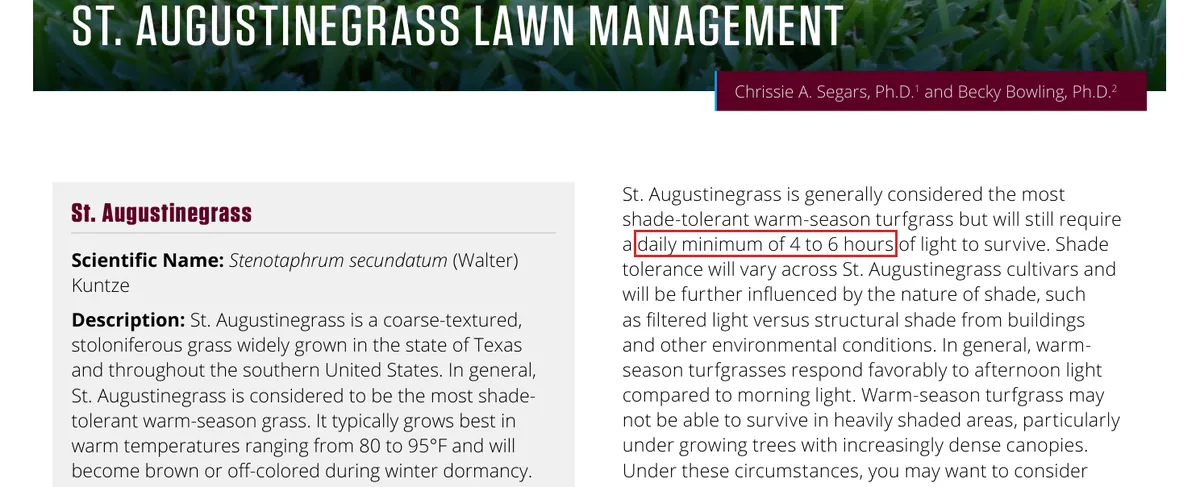
Six extension sources give six different floors, and they are not all measuring the same thing. Illinois gives a survival floor for its most shade-tolerant mixes; Nebraska gives the light needed for turf to thrive. Read the table as a range: under 2 hours no lawn grass is recommended, between 2 and 4 only the tier A grasses hang on, and 6 hours opens every option.
| Source | What it says | Grass it applies to |
|---|---|---|
| Illinois Extension | At least 2 hours of direct sun every day, and this minimum does not by itself give a good stand | Most shade-tolerant mixes (fine fescue based) |
| Clemson HGIC 1202 | Under 4 hours of sunlight a day is too shady for grass to grow well; tall fescue grows well with as little as 5 | All grasses; tall fescue |
| Oregon State EM 9175 | Turfgrass will likely not grow well with under 4 hours of direct sun a day | Any species |
| Mississippi State P2892 | About 4 hours of direct sun, or a full day of good filtered sunlight | St. Augustinegrass |
| Texas A&M EHT-144 | Daily minimum of 4 to 6 hours; Palmetto about 5, Raleigh 5 to 6, Floratam at least 6 | St. Augustinegrass cultivars |
| Nebraska Extension, Feb. 2024 | A minimum of 6 hours of full sun a day to really thrive | Turfgrasses in general |
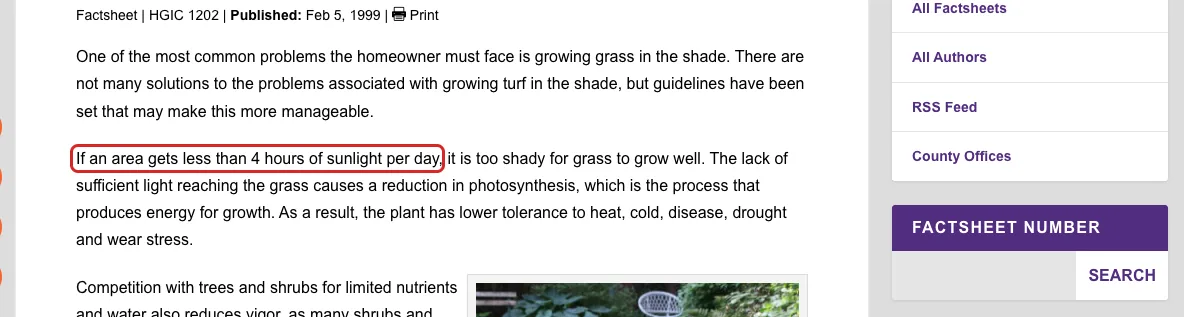
Several popular guides claim St. Augustine survives with no direct sun if it gets enough indirect light. The primary sources do not say that. Mississippi State’s alternative to 4 direct hours is a full day of good, filtered light, and Texas A&M adds that warm-season grasses respond better to afternoon light than to morning light and may not survive under trees with increasingly dense canopies (EHT-144).
Count your hours in midsummer with the trees in full leaf, which is when Nebraska Extension says to check (Nebraska Extension). Mississippi State’s method is to look at the spot on the hour through one day and note whether it is shaded, an estimate it calls often good enough for a first assessment (MSU P2892).
How much shade can each grass take? What the light trials measured
Hours ignore how bright the light is, so turf researchers measure DLI with quantum sensors. In College Station, Texas, full summer sun averaged 47.6 mol in 2016 and 46.2 in 2017, and shade cloth rated 50, 70 and 90 percent cut it to about 21, 12 and 5.6 mol (Wherley et al., Table 2). Matching those levels to each grass’s 2-inch minimum gives the table below; the share-of-full-sun column is our arithmetic on the 46.9 mol two-year mean.
| Cultivar, mowed at 2 in | Summer minimum DLI, mol/m²/day | Share of full College Station summer sun | Heaviest test shade whose summer light met the minimum |
|---|---|---|---|
| Zorro zoysia | 11.75 | 25% | 70 percent (about 12 mol) |
| Zeon zoysia | 13.25 | 28% | 50 percent (about 21 mol) |
| Palmetto St. Augustine | 15.5 | 33% | 50 percent (about 21 mol) |
| Palisades zoysia | 15.8 | 34% | 50 percent (about 21 mol) |
| JaMur zoysia | 16.45 | 35% | 50 percent (about 21 mol) |
| Celebration bermuda | 23.8 | 51% | 30 percent (27.9 mol) |
| Latitude 36 bermuda | 25.55 | 54% | 30 percent (27.9 mol) |
| Tifway bermuda | 28.6 | 61% | Full sun only (46 to 48 mol) |
| TifGrand bermuda | 32.05 | 68% | Full sun only (46 to 48 mol) |
Zorro was the only grass whose 2-inch minimum the 70 percent shade plots met, and only just: 11.75 mol against about 11.7 to 12.0 measured there. Palmetto, included as the shade-tolerant check, needed 15.5, so in this trial two Manila zoysias beat the best-known shade St. Augustine (Wherley et al.). At the same height TifGrand needed 32.05 mol, about 68 percent of open sun.
Mowing height moved the answer in opposite directions. The USGA summary of the finished study puts zoysia at 18 to 26 mol at a 0.75 inch fairway height and 9 to 14 at 2 inches, while Tifway and TifGrand needed more light at 2 inches (USGA Green Section, Oct. 2019); the 2017 interim figures in the table run 11.75 to 16.45 for zoysia. For a zoysia lawn under trees, mow at the top of its range; for bermuda, a higher deck does not buy shade tolerance.
Treat every DLI figure as a ranking, not a meter target. Arkansas researchers measured common bermuda at 26.8 mol in research plots but estimated 11.5 mol on shaded golf course sites, and Meyer zoysia at 27.8 versus 22.6; they blamed seasonal shade changes and tree root competition (Russell, Karcher and Richardson, 2017). Under a real tree, roots take water and nutrients that no light number captures.
Under a pine the trouble runs past light to shallow roots and a fall needle mat, and our guide on how to grow grass under pine trees ranks those limiters against the soil-acid myth.
Where thick roots break through thin shade turf, Purdue caps a compost and soil topdressing at under 2 inches, and our guide to getting rid of tree roots in a lawn sets that beside 6 other published limits.
Which cultivar should you buy for a shady lawn?
The National Turfgrass Evaluation Program grows each species’ entries side by side in a shaded plot, rates them 1 to 9 and treats 6 or above as generally acceptable (NTEP 2023 St. Augustinegrass Test report). Few cultivars reached 6 in shade, which says as much about shade as about the grasses. Two entries differ only when the gap exceeds the LSD shown.
| Species and shade site | Best named cultivars (shade quality, 1 to 9) | Weakest named cultivar | LSD | Source |
|---|---|---|---|---|
| St. Augustinegrass, Gainesville, Fla., 2025 | Cobalt 5.7 (96.0% summer cover); Palmetto 4.7 (83.3%); Raleigh 4.3 (70.0%) | Floratam 2.3 (30.0% cover) | 0.9 quality; 16.1 cover | NTEP 2023 test, Table 5 |
| Zoysiagrass, College Station, Texas, 2020 to 2023 | Empire 5.1; Zeon 5.0; Emerald 4.8 (top entry, experimental FAES 1319, 5.6) | Meyer 3.5 | 1.9 | NTEP 2019 zoysia test, Table 18 |
| Bermudagrass, College Station, Texas, 2020 to 2023 | Celebration 5.4; Tahoma 31 5.1; TifTuf 5.0 | Tifway 3.8 | 1.4 | NTEP 2019 bermuda test, Table 25A |
| Tall fescue, Ames, Iowa, 2018 to 2023 | Grande 3, PST-5TRN, Stealth and Xanadu 6.3 | Expanse 4.8 | 0.9 | NTEP 2018 tall fescue test, Table 29 |
Among fine fescues, Purdue rates Chewings excellent for shade, strong and slender creeping red good to excellent, hard fescue good and sheep fescue fair to good. Strong creeping red turned up in 64 percent of northern retail seed products Purdue’s researchers sampled in 2018, Chewings in 27 percent and hard fescue in 7 percent (Purdue TURF-65-W, Table 1). Read the label: a shade mix should list one of those three first.
Nebraska Extension warns that perennial ryegrass, common in seed mixes for quick green, lasts only one or two seasons in shade, and that fine fescue should be blended with tall fescue or Kentucky bluegrass rather than sown alone (Nebraska Extension). NC State’s rate for fine fescue in a tall fescue or bluegrass mix is 1.5 lb per 1,000 sq ft (NC State). Our tall fescue guide covers cultivar blends, and how to overseed a lawn covers the seeding.
How do you keep grass alive in shade?
Shade changes four settings: mowing height, nitrogen, water and timing. The sources agree on direction and differ on size, so the steps give each figure with its source.
- Prune first. Clemson says the lowest tree branches should ideally be over 6 feet above the soil, and Penn State says not to plant shallow-rooted Norway or silver maples where you want turf (Clemson HGIC 1202; Penn State).
- Raise the mower 0.5 to 1 inch above the sun height for that grass (Clemson; Purdue TURF-65-W). Illinois puts shaded cool-season lawns near 3 inches; Nebraska says 3 to 3.5 inches all summer.
- Cut nitrogen. Clemson gives heavily shaded grass one-half to two-thirds of the full-sun rate; UF’s Unruh says 1/4 to 1/2 less, applied more often; Illinois says 1 to 2 lb of actual nitrogen per 1,000 sq ft per season is all a shaded cool-season lawn needs.
- Water deeply and less often. In UF’s trial, 30 percent shade cut turf water use by 19.8 percent, 60 percent shade by 35.8 percent and 90 percent shade by 60.5 percent (Unruh, UF/IFAS). Tree roots can reverse that, so water when the grass wilts (MSU).
- Seed cool-season shade by mid-September, Clemson’s cutoff, so seedlings mature before leaves fall; after that, wait for spring. Rake or bag leaves so they do not smother the stand (Clemson; Penn State).
- Keep traffic off. Mississippi State names riding-mower wheels as a main cause of decline under shade trees and suggests string-trimming or mulch inside the drip line (MSU P2892).
The sources split three ways on feeding. Clemson, UF and Illinois cut nitrogen; Mississippi State says to apply the normal rate but no more, because shaded grass already pushes leaf growth at the expense of roots (MSU P2892); Penn State advises slightly more than normal, since the trees take a share (Penn State). The calculator uses the cuts; for the other two, select full sun.
- Pounds of nitrogen per year
- 1.5
- Pounds of urea (46-0-0) per year
- 3.3
- Pounds of a 24-0-6 type lawn fertilizer per year
- 6.3
Default: 1,000 sq ft of tall fescue in heavy shade at one-half = 1.5 lb N a year, 3.3 lb of urea. Split it into feedings of no more than 1 lb N of quick-release product per 1,000 sq ft (Purdue).
| Lawn, 1,000 sq ft | Full-sun rate (NC State) | Heavy shade, one-half (Clemson) | Heavy shade, two-thirds (Clemson) | Urea 46-0-0 at one-half |
|---|---|---|---|---|
| Tall fescue | 3 lb N (range 2.5 to 3.5) | 1.5 lb N | 2.0 lb N | 3.3 lb |
| St. Augustinegrass | 3 lb N (range 2 to 4) | 1.5 lb N | 2.0 lb N | 3.3 lb |
| Zoysiagrass | 2 lb N (range 1 to 3) | 1.0 lb N | 1.3 lb N | 2.2 lb |
| Creeping red or Chewings fescue | Under 2 lb N (Purdue) | Under 1.0 lb N | Under 1.3 lb N | Under 2.2 lb |
When should you stop trying to grow grass in shade?
Stop when the spot gets under 2 hours of direct sun in midsummer, or when a shade mix comes up and then thins within a season. Illinois describes exactly that pattern: a shade lawn mix is seeded, comes up healthy and declines rapidly for lack of light (Illinois Extension). Oregon State says redesigning the area without turf may be the best option below 4 hours (EM 9175).
Thin shade turf is where ground ivy moves in; if it already has, our ranking of creeping charlie controls by trial results gives the fall spray dates that held it under 10 percent cover in Purdue plots.
Common chickweed is the other shade invader: Cornell’s weed profile says it can flower and set seed in as little as 1.5 percent of full daylight, and our guide on getting rid of chickweed in a lawn pairs the fall spray with the grass each label allows.
Wild violets favor the same moist, shaded turf, and our guide on how to get rid of wild violets in a lawn compares how much triclopyr each of 6 violet-labeled lawn products delivers per spray.
1Does the spot get under 2 hours of direct sun in midsummer, with the trees in full leaf?
YesStop seeding grass. Plant liriope or mondo grass (NC State rates liriope to under 2 hours), keep the moss, or mulch.
NoGo to the next question
2Does the soil stay wet most of the year?
YesIn the North, rough bluegrass is the only grass Penn State lists for wet shade. Elsewhere, fix drainage first: fine fescues do not tolerate constantly wet soil.
NoGo to the next question
3Is St. Augustinegrass or zoysia the usual lawn grass where you live?
YesWith 4 to 5 hours of sun, a shade-rated St. Augustine such as Palmetto (Texas A&M). For less light or a finer lawn, Zorro or Zeon zoysia mowed at 2 inches. Skip Floratam and bermuda.
NoGo to the next question
4Does the spot get 5 hours or more of direct sun?
YesTall fescue blend, with fine fescue at 1.5 lb per 1,000 sq ft in the mix (Clemson; NC State).
NoBetween 2 and 5 hours in a cool-season area: a fine fescue mix led by creeping red, Chewings or hard fescue, mowed near 3 inches on about half the nitrogen. Expect a thin stand near 2 hours (Illinois).
Source: Illinois Extension; Clemson HGIC 1202; Penn State; Texas A&M EHT-144; Wherley et al. 2017; NC State
NC State rates liriope from full sun down to deep shade of under 2 hours of direct sun; our monkey grass guide compares it with mondo grass for paths and edges. Where moss has already filled in, our moss in lawns guide sets out when to keep it. Penn State’s heavy-shade list adds pachysandra, periwinkle and purple wintercreeper (Penn State), but Maryland has barred wintercreeper (Euonymus fortunei) from sale and planting since June 1, 2024 under its Prohibited Invasive Plant List (Maryland Department of Agriculture), so skip it there.
Leave English ivy off that list: Washington banned its sale in August 2025 and Maryland added it to its prohibited list in July 2026, and our guide to killing English ivy covers clearing an existing patch before you replant.
Creeping thyme is not a shade fix: it needs full sun of 6 or more hours, per our creeping thyme guide. Microclover is not one either: Maryland rates its shade tolerance very poor, as our clover lawn guide explains. For every grass’s sun, wear and cold scores in one place, see types of lawn grass.
How we compiled this
On Nov. 11, 2026 we read 10 extension publications (Illinois, Clemson HGIC 1202 and 1215, Mississippi State P2892, Penn State, Nebraska Extension, Oregon State EM 9175, Texas A&M EHT-144, NC State, Purdue TURF-63-W and TURF-65-W), three light-requirement studies (UF/IFAS, Texas A&M, University of Arkansas), the USGA summary of the Texas A&M work and four NTEP shade tables. Tiers, shade-level matches, shares of full sun and nitrogen figures are our arithmetic on those numbers. We grew no grass and measured no light.
Frequently asked questions
Can grass grow in 100% shade?
No. Mississippi State says no species of turfgrass will grow in complete shade, and Illinois sets a floor of 2 hours of direct sun a day even for the most shade-tolerant mixes. In Texas A&M’s trial, no cultivar’s summer minimum was met under 80 or 90 percent shade cloth.
What grass needs the least amount of sunlight?
Fine fescues among cool-season grasses: Purdue rates Chewings fescue excellent for shade, and Penn State lists fine fescues for heavy shade. Among warm-season grasses, Zorro zoysia had the lowest summer light minimum at a 2 inch height in Texas A&M plots, 11.75 mol per square meter per day, ahead of Palmetto St. Augustine at 15.5.
What is the best grass to grow under a tree?
In the North, a fine fescue mix with tall fescue, seeded by mid-September and mowed near 3 inches. In the South, a shade-rated St. Augustinegrass such as Palmetto or a Manila zoysia such as Zorro. Prune the lowest branches to 6 feet or more (Clemson) and expect tree roots to take water.
Does dense shade grass seed really work?
Only above the light floor. Illinois says shade mixes often come up healthy and then decline rapidly where light is short. Check that the label lists creeping red, Chewings or hard fescue first, and that the spot gets at least 2 to 4 hours of direct summer sun.
How do you grow grass in heavy shade?
Raise the mower 0.5 to 1 inch, cut nitrogen to one-half to two-thirds of the sun rate, water deeply but less often, keep traffic off and rake leaves promptly (Clemson; Mississippi State). Under 2 hours of direct sun, switch to liriope, moss or mulch instead.
Sources
- University of Illinois Extension, Managing Shady Lawns, Current online edition. Accessed November 2026.
- Clemson Cooperative Extension, HGIC, HGIC 1202: Growing Grass in Shade, Published Feb. 5, 1999. Accessed November 2026.
- Clemson Cooperative Extension, HGIC, HGIC 1215: Centipedegrass, Current online edition. Accessed November 2026.
- Mississippi State University Extension (McCurdy, Baldwin), P2892: Selecting and Managing Turfgrass for Shade, POD-07-24. Accessed November 2026.
- Penn State Extension (J. C. Harper II), Growing Turf Under Shaded Conditions, Updated Dec. 1, 2025. Accessed November 2026.
- Nebraska Extension in Lancaster County (S. Browning), Lawns for Shady Areas, Feb. 25, 2024. Accessed November 2026.
- Oregon State University Extension, EM 9175: Managing Moss in Lawns in Western Oregon, PDF. Accessed November 2026.
- Texas A&M AgriLife Extension, EHT-144: St. Augustinegrass Lawn Management, PDF. Accessed November 2026.
- NC State Extension, Extension Gardener Handbook, Chapter 9: Lawns (Table 9-1), Current online edition. Accessed November 2026.
- Purdue Extension, TURF-63-W: Fine Fescues: Understanding the Differences, PDF. Accessed November 2026.
- Purdue Extension, TURF-65-W: Management of Fine Fescues, PDF. Accessed November 2026.
- J. B. Unruh, UF/IFAS, Daily Light Requirements for Grass Species, 2015 presentation, PDF. Accessed November 2026.
- B. Wherley, Z. Chen and R. Jessup, Texas A&M, Minimum Daily Light Integral Requirements for Warm-Season Fairway/Tee and Rough Cultivars, USGA research summary, 2017. Accessed November 2026.
- T. Russell, D. Karcher and M. Richardson, University of Arkansas, Determining Precise Light Requirements for Various Turfgrass Systems, USGA research summary, 2017. Accessed November 2026.
- USGA Green Section (C. Thompson), Minimum Daily Light Integrals: Do Cultivars, Cutting Heights and PGRs Matter?, Oct. 4, 2019. Accessed November 2026.
- National Turfgrass Evaluation Program, 2023 National St. Augustinegrass Test, 2025 Data, Table 5, 2026 report. Accessed November 2026.
- National Turfgrass Evaluation Program, 2019 National Zoysiagrass Test, Table 18 (shade, College Station), 2020 to 2023 data. Accessed November 2026.
- National Turfgrass Evaluation Program, 2019 National Bermudagrass Test, Table 25A (shade, College Station), 2020 to 2023 data. Accessed November 2026.
- National Turfgrass Evaluation Program, 2018 National Tall Fescue Test, Table 29 (shade, Ames), 2018 to 2023 data. Accessed November 2026.