How to grow grass under pine trees: get the spot 4 or more hours of direct sun, rake needles off weekly, seed a shade grass for your region, and lime only if a soil test says so. Under 2 hours, mulch instead.
How to grow grass under pine trees comes down to four limiters: light, root competition for water, the needle mat and, least often, soil pH. Several pages ranking for this question lead with lime, one naming 20 pounds of ground limestone per 1,000 square feet as the usual fix. The soil measurements point elsewhere.
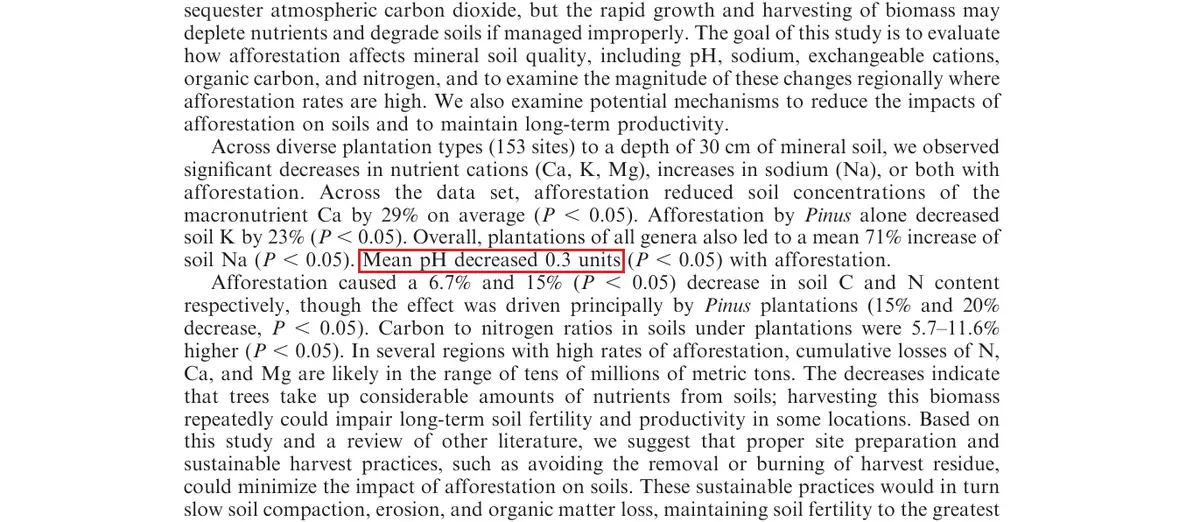
We set the published pH measurements side by side. Pine plantations on former grassland or shrubland lowered soil pH about 0.3 unit, from 5.7 to 5.4, across 68 comparisons (Berthrong, Jobbágy and Jackson, 2009). A year under 3.5 inches of pine straw took a Florida soil from 5.0 to 4.4 (Duryea, English and Hermansen, 1999). Lawn fescues grow well across pH windows 1.0 to 1.5 units wide (UK AGR-214, Table 2), so a pine rarely pushes soil out of range by itself.
Oregon State University Extension blames evergreen roots that are “numerous and shallow,” plus shade (OSU Extension, July 2023); UNH Extension says the same of eastern white pine (UNH Extension, Oct. 2019).
Why won’t grass grow under pine trees? Check the four limiters in order
Check them in this order. Soil pH matters only when a lab says it is out of range for the grass you plan to grow.
| Limiter | How to check it | Threshold | What to do | Source |
|---|---|---|---|---|
| Light | Note sun or shade on the spot every hour on a clear midsummer day | Under 4 hours of direct sun, or under 50% open sunlight: too shady for turf to grow well. Under 2 hours: no lawn grass | Raise the canopy (keep live branches on the top 2/3 of the tree); pick a grass by hours | NC State; Illinois; MSU P2892 |
| Root competition | Dig a trowel slot 6 inches deep under the canopy and look for a mat of fine roots; compare soil moisture with the open lawn | Most fine, water-absorbing tree and grass roots sit in the top 6 inches | Water 1 inch every 7 to 10 days, deeply; never till; no more than 2 inches of soil over roots | ISA Trees and Turf; Penn State |
| Needle mat | Look at the soil surface from September to November | Any layer that hides the soil over new seedlings blocks light, air and water | Rake new seedings at least weekly through the drop | Iowa State; NC State |
| Soil pH | Lab soil test with a lime requirement | Below 5.5 for tall and fine fescues, 6.0 for zoysia, 5.0 for centipede | Lime at the lab rate only; never lime centipede above 6.0 | UK AGR-214; UGA C1003 |
1Does the spot get under 2 hours of direct sun on a clear midsummer day?
YesNo lawn grass will hold there (Illinois Extension). Mulch 2 to 4 inches under the drip line (ISA), or plant Pennsylvania sedge or acid-tolerant shade shrubs.
NoGo to the next question
2Does it get 2 to 4 hours?
YesLimb the pine up first: live branches on the top two-thirds of its height, no more than 25 percent removed at once (USDA Forest Service; ISA), then count again. At 2 to 4 hours only fine fescue in the North, or shade St. Augustinegrass in the South, has a chance.
NoGo to the next question
3Is the soil under the canopy dry, with a mat of fine roots in the top 6 inches, when the open lawn is moist?
YesRoot competition: water about 1 inch every 7 to 10 days, deeply (ISA); never till; add no more than 2 inches of soil (Penn State).
NoGo to the next question
4Do needles cover the soil from September to November?
YesRake new seedings at least weekly through the drop until the grass is established (NC State; Penn State).
NoGo to the next question
5Does a lab soil test read below your grass's range (5.5 for fescues, 6.0 for zoysia, 5.0 for centipede)?
YesLime at the lab's rate only (UK AGR-214; UGA C1003).
NoLight, roots, needles and pH all check out: seed or sod a shade grass for your region, mow 0.5 to 1 inch higher than in sun, and feed 1 to 2 lb of nitrogen per 1,000 sq ft a season (Clemson; Illinois).
Source: NC State, Illinois, Clemson, Penn State and UGA Extension; ISA; USDA Forest Service
Do pine needles make soil acidic? What the measurements show
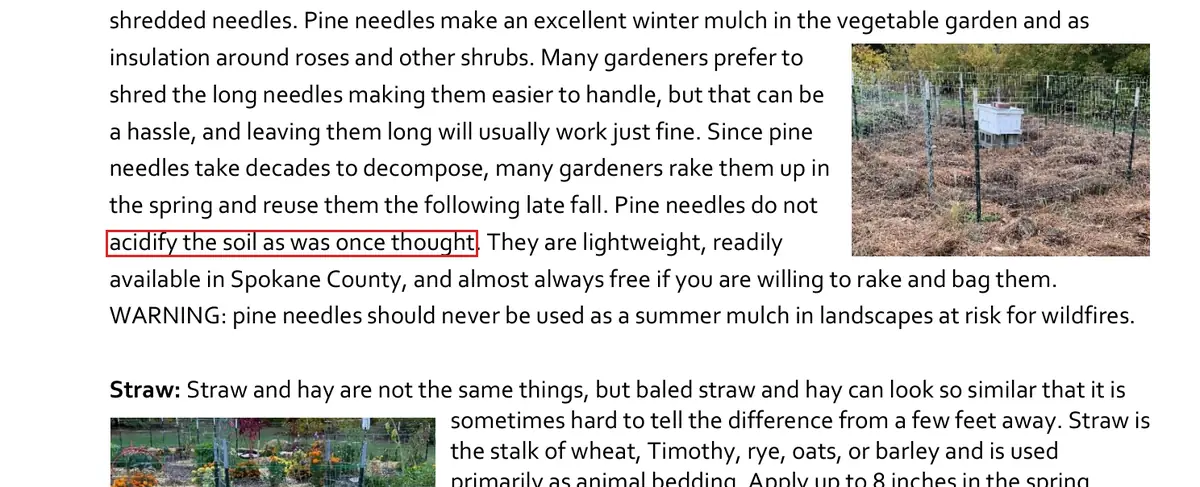
Fresh pine needles read pH 3.2 to 3.8, but Oregon State says working them into soil gives only “a slight drop” that would not damage plants, and microbes neutralize needles left on top (OSU, 2023). UNH says a 2 to 3 inch layer will not change soil pH enough to measure, and WSU says needles “do not acidify the soil as was once thought” (WSU Extension C075).
| What was measured | Setting | Soil pH before | Soil pH after | Change | Source |
|---|---|---|---|---|---|
| Fresh ponderosa pine needles (the needles themselves) | Needle tissue at drop | n/a | 3.2 to 3.8 | n/a | Oregon State, 2023 |
| 2 to 3 inch pine needle mulch | Garden soil, New Hampshire | Not stated | Not stated | Too small to measure | UNH Extension, 2019 |
| Pine straw mulch, 9 cm (3.5 in), 1 year | Field plots, Gainesville, Fla. | 5.0 | 4.4 | minus 0.6 | Duryea et al., 1999 |
| Pine plantations on former grassland or shrubland (68 comparisons) | Global meta-analysis, top 30 cm of soil | 5.7 | 5.4 | minus 0.3 | Berthrong et al., 2009 |
| Other conifer plantations | Same meta-analysis | 4.6 | 4.4 | minus 0.2 | Berthrong et al., 2009 |
| Eucalyptus plantations (a broadleaf tree) | Same meta-analysis | 6.0 | 5.3 | minus 0.7 | Berthrong et al., 2009 |
| All plantation types | Same meta-analysis | 5.6 | 5.3 | minus 0.3 | Berthrong et al., 2009 |
The pine effect is real but small. The largest drop, 0.6 unit, came from a straw layer no lawn would carry, and pine plantations moved pH less than eucalyptus plantations did. The meta-analysis points to trees taking up calcium, magnesium and potassium as a major driver (Berthrong et al., 2009).
The pine also picks its soil: eastern white pine grows best on acidic, well-drained ground, so low pH under an old pine often predates it (UNH Extension). A test can still read low there, which is why the test, not the tree, sets the lime rate.
Will lime help grass grow under pine trees?
Only when a lab test reads below your grass’s range. Asked in April 2025 whether to lime before seeding under a pine, the Ask Extension expert, pointing to Michigan State’s soil lab, said to test instead of guessing and to suspect shade first (Ask Extension #898629). Targets: 5.5 to 6.5 for tall, Chewings and creeping red fescue, 5.0 to 6.5 for hard fescue and 6.0 to 7.0 for zoysiagrass (UK AGR-214); centipedegrass wants 5.0 to 6.0 and yellows from iron shortage above 6.0 (UGA C1003).
If lime is called for, the product math is in our guide to lime for lawn soil, by grass and by bag, and sampling follows our steps for taking and reading a lawn soil test. Sample the bare zone under the pine separately from the open lawn: 2 areas, 2 reports.
How much sun reaches the ground under your pine?
Pines cast lighter shade than most shade trees: NC State groups them with poplars, ashes and birches as giving “a more open shade than maples and oaks,” hardwoods that can block nearly 95 percent of summer sun in full leaf. Under 4 hours of sun, or under 50 percent open sunlight, is too shady for turf to grow well (NC State; Clemson HGIC 1202).
But pine shade never lifts. A leafless hardwood lets about half the winter sun through (NC State); a pine sheds only its oldest needles each autumn, and Scots and Austrian pines keep theirs 3 years (Iowa State). Pines planted close together, or over an understory, cast very dense shade (NC State).
Count the hours on a clear midsummer day, checking the spot on the hour (MSU P2892; Nebraska Extension, 2024). Count only direct sun on the soil, then match the number to our ranking of grass that grows in shade by hours of sun.
How high can you limb up a pine to let in light?
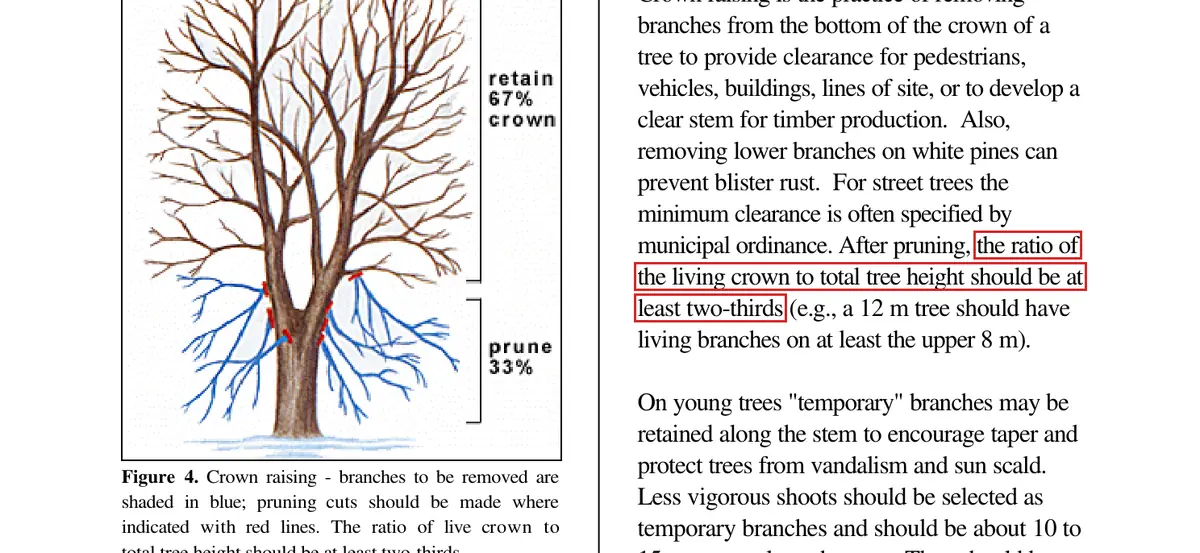
Raising the canopy adds light without losing the tree. The USDA Forest Service rule is to keep living branches on at least the top two-thirds of the height, so a 45-foot pine clears to about 15 feet, and to remove no more than one-fourth of the living branches at one time (USDA Forest Service, NA-FR-01-95; ISA, Pruning Mature Trees, 2021).
- Highest point to clear the trunk (ft)
- 15
- Live crown to keep (ft)
- 30
Default: a 45 ft pine can be cleared to 15 ft, keeping 30 ft of live crown. Worked example: a 60 ft pine, 20 ft of clear trunk and 40 ft of crown. Remove no more than one-fourth of the live branches at one time (USDA Forest Service NA-FR-01-95; ISA); if reaching the height takes more, split the work over 2 years.
- Divide the pine’s height by 3: that is the highest point to clear the trunk.
- Start below 6 feet: Clemson wants the lowest branches over 6 feet up, and NC State says limbing to 6 feet improves air movement (NC State).
- If reaching that height would remove more than 25 percent of the live branches, stop and finish next year.
- Cut just outside the branch collar, never flush and never leaving a stub; use 3 cuts on heavy limbs (USDA Forest Service).
- Prune in the dormant season to cut resin flow; on white pine, removing lower branches can also help prevent blister rust (USDA Forest Service).
Limbs that need a ladder, or hang near a roof or wires, call for an ISA Certified Arborist, and the credentials to ask for.
Roots and water: why tilling and topsoil backfire under pines
The roots that beat your grass sit where you would rake seed. ISA puts most fine tree and grass roots in the top 6 inches and warns that seedbed prep can disrupt the upper 4 to 6 inches and thin the tree’s canopy (ISA, Trees and Turf, 2021). Penn State lists pines as sensitive to root disturbance (Penn State).
So skip the tiller. Rake, scratch the surface and add no more than 2 inches of soil or compost, none within 1 foot of the trunk (Penn State); NC State allows 3 to 4 inches over surface roots, but under a pine we would stay at 2. Our guide to how much soil you can put over tree roots compares 7 published limits.
Water about 1 inch every 7 to 10 days, deeply: ISA says frequent, shallow watering helps neither tree nor turf (ISA), and Illinois says to water shade lawns as seldom as possible (Illinois).
Feed less than a sunny lawn: 1 to 2 pounds of nitrogen per 1,000 square feet a season (Illinois), or one-half to two-thirds of the sun rate (Clemson). Penn State alone advises slightly more, so the trees get a share, while warning that overfeeding hurts fine fescue (Penn State).
Are pine needles killing your grass?
Needles do their damage as a mat, not as acid. Pines shed their oldest needles each autumn, and white pines drop all of the previous year’s at once (Iowa State). In Florida, 3.5 inches of pine straw was still 1.6 inches deep a year later, and still held back lettuce seed in a lab germination test at 9 months and 1 year (Duryea et al., 1999).
That drop lands in the best window for seeding cool-season grass. Penn State says fall-seeded areas under trees must be kept free of leaves (Penn State), and NC State says to remove them frequently until grass is established, because a layered mat blocks light, air and water (NC State). Neither gives an interval; weekly raking is our reading of “frequently.”
Once grass is established, NC State allows mowing light drops in. Raked needles make free bed mulch (UNH); fire and settling data are in our pine straw vs mulch comparison.
What is the best grass for under pine trees, by region?
Match the grass to the light first and the soil second. Dry, acidic pine soil favors fine fescue in the North and centipedegrass in the Southeast.
| Region | Grass and shade cultivars | Least direct sun a source states | Best soil pH | Fit under a pine | Sources |
|---|---|---|---|---|---|
| North | Fine fescues: creeping red, Chewings, hard | 2 hours, and that gives a thin stand | 5.5 to 6.5; hard fescue 5.0 to 6.5 | Prefers drier soils (Penn State): the best match for dry pine shade | Illinois; UK AGR-214; Penn State |
| North, wet spots only | Rough bluegrass, Sabre | Heavy shade on constantly moist soil | No range in AGR-214 | Fails on the dry soil most pines create | Penn State |
| Transition zone and Piedmont | Turf-type tall fescue mix: 80% tall fescue, 10% Kentucky bluegrass, 10% fine fescue at 6 lb per 1,000 sq ft | 5 hours | 5.5 to 6.5 | Needs more light than fine fescue; limb up first | Clemson; NC State; UK AGR-214 |
| Gulf and South Atlantic coasts | St. Augustinegrass: Seville, Bitterblue, Palmetto; not Floratam | About 4 hours, or a full day of good filtered light; 4 to 6 hours to thrive | No range given; UF calls it adapted to most Florida soils | Sod, sprigs or plugs, not seed; Floratam has poor shade tolerance | MSU P2892; Clemson; UF/IFAS ENH5 |
| South and transition zone | Zoysiagrass: Zeon | Partial shade; thins in dense shade | 6.0 to 7.0 | Lime may be needed on acid pine soil; test first | Clemson; UK AGR-214 |
| Southeast | Centipedegrass | Fair shade tolerance; not heavy shade | 5.0 to 6.0 | Adapted to infertile, acidic soils; seed or sod; do not lime above 6.0 | Clemson; UGA C1003 |
| Anywhere | No lawn grass | Under 2 hours | n/a | Mulch, a native sedge or shade shrubs instead | Illinois |
Mow shade grass one-half to 1 inch higher than in sun (Clemson). Seed cool-season grass in fall, as Penn State prefers under trees, at the rates in our steps for overseeding a lawn with extension rates; if it comes up thin, work through why grass seed is not growing.
What to put under a pine when grass will not grow
Under 2 hours of direct sun, stop reseeding. ISA calls mulch the best alternative to turf around trees: 2 to 4 inches of organic material under the drip line, kept a few inches off the trunk (ISA, Trees and Turf). Under a pine, the needles already supply it.
| Option | Light and soil | Size or depth | Caution | Source |
|---|---|---|---|---|
| Needle or pine straw mulch bed | Any shade | 2 to 4 in under the drip line | WSU: never a summer mulch where wildfire is a risk | ISA; WSU C075 |
| Pennsylvania sedge (Carex pensylvanica) | Part shade to shade; dry to average soil; zone 3a | 6 to 12 in tall, spreads by rhizomes | NC State: native there but performs best in cooler climates | UW-Madison Extension; NC State Plant Toolbox |
| Acid-tolerant shade shrubs and perennials | Matches the soil many pines grow on | Plant 1 ft or more from the trunk; no soil over 2 in | Do not cut roots 2 in or thicker | Penn State |
| Avoid: English ivy, periwinkle (Vinca minor, V. major), Japanese pachysandra, creeping lilyturf (Liriope spicata), wintercreeper euonymus | Shade-tolerant, which is why they spread | n/a | On Maryland Extension’s avoid list (updated Sept. 2026), which notes wintercreeper cannot legally be sold in Maryland; older Penn State and NC State pages still suggest some of them | UMD Extension |
For shrubs, our list of plants that like acidic soil, with pH ranges for 37 plants flags which take part shade. Plant small divisions, and if you hit a root 2 inches or thicker, refill and move over (Penn State).
How we compiled this
We read 26 primary documents in November 2026: extension publications from 16 universities, ISA consumer brochures, a USDA Forest Service pruning leaflet, the Duryea 1999 mulch trial and the Berthrong 2009 meta-analysis of 153 plantation sites. The pH table copies each study’s reported numbers; we did no soil testing or field work. Hour and pH thresholds are quoted as each source states them, and where sources disagree, both are shown.
Frequently asked questions
Will lime help grass grow under pine trees?
Only if a lab soil test reads below your grass’s range: under 5.5 for tall and fine fescues or 6.0 for zoysia (UK AGR-214). Centipedegrass prefers 5.0 to 6.0, so liming it usually hurts (UGA C1003). Pine needles moved soil pH by 0.6 unit at most in the trials we compiled, so shade and roots are the likelier cause.
What is the best grass seed for under pine trees?
In the North, a fine fescue blend (creeping red, Chewings, hard), which Illinois says survives on about 2 hours of direct sun. In the transition zone, a turf-type tall fescue mix needing about 5 hours (Clemson). In the Southeast, centipedegrass seed or shade-tolerant St. Augustinegrass sod such as Seville.
Can I just throw grass seed down under a pine tree?
Not on top of needles. The expert answering Ask Extension #898629 called raking or rolling seed into contact with soil a critical step. Rake the needles off, scratch the surface without tilling, rake the seed in, and keep new needles off it until the grass is established.
Should you leave pine needles on the lawn?
Not on new or thin grass: NC State says a layered mat blocks light, air and water. On an established lawn, a light drop can be mowed in. In beds, leave them: UNH Extension says even 2 to 3 inches will not measurably change soil pH.
What is the best thing to plant under pine trees?
Where the ground gets under 2 hours of direct sun, a 2 to 4 inch needle or wood-chip mulch (ISA), Pennsylvania sedge in cooler regions (UW-Madison), or acid-tolerant shade shrubs planted 1 foot or more from the trunk (Penn State). Skip English ivy, periwinkle and Japanese pachysandra (UMD Extension).
Sources
- Oregon State University Extension (Pokorny; Detweiler), Myth vs. reality: What’s the truth behind some common gardening practices?, July 14, 2023. Accessed November 2026.
- University of New Hampshire Extension, Do pine trees and pine needles make soil more acidic?, Oct. 16, 2019. Accessed November 2026.
- Washington State University Extension, Spokane County, Guide to Mulches, C075, 2025 posting. Accessed November 2026.
- Berthrong, Jobbágy and Jackson, Ecological Applications 19(8), A global meta-analysis of soil exchangeable cations, pH, carbon, and nitrogen with afforestation, 2009. Accessed November 2026.
- Duryea, English and Hermansen, Journal of Arboriculture 25(2), A Comparison of Landscape Mulches: Chemical, Allelopathic, and Decomposition Properties, March 1999. Accessed November 2026.
- University of Kentucky Cooperative Extension, AGR-214, Table 2: pH ranges for optimum growth of lawn species, Current publication. Accessed November 2026.
- University of Georgia Extension, Centipedegrass Decline, C1003, Current publication. Accessed November 2026.
- Ask Extension (expert answer to a Wayne County, Mich. gardener), Planting grass seed under pine trees, #898629, April 29, 2025. Accessed November 2026.
- NC State Extension, Selecting and Managing Lawn Grasses for Shade, Current publication. Accessed November 2026.
- Clemson Cooperative Extension HGIC, Growing Grass in Shade, HGIC 1202, Current fact sheet. Accessed November 2026.
- Clemson Cooperative Extension HGIC, Centipedegrass, Current fact sheet. Accessed November 2026.
- Clemson Cooperative Extension HGIC, St. Augustinegrass, Current fact sheet. Accessed November 2026.
- Clemson Cooperative Extension HGIC, Zoysiagrass, Current fact sheet. Accessed November 2026.
- University of Illinois Extension, Managing shady lawns, Current page. Accessed November 2026.
- Mississippi State University Extension, Selecting and Managing Turfgrass for Shade, P2892, Current publication. Accessed November 2026.
- Nebraska Extension, Lancaster County (Browning), Lawns for Shady Areas, Feb. 25, 2024. Accessed November 2026.
- Iowa State University Extension and Outreach, Seasonal Needle Loss, Current page. Accessed November 2026.
- USDA Forest Service, Northeastern Area (Bedker, O’Brien and Mielke), copy hosted by NY DEC, How to Prune Trees, NA-FR-01-95, Leaflet. Accessed November 2026.
- International Society of Arboriculture, TreesAreGood.org, Pruning Mature Trees, 2021 edition. Accessed November 2026.
- International Society of Arboriculture, TreesAreGood.org, Trees and Turf, v02.2021. Accessed November 2026.
- Penn State Extension (Harper), Growing Turf Under Shaded Conditions, Current article. Accessed November 2026.
- Penn State Extension, Underplanting Trees: Respect the Roots, Current article. Accessed November 2026.
- UF/IFAS Extension (Trenholm et al.), St. Augustinegrass for Florida Lawns, ENH5, 2021 revision. Accessed November 2026.
- University of Maryland Extension, Groundcovers, Updated Sept. 21, 2026. Accessed November 2026.
- University of Wisconsin-Madison Extension, Alternatives to Lawn: Groundcovers, Current article. Accessed November 2026.
- NC State Extension Gardener Plant Toolbox, Carex pensylvanica, Current page. Accessed November 2026.