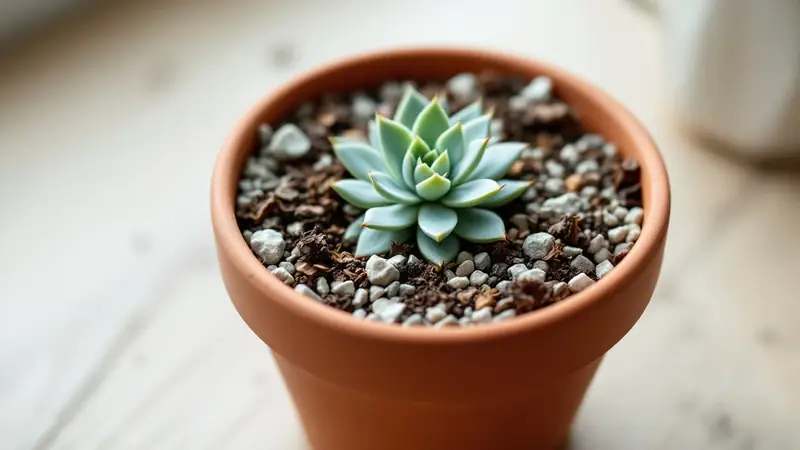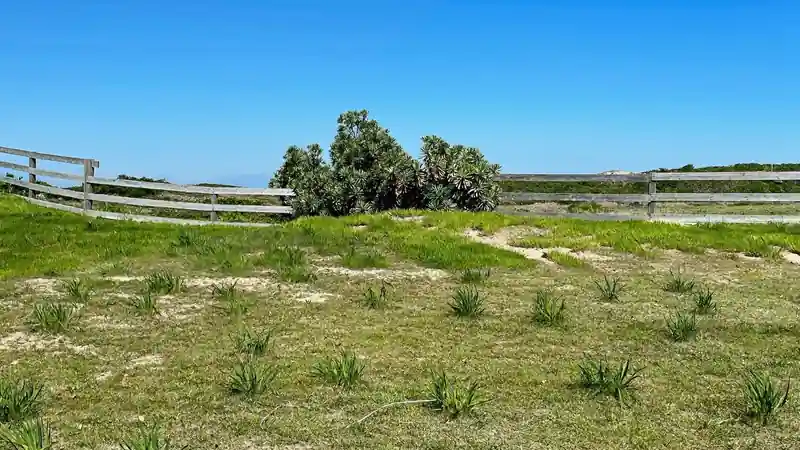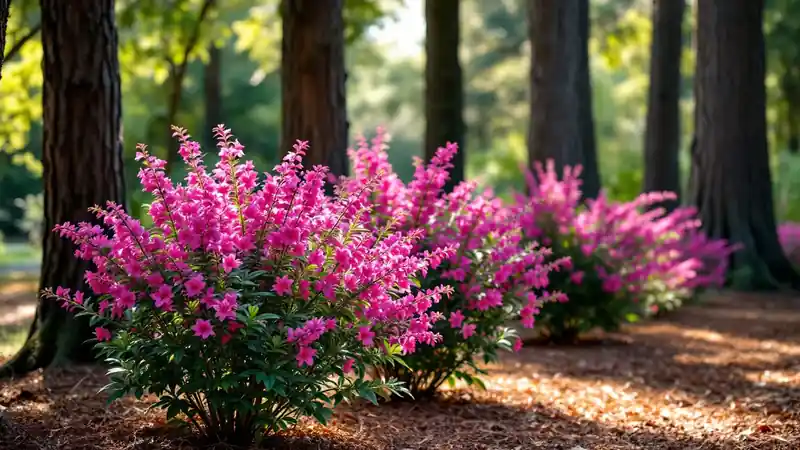
What plants like acidic soil: blueberries, azaleas, rhododendrons, camellias, gardenias, mountain laurel, pieris, heather, pin oak, hemlock and centipedegrass. Extension services put most of them between pH 4.5 and 6.0; typical garden plants want 6.0 to 7.0.
If you are asking what plants like acidic soil, the useful answer is a number for each plant, not a list of names. We compiled the published pH range for 37 landscape plants, each from an extension service or the Royal Horticultural Society, and added light and hardiness zone data from NC State’s plant database. Then we counted the University of Minnesota’s 181-plant pH appendix: only 27 plants are rated for acid soil alone.
Start with a lab number for your own ground; a color kit is too coarse for this job, and our soil test guide compares 25 state lab fees. If the reading sits above the range in the table for a plant you want, lowering soil pH with sulfur gives the pounds per 1,000 sq ft by soil texture.
Acid-loving plants: pH range, light and zones for 37 plants
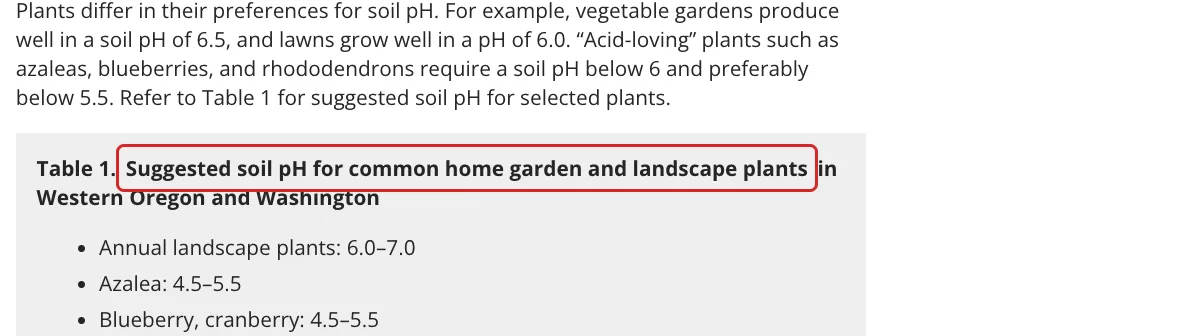
Oregon State Extension defines the group: acid-loving plants such as azaleas, blueberries and rhododendrons require a soil pH below 6 and preferably below 5.5 (EC 1560, reviewed 2026). Clemson’s HGIC 1650 sets their target at pH 5.0 to 5.5, against 5.8 to 6.5 for vegetables, grasses and most ornamentals. The table gives each plant’s published range, the source, NC State’s pH rating and the University of Minnesota rating where the plant appears.
Swipe the table sideways to see every column.
| Plant | Type | Published pH | Source | NC State pH rating | Minnesota rating | Light (NC State) | USDA zones (NC State) |
|---|---|---|---|---|---|---|---|
| Highbush blueberry (Vaccinium corymbosum) | Fruiting shrub | 4.5 to 5.5 | Oregon State EC 1560 | Acid only (below 6.0) | Acid only | Sun, Part shade | 3a to 8b |
| Lowbush blueberry (Vaccinium angustifolium) | Fruiting ground cover | Below 6.0 | NC State Toolbox | Acid only (below 6.0) | Acid only | Part shade, Dappled, Deep shade | 2a to 8b |
| Cranberry (Vaccinium macrocarpon) | Fruiting ground cover | 4.5 to 5.5 | Oregon State EC 1560 | Acid only (below 6.0) | Acid only | Sun, Part shade | 3a to 7b |
| Azalea (Rhododendron spp.) | Shrub | 4.5 to 6.0 | Clemson HGIC 1059 | Acid only (below 6.0) | Acid, slightly acid | Part shade, Dappled, Deep shade | 4a to 8b |
| Catawba rhododendron (Rhododendron catawbiense) | Shrub | 4.5 to 5.5 | Oregon State EC 1560 | Acid only (below 6.0) | Acid, slightly acid | Sun, Part shade, Deep shade | 4a to 8b |
| Camellia (Camellia japonica) | Shrub | 5.0 to 6.5 | Oregon State EC 1560 | Acid only (below 6.0) | Not listed | Part shade | 7a to 9b |
| Gardenia (Gardenia jasminoides) | Shrub | 5.0 to 6.0 | Clemson HGIC 2058 | Acid only (below 6.0) | Not listed | Sun, Part shade, Dappled | 7b to 11b |
| Bigleaf hydrangea, for blue flowers (Hydrangea macrophylla) | Shrub | 4.5 to 6.0 | Oregon State EC 1560 | Acid or Alkaline or Neutral | Not listed | Part shade, Dappled, Deep shade | 6a to 11b |
| Mountain laurel (Kalmia latifolia) | Shrub | Below 6.0 | NC State Toolbox | Acid only (below 6.0) | Not listed | Sun, Part shade, Dappled | 4a to 9b |
| Japanese pieris (andromeda) (Pieris japonica) | Shrub | Below 6.0 | NC State Toolbox | Acid only (below 6.0) | Not listed | Sun, Part shade | 4b to 8b |
| Heather (Calluna vulgaris) | Low shrub | 6.5 or less, ideally 5.5 | RHS | Acid only (below 6.0) | Not listed | Sun, Part shade | 4a to 6b |
| Dwarf fothergilla (Fothergilla gardenii) | Shrub | Below 6.0 | NC State Toolbox | Acid only (below 6.0) | Not listed | Sun, Part shade, Dappled | 5a to 8b |
| Drooping leucothoe (Leucothoe fontanesiana) | Shrub | Below 6.0 | NC State Toolbox | Acid only (below 6.0) | Not listed | Part shade, Dappled, Deep shade | 4a to 6b |
| Redvein enkianthus (Enkianthus campanulatus) | Shrub | Below 6.0 | NC State Toolbox | Acid only (below 6.0) | Not listed | Sun, Part shade | 4a to 7b |
| Inkberry holly (Ilex glabra) | Shrub | Below 6.0 | NC State Toolbox | Acid only (below 6.0) | Not listed | Sun, Part shade | 4a to 11b |
| Loropetalum (Loropetalum chinense) | Shrub | Below 6.0 | NC State Toolbox | Acid only (below 6.0) | Not listed | Sun, Part shade | 7b to 9b |
| Summersweet (Clethra alnifolia) | Shrub | Acid to neutral | NC State Toolbox | Acid or Neutral | Not listed | Sun, Part shade | 3a to 9b |
| American holly (Ilex opaca) | Tree | Acid to neutral | NC State Toolbox | Acid or Neutral | Not listed | Sun, Part shade | 5a to 9b |
| Sweetbay magnolia (Magnolia virginiana) | Tree | Below 6.0 | NC State Toolbox | Acid only (below 6.0) | Not listed | Sun, Part shade | 5a to 10b |
| Flowering dogwood (Cornus florida) | Tree | 5.2 to 6.0 | Oregon State EC 1560 | Acid or Neutral | Not listed | Sun, Part shade | 5a to 9b |
| Pin oak (Quercus palustris) | Tree | 5.0 to 6.5 | Iowa State | Acid only (below 6.0) | Acid only | Sun, Part shade | 4a to 8b |
| Red oak (Quercus rubra) | Tree | 5.0 to 6.5 | Iowa State | Acid or Neutral | Acid only | Sun, Part shade | 4a to 8b |
| White oak (Quercus alba) | Tree | 5.0 to 6.5 | Iowa State | Acid only (below 6.0) | Acid, slightly acid | Sun, Part shade | 3a to 9b |
| Red maple (Acer rubrum) | Tree | Below 6 | Minnesota BU-01731 | Acid or Neutral | Acid only | Sun, Part shade | 2a to 9b |
| Eastern white pine (Pinus strobus) | Tree | Below 6 | Minnesota BU-01731 | Acid only (below 6.0) | Acid only | Sun, Part shade | 3a to 8b |
| Eastern hemlock (Tsuga canadensis) | Tree | Below 6 | Minnesota BU-01731 | Acid only (below 6.0) | Acid only | Part shade, Dappled, Deep shade | 3a to 7b |
| Sourwood (Oxydendrum arboreum) | Tree | Below 6.0 | NC State Toolbox | Acid only (below 6.0) | Not listed | Sun, Part shade, Dappled, Deep shade | 5a to 9b |
| Serviceberry (Amelanchier canadensis) | Shrub or small tree | Below 6 | Minnesota BU-01731 | No rating | Acid only | Sun, Part shade, Dappled | 3a to 8a |
| Bearberry (Arctostaphylos uva-ursi) | Ground cover | Below 6 | Minnesota BU-01731 | Acid or Neutral | Acid only | Sun, Part shade, Dappled | 3a to 7b |
| Wintergreen (Gaultheria procumbens) | Ground cover | Below 6.0 | NC State Toolbox | Acid only (below 6.0) | Not listed | Part shade, Dappled, Deep shade | 3a to 7b |
| Japanese pachysandra (Pachysandra terminalis); spreads: UMD Extension advises against planting it | Ground cover | Below 6 | Minnesota BU-01731 | Acid only (below 6.0) | Acid only | Part shade, Deep shade | 4a to 9b |
| Christmas fern (Polystichum acrostichoides) | Fern | Below 6.0 | NC State Toolbox | Acid only (below 6.0) | Not listed | Part shade, Dappled, Deep shade | 3a to 9b |
| Cinnamon fern (Osmundastrum cinnamomeum) | Fern | Below 6.0 | NC State Toolbox | Acid only (below 6.0) | Not listed | Sun, Part shade, Dappled, Deep shade | 4a to 9b |
| Large-flowered trillium (Trillium grandiflorum) | Perennial | Acid to neutral | NC State Toolbox | Acid or Neutral | Not listed | Part shade, Dappled, Deep shade | 4a to 8b |
| Centipedegrass (Eremochloa ophiuroides) | Lawn grass | 5.0 to 6.0 | UGA C1003 | Acid only (below 6.0) | Not listed | Sun, Part shade | 7a to 10b |
| Creeping red fescue (Festuca rubra) | Lawn grass | 5.5 to 6.5 | Kentucky AGR-214 | Acid or Neutral | Not listed | Sun, Part shade, Dappled | 3a to 6b |
| Potato (Solanum tuberosum) | Vegetable | 5.0 to 5.5 | Oregon State EC 1657 | Acid only (below 6.0) | Not listed | Sun | 2a to 11b |
Two patterns stand out. Of the 37 plants, 27 carry NC State’s acid-only rating, and none of the 14 rows with a published low and high end tops out above pH 6.5. The tightest limits belong to blueberries, cranberries and rhododendrons, capped at 5.5 by Oregon State, and to the potato, which Oregon State’s EC 1657 puts at 5.0 to 5.5. Where no number is published the wording is still firm: Illinois Extension says mountain laurel requires acid soil.
Same plant, different numbers: which pH should you aim for?
Extension services write for their own soils, so the same plant gets different targets. The University of Minnesota puts blueberries, azaleas and rhododendrons at pH 4.5 to 5.2 (BU-01731, revised 2008); Oregon State says 4.5 to 5.5; Clemson says 5.0 to 5.5. Aim for the band where the sources overlap and you satisfy all of them.
| Plant | Oregon State EC 1560 | Minnesota BU-01731 | Clemson HGIC | Other extension | Overlap of all sources |
|---|---|---|---|---|---|
| Blueberry | 4.5 to 5.5 | 4.5 to 5.2 | 5.0 to 5.5 (HGIC 1650) | None | 5.0 to 5.2 |
| Azalea | 4.5 to 5.5 | 4.5 to 5.2 | 4.5 to 6.0 (HGIC 1059); 5.0 to 5.5 (HGIC 1650) | None | 5.0 to 5.2 |
| Rhododendron | 4.5 to 5.5 | 4.5 to 5.2 | 5.0 to 5.5 (HGIC 1650) | None | 5.0 to 5.2 |
| Bigleaf hydrangea, blue | 4.5 to 6.0 | Below 5.0 | None | UGA: 5.5 or lower; WSU: 3.5 to 5.5 | 4.5 to 5.0 |
| Centipedegrass | None | None | 5.5 to 6.0 (HGIC 1215) | UGA C1003: 5.0 to 6.0 | 5.5 to 6.0 |
| Pin oak | Shade trees 5.0 to 6.5 | Acid, below 6, only | None | Iowa State: 5.0 to 6.5 | 5.0 to 6.0 |
Hydrangea color is the clearest case. UGA Extension says bigleaf hydrangeas bloom blue when soil is at pH 5.5 or lower, because aluminum is more available to the roots, and turn pink at pH 7.0 or higher (UGA, Sept. 20, 2012). Linda Chalker-Scott of Washington State University cites research giving pH 3.5 to 5.5 for blue and 5.5 to 7.5 for pink, and adds that phosphorus favors pink (WSU, spring 2009). Minnesota’s threshold is stricter: below 5.0. White-flowered hydrangeas lack the pigment and do not change.
Region decides how much work the target takes. Oregon State says winter rain leaches calcium and magnesium from soils west of the Cascades, yet even there the only plants that normally need acidifying are azalea, blueberry, rhododendron and possibly camellia and dogwood. Clemson puts South Carolina soils at pH 4.5 to 6.0, and our state data on whether clay soil is acidic shows southeastern clay averaging pH 5.2 against 7.6 in the Mountain West. The sibling page on how soil forms covers the leaching itself.
Which plants need acid soil, and which only tolerate it?
Most plants on acid-loving lists tolerate acid soil rather than require it. We counted the X marks in the University of Minnesota appendix, which rates 181 landscape plants across three columns. 27 are marked for acid soil only, 17 for acid and slightly acid, 31 for all three columns, and 106 never get the acid mark (one more line, smooth sumac, carries no mark).
The 27 acid-only plants, in Minnesota’s own names: American Bittersweet, American Mountain Ash, American Redbud, Balsam Fir, Canada Hemlock, Canby Paxistima, Chokeberry, Common Bearberry, Common Chokecherry, Creeping Juniper, Eastern White Pine, European Larch, Fraser Fir, Japanese Pachysandra, Korean Rhododendron, Northern Bayberry, Norway Spruce, Pin Oak, Red Maple, Red Oak, Saucer Magnolia, Serviceberry, Staghorn Sumac, Star Magnolia, Vaccinium (blueberry, lingonberry, cranberry), White Fringetree, White Spruce.
Serviceberry, star magnolia and white fringetree from that list are also three of the earliest answers to which tree with white flowers in spring is blooming in a yard, and our identification key separates them by bloom timing, petal count and scent.
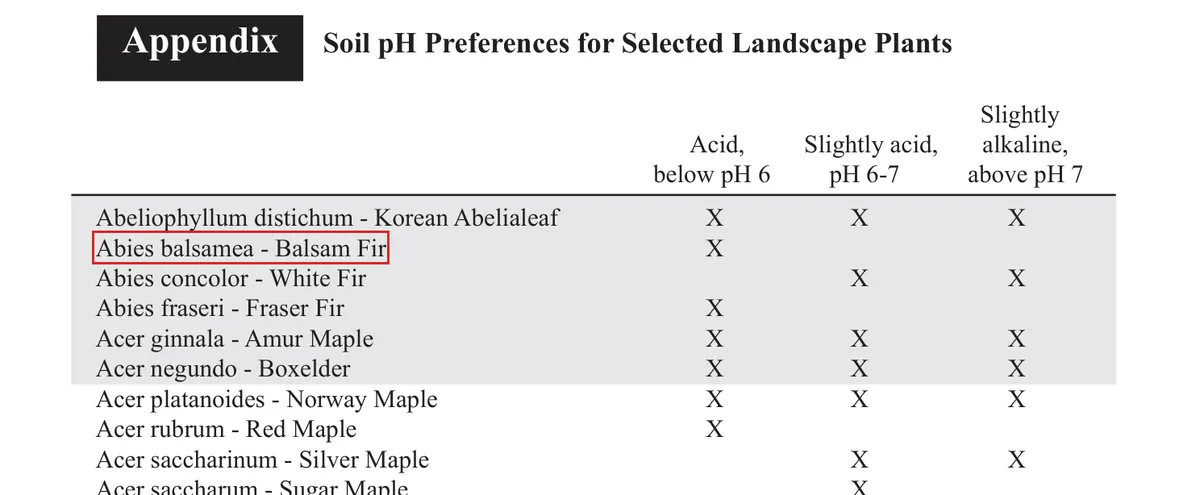
Read the appendix as a cold-climate list with a long history: its footnote credits Spurway’s 1944 Michigan State bulletin 306, modified for Minnesota, and the bulletin was revised in 2008. It skips southern plants such as camellia, gardenia and centipedegrass, which is why the main table pulls those from Clemson, Oregon State and UGA instead.
Acid-loving plants for shade, and for full sun
NC State’s database tags 12 of the 37 plants for deep shade, under 2 hours of direct sun: lowbush blueberry, azalea, Catawba rhododendron, bigleaf hydrangea, drooping leucothoe, eastern hemlock, sourwood, wintergreen, Japanese pachysandra, Christmas fern, cinnamon fern, large-flowered trillium. Japanese pachysandra carries a caveat: University of Maryland Extension lists it among groundcovers to avoid because it spreads out of bounds, so choose wintergreen or a native fern for deep shade in the Mid-Atlantic. Those suit the woodland border the shade-plant results describe, and our list of grasses that grow in shade covers the lawn side, where creeping red fescue, rated 5.5 to 6.5 by Kentucky’s AGR-214, is the acid-tolerant option.
For 6 or more hours of sun, NC State rates highbush blueberry, cranberry, pin oak, white oak, red maple, eastern white pine, loropetalum, inkberry holly and centipedegrass for full sun to part shade, and potato for full sun only. Camellia japonica is the exception among the shrubs: NC State lists it for part shade alone.
Acid-loving trees and lawn grasses
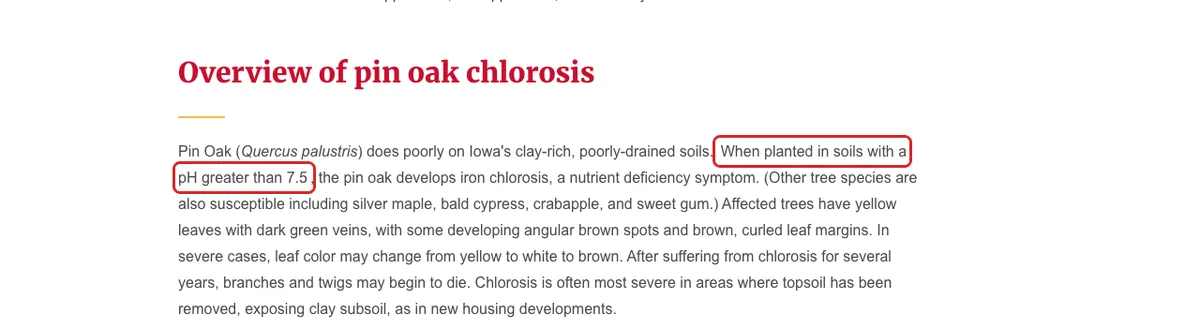
Pin oak is the tree most often in trouble. Iowa State Extension says pin oak planted in soil above pH 7.5 develops iron chlorosis and lists it with white oak, red oak and flowering dogwood in its pH 5.0 to 6.5 group (Iowa State, reviewed September 2022). Kansas State’s MF718 says iron is readily available to trees at pH 5.0 to 6.5 and names pin oak, silver maple, baldcypress and sweetgum as the most susceptible species (K-State MF718). Red maple, acid-only in the Minnesota appendix, is also the most common U.S. forest tree at 22.5 billion stems in USDA Forest Service counts, as our tally of common tree species shows.
Centipedegrass is the acid-loving lawn. UGA’s Circular 1003 says it prefers pH 5.0 to 6.0 and that iron availability falls above 6.0, turning the grass yellow; Clemson’s HGIC 1215 narrows the target to 5.5 to 6.0. Lime it only on a soil test: our centipede grass lawn guide covers the 6.0 to 6.5 zone, where sulfur goes on at 5 lb or less per 1,000 sq ft per pass. Among cool-season grasses, Kentucky’s AGR-214 gives hard fescue 5.0 to 6.5 against 6.0 to 7.0 for Kentucky bluegrass.
Signs your soil is not acidic enough
The classic sign is iron chlorosis: new leaves turn pale green or yellow while the veins stay green, often with brown edges (Oregon State EC 1560). Clemson’s HGIC 2058 says gardenias grow best at pH 5.0 to 6.0 and that soil iron becomes unavailable above 7.0, so the plant starves even when iron is present (Clemson, updated July 28, 2026).
Yellow leaves alone do not prove high pH. Oregon State notes that nitrogen shortage yellows older leaves first and without green veins, that sun or drought stress shows on the south or west side, and pictures a yellowing rhododendron in soil at pH 5.4. The same leaf check for turf is in our guide to why grass turns yellow.
1Are the older leaves yellow all over, veins included?
YesLikely nitrogen shortage, not pH: Oregon State says it shows first in older leaves without green veins.
NoGo to the next question
2Is the yellowing mostly on the south or west side of the plant?
YesLikely sun or drought stress (Oregon State). Move the plant or adjust watering before touching pH.
NoGo to the next question
3Are the newest leaves pale or yellow with green veins?
YesIron chlorosis pattern. Lab-test pH; if it reads above the plant's range in the table, lower it with sulfur and retest in 3 months.
NoTest anyway: Oregon State shows a rhododendron yellowing at pH 5.4, so check drainage and roots when pH is in range.
If the lab confirms pH above the plant’s range, the fixes are slow. UC Master Gardeners of Placer County say elemental sulfur lowers pH over 3 to 6 months and iron sulfate in about a month, at a higher rate (UC MG Placer, Dec. 11, 2025). Oregon State adds that ammonium sulfate is the most acidifying nitrogen fertilizer, twice ammonium nitrate or urea, but 3.5 lb of nitrogen per 1,000 sq ft a year moves a lawn only 0.1 to 0.2 units, so it suits drops of 0.4 or less.
Two popular shortcuts barely register. A Washington State University review reports composting coffee grounds measured anywhere from pH 4.6 to 8.4 across studies, so they cannot be counted on to acidify (WSU, Chalker-Scott), and a 2 to 3 inch layer of pine mulch changes soil pH too little to measure in UNH Extension’s view, as our pine straw vs mulch comparison details.
Peat moss does register, but only in bulk: in a 2021 pot trial, Canadian sphagnum at 10 percent of the mix took a pH 7.3 soil to 6.0 and a 50 percent mix reached 5.2, the dose math behind our page on what peat moss does for soil.
How we compiled this
On Nov. 16, 2026 we read 17 primary documents: Oregon State EC 1560 and EC 1657, Clemson HGIC 1650, 1059, 1215 and 2058, University of Minnesota BU-01731, Iowa State, Kansas State MF718, UGA C1003 and a UGA hydrangea article, Kentucky AGR-214, the RHS Calluna page, a WSU hydrangea review, WSU’s coffee grounds review, UC Master Gardeners of Placer County and Illinois Extension’s shrub selector. Light, zones and pH ratings come from NC State’s Extension Gardener Plant Toolbox records for 37 plants. We counted the Minnesota appendix marks from the PDF’s text positions and checked each page against its image. We did not grow or test any plant.
Frequently asked questions
What plants do not like acid soil?
In Minnesota’s appendix, 106 of 181 rated landscape plants never get the acid mark, including all 5 lilacs listed, common and Korean boxwood, honey locust and Japanese barberry. UC Master Gardeners of Placer County put geraniums at pH 6.0 to 6.6.
What grows well in shady acidic soil?
Rhododendrons and azaleas, drooping leucothoe, wintergreen, Japanese pachysandra, Christmas and cinnamon ferns, trillium, eastern hemlock and lowbush blueberry, all rated for deep shade (under 2 hours of direct sun) and acid soil in NC State’s plant database.
Do coffee grounds really acidify soil?
Not reliably. Washington State University reports composting grounds measured from pH 4.6 to 8.4 and says not to assume they are acidic. Use elemental sulfur at a soil-test rate instead.
Which fertilizer is best for acidic soil?
For acid-loving plants, one with ammonium nitrogen: Oregon State rates ammonium sulfate as the most acidifying, twice ammonium nitrate or urea. It lowers pH only 0.1 to 0.2 units a year, so pair it with sulfur for bigger corrections.
What vegetables like acidic soil?
Few. Oregon State’s EC 1657 puts potato at 5.0 to 5.5 and blueberries at 4.5 to 5.5, while tomatoes and carrots want 6.0 to 6.8. Clemson puts most vegetables at 5.8 to 6.5.
Sources
- Oregon State University Extension, Acidifying Soil for Blueberries and Ornamental Plants in the Yard and Garden West of the Cascade Mountains, EC 1560, Published April 2003, reviewed 2026. Accessed November 2026.
- Oregon State University Extension, Living on the Land: Managing Soil pH, EC 1657, Published January 2021, reviewed 2023. Accessed November 2026.
- Clemson Cooperative Extension, How to Change Soil pH in South Carolina, HGIC 1650, Reviewed May 13, 2026. Accessed November 2026.
- Clemson Cooperative Extension, Azalea, HGIC 1059, Updated Sept. 5, 2019. Accessed November 2026.
- Clemson Cooperative Extension, Gardenia Diseases and Other Problems, HGIC 2058, Updated July 28, 2026. Accessed November 2026.
- Clemson Cooperative Extension, Centipedegrass Yearly Maintenance Program, HGIC 1215, Updated Aug. 15, 2024. Accessed November 2026.
- University of Minnesota Extension (C. Rosen, P. Bierman, R. Eliason), Soil Test Interpretations and Fertilizer Management for Lawns, Turf, Gardens, and Landscape Plants, BU-01731, appendix, Revised 2008. Accessed November 2026.
- Iowa State University Extension and Outreach, Pin Oak Chlorosis, Last reviewed September 2022. Accessed November 2026.
- Kansas Forest Service, K-State Research and Extension, Iron Chlorosis in Trees, MF718, September 2003. Accessed November 2026.
- UGA Cooperative Extension, Centipedegrass Decline, Circular 1003, Full review June 21, 2022. Accessed November 2026.
- UGA Cooperative Extension (T. Williams), Hydrangea blooms turn colors based on soil pH levels, Sept. 20, 2012. Accessed November 2026.
- Washington State University (L. Chalker-Scott), MasterGardener, Hydrangea flower color (MasterGardener column, spring 2009), Spring 2009. Accessed November 2026.
- University of Kentucky Cooperative Extension, Liming Kentucky Lawns, AGR-214, Table 2, July 2014. Accessed November 2026.
- Royal Horticultural Society, Calluna (heather) growing guide, Current page. Accessed November 2026.
- NC State Extension, Extension Gardener Plant Toolbox, plant records for the 37 plants in the main table, Records checked November 16, 2026. Accessed November 2026.
- University of Illinois Extension, Shrub Selector: Kalmia latifolia, Current page. Accessed November 2026.
- Washington State University (L. Chalker-Scott), Coffee grounds (MasterGardener column, winter 2009), Winter 2009. Accessed November 2026.
- UC Master Gardeners of Placer County (T. Grenfell), Acid-loving Plants, Dec. 11, 2025. Accessed November 2026.