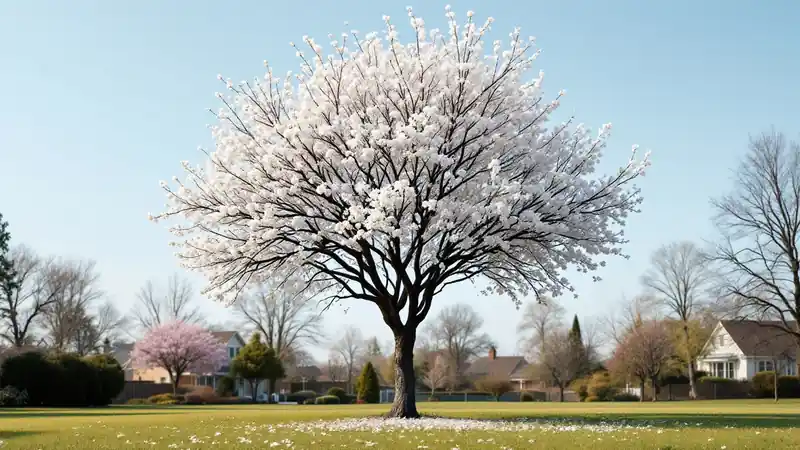
A tree with white flowers in spring is usually a Callery (Bradford) pear, serviceberry, wild plum, cherry, star magnolia or flowering dogwood. Timing, petal count and smell separate them: Callery pear smells rancid and finishes before dogwood, whose four white bracts open in April.
If you are trying to name a tree with white flowers in spring, three checks do most of the work: whether the branches are still bare, how the flower is built (5 petals, 4 bracts, a hanging bell or a long spike), and whether it smells sweet or rancid. Below is a key built on those checks, a 20-tree table with each tree’s bloom timing, flower form, smell and leaf clue taken from NC State Extension plant records and four other primary sources, and the state sale rules and swap programs for Callery pear.
The Callery pear gets extra space here because it is the one tree on the list that states are banning. NC State lists it as invasive in North Carolina and introduced in 26 states plus Washington, D.C., and Penn State calls its blossoms “infamous for their strong rancid odor” (Penn State Extension). Our overview of the most common U.S. tree species covers general tree identification; this page stays on white spring flowers.
How do you identify a tree with white flowers?
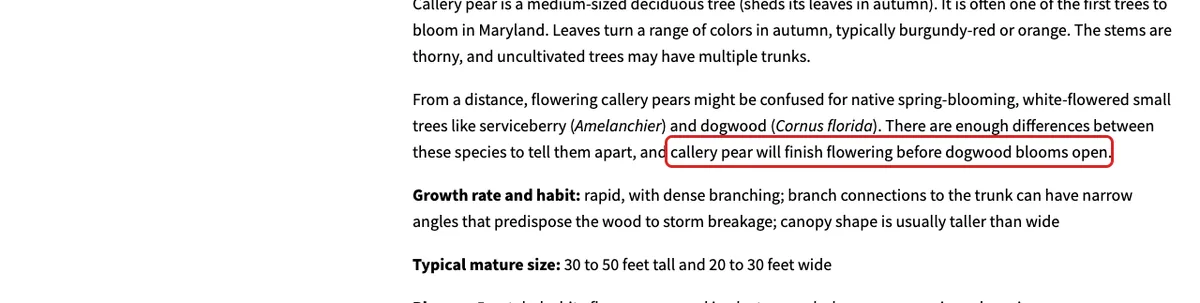
Start with the calendar and the leaves. University of Maryland Extension says Callery pear “will finish flowering before dogwood blooms open” (UMD Extension, updated Nov. 3, 2026), and NC State dates native flowering dogwood bloom to April, before its leaves, with kousa dogwood nearly a month later among full leaves (NC State). So a tree in full white bloom on bare twigs in March is almost never a dogwood.
Then look at one flower up close and answer the questions in order. Each step rules out a group; the first yes is your likely tree, and the table below confirms it by leaf and height.
1Is each "flower" 4 broad white petal-like bracts around a small green-yellow button?
YesA dogwood. On bare branches in April: flowering dogwood (Cornus florida). Pointed bracts above full leaves about a month later: kousa dogwood.
NoGo to the next question
2Are there 12 to 18 narrow strap-like petals on bare branches in late winter?
YesStar magnolia (Magnolia stellata), 3 to 4 in flowers, fragrant.
NoGo to the next question
3Do small white bells hang under the branches as leaves unfold?
YesCarolina silverbell (4 fused petals, late April to May) or, in late spring, Japanese snowbell.
NoGo to the next question
4Are the flowers pea-shaped, in hanging clusters up to 8 in, with a sweet smell?
YesBlack locust (Robinia pseudoacacia): pinnately compound leaves, April to June.
NoGo to the next question
5Are the flowers in upright cone-shaped clusters 6 in or taller over hand-shaped leaves?
YesHorse chestnut (Aesculus hippocastanum), May. The seed is poisonous.
NoGo to the next question
6Are 5-petaled flowers packed in dense balls, with a rancid smell, before or as glossy leaves appear?
YesCallery (Bradford) pear. Check for thorns on wild trees; it finishes before dogwood opens.
NoGo to the next question
7Are the 5 petals long and narrow, in loose drooping clusters of 6 to 14, very early?
YesServiceberry (Amelanchier).
NoGo to the next question
8Are small 5-petaled flowers strung along hanging finger-like spikes 3 to 6 in long, with leaves out?
YesBlack cherry (late April to May) or chokecherry (6 in clusters).
NoGo to the next question
9Are flowers in flat-topped clusters of up to 50, with an unpleasant smell and thorny twigs?
YesA hawthorn (Crataegus), April to June.
NoRound 5-petaled flowers in small clusters: American plum (2 to 5 per cluster, March to April, before leaves), Yoshino cherry (5 or 6 per cluster, slight almond scent) or apple and crabapple (pink buds, April to May). Confirm with the leaf clue in the table.
Source: NC State Extension Gardener Plant Toolbox; UMD Extension; Morton Arboretum (compiled Nov. 2026)
Two leaf checks settle most ties. Dogwoods, fringetree, horse chestnut, blackhaw, Japanese tree lilac and catalpa carry opposite leaves; every other tree in the table has alternate leaves (NC State and Morton Arboretum records). If the leaves are glossy and leathery with a wavy, round-toothed edge and the twigs carry thorns, suspect a wild Callery pear: UMD Extension lists exactly those traits, and notes uncultivated trees may have several trunks. NC State rates its growth rapid, which is why it also appears in our comparison of the fastest-growing trees.
20 white-flowering trees by bloom time, flower, smell and leaf
The table runs in rough bloom order, from star magnolia in late winter to catalpa in early summer. Bloom months shift with latitude: the NC State records describe North Carolina, so trees in Zone 5 tend to bloom later than the dates shown. The heights are NC State’s mature ranges, except horse chestnut, which comes from the Morton Arboretum.
Swipe the table sideways to see every column.
| Tree | When it blooms | Flower form | Smell | Leaf clue | Mature height | Source |
|---|---|---|---|---|---|---|
| Late winter to early spring | ||||||
| Star magnolia (Magnolia stellata) | Late winter to early spring, on bare branches | Single 3 to 4 in stars of 12 to 18 strap-shaped tepals | Fragrant | Alternate, simple, smooth-edged; flower buds tan and fuzzy | 15 to 20.5 ft | NC State |
| Callery pear, incl. Bradford (Pyrus calleryana) | Early spring, before leaves; done before dogwood opens (UMD) | 5 petals, 0.75 to 1 in, in dense 3 in clusters | Malodorous; “rancid” (Penn State) | Glossy, leathery, oval, wavy round-toothed edge; thorns on wild trees | 30 to 50 ft | NC State |
| American plum (Prunus americana) | March to April, before leaves | 5 petals, 1 in, in clusters of 2 to 5 | Aromatic | Alternate, oblong, sharply toothed; suckers into thickets | 15 to 25 ft | NC State |
| Downy serviceberry (Amelanchier arborea) | March to May, before or with leaves | 5 narrow strap petals; drooping clusters of 6 to 14 | Fragrant | Alternate, oval, finely toothed; buds long and pointed | 15 to 25 ft | NC State |
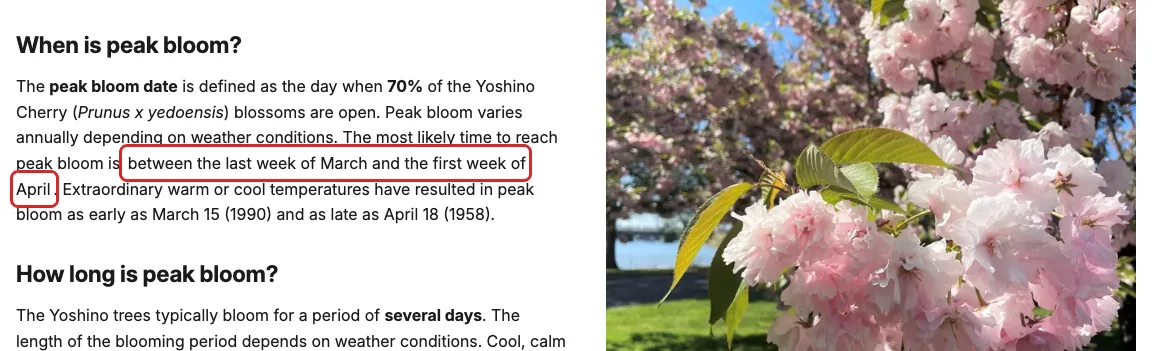
| Yoshino cherry (Prunus x yedoensis) | D.C. peak: last week of March to first week of April (NPS) | 5 petals, snow white, 5 or 6 per cluster | Slight almond | Serrated; wart-like glands where stalk meets blade | 30 to 40 ft | NC State |
| White eastern redbud (‘Alba’) (Cercis canadensis) | March to May, before leaves | Small lipped flowers under 1 in, clustered on bare twigs | Not noted | Heart-shaped, smooth-edged | 20 to 30 ft | NC State |
| Mid-spring | ||||||
| Flowering dogwood (Cornus florida) | April, before leaves | 4 white bracts around a button of tiny flowers; 3 to 6 in across | Not noted | Opposite; veins arch toward the tip | 15 to 25 ft | NC State |
| Carolina silverbell (Halesia tetraptera) | Late April to May, as leaves unfold | Hanging bells, 0.5 to 0.75 in, in groups of 2 to 5 | Not noted | Alternate, oblong, toothed | 10 to 40 ft | NC State |
| Apple and white crabapples (Malus) | April to May, 1 to 2 weeks (CSU) | 5 petals (crabapples up to 10+), 1 to 1.5 in; pink buds | Sargent crabapple fragrant | Alternate, oval, toothed | 15 to 30 ft | NC State |
| Black cherry (Prunus serotina) | Late April to May, with leaves | Small 5-petal flowers in hanging 3 to 6 in spikes | Fragrant | Narrow, finely toothed | 60 to 80 ft | NC State |
| Chokecherry (Prunus virginiana) | April and May | 0.5 in cup-shaped flowers in 6 in clusters | Fragrant | Alternate, oval, sharply toothed | 20 to 30 ft | NC State |
| White fringetree (Chionanthus virginicus) | April to May | Ivory to white fleecy clusters 4 to 8 in long | Delicately fragrant | Opposite, simple | 12 to 30 ft | NC State |
| Late spring | ||||||
| Washington hawthorn (Crataegus phaenopyrum) | April to June; each bloom lasts up to 10 days | Flat-topped clusters of up to 50 half-inch flowers, pink anthers | “May be unpleasant”; draws midges | Alternate, lobed and toothed; thorny twigs | 25 to 30 ft | NC State |
| Horse chestnut (Aesculus hippocastanum) | May (Morton Arboretum) | Upright clusters 6 in or taller; yellow to red-speckled centers | Not noted | Opposite, palmate, 5 to 7 leaflets | 50 to 75 ft | Morton Arboretum |
| Black locust (Robinia pseudoacacia) | April to June | Pea-shaped flowers in hanging clusters up to 8 in | Very fragrant | Pinnately compound, oval leaflets | 30 to 50 ft | NC State |
| Kousa dogwood (Cornus kousa) | Late spring, about a month after flowering dogwood | 4 pointed bracts, 2 to 3 in long, above the leaves | Not noted | Opposite, oval, smooth-edged | 20 to 30 ft | NC State |
| Blackhaw viburnum (Viburnum prunifolium) | May and June | Flat 4 to 5 in clusters of quarter-inch flowers | Strongly fragrant | Opposite, oval, finely toothed | 12 to 15 ft | NC State |
| Late spring to early summer | ||||||
| Southern magnolia (Magnolia grandiflora) | May to June, a few into summer | 8 to 12 in cups of 6 to 12 petals | Fragrant | Evergreen, leathery, glossy | 60 to 80 ft | NC State |
| Japanese tree lilac (Syringa reticulata) | June, for about 2 weeks | Creamy upright clusters 6 to 12 in | Musky, privet-like | Opposite, oval, smooth-edged | 25 to 30 ft | NC State |
| Southern catalpa (Catalpa bignonioides) | Early summer | 1.5 in bells, yellow and purple spots, 6 to 12 in clusters | Flowers fragrant; crushed leaves smell | Heart-shaped, about 10 in, opposite or whorled | 30 to 60 ft | NC State |
Callery pear, serviceberry and American plum are the hardest three to tell apart. All three bloom white on bare or nearly bare branches in early spring, and all have 5-petaled flowers, so the next section compares them side by side.
Is it a Bradford pear, a serviceberry, a wild plum or a cherry?
Callery pear packs its flowers into tight, ball-shaped bundles, each flower about three-quarters of an inch across (Penn State Extension). NC State puts the cluster at about 3 inches long, with 0.75 to 1 inch flowers that are “showy, and malodorous.” Serviceberry looks airier: its 5 petals are narrow straps, and 6 to 14 flowers hang in loose 3 to 7 inch drooping clusters (NC State).
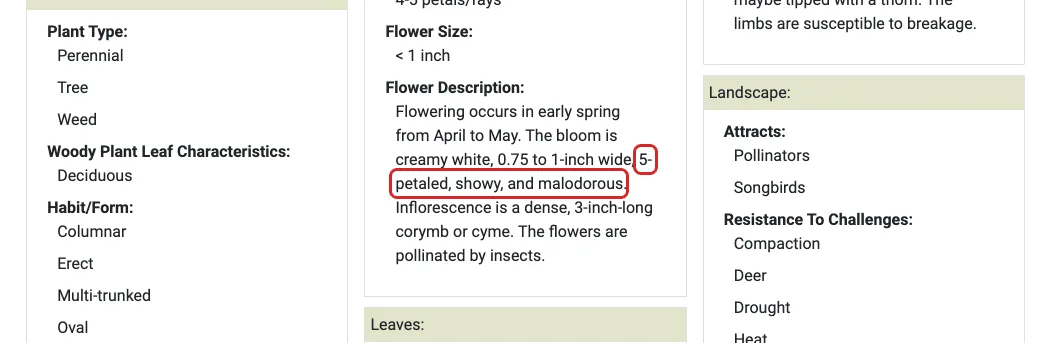
- Callery pear: dense white balls of 5-petaled flowers, a rancid smell (Penn State), glossy, leathery leaves and thorns on wild trees. Mature height 30 to 50 feet (UMD Extension).
- Serviceberry: narrow, strap-like petals in drooping clusters, flowers NC State tags as fragrant, and bloom before or with the leaves; usually 15 to 25 feet (NC State).
- American plum: round 1 inch petals in clusters of only 2 to 5, March to April before leaves, and suckers that form thickets (NC State).
- Yoshino cherry: snow-white flowers in clusters of 5 or 6 with a slight almond scent, and wart-like glands on the leaf stalk (NC State).
NC State calls Yoshino the most commonly planted cherry in the Washington, D.C., area. The National Park Service puts peak bloom there most often between the last week of March and the first week of April, with extremes of March 15 (1990) and April 18 (1958); in 2026 peak came on March 26 (NPS Bloom Watch).
Bradford is one cultivar of the species; Aristocrat, Chanticleer, Cleveland Select, Capital and Redspire are others NC State lists. The old claim that Bradford pears are sterile misses the mechanism: when different Callery cultivars grow within insect-pollination distance, they often set fertile seed that sprouts once dispersed (Penn State Extension). UMD Extension says the escaped trees form “dense, thorny thickets” in fields and meadows.
What tree with white flowers smells bad?
Callery pear is the usual culprit. Penn State describes a “strong, rancid odor” from the blossoms, and NC State tags the species malodorous. Hawthorns are the second suspect: NC State says Washington hawthorn’s odor “may be unpleasant” and attracts midges, and calls green hawthorn’s flowers unpleasant-smelling for the same reason (NC State). Hawthorns bloom later, April to June, with flat-topped clusters of up to 50 half-inch flowers and pink anthers.
Japanese tree lilac is the June case: NC State describes its creamy 6 to 12 inch clusters as having a “musky, privet-like scent.” Catalpa is a partial match; its flowers are fragrant but NC State says the leaves have “an unpleasant odor when crushed.” If the scent is sweet, the likelier trees are black locust (“very fragrant”), blackhaw (“strongly fragrant”), star magnolia, southern magnolia, fringetree, black cherry and chokecherry, all described as fragrant in their NC State records.
Which trees have white flowers in late spring and early summer?
After dogwood season, the white bloom shifts to trees in full leaf. Kousa dogwood opens about a month after flowering dogwood, with 4 pointed bracts 2 to 3 inches long sitting above the leaves. Black locust hangs pea-shaped flowers in clusters up to 8 inches long from April to June, over pinnately compound leaves (NC State). Horse chestnut holds its flowers upright in clusters 6 inches or taller in May, over hand-shaped leaves of 5 to 7 leaflets, and its seed is poisonous (Morton Arboretum).
The largest white flowers in the table belong to southern magnolia: 8 to 12 inch cups of 6 to 12 petals from May to June on an evergreen tree 60 to 80 feet tall (NC State). Southern catalpa follows in early summer with 1.5 inch bells marked by yellow ridges and purple spots, in 6 to 12 inch clusters among 10 inch heart-shaped leaves (NC State).
Which small trees have white flowers?
Five trees in the table top out at 25 feet or less in NC State’s mature ranges: blackhaw viburnum (12 to 15 feet), star magnolia (15 to 20.5 feet), downy serviceberry, flowering dogwood and American plum (15 to 25 feet each). Sargent crabapple is smaller still at 6 to 8 feet with fragrant white flowers from pink buds (NC State), though it often blooms heavily only in alternate years.
For white flowers in summer rather than spring, the crape myrtles ‘Natchez’ and ‘Acoma’ start blooming in mid to late June in Mississippi State’s cultivar table, and our guide on when to prune crape myrtles covers the late-winter cuts that keep them flowering without topping.
For a planting under power lines or near a house, the chart rules out black cherry and southern magnolia at 60 to 80 feet and horse chestnut at 50 to 75. Serviceberry, white fringetree, star magnolia and chokecherry are among the 27 plants a University of Minnesota appendix marks for acid soil only, a list our guide to plants that like acidic soil reproduces; test your soil pH before buying one. Our tree planting cost data puts a nursery-planted 15-gallon tree at about $275 to $415.
Is Bradford pear illegal, and can you trade one for a free tree?
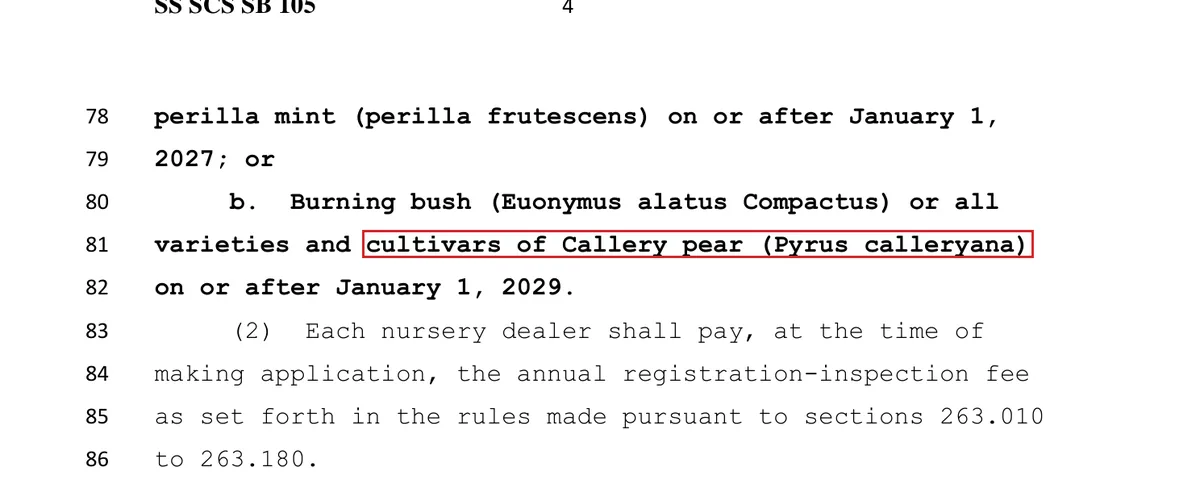
None of the rules below orders removal of trees already planted; they stop sale and propagation. Ohio’s ban on Callery pear sales took effect Jan. 7, 2023, South Carolina’s on Oct. 1, 2024, and Missouri’s starts Jan. 1, 2029 under SB 105, which covers “all varieties and cultivars” (Missouri SB 105). Five states also run swap programs that hand out a free native tree for a cut pear.
| State | Type | What it does (source) |
|---|---|---|
| Ohio | Sale ban | Callery pear on the prohibited invasive list; its exemption ended Jan. 7, 2023 (Ohio Adm. Code 901:5-30-01) |
| South Carolina | Sale ban | Added to the State Plant Pest List; nursery sales banned from Oct. 1, 2024 (Clemson, July 14, 2021; S.C. plant pest list) |
| Pennsylvania | Noxious weed | Listed as a noxious weed by the Pennsylvania Department of Agriculture |
| Missouri | Sale ban (scheduled) | Nursery dealers may not sell “all varieties and cultivars” on or after Jan. 1, 2029 (SB 105) |
| Missouri | Buyback | Photo of a cut Callery pear earns 1 free native tree per household; 2026 registration ran March 16 to April 16 (MDC, MoIP) |
| South Carolina | Bounty | Swap up to 5 Bradford pears one-for-one for free native trees; 2027 events March 6 to April 17 (Clemson Extension) |
| North Carolina | Bounty | Up to 5 trees exchanged; replacement trees free and native, first come, first served (NC Bradford Pear Bounty) |
| Kentucky | Bounty | Photo of the cut tree earns a free native tree or nursery voucher; county events since 2022, fall 2026 round announced Oct. 5, 2026 (University of Kentucky) |
| Kansas | Buyback | 1 free tree per household; Callery pears removed in 2025 or 2026 qualify (Kansas Forest Service) |
Cutting alone does not kill a Callery pear. Penn State says cut trees “will readily resprout” unless the stump gets herbicide: an oil-based mix (1:4) on the cut surface and sides any time after cutting, or a water-based mix (1:1) on the fresh cut immediately; it names glyphosate plus water-based triclopyr for foliar sprays on trees under 10 feet (Penn State Extension). The label is the law: use only a product labeled for the site, at the label rate. For a mature tree, our tree removal cost guide prices a 30 to 60 foot tree at an estimated $570 to $1,285, and stump grinding prices start at a $150 to $225 minimum.
This page is general information, not legal or pesticide advice. State plant lists and bounty dates change; confirm with the agency or program linked above before you buy, cut or spray, and follow the herbicide label.
If the pear is large or near a roof or wires, an ISA-certified arborist can fell it in sections. For a replacement, the native trees UMD Extension suggests in place of Callery pear are fringetree, serviceberry, green hawthorn, flowering dogwood and white-flowered eastern redbud (UMD Extension); mulch the new tree in a ring 3 feet wide, as our tree mulching guide details.
How we compiled this
In November 2026 we read the NC State Extension Gardener Plant Toolbox records for 22 species and kept 20, adding Morton Arboretum (horse chestnut), the National Park Service (Yoshino bloom dates) and Colorado State Extension (crabapple timing). Callery pear identification comes from UMD and Penn State Extension; sale rules from Ohio’s administrative code, Clemson, the Pennsylvania Department of Agriculture and Missouri SB 105; bounty terms from each program’s own page. We did not observe or test any trees. Bloom months are the sources’ wording for their own region.
Frequently asked questions
What kind of tree has white blossoms in early spring?
Before the leaves come out, the common ones are star magnolia (late winter), Callery pear, American plum, serviceberry, Yoshino cherry and white redbud. Flowering dogwood follows in April. In Washington, D.C., Yoshino cherries most often peak between the last week of March and the first week of April (NPS).
What tree has white flowers that smell like fish?
Almost always a Callery (Bradford) pear. Penn State Extension describes a “strong, rancid odor” from its blossoms, and NC State tags the species malodorous. Hawthorns can also smell unpleasant; their odor attracts midges, the flies that pollinate them (NC State).
What trees have fluffy white flowers?
White fringetree is the usual answer: its ivory to white flowers hang in airy 4 to 8 inch clusters in April to May (NC State). Japanese tree lilac gives a similar fluffy look in June with 6 to 12 inch upright clusters, and Callery pear’s dense balls of flowers look fluffy from a distance.
What kind of tree has very large white flowers?
Southern magnolia, with 8 to 12 inch flowers of 6 to 12 petals from May to June on an evergreen tree (NC State). Star magnolia’s flowers are 3 to 4 inches across, and flowering dogwood’s 4-bract “flowers” measure 3 to 6 inches.
Is it illegal to plant a Bradford pear?
Selling one is illegal in Ohio (since Jan. 7, 2023) and South Carolina (since Oct. 1, 2024), and Missouri bans nursery sales from Jan. 1, 2029 (SB 105). These rules target sale and propagation; none of them orders removal of trees already in yards.
Sources
- NC State Extension, Extension Gardener Plant Toolbox, Pyrus calleryana (Callery pear), current record. Accessed November 2026.
- NC State Extension, Extension Gardener Plant Toolbox, Cornus kousa (Kousa dogwood), current record. Accessed November 2026.
- NC State Extension, Extension Gardener Plant Toolbox, Cornus florida (flowering dogwood), current record. Accessed November 2026.
- NC State Extension, Extension Gardener Plant Toolbox, Amelanchier arborea (downy serviceberry), current record. Accessed November 2026.
- NC State Extension, Extension Gardener Plant Toolbox, Prunus americana (American plum), current record. Accessed November 2026.
- NC State Extension, Extension Gardener Plant Toolbox, Prunus x yedoensis (Yoshino cherry), current record. Accessed November 2026.
- NC State Extension, Extension Gardener Plant Toolbox, Crataegus phaenopyrum (Washington hawthorn), current record. Accessed November 2026.
- NC State Extension, Extension Gardener Plant Toolbox, Crataegus viridis (green hawthorn), current record. Accessed November 2026.
- NC State Extension, Extension Gardener Plant Toolbox, Magnolia grandiflora (southern magnolia), current record. Accessed November 2026.
- NC State Extension, Extension Gardener Plant Toolbox, Syringa reticulata (Japanese tree lilac), current record. Accessed November 2026.
- NC State Extension, Extension Gardener Plant Toolbox, Catalpa bignonioides (southern catalpa), current record. Accessed November 2026.
- NC State Extension, Extension Gardener Plant Toolbox, Malus sargentii (Sargent crabapple), current record. Accessed November 2026.
- University of Maryland Extension, Callery (Bradford) pear, updated Nov. 3, 2026. Accessed November 2026.
- Penn State Extension, Callery pear, current. Accessed November 2026.
- Penn State Extension, Callery pear: accurate identification, current. Accessed November 2026.
- The Morton Arboretum, Horse chestnut, current. Accessed November 2026.
- National Park Service, National Mall and Memorial Parks, Bloom Watch, 2026 season. Accessed November 2026.
- Colorado State University Extension, Flowering crabapple trees, current. Accessed November 2026.
- Ohio Department of Agriculture, via Cornell Legal Information Institute, Ohio Adm. Code 901:5-30-01, Invasive plants, current Nov. 2026. Accessed November 2026.
- Clemson University News, Invasive Bradford pear, 3 other species to be banned for sale in SC, July 14, 2021. Accessed November 2026.
- Clemson University Regulatory Services, South Carolina State Plant Pest List, current Nov. 2026. Accessed November 2026.
- Pennsylvania Department of Agriculture, Controlled plant and noxious weed lists, current Nov. 2026. Accessed November 2026.
- Missouri General Assembly, SB 105 (2025), truly agreed and finally passed, 2025. Accessed November 2026.
- Missouri Department of Conservation, Have invasive pear trees? Cut them down and get a free native tree, March 10, 2026. Accessed November 2026.
- Missouri Invasive Plant Council, Callery pear buyback, 2026. Accessed November 2026.
- Clemson Cooperative Extension, Bradford Pear Bounty, 2027 dates. Accessed November 2026.
- NC Bradford Pear Bounty, Tree bounty program, 2026. Accessed November 2026.
- University of Kentucky, Martin-Gatton CAFE, Kentucky residents can trade Bradford pears for native trees at fall bounty Extension events, Oct. 5, 2026. Accessed November 2026.
- Kansas Forest Service, K-State, 2026 Callery pear buyback, 2026. Accessed November 2026.