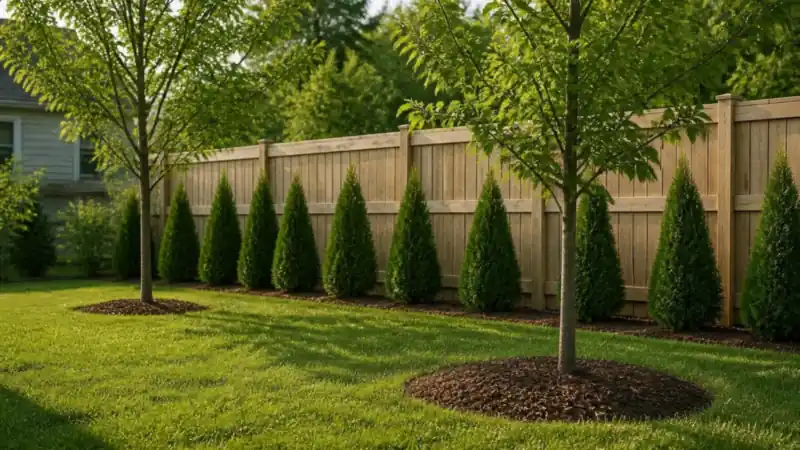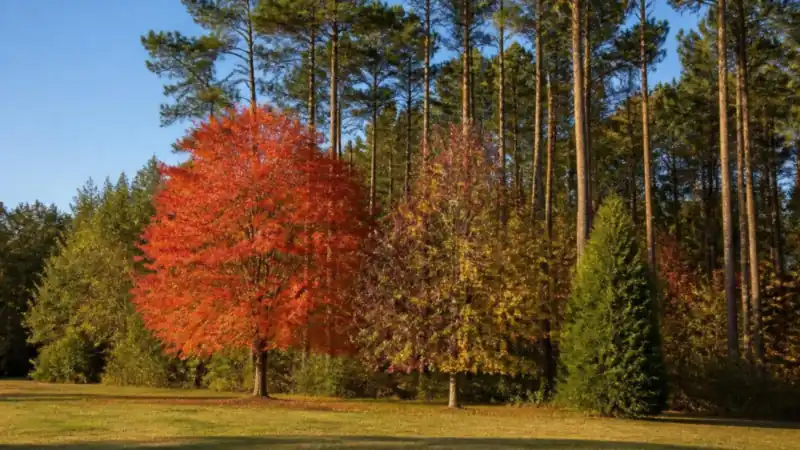
Types of trees split into two groups: conifers (softwoods such as loblolly pine) and broadleaf trees (hardwoods such as red maple). Red maple is the most common U.S. species: 22.5 billion of 341.8 billion forest trees (USDA FIA).
Key takeaways
- The USDA Forest Service counts 341.8 billion live trees at least 1 inch thick on forest land in the 48 conterminous states, spread over 426 species codes; red maple (22.46 billion), loblolly pine (19.80 billion) and sweetgum (15.25 billion) lead (FIA EVALIDator, FIADB 1.9.5, pulled October 30, 2026).
- By genus, pines lead: 41 pine species codes add up to 52.8 billion trees (15.5 percent), ahead of 60 oaks at 38.8 billion and 15 maples at 36.3 billion (FIA EVALIDator).
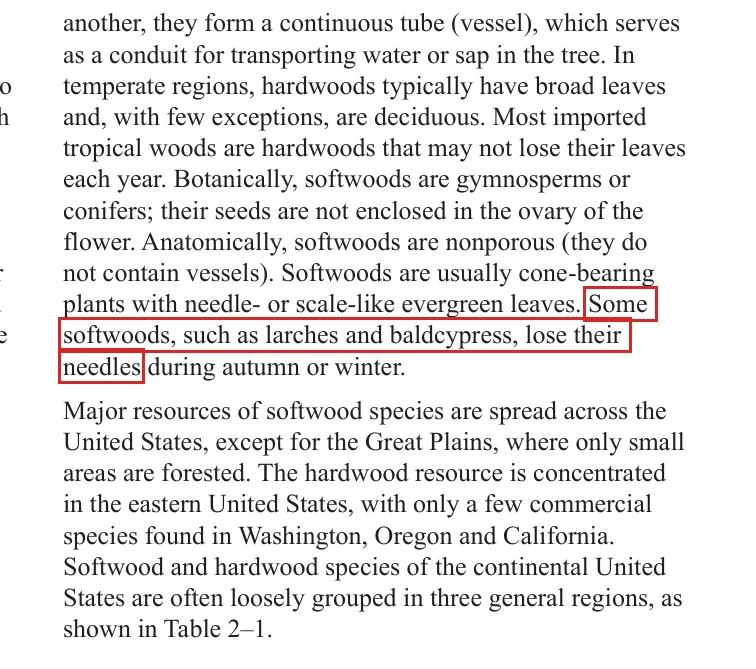
- Hardwoods (flowering trees, or angiosperms) make up 61.4 percent of U.S. forest trees and softwoods (conifers) 38.6 percent; the names do not describe hardness, and larches and baldcypress drop their needles each fall (USDA Wood Handbook, FPL-GTR-282, p. 2-2).
- Red maple is the most common tree in 9 states and loblolly pine in 7, but Douglas-fir holds the most wood: 151.1 billion cubic feet, 11.5 percent of the U.S. total (FIA EVALIDator).
- Callery (Bradford) pear can no longer be sold in Ohio (Ohio Adm. Code 901:5-30-01), and FIA already counts 159 million Callery pears and 334 million trees of heaven on U.S. forest land.
What are the main types of trees?
Botanists sort trees into two groups by how they carry seed. Conifers (gymnosperms) bear naked seeds, usually in cones, and their wood is called softwood; broadleaf trees (angiosperms) enclose seeds in a fruit, and their wood is called hardwood (USDA Forest Products Laboratory, Wood Handbook, 2021). In the FIA count, broadleaf trees make up 61.4 percent of U.S. forest trees and conifers 38.6 percent.
A second split, evergreen or deciduous, describes whether a tree keeps its leaves through winter. It does not line up perfectly with the first. The Wood Handbook names larches and baldcypress as conifers that lose their needles in autumn or winter, and Virginia Tech lists live oak, American holly and southern magnolia as broadleaf evergreens (Virginia Tech Dendrology). The four combinations give the four types of trees most lists describe.
| Type | What it looks like | Most common U.S. examples (live trees on forest land) | Source |
|---|---|---|---|
| Evergreen conifer | Needles or scales kept 2 or more years; cones | Loblolly pine (19.80 billion), balsam fir (14.20 billion), Douglas-fir (10.20 billion) | VT: loblolly; FIA |
| Deciduous conifer | Needles turn yellow and drop each fall | Tamarack (1,451 million), baldcypress (513 million) | VT: tamarack; Wood Handbook |
| Evergreen broadleaf | Thick, leathery leaves kept through winter | American holly (3.09 billion), live oak (1,195 million), southern magnolia (263 million) | VT: holly; VT: magnolia |
| Deciduous broadleaf | Flat leaves drop in fall; most U.S. hardwoods | Red maple (22.46 billion), sweetgum (15.25 billion), quaking aspen (10.64 billion) | VT: red maple; Wood Handbook |
Palms sit outside both groups: they are flowering plants, but they do not lay down annual wood rings the way hardwoods do. FIA still tallies them as trees, and it counts 169 million cabbage palmettos on U.S. forest land, almost all of them in the Southeast (FIA EVALIDator).
How many types of trees are there?
About 73,000 tree species grow worldwide, according to a 2022 estimate that also put roughly 9,000 of them still undescribed (Cazzolla Gatti et al., PNAS 119(6), 2022). The contiguous United States has 881 native tree species, 294 of them found nowhere else (Morton Arboretum and partners, 2022 checklist). FIA records 426 tree codes on U.S. forest land.
| Measure | Figure | Source |
|---|---|---|
| Tree species worldwide (estimate) | About 73,000, with about 9,000 undiscovered | Cazzolla Gatti et al., PNAS, 2022 |
| Native tree species, contiguous U.S. | 881 (294 endemic) | Morton Arboretum, Plants, People, Planet, 2022 |
| Native U.S. tree species threatened with extinction | About 11 to 16 percent | Morton Arboretum, 2022 |
| Tree codes FIA recorded on forest land, 48 states | 426 (413 at species or variety level; the rest are genus groups such as hawthorn spp.) | FIA EVALIDator, FIADB 1.9.5 |
| Live trees at least 1 inch d.b.h. on forest land, 48 states | 341.8 billion (sampling error 0.28 percent; 130,812 plots) | FIA EVALIDator |
| Share held by the 10 most common species | 37.2 percent | FIA EVALIDator |
| Share held by the 20 most common species | 51.7 percent | FIA EVALIDator |
| Net wood volume, live trees at least 5 inches d.b.h. | 1,314 billion cubic feet | FIA EVALIDator |
Twenty species hold just over half of all U.S. forest trees (51.7 percent), and the other 406 codes share the rest. That concentration is why a list of 25 species covers most of what a hiker or homeowner sees in eastern and western woods.
What are the most common trees in the United States?
Red maple is the most common tree in the United States, with an estimated 22.46 billion live trees on forest land, 6.6 percent of the total. Loblolly pine (19.80 billion) and sweetgum (15.25 billion) follow, then balsam fir, quaking aspen and Douglas-fir, per the USDA Forest Service FIA program (data pulled October 30, 2026).
Swipe the table sideways to see every column.
| Rank | Species | Type | Live trees (billions) | Share of U.S. trees | Sampling error | States where it ranks first | Mature height (source) |
|---|---|---|---|---|---|---|---|
| 1 | Red maple (Acer rubrum) | Broadleaf, deciduous | 22.46 | 6.57% | 0.9% | 9 | Up to 90 ft (VT) |
| 2 | Loblolly pine (Pinus taeda) | Conifer, evergreen | 19.80 | 5.79% | 1.3% | 7 | Over 100 ft (VT) |
| 3 | Sweetgum (Liquidambar styraciflua) | Broadleaf, deciduous | 15.25 | 4.46% | 1.2% | 0 | To 80 ft (VT) |
| 4 | Balsam fir (Abies balsamea) | Conifer, evergreen | 14.20 | 4.15% | 1.8% | 3 | To 80 ft (VT) |
| 5 | Quaking aspen (Populus tremuloides) | Broadleaf, deciduous | 10.64 | 3.11% | 1.8% | 2 | 30 to 40 ft (VT) |
| 6 | Douglas-fir (Pseudotsuga menziesii) | Conifer, evergreen | 10.20 | 2.99% | 1.2% | 2 | 40 to 80 ft in landscapes (NC State) |
| 7 | Lodgepole pine (Pinus contorta) | Conifer, evergreen | 9.60 | 2.81% | 2.5% | 3 | Up to 80 ft (VT) |
| 8 | American beech (Fagus grandifolia) | Broadleaf, deciduous | 8.73 | 2.56% | 1.5% | 2 | Up to 100 ft (VT) |
| 9 | Sugar maple (Acer saccharum) | Broadleaf, deciduous | 8.57 | 2.51% | 1.2% | 2 | To 100 ft (VT) |
| 10 | Gambel oak (Quercus gambelii) | Broadleaf, deciduous | 7.83 | 2.29% | 3.3% | 2 | To 65 ft or a shrub (VT) |
| 11 | Subalpine fir (Abies lasiocarpa) | Conifer, evergreen | 6.89 | 2.02% | 2.2% | 0 | 40 to 100 ft (VT) |
| 12 | Water oak (Quercus nigra) | Broadleaf, deciduous | 5.36 | 1.57% | 1.7% | 0 | 50 to 80 ft (NC State) |
| 13 | Yellow-poplar (Liriodendron tulipifera) | Broadleaf, deciduous | 5.02 | 1.47% | 1.9% | 0 | Over 100 ft (VT) |
| 14 | Eastern redcedar (Juniperus virginiana) | Conifer, evergreen | 4.90 | 1.43% | 1.9% | 2 | Up to 60 ft (VT) |
| 15 | Winged elm (Ulmus alata) | Broadleaf, deciduous | 4.90 | 1.43% | 1.7% | 1 | 40 to 60 ft (NC State) |
| 16 | Ponderosa pine (Pinus ponderosa) | Conifer, evergreen | 4.89 | 1.43% | 1.9% | 1 | 60 to 125 ft (NC State) |
| 17 | Eastern hophornbeam (Ostrya virginiana) | Broadleaf, deciduous | 4.68 | 1.37% | 1.8% | 0 | Up to 40 ft (VT) |
| 18 | Blackgum (Nyssa sylvatica) | Broadleaf, deciduous | 4.46 | 1.31% | 1.5% | 0 | Up to 80 ft (VT) |
| 19 | White oak (Quercus alba) | Broadleaf, deciduous | 4.27 | 1.25% | 1.4% | 0 | Up to 100 ft (VT) |
| 20 | Black cherry (Prunus serotina) | Broadleaf, deciduous | 4.19 | 1.23% | 1.4% | 0 | Near 100 ft (VT) |
| 21 | Red spruce (Picea rubens) | Conifer, evergreen | 4.09 | 1.20% | 3.2% | 0 | 60 to 80 ft (VT) |
| 22 | American hornbeam (Carpinus caroliniana) | Broadleaf, deciduous | 3.58 | 1.05% | 2.2% | 0 | Up to 25 ft (VT) |
| 23 | Green ash (Fraxinus pennsylvanica) | Broadleaf, deciduous | 3.56 | 1.04% | 2.2% | 1 | To 70 ft (VT) |
| 24 | Two-needle pinyon (Pinus edulis) | Conifer, evergreen | 3.43 | 1.00% | 2.0% | 2 | Up to 45 ft (VT) |
| 25 | Engelmann spruce (Picea engelmannii) | Conifer, evergreen | 3.40 | 1.00% | 2.4% | 0 | 80 to 100 ft (VT) |
Counts favor small, numerous stems. FIA tallies every live tree from 1 inch in diameter at breast height, so understory species such as eastern hophornbeam (4.68 billion) and American hornbeam (3.58 billion), which Virginia Tech puts at up to 25 feet, rank in the top 25 alongside timber trees. Sampling error stays under 3.5 percent for every species in the table.
Which type of tree holds the most wood?
Douglas-fir holds the most wood of any U.S. tree: 151.1 billion cubic feet of net volume, 11.5 percent of the national total, though it ranks sixth by number of trees. Loblolly pine is second at 136.9 billion cubic feet, and red maple drops to third (FIA EVALIDator).
| Species | Rank by tree count | Live trees (billions) | Rank by wood volume | Net volume (billion cu ft) | Worked: cubic feet per counted tree |
|---|---|---|---|---|---|
| Douglas-fir | 6 | 10.20 | 1 | 151.1 | 151.1 / 10.20 = 14.8 |
| Loblolly pine | 2 | 19.80 | 2 | 136.9 | 136.9 / 19.80 = 6.9 |
| Red maple | 1 | 22.46 | 3 | 57.2 | 57.2 / 22.46 = 2.5 |
| Yellow-poplar | 13 | 5.02 | 4 | 48.0 | 48.0 / 5.02 = 9.6 |
| Ponderosa pine | 16 | 4.89 | 5 | 45.7 | 45.7 / 4.89 = 9.4 |
| Sweetgum | 3 | 15.25 | 9 | 29.1 | 29.1 / 15.25 = 1.9 |
| Balsam fir | 4 | 14.20 | 46 | 6.9 | 6.9 / 14.20 = 0.5 |
The last column explains the gap. A counted Douglas-fir carries about 14.8 cubic feet of wood against 2.5 for a red maple and 0.5 for a balsam fir, whose stands are crowded with saplings. Gambel oak and two-needle pinyon, both top-25 by count, report no merchantable volume in this FIA attribute because they are woodland species measured at the root collar.
Are pines, oaks or maples the most common type of tree?
Pines are the most common type of tree in the United States when species are grouped by genus: 41 pine codes total 52.8 billion trees, 15.5 percent of the count. Oaks are second with 38.8 billion across 60 codes, and maples third with 36.3 billion, of which red maple alone supplies 22.5 billion (FIA EVALIDator).
| Genus | FIA species codes | Live trees (billions) | Share | Most numerous member |
|---|---|---|---|---|
| Pines (Pinus) | 41 | 52.83 | 15.5% | Loblolly pine |
| Oaks (Quercus) | 60 | 38.84 | 11.4% | Gambel oak |
| Maples (Acer) | 15 | 36.31 | 10.6% | Red maple |
| True firs (Abies) | 10 | 27.43 | 8.0% | Balsam fir |
| Sweetgum (Liquidambar) | 1 | 15.25 | 4.5% | Sweetgum |
| Junipers and eastern redcedar (Juniperus) | 12 | 13.79 | 4.0% | Eastern redcedar |
| Aspens and cottonwoods (Populus) | 12 | 12.84 | 3.8% | Quaking aspen |
| Spruces (Picea) | 8 | 11.49 | 3.4% | Red spruce |
| Douglas-firs (Pseudotsuga) | 2 | 10.20 | 3.0% | Douglas-fir |
| Elms (Ulmus) | 8 | 9.58 | 2.8% | Winged elm |
What is the most common tree in each state?
Red maple is the most common tree in 9 states, from Connecticut to Tennessee, and loblolly pine leads 7 Southern states. Western leaders are conifers or woodland trees: Douglas-fir in Oregon and Washington, lodgepole pine in Idaho, Montana and Wyoming, Gambel oak in Colorado and Utah (FIA EVALIDator, latest state inventories).
Swipe the table sideways to see every column.
| State | Most common tree | Share of state’s live trees | Runner-up (share) | State total (billion trees) | FIA evaluation year |
|---|---|---|---|---|---|
| Alabama | Loblolly pine | 22.0% | Sweetgum (15.3%) | 15.83 | 2025 |
| Arizona | Two-needle pinyon | 17.1% | Utah juniper (14.0%) | 3.96 | 2023 |
| Arkansas | Loblolly pine | 14.5% | Sweetgum (10.2%) | 11.17 | 2025 |
| California | Tanoak | 12.1% | Douglas-fir (11.1%) | 9.81 | 2024 |
| Colorado | Gambel oak | 33.7% | Quaking aspen (14.8%) | 10.93 | 2023 |
| Connecticut | Red maple | 22.1% | Sweet birch (14.2%) | 0.72 | 2025 |
| Delaware | American holly | 31.0% | Red maple (16.5%) | 0.22 | 2025 |
| Florida | Slash pine | 14.1% | Pondcypress (12.5%) | 8.08 | 2025 |
| Georgia | Loblolly pine | 19.4% | Sweetgum (15.5%) | 14.02 | 2025 |
| Idaho | Lodgepole pine | 17.9% | Subalpine fir (16.7%) | 7.30 | 2023 |
| Illinois | American elm | 8.9% | Hackberry (7.2%) | 2.02 | 2025 |
| Indiana | Sugar maple | 16.5% | American beech (7.7%) | 2.01 | 2025 |
| Iowa | Hackberry | 9.5% | American elm (9.2%) | 0.99 | 2026 |
| Kansas | Hackberry | 15.3% | Eastern redcedar (15.1%) | 0.90 | 2025 |
| Kentucky | Red maple | 12.0% | Sugar maple (9.0%) | 7.29 | 2024 |
| Louisiana | Loblolly pine | 21.2% | Sweetgum (13.0%) | 8.18 | 2026 |
| Maine | Balsam fir | 32.3% | Red maple (12.5%) | 22.09 | 2025 |
| Maryland | Red maple | 15.0% | Sweetgum (12.9%) | 1.29 | 2025 |
| Massachusetts | Red maple | 20.2% | Eastern white pine (12.3%) | 1.33 | 2025 |
| Michigan | Balsam fir | 14.7% | Red maple (14.2%) | 14.02 | 2025 |
| Minnesota | Quaking aspen | 22.0% | Balsam fir (12.5%) | 15.26 | 2025 |
| Mississippi | Loblolly pine | 18.9% | Sweetgum (17.0%) | 11.20 | 2025 |
| Missouri | Eastern redcedar | 11.2% | White oak (9.0%) | 7.85 | 2025 |
| Montana | Lodgepole pine | 23.4% | Douglas-fir (20.8%) | 11.86 | 2022 |
| Nebraska | Eastern redcedar | 44.0% | Hackberry (8.8%) | 0.41 | 2025 |
| Nevada | Singleleaf pinyon | 48.9% | Utah juniper (26.1%) | 2.54 | 2023 |
| New Hampshire | Balsam fir | 19.4% | American beech (12.8%) | 4.20 | 2025 |
| New Jersey | Pitch pine | 17.2% | Red maple (13.6%) | 0.73 | 2025 |
| New Mexico | Two-needle pinyon | 23.4% | Gambel oak (22.7%) | 6.02 | 2022 |
| New York | American beech | 17.7% | Red maple (11.4%) | 11.39 | 2025 |
| North Carolina | Loblolly pine | 15.8% | Red maple (14.2%) | 13.20 | 2024 |
| North Dakota | Green ash | 23.1% | Quaking aspen (15.8%) | 0.36 | 2025 |
| Ohio | Sugar maple | 14.3% | Red maple (11.2%) | 3.64 | 2025 |
| Oklahoma | Winged elm | 13.0% | Post oak (12.9%) | 5.51 | 2025 |
| Oregon | Douglas-fir | 22.3% | Lodgepole pine (18.9%) | 10.14 | 2024 |
| Pennsylvania | Red maple | 16.5% | Sweet birch (14.2%) | 7.60 | 2025 |
| Rhode Island | Red maple | 28.9% | Eastern white pine (15.0%) | 0.13 | 2025 |
| South Carolina | Loblolly pine | 23.3% | Sweetgum (20.6%) | 8.81 | 2025 |
| South Dakota | Ponderosa pine | 57.5% | Eastern hophornbeam (5.9%) | 0.64 | 2025 |
| Tennessee | Red maple | 9.6% | Yellow-poplar (7.0%) | 8.27 | 2024 |
| Texas | Honey mesquite | 14.8% | Ashe juniper (11.8%) | 18.09 | 2023 |
| Utah | Gambel oak | 32.8% | Utah juniper (12.7%) | 6.73 | 2022 |
| Vermont | American beech | 17.2% | Balsam fir (13.4%) | 3.22 | 2025 |
| Virginia | Red maple | 11.8% | Loblolly pine (10.7%) | 10.51 | 2025 |
| Washington | Douglas-fir | 21.8% | Western hemlock (18.7%) | 8.94 | 2023 |
| West Virginia | Red maple | 12.4% | American beech (11.1%) | 5.80 | 2025 |
| Wisconsin | Quaking aspen | 13.2% | Red maple (12.5%) | 11.70 | 2025 |
| Wyoming | Lodgepole pine | 36.8% | Subalpine fir (22.9%) | 4.85 | 2023 |
Alaska and Hawaii sit outside the national count. In coastal Alaska (2022 evaluation) western hemlock leads with 30.1 percent of live trees; in Hawaii (2019) the leader is strawberry guava, an introduced species, at 40.8 percent, ahead of native ohia lehua at 18.5 percent (FIA EVALIDator). South Dakota’s ponderosa pine (57.5 percent) and Nevada’s singleleaf pinyon (48.9 percent) are the most dominant state leaders; Illinois’s American elm, at 8.9 percent, is the least.
How do you identify a type of tree?
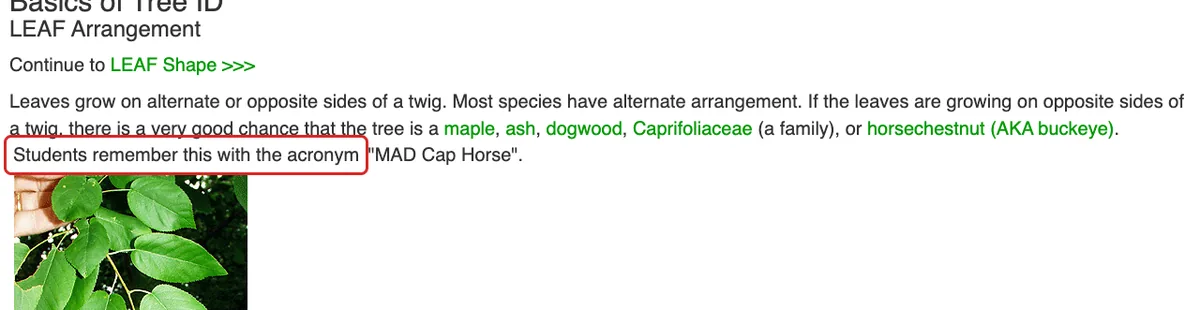
Start with the leaf. Needles or scales mean a conifer; a flat blade means a broadleaf tree. On a broadleaf, check whether leaves sit opposite each other on the twig: Virginia Tech Dendrology says most species are alternate, and opposite leaves usually point to maple, ash, dogwood, the honeysuckle family or buckeye, remembered as “MAD Cap Horse.”
- Look at the leaf type. Needles in bundles wrapped by a papery sheath are pines; single needles are spruce, fir, hemlock or Douglas-fir; tiny overlapping scales are cedars and junipers (VT: eastern redcedar).
- For pines, count needles per bundle: 2 in lodgepole pine (1.5 to 3 inches long), 3 in loblolly pine (6 to 9 inches), usually 3 in ponderosa pine (5 to 10 inches), 5 in eastern white pine (3 to 5 inches) (VT: lodgepole; loblolly; ponderosa; white pine).
- For single needles, roll one between your fingers. A sharp, 4-sided needle on a woody peg is a spruce (VT: red spruce); a flat, blunt needle silvery below is a fir (VT: balsam fir); a 1/2-inch flat needle with 2 white lines below is eastern hemlock (VT: hemlock).
- For broadleaves, check the arrangement on the twig. Opposite leaves: maple, ash, dogwood or buckeye (Ohio State Extension BYGL, 2022). Alternate: oak, beech, sweetgum, yellow-poplar, cherry and most others.
- Check simple or compound. Red maple has one 3- to 5-lobed blade; green ash has 7 to 9 leaflets on one stalk (VT: green ash); tree of heaven has 11 to 41 leaflets on a leaf 1 to 3 feet long (VT: ailanthus).
- Match the shape. Sweetgum leaves are star-shaped with 5 to 7 lobes (VT: sweetgum); yellow-poplar leaves have 4 lobes and a flat, notched top (VT: yellow-poplar); American beech leaves have 11 to 14 pairs of straight veins, each ending in a tooth (VT: beech).
1Are the needles held in bundles with a papery sheath at the base?
YesPine. Count the needles per bundle: 2 = lodgepole pine or two-needle pinyon; 3 = loblolly or ponderosa pine; 5 = eastern white pine.
NoGo to the next question
2Are the leaves tiny scales pressed flat against the twig?
YesCedar, juniper or arborvitae. Eastern redcedar is the most common, with 4.90 billion trees on U.S. forest land.
NoGo to the next question
3Are the needles single, sharp and 4-sided, each on a small woody peg?
YesSpruce: red, black or Engelmann spruce.
NoGo to the next question
4Are the needles single and flat?
YesFir, hemlock or Douglas-fir. Hemlock: 1/2-inch needles with 2 white lines below. Douglas-fir: cones with 3-lobed bracts. Fir: blunt needles, silvery below.
NoGo to the next question
5Do the leaves grow in opposite pairs on the twig?
YesMaple, ash, dogwood or buckeye. One lobed blade = maple; 7 to 9 leaflets = green ash.
NoGo to the next question
6Is each leaf made of several leaflets on one stalk?
YesAlternate compound leaf: hickory, walnut, honey mesquite or tree of heaven (11 to 41 leaflets).
NoAlternate simple leaf: oak if lobed or bristle-tipped with acorns; sweetgum if star-shaped; yellow-poplar if 4-lobed with a flat top; beech if each straight vein ends in a tooth.
Swipe the table sideways to see every column.
| Tree | Leaf or needle clue | Length | Source |
|---|---|---|---|
| Loblolly pine | Needles in bundles of 3 (usually) | 6 to 9 in. | VT |
| Ponderosa pine | Bundles of 3, sometimes 2 | 5 to 10 in. | VT |
| Lodgepole pine | Bundles of 2, twisted | 1.5 to 3 in. | VT |
| Two-needle pinyon | Bundles of 2 (usually), stiff and curved | 1 to 2 in. | VT |
| Eastern white pine | Bundles of 5, soft | 3 to 5 in. | VT |
| Red spruce | Single, 4-sided, sharp, on woody pegs | 1/2 to 5/8 in. | VT |
| Balsam fir | Single, flat, blunt or notched, silvery-blue below | About 3/4 in. | VT |
| Eastern hemlock | Single, flat, 2 white lines below | About 1/2 in. | VT |
| Douglas-fir | Single, no woody pegs, blunt tips, fragrant | 3/4 to 1 1/4 in. | VT |
| Tamarack | Clusters on spur shoots, soft; turns yellow and drops in fall | 3/4 to 1 in. | VT |
| Eastern redcedar | Scales 1/16 in., plus needle-like juvenile leaves | 1/16 to 1/4 in. | VT |
| Red maple | Opposite, simple, 3 to 5 lobes, toothed | 2 to 4 in. | VT |
| Sugar maple | Opposite, simple, 5 rounded lobes, smooth edge | 3 to 6 in. | VT |
| Green ash | Opposite, compound, 7 to 9 leaflets | 6 to 9 in. (whole leaf) | VT |
| Sweetgum | Alternate, star-shaped, 5 to 7 lobes | 4 to 6 in. across | VT |
| White oak | Alternate, 7 to 10 rounded lobes | 4 to 7 in. | VT |
| Quaking aspen | Alternate, nearly round, flattened leaf stalk | 1 to 3 in. | VT |
| American holly | Alternate, evergreen, spiny-toothed | 2 to 4 in. | VT |
Which types of trees grow best in your region?
Extension services recommend different types of trees by region. Cornell lists red maple (40 to 60 ft, zone 3b) for the Northeast, UGA rates baldcypress and willow oak “very desirable” for Georgia, and New Mexico State picks desert willow (25 ft, low water) for the Southwest. Each row below names one extension publication and what it prints.
| Region | Trees the publication recommends (mature height as printed) | Type | Extension source |
|---|---|---|---|
| Northeast | Red maple (40 to 60 ft, zone 3b); northern red oak (60 to 75 ft); swamp white oak (50 to 60 ft); black gum (40 to 70 ft) | Broadleaf, deciduous | Cornell Urban Horticulture Institute, Recommended Urban Trees |
| Southeast | Baldcypress (60 to 100 ft); willow oak (40 to 60 ft); Shumard oak (55 to 80 ft); tulip poplar (80 to 100 ft); all rated “very desirable”, zones 6 to 8 | Deciduous conifer and broadleaves | UGA Extension Circular 1013, Shade Trees for Georgia (reviewed Aug. 2026) |
| Midwest | Bur oak (50 to 80 ft); Kentucky coffeetree (60 ft); swamp white oak (60 ft); American linden (60 ft) | Broadleaf, deciduous | Iowa State Extension, Shade Trees for Iowa (updated June 2025) |
| Great Plains | Bur oak and Shumard oak (over 60 ft); Kentucky coffeetree and lacebark elm (40 to 60 ft); chinkapin oak (20 to 40 ft table) | Broadleaf, deciduous | K-State Research and Extension MF-2688 (2005) |
| Southwest | Desert willow (25 ft, low water); mesquite (20 ft, low water); western hackberry (30 ft); soapberry (40 ft) | Broadleaf, deciduous | NMSU Guide H-426, Shade Trees for New Mexico (rev. 2009) |
| Mountain West | Bur oak and Kentucky coffeetree (slow, low water); common hackberry and chinkapin oak (moderate, low water); no heights printed | Broadleaf, deciduous | Colorado State Extension Fact Sheet 7.419 (reviewed Aug. 2025) |
| Pacific Northwest | Douglas-fir (75 to 150 ft); western redcedar (to 165 ft or more); Oregon white oak (to 100 ft or more); vine maple (15 to 30 ft) | Conifers and broadleaves, all native | Oregon State Extension EC 1577 (rev. Oct. 2022) |
| California (Central Valley) | Southern live oak (40 to 80 ft); valley oak (70 ft or more); coast live oak (20 to 70 ft, drought-tolerant); western redbud (10 to 18 ft) | Evergreen and deciduous broadleaves | UC Master Gardeners of Fresno County, Landscape Trees (rev. Oct. 2021) |
Most of these lists favor broadleaf deciduous trees for shade, and only the Oregon and Georgia picks include a conifer. Planted size matters for cost: our tree planting cost guide prices each container size, and the fastest growing trees ranking covers growth rates in feet per year, which this page does not repeat. More species and lawn guides are in our Turf and Trees section.
Which types of trees should you not plant?
Callery (Bradford) pear, tree of heaven and Norway maple are the trees states ban from sale most often. As of October 2026, Callery pear sales are banned in 6 states, with 5 more bans dated through 2030; tree of heaven is restricted in 13 states and Norway maple in 6. FIA already counts 159 million Callery pears and 334 million trees of heaven on U.S. forest land.
In early spring those Callery pears are the trees covered in white bloom before native dogwoods open; our tree with white flowers in spring identification key separates them from serviceberry, wild plum and cherry by bloom timing, petal count and smell.
| Tree | Live trees on U.S. forest land (FIA) | Why extension services flag it | Where sale is banned or restricted (rule) | Plant instead |
|---|---|---|---|---|
| Callery pear, incl. Bradford, Cleveland Select, Aristocrat, Chanticleer (Pyrus calleryana) | 159 million | Weak crotches break with age, wind and ice; invasive and spreads by seed (NC State) | In force: Ohio, Jan. 7, 2023 (OAC 901:5-30-01); Pennsylvania, Class B noxious weed (51 Pa.B. 7711, Dec. 2021); Delaware, July 1, 2022 (3 Del. Admin. Code 806); Minnesota, restricted noxious weed, 2023 (MDA list); Maine, Jan. 1, 2024 (Ch. 273 do-not-sell list); South Carolina, Oct. 1, 2024 (S.C. Code Regs. 27-135). Scheduled: Connecticut Oct. 1, 2027 (CGS 22a-381d); Illinois Jan. 1, 2028 (Exotic Weeds Act); Massachusetts after Dec. 31, 2028 (MDAR list); Missouri Jan. 1, 2029 (SB 105); New Jersey sale ban Jan. 1, 2030 (NJDA) | Serviceberry, eastern redbud or flowering dogwood (NJDA and Rutgers alternatives list, 2026) |
| Tree of heaven (Ailanthus altissima) | 334 million | Wind-blown seed and root suckers form dense thickets; invasive in natural areas in 30 states (NC State) | Pennsylvania (49 Pa.B., 2019), Ohio, Connecticut, New Hampshire (Agr 3802.01), Vermont (Quarantine #3), Maine, Minnesota, Washington (WAC 16-752-610), Oregon (OAR 603-052-1200), Indiana (312 IAC 18-3-25), Illinois, Delaware, New Jersey | Red maple or northern red oak (NC State) |
| Norway maple (Acer platanoides) | 37 million | Shallow roots keep plants from growing under it; cultivars freely self-seed (NC State) | Massachusetts (import banned 2006, propagation 2009, MDAR); New Hampshire (Agr 3802.01); Vermont (Class B, sell-off ended July 1, 2013, Quarantine #3); Maine (Jan. 1, 2018); Delaware; New Jersey. Not banned in Connecticut or Indiana | Sugar maple or red maple (NC State) |
| Chinese tallow (Triadica sebifera) | 976 million | Escaped along the coastal Southeast from North Carolina to Texas; grows quickly to 40 ft (NC State) | Florida (FAC 5B-57.007); Texas (4 TAC 19.300) | Baldcypress or blackgum for wet sites (UGA C1013 lists baldcypress) |
| White mulberry (Morus alba) | 147 million | Naturalized in fields, forest margins and roadsides nationwide; shallow roots (NC State) | Ohio; Indiana (312 IAC 18-3-25) | Native red mulberry |
| Siberian elm (Ulmus pumila) | 70 million | Weak branches and messy habit; forms dense thickets along roadsides (NC State) | Ohio (OAC 901:5-30-01) | Hackberry or bur oak (Iowa State, CSU lists) |
| Mimosa (Albizia julibrissin) | 61 million | Weak limbs; seeds spread by wind, water and animals and are toxic to livestock and dogs (NC State) | Delaware (sale ban from May 1, 2029); New Jersey | Eastern redbud |
| Princess tree (Paulownia tomentosa) | 44 million | Adds about 15 ft a year; common along roadsides and disturbed openings (NC State) | Ohio; Connecticut; Maine (2018) | Yellow-poplar (tulip tree) |
| Russian olive (Elaeagnus angustifolia) | 14 million | Dominates stream and river banks in the central and western U.S. (NC State) | Ohio; South Carolina (Oct. 1, 2024); Connecticut; Maine (Jan. 1, 2024); Colorado (8 CCR 1203-5) | Desert willow in the Southwest (NMSU H-426) |
Chinese tallow is the most widespread of these in U.S. forests, at 976 million trees, almost all in the Gulf states. Callery pear has the widest set of sale bans, but the FIA estimate of 159 million trees carries a 15.3 percent sampling error because it turned up on only 238 plots. Existing trees stay legal everywhere listed; the rules stop sale and propagation. If you are replacing one, our fastest growing trees comparison lists the same bans for fast growers.
This page is general information, not legal advice. State plant lists change; confirm with the agency linked for your state before you buy, sell or plant.
What do popular tree lists get wrong?
Most “types of trees” lists treat evergreen as a synonym for conifer, quote species totals without a date, and rank no tree by how often it actually grows. The primary sources correct all three: the Wood Handbook names deciduous conifers, and FIA counts every species on 130,812 plots.
| Common claim | What the primary source says | Source |
|---|---|---|
| “Conifers are evergreen; broadleaf trees lose their leaves.” | Larches and baldcypress drop needles in autumn or winter; FIA counts 1,451 million tamaracks. Live oak and American holly stay green. | Wood Handbook p. 2-2; VT |
| “Hardwood trees have hard wood.” | The terms are botanical. Longleaf pine and Douglas-fir (softwoods) are typically harder than basswood and aspen (hardwoods). | Wood Handbook p. 2-2 |
| “There are about 60,000 tree species.” | The 2022 PNAS estimate is about 73,000, including about 9,000 not yet described. | Cazzolla Gatti et al., 2022 |
| “Oak is the most common tree in America.” | No single oak makes the top 9. As a genus, oaks (38.8 billion) trail pines (52.8 billion); the most common single species is red maple. | FIA EVALIDator, Oct. 2026 |
| “Bradford pear is sterile, so it cannot spread.” | NC State lists Callery pear, the species behind Bradford, as invasive and reproducing by seed; FIA counts 159 million on U.S. forest land. | NC State Extension; EVALIDator |
Which type of tree should you plant?
Pick the type from the job the tree must do, then the species from your region’s extension list. Evergreen conifers screen year-round; deciduous broadleaves shade in summer and let winter sun through. Under power lines, Utah State University Extension holds trees to 25 feet or less at maturity (USU Extension, June 2026).
For a small flowering tree near a line or a roof, crape myrtle cultivars run from 2 feet (‘Pocomoke’) to 30 feet (‘Natchez’) in Mississippi State’s table, and our guide on when to prune crape myrtles and which cultivars stay small compares mature heights from 3 extension sources so the tree never needs topping.
| If your situation is | Do this | Why (source) |
|---|---|---|
| You need a year-round screen or windbreak | Plant an evergreen conifer suited to your zone, such as eastern redcedar (30 to 40 ft, zones 2a to 9b) | Conifers keep needle or scale leaves through winter (Wood Handbook); size and zones from NC State Extension |
| You want summer shade and winter sun on a south or west wall | Plant a deciduous broadleaf from your region’s extension list, such as red maple in the Northeast or bur oak in the Midwest | Deciduous broadleaves drop leaves in fall (Wood Handbook); picks from Cornell and Iowa State |
| Overhead power lines are within reach of the mature crown | Choose a tree 25 ft or shorter at maturity, such as flowering dogwood (15 to 25 ft) or western redbud (10 to 18 ft) | USU Extension (June 2026): taller trees risk line contact and need repeated clearance pruning; heights from NC State and UC Master Gardeners |
| The list or nursery offers green or white ash | Pick another genus | “Given enough time, EAB will kill nearly all unprotected native ash trees” (Nebraska EAB Working Group, 2017) |
| One species is already more than 5 percent of the trees on your street or lot (or one genus more than 10 percent) | Plant a different genus, and a different family if one family passes 15 percent | The 5-10-15 diversity goal in the Nebraska EAB Working Group recommendations; stricter than the 10-20-30 rule in our tree planting cost guide |
| A nursery offers Bradford, Cleveland Select, Aristocrat or Chanticleer pear | Do not buy it; all are Callery pear. Plant a native flowering tree instead | Sale banned in Ohio (OAC 901:5-30-01), Pennsylvania and South Carolina; Illinois from 2028 and Missouri from 2029 |
| Your soil stays wet or floods in the Southeast | Plant baldcypress (60 to 100 ft), a deciduous conifer | Rated “very desirable” for Georgia (UGA Circular 1013) |
| Your yard is dry and hot in the Southwest | Plant desert willow (25 ft) or mesquite (20 ft), both low-water | NMSU Guide H-426 |
| Speed matters more than lifespan | Compare species by growth rate before buying | Growth rates in feet per year are in our fastest growing trees comparison |
Swapping a banned or dying tree usually starts with removal. Our tree removal cost guide prices the job by tree size, and the stump grinding cost page covers the stump, which some species resprout from. For a tree near the house that leans or has a cracked trunk, ask an ISA-certified arborist for a risk assessment; our arborist guide explains the credentials. After planting a replacement, spread 2 to 4 inches of wood-chip mulch kept at least 6 inches from the trunk (Iowa State Extension); our mulch calculator sizes the order.
Before paying for removal, confirm the tree is really gone: Harvard Forest records show oaks and white ash breaking bud as late as late May or June 1, and our guide to telling whether a tree is dead gives the twig tests and Iowa State’s June 1 rule.
How we compiled this
We pulled live-tree counts and net volume by species from the USDA Forest Service FIADB-API (EVALIDator, FIADB 1.9.5) on October 30, 2026, using the most recent evaluation for each of the 48 conterminous states (31 states from 2025, 2 from 2026, the rest from 2022 to 2024; statewide Texas from 2023), plus one query per state for the state leaders. Classification, leaf clues and heights come from the USDA Wood Handbook, Virginia Tech dendrology fact sheets and NC State Extension; regional picks and sale bans come from extension publications and state rule texts, about 71 primary documents in all. We did no field sampling; every count is a statistical estimate with the sampling error shown.
| Recap | Figure |
|---|---|
| Most common U.S. tree (count) | Red maple, 22.46 billion (6.6%) |
| Most common genus | Pines, 52.8 billion (15.5%) |
| Most wood (volume) | Douglas-fir, 151.1 billion cu ft |
| Hardwood vs softwood share of trees | 61.4% vs 38.6% |
| States led by red maple / loblolly pine | 9 / 7 |
Frequently asked questions
What are the 4 types of trees?
Most guides mean four combinations: evergreen conifers such as loblolly pine, deciduous conifers such as tamarack and baldcypress, evergreen broadleaf trees such as American holly and live oak, and deciduous broadleaf trees such as red maple. The USDA Wood Handbook confirms the conifer exception: larches and baldcypress lose their needles in autumn or winter, so evergreen and conifer are not the same thing.
What are the two main types of trees?
Conifers and broadleaf trees. Conifers (gymnosperms) carry naked seeds, usually in cones, and produce softwood; broadleaf trees (angiosperms) enclose seeds in fruit and produce hardwood (Wood Handbook). Of the 341.8 billion live trees FIA counts on U.S. forest land, broadleaf trees make up 61.4 percent and conifers 38.6 percent (FIA EVALIDator, October 2026).
What is the most common tree in the United States?
Red maple (Acer rubrum), with about 22.46 billion live trees at least 1 inch thick on forest land in the 48 conterminous states, 6.6 percent of the total, and a sampling error under 1 percent (FIA EVALIDator, pulled October 30, 2026). It is the leading species in 9 states. Loblolly pine is second at 19.80 billion.
How many trees are there in the United States?
FIA estimates 341.8 billion live trees at least 1 inch in diameter on forest land in the 48 conterminous states, from 130,812 field plots (FIA EVALIDator, October 2026). The figure leaves out seedlings under 1 inch, trees in yards and cities outside forest land, and Alaska and Hawaii, where coastal Alaska alone adds about 6.5 billion.
Are all evergreen trees conifers?
No. American holly, live oak and southern magnolia are broadleaf trees that keep thick, leathery leaves through winter (Virginia Tech Dendrology). FIA counts 3.09 billion American hollies on U.S. forest land, more than eastern white pine. The reverse also holds: tamarack and baldcypress are conifers that drop their needles each fall (Wood Handbook).
What is the difference between hardwood and softwood trees?
The terms are botanical, not a hardness test. Hardwoods are angiosperms with seeds enclosed in a fruit and water-conducting vessels in the wood; softwoods are gymnosperms, mostly conifers, without vessels. The USDA Wood Handbook notes that softwoods such as longleaf pine and Douglas-fir are typically harder than the hardwoods basswood and aspen.
What trees have opposite leaves?
Maple, ash, dogwood, members of the honeysuckle family and buckeye (horsechestnut), remembered as “MAD Cap Horse” (Virginia Tech Dendrology). Most tree species have alternate leaves, so opposite leaves narrow the search quickly. Among conifers, dawn redwood has opposite needles and baldcypress alternate ones, per Ohio State Extension. Check buds and leaf scars in winter: they follow the same pattern.
Is a palm tree a tree?
For inventory purposes, yes: FIA counts 169 million cabbage palmettos on U.S. forest land (FIA EVALIDator). Botanically, palms differ from other trees: they have no cambium layer adding wood each year, so they form no bark or annual rings and do not keep thickening, as UF/IFAS Extension explains (Jan. 2024).
Sources
- USDA Forest Service, Forest Inventory and Analysis, EVALIDator / FIADB-API: number of live trees and net volume by species, 48 states (FIADB 1.9.5), State evaluations 2022 to 2026; pulled Oct. 30, 2026. Accessed October 2026.
- USDA Forest Service, Forest Inventory and Analysis program, Current. Accessed October 2026.
- USDA Forest Service, Forest Products Laboratory, Wood Handbook: Wood as an Engineering Material, FPL-GTR-282, Chapter 2, March 2021. Accessed October 2026.
- Cazzolla Gatti, Reich et al., The number of tree species on Earth, PNAS 119(6), 2022. Accessed October 2026.
- The Morton Arboretum and partners, Data sharing for conservation: checklist of U.S. native tree species, 2022. Accessed October 2026.
- Virginia Tech Dept. of Forest Resources and Environmental Conservation, Dendrology fact sheets (red maple, loblolly pine, sweetgum and 35 more), 2025. Accessed October 2026.
- Virginia Tech Dendrology, Basics of Tree ID: Leaf Arrangement, Current. Accessed October 2026.
- Ohio State University Extension, BYGL, Winter Tree ID, Part 2: Deciduous Trees, Jan. 28, 2022. Accessed October 2026.
- NC State Extension, Plant Toolbox species pages (water oak, winged elm, ponderosa pine, Douglas-fir, invasive species), Current. Accessed October 2026.
- UF/IFAS Extension Duval County, Are Palm Trees Really Trees?, Jan. 23, 2024. Accessed October 2026.
- Cornell Urban Horticulture Institute, Recommended Urban Trees: medium and large trees, Undated PDF. Accessed October 2026.
- University of Georgia Extension, Circular 1013, Shade Trees for Georgia, Reviewed Aug. 2026. Accessed October 2026.
- Iowa State University Extension, Shade Trees for Iowa, Updated June 10, 2025. Accessed October 2026.
- K-State Research and Extension, MF-2688, Shade and Ornamental Trees for Kansas, Sept. 2005. Accessed October 2026.
- New Mexico State University, Guide H-426, Shade Trees for New Mexico, Rev. March 2009. Accessed October 2026.
- Colorado State University Extension, Fact Sheet 7.419, Selecting Large Deciduous Trees, Reviewed Aug. 2025. Accessed October 2026.
- Oregon State University Extension, EC 1577, Gardening with Oregon Native Plants West of the Cascades, Rev. Oct. 2022. Accessed October 2026.
- UC Master Gardeners of Fresno County, Landscape Trees, Rev. Oct. 2021. Accessed October 2026.
- Utah State University Extension, What Are the Best Small Trees for Planting Near Power Lines?, June 3, 2026. Accessed October 2026.
- Nebraska Emerald Ash Borer Working Group, EAB Key Points and Recommendations, March 2017. Accessed October 2026.
- Ohio Administrative Code, via Cornell LII, 901:5-30-01, Invasive plants, Current rule. Accessed October 2026.
- Pennsylvania Bulletin, 51 Pa.B. 7711, Controlled plant and noxious weed list (Callery pear), Dec. 11, 2021. Accessed October 2026.
- Pennsylvania Bulletin, 49 Pa.B. notice, noxious weed list (tree of heaven), 2019. Accessed October 2026.
- Clemson University Regulatory Services, South Carolina State Plant Pest List (S.C. Code Regs. 27-135), Current. Accessed October 2026.
- Delaware Department of Agriculture, Nursery inspection and invasive plant sales (3 Del. Admin. Code 806), Current. Accessed October 2026.
- Minnesota Department of Agriculture, Minnesota Noxious Weed List, Current. Accessed October 2026.
- Maine DACF, Invasive terrestrial plants, Chapter 273 do-not-sell list, Current. Accessed October 2026.
- Connecticut General Assembly, General Statutes chapter 446i, sec. 22a-381d, Current. Accessed October 2026.
- Illinois Department of Natural Resources, Nine new invasive species regulated under the Exotic Weeds Act, Current. Accessed October 2026.
- Massachusetts Department of Agricultural Resources, Massachusetts Prohibited Plant List, Current. Accessed October 2026.
- Missouri Senate, SB 105 (2025), truly agreed to and finally passed, 2025. Accessed October 2026.
- New Jersey Department of Agriculture, Invasive plants program (S1029), 2026. Accessed October 2026.
- New Jersey Department of Agriculture and Rutgers, Alternatives to invasive plants, 2026. Accessed October 2026.
- New Hampshire Code of Administrative Rules, via Cornell LII, Agr 3802.01, Prohibited invasive species, Current. Accessed October 2026.
- Vermont Agency of Agriculture, Quarantine #3, Noxious Weeds, Current. Accessed October 2026.
- Washington State Legislature, WAC 16-752-610, Noxious weed seed and plant quarantine, Current. Accessed October 2026.
- Oregon Administrative Rules, via Cornell LII, OAR 603-052-1200, Quarantine: Noxious Weeds, Current. Accessed October 2026.
- Indiana DNR, 312 IAC 18-3-25, Terrestrial Plant Rule, In force 2019. Accessed October 2026.
- Florida Administrative Code, 5B-57.007, Noxious Weed List, Current. Accessed October 2026.
- Texas Administrative Code, via Cornell LII, 4 TAC 19.300, Noxious and invasive plants, Current. Accessed October 2026.
- Colorado Department of Agriculture, 8 CCR 1203-5, Nursery rules, Current. Accessed October 2026.