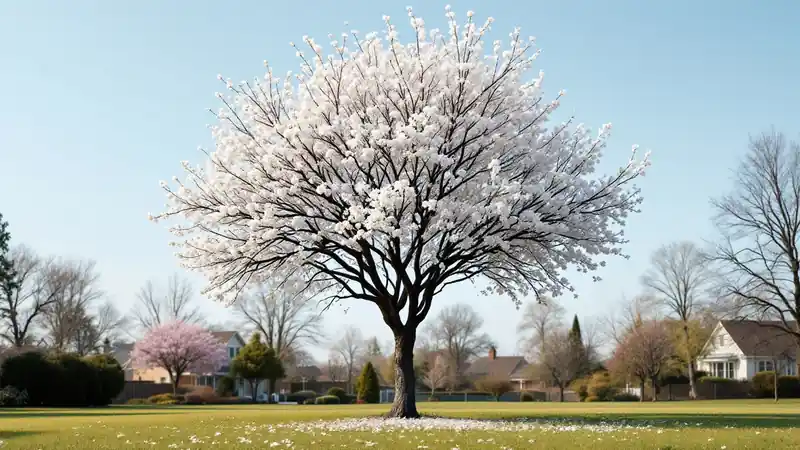
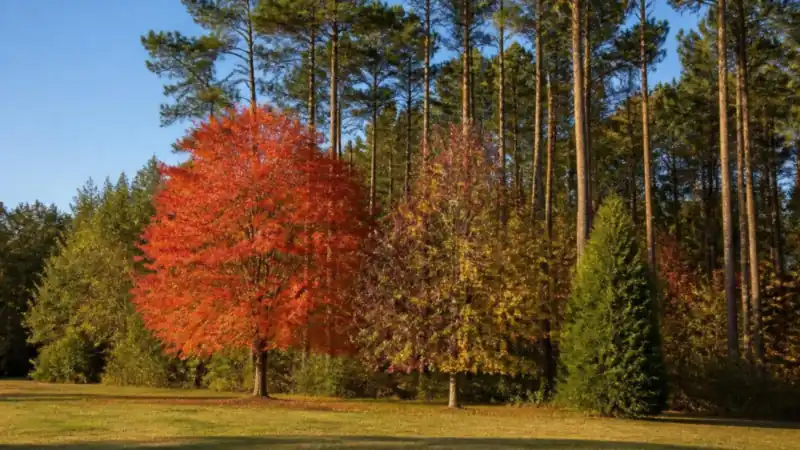
How to tell if a tree is dead: scrape a twig with a fingernail. Green, moist tissue means alive; brown and dry means that part is dead. Repeat lower down to the trunk, check inside buds, and give a bare tree until June 1.
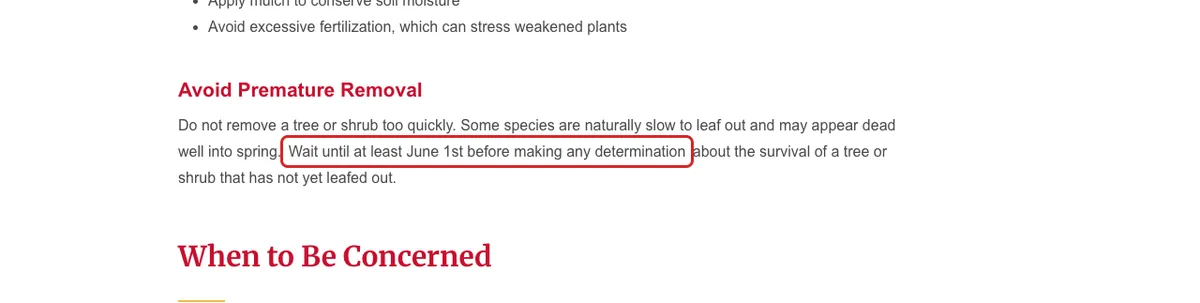
How to tell if a tree is dead comes down to finding living tissue: a thin green or cream layer just under the bark, green tissue inside the buds, or twigs that bend instead of snapping. Iowa State University Extension’s test is a gentle scratch on small twigs, where green means alive and brown, dry tissue means dieback, and its rule is to wait until at least June 1 before judging a tree that has not leafed out (Iowa State Extension, reviewed May 2026).
How late is normal? We summarized 34 springs of bud-break records for 15 species from Harvard Forest’s public phenology dataset in Massachusetts: white oak breaks bud on average 22 days after black cherry, and in 2005 single white and black oaks waited until June 1. The tests below run from twig to root, then the trunk signs that mean a tree is not only dead but dangerous.
If any part of the tree could land on a house, a driveway or a power line, do not wait for spring. The U.S. Forest Service calls dead wood “not negotiable” and says dead trees and branches “can break and fall at any time” (USDA Forest Service, NA-FR-01-96, 1996). The credential to ask for is covered in what TRAQ and the 3 A300 risk assessment levels mean.
This page is general information, not a tree risk assessment. Stay out of the fall zone of any tree that is cracked, hanging or newly leaning, and never go near branches touching power lines; ISA tells owners to call the utility instead (ISA, Recognizing Tree Risk, 2021).
The scratch test: start at the twig tips, finish at the trunk
The scratch test reads the inner bark and cambium, the living layer between the dead outer bark and the wood. Lift a fingernail-size strip with a thumbnail or pocketknife. In a living conifer the inner bark is cream-colored and moist; in a dead one it is brown (UC Master Gardeners of Placer County, adapted from CAL FIRE Tree Notes #30). On broadleaf twigs, living tissue usually shows green.
- Pick pencil-thin twigs at the tips of 3 or 4 branches on different sides of the crown. Green and moist under the bark: that twig is alive (Iowa State).
- If a twig is brown, move toward the trunk and scratch again at each fork until you reach green. Wood beyond the last green spot is dieback; Iowa State says to prune it once new growth begins.
- If every branch you can reach tests brown, scratch the trunk at chest height on 4 sides. UC Master Gardeners: “If the inner bark is dead around the entire circumference of the trunk, the tree is dead.”
- Green on only 1 to 3 sides means a non-lethal injury or a tree in the process of dying (UC Master Gardeners); read the trunk signs below.
The snap test and the bud test
A young twig on a living tree bends. NC State Extension’s version is to take a year-old twig and bend it to a 90-degree angle: if it breaks, the tree is most likely dead (NC State Extension, Caswell County, Nov. 2022).
Buds answer the question in winter. Gently peel back the bud scales: green inner bud tissue means the branch may still leaf out, while brown tissue means the branch is most likely dead and should be cut back to a live bud or branch (UW Madison Extension, Winter Burn, revised March 2, 2024). NC State adds that dry buds on new twigs are an early sign of a dead tree.
| Test | How to do it | Alive | Dead | Use it on | Source |
|---|---|---|---|---|---|
| Twig scratch | Thumbnail or knife on a pencil-thin twig | Green, moist tissue | Brown, dry tissue | Broadleaf trees and shrubs | Iowa State, 2026 |
| Trunk scratch | Small strip of outer bark at chest height, 4 sides | Cream or green, moist inner bark | Brown all the way around: whole tree dead | Trees whose twigs all test brown | UC Master Gardeners / CAL FIRE |
| Snap test | Bend a 1-year-old twig to 90 degrees | Bends | Breaks | Dormant deciduous trees | NC State, 2022 |
| Bud test | Peel back the bud scales | Green inner bud tissue | Brown bud tissue | Winter and early spring, broadleaf or evergreen | UW Madison, 2024 |
| Leaf-out date | Compare with the same species nearby | Buds swelling or leaves by June 1 | No bud swelling after June 1, or only parts of the canopy leaf out | Deciduous trees in spring | Iowa State, 2026 |
| Crown color | Look at the whole crown at once | Any green left | One uniform color through the entire crown | Pines, spruces, firs | UC Master Gardeners / CAL FIRE |
| Which needles are brown | Check inner vs outer foliage | Oldest inner needles yellow in fall | Newest outer needles brown, or whole branches dead | Conifers in fall | Iowa State, 2023 |
| Which side is brown | Walk around the tree after snowmelt | Brown on south, southwest or west side, green buds under it | The entire evergreen brown | Evergreens in spring | UW Madison, 2024 |
Dead or dormant? How late each tree leafs out
Late leaf-out is the most common false alarm. Iowa State lists black walnut, honeylocust, Kentucky coffeetree, northern catalpa, sycamore, hickory and pecan as shade trees that often leaf out later than other landscape plants, and names cool springs, late frost, anthracnose and transplant shock as further delays (Iowa State, 2026). If neighbors of the same species are bare too, the cause is the weather. If you are not sure what you have, start with how to identify the most common U.S. yard trees.
Harvard Forest shows how wide the spread is at a single site. Staff have recorded bud break, the day 50 percent of a tree’s buds show emerging leaves, on the same tagged trees every spring since 1990 (O’Keefe and VanScoy, Harvard Forest dataset HF003, 2024). From 1990 to 2023, black and white oak averaged May 12 and May 14, against April 22 for black cherry, and the latest deciduous bud break on record was June 1, 2005, on a white oak and a black oak.
Swipe the table sideways to see every column.
| Species | Springs recorded | Average bud break | Latest bud break, any tree | Average date leaves reach 75% size |
|---|---|---|---|---|
| Black cherry | 1990 to 2023 | April 22 | May 5 | May 22 |
| Quaking aspen | 1990 to 2023 | April 30 | May 17 | May 15 |
| Sugar maple | 1990 to 2023 | May 2 | May 16 | May 20 |
| Paper birch | 1990 to 2023 | May 4 | May 17 | May 22 |
| Red maple | 1990 to 2023 | May 7 | May 22 | May 28 |
| Northern red oak | 1990 to 2023 | May 8 | May 31 | May 30 |
| American beech | 1990 to 2023 | May 8 | May 18 | May 23 |
| Yellow birch | 1990 to 2023 | May 8 | May 21 | May 25 |
| Black birch | 1990 to 2023 | May 10 | May 20 | May 25 |
| White ash | 1990 to 2023 | May 12 | May 28 | June 2 |
| Black oak | 1990 to 2023 | May 12 | June 1, 2005 | June 2 |
| White oak | 1990 to 2023 | May 14 | June 1, 2005 | June 3 |
| Black gum (tupelo) | 1990 to 2001 | May 18 | May 31 | June 9 |
| Eastern hemlock | 1990 to 2001 | May 25 | June 3 | June 13 |
| Eastern white pine | 1990 to 2001 | June 6 | June 15 | July 5 |
Read the record with 2 limits. Harvard Forest is one site in central Massachusetts, so the same species leafs out earlier in the South and later farther north or higher up, and it does not track black walnut or Kentucky coffeetree. Iowa State’s signs of a real problem are no bud swelling after June 1, branches that fail the scratch test, only part of the canopy leafing out, and bark that splits or discolors.
How to tell if an evergreen tree is dead
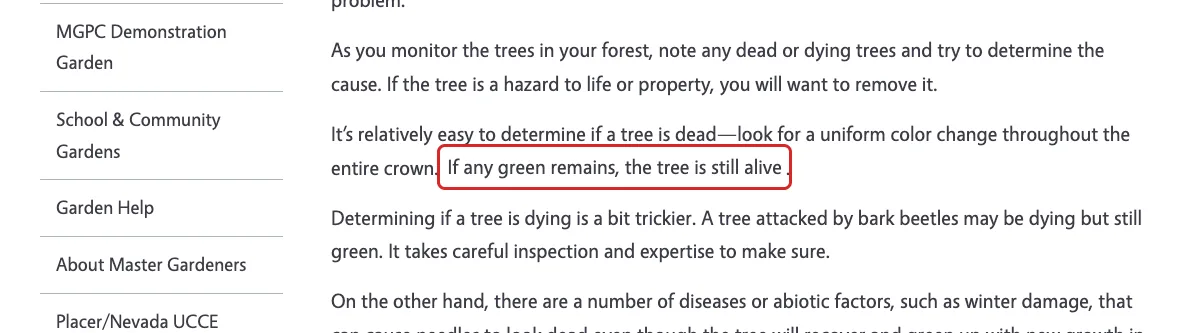
An evergreen is dead when the whole crown has turned one color. UC Master Gardeners, adapting CAL FIRE Tree Notes #30, tells owners to look for “a uniform color change throughout the entire crown” and says that “if any green remains, the tree is still alive” (UC Master Gardeners). The same note warns that a conifer attacked by bark beetles may be dying while still green.
Brown needles alone prove little. Pines, spruces and firs shed their oldest inner needles in fall; white pine and arborvitae drop all of last year’s needles at once, while Scots and Austrian pines keep needles for 3 years (Iowa State, Seasonal Needle Loss, reviewed Jan. 2023). Fungal diseases follow a different pattern: browning of the newest, outermost needles, whole dead branches, or thinning on the lower branches only. Larch, bald cypress and dawn redwood are conifers that lose every needle each fall, and Iowa State notes owners have removed them believing they were dead.
Winter burn browns foliage from the branch tips inward, mostly on the south, southwest or west side, and shows up as the snow melts (UW Madison, 2024). Minnesota Extension names yew, arborvitae and hemlock as the most susceptible (University of Minnesota Extension). Pines, spruces and firs usually push new tips in spring that fill in within a couple of growing seasons, but if the entire evergreen is brown, UW Madison calls recovery unlikely.
Arborvitae need a separate check: once foliage is gone from the inner wood it will not regrow, even if light reaches it (University of Maryland Extension, July 16, 2024). A hedge with brown, bare interiors can be alive and still permanently thin.
Trunk, bark and root signs: dead, dying or dangerous
Green leaves do not clear a tree. The Forest Service guide warns that trunks and branches “can be quite defective and still support a lush green crown,” and sorts defects into 7 types: dead wood, cracks, weak branch unions, decay, cankers, root problems and poor architecture (USDA Forest Service).
| Sign | What it means | Act when | Source |
|---|---|---|---|
| Bark peeling in plates or sheets | Normal on sycamore, redbud, silver maple, shagbark hickory, birch and Scotch pine if healthy bark shows underneath | Bark is gone down to bare wood; if it is missing all the way around, everything above dies | Iowa State, Sept. 2026 |
| Deep crack through the bark into the wood | The tree is already failing | Crack goes deep or through the stem, 2 or more cracks together, or a crack touches another defect | USDA Forest Service |
| Canker: sunken or missing bark | Stem is more likely to break there | Cankers cover more than half the circumference | USDA Forest Service |
| Mushrooms, conks or brackets on root flare, trunk or branches | Advanced decay | Decay joins a crack or weak union, or sound wood is under 1 inch thick per 6 inches of trunk diameter | USDA Forest Service |
| Varnished reddish-brown shelf with white pores at the base | Ganoderma root and butt rot | Conks alone do not prove extensive decay; trees can stay stable for years, so have the decay measured | UMass Extension |
| Carpenter ants in the trunk | They nest in decayed wood and do not cause it | Check whether the rot has made the tree a failure risk | Purdue, 2013 |
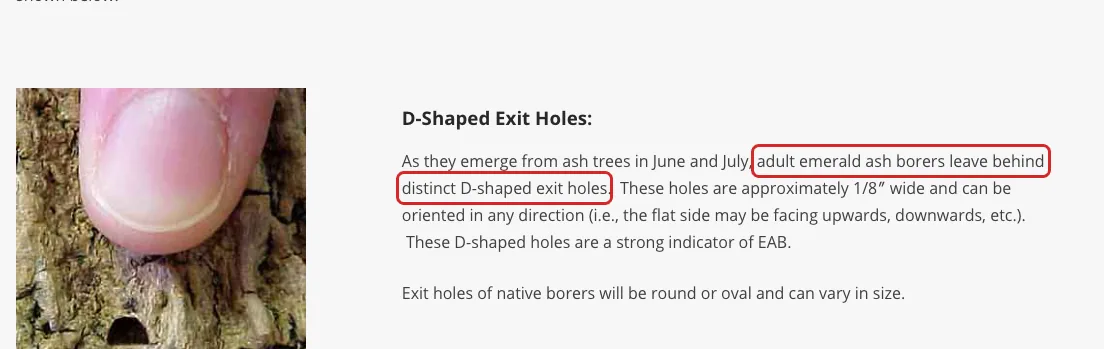
| D-shaped exit holes about 1/8 inch wide, S-shaped tunnels (ash only) | Emerald ash borer | Over 50 percent canopy decline: unlikely to recover even if treated | UW Madison EAB; Herms et al., 2014 |
| Woodpecker flecking, sprouts at the trunk base | Insects under the bark or general stress | Not proof of EAB alone; look for the holes | UW Madison EAB |
| New lean, soil mounding or exposed roots | The root plate is moving | Immediately; also if more than half the roots under the crown were cut or crushed | USDA Forest Service |
| Small, off-color leaves, twig dieback | Common symptoms of root problems | With any other defect on this list | USDA Forest Service; ISA |
Mushrooms scattered across the lawn usually feed on buried wood and dead roots, which is how lawn mushrooms and fairy rings start; the decay signs grow from the root flare, trunk or branches. A deep mulch volcano hides that flare; how to mulch around a tree and fix a mulch volcano gives the 2 to 4 inch depth to pull it back to before you inspect.
Partly dead: is there a 50 percent rule?
No general arboriculture standard sets a percentage of dead crown at which a tree must come down. Two 50 percent lines exist in narrower settings. California’s Forest Practice Rules define “dying trees” as those with 50 percent or more of the foliage-bearing crown dead or fading, bark beetle attacks around the trunk, or 75 percent or more of the lower trunk girdled by wildlife (Cal. Code Regs. tit. 14, § 895.1). For ash, the multistate insecticide guide says trees with more than 50 percent canopy decline “are unlikely to recover even if treated” (Herms et al., 2nd ed., June 2014).
Below those lines, dead limbs are usually a pruning job, called crown cleaning; tree trimming prices by height and job type show what it runs. Purdue’s urban forester puts removal last, after pruning, cabling and plant health care, and only as “an informed decision” (Purdue Extension, June 2020). On oaks in oak wilt country, timing decides whether a cut is safe; see when to prune oak trees.
When is a dead tree an emergency, and who do you call?
Risk depends on what the tree can hit. Purdue defines the target zone as a circle around the tree at least as wide as the tree is tall, and recommends an inspection by an ISA Certified Arborist at least every 3 to 5 years and after major storms (Purdue, 2020). A dead tree whose target zone holds a house, a drive, a play area or a line is the case the Forest Service says to act on immediately.
1Is the tree or a large dead branch cracked, hanging, or newly leaning with soil heaving, and within one tree height of a house, drive, play area or power line?
YesTreat it as urgent: keep people out of that zone, call the utility for any line contact, and call a tree service or TRAQ arborist now. The Forest Service says dead wood must be removed immediately.
NoGo to the next question
2Do pencil-thin twigs show green, moist tissue when scratched, or green tissue inside peeled bud scales?
YesAlive, at least in part. Scratch toward the trunk to map the dead wood, and if the tree is bare, wait until June 1 before deciding (Iowa State).
NoGo to the next question
3Is the inner bark brown and dry all the way around the trunk at chest height?
YesThe tree is dead (UC Master Gardeners). Plan removal before the wood gets more brittle.
NoGo to the next question
4Is it an evergreen whose whole crown has turned one uniform color?
YesDead: with no green left there is nothing to regrow (UC Master Gardeners / CAL FIRE).
NoMixed results mean a partly dead tree. If more than half the crown is dead, or there are conks, deep cracks or cankers on the trunk, book a Level 2 assessment from a TRAQ arborist.
Source: USDA Forest Service NA-FR-01-96; Iowa State Extension 2026; UC Master Gardeners of Placer County
Ask for a Tree Risk Assessment Qualified (TRAQ) arborist and a Level 2 assessment, the 360-degree ground inspection of a single tree under ANSI A300 Part 9; ISA’s Find an Arborist directory lets you verify the credential. For a tree already on the house or the wires, start with the first-hour emergency tree removal checklist. For a planned job, tree removal cost by height and trunk diameter lists city bid prices, and maples, willows and poplars will resprout unless you treat the stump within minutes of the cut.
Across 99,213 standing dead trees in eastern U.S. forests, 48.2 percent had fallen by the resurvey about 5 years later, and the average recently dead tree had a 50/50 chance of still standing after 7.23 years (Oberle et al., PLOS ONE, 2018). Species spread is wide, from an expected half-life of 1.3 years for American basswood to 35.8 years for Osage orange, and dead trees fell faster in warmer places.
How we compiled this
We compiled this page in November 2026 from 19 primary documents: extension publications from Iowa State, UW Madison, NC State, Purdue, UMass, Minnesota, Maryland and the University of California, the USDA Forest Service hazard guide, ISA’s risk brochure, California’s Forest Practice Rules, the multistate EAB insecticide guide, a Forest Service snag-fall study and the Harvard Forest phenology archive. The leaf-out table is our own average of 2,606 tree-year records in Harvard Forest file hf003-05 (1990 to 2023) by species. We did not inspect any trees, and this page is no substitute for an on-site risk assessment.
Frequently asked questions
Can a tree look dead but still be alive?
Yes. Late leafers such as black walnut and Kentucky coffeetree can stay bare into late spring, and Iowa State says to wait until at least June 1 before deciding. Larch, bald cypress and dawn redwood drop every needle each fall. A green scratch on a twig settles it (Iowa State).
How long will a dead tree stay up?
Often only a few years. In eastern U.S. forests, 48.2 percent of standing dead trees fell within about 5 years, and the average half-life was 7.23 years (Oberle et al., 2018). Dead wood can still fail on any given day, so that average is no safety margin.
Can a tree that looks dead be revived?
Only if living tissue remains. If the inner bark is brown all the way around the trunk, the tree is dead (UC Master Gardeners). An ash with more than 50 percent canopy decline is unlikely to recover even with a systemic insecticide (Herms et al., 2014).
What does a dead tree look like inside?
Under the bark, dead inner bark is brown and dry instead of green or cream and moist. In decayed wood the Forest Service describes wood that is soft, punky or crumbly, or a cavity; Ganoderma white rot leaves wood light-colored and stringy to spongy (UMass Extension).
Can a dead tree have green leaves?
For a while. A tree with damaged roots can leaf out on stored reserves; NC State Extension says a tree whose roots were cut in grading may take up to 5 years to die (NC State, 2022). Bark beetle-killed conifers can also stay green while dying.
Sources
- Iowa State University Extension and Outreach (Steil), Late Leaf Emergence on Fruit and Ornamental Trees and Shrubs, Last reviewed May 2026. Accessed November 2026.
- Iowa State University Extension and Outreach, Seasonal Needle Loss, Last reviewed Jan. 2023. Accessed November 2026.
- Iowa State University Extension and Outreach, Shedding, Peeling, and Splitting Bark on Shade Trees, Last reviewed Sept. 2026. Accessed November 2026.
- University of Wisconsin-Madison Extension (Jull), Winter Burn, UW Plant Disease Facts D0127, Revised March 2, 2024. Accessed November 2026.
- University of Wisconsin-Madison, EAB in Wisconsin, Symptoms and Signs of EAB, Current page. Accessed November 2026.
- NC State Extension, Caswell County Center (Sellars), Is My Tree Dying??, Nov. 15, 2022. Accessed November 2026.
- UC Master Gardeners of Placer County, Dead or Dying: How Can You Tell? (adapted from CAL FIRE Tree Notes #30), 2007 newsletter, current page. Accessed November 2026.
- California Code of Regulations (via Cornell LII), Cal. Code Regs. tit. 14, § 895.1, Definitions (“Dying Trees”), Current text. Accessed November 2026.
- USDA Forest Service, Northeastern Area (via Cornell Cooperative Extension), How to Recognize Hazardous Defects in Trees, NA-FR-01-96, 1996. Accessed November 2026.
- International Society of Arboriculture, TreesAreGood.org, Recognizing Tree Risk brochure, July 2021 edition. Accessed November 2026.
- International Society of Arboriculture, TreesAreGood.org, Find an Arborist, Current page. Accessed November 2026.
- Purdue Extension, Forestry and Natural Resources (Purcell), How to Identify Tree Defects and What to Do about It?, June 19, 2020. Accessed November 2026.
- Purdue Extension, Forestry and Natural Resources (Purcell), Question: Are Carpenter Ants Harmful To My Tree?, July 9, 2013. Accessed November 2026.
- UMass Amherst Extension, Root and Butt Rot caused by Ganoderma sessile, Current fact sheet. Accessed November 2026.
- Herms, McCullough, Smitley, Sadof and Cranshaw (via University of Arkansas), Insecticide Options for Protecting Ash Trees from Emerald Ash Borer, 2nd ed., June 2014. Accessed November 2026.
- Oberle, Ogle, Zanne and Woodall, USDA Forest Service Treesearch, When a tree falls: Controls on wood decay predict standing dead tree fall and new risks in changing forests, PLOS ONE 13(5), 2018. Accessed November 2026.
- O’Keefe and VanScoy, Harvard Forest Data Archive, Phenology of Woody Species at Harvard Forest since 1990, HF003 (v.37), 2024, data 1990 to 2023. Accessed November 2026.
- Harvard Forest Data Archive, hf003-05: mean spring dates (individual trees), CSV, 2024. Accessed November 2026.
- University of Minnesota Extension, Protecting trees and shrubs in winter, Current page. Accessed November 2026.
- University of Maryland Extension, Maryland Grows, Q&A: Reduce the height of an arborvitae, July 16, 2024. Accessed November 2026.