When to prune crape myrtles: late winter, after the hardest freezes and before buds break. That is December to February in Florida, late January to early March on the Gulf Coast and Carolinas, February to March in Virginia and Maryland. Never top them.
Knowing when to prune crape myrtles matters less than knowing how little to cut. Crape myrtles (Lagerstroemia indica and its hybrids with L. fauriei) flower on the current season’s shoots, so a late-winter cut never removes this summer’s blooms, and Clemson Extension says the plant “will produce plenty of flowers without any pruning” (Clemson HGIC 1009, 2015). Late winter is simply when the wood is bare enough to read and the worst cold has passed.
This page adds what the top results leave out: the window each of 10 state extension services publishes, with the document and date; the numbers from University of Florida’s 4-year topping trial on ‘Natchez’, where the barrier zone of discolored wood ran 74 cm (2.5 ft) behind topping cuts against 1.8 cm behind pollard cuts (Gilman and Knox, Journal of Arboriculture, 2005); a cut list by goal; and mature heights for 15 cultivars from 3 extension tables, because a crape that outgrows its spot is the usual reason crews top it.
A limb over a roof or a line is crew work; our breakdown of tree trimming cost for small and mid-size trees shows what a crew charges per tree, and the ISA arborist credentials and the ANSI A300 pruning standard explain what to put in the quote, starting with “no topping”.
When to prune crape myrtles, state by state
Extension services across the crape myrtle belt agree on the season and differ by a few weeks on the edges. Florida’s UF/IFAS publication ENH1138 puts structural pruning in December through February, when plants are leafless, and says severe pruning should come late in that window because “pruning too early might stimulate new growth that could be damaged by low temperatures” (Knox et al., UF/IFAS ENH1138, rev. Dec. 2024). Farther north the window slides into March.
| State | Published pruning window | Document |
|---|---|---|
| Florida | December to February (leafless, dormant); severe cuts late in that period | UF/IFAS ENH1138, rev. Dec. 2024 |
| Louisiana | Late January through early March; February in the AgCenter’s pruning page | LSU AgCenter, Successfully Pruning Crape Myrtles (undated) |
| Mississippi | Late January to early March; never in fall after leaf drop | MSU Extension blog; MSU P2007, rev. 2024 |
| Texas | Early spring: remove new suckers; clip faded seed capsules for rebloom only through September | Texas A&M AgriLife, Bexar County; Bexar County plant of the week |
| Arkansas | February, before new growth; “typically late February” | UA Division of Agriculture Q&A, 2012 to 2017 |
| Alabama | Before new growth begins in spring | Alabama Extension, rev. Apr. 2026 |
| South Carolina | Late winter or early spring, before growth begins | Clemson HGIC 1009, rev. 2015 |
| North Carolina | February to March in eastern NC; late January to early March in Wake Forest | NC Extension, Pender County, 2022; Town of Wake Forest guide |
| Virginia | Late winter or early spring, before new growth; not late summer or early fall | Virginia Tech SPES-387P, 2022 |
| Maryland | Late winter or early spring, around February or March, before dormancy breaks | UMD Extension, updated Jan. 24, 2025 |
The rule has two triggers, not a date: past your coldest stretch, and before the buds swell. University of Arkansas horticulturists put it plainly: pruning in fall “can expose them to winter damage if we have a cold winter,” so the key “is to get them through the bulk of the winter before pruning” (UA Division of Agriculture, Sept. 30, 2017).
Is it too late to prune crape myrtles? The month-by-month answer
Once leaves are out, structural cuts wait for next winter, but 3 kinds of cuts are fine in any month: dead, broken and hazard wood, which ENH1138 says “may be done anytime” (UF/IFAS ENH1138). Crape myrtles also leaf out late, and Maryland Extension notes it “isn’t unusual for new leaves to not appear until sometime in May” (UMD Extension, 2025), so a bare plant in April is not a reason to cut harder.
| Month | Task | Why | Source |
|---|---|---|---|
| December to February | Structural pruning in Florida and the Gulf Coast: suckers, crossing and inward branches, lower limbs | Branch structure is easiest to see without leaves | UF/IFAS ENH1138 |
| Late January to early March | Same work from Louisiana and Mississippi to the Carolinas; any hard cut or pollarding goes last | Early hard cuts can push growth that a late freeze kills | MSU Extension; LSU AgCenter |
| March to April | Virginia, Maryland, zone 6 to 7 edge: wait for buds, then cut winter-killed stems back to live wood | Stems can die back to the ground while roots survive | Missouri Botanical Garden |
| May to June | Rub off new suckers while soft; remove extra sprouts on old topping knobs | Young sprouts snap off cleanly and leave smaller wounds | Virginia Tech; Clemson |
| June to September | Optional: clip faded flower clusters on plants you can reach for a second flush | Texas A&M gives 30 to 45 days to rebloom; stop after September | Texas A&M AgriLife |
| Late summer to fall | No pruning beyond dead or broken wood | New shoots may not harden before frost | Virginia Tech; MSU P2007 |
| Any month | Dead, damaged or hazard limbs and clearance over walks and drives | Safety cuts are not tied to the season | UF/IFAS ENH1138 |
Fall is the one season every source rules out for structural cuts. Mississippi State’s P2007 says not to prune “in the fall following leaf drop,” because it “may stimulate new growth and make the plants susceptible to winter injury” (MSU Extension P2007, POD-08-24). Late summer carries the same risk in Virginia, where new shoots “may freeze if they fail to go fully dormant” (Virginia Tech SPES-387P).
What crape murder does: the measured damage
Crape murder is topping: cutting every stem back at an arbitrary height through wood several years old, instead of back to a bud, side branch or trunk. Virginia Tech’s publication calls it “regarded as an unacceptable practice by trained horticulturists and arborists” (Virginia Tech SPES-387P, 2022), and the International Society of Arboriculture’s figures on topping are summarized in our guide to what tree trimming should and should not include.
The best numbers come from a University of Florida trial near Tallahassee (USDA zone 8b). Ten ‘Natchez’ trees each were topped, pollarded or left unpruned every spring from 1998 to 2001, then the cut stems were split open in fall 2002 (Gilman and Knox, 2005). The table sets out what the study measured.
| Measure | Topped | Pollarded | Source |
|---|---|---|---|
| First cut | Through 4 to 5 year old wood, 27 mm (1.1 in) across, 4 to 5 ft up | Through 2 to 3 year old wood, 18 mm (0.7 in) across, 6 to 8 ft up | Gilman and Knox 2005 |
| Barrier zone behind the original cut | 74 cm (2.5 ft) on average | 1.8 cm (0.7 in) | Gilman and Knox 2005 |
| Dead stub wood in the canopy after 4 years | 6 times the volume of the pollarded trees | Baseline | Gilman and Knox 2005 |
| Mean dead stub length | 23 mm (0.9 in), some over 80 mm (3 in) | 3.5 mm (0.15 in) | Gilman and Knox 2005 |
| Wound closure 4 years later | 7 of 9 original cuts closed | All original cuts closed | Gilman and Knox 2005 |
| Time to prune | Rose every year; equal to pollarding by 2001 | Same each year | Gilman and Knox 2005 |
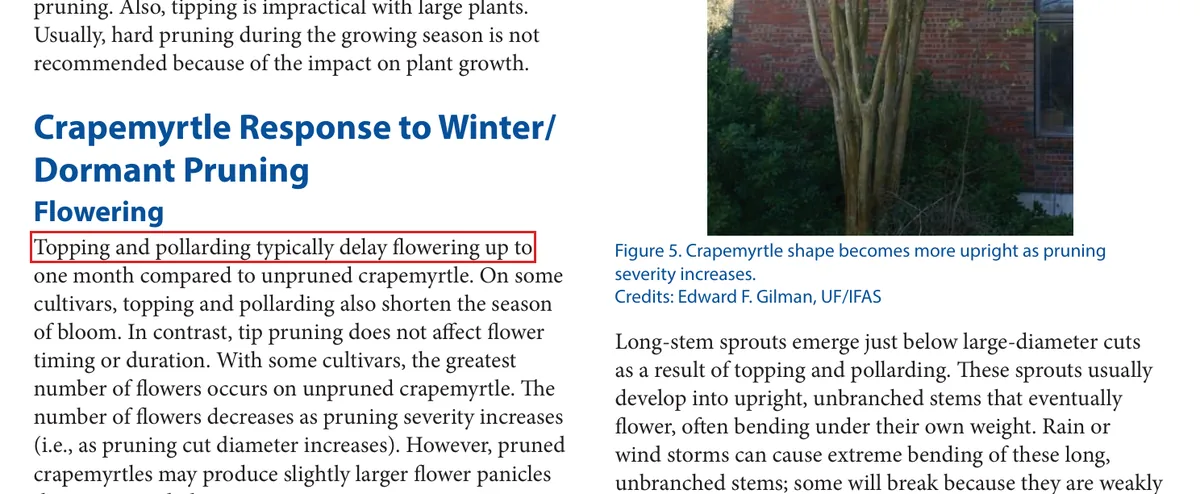
| First flowers | Up to 1 month later than unpruned | Up to 1 month later than unpruned | UF/IFAS ENH1138 |
| Flower count and size | Fewer flowers as cut diameter rises; panicles slightly larger | Same pattern | UF/IFAS ENH1138 |
Topping persists because it is fast in the first winter, and regrowth is “so vigorous that the plant grows to its original size within a couple of years,” so crews cut lower each year until the stubs reach the main trunks (UF/IFAS ENH1138). The unbranched sprouts that follow “eventually flower, often bending under their own weight.”
Topping rarely kills a vigorous crape myrtle, which walls off decay well, but ENH1138 warns that pruning “large, old plants can cause more stress and decay and can even kill the plant.” If a crape myrtle shows no new growth by June, the scratch and snap tests for a tree that may be dead settle whether the stems are still alive.
What to cut on a crape myrtle, by goal
Every cut is either a thinning cut, removing a branch just outside its collar, or a heading cut back to an outward-facing bud or side branch. Virginia Tech adds one rule people skip: do not paint the cut ends (Virginia Tech SPES-387P).
| Goal | Cut | Limit or timing | Source |
|---|---|---|---|
| Tree form | Keep 3 to 5 evenly spaced trunks; remove the rest at ground level | Do it while the extra stems are young | Clemson HGIC 1009; MSU P2007 |
| Clearance and bark display | Remove side branches on the trunks from the bottom up | Up to 1/3 to 1/2 of the plant’s height; Wake Forest says 4 to 6 ft but never more than half | Clemson; Wake Forest |
| Suckers | Pull or rub off root and base sprouts while soft; cut older ones flush | Every spring and summer; topping raises the count | Clemson; UF/IFAS |
| Crossing, rubbing, inward branches | Thinning cut just outside the branch collar | Dormant season | Virginia Tech; UF/IFAS |
| Twiggy growth | Remove twigs back to lower side branches | Pencil-size stems (UF, Wake Forest); LSU: avoid cuts wider than a finger | UF/IFAS; LSU AgCenter |
| Seed pods | Optional; clip within reach just above a lateral bud | Winter pods do not change next summer’s bloom | UF/IFAS; Clemson |
| Second bloom | Cut faded clusters right after the first flush | Cultivars that bloom before mid-July; rebloom in 30 to 45 days | Virginia Tech; Texas A&M |
| Hold a set height | Pollard: cut every sprout back to the same knob each winter | Start through wood about 3 years old or younger; never cut into the knob | UF/IFAS ENH1138 |
| Dwarf shrub forms | Cut all stems to within 6 inches of the ground each year | Late winter; larger flowers on container and border dwarfs | Virginia Tech; Clemson |
1Is the branch dead, broken, rubbing a roof, or blocking a walk or drive?
YesCut it now, any month, back to live wood or just outside the branch collar (UF/IFAS ENH1138).
NoGo to the next question
2Is it fall, after leaf drop, or before your area's coldest weeks are over?
YesWait. Fall cuts can push growth that freezes (MSU P2007; UA Division of Agriculture).
NoGo to the next question
3Have the buds already broken in spring?
YesLimit work to suckers, sprouts on old knobs and faded flower clusters until next winter.
NoGo to the next question
4Does the plant outgrow its space every year?
YesPollard at a fixed height each winter, cut a dwarf to 6 inches, or replace it with a cultivar whose mature height fits (UF/IFAS; Virginia Tech).
NoGo to the next question
5Would the cut go through wood thicker than your finger?
YesDo not head it. Remove the whole branch at a fork or the trunk with a thinning cut (LSU AgCenter; Clemson).
NoThin only: suckers at the ground, crossing and inward branches at the collar, lower limbs up to one third to one half of the height. Leave the top alone.
Source: UF/IFAS ENH1138 (2024); MSU P2007; LSU AgCenter; Clemson HGIC 1009; Virginia Tech SPES-387P
The pencil rule, and where the guides disagree
“Pencil pruning” means two different things in print. UF/IFAS uses it for tipping, a light shear of 1-year-old stems at the canopy edge that “does not affect flower timing or duration” but takes more time every year (UF/IFAS ENH1138). The Wake Forest guide uses it as a size limit: make most cuts “when the branch is the size of a pencil” (Town of Wake Forest). Greg Grant, writing for Texas A&M AgriLife in Bexar County, calls routine pencil-size pruning advice from the 1960s “outdated” (Texas A&M AgriLife, Stop the Crape Murder).
The way to reconcile them: tipping is optional, and the pencil or finger is a cap on cut size, not a quota. LSU AgCenter’s rule of thumb is to “avoid cutting back branches larger around than your finger, if at all possible” (LSU AgCenter). Anything thicker should come out as a thinning cut at a fork or the trunk, which is how Clemson keeps a tree smaller: remove “all twiggy growth back to lower growing side branches” (Clemson HGIC 1009).
How to fix a crape myrtle that was already topped
A topped crape myrtle can be partly “untopped,” though Virginia Tech says it “will never again have its true or natural crapemyrtle form.” Two routes are published, and the Wake Forest guide judges the odds good “for cuts up to about two inches” (Town of Wake Forest).
- Gradual route, late winter: on each knob (the “topping knuckle”), keep the 2 or 3 strongest sprouts that point outward and cut the rest off at their base (Virginia Tech; UF/IFAS Extension).
- Head the kept sprouts back to an outward-facing bud to start new side branches, then leave them alone the next winter.
- Remove any new sprouts on the knob in May and June while they are soft. In UF’s trial, branch collars formed only at the base of sprouts less than 0.64 times the diameter of the largest sprout on the cut, which argues for one leader per knob with the others kept visibly thinner (Gilman and Knox 2005).
- Drastic route, dormant season: cut every trunk to 1 to 2 inches above the ground. After 2 to 3 weeks of growth, keep 3 to 5 of the most vigorous shoots per trunk and remove the rest; UF/IFAS expects a natural-looking plant within 3 to 5 years (UF/IFAS Extension).
Do not cut below an old knob to “clean it up.” ENH1138 says a pollard head “contains abundant stored energy with little decay and should not be removed,” while a new cut lower down goes through older, wider wood, the cut type that left a 74 cm barrier zone in the Florida trial (UF/IFAS ENH1138).
Too big for the spot? Choose a crape myrtle by mature height
UF/IFAS says a crape myrtle that needs routine pruning to fit “should be considered for replacement with a smaller-maturing cultivar” (UF/IFAS ENH1138), and NC Extension in Pender County names ‘Natchez’, ‘Muskogee’ and ‘Tuskegee’ as easily reaching 25 feet (NC Extension, 2022). Published heights for the same cultivar differ by source, so the table shows 3 of them side by side.
Swipe the table sideways to see every column.
| Cultivar | MSU P2007 mature height (ft) | UF/IFAS ENH1138 height (ft) | Clemson HGIC 1023 height (ft) | U.S. National Arboretum description | Days of bloom (MSU) |
|---|---|---|---|---|---|
| ‘Pocomoke’ | 2 | Not listed | Not listed | 0.5 m tall, 0.9 m wide at 8 years in a container; keeps its mound without pruning | 90 |
| ‘Chickasaw’ | 2 | Not listed | 3 | 90 | |
| ‘Ruby Dazzle’ | 3 | Not listed | Not listed | 90 | |
| ‘Hopi’ | 7 | Not listed | 9 | 2.3 m tall, 3 m wide in 12 years | 100 |
| ‘Pecos’ | 7 | Not listed | Not listed | 100 | |
| ‘Tonto’ | 12 | 5 to 10 | 9 | Semi-dwarf; hardy to zone 7b | 80 |
| ‘Acoma’ | 14 | 10 to 15 | 15 | 90 | |
| ‘Catawba’ | 15 | 12 to 15 | 19 | 70 | |
| ‘Sioux’ | 15 | 15 to 20 | 15 | Hardy to zone 7b | 110 |
| ‘Tuskegee’ | 16 | Not listed | 17 | Hardy to zone 7b | 100 |
| ‘Tuscarora’ | 16 | 15 to 20; 18 to 25 | 23 | 70 | |
| ‘Miami’ | 20 | 20 to 25 | 25 | 110 | |
| ‘Muskogee’ | 20 | 20 to 25 | 35 | 28 ft tall, 30 ft spread at 35 years | 120 |
| ‘Biloxi’ | 25 | Not listed | Not listed | 80 | |
| ‘Natchez’ | 30 | 25 to 30 | 35 | 30 ft tall, 35 ft spread at 35 years | 110 |
Plan around a roof or a wire with the tallest figure: Clemson lists ‘Natchez’ and ‘Muskogee’ at 35 feet, and the National Arboretum’s own notes put the original ‘Natchez’ at 30 feet tall with a 35-foot spread at 35 years (U.S. National Arboretum). For a bed by the foundation, the dwarfs under 4 feet in MSU’s table, such as ‘Pocomoke’ and ‘Chickasaw’, need no height pruning at all.
UF/IFAS’s invasive-plant assessment rates L. indica “not considered a problem species at this time” (UF/IFAS Assessment of Non-native Plants). Swapping an oversized tree for a dwarf is a planting job; our page on what nurseries charge to plant a container tree has per-size labor rates, and removal pricing for small trees covers taking the old one out. If you want white summer flowers on a small tree, ‘Natchez’ and ‘Acoma’ are the white cultivars in the table, a season after the spring bloomers in our key to trees with white flowers.
Pruning crape myrtles in zone 6 and 7: dieback first
At the cold edge the question is not shaping but how much winter killed. Missouri Botanical Garden says above-ground branches are winter hardy to USDA zone 7, roots “usually but not always” to zone 5, and in St. Louis branches “often die to the ground in winter, particularly when temperatures dip below -5°F” (Missouri Botanical Garden Plant Finder). Maryland Extension rates crape myrtle hardy in zones (6)7 to 9 in the ground, less reliably in containers (UMD Extension).
There, wait for spring growth, then cut dead stems back to the first live bud or the ground. Where it is marginally hardy, Missouri Botanical Garden suggests cutting stems back to 8 inches in early spring each year and treating the plant as a shrub, since root sprouts typically grow 2 to 4 feet by fall and flower on that new wood. The garden also advises a winter mulch; our guide on how to mulch around trees covers depth and keeping it off the trunk.
How we compiled this
We compiled this page in November 2026 from 20 primary documents: extension publications and pages from UF/IFAS, Mississippi State, LSU AgCenter, Clemson, Virginia Tech, NC State, Maryland, Arkansas, Alabama and Texas A&M AgriLife; the 2005 Journal of Arboriculture topping study; the Missouri Botanical Garden Plant Finder; the U.S. National Arboretum Lagerstroemia checklist; and a municipal urban forestry guide. Heights are copied as published, not averaged. We did not prune or measure any plants.
Frequently asked questions
What month should crepe myrtles be cut back?
Late winter, usually February, with the full window running from December in Florida to early March in Louisiana, Mississippi and the Carolinas, and into March in Virginia and Maryland (LSU AgCenter; UMD Extension). Finish before buds break.
What happens if you don’t cut back crepe myrtles?
They still bloom. Virginia Tech notes that old unpruned roadside plants carry smaller flower clusters but “far greater” numbers and a longer bloom season, and UF/IFAS found the greatest flower count on unpruned plants of some cultivars (Virginia Tech; UF/IFAS).
Can you cut a crepe myrtle back to the ground?
Yes, if it is healthy. Clemson says cutting stems to about 6 inches each year “will not kill or injure a healthy crape myrtle,” and UF/IFAS restores topped trees by cutting to 1 to 2 inches and keeping 3 to 5 new shoots per trunk (Clemson HGIC 1009; UF/IFAS).
Do you cut crepe myrtles above or below the knot?
Above it. Cut sprouts back to the knob each winter, or keep 2 to 3 per knob to restore a branch frame. UF/IFAS says the knob “should not be removed”; cutting below it means a new, larger cut into older wood (UF/IFAS ENH1138).
Can you trim crepe myrtles in the fall?
Only dead or broken wood. Mississippi State and Arkansas Extension both warn that pruning after leaf drop can push new growth that freezes (MSU P2007; UA Division of Agriculture).
Sources
- UF/IFAS Extension (Knox, Gilman, Young, Klein, Leyton), Crapemyrtle Pruning, ENH1138, Rev. December 2024. Accessed November 2026.
- UF/IFAS Extension, Solutions for Your Life, Crape Myrtle Pruning, Modified Aug. 2025. Accessed November 2026.
- Gilman, E.F. and G.W. Knox, Journal of Arboriculture 31(1), Pruning Type Affects Decay and Structure of Crapemyrtle, 2005. Accessed November 2026.
- Virginia Cooperative Extension (Appleton, Orband, Bartkus), Pruning Crapemyrtles, SPES-387P, 2022. Accessed November 2026.
- Clemson Cooperative Extension HGIC, Crape Myrtle Pruning, HGIC 1009, Rev. June 19, 2015. Accessed November 2026.
- Clemson Cooperative Extension HGIC, Crape Myrtle Varieties, HGIC 1023, Updated Apr. 19, 2005. Accessed November 2026.
- Mississippi State University Extension (Wilson), Crapemyrtle: Flower of the South, P2007, POD-08-24. Accessed November 2026.
- Mississippi State University Extension, How to Prune Crape Myrtles (blog), Undated. Accessed November 2026.
- LSU AgCenter, Successfully Pruning Crape Myrtles, Undated. Accessed November 2026.
- University of Arkansas Division of Agriculture, Pruning Crape Myrtle (Q&A archive), 2012 to 2017. Accessed November 2026.
- Alabama Cooperative Extension System, Woody Landscape Plants: Pruning, Modified Apr. 2026. Accessed November 2026.
- N.C. Cooperative Extension, Pender County, How Do I Prune Crape Myrtle?, Updated July 22, 2022. Accessed November 2026.
- Town of Wake Forest Urban Forestry Advisory Board, Proper Pruning of Crape Myrtles, Undated. Accessed November 2026.
- University of Maryland Extension, Crapemyrtle: Identify and Manage Problems, Updated Jan. 24, 2025. Accessed November 2026.
- Missouri Botanical Garden, Plant Finder: Lagerstroemia indica, Current page. Accessed November 2026.
- Texas A&M AgriLife Extension, Bexar County, Crapemyrtle: The Perfect Texas Landscape Plant, Archive. Accessed November 2026.
- Texas A&M AgriLife Extension, Bexar County (Grant), Stop the Crape Murder!, Archive. Accessed November 2026.
- U.S. National Arboretum, Lagerstroemia Checklist, names N to O, Current page. Accessed November 2026.
- U.S. National Arboretum, Lagerstroemia Checklist, names M, Current page. Accessed November 2026.
- U.S. National Arboretum, Lagerstroemia Checklist, names P to Q, Current page. Accessed November 2026.
- U.S. National Arboretum, Lagerstroemia Checklist, names H, Current page. Accessed November 2026.
- UF/IFAS Assessment of Non-native Plants in Florida’s Natural Areas, Lagerstroemia indica, Current page. Accessed November 2026.