How fast do arborvitae grow? Slower than plant tags say: ‘Emerald Green’ averaged 5.3 inches a year in an Iowa State trial, and the original ‘Green Giant’ reached 30 feet in 30 years. Published best-year rates run 6 inches to 4 feet.
Ask how fast do arborvitae grow and most answers repeat the nursery line: 1 to 2 feet a year for ‘Emerald Green’, 3 to 5 feet for ‘Green Giant’. Two primary records measure something closer to real yards. An Iowa State University trial at the Muscatine Arboretum planted six arborvitae cultivars in June 2001 and measured them in October 2003 and October 2006: ‘Emerald’ grew from 34 to 50 inches, or 5.3 inches a year. The U.S. National Arboretum release sheet for Thuja Green Giant (November 1999) gives the original tree’s size as “30 feet at 30 years,” an average of 1 foot a year. The tables below put those measurements next to the extension and retail figures for 17 arborvitae, then turn each rate into years to an 8-foot screen.
Arborvitae growth rate by cultivar
Growth rates fall into three bands. Narrow American arborvitae cultivars (Thuja occidentalis) such as ‘Emerald Green’, ‘Nigra’ and ‘Holmstrup’ measure 5 to 12 inches a year; the hybrid ‘Green Giant’ and western redcedar (Thuja plicata) are rated 2 to 4 feet in their best years; globes add a few inches. The species itself is rated “Slow” in the NC State Extension Plant Toolbox. For the full list of fast trees beyond arborvitae, see our ranking of the fastest growing trees for privacy and shade.
Swipe the table sideways to see every column.
| Cultivar | Retail claim per year (Nature Hills, May 2026) | Extension or arboretum figure per year | Measured or long-run record |
|---|---|---|---|
| ‘Green Giant’ (T. standishii x plicata) | 3 to 5 ft | 3 to 4 ft “in optimal conditions” (NC State); 2 to 3 ft (U. of Arkansas evaluation); 2 to 4 ft at JC Raulston Arboretum (NC State Extension); 3 to 4 ft (Missouri Botanical Garden) | 30 ft at 30 years, about 1 ft a year (USNA) |
| ‘Emerald Green’ (‘Smaragd’) | 1 to 2 ft | Up to 12 in (NYBG) | 5.3 in a year, years 3 to 5 (Iowa State) |
| ‘Techny’ (‘Mission’) | 1 to 2 ft | Up to 12 in (NYBG) | None found |
| ‘Nigra’ | Not in sample | 6 to 8 in (NYBG) | Planted 2005 at Iowa State, not measured |
| ‘Holmstrup’ | Not in sample | None found | 6.7 in a year (Iowa State) |
| ‘Pyramidalis’ | Not in sample | None found | 14.0 in a year (Iowa State) |
| ‘Elegantissima’ | Not in sample | None found | 10.3 in a year (Iowa State) |
| ‘Hetz Wintergreen’ | Not in sample | 12 to 18 in (NYBG) | None found |
| ‘American Pillar’ (sport of ‘Hetz Wintergreen’) | 3 to 4 ft | No extension figure; introducer says “very rapid growth rate” (Spring Meadow) | None found |
| North Pole (‘Art Boe’) | 1 to 2 ft | No extension figure; introducer says “Fast growing” (Spring Meadow) | None found |
| ‘DeGroot’s Spire’ | 6 to 12 in | 6 or more in (NYBG) | None found |
| Woodwardii (globe) | Not in sample | None found | 5.3 in a year (Iowa State) |
| American arborvitae (T. occidentalis, species) | Not in sample | “Slow” (NC State) | None found |
| Western redcedar (T. plicata, species) | Not in sample | 2 to 3 ft (NC State) | None found |
| ‘Spring Grove’ (T. plicata ‘Grovepli’) | 3 to 4 ft | No extension figure; introducer says “fast growing” (Spring Meadow) | None found |
| Oriental arborvitae (Platycladus orientalis) | Not in sample | “Slow” (NC State) | ‘Berckman’s Golden Biota’: 6.3 in a year (Iowa State) |
| ‘Steeplechase’ (T. plicata x standishii) | Not in sample | No rate stated; 20 to 30 ft tall (Penn State Extension) | None found |
What did arborvitae actually grow in a measured trial?
The Iowa State report (ISRF06-20, by farm superintendent Vince Lawson and Joe Hannan) is the only cultivar-by-cultivar height record we found from a U.S. university. Three plants of each cultivar went into a full-sun knoll of moderately well drained clay loam in USDA zone 5, were mulched with wood chips and never pruned. The growth figures cover their third through fifth years in the ground, after the first establishment seasons.
| Cultivar | Height Oct 2003 (in) | Width Oct 2003 (in) | Height Oct 2006 (in) | Width Oct 2006 (in) | Height growth (in a year) |
|---|---|---|---|---|---|
| Emerald (‘Smaragd’) | 34 | 18 | 50 | 28 | 5.3 |
| Holmstrup | 29 | 15 | 49 | 24 | 6.7 |
| Woodwardii (globe) | 20 | 25 | 36 | 46 | 5.3 |
| Elegantissima | 42 | 27 | 73 | 53 | 10.3 |
| Berckman’s Golden Biota (Platycladus orientalis) | 28 | 16 | 47 | 27 | 6.3 |
| Pyramidalis | 55 | 24 | 97 | 33 | 14.0 |
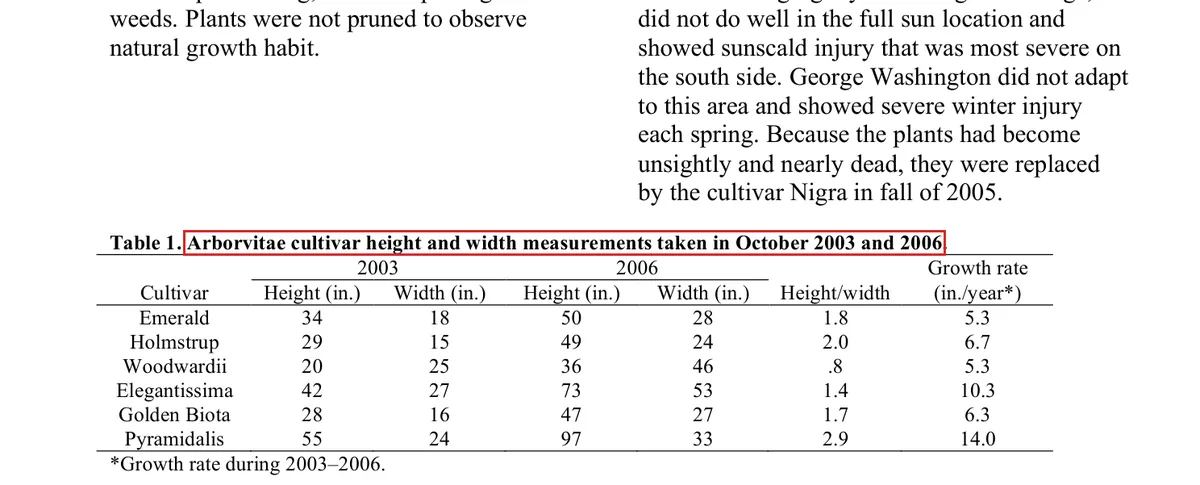
Read the trial with its limits in mind: 3 plants per cultivar, one site, and 2 dry years. The report says Muscatine had below-normal rainfall in 2005 and 2006, so the 5.3-inch ‘Emerald’ figure is a dry-year rate on fertile soil, not a worst case. Even so, the fastest Thuja occidentalis in the test, ‘Pyramidalis’ at 14.0 inches a year, grew less than half of the 2 to 3 feet a year retail pages quote for ‘American Pillar’ and its relatives.
How fast does Green Giant arborvitae grow?
Expect 2 to 4 feet a year once it is established in a good site, and about 1 foot a year averaged over 30 years. The NC State page says 3 to 4 feet “in optimal conditions”; the University of Arkansas, which put ‘Green Giant’ into its Plant Evaluation Program in spring 2001, reports 2 to 3 feet; the JC Raulston Arboretum in Raleigh reported 2 to 4 feet. The USNA sheet lists it as reaching 60 feet tall and 12 to 20 feet wide, hardy in zones 5 to 7.
Water is the input that moves the number most. In a Kansas State University greenhouse test (SNA Research Conference, vol. 56, 2011), container ‘Green Giant’ plants kept at 90 percent of container capacity reached 58.6 cm; recurring moderate drought cut that to 49.5 cm and severe drought to 43.1 cm, 16 and 26 percent shorter. ‘Green Giant’ was the most drought-responsive of the four conifers tested. The University of Georgia advises fertilizing it in late winter and midsummer with a granular 16-4-8, while Iowa State Extension says newly planted trees generally need no fertilizer; a soil test settles which applies to your yard.
How fast does Emerald Green arborvitae grow?
Plan on 5 to 12 inches a year. NYBG’s plant information service says ‘Smaragd’ “grows up to 12 inches a year,” and the Iowa State plants averaged 5.3 inches in years 3 to 5, adding 10 inches of width at the same time. The 1 to 2 foot figure on retail pages has no measured source behind it in the records we read. Mature size is 10 to 15 feet tall and 3 to 4 feet wide at the Morton Arboretum; the introducer Spring Meadow lists 10 to 15 feet by 6 to 8 feet.
How long until arborvitae make a privacy screen?
Divide the height you still need by the growth rate, then add the establishment period. Iowa State Extension puts establishment at about 12 months per inch of trunk diameter in zones 4 and 5, so a 3-foot nursery arborvitae with a trunk under 1 inch loses most of one season to rooting in. The table uses a 3-foot plant and targets of 8 and 10 feet.
| Cultivar and rate basis | Height growth a year | Years from 3 ft to 8 ft | Years from 3 ft to 10 ft | Rate source |
|---|---|---|---|---|
| ‘Emerald Green’, Iowa State measured | 5.3 in | 11.3 | 15.8 | Iowa State trial, 2003 to 2006 |
| ‘Emerald Green’, NYBG figure | 12 in | 5.0 | 7.0 | NYBG: up to 12 in |
| ‘Emerald Green’, retail claim | 12 to 24 in | 2.5 to 5.0 | 3.5 to 7.0 | Nature Hills: 1 to 2 ft |
| ‘Holmstrup’, Iowa State measured | 6.7 in | 9.0 | 12.5 | Iowa State trial |
| ‘Nigra’, NYBG figure | 6 to 8 in | 7.5 to 10.0 | 10.5 to 14.0 | NYBG: 6 to 8 in |
| ‘Pyramidalis’, Iowa State measured | 14 in | 4.3 | 6.0 | Iowa State trial |
| ‘Green Giant’, 30-year average | 12 in | 5.0 | 7.0 | USNA: 30 ft at 30 years |
| ‘Green Giant’, Arkansas evaluation | 24 to 36 in | 1.7 to 2.5 | 2.3 to 3.5 | U. of Arkansas: 2 to 3 ft |
| ‘Green Giant’, NC State optimal | 36 to 48 in | 1.2 to 1.7 | 1.8 to 2.3 | NC State: 3 to 4 ft |
| ‘Green Giant’, retail claim | 36 to 60 in | 1.0 to 1.7 | 1.4 to 2.3 | Nature Hills: 3 to 5 ft |
| Western redcedar (T. plicata) | 24 to 36 in | 1.7 to 2.5 | 2.3 to 3.5 | NC State: 2 to 3 ft |
- Years of growth needed
- 11.3
- Growing seasons, rounded up
- 12
Default: 5 ft at 5.3 in a year = 11.3 years. Add about 1 season for establishment (Iowa State Extension: 12 months per inch of trunk diameter in zones 4 and 5). Drought factors scale the Kansas State container-plant height loss to the whole period, our approximation.
The calculator default is 5 feet still to grow at the Iowa State ‘Emerald Green’ rate: 5 × 12 ÷ 5.3 = 11.3 years, about 12 growing seasons. Switch the rate to the NYBG figure and the same screen takes 5.0 years; the gap between those two answers is why a 5-foot plant at planting costs more but buys back 2 to 4 years. Our tree planting cost guide lists what each nursery size adds to the bill.
How far apart to plant arborvitae
NYBG’s rule is to plant hedge and screen arborvitae “at least two-thirds of their minimum, mature width apart,” and a full tree width from a fence or building. For ‘Green Giant’ that works out to 8 feet; UGA Extension recommends 15 feet in the row for screening and wind resistance. The spacing column applies the two-thirds rule to the narrowest published width.
| Cultivar | Mature height x width | Size source | Minimum spacing, on center (2/3 x min. width) | USDA zones | Rutgers deer rating (species) |
|---|---|---|---|---|---|
| ‘Emerald Green’ | 10 to 15 x 3 to 4 ft | Morton | 2.0 ft | 4 to 8 (NYBG) | D |
| North Pole | 10 to 15 x 3 to 5 ft | Spring Meadow | 2.0 ft | 3 to 9 (Spring Meadow) | D |
| ‘American Pillar’ | 15 to 20 x 3 to 5 ft | Spring Meadow | 2.0 ft | 3 to 8 (Spring Meadow) | D |
| ‘Holmstrup’ | 6 to 8 x 2 to 3 ft | Morton | 1.3 ft | Not stated | D |
| ‘Nigra’ | 25 to 30 x 5 to 8 ft | Morton | 3.3 ft | 3 to 7 (NYBG) | D |
| ‘Pyramidalis’ | 20 to 30 x 5 to 8 ft | Morton | 3.3 ft | Not stated | D |
| ‘Techny’ | 10 to 15 x 6 to 10 ft | Morton | 4.0 ft | 3 to 8 (NYBG) | D |
| ‘Steeplechase’ | 20 to 30 x about 8 ft | Penn State | 5.3 ft | Not stated | Not rated |
| ‘Spring Grove’ | 25 to 30 x 12 to 15 ft | Spring Meadow | 8.0 ft | 5 to 8 (Spring Meadow) | C (species) |
| ‘Green Giant’ | To 60 x 12 to 20 ft | USNA | 8.0 ft (UGA: 15 ft) | 5 to 7 (USNA) | Not rated |
| Western redcedar | 50 to 70 x 15 to 25 ft | NC State | 10.0 ft | 5a to 7b (NC State) | C |
| Oriental arborvitae | 18 to 25 x 10 to 15 ft | NC State | 6.7 ft | 6a to 9b (NC State) | Not checked |
Closer spacing fills a gap sooner but sets up competition: NYBG warns crowded young trees “will struggle to compete for water and nutrition” and become prone to fungal disease. If the screen has to block a view this year, compare a fence first; our fence installation cost guide puts a 6-foot treated-pine privacy fence at an estimated $27 to $39 per linear foot.
Which arborvitae should you plant for your site?
1Do deer browse your yard in winter?
YesSkip American arborvitae cultivars (Rutgers D). Choose 'Green Giant' in zones 5 to 7 if you have 8 or more feet of width, or protect plants with fencing or wraps.
NoGo to the next question
2Is your planting strip narrower than 8 feet?
YesChoose 'Emerald Green', North Pole or 'American Pillar' (3 to 5 ft wide) at 2 to 3 ft on center; expect about 5 to 12 in a year.
NoGo to the next question
3Do you need a screen taller than 15 feet, in zones 5 to 7?
YesChoose 'Green Giant' at 8 to 15 ft on center; expect 2 to 4 ft a year in good years and about 1 ft a year over 30 years.
NoChoose 'Techny' (10 to 15 ft tall, 6 to 10 ft wide) at 4 to 6.7 ft on center, or 'Nigra' (25 to 30 ft) at 3.3 ft or more.
Source: Rutgers deer ratings; Morton Arboretum; USNA; NYBG spacing rule
- Deer: if they browse your yard in winter, skip American arborvitae cultivars (Rutgers rating D; NYBG says damage runs from the ground to about 4 feet). ‘Green Giant’ is described as deer resistant by NC State and UGA, and only “somewhat deer-resistant” by Penn State.
- Width: with less than 8 feet of planting strip, choose ‘Emerald Green’, North Pole or ‘American Pillar’ at 2 to 3 feet on center.
- Height: for more than 15 feet of screen in zones 5 to 7, choose ‘Green Giant’ at 8 to 15 feet; for 10 to 15 feet, ‘Techny’ at 4 to 6.7 feet.
- Soil: set the root flare at grade in well-drained soil; NC State lists root rot in poorly drained soils for ‘Green Giant’.
What slows arborvitae growth?
Shade, dry soil, deer and bagworms account for most slow screens. NC State gives full sun as 6 or more hours of direct sun and says ‘Green Giant’ does best in moist, full sun with light afternoon shade. NYBG says established arborvitae need about 1 inch of water a week until the ground freezes, and Penn State Extension notes they are not drought tolerant; a soaker hose under 1 to 3 inches of mulch is the usual way to deliver it. Our guides to mulching around trees and soaker hose vs drip irrigation cover both.
Bagworms are the main pest. The University of Arkansas says ‘Green Giant’ is “very susceptible to bagworm,” contrary to catalog claims, and Penn State recommends removing bags by hand or spraying Bacillus thuringiensis (Bt) in June while the larvae are small; follow the product label. In heavy clay, NYBG says improving only the planting hole creates a basin that holds water, so amend the whole bed; see how to improve clay soil.
How we compiled this
In November 2026 we read 20 documents: the USNA ‘Green Giant’ release sheet (November 1999), Iowa State report ISRF06-20 (2007), the Kansas State drought paper in SNA Research Conference vol. 56 (2011), NYBG’s arborvitae guide, 5 NC State Extension pages, Morton Arboretum, Penn State, University of Arkansas, UGA, Iowa State Extension and Rutgers deer ratings, 4 Spring Meadow spec pages and 1 retail growth chart (Nature Hills, May 2026). We did not plant or measure trees. Retail rates are shown only as claims. The Iowa State trial covered 3 plants per cultivar at one site.
Frequently asked questions
How long does it take for arborvitae to reach full height?
Decades. At the Iowa State rate of 5.3 inches a year, a 3-foot ‘Emerald Green’ needs about 16 to 27 years to reach its 10 to 15 foot mature height; at NYBG’s 12 inches, 7 to 12 years. The original ‘Green Giant’ was 30 feet at 30 years on its way to 60 feet (USNA).
How do I stop my arborvitae from growing taller?
Start shearing while it is young and set a height limit each year. NYBG advises pruning in late winter or early spring, cutting back to a side branch and removing no more than one-third of a branch’s length. Arborvitae do not grow new buds from old wood.
Can I cut the top off Emerald Green arborvitae?
Only lightly, on young growth. NYBG says that if you remove a considerable amount from the tops of mature trees, the top growth will not be replaced and stays bald. If a mature hedge is far too tall, NYBG recommends replacing it and shearing the new plants at the height you want.
How do you make Green Giant arborvitae grow faster?
Keep the soil moist and the site sunny. In a Kansas State test, recurring drought made ‘Green Giant’ 16 to 26 percent shorter. Give 6 or more hours of sun, mulch 1 to 3 inches deep, and fertilize in late winter and midsummer only if a soil test or weak growth calls for it (UGA).
What is the downside of arborvitae?
Deer, bagworms, snow and size. Rutgers rates American arborvitae D, Frequently Severely Damaged by deer; Arkansas calls ‘Green Giant’ very susceptible to bagworm; Penn State says native arborvitae branches break under snow and ice; and ‘Green Giant’ reaches 12 to 20 feet wide.
How far apart do you plant Emerald Green arborvitae for privacy?
At least 2 feet on center, using NYBG’s two-thirds-of-mature-width rule and Morton’s 3-foot minimum width. Three feet on center gives each plant its full minimum width, and the row should sit at least one tree width (3 to 4 feet) off the fence.
Sources
- U.S. National Arboretum, USDA ARS, Thuja ‘Green Giant’ (NA 29972) Elite Plant release sheet, November 1999. Accessed November 2026.
- Iowa State University, Muscatine Island Research and Demonstration Farm, Arborvitae (Thuja occidentalis) Cultivar Observation, ISRF06-20 (Lawson and Hannan), 2007. Accessed November 2026.
- Kansas State University (Pool, Griffin, Boyer, Warren), Irrigation Frequency Affects Growth and Photosynthetic Capacity of Four Conifer Species, SNA Research Conference vol. 56, Table 1, 2011. Accessed November 2026.
- New York Botanical Garden, Plant Information, Arborvitae (Thuja), current guide. Accessed November 2026.
- NC State Extension Gardener Plant Toolbox, Thuja ‘Green Giant’, current. Accessed November 2026.
- NC State Extension Gardener Plant Toolbox, Thuja occidentalis, current. Accessed November 2026.
- NC State Extension Gardener Plant Toolbox, Thuja plicata, current. Accessed November 2026.
- NC State Extension Gardener Plant Toolbox, Platycladus orientalis, current. Accessed November 2026.
- NC State Extension Gardener, Green Giant Stands Tall Among Evergreens, undated. Accessed November 2026.
- University of Arkansas System Division of Agriculture, Green Giant Arborvitae plant database entry, undated. Accessed November 2026.
- University of Georgia CAES (Gary Wade), Fast-growing, pest-free Green Giant draws acclaim, undated. Accessed November 2026.
- Missouri Botanical Garden Plant Finder, Thuja ‘Green Giant’, current. Accessed November 2026.
- The Morton Arboretum, Eastern arborvitae (cultivar list), current. Accessed November 2026.
- Penn State Extension (Lois Miklas), The Mighty Arborvitae, updated Nov. 15, 2023. Accessed November 2026.
- Rutgers Cooperative Extension, Landscape Plants Rated by Deer Resistance (arborvitae entries), current. Accessed November 2026.
- Iowa State University Extension, Care of Newly-Planted Trees, current. Accessed November 2026.
- Spring Meadow Nursery, Spring Grove Thuja plicata ‘Grovepli’ spec page, current. Accessed November 2026.
- Spring Meadow Nursery, Full Speed A Hedge ‘American Pillar’ spec page, current. Accessed November 2026.
- Spring Meadow Nursery, North Pole arborvitae spec page, current. Accessed November 2026.
- Spring Meadow Nursery, ‘Smaragd’ arborvitae spec page, current. Accessed November 2026.
- Nature Hills Nursery (retail claims only), Arborvitae Growth Rate Explained, May 11, 2026. Accessed November 2026.
- The Green Industry Report, arborvitae growth rate dataset (CSV), compiled November 2026.