How to kill a tree stump: within 5 minutes of the last cut, paint the pale outer ring with undiluted glyphosate or 8% triclopyr concentrate. To make it rot, drill 1-inch holes, add nitrogen, keep it moist and covered: 1 to 3 years.
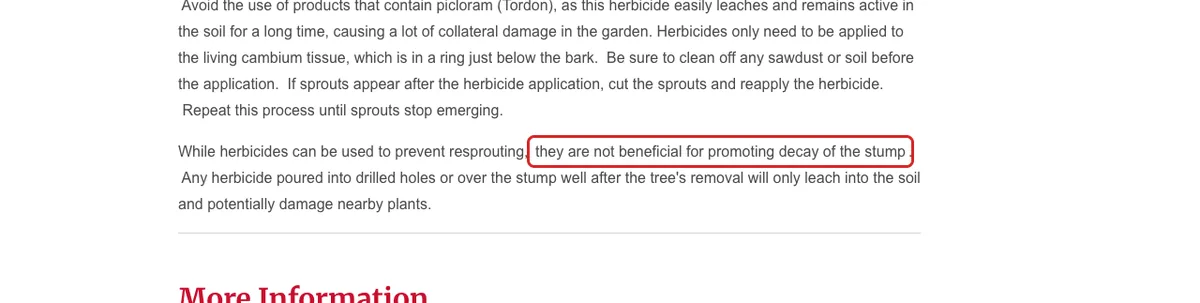
How to kill a tree stump depends on 2 separate jobs that most guides blur: stopping the roots from sending up sprouts, and getting the dead wood to rot. A herbicide does the first and nothing for the second; Iowa State says herbicide poured into an old stump “will only leach into the soil” (ISU Extension, reviewed April 2025). The stump removers on store shelves are the reverse: the Spectracide granules’ safety data sheet lists 100 percent potassium nitrate and no EPA registration (Chemsico SDS), so they are not herbicides and do not stop sprouts.
The species table below says whether your stump will resprout at all, from 3 extension lists, a Forest Service count of stumps still alive 9 to 11 years after cutting, and USDA decay-resistance classes. Most conifers need no herbicide. If you would rather pay for speed, see stump grinding prices per inch and minimum charges.
This page is general information, not pesticide or legal advice. The label is the law: read the whole label of the product you buy, keep children and pets off treated stumps until dry, and check local rules before burning anything.
Will your stump resprout? Check the species first
Every broadleaf tree can sprout from dormant buds at the root collar; conifers rarely can, and the 2 major exceptions are coast redwood and Pacific yew, with pitch pine and shortleaf pine as weaker sprouters (Penn State Extension, Dec. 16, 2025). Washington State University names maple, cottonwood, Lombardy poplar, black locust, willow, Russian olive and tree of heaven as the usual culprits among stumps that “will not die” (WSU Extension, Killing Tree Stumps). Use our guide to the most common U.S. yard tree species if you are not sure what you cut down.
Swipe the table sideways to see every column.
| Tree | Resprouts after cutting? | Cut-stump control: glyphosate / triclopyr (Arizona) | Heartwood decay resistance (USDA) | What to use |
|---|---|---|---|---|
| Maples, incl. boxelder | Yes (WSU, Arizona); red maple stumps 49 to 65% still sprouting 9 to 11 years after a clearcut | Fair / Good | Slightly or nonresistant | Triclopyr; PNW Handbook: glyphosate only suppresses bigleaf maple |
| Cottonwood, poplars, aspen | Yes, plus root suckers | Good / Good (cottonwood) | Slightly or nonresistant | Either; look for same-species trees nearby first |
| Willows | Yes | Fair / Good | Slightly or nonresistant | Triclopyr |
| Black locust | Yes, plus suckers; cut-stump results variable (WIGL) | Fair / Good | Very resistant | Triclopyr; slowest rot in this table |
| Honey locust | Suckers (Arizona) | Fair / Good | Moderately resistant | Triclopyr |
| Tree of heaven | Yes, prolific root suckers; cut-stump treatment rated poor (Penn State) | Not rated | Not listed | Basal bark or hack-and-squirt before cutting |
| Russian olive | Yes (WSU, Arizona) | Good / Fair | Not listed | Glyphosate |
| Elms, incl. Siberian elm | Yes (Arizona) | Good / Good | Slightly or nonresistant | Either |
| Ash | Yes (Arizona) | Good / Good | Slightly or nonresistant | Either |
| Oaks | Yes; red oak group 42 to 60%, white oak and hickory 0 to 36% sprouting after 9 to 11 years | Fair / Good | White oaks resistant; red oaks not listed | Triclopyr |
| Callery (Bradford) pear | Yes: 7 of 7 cut, untreated clusters resprouted within 40 days (Arkansas) | Undiluted triclopyr amine: 0 of 9 resprouted at 40 days | Not listed | Triclopyr on the fresh cut |
| Sweetgum | Listed for stump treatment on glyphosate label 71995-25 | Label-listed (glyphosate) | Slightly or nonresistant | Glyphosate |
| Hackberry | Suckers (Arizona) | Not rated | Slightly or nonresistant | Either |
| Most pines, spruces, true firs | No; pitch and shortleaf pine are exceptions | Not needed | Slightly or nonresistant | No herbicide; grind or let rot |
| Junipers, incl. eastern redcedar | No, except alligator juniper (Arizona) | Not needed | Resistant | No herbicide; expect slow rot |
| Coast redwood, Pacific yew | Yes, the 2 main sprouting conifers (Penn State) | Not rated | Old-growth redwood resistant; yew very resistant | Treat the fresh cut |
An untreated hardwood stump is not a dead one. In 7 Virginia and West Virginia stands cut 9 to 11 years earlier, 65.1 percent of red maple stumps and up to 78.5 percent of chestnut oak stumps on clearcuts still carried living sprouts (Atwood, Fox and Loftis, 2009).
The cut-stump method: treat the outer ring within minutes
Water-based herbicides must go on while the cut is fresh, because woody plants seal the wound: within 5 minutes if possible (WIGL, citing Enloe et al. 2013), the window University of Arizona says most labels mean (Schalau, 2009). Labels say “immediately”, and the Roundup Ultra master label warns that “a delay in application could result in reduced performance” (EPA Reg. No. 524-475).
- Cut the stump low and brush off sawdust and soil (ISU).
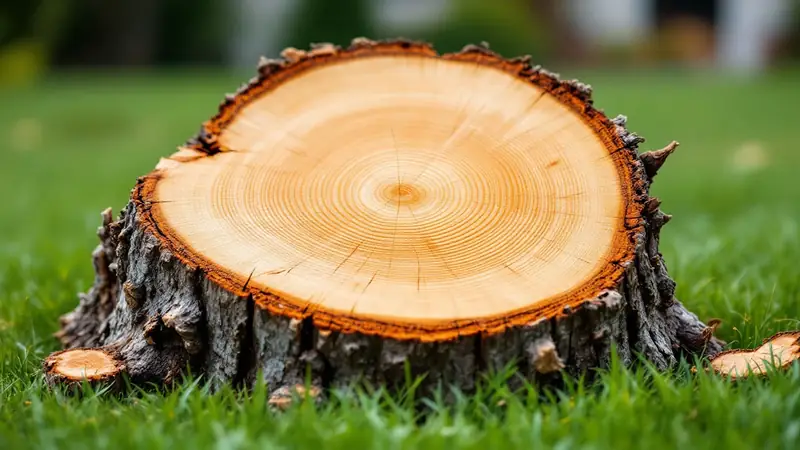
- On stumps 4 inches or wider, treat the pale ring of sapwood just inside the bark; it carries herbicide to the roots (Penn State Extension). On smaller stems, wet the whole face.
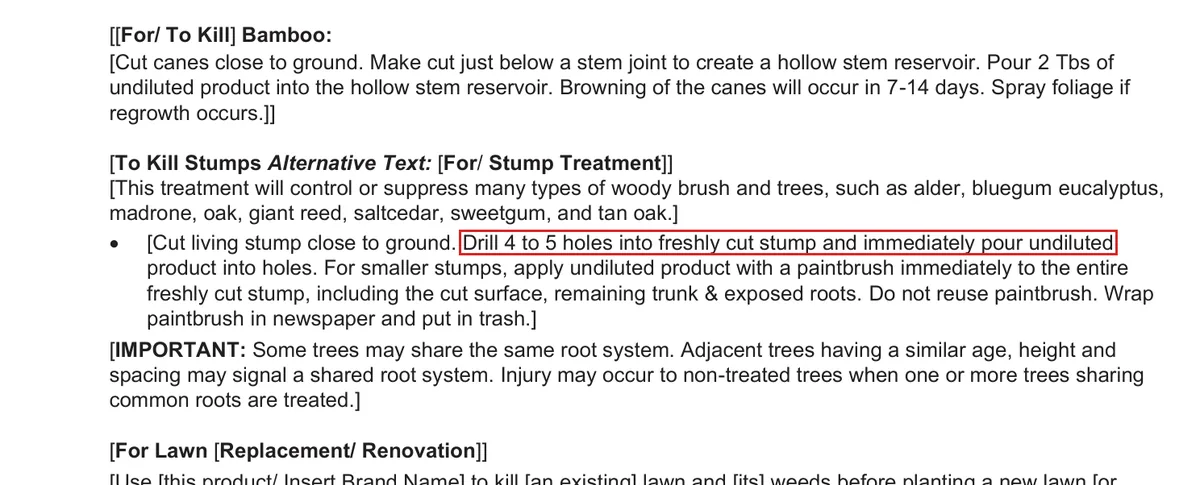
- Apply undiluted concentrate: glyphosate 50.2% such as Roundup Weed & Grass Killer Super Concentrate (EPA Reg. No. 71995-25), which also allows filling 4 to 5 drilled holes, or 8.0% triclopyr amine such as Ortho Brush-B-Gon (239-2491), painted on “the cut surface, remaining trunk and exposed roots”.
- Cut and retreat any sprouts until they stop (ISU).
Ready-to-spray bottles are too weak: label 92564-6 limits stump use to the concentrate at full strength (EPA Reg. No. 92564-6, Aug. 2026). Some Roundup-branded products contain no glyphosate, so check the Reg. No. against our table of which Roundup products still contain glyphosate.
Missed the window, or treating in winter?
Use an oil-based triclopyr ester, which can go on any time before sprouts appear, over the sapwood and down the sides to the root collar (Penn State). Pathfinder II, a ready-to-use 13.6% ester (EPA Reg. No. 62719-176, June 2026), allows year-round use except over snow or standing water. With a water-based concentrate, recut the old stump “all the way into live wood” first (WSU).
On season, Penn State prefers late summer and fall, when sugars move to the roots, and says spring sap flow makes treatment fail; WSU says any time works. If you can choose, cut maples and poplars August to October.
When a stump treatment can kill the tree next to it
Same-species trees can share roots through grafts. Label 524-475 says not to treat a stump whose roots “might be grafted” to trees you keep, and that neighbors of similar age, height and spacing may share one root system (524-475, section 13.4); the PNW Handbook repeats the warning for glyphosate and imazapyr. Iowa State rules out picloram (Tordon), which leaches and persists in soil (ISU).
Tree of heaven defeats the method: Penn State says the tree “will resprout prolifically” from roots after a cut-stump treatment, so treat it standing with basal bark or hack-and-squirt (Penn State).
1Is it a pine, spruce, fir or juniper (not coast redwood, Pacific yew, pitch or shortleaf pine)?
YesNo herbicide needed: it will not resprout. Grind it or use the decay recipe.
NoGo to the next question
2Is it tree of heaven, and is it still standing?
YesDo not cut it first: Penn State advises basal bark or hack-and-squirt on the standing tree, because cut-stump treatment lets the roots resprout.
NoGo to the next question
3Is a tree of the same species you want to keep growing close by, at similar age, height and spacing?
YesSkip herbicide: roots may be grafted (label 524-475). Grind, then cut sprouts as they appear, before they reach 8 inches.
NoGo to the next question
4Was the stump cut within the last 5 minutes, or can you recut it into live wood now?
YesPaint the outer sapwood ring with undiluted glyphosate concentrate or 8% triclopyr amine concentrate, following the label.
NoTreat it any time before sprouts appear with a ready-to-use triclopyr ester in oil over the sapwood and sides to the root collar, then start the decay recipe or grind.
What stump removers contain, and what the 4 to 6 weeks means
Gordon’s potassium nitrate label says to drill a 1-inch hole about 10 inches down plus a slanting side hole to meet it, pour at least 4 ounces in each and fill with water (PBI/Gordon label 530/2-2019). Then: “After 4 to 6 weeks, fill the holes with kerosene or fuel oil” and light it. The 4 to 6 weeks is soaking time before a burn, not the time a stump takes to vanish.
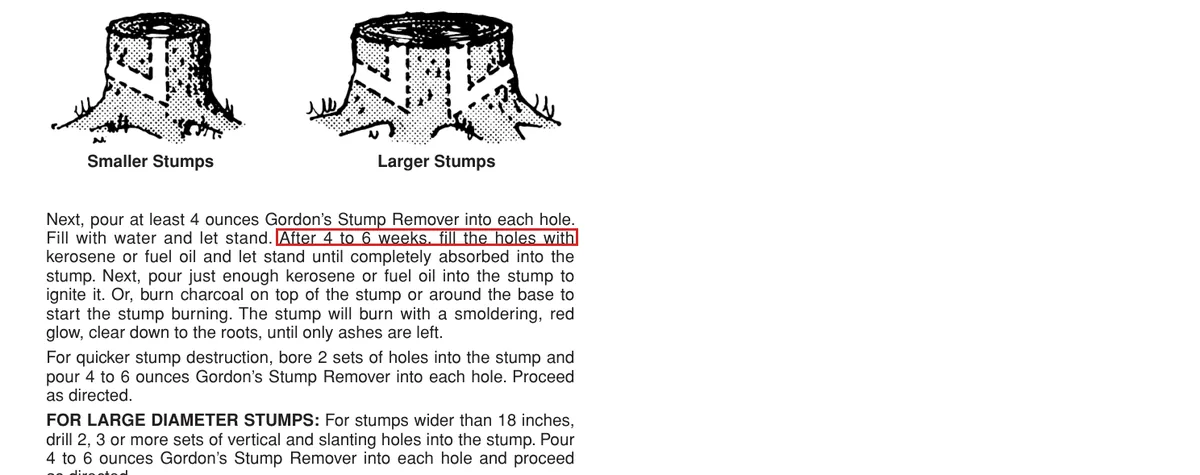
Without a fire, potassium nitrate is just nitrogen fertilizer; Iowa State says regular fertilizer works as well (ISU). Illinois Extension, citing UGA’s Kim Coder, credits chemical treatment with about 25 percent faster decay, against up to 50 percent from more surface area, air, moisture and nitrogen (Illinois Extension, July 18, 2025). It is also an oxidizer that “may intensify fire” (Spectracide SDS).
| Material | Formula | Nitrogen by weight | Arithmetic (g/mol) | What it does to a stump |
|---|---|---|---|---|
| Potassium nitrate (stump remover) | KNO3 | 13.9% | 14.0 / 101.1 | Supplies nitrogen; oxidizer that helps a stump burn |
| Urea | CO(NH2)2 | 46.6% | 28.0 / 60.1 | Same nitrogen at about one-third the weight |
| Ammonium sulfate | (NH4)2SO4 | 21.2% | 28.0 / 132.1 | Nitrogen plus sulfur; acidifies soil |
| Epsom salt | MgSO4·7H2O | 0% | No nitrogen; 9.9% Mg, 13.0% S | No nitrogen for decay fungi; a salt Coder says not to concentrate in holes |
| Rock salt | NaCl | 0% | No nitrogen; 39.3% sodium | Sodium stays in soil and harms what you plant next |
The label dose is small. Coder calls for 0.6 lb of nitrogen a year around a 12-inch stump (Coder, 2003, Table 1); Gordon’s minimum for a 12- to 18-inch stump, 2 holes at 4 ounces, is 0.5 lb of potassium nitrate, or 0.07 lb of nitrogen, about one-ninth of that. The same 0.6 lb of nitrogen is 1.3 lb of urea.
Epsom salt, rock salt and other home remedies
We found no trial or label showing Epsom salt rots or kills stumps. It carries 0 percent nitrogen, the nutrient Coder names as the main limit on decay, and he warns against “concentrating any salt in holes or piles” (Coder, 2003); Illinois Extension says such salts harm the decay organisms themselves (Illinois Extension).
Rock salt leaves sodium behind; see how much salt kills plants and how long it stays in soil. Vinegar “does not travel throughout the plant” (NPIC), as our page on what 5% to 30% vinegar kills and what regrows shows. Iowa State lists diesel among methods to avoid (ISU); our page on what gasoline does to soil and groundwater sets out why.
How to rot a tree stump faster: the decay recipe
Coder’s map puts natural decay of an open-grown stump at about 2 years in the warmest U.S. soils to 7 in the coldest, before size or wood type is counted; decay doubles with every 18°F rise in soil temperature between 40°F and 105°F (Coder, 2003). Extension estimates run 5 to 10 years (CSU PlantTalk 1740) or 10 or more (ISU), cut to 1 to 3 years with these steps.
- Cut the stump low and slice off the bark (Coder).
- Drill 1-inch holes at least 10 inches deep, no more than 12 inches apart, into the top and major roots (ISU).
- Loosen the soil 12 to 24 inches deep around it so oxygen reaches the wood (Coder).
- Spread slow-release nitrogen over the treatment area below in 3 doses 6 weeks apart from full leaf, not all on the stump face (Coder).
- Rub healthy soil on the face, cover with coarse mulch or landscape fabric, not solid plastic, and water weekly without puddling (Coder).
- Every 3 months, tear into it with a pry bar. After it loses 1/5 to 1/3 of its mass, sprinkle granulated sugar (Illinois Extension).
| Stump diameter, 1 in. above ground (in.) | Treatment area diameter (ft) | Nitrogen per split dose, 3 a year (lb) | Nitrogen per year (lb) | Urea 46-0-0 per year (lb) | Potassium nitrate per year (lb) |
|---|---|---|---|---|---|
| 6 | 2.4 | 0.05 | 0.2 | 0.4 | 1.4 |
| 10 | 4.0 | 0.15 | 0.5 | 1.1 | 3.6 |
| 12 | 4.8 | 0.2 | 0.6 | 1.3 | 4.3 |
| 16 | 6.4 | 0.4 | 1.1 | 2.4 | 7.9 |
| 20 | 8.0 | 0.6 | 1.8 | 3.9 | 13.0 |
| 24 | 9.6 | 0.9 | 2.6 | 5.7 | 18.8 |
| 30 | 12 | 1.3 | 4.0 | 8.7 | 28.9 |
| 36 | 14 | 1.9 | 5.8 | 12.6 | 41.9 |
Species sets the ceiling. The USDA Wood Handbook ranks black locust, red mulberry and Osage-orange heartwood as very resistant to decay, and maples, elms, cottonwood, willows, sweetgum and most pines as slightly or nonresistant (Arango and Lebow, Wood Handbook ch. 14, 2021). Coder notes that sapwood decays quickly in every stump while resistant heartwood can take many more years, which is when grinding a locust or juniper starts to look cheap.
Every stump method compared
Swipe the table sideways to see every column.
| Method | Active or material | What it does | Rate or dose | Time | Source |
|---|---|---|---|---|---|
| Glyphosate concentrate on a fresh cut | Glyphosate 50.2% (71995-25) | Kills roots | Undiluted; paint, or fill 4 to 5 drilled holes | Immediately after cutting | Label |
| Glyphosate, ag concentrate | Glyphosate (524-475) | Kills roots | 50 to 100% solution over the whole cambium | Immediately; delay reduces control | Label (2016) |
| Triclopyr amine concentrate | Triclopyr TEA 8.0% (239-2491) or 8.8% (92564-6) | Kills roots | Undiluted; cut face, trunk, exposed roots | Freshly cut | Labels (2024, 2026) |
| Triclopyr ester in oil | Triclopyr ester 13.6% (62719-176) | Kills roots | Wet cambium ring and sides to root collar | Any time except snow or standing water | Label (2026) |
| Triclopyr amine, Callery pear demo | Garlon 3A, undiluted | Kills roots | Spray bottle on each fresh cut | 0 of 9 clusters resprouted at 40 days | Arkansas FSA5038 |
| Imazapyr | Imazapyr 4 lb/gal (forestry) | Kills roots | 4 to 6 oz per gal on the cambium band | Right after cutting; moves through roots and soil | PNW Handbook |
| Picloram (Tordon) | Picloram | Kills roots | Avoid in yards | Leaches, persists in soil | ISU |
| Potassium nitrate stump remover | KNO3 100% (SDS) | Adds nitrogen; prepares stump to burn | At least 4 oz per 1-in. hole, holes filled with water | 4 to 6 weeks, then kerosene and fire | Gordon’s label |
| Nitrogen fertilizer, decay recipe | Slow-release N, low salt index | Feeds decay fungi | 0.6 lb N a year for a 12-in. stump | Breaks up with a spade in 1 to 3 years | Coder; ISU |
| Epsom salt | MgSO4·7H2O | No measured effect found | None published | No trial found | Coder (salt caution) |
| Rock salt | NaCl | Salts the soil | Not recommended | Sodium persists | Our salt page |
| Girdle before cutting | None | Starves roots | 2-in. wide ring, cut 1 in. past the bark | Tree dies over about a year | WSU |
| Cut sprouts repeatedly | None | Starves roots | Cut before sprouts reach 8 in. | 5 to 10 years; large trees 7+ | CSU; WSU |
| Grind | Machine | Removes wood 8 to 12 in. deep | About $150 to $220 for 1 stump up to 24 in. | Hours | ISU; our price lists |
| Dig out | Shovel, saw, pry bar | Removes stump | Stumps under about 12 in. | Hours to days | ISU |
| Burn | Charcoal or kerosene | Removes wood above char | Check local burn rules first | Can smolder for days | ISU; Illinois |
When to grind, dig or burn instead
Grinding takes the stump and large roots 8 to 12 inches down in hours (ISU); our October 2026 compilation of 14 price lists puts one stump up to 24 inches at about $150 to $220. Roots left behind can still sprout, so treat a resprouting species’ fresh cut even if a grinder is booked.
Dig only small stumps: Iowa State says under about 12 inches, the Illinois Extension author not much over 6, and Coder’s figure is 450 lb of force to pull one half-inch root (Illinois Extension). Iowa State ranks burning first among methods to avoid: stump fires can burn for days and many cities ban them; Illinois adds that charred wood resists decay. Buried roots keep feeding fungi for years, and mushrooms on buried roots and stumps are often the sign. For surface roots, see getting rid of tree roots in a lawn.
How we compiled this
We read 5 EPA-stamped herbicide labels (2016 to 2026), 1 specimen stump-remover label, 1 safety data sheet, 8 extension publications (WSU, Arizona, Penn State twice, Iowa State, Illinois, Colorado State, Arkansas), the PNW Weed Management Handbook, 1 Forest Service field study, the USDA Wood Handbook and a UGA Warnell decay guide, all opened at the source on Nov. 24, 2026. We did not test any method. Nitrogen percentages and fertilizer weights are our arithmetic from atomic weights and Coder’s table.
Frequently asked questions
What will kill a tree stump quickly?
Undiluted glyphosate or triclopyr concentrate on the outer ring within about 5 minutes of cutting; Roundup’s stump page says the stump dies in 2 to 4 weeks (Roundup). The wood still takes 1 to 3 years to rot even with the decay recipe.
How long does it take for Epsom salt to rot a stump?
No published trial gives a time. Epsom salt has no nitrogen, and UGA’s Coder advises against concentrating salts in stump holes (Coder, 2003). Use nitrogen fertilizer instead.
What is the best homemade tree stump killer?
None is reliable: salt, vinegar and Epsom salt do not reach the roots. Use a labeled concentrate on a fresh cut to stop sprouts, and plain nitrogen fertilizer to rot the wood, which Iowa State says works as well as commercial removers (ISU).
How do you get rid of a stump in 2 to 3 days?
Grind or dig it. A grinder removes it 8 to 12 inches down in hours (ISU); stump removers need 4 to 6 weeks before a burn.
Can a tree grow back from just a stump?
Most broadleaf trees can: 49 to 65 percent of red maple stumps on clearcuts still had living sprouts 9 to 11 years later (Atwood et al. 2009). Most pines cannot.
Sources
- Washington State University Extension, Killing Tree Stumps, Undated fact sheet, posted Dec. 2013. Accessed November 2026.
- University of Arizona Cooperative Extension (Schalau), Using Cut Stump Application of Herbicides to Manage Woody Vegetation, Backyards & Beyond, Fall 2009. Accessed November 2026.
- Penn State Extension, Cut Stump Herbicide Treatment, Current page. Accessed November 2026.
- Penn State Extension (Caroff), What Makes Some Tree Species Prolific Stump Sprouters?, Updated Dec. 16, 2025. Accessed November 2026.
- Pacific Northwest Weed Management Handbook, Treatments for Tree Stem Injection/Hack and Squirt and Cut Stump, Current online edition. Accessed November 2026.
- Woody Invasives of the Great Lakes Collaborative, Cut-Stump Herbicide, Updated May 12, 2025. Accessed November 2026.
- Iowa State University Extension and Outreach (Steil), How to Remove Tree Stumps, Reviewed April 2025. Accessed November 2026.
- University of Illinois Extension (Enroth), What to do with that tree stump? A guide to tree stump removal, July 18, 2025. Accessed November 2026.
- Colorado State University Extension, PlantTalk Colorado, 1740: Stump Removal, Current page. Accessed November 2026.
- Coder, University of Georgia Warnell School (hosted by the Town of Harpers Ferry, WV), Accelerating Stump Decay Processes, Publication FOR03-13, June 2003. Accessed November 2026.
- Atwood, Fox and Loftis, USDA Forest Service Treesearch, Effects of alternative silviculture on stump sprouting in the southern Appalachians, Forest Ecology and Management 257: 1305 to 1313, 2009. Accessed November 2026.
- Arango and Lebow, USDA Forest Products Laboratory, Wood Handbook, Chapter 14: Biodeterioration of Wood, FPL-GTR-282, 2021. Accessed November 2026.
- University of Arkansas Cooperative Extension (Hackman, Rushing and Beckwith), Controlling Invasive Callery Pear in Arkansas, FSA5038, Nov. 2025. Accessed November 2026.
- PBI/Gordon Corporation (via Tractor Supply), Gordon’s Stump Remover specimen label 530/2-2019, 2019. Accessed November 2026.
- Chemsico (via Home Depot), Spectracide Stump Remover Granules Safety Data Sheet, Revised Dec. 14, 2015. Accessed November 2026.
- U.S. EPA (Scotts/Monsanto), Roundup Weed & Grass Killer Super Concentrate label, EPA Reg. No. 71995-25, Jan. 28, 2021. Accessed November 2026.
- U.S. EPA (Bayer/Monsanto), Roundup Ultra master label, EPA Reg. No. 524-475, Submitted Oct. 17, 2016. Accessed November 2026.
- U.S. EPA (Scotts), Ortho Brush-B-Gon Brush Killer label, EPA Reg. No. 239-2491, Aug. 6, 2024. Accessed November 2026.
- U.S. EPA, Triclopyr 8.8% Concentrate Herbicide label, EPA Reg. No. 92564-6, Aug. 17, 2026. Accessed November 2026.
- U.S. EPA (Corteva), Pathfinder II label, EPA Reg. No. 62719-176, June 9, 2026. Accessed November 2026.
- National Pesticide Information Center, Vinegar (acetic acid) as an herbicide, Current page. Accessed November 2026.
- Roundup (Scotts), Tree Stump Removal with Roundup Weed and Grass Killer Products, Current page. Accessed November 2026.